
THE MASTER SHIPWRIGHT’S CONSIDERATIONS
King Charles II and Samuel Pepys
During the long years of his reign, King Charles II became extremely competent in understanding all aspects of his navy. He took a particular interest in shipbuilding and was able to discuss and examine all manner of technical details with his master shipwrights. There were four major yards, where the majority of his warships were built – Deptford, Woolwich, Chatham and Portsmouth. The premier yard was Deptford, with its great double dock and the storehouse that supplied the whole navy. Being so close to London, it had the closest relationship with the administration, and particularly with the King, who could and did attend the launch of most ships while at the same time getting to know the Shish family of master shipwrights very well indeed. The master shipwrights’ direct superiors were the officers of the Navy Board based in London, but because Chatham and Portsmouth yards were some distance away, a commissioner was appointed to act as a Navy Board officer.
Samuel Pepys
Many extraordinary men rose to prominence during the reign of King Charles II. One of them was Samuel Pepys, who was known only as a naval administrator during his lifetime although today he is more famous for his diary written between 1660 and 1669. He was educated at St Paul’s School, London and went on to gain a BA degree at Magdalene College, Cambridge. Shortly after the Restoration of Charles II in 1660 he became Clerk of the Acts to the Navy Board, a position he gained through the patronage of his kinsman, Edward Montague, Earl of Sandwich, who had a leading role in Charles’s Restoration after the interregnum.
The Navy Board was the junior administrative body to the Admiralty, and the Clerk of the Acts was the most junior position of the four officers of the Navy Board. Pepys proved to be a man of energy and ability who had a lust for life, qualities admired by the King and his brother, the Duke of York, who also served as Lord High Admiral. Pepys was flexible of mind and effortlessly changed his early Puritan sympathies to become a flamboyant supporter of the court party. At the end of the Second Dutch War, fought between 1665 and 1667, Pepys brilliantly defended the apparent poor performance of the Navy Office at the bar of the House of Commons, inflating his importance, not only in his own eyes but in the eyes of others. In time he was duly rewarded by being appointed Secretary to the Admiralty Commission on 18 June 1673, becoming the most important administrative official in the Navy. As well as a love of regulations and establishments, he set in place a comprehensive archive system to record the Navy’s activities. In doing so, he established a lasting legacy by transforming the management of the Navy.
His attitude towards master shipwrights was straightforward. He had his own one and only protégé, the shipwright Anthony Deane, with whom he established a lifelong friendship in the summer of 1662. He shamelessly promoted his abilities above those of all the other shipwrights of the period. At the time, Deane was the assistant master shipwright at Woolwich and was willing to instruct Pepys about all the aspects of shipbuilding as well as about everyday tasks such as measuring timber. He even presented him with a model ship. In return, Deane received unwavering support and praise from Pepys, becoming a man upon whom he could totally depend and one whom he could use.
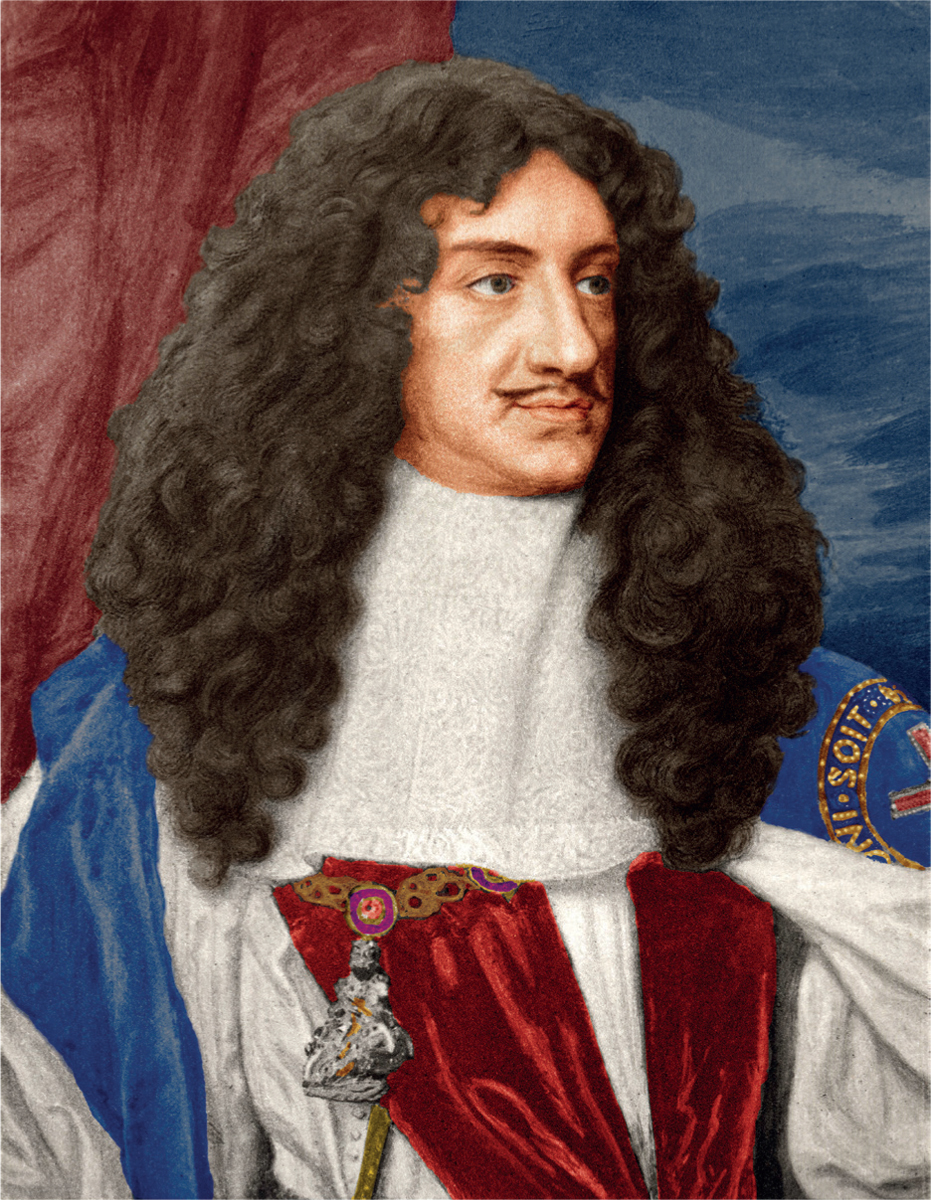
King Charles II, who was renowned for enjoying his pleasures. It is less well known that among those pleasures was a love of ships and shipbuilding. At the time he ordered the repair of the old Tyger, he attended more Admiralty Board meetings than any other member.
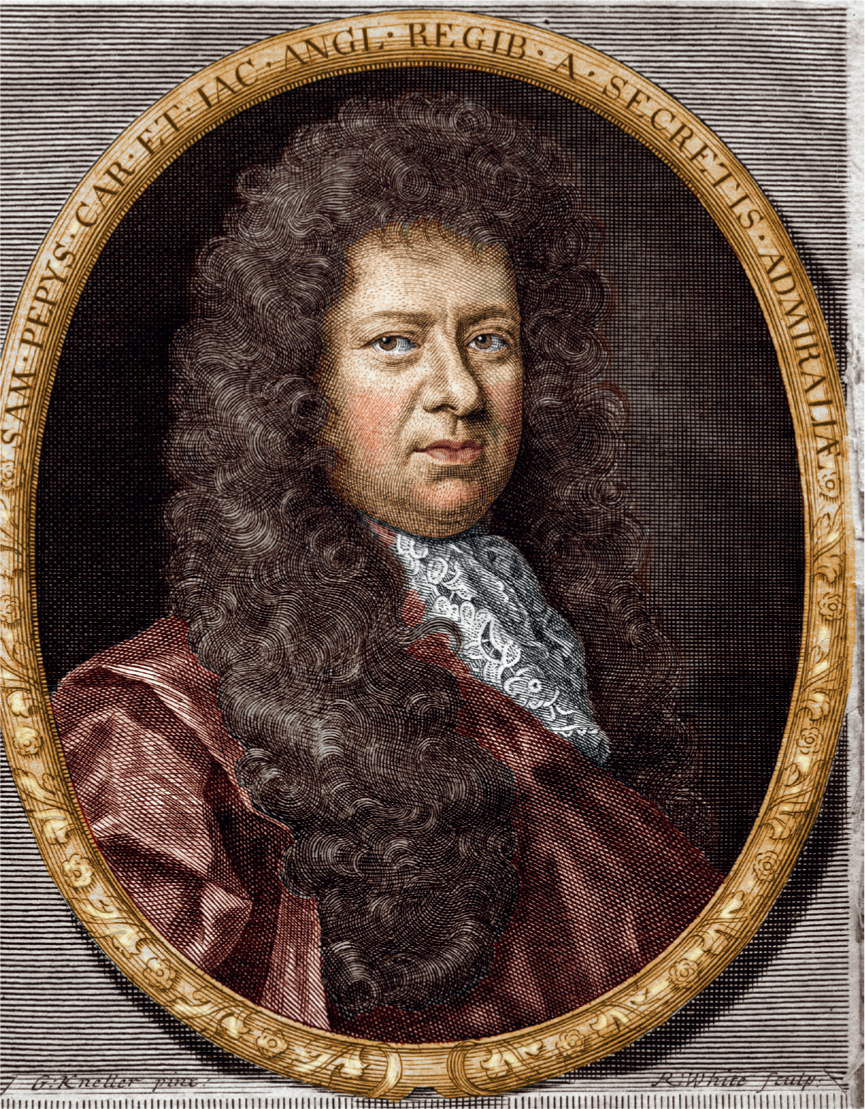
Samuel Pepys as Secretary to the Admiralty Commission. As well as being a great administrator, he collected material concerning shipbuilding to include in a book about the history of the Navy. It was never completed.
The Shish Family of Master Shipwrights
By contrast, Pepys regularly slandered Jonas Shish and his sons John and Thomas, throwing many accusations at them. He thought that Jonas could not measure the volume of timber properly1 and that he depended on his eyes to build ships.2 Pepys also wrote that Shish wrongly measured ships’ blocks by their sheave diameter when the blockmaker said they should be measured by their length.3
Perhaps the most famous example of Pepys’s bias occurred in 1686 when King James II asked him to make a list of noted shipbuilders who might be considered for a position as a commissioner to repair the fleet, and in the list he drew up he compared them all unfavourably with Sir Anthony Deane. Of Sir John Tippetts he wrote: ‘his age and infirmities arising from the gout (keeping him generally within doors, or at least incapable of any great action abroad) would render him wholly unable to go through the fatigue of the work’; of Sir Phineas Pett, ‘in every respect as the first’; of Mr Lee, the master shipwright at Chatham, ‘[he] never built a ship in his life ... also full of the gout and by consequence as little capable as the former of the fatigue before mentioned’. Of Mr Betts, master shipwright at Portsmouth, he wrote that he ‘has built several good ships ... but is illiterate, and not of countenance, method, or authority sufficient for a commissioner of the Navy’. Mr John Shish, master shipwright at Deptford, was described as being ‘old Jonas Shish’s son, as illiterate as he ... low-spirited, of little appearance or authority ... little frugality; his father a great drinker, and since killed with it’. Mr Lawrence, master shipwright at Woolwich, ‘has never built a ship in his life but the Little Victory, which he rebuilt at great charge, and when done was found fit for nothing but a fire-ship. A low-spirited, slow and gouty man ... illiterate and supine to the last degree.’4 And so the list went on, leaving the reader in disbelief that any of the master shipwrights could ever have built a satisfactory ship. The King, who personally knew them all, must have laughed when he read it. This was Pepys at his best in supporting a friend, and at his worst in abusing others.
Another who compared shipwrights was William Sutherland, author of both Ship-builders Assistant (1711) and Ship-building Unvail’d (1717), and himself a shipwright. His opinion is likely to be much more reliable than that of Pepys. He thought ‘Old Mr Shish and his sons, all eminent builders’5 and wrote: ‘I could never learn that Sir Anthony was much of a mathematician, or a very great proficient in practice, but had the art of talking well, and gave good encouragement to those men who was well known to be grounded in the practik part of building ships.’6
Pepys looked down on the socially inferior Shish family. The love-of-life attitude of the gregarious Pepys made him very different from Jonas, a God-fearing Puritan who gained prominence during the Commonwealth. Jonas must have known of, and taken a dim view of, Pepys’s antics with Mrs Elizabeth Bagwell, his foreman Owen’s daughter-in-law. She brazenly exchanged her favours with Pepys for the advancement of her husband, William, and other members of her family.7 Her efforts eventually helped William achieve the position of master shipwright at Portsmouth.
Old Jonas Shish and his son, John, held the position of master shipwright at Deptford between 1668 and 1686. The family had a long history as shipwrights in the yard and were well liked by members of the local gentry such as John Evelyn, as well as regarding their workmen with sympathy and understanding. On one occasion Jonas received the gift of a shoulder of veal from a woman whose son he had taken on in the yard as an ochum boy. Shish would have none of it, saying, ‘Nan, nan (for he spoke thick) take it and roast it and get butter and make soups for the boys, it will fill their bellies bravely.’8 Before he became master shipwright, Jonas had already built a number of successful ships, including two fourth rates, the Foresight in 1650 and the Leopard in 1659. A fifth rate, the Guernsey, was built in 1654 and a third rate, the Cambridge, in 1666.9 Although he spoke with a thick accent, ‘Mr Shish was very well belov’d by King Charles II who took much delight in the shipwrights art and used to call him his country builder.’10
One would have thought the quality of John Shish’s education by his father would have been rather limited. John Evelyn agreed that Jonas was a plain, honest carpenter who could give little account of his art by discourse and was hardly capable of reading. Yet, he continued, he had great ability and was remarkable for bringing up his children well and teaching them to be able shipwrights.11 As a young man, John Shish would have served seven years as an apprentice, or servant, as they were usually called. He would have learnt practical skills such as hewing, spiling and using staffs with marked-out dimensions to lay out the mould loft and set frame timbers in their correct places. These were skills that every apprenticed shipwright in the yard would have learnt. On 6 November 1665, John Shish was considered sufficiently accomplished to be appointed master carpenter of the Charles,12 a first rate then being built at Deptford. Shortly afterwards, on 22 November, he married Mary Lake and during the next year was blessed with the birth of his first son.
In 1668 Jonas Shish was appointed master shipwright at Deptford and John, at the age of 25, became his assistant. In this elevated position he would have known how to make draughts and would have had an understanding of the hull shape necessary to perform a specific duty. It was an art form more than it was scientific. He also needed the academic ability to calculate the geometry of a ship’s rising and narrowing lines to achieve the desired hull shape. These skills were primary among the master shipwrights’ secrets. He would have been taught these skills by his father, although it is quite possible that Jonas employed a mathematician to do the endless calculations. If so, then the mathematician would have been entered in the pay books as a shipwright, leaving no trace of his true role. John Shish’s education was better than Pepys could have imagined and way beyond an administrator’s understanding. John Shish did not depend on his eyes to build ships, for not only did he make draughts, but he digitised his ships’ lines by calculation to create perfect curves and eliminate any errors that might have been caused by scaling from drawings.
During the time he spent as assistant master shipwright to his father, John helped build many ships. Among them were the three-decked first rates, the Charles of 1668 and the London of 1670. Technically, the London was rebuilt as she was burnt down almost to the wrongheads at the head of the floor timbers, meaning that everything above was built new.13 In 1673, the three-year-old yacht Saudadoes, built by Anthony Deane, was altered beyond recognition, much to the anger of Deane and Pepys. The work on her was followed in 1674 by the construction of the Royal Oak, built as a response to the French Superbe, and the largest two-deck third rate yet built, as well as being the first English 74-gun ship. Eight sloops of about 50 tons and two smacks of about 20 tons were also built between 1672 and 1673. One of the smacks was, interestingly enough, named Young Shish by the King. The name was probably an acknowledgement of John Shish’s first design.
In 1673, during the Third Dutch War, John Shish was appointed master shipwright at Sheerness. The yard had only been established in 1665, as a forward base near deep water so that ships did not always have to navigate the tortuous route to Chatham. It was damaged in 1667 during the Dutch attack on the Medway, but by 1673 was again functional,14 although no ships had yet been built there. On 1 July 1674, John Shish wrote to Samuel Pepys, the Secretary to the Admiralty, sending him a small treatise entitled Account of Dimensions of a Ship. It reveals the calculated dimensions used to define the rising and narrowing lines of a fourth-rate ship. Three weeks later the Tyger arrived at Deptford, and two weeks after that, at Windsor Castle on 2 August 1674, the King approved Jonas’s request to exchange places with his son John. John became master shipwright for both Deptford and Woolwich yards and Jonas became master shipwright at Sheerness.15 A few months later, the King consented that John could also officiate at Sheerness and that Jonas could officiate at Deptford.16 The close family connections were strengthened even more when Jonas’s younger son, Thomas, later become master shipwright at Woolwich.
The Master Shipwright’s Duties
Master shipwrights needed a number of vital qualities in addition to being able to design ships. Top of the list was the very different but practical skill of motivating workmen, the majority of whom were shipwrights. Their numbers at each yard varied wildly, between 150 and over 500, depending on the political and monetary situation.
Trades employed in building a ship at Deptford in 1678 by percentage.17 (Other trades, such as ironmongers and carvers, were provided by outside suppliers.)
| Trade | Percentage |
| Shipwrights | 60 |
| Caulkers | 3 |
| Joiners | 5 |
| Seaman-Riggers | 3 |
| Labourers | 12 |
| Ocum boys | 2 |
| Sawyers | 13 |
| Bricklayers Plumbers Scavelmen Teamers and Others | 2 |
Just as important a skill was organizing the supply of vast quantities of wood to keep the workmen busy. Master shipwrights also needed to know how to repair, maintain and rebuild old ships. The duties of all the officers of the Navy administration were formalised at a Privy Council meeting held at Whitehall on 13 June 1673.18 For the master shipwrights and their assistants, their first duty was to attend all the grounding, graving, docking, repairing and building of new ships. A warrant would be issued by the administration before any of these works could take place. To make sure they maintained an accurate control of cost, the master shipwrights had to keep a counter book, together with the storekeeper, recording the amount of provisions used and their quality. They were also to join with the storekeeper in examining and agreeing the expense of all timber and ironwork issued by warrant to their shipwrights and others working under their supervision, such as carvers and joiners. Even a modest amount of work, such as adding a few extra carvings or making some small repairs, could not be performed before they had received a warrant issued by at least two officers of the Navy Board. When old ships were broken up they had to make sure that all reusable pieces, whether of timber or metal, were saved and not wasted. Care had to be taken that timber was not hewn into chips by the workmen or carried away in the carpenters’ private boats. They also had to make sure all the workmen’s tools were accounted for after the work was finished.
The master shipwright also had to make sure that the correct amount of carpenters’ stores was issued to ships before they went to sea. He also helped the Clerk of the Survey check the amount consumed after its return. Another officer in the yard who assisted them in checking deliveries, primarily oak, were of the correct quantity and quality was the storekeeper. They also worked jointly with the surveyor in making a yearly account of all the ships at the yard, with an estimate of their defects and how long they would remain seaworthy if the defects were repaired.
The care of the men was addressed as well. In addition to making sure they carried out their work properly, the master shipwright also had to see they were properly quartered. In the presence of another principal officer, he rated all the men’s daily rate of pay and decided when any of them should be discharged. He had to make sure there was a balance – that is, that there were not too many boys or servants entered onto the yard’s pay books. Servants were apprenticed to a skilled shipwright for a seven-year period under the 1563 Statute of Artificers. The shipwright received their wages but was responsible for their welfare as well as their tuition. Another duty of the master shipwright was to observe the time when the men made an appearance in the morning and the time they departed in the evening in order that the Clerk of the Cheque could calculate their wages. Another well-known duty was to be at the dockyard gate when the bell rang in the morning and evening to observe the lawful ‘chips’ – the offcuts of timber and plank – carried out by the men. He was to make sure that these chips were not made wilfully out of good timber and plank and that they could not be used as fuel for heating the pitch kettle. Those men who offended could be punished, usually by a deduction of wages, or they could be dismissed for a more serious offence. The master shipwright would have delegated many of the tasks to his assistant but would retain the responsibility for them being carried out.
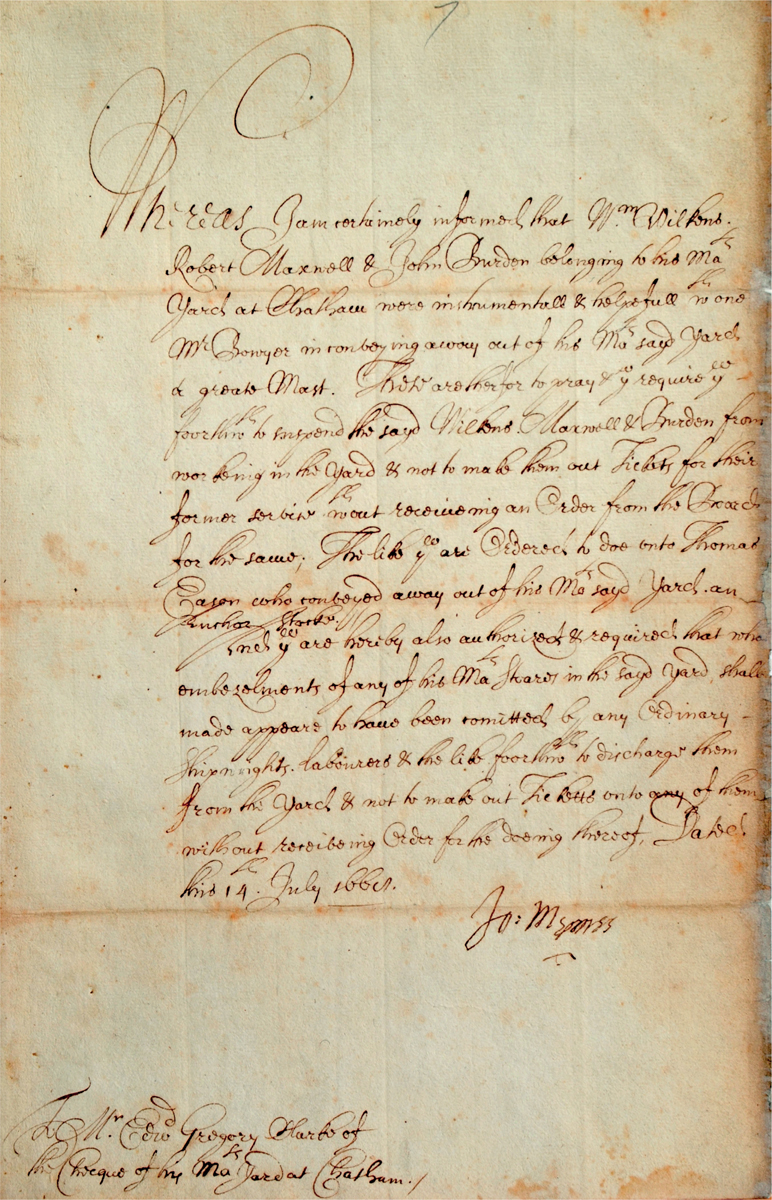
This letter signed by the Navy Board officer Sir John Mennes tells how a number of men at Chatham managed to carry a ‘great mast’ out of the yard. As a main or great mast was in the region of 33 inches in diameter and 95 feet long, and weighed some 7.5 tons, it must have taken some ingenuity for them to take it away. The carpenter’s private boat mentioned in the master shipwright’s duties comes to mind.
In addition to all these organizational and technical responsibilities, master shipwrights needed to be aware of the continual improvements and innovations made in shipbuilding. They would have had little difficulty in knowing what they were because the greatest and most enthusiastic promoter of new ideas was King Charles himself. During a conversation with Samuel Pepys he discussed the great improvements in the art of shipbuilding, saying he most truly made it his business to try always for the improving of that matter.19 Bishop Burnett, who knew the King well, thought that he ‘has knowledge in many things, chiefly in all naval affairs; even in the architecture of ships he judges as critically as any of the trade can do, and knows the smallest things belonging to it’. He added that this interest in a trade was such that ‘he knew the architecture of ships so perfectly that in that respect he was exact rather more than became a prince’.20 The King’s interest in scientific advance had already seen him establish the Royal Society to promote the works of men such as Newton, Wren and Boyle. Members of the Royal Society came up with their own proposals for the design of ships. They must have been confident that their undoubted genius would be of benefit to the likes of the Shish family of Deptford. The first president of the Royal Society, Lord Brouncker, designed a yacht, Robert Hooke proposed a moving keel and Sir William Petty wrote about the principles of ship form.21 The collective members designed the hull of the second-rate Royal Katherine of 1664, but she proved so unstable that she had to go back into dock for alterations. We can almost feel the smug satisfaction of the shipwrights who turned her into a satisfactory ship by widening her with girdling.22
New Ships
The King and the Admiralty decided on the need for a new ship or ships and specified what sort of vessels they would be. All three-deck first- and second-rate ships were built in the King’s own yards according to instructions issued by an Admiralty warrant. A majority of third-rate ships were ordered in the same way, but more than half of the smaller fourth-rate ships were ordered by contract from well-known and trusted commercial shipbuilders.
The processes involved in ordering ships from these two sources were very different from each other. For ships built in the King’s yards, the Admiralty requested a draught for approval together with an estimate of the cost from the master shipwright. If it was decided to proceed, and it usually was, a one- or two-page warrant of about 750 words was issued. It included the important dimensions and usually a general threat or two should the master shipwright take it upon himself to deviate from it. The ordering process did not take too long, and certainly not long enough to allow time for a so-called Admiralty Board model to be built for the instruction of the Admiralty. The Admiralty and its advisory body, the Navy Board, were perfectly capable of understanding drawings and reading specifications without such aids. A typical warrant, for building the fourth-rate Medway and dated 17 March 1690, is reproduced in Appendix 1.
When ships were ordered from a private shipbuilder, a comprehensive contract was drawn up giving the precise details and size of just about every piece of timber in the ship. This the Admiralty felt was necessary as builders working for profit would otherwise make the ship as slight as possible. As a result, the contract was five times longer than a warrant. A series of contracts covering the building of fourth-rate ships during the second half of the 17th century is reproduced in Chapter 10. The cost was worked out at an agreed rate per ton and staged payments were made as the work progressed. If the ship was built in the Thames, regular inspections were usually made by members of Shipwrights Hall. If it was built in faraway in places such as Bristol, then a surveyor was appointed by the Admiralty to reside there with authority over the quality of construction and timber used.
Alterations
Many new ships were altered for a variety of interesting reasons. Some were altered to suit the latest aesthetic style, some because they did not meet their intended load-carrying or sailing expectations. Others were altered during building with extra scantling in timber and plank, often by agreement with the King or the Duke of York or by their instruction. In 1674 Anthony Deane received £589 for additional work when building the Swiftsure and the Harwich.23
An interesting example is the Saudadoes. In 1670, the master shipwright at Portsmouth, Anthony Deane, built a yacht for Queen Catherine of Braganza which had a keel length of 51ft 6in and was 86 tons burden. The Queen gave her yacht the Portuguese name Saudadoes,24 and it sailed to her native Portugal a number of times. It was, however, a small vessel for such voyages and, on 13 June 1673, the Navy Board received instructions from the Admiralty headed by the King to have her ‘lengthened at Deptford about eight feet more of less as the Master Shipwright there shall think fitting and a contrivance made to steer aloft’.25 The next day a warrant in pursuance of His Royal Highness’s order was sent to Jonas Shish for him to go ahead with the alterations.26
Jonas immediately started work, but a month later, on 9 July, he wrote to the Navy Board saying the plank of the upper works was very thin and shaken, and that it required shifting. He also found the body of the ship very full fore and aft, making it impossible for the remaining hull bottom to sail well. To correct her, Jonas said the planks without board needed stripping off down to the keel and the frames moved to answer lines for the quickest way of sailing. Alarmed by this news which implied the ship would be taken apart, the Navy Board replied the same day, advising that its members thought it necessary for him to wait for Anthony Deane to see the ship that he had built only three years before. As arranged, Deane travelled to London and visited Deptford a week later. His jaw must have dropped open in astonishment when ‘he enquired what was become of her and found that she was taken into pieces and that her keel was longer and laid on the slip and the new body of a ship in building thereon’.27
At the same time, Samuel Pepys, the newly appointed Secretary to the Admiralty, must have heard from the King or the Duke of their intended improvements to the ship, for he sent a letter to Jonas giving him permission to do anything he liked if he thought it would improve her – or, in his words, ‘Not to omit the doing of any work to the Saudadoes now repairing that in his judgement will better her qualities or otherwise render her more fit for service.’28
The distraught Deane made his feelings known to his patron and friend Samuel Pepys, who then suddenly changed his relaxed view regarding the alterations. On 25 July, Jonas was ordered to visit the Navy Board, the junior body to the Admiralty, to give an account of his alterations and to bring with him any orders he had received. According to the Navy Board’s account of the meeting, Jonas gave no satisfactory explanation for the work, and ‘Commissioner Deane humbly make known the same to His Majesty and also to the Lords of the Admiralty’.29 It seems that Anthony Deane attended the meeting, and quite probably his good friend Samuel Pepys did as well, for he signed the account along with the Navy Board officers.
Jonas appears to have been isolated and in desperate trouble with his superiors. But he had the ear and backing of the one man who really mattered. Just a few days after his difficult meeting, Jonas must have taken great pleasure in informing the Navy Board that he had seen the King, who had commanded the building of Saudadoes according to a draught had he shown him. The ‘eight feet more or less’ was now more than 22 feet, which would increase the ship from its original 86 tons to 180 tons. This must have caused more outrage among the Navy Board officers, for, according to Anthony Deane, the King had told him he would make the keel no longer than 60 feet in agreement with the ‘eight feet more or less’ originally mentioned. Trying to cling on to some sort of credibility, the Navy Board argued that the larger ship would be more expensive to operate as it would need victuals and wages for several men more. The Navy Board passed on Jonas’s letter, which gave an account of his meeting with the King and details of the vessel, to the Admiralty, adding the following sour note: ‘we have received a letter from Mr Shish which he thinks fit for your perusal and therefore do send same to you’.30
Aware of the ill feeling towards him, Jonas wrote another letter to the Navy Board the next day, in which he stated: ‘I do see and perceive it is the desire of a gentleman who now sitteth with you at ye Board (presumably Deane) that the keel of His Majesty’s ship the Saudadoes should be shortened from the draught which I have formerly shown your Honourables. Sir, I know and am assured that there are two great evils which will infuse it. First, the ship will not sail so well neither be so good condition in the sea. Secondly the King’s room and the stateroom will be so much shortened that there will not be sufficient length of room for ye accommodation of the King and Queen. Sir, it is His Majesty’s desire that the ship should be the length which is now propounded in the draught and therefore I thought it convenient to acquaint your Honourables that hereafter I may not be blamed. Almighty God doth know that I have no self interest in it but only that His Majesty & the Queen may have a ship which may do them honour & good service which is left for your consideration.’31
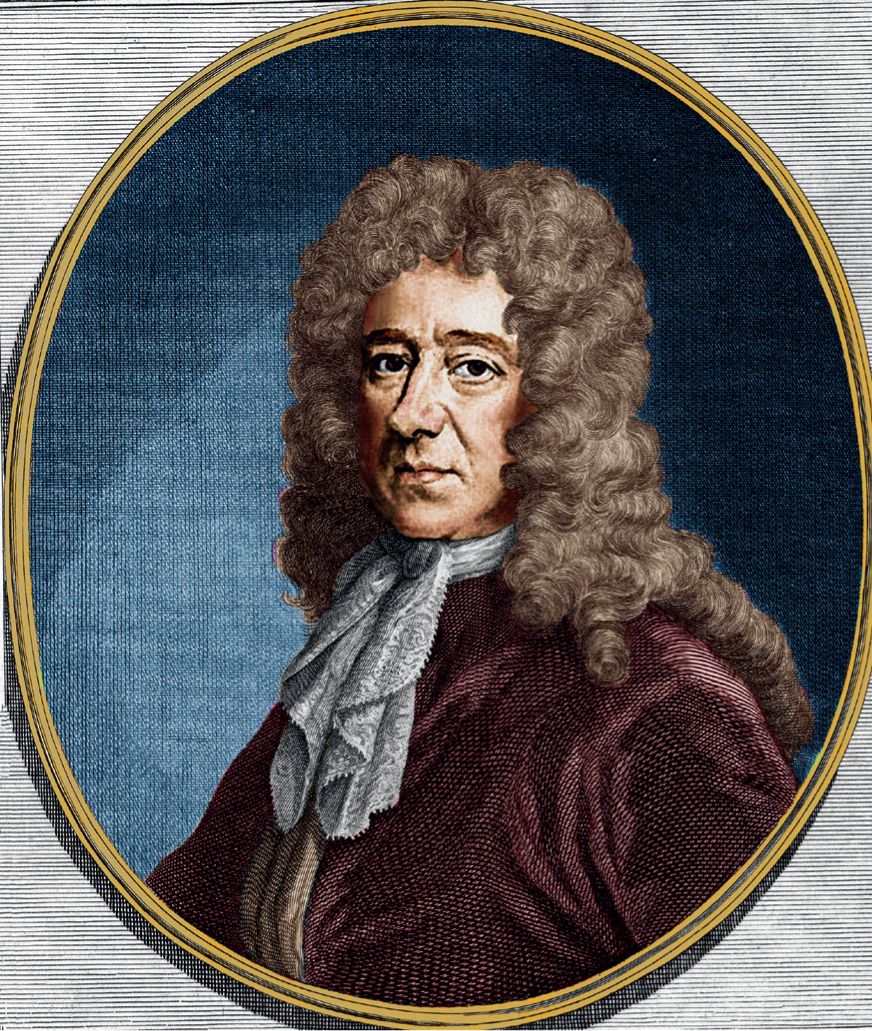
Sir Anthony Deane, a master shipwright, and friend and protégé of Samuel Pepys.
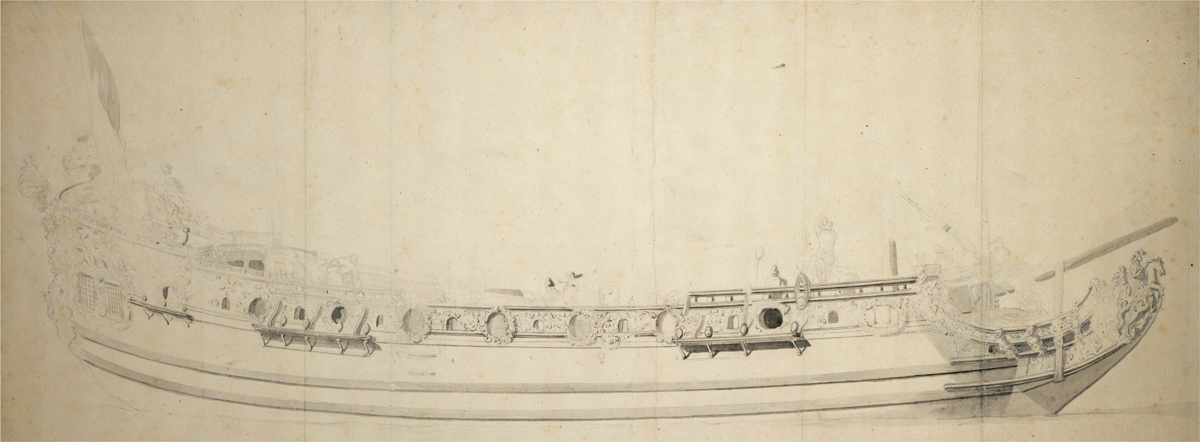
The Saudadoes as rebuilt by Jonas Shish in 1673 (Robinson 1191). Portrait of the ‘Saudadoes’. Willem van de Velde, the Younger, c.1676? PAI7303; Photo: © National Maritime Museum, Greenwich, London.
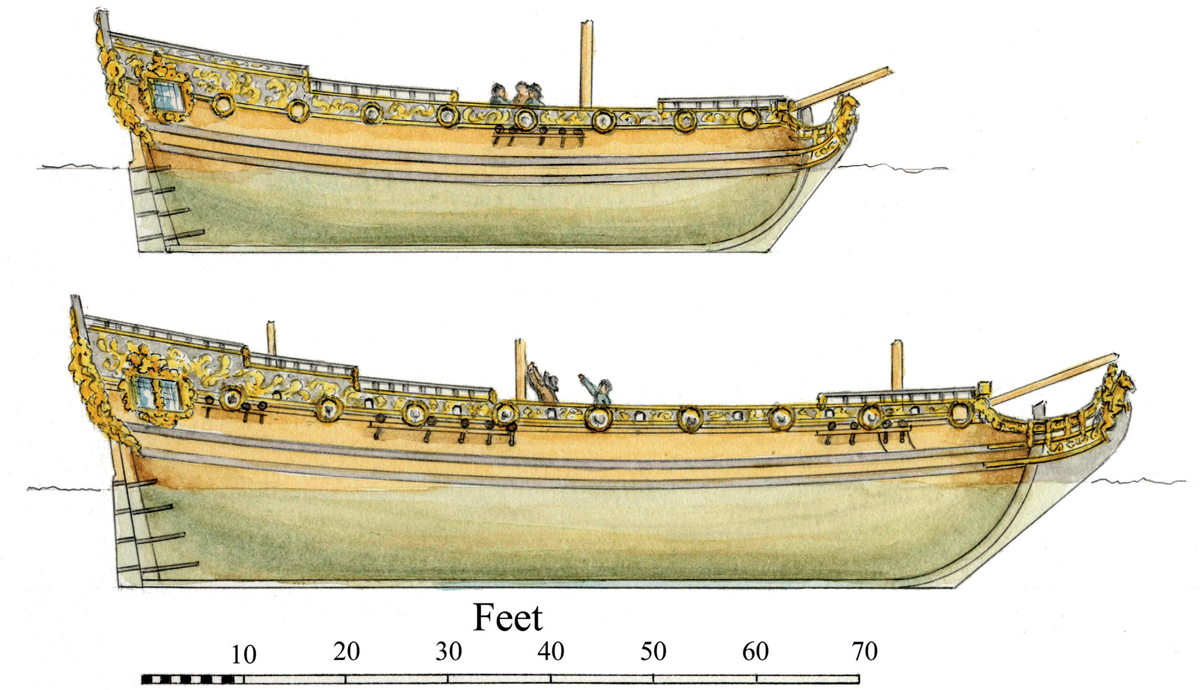
Queen Catherine’s yacht Saudadoes as she was originally built in 1670 by Anthony Deane. Author. Bottom. The vessel only three years later after she was altered by Jonas Shish. He was supposedly only going to increase her length by eight feet, but King Charles had Shish make a new ship that included very little of the original. Author.
For the next three months, Shish quietly got on with his work. Then, on 7 October, the Navy Board began to work out the cost ‘of ye vessel now in building in His Majesty’s yard at Deptford out of the body of the Saudadoes’, even though the final amount could not be estimated as the manner of gilding required by Charles was not yet known. Menacingly, they added that the estimate would include a report touching on, as they put it, the irregularities practised by Mr Shish in his work on the said vessel.32 The King was out of town at the time, but on his return he gave the Navy Board directions for Saudadoes to be furnished with a set of silk pennants and to be gilded like the Greyhound, ironically a ship built by Deane the previous year.33
The estimate, together with its report regarding Jonas Shish’s supposed irregularities, was finished by 3 November. In it, he was charged by the Navy Board of proceeding on the vessel contrary to his original orders of 13 June which mentioned lengthening the ship by about ‘eight feet more or less’. It was passed to the Admiralty for its consideration,34 but by then its head, the King, had the ship he had always intended to have, while Jonas was left with a slightly bruised superior in the shape of Samuel Pepys, a man who would denigrate him forever after. An anonymous writer in 1717 said with great insight that Shish was King Charles’s favourite, ‘for which the Commissioners slighted him as all mankind ever was and ever will be for being favourites’.35 The episode has clear echoes of the ‘gentleman vs. tarpaulin’ disputes that raged among the sea officers of the period.36
By 1678, toward the end of his career, old Jonas’s relationship with the Navy Board was interestingly different and he was writing phrases to them such as ‘all the concernments that I have undertaken at sea and ashore I bless God never any miscarry under my hand but have had the love and good wishes of all the masters as I have served’37 and ‘I have been a servant to this honourable Board 29 years in which time there hath passed through my hands business of great concernments and I bless God I have discharged a good conscience which with great comfort I shall carry on with me to my grave’.38
Girdling and Furring
Very often new ships were found deficient when they went to sea, being tender under sail or having their gunports too near the water when loaded for service. This was not the result of a fundamental design error in 17th-century ships, it was simply that they were loaded with as many heavy guns as possible. For instance, the biggest third rates were the successful third-rate 70-gun ships of the 1677 programme. They were exactly the same length, breadth and depth as the sixth-rate frigate Trincomalee that was built in 1817 and that can still be seen at Hartlepool today. Her main armament was 28 eighteen pounders among her 46 guns, while the 70-gun ships of 1677 carried 32 pounders on their lower decks, the same size as the biggest guns on Nelson’s Victory. Not only did the 17th-century warships carry much heavier guns, but the beams and structure had to be equally massive to carry them. The reason so much of these ships’ carrying capacity was devoted to guns was that it was likely any battle would be fought close to home against the Dutch or French, often only a day’s sailing away. When this commitment to heavy guns caused inevitable problems, it never seemed to have occurred to anyone that perhaps a few guns should be removed. Instead, the obvious answer was to make the ship wider and bigger underwater so that it would carry the anticipated weight.
There were two ways of increasing breadth and volume underwater. The least drastic of these was girdling, carried out by fixing thick stuff directly onto the existing plank fore and aft. The second, less-used option, was furring, generally employed when even greater breadth was required. Furring involved removing the existing planking and adding timber to the frames to make them wider. The widened frames were then replanked.
After the Prince was launched in 1670, it became apparent she required more breadth, and this became the subject of some debate between her builder, Phineas Pett II, the Admiralty and, of course, King Charles. It was decided that she should be girdled with fir timber, as had been done years previously on the second rates Henry and Katherine. It turned them both from very tender ships with their gunports too near the water into very highly regarded ships that carried their ordnance very well and bore a good sail.39 Before they were girdled, Pepys described them in less nautical terms as ‘useless’.40 By 1674, the Henry had carried her girdling for 18 years, but it remained in good condition and was very serviceable.41 The Prince’s girdling consisted of 6½-inch-thick good hard yellow fir timber of very great length. She fought through the Third Dutch War and, after its conclusion in 1674, was repaired by Pett in the dock at Chatham. The old fir above water, up to the lower edge of the main wale, was badly damaged by shot received in battle. It was stripped off and replaced with good new oak up to the lower edge of the gunports. Underwater, Pett repaired the old fir to make it very serviceable by firmly caulking the seams to help support the badly split oak plank beneath.42 King Charles contemplated the work done but did not agree that Pett should leave the old fir in place and approved a letter saying it was his pleasure that all the fir be removed and replaced with an oak girdling of at least seven inches thick.
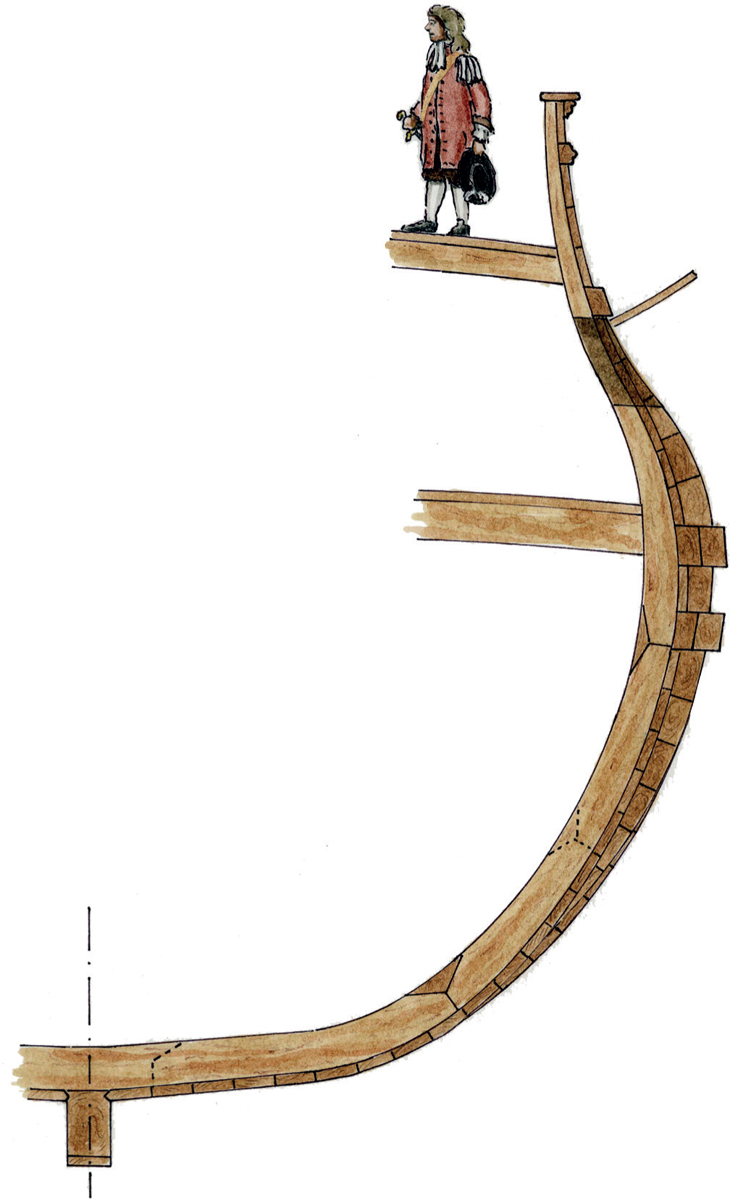
The midship section of the fourth-rate Hampshire according to a contemporary drawing44 showing the framing, planking and eight-inch-thick maximum girdling applied shortly after her rebuilding. Author.
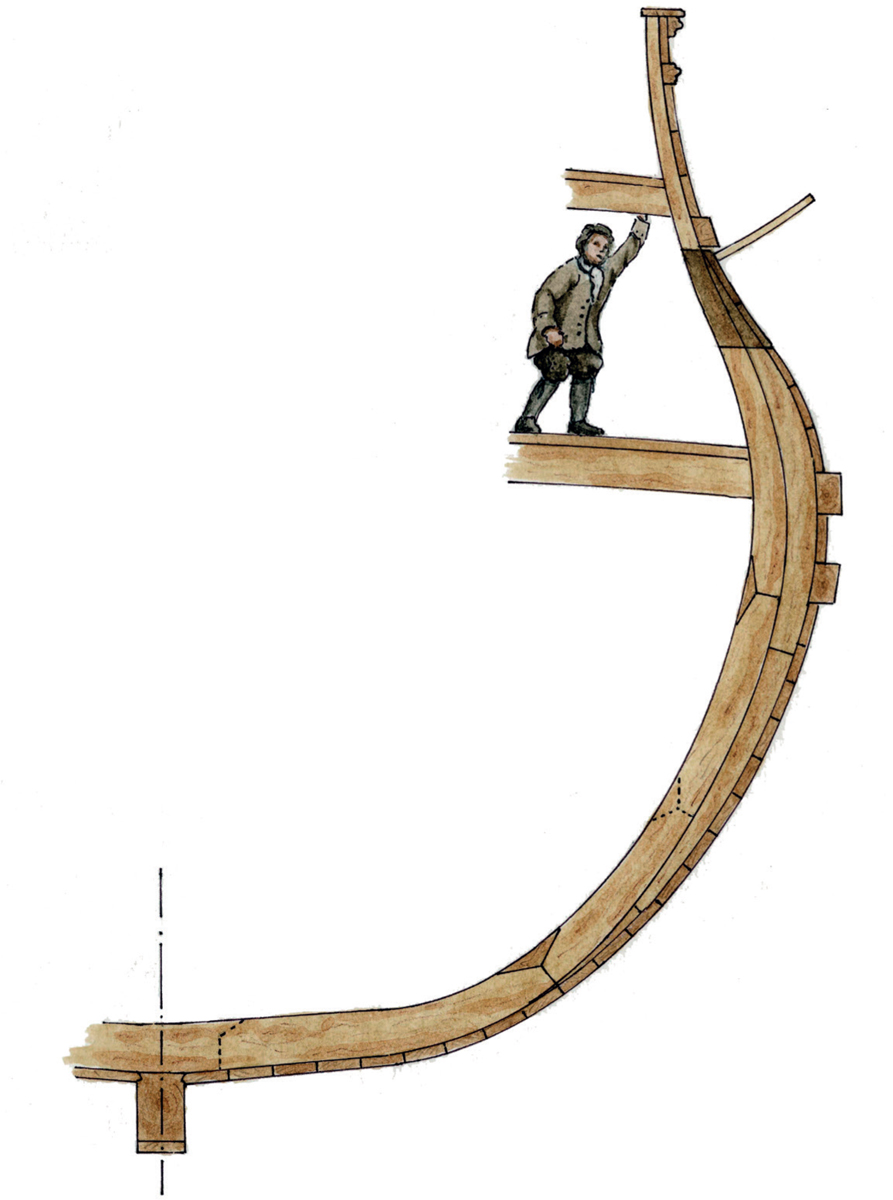
The same ship showing how the extra breadth may have been achieved by furring the frames. Author.
Pett, relying on his experience and knowing the King would listen to reasoned argument, respectfully replied in a paper in which he said that as the work was of so great a charge he most humbly thought it his duty to let the King know his thoughts. He noted that the existing fir was within half an inch thickness of the proposed oak and being half the weight would be more buoyant. As result, he calculated that there would be a saving of 50 tons and that the Prince would carry her ordnance four inches higher. He also noted that the fir was of great length and only spiked in place, whereas oak, coming in much shorter lengths, would need iron bolts. Keeping the fir would therefore also save a great deal of money. The paper was examined by Charles and the Admiralty, who asked the Navy Board, and in particular the Surveyor, Sir John Tippetts, for their opinions. They broadly agreed with Pett and informed the Admiralty with Charles in attendance. The result was that ‘His Majesty is pleased to approve of what you therein represent and accordingly we do hereby direct that you give order for the forebearing the doing anything further to the said ships girdling than is present done’.43
The Prince remained at Chatham for the next six years with the oak girdling above water and fir below. Then, in 1680, it was found that all the girdling and some of the wale pieces above water were rotten and required shifting. After their removal, it was discovered that the plank underneath needed caulking and that new girdling needed to be fitted.45 The damage was caused not so much by the use of poor timber but by the unprecedented harsh winters and hot summers which affected all ships during that period. Later, in 1691, the Prince was docked at Chatham for repairs and was surveyed by a body of master shipwrights. They found she needed very extensive work which included removing all the plank and all the wales from the top of the sides down to five strakes below the lower wale. The exposed frames, consisting of fully two-thirds of the toptimbers and upper futtocks, were also found to be rotten and required replacing. The new frames would not be put back in the same position as the originals, but instead five inches further outboard. The remaining third of the existing frames, still in place and in good condition, would then be made wider, in and out, by adding five inches of furring to bring them out to the same breadth. Then the Prince could be planked in the normal manner without any girdling at all.46
Pett was not the only shipwright with the confidence to query his orders for girdling a ship. In 1674 Jonas Shish was asked to girdle a sloop with three-inch-thick fir plank and responded by pointing out the disadvantage of doing so, saying the fixings might split the frame timbers, but if he had to do it he would be very careful.47 Another example is the Hampshire, a typical fourth rate that was built in 1653 by Phineas Pett II at Deptford. She was girdled early in her career, but years later, when she was being repaired, the frame timbers were found to be bored and damaged so much that many were unserviceable and required replacing. She underwent a bewildering number of repairs to the hull during her career.48
Accidents
Wooden sailing ships were very vulnerable to accidental damage. In March 1690, the fourth-rate Advice hit a rock in bad weather while manoeuvring with her anchors in Plymouth Sound. She made it into the Cattwater, where she was hauled up the graving place for the damage to be inspected.49 Seven feet of the main and false keel abaft had been beaten off along with five inches of the rising wood above that. The bottom three feet of the sternpost was broken off and missing, while the rudder was broken in pieces to the lower rudder irons.50 The Advice was lucky to have survived, but such a large amount of damage could not be repaired at Plymouth, and she was obliged to sail on to the dry dock at Portsmouth. She arrived at the end of the month, but it took until 15 April before she was unloaded of stores and 91 tons of ballast to make her ready for docking. The repairs themselves only took 16 days and then she was again ready to leave.51 To have completed such a huge amount of work in such a short time is a testament to the skill and resourcefulness of the dockyard personnel.
The worst kind of accident that could occur was the sudden explosion of the gunpowder magazine. Fortunately, this was not a common event. During the whole of the second half of the 17th century, only about seven warships were lost in accidents of this kind that had no connection with enemy action. Of course, the results were often catastrophic, leaving the ships involved beyond the help of master shipwrights. One such accident occurred in 1669, to the fifth-rate Oxford under the command of Henry Morgan. He was leading a buccaneer attack on Hispaniola and, true to the legendary reputation of commanders in that part of the world, held a drunken council of war during which the ship blew up, killing about 250 people.52 The worst accident occurred to the third-rate Breda in 1690 at anchor in Cork harbour, when she suddenly went up in great sheets of fire, killing all but about seven of her crew of over 400 men.53 Another terrible accident happened to the second-rate London. There were about 325 people aboard as she reached the Buoy of the Nore in the Thames on 7 March 1665. She was not yet a fighting ship. Her commander, Sir John Lawson, and the commissioned officers were still ashore and many stores were still being brought out to her. The most senior officers aboard were the warrant officers, who were not from the social upper classes but were men appointed for their ability and experience. One of them, Richard Hodges, the gunner, may have been loading some of the guns for the expected battle to come. As the ship was near land but out of harm’s way in the river, life aboard would have been relaxed and noisy. Many men would have been stowing the stores below decks. Some men would have played music, probably the tunes of popular songs, on their own instruments, while others played board games. In quieter corners, many women, for they were allowed aboard during the fitting out, would have been saying their goodbyes to husbands and lovers, hoping for their safe return.
Suddenly, the ship exploded in searing heat and flame, within minutes ending up on the bottom in two distinct parts. Death would have been mercifully sudden for most on board. The dreadful catastrophe must have been caused by an accident involving the tons of gunpowder stored below decks in the magazine. We will never know exactly what happened, but Samuel Pepys recorded the event. ‘This morning is brought me to the office the sad news of the London in which Sir J Lawsons men were all bringing her from Chatham to the Hope, and thence he was to go to sea in her but a little a this side the buoy of the Nore, she suddenly blew up. About 24 and a woman that were in the roundhouse and coach (cabins high up in the stern) saved; the rest, being above 300, drowned the ship breaking all in pieces with 80 pieces of brass ordnance. She lies sunk with her roundhouse above water. Sir J Lawson hath a great loss in this of so many good chosen men and many relations among them.’54
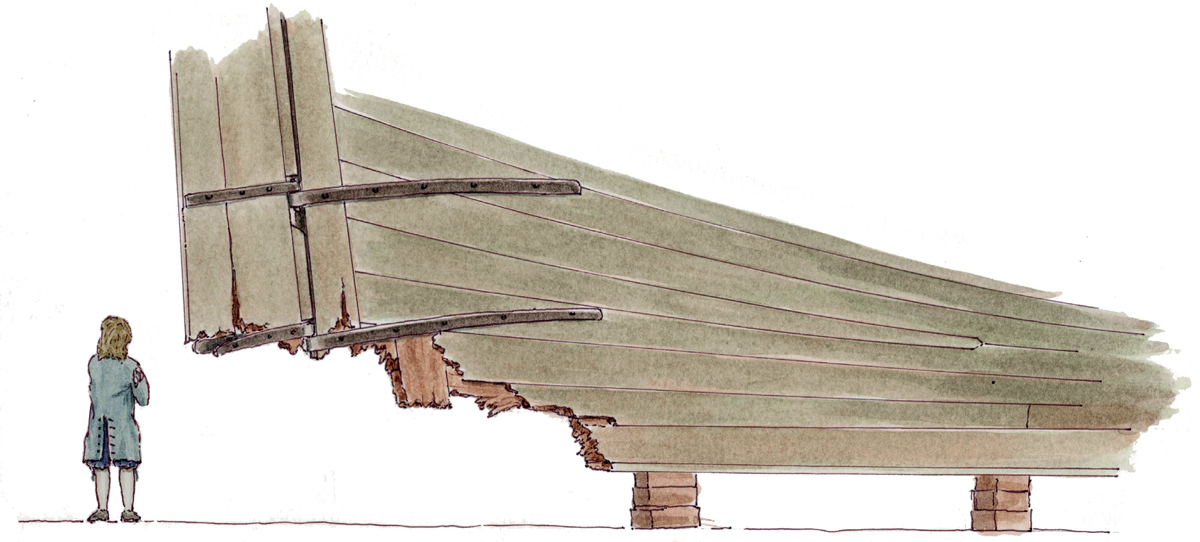
The damage suffered by the fourth-rate Advice after she hit rocks in Plymouth Sound while trying to manoeuvre into the Cattwater. Author.
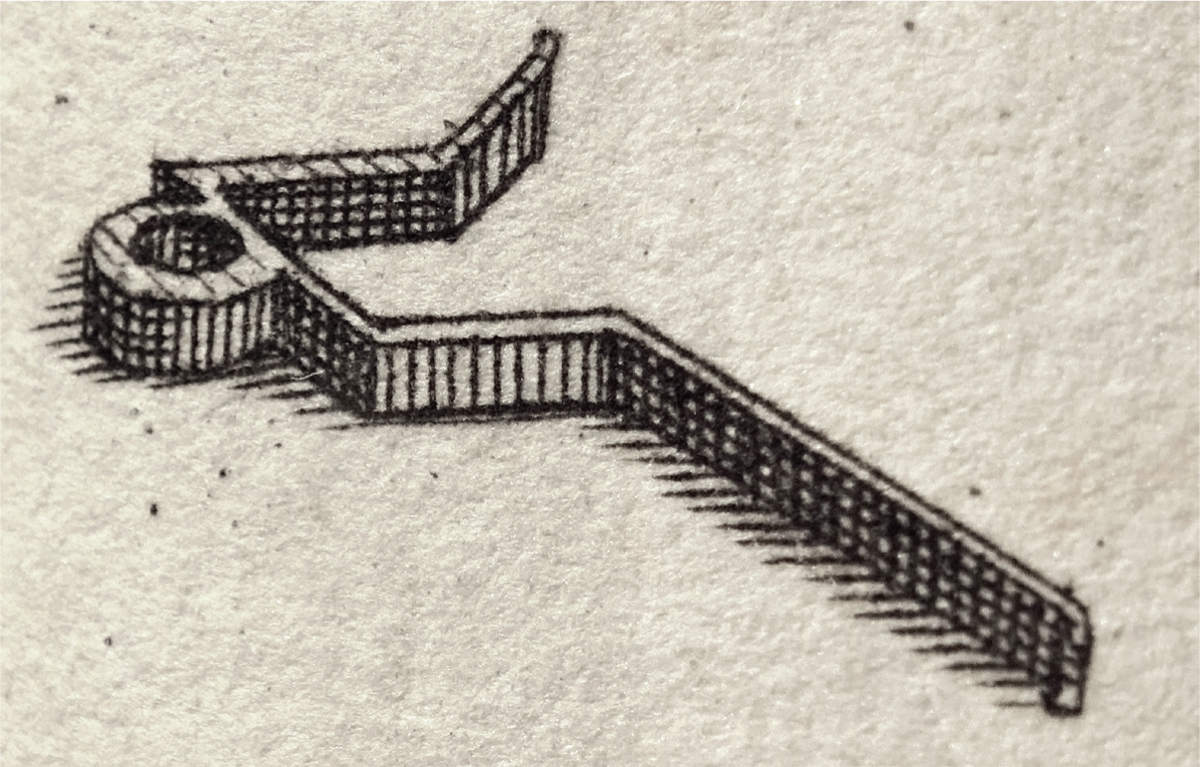
Rudder irons and gudgeon fitted to the stern of the ship to take the pintles of the rudder. From Thomas Blanckley, A Naval Expositor, 1750.
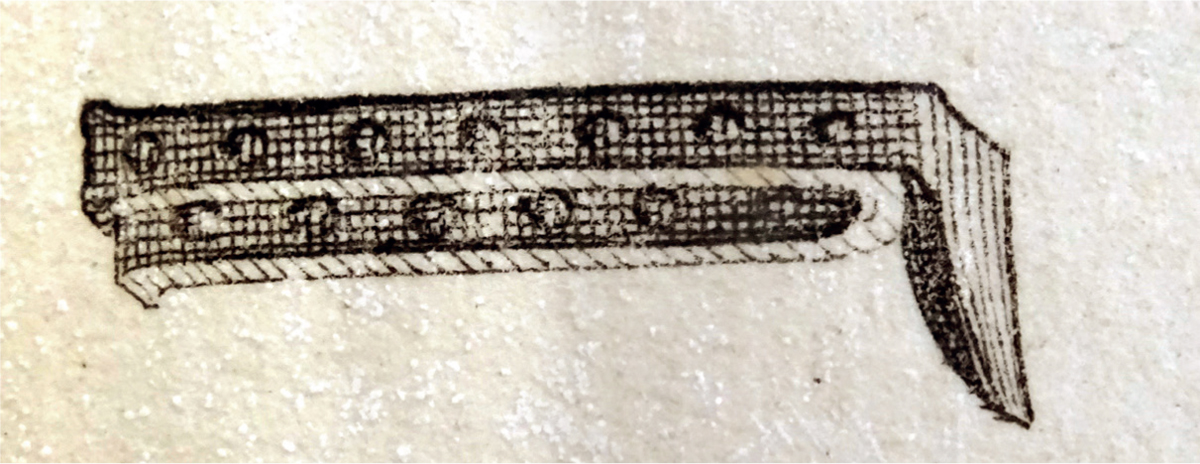
Pintles. From Thomas Blanckley, A Naval Expositor, 1750.
A powder explosion was described graphically after the old Anne of 1654 was lost at Sheerness on 2 December 1673. The first account came from John Shish, the master shipwright. The accident happened at about the time he was writing a treatise about shipbuilding at the request of Samuel Pepys. The Anne had just come out of the dock and was being made ready for sea and having her rigging set up. Except for some bandoliers and powder horns, no gunpowder was supposed to be aboard, as it should all have been removed before docking. The ship was quietly anchored in 16 fathoms of water and positioned a little within Sheerness point near the fort. Moored alongside her was the Hestor fireship. The Anne was not yet a fighting ship, and the men would have been amusing themselves or saying their goodbyes to wives, children and sweethearts. At midday she was mustered and found to have 177 men aboard. It was later estimated that during the next couple of hours about 37 had left in the long boat or pinnace, leaving the lieutenant and the purser as the only officers aboard. At the time, a party of four carpenters and three joiners were working in the ship helping fit her out, probably setting up partitions and bulkheads. They were thought to be working in the empty powder room, situated in the bows below water level. Suddenly, at about 2 o’clock in the afternoon, the ship exploded. Her bows were blown apart and the foremast, bowsprit and the head of the ship all blown away. Further aft, the bulkhead of the steerage and coach were destroyed. ‘It shattered the greatest part of her almost to pieces,’ wrote John Shish.
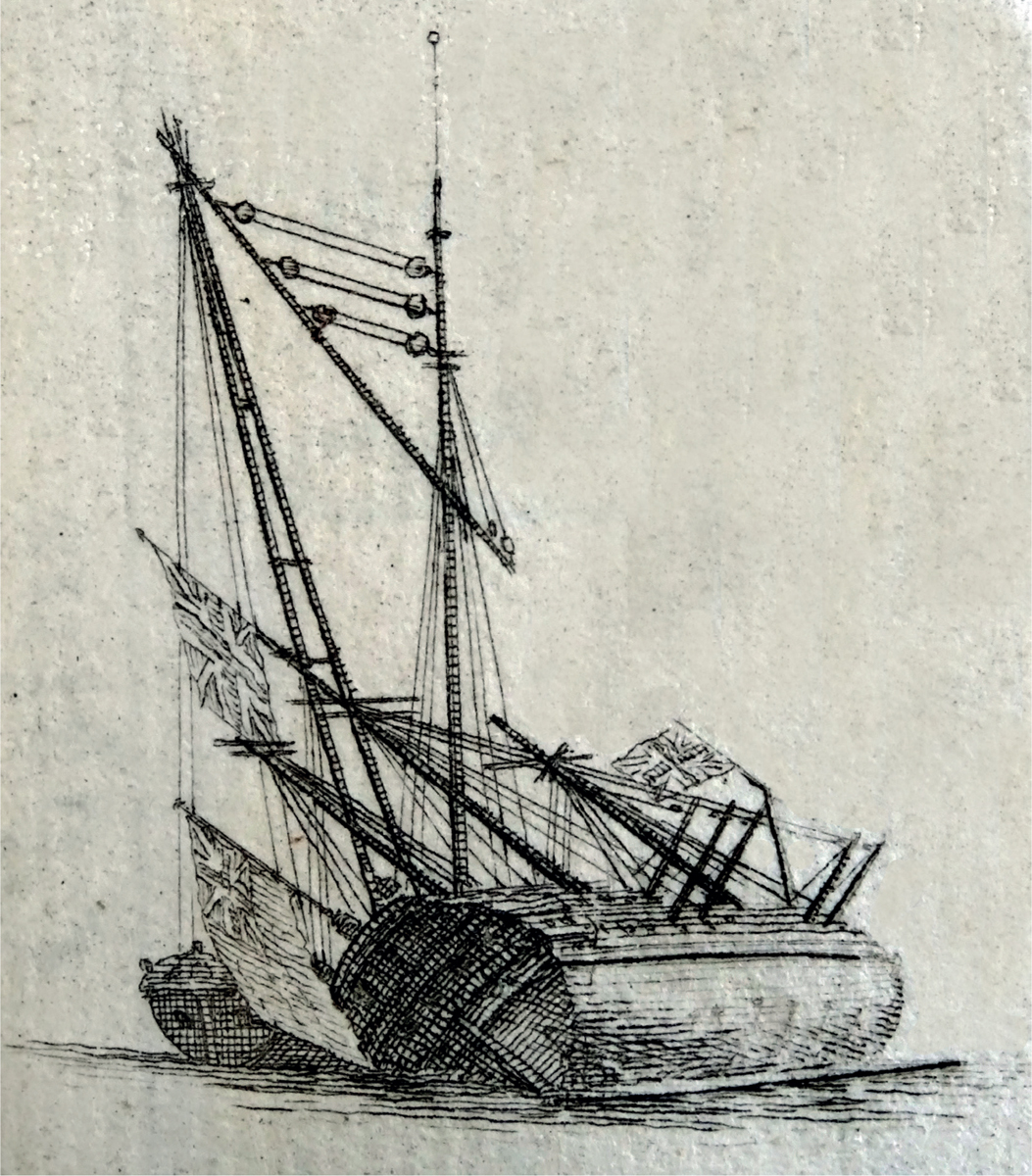
A ship being careened. The stores and guns were taken out of the ship, enabling her to be hauled down aboard the hulk on her port side so that the bottom could be cleaned and repaired. The hulk was usually an old ship that had been cut down to her gundeck. From A Naval Expoisitor, Thomas Blanckley, 1750.
Shish believed that the broken ruin remained afloat for about seven minutes before sinking, taking the Hestor down with her. Once the wreck had settled, the top of the main mast was all that remained above water. Of all those who had been aboard, only 20 souls survived, and many were so badly hurt that five of them died during the course of the next day. Among them was the purser. As well as all the men, the wives and children of the purser, the master, the carpenter and several other men were also killed. One lucky survivor was the lieutenant, who, having been in the stern of the ship, narrowly escaped.55
It was immediately apparent that the explosion had been caused by a large quantity of powder that should not have been aboard. Embezzlement was suspected, and when the gunner turned up two hours after the explosion he was secured in the fort. An enquiry found that when the ship had come into port and the powder taken out, the gunner had taken the opportunity to embezzle some and hide it aboard. He had been tempted by the high value of the powder, for a 100 lb barrel was worth £3 and it would have taken at least 12 barrels to cause such an explosion. Its value was as much as the gunner would earn in a year. Gunpowder was dangerous enough in the secure area of the purpose-built powder room where it was under lock and key. That area also had protected lighting and no iron nails that might have caused a spark. The embezzled powder, however, had been hidden in an unprotected hiding place, and it was assumed that the innocent carpenters working under the light of unprotected candles had accidently set off the explosion.56 After the accident the remains of the ship caused an obstruction and it was decided to blow them to pieces to clear them away.57
Another accident, which occurred aboard the Eagle in 1691 showed just how dangerous a small amount of loose powder could be. Thomas Marsh, an apprentice, was working in the powder room, which had been swept with all possible care and afterwards duly swabbed. But inside the room were two chests, one of which contained some paper and parchment cartridges which were thought to be safe as they had been emptied of their powder. Marsh dropped a candle which ‘put all into flame and disorder about him, the poor fellow is singed to some purpose’. The poor singed Marsh was lucky to survive, and lucky too that there was not enough powder to set the ship on fire.58
A similar disaster to that suffered by the Anne befell another ship. In 1691, the third-rate Exeter was alongside the hulk lying in the Hamoaze at Plymouth in order to be careened. All her stores, guns, sails and rigging were taken ashore, when she suddenly took fire and the forecastle blew up. The fire quickly spread aft and blew up the quarterdeck, killing or wounding about 100 men. The hulk managed to cut herself free, while the Elizabeth and the Foresight anchored nearby cut their cables and hoisted their topsails to get out of the way. The Exeter burnt down to the water and sank. A thorough investigation found the cause of the explosion. Before she had been careened, all of the Exeter’s 300 barrels of powder should have been taken ashore, but the gunner had embezzled about 20 barrels and hidden them in several places about the ship.59 To put an end to such ‘hellish practice’ in the future, orders were issued that when ships were refitted or laid up they were to be strictly searched by the officers of the yard for any powder in order to prevent accidents or embezzlement.60
Estimates were made for rebuilding the Exeter. This would involve taking off some of the surviving outside plank in order for some new frame timbers to reach down and overlap those in the lower hull. The biggest problem was finding sufficient timber to carry out the work, as it was extremely scarce at a time when a series of new ships were already being built.61 As a result, it was decided instead to turn the Exeter into a hulk. The estimate for cutting her down to the sill of the gundeck ports and repairing the bows, which had been blown out by the explosion, and then taking her to Chatham was estimated at £2,176 14s 10½d.62
Leaks
Sudden leaks were an unpredictable problem and the cause of much consternation to administrators such as Samuel Pepys when his carefully laid plans were thrown into disarray by a ship’s unexpected disability. In the summer of 1677 the fourth-rate Phoenix of 1647 returned home early from Jamaica, her officers complaining of leaks, much to the scepticism of Pepys. He thought coming home ‘upon pretence of the ships disabilities’ should be investigated and ordered a strict survey of the ship. The ship’s commissioned and warrant officers wrote a report saying, on oath, that they had done everything they could to find its cause. They said the leak sprang on 2 April, when the ship began to make as much water in eight hours as she normally did in a week. To find out where it was coming from, they brought her by the head, then by the stern, and cut through some of the internal planking every two feet, all to no avail. After that they took up the limber boards next to the keelson but still couldn’t find the source of the leak. Nor could they see the outside of the hull as it had been sheathed with lead. They reckoned the probable cause was that the oakum between the planks was going rotten as it was six or seven years old. The leak got worse, and by 20 June they found as much water coming in during an hour as it had formerly in eight.63 Their theory of rotting oakum seems to have been correct as estimates were made later in the year that included taking off the lead sheathing, making good the plank under it and recaulking the seams.64
A similar misfortune befell another fourth rate, the Reserve. She started making ten inches of water every four-hour watch, which her crew put down to a leak in the sternpost. Sir Richard Rooth, Commander-in-Chief at the Downs, ordered the carpenters of the Monmouth, the Royal Oak and the Mary Rose to examine her. They found a leak in the sternpost which stopped by itself, but then saw water coming up from under the rider in the breadroom aft, about eight feet below water level. They cut the ceiling on both sides of it but thought it may be coming past rusted iron bolts which went right through to the outside of the hull. Although the leak eased to five inches of water per watch, they found it couldn’t be stopped without the ship being docked or laid ashore.65 A general survey of the Reserve later concluded that she was weak in her quarters and that extra standards and a substantial beam were required in that area.66
A completely tight ship that didn’t let in water at all was unusual and brought its own problems. This was the case with the Royal Sovereign in 1691, when the officers made plans to bore a hole to let water in and ‘sweeten’ the ship by washing out the dirt and filth through the pumps.67
Ice
An unusual but serious problem was caused by climate change in the form of the so-called Little Ice Age. It was particularly severe during the winter of 1683–4, when those aboard the Eagle guard ship at Sheerness wrote of a ‘miraculous escape we have had of losing His Majesty’s ship Eagle and with little hopes of saving ourselves’. Their ordeal started on Thursday 3 January when the weight of ice broke the swivel bolt of the hawsers, even though it was hauled up above water to save the bridles. Cast adrift, the Eagle was taken by the tide from her moorings and ended up halfway to Blackstakes, where she managed to moor with her sheet and best bower anchors. There they remained until Sunday, when a huge piece of ice fell across the hawse and broke the solidly frozen cable of one anchor at the bitts and the other in the shank. Once more cast adrift, they were carried out into the Thames estuary in a sea full of ice with only the smallest anchor remaining, the 3 cwt kedge. With little wind, but helped by the flood tide, the poor, frightened and cold men towed the ship with their boats and anchored with the kedge when the tide ebbed. They managed to keep near the shore, ‘and about 4 a Monday morning anchored below Minster Cliff where we stopped by ye kedge in 3 fathoms until seven and then ye wind came at E b N which it pleased God to freshen and with the flood we got with much ado into Sheerness’.68
Another ship in difficulty at Sheerness was the fourth-rate Diamond. She was lightened so that she could be brought ashore out of the ice. This was done by those on board together with the shipwrights and caulkers from the yard and soldiers borrowed from a Captain Crawford. It took four days of struggle in terrible conditions to bring both her and the Arms of Horne to safety. During the operation, the Diamond had her fore yard and the fore part of the knee of the head broken as well as 300 feet of sheathing toward the bow cut through to the plank.69
Other ships had similar difficulties, but at Woolwich the ships were all well secured on the beach and shored upright.70 Taking heed of this, the Navy Board issued warrants for similar precautions to be taken everywhere else the next winter. Ships were to be brought ashore, and to prevent damage caused by the stress of being unsupported by the water, they were to be shored in the hold to strengthen them internally, as well as shored externally to prevent movement. To provide enough shores, a great many masts of six hands had to be found.71 The damage caused by the harsh conditions was catastrophic to the condition of the ships. The seams and the wood grain were opened up, becoming a source of rot during the hot summers that followed.
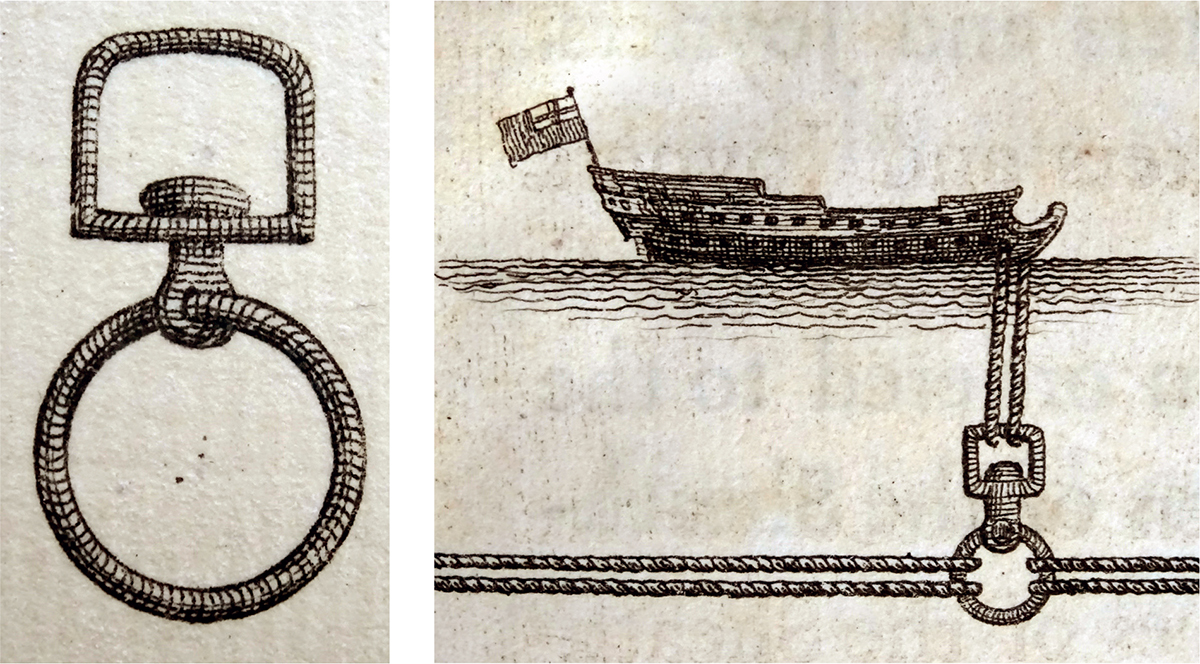
Moorings with the detail of the swivel, from A Naval Expositor by Thomas Blanckley, 1750.
Maintenance
Wood does not generally rot when it is always wet or always dry. However, this state was never possible with wooden ships as they were always exposed to the weather and were partly submerged in water. Above water, they were more susceptible to rot as fresh rainwater is more damaging than seawater. They were therefore in a perpetual state of deterioration and required regular maintenance to keep them in good condition. In service, this normally consisted of a week or so during winter when the ship could be docked to repair and grave the hull. While vessels were laid up in ordinary, a great deal of damage and rot was caused by rainwater dripping in the upper works and to some of the joiners, carvers, plumbers and glass work.72 Routine maintenance, such as airing during hot weather and closing hatches and ports in wet conditions, was the responsibility of the ship’s five permanent warrant officers and their servants. Repairs beyond their capabilities were made on the orders of the Navy Board, usually following the advice of the yard’s master shipwright and surveyor, as and when finances permitted. Decay and rot often started before ships were even launched as they were usually built from recently felled green timber. Seasoning, the drying out of the timber, occurred while the ship was afloat, and a good deal of expertise, diligence and good weather was needed for this process to have a successful conclusion.73
Very soon after the Restoration of King Charles II it became apparent at faraway Portsmouth that the cost of ship repairs could escalate beyond any reasonable expectation if left entirely in the hands of the master shipwrights. As a result, the Admiralty issued an order in May 1661 that master shipwrights were not to perform any repairs until they had made an estimate of the work, sent it to the Admiralty for approval and received orders to carry out the work.74 Of course, an estimate made on what is externally visible can prove radically inaccurate when the ship’s planking is removed and the internal structure is revealed for examination. This was a problem when work was carried out in the King’s yards, but it was even worse when repairs were carried out privately under contract. In one case, a merchant builder, Mr Henry Johnson, was repairing the Diamond and the Dragon according to the findings of a survey, but when laid open, the ships proved much worse than expected in some places and better in others. The Surveyor of the Navy, Sir John Tippetts, sensibly suggested that another survey was carried out and a new agreement made to prevent any dispute that might otherwise have occurred.75
When timber and plank were roughly removed from ships during repairs, many pieces that might have otherwise been fit for further use were split and rendered useless. Instructions were issued, more than once, for shipwrights to be careful in this work and save what they could.76 Another wasteful practice occurred when ships came into port and were laid up waiting for repair. The storerooms, cabins and other partitions were taken down, but instead of being carefully stored for future use, they were often embezzled. As a result, orders were issued that rooms, bulkheads, cabins, doors, scuttles, shot lockers, locks, bolts and other such materials were to be delivered into the custody of the boatswain, who was to ident for them in the same way he did for other stores.77
The decks, gratings and ladders of the King’s ships had long been kept ‘clean and sweet by washing and swabbing’, a practice also carried out on merchant and Dutch ships. In 1695, the master shipwright at Chatham complained of a new practice of scraping decks. Some ships returning to the dockyard were found to be in such a miserable condition that they could only be made good at great cost. One ship, the Royal William, had only been in service for two months and on returning was in as bad condition as if she had been at sea for many years. The Navy Board wrote to the Admiralty asking for the old method to be reinstated, but appeared to receive little sympathy from the sea officers.78
In 1697, at the end of William III’s war with France, many ships were in poor condition and required attention. A general order was issued which attempted to cover everything related to rebuilding, repair and maintenance. Before carrying out repairs, master shipwrights were to carefully survey the hull, rigging and stores of ships and, as in the past, not start work until a warrant had been received. If extra work was found necessary after they had started, they were not to proceed until they had received an order to do so. The first task was to remove standing cabins, those cabins made from wood rather than canvas, standards on the decks and lyme linings to allow clear access to the decks for caulking and for air to circulate. After the repairs had been made but before the ship returned to service, the standards were to be put back in place but fixed with spikes only at their head and heels. Similarly, to prevent the carved works rotting, they were to be set up away from the plank they were nailed upon to allow air to circulate beneath. On the lower deck, only the first four seams of the planks from the waterways at the sides were to be caulked, in order to leave the rest open to the air. Some long whole-deck planks were not to be treenailed down onto their beams for the same reason. The lower masts, the anchor linings and any other similar items were to be made to fit but to hang loose. To keep the topmasts and main yards out of the weather, they were to be stored ashore in the mast houses, while the smaller yards were to be kept aboard and hung up between decks.
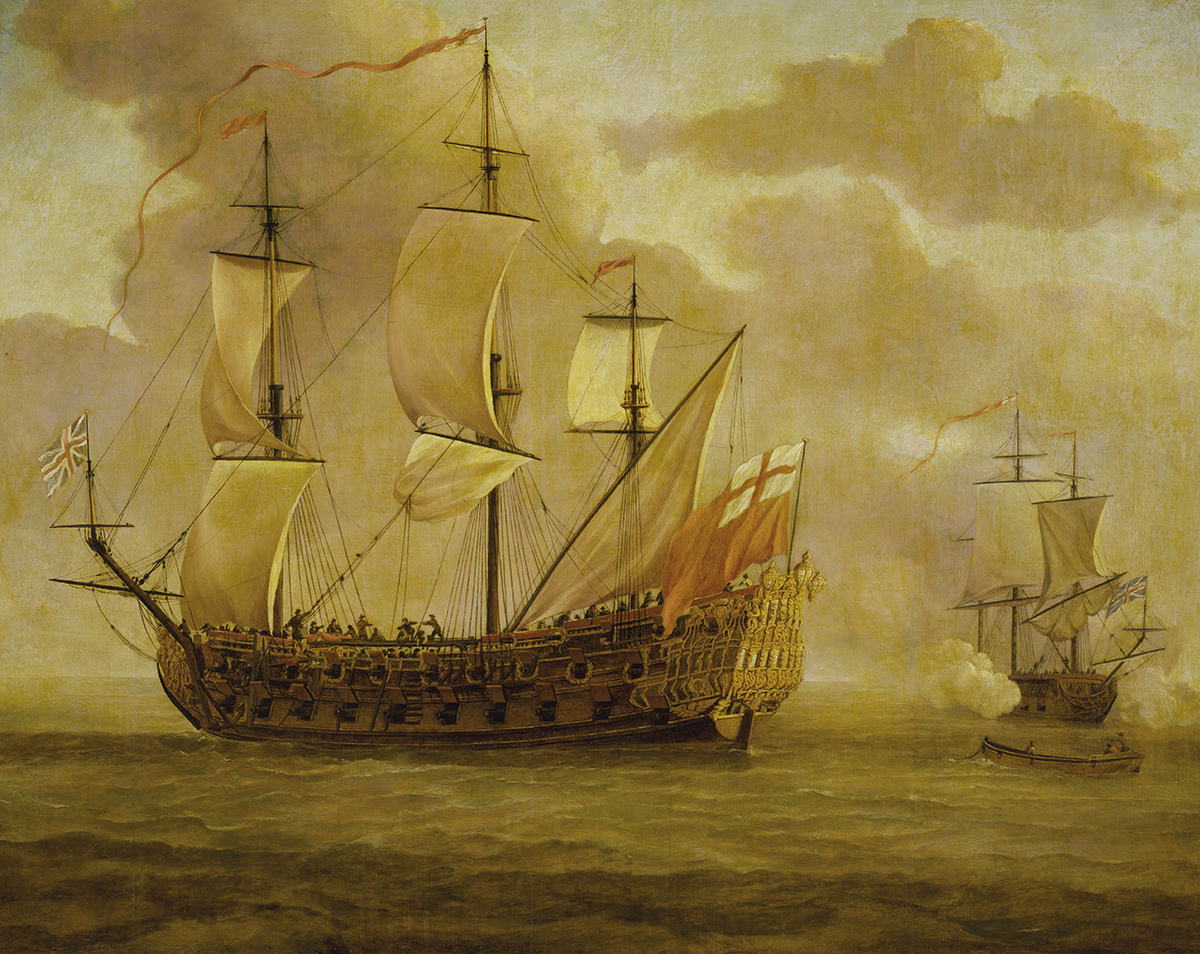
The fourth-rate Woolwich, painted by Willem van de Velde the Elder. King Charles instructed Phineas Pett III of the Woolwich dockyard to commission the painting from van de Velde and to hang it in the Charlotte yacht80. For this reason, it was painted on wood board rather than on canvas. The painting shows a square tuck, a feature not shown on drawings of the ship and only introduced in fourth-rate ships in about 1690. The surviving records of her repairs and refits are the most complete for any fourth rate of the period. The Woolwich before a light breeze. Willem van de Velde, the Elder, c.1677. BHC3732; Photo: © National Maritime Museum, Greenwich, London.
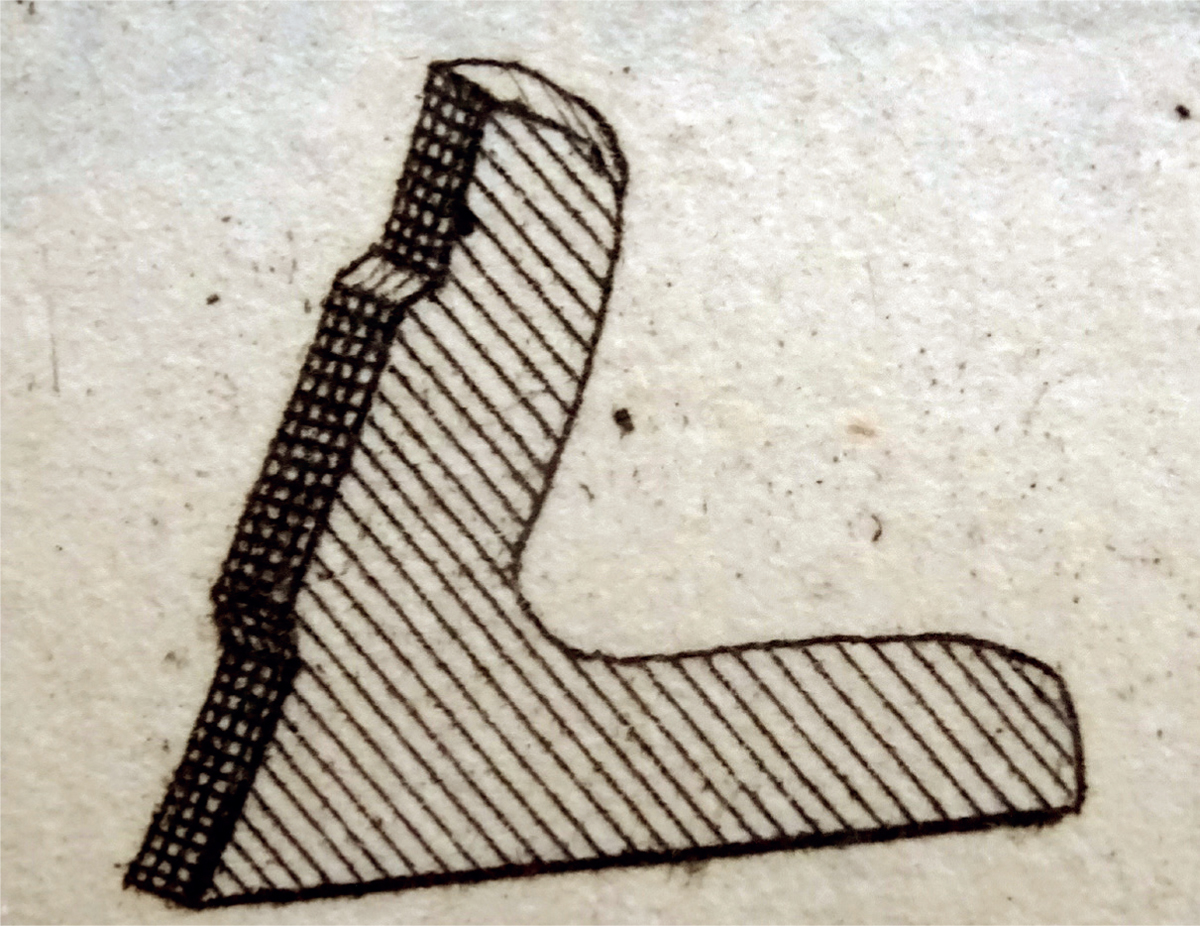
Standards were used to support bulkheads in new ships and were fitted over beams between the deck and the sides. They were also added to strengthen weakening old ships. From Thomas Blanckley, A Naval Expositor, 1750.
Once repaired and afloat, ships in ordinary were to be ballasted deep enough for the water to support each end to help prevent hogging. Because of their exposure to the weather, ships were to be annually trimmed, caulked and payed, and to be docked at least once every three years for graving. To air the holds in good weather, the hatches, gratings and ports were to be left open, and they were to be shut up in bad. During summer and dry weather, ships’ sides were to be watered morning and evening, as had formerly been done to keep them cool, and to stop them drying out too much and cracking. The carpenter warrant officers were to frequently inspect their ships, and any drips were to be stopped by them without delay. The quickwork – that is, the light external covering near the top of the sides that was often clinker laid and payed with tar and blacking – was in future to be painted with oil that was black and timber coloured. While in ordinary, the three standing lower masts and the bowsprit were left standing and were to be payed with rozin and tallow once a year. Once each summer the sails in store were to be well aired, surveyed and mended.
Once a week the master shipwright at the yard was to meet the ships’ carpenters to examine and correct any faults. In former times the great cabin and the officers’ cabins had been made use of by the warrant officers for their lodgings, and as a result a great deal of damage was done to the carving and paintwork. Now they were to lodge in their own cabins, or in some other cabins between decks. Each quarter year the boatswains were allowed two buckets, 12 brooms, a shovel, a basket and two pounds of candles to keep the ship in order. They were always to have a jack and ensign aboard to be flown on Sundays and holidays. They were also to check the moorings and not let any merchant ships use them. Most of the new comprehensive and sensible instructions were the result of years of experience and reaffirmed previous issues and practices.79 But as worthwhile and sensible as they were, these instructions would only be effective as long as they were enforced and as long as the men were encouraged to carry them out by such means as keeping them in regular pay.
The Repairs and Refits during the Life of a Fourth-Rate Ship
Wooden ships required regular repairs, refits and the occasional rebuilding, whose frequency and extent were difficult to regulate as there were so many factors involved. These included the quality of the timber and the workmanship during the original build. Ships that were laid up were particularly prone to rot, the severity of the rot depending on their maintenance and the weather. The extremes of very hot summers and winter ice were particularly damaging. Ships sent to sea did not suffer so much from rot, but their fastenings and structural integrity became weaker as a result of the storms they encountered. The variety of factors involved meant that work was often carried out on ships at the point that it became necessary. To gain more of an understanding of the nature of this work, a comprehensive search was conducted to find the most complete surviving records for the repairs and refits of a fourth-rate ship. Those for the large fourth-rate Woolwich, between her construction at Woolwich in 1675 and the end of her career in 1698, are recorded here as they were found to be remarkably complete and the most revealing.
The finishing works on the new Woolwich were being completed during April 1675. This included fitting the rails, the gunwales, the planksheers, the capstans, the gratings, the ladders, the bulkheads, the standards, the false post, the rudder, the tiller, the chainwales and the gun ports. Other work was being carried out by joiners, painters, plumbers, glaziers, smiths and carvers, and by the caulkers, who were making the planking watertight. The cost of all this finishing work was estimated at £1,270,81 out of the total cost for building the hull of £6,147.82 The Woolwich was adorned with an abundance of elaborate carvings83 produced by John Leadman and Joseph Helby, the approved carvers for the Deptford and Woolwich yards. They cost £285 6s 4d,84 which was double the usual amount for a ship of her size and far in excess of the £160 paid for the carvings on the much larger third-rate Lenox of 1678.85
After her launch, the new Woolwich sailed to Chatham between 20 March and 10 April 1676.86 A survey carried out on her in July of that year found there was still some work to be done by shipwrights, carvers, joiners, painters, glaziers, plumbers and masons, as well as the regular caulking and graving. In all, this work was valued at £200.87 She was fitted out for a voyage to the Mediterranean, departing in May 1677 and returning to Portsmouth in April 1678. She had been lead sheathed for the voyage and this needed repair, as did some copper sheathing in the wake of the anchors near the bow. Copper sheathing must have been used in the vulnerable area near the bow as the soft lead would have been subject to additional wear and damage. By the time she returned home, and in common with many other ships sheathed with lead, some of the rudder irons had become badly eroded by electrolytic action and needed replacing. Other defects included replacing all the lead scuppers on the upper deck which had been broken by the working of the ship. The bricks of the hearth that held the furnaces, or cauldrons, as we would call them, had also been worked loose and needed taking down and setting up anew. Other work included fitting half gunports, which hinged in halves at the side, rather than single gunport lids that were hinged at the top. The powder room forward on in the bows needed alteration and another powder room, or some powder chests, needed to be provided further aft. The main and fore yards needed strengthening with fishes (long, shaped strengthening pieces to fit a mast or yard, spiked and roped in place) and a new studding sail boom was required. The original pinnace was lost and a replacement had to be found. Some work by joiners, carvers, painters and glaziers had to be repaired, and, finally, the hull had to be caulked within board and tallowed without. Tallow was a protective coating consisting mainly of animal fat. This improved the ship’s sailing performance, but it did not last long and quickly became foul.88 Its use seems surprising as the underwater part of the ship was sheathed with lead. All this work was estimated to cost £495.89

The amount of time spent in harbour and at sea by the Woolwich, from her construction in 1675 up until the end of 1682. Author.
After her refit at Portsmouth, that took two months, the Woolwich set sail in late June 1678 for the Newfoundland and Streights station before returning to Portsmouth a year later, in July 1679.90 She was now nearly four years old and requiring more serious repair work. A survey dated 21 August 1679 was made by the shipwrights Daniel Furzer and Roger Eastwood. They found some part of the upper deck had to be renewed, as did three pairs of standards on the gundeck. Several hanging knees underneath the same deck also needed replacing. The working of the ship had loosened the cross pillars in the hold and they needed new bolting. Cross pillars appear to have been fitted to ships the size of the Woolwich and larger but are not mentioned in contracts for building fourth-rate ships of the period. The ship’s movement had also loosened the brick hearth and range, as it had done previously, and once again they had to be made good. Similarly, most of the lead scuppers on both decks required replacing. On the outside, the lead sheathing needed repair and one of the wale pieces had to be renewed. To do this, the fore channel covering it had to be taken off. In much the same way, the lining of the hawse had to be shifted to carry out repairs beneath. At the other end of the ship the rudder needed a repair. The main and fore yards needed strengthening and the tops repaired. In addition, the usual work by joiners, carvers, painters and glaziers had to be performed and the ship had to be caulked within and without. The cost of all this would be £1,669 – that is, more than a quarter of her original building cost.91
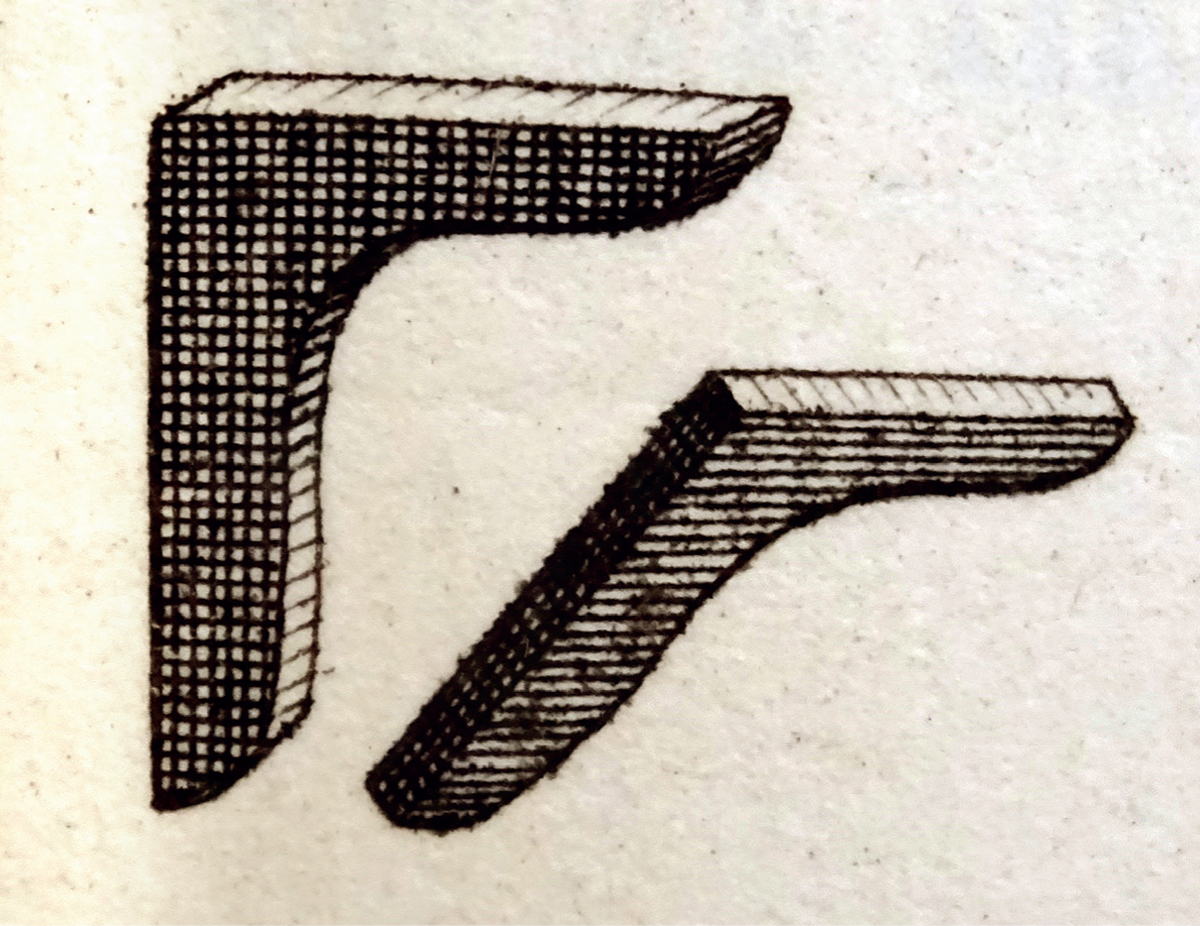
Most beams had two knees at each end, one of them a hanging or up-and-down knee, and the other a lodging knee, lying horizontally. From Thomas Blanckley, A Naval Expositor, 1750.
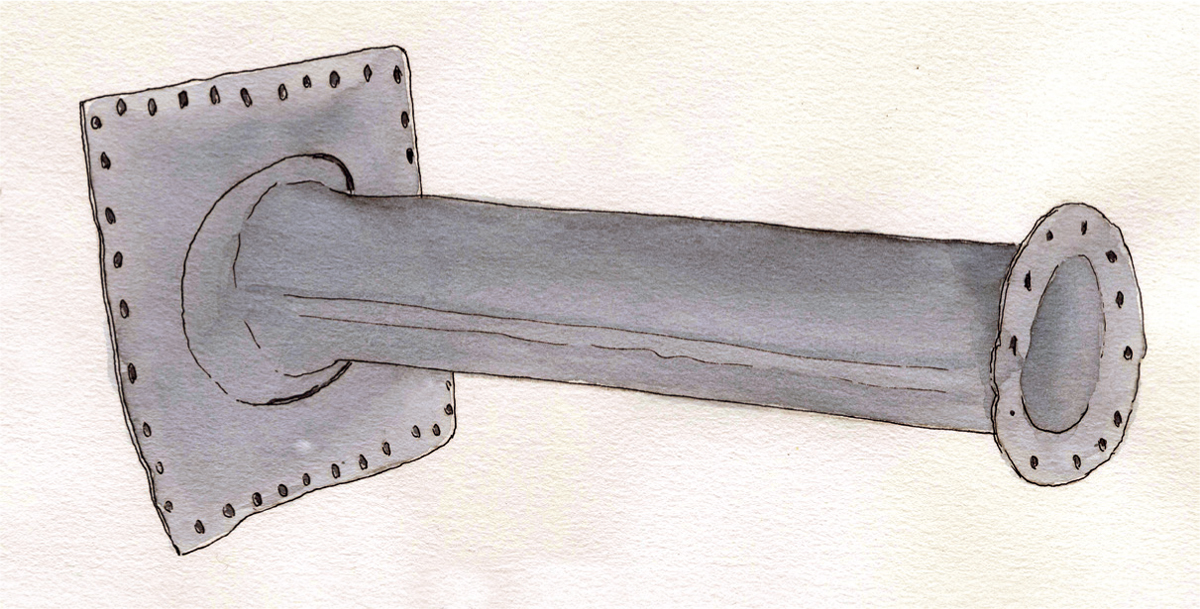
A lead scupper from the wreck of the Stirling Castle. The smaller end took water from the waterways at the edge of the deck to discharge it outside the ship. Author.
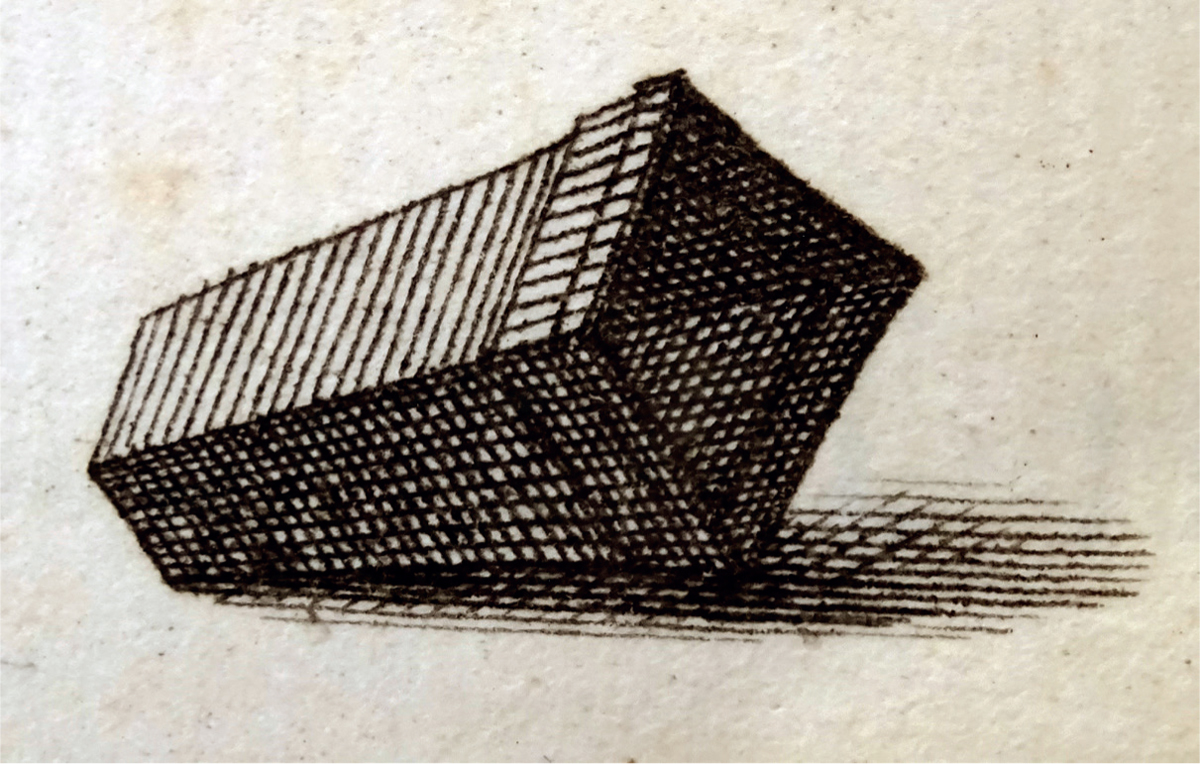
A leather scupper. It was nailed to the outside of the lead scupper and freely allowed water to run out of the ship, but collapsed and stopped water entering when underwater. From Thomas Blanckley, A Naval Expositor, 1750.
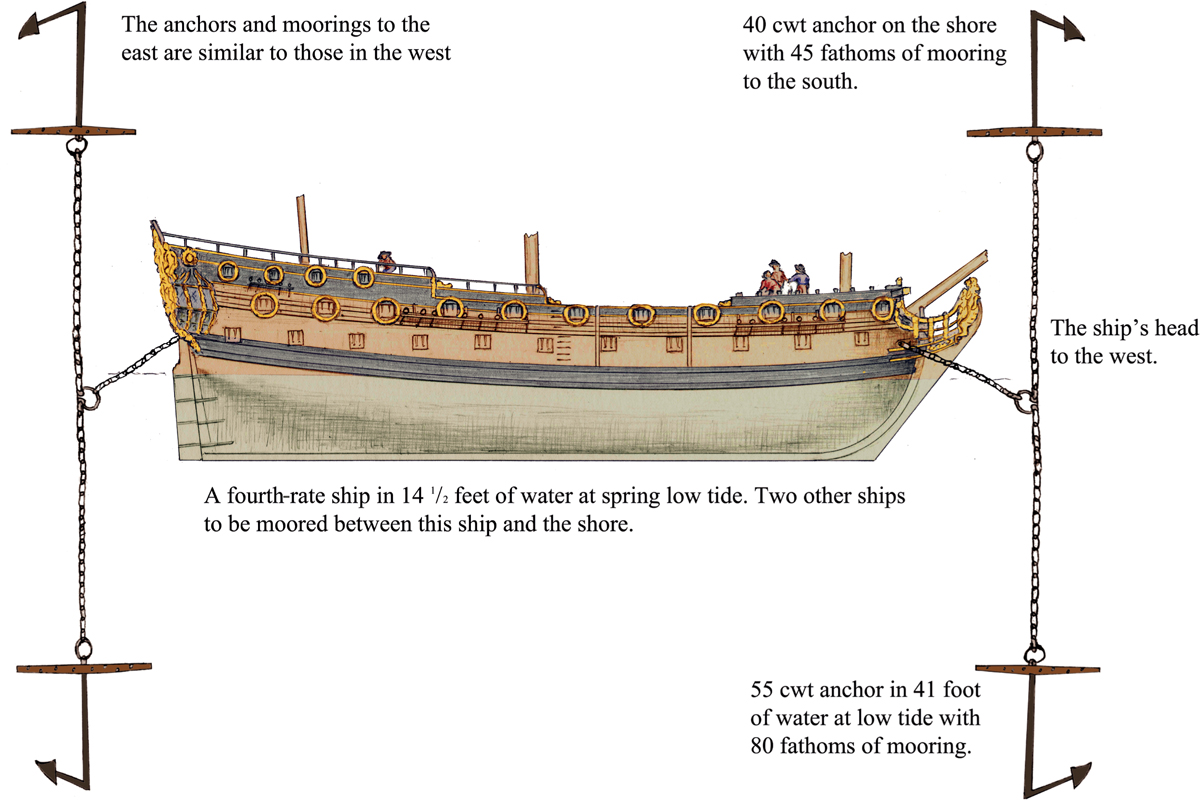
The method proposed in 1698 for mooring ships at Woolwich by using two anchors at each end. It would prevent ships swinging with the tide and being damaged by passing merchant ships. Author, after Edmund Dummer.
The Woolwich remained at Portsmouth until December 1679, when she left to convoy the herring fleet. She was away for a year before returning in January 1681 to Woolwich, where her crew were paid off.92 At the end of the month Thomas Shish, the master shipwright, reported that the Woolwich needed a considerable repair and that it would take some time to complete.93 After Admiralty approval for the repairs was received, she was docked and the lead sheathing taken off in several places in order to inspect the plank seams and butt joints beneath. Shish found the exposed seams very open and the caulking so rotten it would need clearing out and renewing.94 All the lead was removed, but as the caulking proceeded, Shish found the plank very rotten in many places, and this would all need replacing. To do this, he needed a large amount of four-inch-thick plank and asked if this could be supplied from Deptford or elsewhere. He was also short of 2,500 treenails of two feet in length for fixing it to the frames.95 The rudder irons, which were themselves replacements for those fitted in 1678, were ‘so much eaten with ye rust that we were forced to unhang ye rudder and new hang it’.96 Lead sheathing had proved a failure due to the damage it caused to ironwork in its near vicinity, and it would not be fitted to the ship again. The Woolwich was finally ready to launch from the dock in May 1681.97 Her works were not ‘wholly completed’ until mid-September, after taking more than seven months.
The Woolwich would not be sent to sea for the rest of the year, but was instead laid up in ordinary. The Thames at Woolwich was not a good anchorage as ‘the King’s ships are exposed to damage from Merchant ships passing up and down and also in danger of being put on shore by ye ice in case of a hard winter’. It was decided that as soon as they could find enough men they would sail her to Sheerness before winter set in.98 In spite of the urgency, it was not until early November 1681 that she was rigged and her anchors, cables and sails taken aboard. Although the hold contained 170 tons of ballast, she still needed another 50 tons.99 Inevitably, just as the Woolwich was ready to leave, a merchantman, the Johns Imployment of Ipswich, ran foul of her, breaking the jackstaff, knocking the head off the figurehead and breaking one of the rails with all its carved work. Thomas Shish estimated that the damage could be repaired very cheaply, for only £3.100 The problem of keeping moored warships out of the ‘tradeway’ of the river was addressed in 1698, when it was proposed to moor fourth-rate ships with two anchors at each end to prevent them swinging with the tides or the wind.101
In April 1682, the Woolwich was manned and sent out to escort an Italian convoy before returning home in early March 1683.102 On her arrival in the Downs, the following estimate was made for refitting her hull, masts, yards, rigging, ground tackle and sails and for furnishing her with six months’ worth of boatswain’s and carpenter’s sea stores:
| Refitting work and providing 6 months stores | £ |
| For timber, plank, boards, & masts | 150 |
| Ocham, pitch, tarr, rozin, oyle & brimstone | 65 |
| Reed, broom, thrums & other petty provisions | 30 |
| Perfecting ye carvers, painters, plumbers, glaziers, & bricklayers work | 30 |
| Completing the sails to two suites | 200 |
| Cables & other cordage and blocks | 300 |
| Anchors & other ironwork & lead | 20 |
| Kerzey, cotton, colours & hamaccoes | 46 |
| Compleating ye Boatswains & Carpenters stores | 300 |
| Total | 1141 |
A note of caution was added to the effect that as the Woolwich was still at sea, her condition could not be accurately determined.103 A short time later, on 8 March, she arrived at Sheerness and was safely moored.104 No major repair work was found necessary, but she was given a thorough refit, especially to her masts and rigging.105
A squadron that included the refitted Woolwich was to be sent to destroy the fortifications at Tangier under the command of Lord Dartmouth in the Grafton. Samuel Pepys also went along, acting as Dartmouth’s secretary. By June 1683 she was in the lower Thames, and by the end of the year she was at Tangier. On 14 April 1684 the Woolwich arrived back at Sheerness, where her sails were taken ashore106 and the men paid off. She was then laid up107 and a survey made of her ‘defects’,108 which resulted in orders being given that she should be repaired and breemed and graved with black stuff.109 Breeming involved burning off the weed and scraping away all the old protective coating, tallow or tar. Approval was also needed for work to begin on repairing the standing rigging and sails and stropping the blocks.110 Joseph Lawrence, the master shipwright at Sheerness, then wrote an account of other works to be performed. The first thing he mentioned was the damage to the figurehead, which appears to have been inadequately repaired by the £3 worth of work carried out by Thomas Shish two years before: ‘The head being broke off in the middle requires to have a piece scarphed on to take the knee. A new lyon, new wales, timbers, planksheers & gunnels. Some planks to be shifted on the upper deck & forecastle. The gratings, planksheers & gunnels to be repaired. The partners decayed to be new. The bowsprit to be taken out & secured with a fish. The fore mast to have a good paunch (a mat fitted to the fore side of the lower masts to stop them from rubbing) brought on afore. The main yard to be well fished. Some waterways defective on the gundeck to be shifted & several lead scuppers that are split. The cross pillars in hold wrought loose to be new kneed and bolted. The channels & wales in the wake of them defective also one of her lower harpins requires to be shifted. Some part of her buttock planks decayed requires shifting. The rudder defective to be secured. Carver’s works, joiner’s & glazier’s to be repaired. The ship to be caulked all over & breemed & graved. The ship to be painted. The ship to be fitted with six months sea stores which charge may amount to the sum of five hundred & fifty pounds or thereabouts. The time the said works may be performed in, if timely supplied with materials, here demanded & sixteen shipwrights – will be three months.’111 At the time a great survey was made of all the King’s ships as part of a proposal by Samuel Pepys to repair the whole fleet. It included the Woolwich and added a couple of additional defects. Once again, the brickwork of the furnaces and the fire hearth was found to be decayed and had to be renewed. Some of the planks under the forecastle and all the gratings also required repair.112 At the time the reports were written, two shipwrights and five caulkers were working on the upper deck.113
Surveys and reports were one thing, carrying out the work was quite another. On 12 August 1684 it was intended ‘God willing… if weather permits’ to dock the Woolwich with the help of about 20 seamen sent down from Chatham.114 A month later she was out of the dock but little or none of the repair work had been done, as they reported she had only been cleaned.115 During September, her standing rigging was refitted, but while strapping the blocks, they found that many needed new sheaves and pins which would have to be sent to Chatham as Sheerness had no blockmaker.116 Over eight months later, on 28 May 1685, orders were received for fitting out the ship, now ten years old, for sea. None of the repairs had yet been made, and Lawrence pointed out that although the work was considerable, it could be performed at Sheerness, but only if she was taken out of the water and laid on shore on ways. This was because the scarph, or joint, of the broken head was underwater. Additionally, the rudder needed new irons, and some planking at the water’s edge needed replacing, as did some of the rider bolts which went through to the outside of the ship. Lawrence also noticed that another ship at Sheerness, the Happy Return, was in a much better state of repair and could be made ready for sea more quickly and cheaply than the Woolwich.117 The Admiralty took Lawrence’s advice and refitted the Happy Return instead. The Woolwich was not overlooked, however, as an estimate was made on 4 June for getting her ready for sea with six months’ worth of boatswain’s and carpenter’s sea stores:118
| Materials | Repairs £ | Sea Stores £ |
| For timber, plank, board & treenails | 160 | 8 |
| Masts, yards, fishes & spars | 3 | 15 |
| Pitch, tarr, rozin, oyle, & brimstone | 40 | 9 |
| Two suits of sails, 2 spare sayles & canvas for stores | 436 | |
| Cables and other cordage | 738 | |
| Cotton, kersey, colours & hammacoes | 40 | |
| Copper, brass, lead, leather & lanthorns | 24 | 96 |
| Ironwork, anchors & grapnels | 261 | |
| Ironwork, sundry sorts | 65 | 52 |
| Boats, buoys, blocks & oars | 80 | |
| Other small stores | 14 | 16 |
| Total materials | 306 | 1751 |
| Workmanship & ornament | 229 | |
| Total | 535 | 1751 |
| Whereof in store or onboard | 1131 | |
| Wanting | 535 | 620 |
The cost of repairs is almost exactly the same as a year before, confirming that little, if anything, had been done to the ship. Indeed, all that was spent on her was for the supply of some tarr and spun yarn.119
By 2 July 1685, the Happy Return was ‘very nigh completed’ and Joseph Lawrence asked the Navy Board if the caulkers from Chatham who had been working on her should be returned or whether they should stay to give the Woolwich an ‘ordinary’ repair. The ordinary repair involving nothing more than caulking her seams and paying her sides while she remained afloat. Alternatively, he asked, should she be taken on the ways to have her ‘full repair’?120 A few days later the Admiralty approved a full repair, but wanted it done while the ship remained afloat. Lawrence patiently explained once more the problems and dangers of doing this. He warned that the strong winds could sink her if he removed planking from her sides and some buttock plank near the water’s edge. It was also difficult and time consuming fitting stages to the sides for men to work on.121 He won the debate but after a month’s work found that all his store of oak and elm timber was consumed. He requested more, as well as sawn plank, treenails and deals.122 During September, Lawrence heard that ten loads of large timber were available at Maidstone, but he could not speak to the owners as they only appeared on market day. Each load consisted of 50 cubic feet of hewn timber.123 The wharfinger, into whose charge this and other timber was entrusted, gave an estimate saying each piece, or tree, contained 80 or 90 cubic feet at a cost of about 55 shillings a load. In addition, there was ordinary-sized oak, containing about 36 or 38 feet in a piece, and costing between 40 and 42 shillings a load, while compass, or curved, timber was 52 shillings a load.124 The timber was bought and arrived at Sheerness during October.125 The oak was bought from three partners, Messers Allen, Lee and Spong, and came from Maidstone Quay, high up the River Medway. All the elm came solely from Allen at Otterham Quay near Rainham.126
The following table lists the actual timber bought out of a £100 budget given to Joseph Lawrence for repair work to the Woolwich. The chart itemises the size of the individual trees in cubic feet:
| Large oak timber at 54s a load | Ordinary oak timber at 44s a load | Compass timber at 54s a load | Elm timber at 43s a load |
| 91 | 64 | 99 | 82 |
| 76 | 53 | 62 | 31 |
| 80½ | 48 | 100 | 34 |
| 70 | 25½ | 48½ | |
| 76 | 49½ | 60 | |
| 57 | 14 | 54 | |
| 60 | 57 | 50 | |
| 19½ | 44 | ||
| 45 | 47½ | ||
| 33 | 47 | ||
| 50 |

The amount of time spent in harbour and at sea by the Woolwich from 1683 up until the end of 1690. Author.
In early November 1685 Lawrence was able to report:
‘The lower parts of each gallery has been taken off, the planks being all defective in the wake of them are now shifted & the galleries made up again. We have also shifted about 200 feet of 4 inch plank under the lower ports upon the gundeck. We have shifted several pieces of plank over set 3 standards & new fayed & bolted them again, also the gundeck caulked all over & 2 planks shifted betwixt the bresthooks on the gundeck. Some part of the gundeck ports unhung & new lined and hung again, also one hanging knee fayed under a gundeck beam in hold-aft.
The heaviest of our works are yet to perform. One gundeck beam to shift. The cross pillars to be kneed & fastened. Two new standards to be fayed & several knees. The cookroom to be taken down & new plank to be shifted underneath.
One lower harpin piece (a forward curved piece of wale) & several plank of 6 inch stuff betwixt & under the wales, also some buttock planks to be shifted. A new rudder, the knee of the head to be scarphed with new rails, timbers & carved works. The bowsprit & main yard to be fished & several other works. In regard our number of shipwrights is but five, & seldom but one or the other of them are disabled by one hurt or other… I do reasonably hope the works may be completed in 3 months’ time.’127
The repairs were completed in early 1686, after which the ship was laid up in harbour. Pepys, in his book Memories Relating to the State of the Navy,128 noted that the estimate of £525 ended up being £1513. The Woolwich was moved to Chatham in early 1688, when she was fitted out for sea. On 21 April work started on her main topmast, her fore topmast and her fore yard. Work proceeded slowly; on 28 July, 22 half gunports and six shot lockers were constructed. By August the gratings were repaired, the bucklers made and the shot lockers put in place. Six months after the work started, the Woolwich’s top gallants were finished. She had to be docked for graving and to have the iron bolts which passed through to the outside of the hull capped with lead.129
The Woolwich was now ready for action and formed part of King James II’s fleet which was supposed to oppose the Glorious Revolution led by William and Mary. While the rest of the fleet achieved practically nothing, she succeeded in capturing two Dutch ships.130 Her efforts were in vain, however, as the momentous events ended when James fled to France. The Woolwich then became part of a fleet under William and Mary assembled to oppose a French-led invasion on behalf of James’s attempt to regain the throne. On 1 May 1689 she took part in the indecisive Battle of Bantry Bay, where ‘she was so much disabled in our sails, masts and rigging with several guns dismounted and three split’. The human cost was 5 killed and 16 wounded.131 Between mid-May and mid-June, she and many other ships were sent to Portsmouth for repairs to their battle damage. Among other things, the Woolwich needed a new main mast, five new guns and several new carriages. By the end of the year the ship was in need of further repairs. She was taken to Chatham and on 5 December entered the dock, where she remained until 28 January 1690. Although she was afloat, it wasn’t until 10 February that she was fully repaired and taking in her guns.132 She joined the main fleet as part of the Red Squadron, but lost her head in an accident at night just before the Battle of Beachy Head on 30 June. As one of the smallest ships in the fleet, she suffered badly during the battle and was very disabled in her masts and yards, especially the main mast, which had to be temporarily repaired with a strengthening ‘fish’. She survived the battle and the following day was hauled over to one side to expose several shot holes below the waterline.
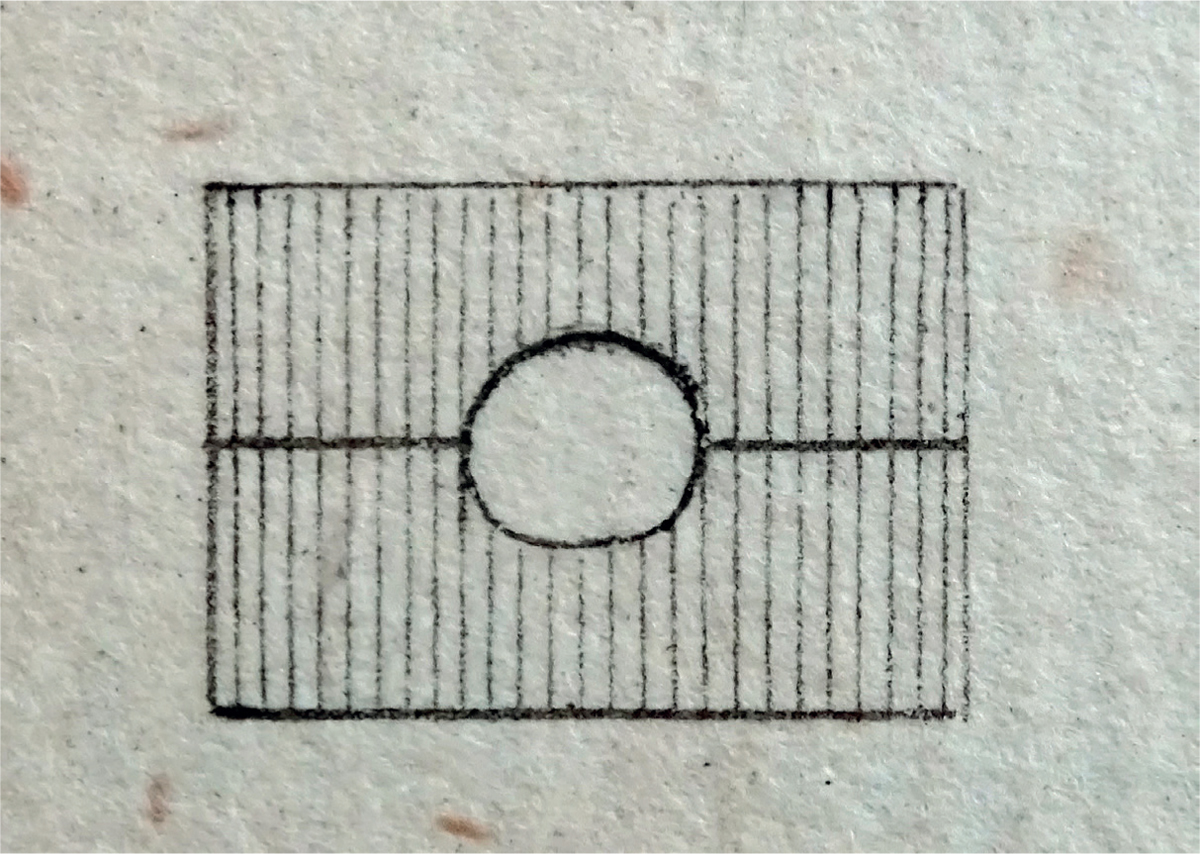
A buckler, used to prevent water washing in at the hawse holes. From Thomas Blanckley, A Naval Expositor, 1750.
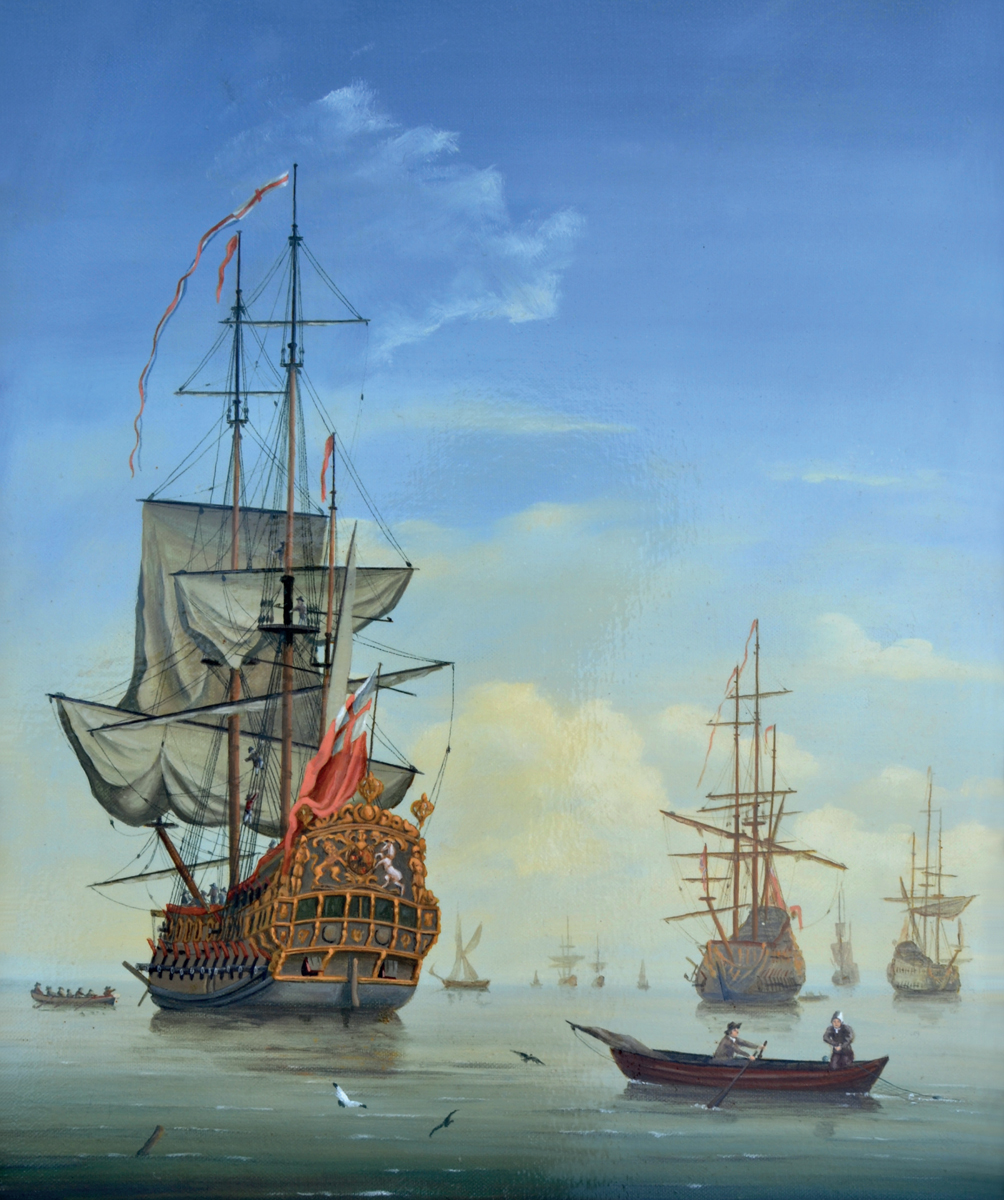
The Lyon, a ship the same size as the Woolwich, which fought next to her at the Battle of Beachy Head. She reputedly dated from Tudor times, and if so, must have had been repaired and rebuilt countless times. She had been rated as a third rate but was reduced to a fourth in February 1690.133 Author.
The worst of the Woolwich’s damage was repaired near Sheerness between 10 July and 17 August,134 after which she was sent cruising to the west. She was in a poor condition and was ordered to the Buoy of the Nore late in November.135 On arrival, she was surveyed by Robert Lee, the master shipwright at Chatham, Daniel Furzer, the master shipwright at Sheerness, and William Bagwell, the assistant master shipwright at Chatham. The shipwrights found that ‘the main stern post is shot off about a foot under water in the late engagement with the enemy and the false post within the same rotten in the wake of the bolts. The carpenter informs us she never had any futtock riders & complains the ship is weak, which we attribute in some measure to the want of the same and a pair of top riders in the quarter. One of the gundeck clamps in the luffs (the curve at the bow) is sprung and some footwaling in the powder room to be shifted, being rotten, which works cannot be performed without a dry dock and without which we humbly give our opinion she cannot be fit for a foreign voyage.’136
The Navy Board received the report on 12 December and sent a copy to the Admiralty, adding that the ship should be sent up the River Medway to Chatham and taken to the head of the double dock for repair and refitting.137 On hearing the news, the officers at Chatham pointed out some problems with this arrangement. As the shattered sternpost had to be removed in the dry dock, the Woolwich would use up valuable space and time when many ships needed docking for cleaning and graving. Also, while the Woolwich remained in the dock, other ships the size of third rates would have to have their bowsprits removed in order to fit in behind her. Moreover, all the hands at Chatham would be busy fitting out the fleet during the winter so that they would be ready for the summer campaign. Three days later, the Navy Board wrote to the Admiralty in agreement with the officers and suggested that the ship should instead be sent up the Thames for repair.138 She arrived on 31 December and was seen by the master shipwright at Woolwich, who thought the repairs would be greater than he had expected. The problem was resolved the same day when a merchant shipbuilder, Mr Haydon, agreed to take the ship into his dock at Lymehouse for repair and refitting.139 Mr Haydon was not one of the approved and trusted shipwrights who built ships for the Navy.
A warrant was issued and the work was carried out between 16 January and 19 February 1691. It was overseen for the Navy by Edmund Dummer and Fisher Harding, who wrote that the price for the work was reasonable and the workmanship and materials were good. Unfortunately for Mr Haydon, his bill was not paid until August 1701.140

The amount of time spent in harbour and at sea by the Woolwich from 1691 up until the end of her career in 1698. Author.
The work carried out on the Woolwich at Mr Haydon’s dock at Lymehouse in 1691
| Work | Cost | ||
| Two pieces of false keel of 4 inches thick brought on. Content 56¼ (cubic) feet well fastened with stirrups and staples. | £26 | 8s | |
| A piece of chainwale, bolts shifted. 15½ (feet) long 6in thick & driving 6 new chain plates in the same. | £ 5 | ||
| 4 inch plank wrought in several places, content 54 feet. | £ 7 | 4s | |
| Two steps fitted for the sides | 10s | ||
| 3 inch plank on lining for the anchors limber boards, containing 33 feet. | £ 3 | 6s | |
| A new rail fitted to the wing transom, 23 ½ feet long 4 ½ inch square | £ 1 | 3s | 6d |
| 4 naval hoods brought on abaft to secure the main post & fastening them with 33 bolts | £21 | ||
| 2 pieces fayed between the upper rails in ye head for the fore tacks 5½ foot long each & 9 foot long | £ 5 | ||
| 6 feet of spruce deal without for wash boards under the cheeks of ye head. | 7s | ||
| 3 new brackets in the galleries & repairing the lower part of one of the galleries | £ 2 | 10s | |
| 2 inch plank without in several places 95 feet | £ 5 | 18s | 9d |
| Taking up 1 old standard on ye gundeck & faying & bolting 3 new standards with bolts in each | £13 | 10s | |
| Shifting 28 feet of gundeck spirketting 4½ inches thick | £ 4 | 4s | |
| Workmanship in putting out 2 lead scuppers | 5s | ||
| 2 pieces fayed between the bresthooks in ye powder room 14 foot long each & well bolted | £14 | ||
| One bresthook fayed upon those pieces 11 foot long and well bolted | £12 | ||
| Putting in 12 gundeck ledges 4½ foot long each | £ 1 | 16s | |
| The bulkhead of ye powder room repaired & fitting lockers | £ 1 | 15s | |
| Taking out & putting in one new crotch within squares for ye cross pillars & bolting the same | £ 3 | 10s | |
| Faying & bolting 2 new floor riders 22½ foot long each with 14 bolts in each rider | £36 | ||
| 8 new futtock riders new fayed 12½ feet long each with nine bolts in each rider | £96 | ||
| 3 futtock riders more fayed to give scarph to the other riders, 12 foot long each with 9 bolts in each rider | £21 | ||
| Faying 6 new top riders running through the gundeck 12½ foot long each & fastened with 10 bolts in each rider | £45 | ||
| 2 new standards fayed in ye steerage & bolting them | £ 6 | ||
| Putting in several pieces after the caulkers without board & on the decks & tearing out some rotten treenails | £ 4 | ||
| For 120 caps of lead nailed over rider bolts under waters | £ 2 | 10s | |
| Breeming the said ship, caulking of her from ye strake above the upper wale down to ye keel, graving her with black stuff & tallowing her from the lower wale to the light water draught | £86 | ||
| For ransacking & caulking all ye upper works to the top of the sides and all the inside works including the gundeck, upper deck, quarterdeck, forecastle & poop | £74 | ||
| Docking of said ship & shoring her | £30 | ||
| The use of a storeroom for the Boatswain, another for ye Carpenter & Gunner & a third for the Purser | £ 6 | ||
| Joyner’s work in new ceiling part of ye bread room with slit deal, new bulkheads in ye round house cabins | £12 | ||
| forward, 2 bed sides, the refitting up the state room, bulkhead in ye great cabin & repairing some other works there | |||
| To ye carver for carving 3 brackets | £11 | 1s | |
| Total | £549 | 8s | 3d |
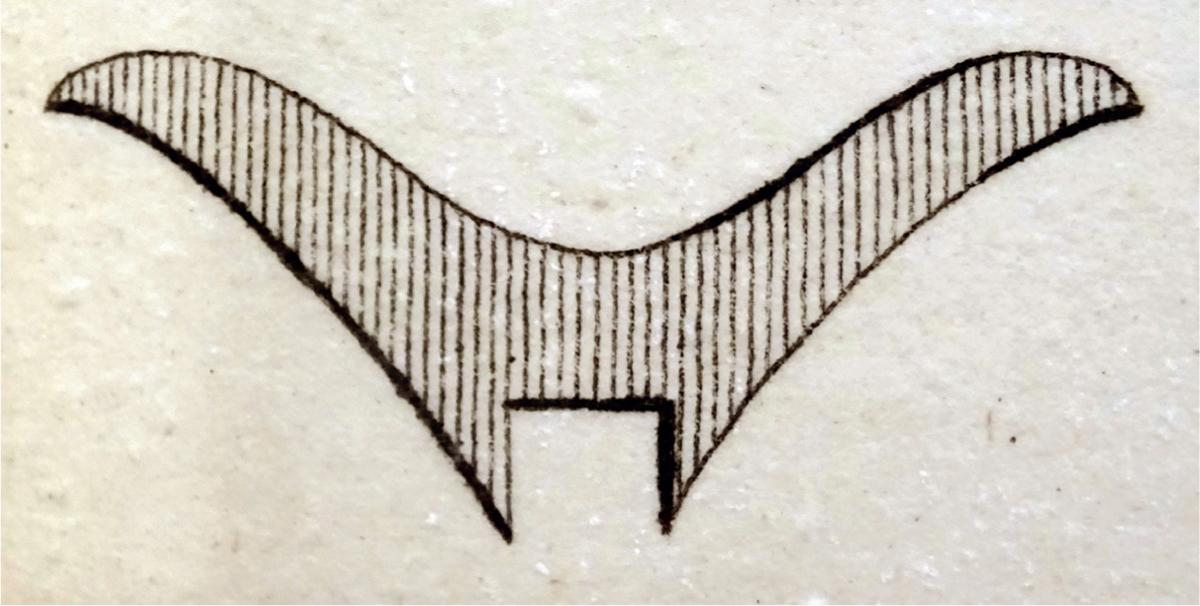
A crotch, mentioned in the list of work to be carried out by Mr Haydon. It fitted at the bottom of the inside of the hull near the stern and helped bind the two halves of the hull together in the wake of the half timbers. The cut-out is made to fit over the keelson. Floor riders, also mentioned in the repairs, were similar and were fitted at the widest part of the ship in midships. They were longer and not so steeply inclined. Also mention are bresthooks, which performed the same function as the crotch at the bows of the ship. Some were fitted down in the hold and others higher up between decks. From Thomas Blanckley, A Naval Expositor, 1750.
The list of work shows that the shattered sternpost was not replaced but repaired with naval hoods, which were bolsters that strengthened the area where the plank met the post. After the repairs, the Woolwich was manned for service and by the beginning of March was in the Thames at Longreach. The repairs were not entirely successful; before the month was out, she had sprung a leak and was surveyed to find the cause.141 She spent the summer of 1691, from May till August, cruising in home waters. It was only six months since her lengthy repair had been carried out in Mr Haydon’s yard, but her officers reported that she was still suffering from serious leaks. As a result, she was paid off and ordered to Woolwich to be refitted. According to the Navy Board, ‘Their Majesties Ship the Woolwich has been a crazy ship a great while having had no considerable repairs since she was built and the Master Shipwright… at Woolwich acquaints us that her condition is such that he doubts she cannot be made fit for another voyage without rebuilding.’142
Because it was expected that the repairs would take a considerable time during the coming winter, when the King’s yards would be very busy, she was sent into one of Robert Castle’s private docks at Deptford.143 There, she was surveyed by respected shipwrights, including Fisher Harding, Edmund Dummer and Robert Castle. They searched for the cause of the leaks and found one hole in the manger under one of the cheeks of the head and another abaft the mast caused by a swinging anchor. An even worse leak was found in the caulking of a forward plank under the lower main wale, which was found to contain no ochum. They recommended that the lining of the hawse and the cheeks of the head be taken off so that the plank beneath could be firmly caulked. Other work they thought necessary included fitting long, four-inch-thick strings in the waist and making good the rails, gunwales and planksheers. They did not find her in such a poor condition as had been reported by the ship’s officers, and estimated the cost of repairs would be about £200.144 Shortly afterwards, on 12 October 1691, a second survey found that several bolts in the transom knees and bresthooks were badly corroded and needed replacing. The corrosion had probably been caused by the use of lead caps fitted earlier over the bolt heads. Other work included replacing an up-and-down knee to a beam forward on, filling in between the wales with four-inch plank, repairing, yet again, the long-suffering lion figurehead and providing a piece for the knee of the head. At the other end of the ship, the rudder had to be taken off as the main and false sternposts needed replacing. This would involve taking out the buttocks planks aft. A painting of the Woolwich by the famous marine Dutch artist van de Velde shows a square tuck, a feature not shown on drawings of her but known to have been introduced on new fourth-rate ships at about this time. It may be that a square tuck was fitted to the ship when her sternpost was replaced and that the van de Velde painting was altered to suit. There was other work to be done, including carving, joiners’ work, painting, caulking and graving. Even when all this work was completed it was thought the ship would be fit for only another three years’ service if she had the customary ordinary repairs.145
The repairs were complete by mid-March 1692, and with the masts set up and ballast put in the hold she set sail from Deptford. It took another month before all her provisions were aboard and she was ready for service.146 She joined the Blue Squadron of the main fleet and fought at the battles of Barfleur and La Hogue between 19 and 24 May. The outcome was a resounding victory that more than made up for the defeat at Beachy Head. The French fleet would not be able to challenge a fleet action for the rest of the war, but remained a threat through commerce raiding. Afterwards the Woolwich’s crew made good her damage, stopping the leaks and repairing the rigging.
On 29 August preparations were made for another refit. The Woolwich was taken to Sheerness, where the guns, stores and ballast were taken out so that she could be docked to expose the hull bottom for cleaning.147 She went into the dock for just one day, on 17 September. Taking the opportunity of being ashore, 50 men, about a third of her crew, deserted the ship and ran off to London. When she was afloat once more, the ballast and stores were put back and the masts and rigging set up. All the work was complete by 16 October and she was able to leave Sheerness.148
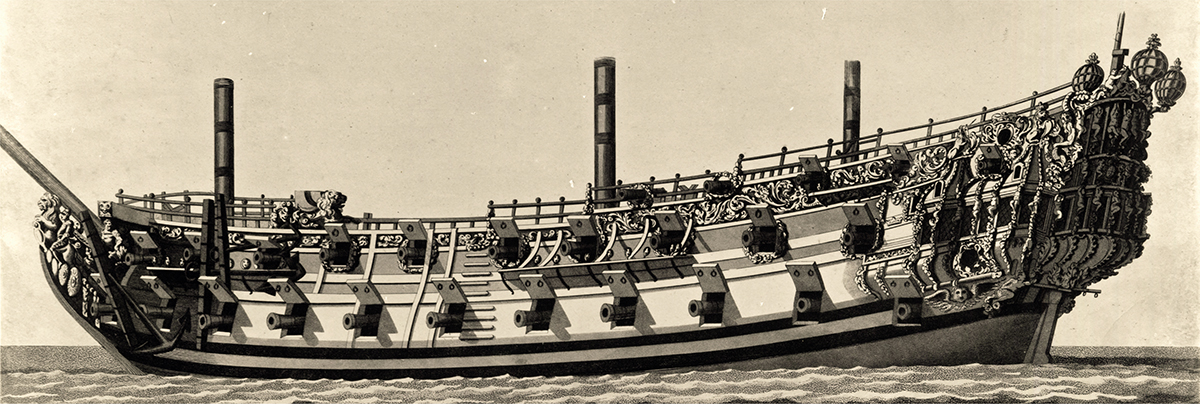
An engraving of the Woolwich from a now-lost van de Velde drawing.
After spending most of the early months of 1693 in the Downs or at Spithead, the Woolwich was then sent out cruising in home waters, often on escort duty.149 A large convoy was assembled to go to the Mediterranean and she was assigned to become part of the escorting squadron. They were attacked by a larger French fleet, and while defending the merchantmen, the Woolwich became fully engaged in the ensuing fight.150 She had the distinction of fighting in every major action of the war. She spent the rest of the year without any major repairs, although the rigging was surveyed on 13 September and she was heeled and cleaned on 6 October.151
At the beginning of 1694, the condition of the Woolwich was once again causing concern and she was ordered to the Buoy of the Nore near the mouth of the River Medway. She was leaking badly, and a survey was carried out by the master shipwright and master attendant from Sheerness dockyard. They found she needed new decks, and that several broken knees had to be replaced as well as three pairs of futtock riders. On top of that, there were many other unspecified repairs to carry out which could only be done in a dry dock.152 She was ordered up the Thames to Woolwich dockyard and cleared of ballast, guns, stores and upper masts. She was then taken into the stern of the double dock behind the James Galley on 17 February. The work took until the 2 April, and then the Woolwich came back out into the river. She was able to set sail three weeks later after her ballast was replaced, her masts set up and her stores put back.153
Once more in service, she was ordered to Orkney but suffered some damage, which was reported on her return to the Buoy of the Nore.154 She was surveyed at Spithead on 17 October and sent into Portsmouth harbour to prepare for a refit and for cleaning in the dock. To prevent a repeat of the mass desertions that had happened in 1692, some of her men were sent on board the London Merchant hospital ship rather than given leave ashore. She went into dock on 24 October for a day to be breemed and tallowed on both sides. Before her ballast was put back, care was taken to clear out the limbers, the passages next to the keel that allowed water to run to the pumps. She sailed out of harbour and anchored at Spithead on 7 November.155
The Woolwich then spent some time at sea on convoy duty, but her condition was again causing concern and on 15 May 1695 she was surveyed at the Buoy of the Nore by the officers from Sheerness. They reported: ‘[We] do understand she is a very weak ship about the water’s edge, her gundeck in general very defective, the ends of several of those beams rotten, as also that she is treenail sick (rotten), and that a perfect account cannot be obtained of her condition until she is brought into dock. We humbly advise her being ordered up to Woolwich, to be disposed of afterwards as upon a second examination as shall be judged best for the service.’156
The Woolwich was beginning to reach the stage when repairs were becoming so extensive and frequent that it would be more economic for her to be taken apart and rebuilt or sold off for disposal. As recommended, she was sent up to Woolwich and her men paid off on 25 June. Rather than take her apart, an agreement was made for her to be repaired in the private dock of James Taylor at Redrith near Deptford.157 The work lasted some five months, and it was not until November that she was rigged and a captain appointed. By the end of year, she was in Longreach taking in her guns.
The first months of 1696 were spent in local waters, but serious leaks began to appear in the bows.158 The Navy Board ordered her home and, knowing she would need considerable repair work to make her seaworthy, sent her up to Woolwich dockyard to be refitted there or in a nearby merchant dock.159 By 6 August her men had been turned over into other ships and the guns and stores sent ashore. She went into Woolwich dock on 18 August and the bowsprit was taken out to find the leaks in the stem. The Woolwich remained in the dock for a month and it wasn’t until the end of October that she was taking in her guns and made ready for the sea. She was sent to Shetland and the Isles of Orkney late in November, but on arrival she started leaking again, this time caused by loose bolts in the orlop beam knees.160 She had been at sea for less than three months by the time she was back at the Nore for a further refit on 24 January 1697. There it was reported that she was very weak and in need of rebuilding very soon.161 Her men were turned over into other ships and all her stores and guns taken out for yet more repairs. These were carried out at Chatham,162 but it wasn’t until 9 August that her guns were brought aboard and enough men found to man her. She went to join the Dunkirk Squadron and was then ordered to Sheerness just as peace was declared in mid-September. The worn-out ship had just managed to survive the conflict. She remained inactive near the Nore until 12 November, when she was ordered to be laid up and her men paid off. Before the month was out she was taken to her birthplace at Woolwich dockyard to be taken apart and rebuilt. Many of the ships in the fleet were in a similar condition and were also rebuilt during the following few years. On 12 March 1698 the Woolwich was listed as being at Woolwich dockyard and as being the first scheduled to be repaired as soon as funds allowed.163 The rebuilt ship was ready for service in February 1702. The new Woolwich was almost the same size as the old, but 9 inches longer on the gundeck, and 6 inches wider and 1 inch deeper in the hold.164 During her 22-year career the Woolwich had spent 45% of her time in harbour, and although it is difficult to estimate, the cost of her repairs and refits was probably twice the cost of the original building. As the ship led a typical life, it’s reasonable to assume from this that the master shipwrights spent about twice as long repairing ships as they did building new ones.
Rebuilds
A number of contracts exist which describe the rebuilding of ships. It is reasonable to assume this involved stripping off the planking then taking the futtocks out from the frames and renewing them where necessary. Then, as the ship was built up again, good parts from the old, perhaps frame timbers, beams and knees, would be reused. This was not always the case, for a number of ships, such as the fourth-rate Portsmouth of 1650, were not taken apart but extensively repaired without any frame timbers being moved at all.165
One old fourth-rate ship that was rebuilt by having her frame timbers taken down was the Assistance, originally built at Deptford in 1650 by the private shipbuilder Henry Johnson, who was paid £3,386 10s for constructing the hull.166 A quarter of a century later, in November 1676, she arrived at Deptford, where Henry Teonge, her chaplain, described her as ‘the rottenest frigate that ever came to England’.167 In June 1684, she was again at Deptford being surveyed by shipwrights. They listed her many defects and estimated it would cost £1,600 to repair them.168 Little was done at the time, but in 1686 it was decided to have her rebuilt in Mr Castle’s nearby private yard. A contract was made out to cover the work. and a rough draught of it survives.169 Another fourth rate, the Ruby, was rebuilt, with almost exactly the same amount of work being performed on her as on the Assistance.170
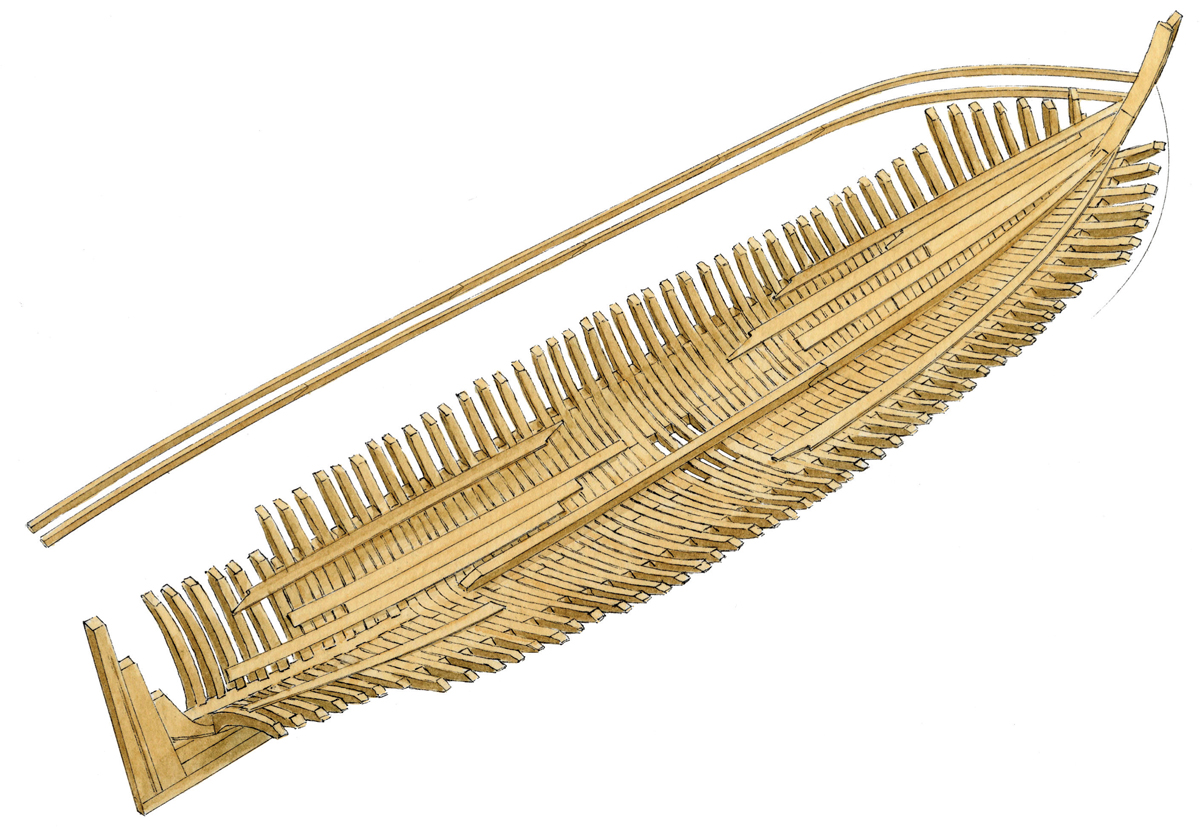
The remains of the old Assistance that were intended to be used in her rebuild of 1686. Author.
The contract for the work on the Assistance read as follows:
Mr Castle for the Assistance to do the work by Sept 29th 86 for £2,900.
To rebuild the said ship within board & without board. To find all manner of materials & workmanship for the complete finishing of the shipwrights work, smiths work, caulking, graving, joining work, carving, painting, glazing, plasterers and plumbers work fit for the sea, excepting the keel, stern post, stem, floor timbers, lower futtocks, part of ye keelson, & part of the footwaling at the floor timber heads. Plank & wales without board at this time remaining upon the said ship, but if the wales or old work before mentioned upon search shall prove defective it shall be done & repaired at my own charge. I do also further oblige myself that all ye timber, plank, iron work, ornament & other materials to be used upon the said ship, shall be of the like number, dimensions, quality & goodness as is done & to be done to the new 4th rate ship now building by Mr John Shish in his Majesty’s yard at Deptford, (the St Albans described in chapter 6) all the works be done to the said ship shall be to the satisfaction & approval of the Commissioners for managing the affairs of his Majesty’s Navy for the time being or whom they shall please to appoint on his Majesty’s behalf, from time to time to survey the same.
I do also oblige myself to build one water boat 27 foot long, 8 foot broad & 3 foot 5inches deep and one pinnace 27 foot long, 5 foot 10 inches broad & 2 foot 6 inches deep with good oak board & wainscot for his Majesty’s service.
The rebuilt Assistance left Deptford in August 1687 and would last until the end of the 17th century, when she was rebuilt once again.
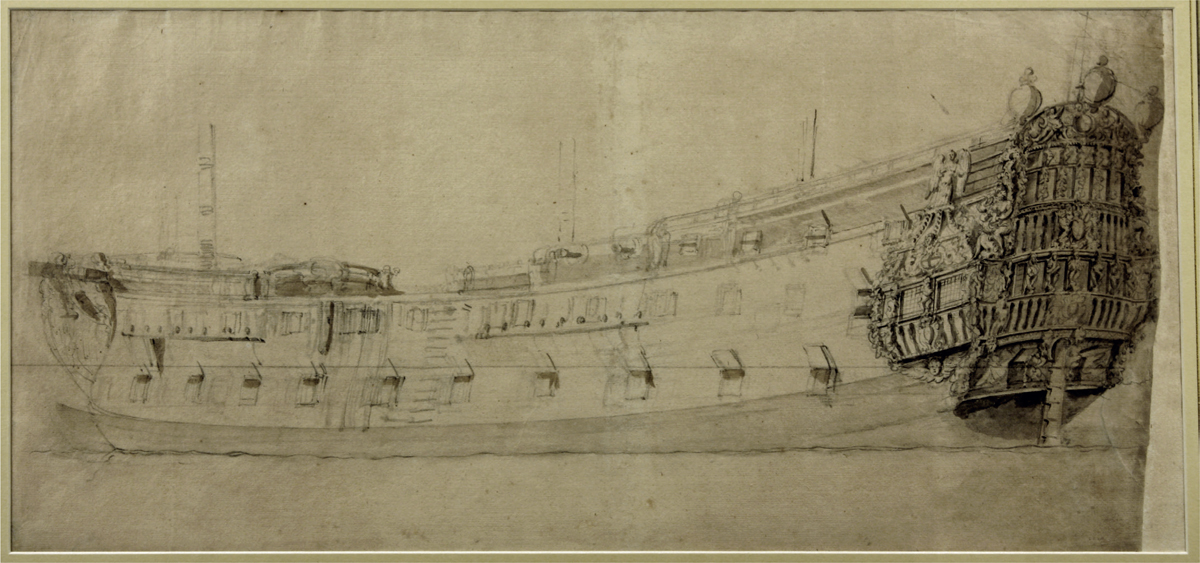
The Assistance as she appeared after her rebuild in 1687. Courtesy Arnold Kriegstein Collection.
The old fourth-rate Greenwich of 1666 was in a poor state by the time she was 25 years old in spite of regular repairs. Her head was weak, with broken rails and gratings having been washed away. The upper deck needed replacing as it was worn so thin it would not hold the oakum caulking. The standards placed on it had worked so loose they needed re-bolting. The gundeck was very decayed near the sides and its supporting beams so loose they worked several inches from side to side. One of the beams was rotten and the standards so loose they lifted at their ends. Several of the hanging and lodging knees were decayed and the bolts loose. The supporting cross pillars in the hold and their knees were split and the bolts worked out. Some of the orlop beams were also decayed and the transom knees split. The bitt pins and cross pieces were worn through, as were the hawse pieces. Her treenails were rotten, making the ship leaky and weak.171 In spite of her condition she would last a few more years before she was rebuilt. Another ship, the 45-year-old Constant Warwick, was so old her upper deck beams rounded downward instead of upward, so that water lay upon the deck without draining.172 The ship was almost beyond use, but before she could be broken up or heavily rebuilt she was taken by the French.
Old Ships’ Demise
One ship that proved beyond repair was the Victory, originally built at Deptford in 1620. By 1690 she had been repaired so often it was decided to have her broken up at Woolwich.173 A contract was made out giving instructions for her decks, knees, internal planking, external planking and frame timbers to be taken apart as far down as the first futtocks. All the parts fit for future use were to be carefully preserved and not split or spoiled during the process. Any middle futtocks in good condition were to be left in place. This would leave only the bottom of the hull partially intact. It was estimated that the work would take two months to complete, at which point the remains would be inspected and a decision made as to whether they should be broken up as well. In the end, it was decided to take the whole ship apart, at a total cost of £270.174 This was a rare occurrence. In his time, King Charles regarded ships with affection and would always repair them rather than break them up.