Authority Revitalized: Weimar’s Foreign Policy
“. . . in the collapse of 1918 the rise of the Wilhelmine state to dominant economic and world power status found its sudden end.”1
Introduction
Germany’s quest for world power status ended with its defeat in 1918.2 Not only were the vestiges of empire removed under the terms of the Versailles Treaty, but Article 231 – the ‘war guilt’ clause – also ascribed to Germany the responsibility for the war, thereby stigmatizing it as a warmonger deserving severe punishment.3 Over the next two years, Germany suffered a number of ‘amputations’ as territories and populations in the east, south-west and north were ceded through a series of follow-up conferences and plebiscites. In the east, Upper Silesia was ceded to Poland and Danzig declared a free city under League of Nations protection; in the north, northern Schleswig went to Denmark; in the west, the industrial region of the Saar was placed under international control and occupied by French troops for a period of fifteen years in compensation of war damage to French mines; in the south-west, Alsace-Lorraine was ceded to France; Eupen-Malmedy to Belgium; a number of key cities, such as Mainz, Koblenz, Cologne and Düsseldorf fell within the occupied region of the left bank of the Rhine, while an area extending 50 kilometres was demilitarized. This area of the Rhineland with a population of 7.6 million was to remain a bone of contention until the early withdrawal of occupation troops in 1930. Carl Schmitt referred to the various League of Nation/Allied controls governing the occupied region as an example of the modern form of imperialism.4 In total, Germany lost about 71,000 square kilometres – roughly one-eighth (or 13 per cent) of its pre-war territory – and 6.4 million Germans (one-tenth of pre-war population) found themselves outside the new borders. Reductions in material resources were equally large (Map 3.1).
The reaction in Germany was predictably indignant, typically describing the Treaty as a ‘peace based on might’ (Gewaltfrieden) and ‘rape’.5 During the debate held in the National Assembly on 12 May 1919 on whether or not Germany should accept the terms of the treaty, Chancellor Scheidemann to rapturous applause roundly rejected the Treaty describing it as ‘this horrific and murderous blow’ (mörderische Hexenhammer) that was little more than a ‘continuation of war’.6 Germans may have been inflamed by the indignity of being treated in this way, but their own government had treated Russia in equally punitive fashion the previous year at Brest-Litovsk in terms comparable to the punishment inflicted by Prussia on a defeated France in 1871.7 That particular circle was now being closed.
Map 3.1 Germany after the Treaty of Versailles, 1919. Used by kind permission Oxford University Press.
Source: Anthony McElligott (ed.), Short Oxford History of Germany: Weimar Germany (Oxford, 2009), p. 307.
There were four interrelated areas of the Treaty that were in contention from 1919 to the mid-1930s by all Germans, irrespective of where they stood on the political spectrum. The first concerned reparations and, in particular, the alleged accusation of sole responsibility for the war; the second revolved around military security of borders and the question of German ‘equality’ among nations; related to this was the third issue of the international political system and role of the League of Nations; the fourth focused on the interrelated issues of national sovereignty in the occupied areas and the loss of territory after the plebiscites.8 The handling of each of these issues tested the authority of government at home, since each alone and collectively also related to the international authority of Germany as a sovereign state. For much of the early period, Germany was not master of its destiny because it was locked into a reactive policy as a consequence of the Versailles Treaty, and, as we will see below, this posed a serious challenge to legitimating republican authority at home.9
French insistence that the letter of the Treaty would be carried out to the full left little doubt that the republic was going to pay for the sins of the father, while guaranteeing security of French borders.10 How successive governments sought to negotiate that debt underpinned Weimar’s foreign policy over the following decade and melded seamlessly with the republic’s domestic politics.11 There was a fairly clear divide between those who sought peaceful renegotiation of the Treaty and who, for the most part, dominated Weimar politics until the beginning of the 1930s, and those who rejected the Treaty outright. Even after Hitler came to power with a clear message of rejection, some in Germany continued to believe that a peaceful renegotiation of the Treaty was still possible, although this became a dwindling prospect.12 But before Germany reached that point, the reception of the Treaty and its aftermath produced what Thomas Mergel has called a ‘foundational consensus’ partly manifested in the political discourse on revision; at the same time, the negative aspects of this discourse also served as a proxy for attacking the republic, as Wolfgang Elz and Thomas Lorenz have shown.13
While most of the contentious issues were largely resolved by the time of the Locarno Treaties in 1925 and Germany’s entry to the League of Nations the following year, the question of ‘war guilt’ and reparations remained a thorn in German flesh. Nevertheless, these two developments were high points of German foreign policy before the depression and not only rehabilitated Germany internationally, but also helped to stabilize the republic’s authority at home by laying the diplomatic foundations for the complete withdrawal of foreign troops from the Rhineland in 1930. The election of May 1928 which returned the parties of the ‘Weimar Coalition’ extended to include Stresemann’s DVP and the Catholic BVP with a majority share of the vote of 58.1 per cent, while a long way off the extraordinary level of support in January 1919, nonetheless appeared to vindicate the policy of revision through reconciliation, as we shall see in the second section of this chapter. The withdrawal of French and Belgian troops from the Rhineland in July 1930 marked another high point of Stresemann’s policies, but one which he would not live to see. For our purposes, it is the celebratory aspect of the withdrawal that is of interest here. This celebration was a double-edged sword for while it was undoubtedly a success that can be booked to the account of the republic, it unleashed an outpouring of popular emotion that blurred the line between a reconciliatory revision of the terms of the Treaty and a resurgent nationalism. As we shall see, the leaders of the republic tried to ride this wave of nationalism but ultimately found themselves carried towards a current of foreign policy based on authoritarian politics.
Notwithstanding the priority accorded by Weimar’s politicians to securing the above aims, there is a further and often overlooked dimension to Weimar’s foreign policy. Understandably, the focus has been mainly on Gustav Stresemann who served as foreign minister from August 1923 until his untimely death in early October 1929.14 This has meant discussion has mostly revolved around the issue of ‘fulfilment’ and the policy of ‘revisionism’ during the years he held office.15 The result of this focus is that the broader and longer-term context of German foreign policy, namely its ambition to be a power at the heart of the continent (mitteleuropäische Staatsmacht), is overlooked when discussing foreign policy under the republic. Continental or world-power ambitions are usually discussed in relation to Fritz Fischer’s path-breaking study of ‘Germany’s quest for world power’ before 1914 and Hitler’s aggressive expansionism from 1933, in which foreign policy during the Weimar period is presented as a hiatus. But geopolitical considerations run through the entire period that frames this study. On the one hand, Germany’s geographical position reaped benefits, not least in terms of markets and continental influence; on the other hand, the fact that in 1914 Germany found itself fighting a war on two fronts gave credence to the old idea of encirclement.16 Germany’s continental ambitions and quest for security of borders underpinned the calls for annexation in the West and in the East during World War I.17 After Versailles, they informed the policy of reconciliation and revisionism pursued first by Rathenau and then by Stresemann. After 1925, this policy became more proactive in the sense that Berlin now displayed greater confidence in pursuing its aims; the depression opened an opportunity to adopt a more offensive policy in that Germany, in spite of its own financial woes, still flexed enough economic muscle to take advantage of the gap opened up by the withdrawal of London and Washington from European markets.
In spite of the tendency in the literature to portray the ‘Stresemann era’ as an interregnum between the quest for Germany’s ‘place in the sun’ under the empire and the aggressive expansionism of Hitler, it can be seen as a link between the two.18 The policies of ‘fulfilment’ and ‘quiet revisionism’ might be viewed as pragmatic responses to the specific conditions faced by Germany arising from defeat, nothing more. Once these external parameters had been either partially or fully lifted, Berlin’s foreign policy returned to an older tradition that placed its interests at the centre of Europe.
After 1918, for obvious reasons the aim of continental hegemony was relegated to a secondary position behind the need to renegotiate Germany’s international place after the Versailles Treaty. Once this had been partly achieved with both the Locarno Treaties and Germany’s acceptance into the League of Nations in 1926, geopolitical considerations began to re-emerge as an important element of foreign policy. After Stresemann’s death, his party colleague, Julius Curtius, sought to translate Germany’s long-term goals into reality but in a manner that was very different from that of his predecessor. During his two years as foreign minister, Curtius attempted to take advantage of the collapse in world trade to expand German economic interests and political influence, notably in Central and Southeastern Europe. As Germany’s mitteleuropäisch economic foreign policy quickened in pace from 1933, so its diplomacy grew increasingly confident, reaching its peak between 1936 and 1938, by which time mutual relations between Berlin and its over-dependent trading partners began to cool. The trajectory of Germany’s continental ambitions finally found their violent apotheosis in the plan for European integration devised by Walther Funk’s Department for Economic Planning after France’s defeat in 1940.19 The complex relationship between Mitteleuropa ideas driving German foreign policy in the transition from late Weimar to the Third Reich and domestic authoritarian politics is explored in the final part of this chapter.20
From continental power to world pariah: The Versailles Treaty
At the height of the war in 1916, many Germans looked forward to a post-war Europe where their nation would be the undisputed leader of the continent. A vision of this German-dominated Europe was provided in one of the most important essays on the subject by Friedrich Naumann in 1915 with the publication of his book Mitteleuropa in which he laid out Germany’s leading cultural and economic role in central Europe. Naumann’s vision found an echo in the work of the renowned geographer Emil Stutzer in his book, The German Cities, published in 1917, that presented a map of continental Europe at whose metropolitan heart was the axis Berlin-Vienna, while other national capitals were reduced to regional main cities.21 The vision of a German Mitteleuropa at war’s end was shared across the political spectrum but ranged from aggressive annexationist to benign conciliationist positions.22 But all could agree with Paul Spahn, speaking on behalf of the Zentrum in the Reichstag in the spring of 1916, when he concluded that ‘the war must end with a tangible result’.23 And indeed, it did, but not with the one Germany had expected. From a continental power to be reckoned with, Germans found themselves in 1918 struggling in the face of a victorious Entente, the country in political turmoil and separatist movements that further threatened the integrity of the Reich. But most of all, the impending terms for peace, which it was widely acknowledged would be grim, preoccupied the political agenda. The new republican government thus had the almost impossible task of re-calibrating German foreign policy in a context where there was little to no room for manoeuvre. As a consequence of this, the authority of the republic hung in the balance for most of its early years.24
The ceasefire in November had been met with widespread relief among the public, but the terms for peace from the Entente proved to be a different matter, as the meaning of defeat and its implication for Germany sank in. Speaking in the National Assembly, the Social Democrat Wilhelm Keil reiterated the expectation that peace would be on the basis of Wilson’s Fourteen Points, a theme that was to remain a leitmotif in German appeals for revision of the Treaty in subsequent years.25 In order to avert the calamity of a humiliating imposition of terms, career diplomats placed their hopes on America to act as a moderating force, while Germany’s new leaders meeting at Weimar on 6 February insisted that Wilson’s Fourteen Points should be the basis upon which such terms were struck.26 This position, which had been set out plainly and publicly from the outset by Count Ulrich von Brockdorff-Rantzau a career diplomat and the republic’s first foreign minister, was reiterated during the following months prior to the negotiations in Paris, even though a number of key politicians, Ebert among them, sensed that the outcome was going to be bleak for Germany.27 During a full debate on conditions for peace in early April, prior to the departure of the German delegation to Versailles, all sides (barring the Independent Socialists) in the National Assembly spoke of the need for a treaty based on equality and understanding, although it was clear by this point that this was unlikely to be the case. Nonetheless, the deputies continued to hold up the prospect for a reconciliatory treaty; as the SPD deputy Gustav Hoch put it: ‘one cannot subject 60–70 million people to unjust peace terms’.28 The Assembly issued a cross-party declaration (excluding the USPD) in which it demanded that the government reject unfavourable terms and accept only conditions within the framework of Wilson’s Fourteen Points for ‘such a peace is as much a blessing for humanity as an imposed peace must remain a curse’.29 The consensus in the Assembly was that in order to leave conflict behind, Europe had to rebuild on terms that furthered peaceful understanding. But the debate in the Assembly on 10 April, with its fierce denial of sole responsibility, severely narrowed the options of both government and delegation and, moreover, raised unrealistic expectations among the public.30
The humiliating treatment of the German delegation led by Brockdorff-Rantzau boded ill for a policy of understanding, particularly between Berlin and Paris. On arriving at Paris on 29 April, the delegation was segregated from the other delegates, placed under watch by a cohort of ten French officers and one American officer and kept waiting for a number of days before being summoned to hear the results of the victors’ deliberations.31 Previously in a speech on 14 February to the National Assembly in Weimar, Brockdorff-Rantzau had balanced toughness with reconciliation: while asserting Germany’s desire for peace within the framework of Wilson’s Fourteen Points, he emphatically rejected German sole culpability for the war.32 Brockdorff-Rantzau was to repeat this again on 7 May at Versailles. Facing the delegates, he conceded Germany’s part in the coming of the war and he did not deny responsibility for the invasion of Belgium, but stated:
We are expected to confess ourselves to be the sole culprits for the war; such a confession, coming from my lips, would be a lie. It is far from our intention to decline responsibility of Germany for the origins of the war and the manner in which it was conducted. . . . but we emphatically contest Germany alone, whose people were convinced they were waging a war of defence, being solely charged with the guilt.33
Referring to Lansing’s Note of 5 November, Brockdorff-Rantzau appealed for a peace based on justice and equality and not ‘might’ (Gewaltfrieden); he called for an impartial inquiry into the origins and conduct of the war, whose findings he was confident, would show that Germany was no more if no less, guilty than other powers. But to no avail. His words cut little ice with the Allies and with French premier Georges Clemenceau in particular. Brockdorff-Rantzau knew that he was now engaged in a war of gestures. In giving his response on 7 May to Clemenceau on the terms for peace and in particular to the proposed Article 231 – the ‘war guilt’ clause, Brockdorff-Rantzau, a diplomat of the old school, caused a sensation when he not only expressed Germany’s refusal to accept sole responsibility for the war, but did so remaining seated thus symbolically demonstrating Germany’s right to be treated not as a vanquished power but as an equal (as set down by protocol).34 After delivering his firm rebuttal of the charge of war guilt, he left the hall pausing in the grand entrance of the Hotel Trianon-Palace to coolly light up a cigarette, a scene captured by photographers from the world’s press.35
In its report, the delegation recommended that the cabinet reject the conditions. Walter Simons (who later served as foreign minister) in a letter to his wife, spoke of the ‘pathological fear and hatred of the French’ towards the Germans, and there was a belief that the French had been the driving force behind the punitive nature of the treaty, thus reflecting a general attitude within the German foreign office.36 Nevertheless, there was a sense that there was little that Germany could do, in spite of its protests. Clemenceau was unambiguous: either Germany accepted the terms, including war guilt, or it faced dire consequences, including the threat of force.37 Referring to the prospect of a military intervention by Entente troops, Otto Landsberg, the Social Democrat minister and a member of the delegation, summed up the futility of resistance when in his response he stated that while ‘this peace is the slow murder of the German people; not to sign is suicide’.38 The cabinet was divided on the issue. Whereas Matthias Erzberger (minister without portfolio), Gustav Bauer, Gustav Noske and Eduard David were fearful of the break-up of the Reich, Rhineland Separatism and the ensuing chaos possibly triggering a Bolshevik style-seizure of power in the event of not signing the Treaty, Brockdorff-Rantzau, on the other hand, preferred to reject the conditions outright thus calling Clemenceau’s bluff. For Brockdorff-Rantzau, it was a question of national honour and personal integrity and of holding one’s nerve in a game of poker where the political stakes were high. Thus, he advised the government in Berlin to remain ‘totally calm, cold blooded and reserved’.39 He believed that the Entente’s front would dissipate in the face of a German refusal to sign the conditions and then Berlin would be in a position to extract better conditions through one-to-one negotiations.40 As it happened, he could not convince the majority of ministers of both the Reich and Länder governments that the unity of the Entente would fall apart. A report by Erzberger, in which the minister without portfolio painted alarming consequences for German domestic politics should the government refuse to sign, swayed the argument.41 Indeed, according to Brockdorff-Rantzau’s later account of these last-minute discussions, it was this report that lay behind Ebert’s intervention on 6 June tipping the balance in favour of acceptance.42 Faced with a divided cabinet, Scheidemann and Brockdorff-Rantzau, together with Preuß, Dernburg and Gothein from the DDP, and the two Majority Social Democrat ministers Landsberg and Schmidt, resigned their positions on 20 June after barely four months in office.43 The remaining ministers formed the nucleus of the new cabinet led by Gustav Bauer, although few were in doubt that the real power in the government was Erzberger. Supported by the majority of the Länder governments, Bauer took the case for signing the treaty to the National Assembly on 22 June, when a clear majority of deputies voted in favour (237 in favour to 138 against).44 A week later, on 28 June and in spite of Berlin’s best efforts to have the offending clauses (Articles 227–31) removed, Hermann Müller and Johannes Bell, respectively foreign minister and colonial minister, signed the Treaty ‘without, however, accepting in doing so that the German people are the originators of the war’.45 It was ratified two weeks later on 11 July.
The peace ultimatum stoked the fires of national indignation: it was alleged that the republic’s leaders, in particular Erzberger upon whom rightwing vitriol was poured,46 had capitulated to France, and there were (predictably) calls for a ‘national opposition’ to rally resistance to the Treaty. French flags that had been captured during the Franco-Prussian war and which now were due to be returned were taken from the Zeughaus by students and burned in front of the statue of Friedrich the Great in central Berlin. The historian Ernst Troeltsch noted at the time how the country appeared to be gripped by a patriotism not seen since the ‘spirit of 1914’ (the so-called Augusterlebnis) and the early days of the wartime Burgfrieden.
The “unacceptable” was or appears again to be a heroic sound at which national honour is ignited and the atmosphere of unity from 1914 could return. A shared danger of death appeared again to have prevailed over the endless disintegration and mutual cutting off and enmity. Schoolchildren coursed through the streets in large demonstrations with black-white-red flags and sang – without any sense of the awful irony – “Watch on the Rhine.”47
Initially, public calls for rejection of the terms of the Treaty were universal, with only a few dissenting voices such as that of Helmuth von Gerlach, the editor of Welt am Montag. More typical was the petition protesting the conditions signed by Thomas Mann.48 Walther Rathenau, who was by no means extreme in his view regarding reparations for Germany’s wartime depredations against Belgium, nonetheless described the terms of the treaty as a ‘calculated murder, cold, clear, intelligent and bloodless, destroying the achievements of the past and the lives of the coming generations’.49 At the beginning of the session on 12 May to debate the conditions laid down by the Entente, the president of the National Assembly and later chancellor, Constantin Fehrenbach, told deputies of the flood of telegrams he had received from all parts of the country decrying the terms.50 Meeting in the Auditorium of Berlin University, every deputy who rose to speak delivered an impassioned plea for rejection, and these appeals found cross-party acclamation.51 We noted already the standing ovation Chancellor Philipp Scheidemann received for his speech, which was also widely circulated in the media, when he called upon the Assembly to reject the terms of the treaty.
The rector of the University, the renowned and much respected legal scholar Professor Wilhelm Kahl, and a deputy for the DVP, in his opening address to the debate reminded the assembled deputies that it was in the same hall that the university’s first rector Johann Gottlieb Fichte had addressed the nation at a similarly critical juncture in its history calling upon citizens to persevere in spite of Napoleon’s victory over Germany.52 Even though Troeltsch had noted that much of this sentiment indicated a return to the politics of the old Fatherland Party, with the exception of the German Nationalists, contributors to the debate appealed to justice and not to hatred.53 The tone of the debate was tinged by a curious mix of indignation and pathos, and while there may have been an element of political theatre, we cannot doubt the depth of emotion unleashed by the treatment of Germany. But the reality, as we noted above, which most deputies acknowledged – was that Germany would have to ‘get on with it’ in spite of the broken pledge of Wilson’s Fourteen Points.54
The public mood of anger and rejection was coupled with a sense of inevitability and demoralization. Once Scheidemann had resigned and it became clear that Germany would have to accept the conditions, Count Harry Kessler, who, like so many others of his class in Germany, was convinced that Germany did not bear sole fault for the war, noted in his diary how he had been afflicted by an ‘indescribable depression; as if all life in my heart and soul had died’.55 He laid the blame for the ‘shame’ brought upon Germany on the Centre Party leader Matthias Erzberger, who had led negotiations and who was a strong advocate of signing; prophetically, Kessler predicted the minister would meet the same fate as Karl Liebknecht, who had been murdered a few months earlier.56 Six hundred kilometres away in Munich, Thomas Mann noted in his diary the confusion and demoralization among the population, himself feeling ‘very irritable, disgusted, embittered and tired’.57 Mann had welcomed the National Assembly’s majority vote in favour of signing the treaty – albeit with the proviso of a ‘well formulated protest’ – but the news that the Treaty had been signed ‘unconditionally’ came as a shock to him.58 According to the cultural historian Wolfgang Schivelbusch, the realization that Germany was no longer a world power but a defeated nation spawned a resentful ‘culture of defeat’ that gnawed at the national psyche for a generation and eventually played into the hands of Hitler.59 But as Thomas Lorenz has argued, the more extreme reaction to the Treaty tended to come from a small if vociferous nationalist segment of the population that was not representative.60 There were others, such as the artist and pacifist Käthe Kollwitz and the romance scholar Victor in Dresden, for whom the Treaty took second place to the myriad difficulties besetting their everyday lives. The indifference of both Kollwitz and Klemperer cautions us not to overstate the psychological impact of the Treaty on the everyday lives of Germans.61
In an attempt to counter the ‘surge from the right’ (‘Welle von Rechts’), Bauer told the National Assembly in October that Germany, by showing willingness to fulfil the conditions imposed at Versailles ‘within its ability to do so’, would expose the impossible and unjust nature of the terms and eventually lead to their revision.62 Bauer and his successors understood that Germany’s room for manoeuvre was severely constrained by the reality of defeat and thus chose pragmatism in the national interest over nationalist sentiment. This conciliatory position did not disguise the fact also that there was cross-party consensus that the terms of the treaty, as well as the subsequent conditions imposed on Germany, whether to do with border changes, especially in the east, or to do with reparations, eventually would have to be revised.63
Behind the international wrangling (mostly with France) were not only material issues, but also questions of authority, both on the world stage and at home. The division that arose within Germany over whether to follow a policy of fulfilment or to pursue a more aggressive policy of revision, characterized domestic politics in these years, divided political parties and lay behind the early challenges to republican authority, such as that launched by Wolfgang Kapp and General Walther Lüttwitz in March 1920.64 But there was also a (grudging) recognition of a need to be pragmatic for all the political sabre-rattling. Thus, Constantin Fehrenbach after becoming chancellor in June 1920 was able to rely on the support of the DNVP and the Majority Socialists in the Reichstag to defeat a KPD/USPD sponsored motion of ‘no confidence’ over the alleged humiliation of the German delegation at the Conference at Spa in early July, when reparations and German disarmament were the chief topics on the table.65 Before the London Conference in March 1921 (also portrayed this time by the right as yet another disaster for Germany), the level of reparations was left in the balance. Fehrenbach had gone to London in the hope that an accommodation over the schedule of reparations payments might be reached between Berlin, Paris, Rome and London, only to be disappointed. The Reparations Commission took a hard line on both the level and timetable for payments; Berlin argued that it was willing to make reparations but emphasized again that it could do so only within its means; the current state of the economy militated against this and so the government was seeking a temporary postponement.
The chancellor sought approval for his programme in the Reichstag on 12 March and got it after a lengthy debate and vote.66 Prior to this, the German foreign minister Walter Simons toured a number of cities in the south-west, including Karlsruhe and Stuttgart, to outline to industrialists the government’s programme for the London Conference. During another Reichstag debate a month later, in spite of reservations (the Social Democrat Rudolf Breitscheid accused the government of having a policy of ‘resignation’ and ‘drift’), a consensus emerged that a policy of ‘fulfilment within Germany’s ability to pay’ was the only way forward.67 The rejection of this by London and Paris (at a meeting on 30 April) merely exposed the weakness of the German government as the allies showed their determination to make Germany pay for the war.68 An appeal to Washington for arbitration fell on deaf ears. On 8 March, French and Belgian troops occupied the left bank of the Rhine, including Düsseldorf and Duisburg. Within a few weeks of the London Ultimatum setting Germany’s reparation obligations at 132 million gold mark, with foreign troops in two of Germany’s industrial cities, and facing an intractable Commission that demanded that Germany’s entire gold and silver reserves be held as guarantee against late payments, the government found itself with its back to the wall. There was now little choice but to either accept the terms of the London Note and the burden of reparations or to resist it and face the humiliation of occupation and the sequestration of the country’s assets (Zwangsvollstreckung). Fehrenbach and his cabinet resigned on 4 May before the issuing of the Ultimatum on 5–6 May.69
When Joseph Wirth formed the next government, he put this to the Reichstag on 10 May pointing out that the policy of resistance might also endanger the integrity of the Reich (with ominous rumblings in Bavaria and from Separatist movements in the Rhineland). His cabinet had discussed the options and reluctantly decided on accepting the ultimatum. Wirth, however, was seeking not merely approval for his government’s policy but collective responsibility via a Reichstag vote. On the one hand, this could be interpreted as a sign of weakness or insecurity on his part or it might be read as a clever stratagem to ensure cross-party consensus at a moment of national crisis. By giving the Reichstag equality in the decision, Wirth was able to stifle critics (mostly but not only on the right) of fulfilment. But any hope of forging a new Burgfrieden in the face of adversity was quickly dampened. While Wirth was able to garner a majority in the Reichstag (220 votes in favour), a sizeable minority of deputies (172) voted against the motion. Importantly, the vote split the bourgeois parties, particularly the liberals who were in government, down the middle.70 As the constitutional historian Ernst Rudolf Huber remarked, ‘There were few cases in the Weimar period where the principle of a ‘free mandate’ was demonstratively expressed to such a degree as in this party politically multiple divided vote on the London diktat (sic)’.71
Paradoxically, the vote stabilized Germany’s foreign policy by clarifying it. Until then, the response to reparations had been one couched in terms of payments ‘within the limits of the feasible’, a formulation that was politically ambiguous as it was economically uncertain. With a Reichstag majority behind him, Wirth accepted unconditionally (‘ohne Vorbehalt oder Bedingung’) the conditions being imposed on Germany by the terms of the London Ultimatum. Whether or not this was a policy of ‘capitulation’ as Huber asserts, the government at the time had little choice. As Wirth noted, ‘The state of freedom is not too dear even when purchased at the heaviest price’.72 In fiscal terms, the economy was rapidly deteriorating and industrial production was falling; parts of the country appeared to be in an almost permanent condition of insurgency; negotiations were still in progress to end the formal state of war with North America (a peace treaty was eventually signed by president Harding in April and ratified in November); and Germany’s eastern borders to Poland and Czechoslovakia remained unsettled. Thus, overcoming the reparations crisis in 1921 was, for Berlin, a precondition to settling these other matters.
Both Wirth and Walther Rathenau, the latter as Minister for Reconstruction and then as foreign minister in Wirth’s second cabinet, were prepared to swallow national(ist) pride in the short term for European and international stability, without precluding revisiting the question of reparations at a later stage. For the moment, it was recognized by some that in order to gain a sound footing and to bring Germany back from the political and economic abyss, this policy of fulfilment had to be followed in order to achieve Germany’s rehabilitation and inter alia the restoration of its continental interests. In a speech to the Reichstag on 2 June 1921, Rathenau spoke of a European ‘community of interests’ and linked this to Germany’s reconstruction as a desideratum of German domestic policy.73 He repeated the message again in Hamburg on 4 July, when he told his audience that ‘rehabilitation, security and peace are only possible when the realization becomes general of the interconnection (Verflochtenheit) between all [nations] of the world’.74 To this end, in October 1921 Rathenau negotiated with his French opposite number Louis Loucheur what became known as the Wiesbaden Agreement, whereby Germany pledged to pay for reconstruction in northern France, with an upper limit set at 7 billion gold mark to be paid until 1 May 1926.75 This was an early step towards détente with France and set the tone for the policy later pursued by Stresemann.76 There were of course the usual criticisms from the right that this policy represented a capitulation to the French. Walther Lambach from the DNVP had previously gone further to argue that Rathenau’s entire interventions in the field of foreign policy since the ending of the war had been guided by self-interest as an industrial magnate.77 But Wirth and Rathenau were for the time being at least asserting the primacy of foreign policy over domestic politics, thus laying the ground for Stresemann from 1924.78 That the reparations conflict with France would fester and finally culminate in the crisis of 1923 could not be foreseen in the spring of 1921.
By the beginning of 1922, Germany was in arrears and relations with France were at low ebb. Wirth wrote to the chairman of the Reparations Commission, Louis Dubois, in early December stating that payments could only be made if Germany were allowed to raise a loan on the financial markets, and this was proving difficult given its low credit rating (not least affected by the unstable political situation within Germany). In order to buy time to negotiate such a loan, Wirth asked for a moratorium but was refused. Meanwhile, a number of other developments exposed the government’s weak position vis-à-vis the Entente Powers. Wirth’s policy of seeking reconciliation through fulfilment had failed, as he acknowledged to the Reichstag budget committee a week later.79 Up to now, Wirth, rather like Heinrich Brüning a decade later, acted in the belief that by showing willingness, Germany would expose the unrealistic if not impossible demands of reparations (attitudes did in fact appear to soften in British and American quarters during negotiations on the Dawes Plan at the London conference July–August 1924).80 But the limitations of this policy were soon apparent as a result of the Entente’s hard-line policy over the partition of Upper Silesia (12 October 1921) and the ultimatum delivered by Aristide Briand on 20 October over the non-delivery of reparations. Both of these actions precipitated the resignation of Wirth’s cabinet in protest on 26 October. Unable to forge an alliance with the DVP who refused to concede ground over Upper Silesia, Wirth immediately formed a second minority cabinet with the Social Democrats and Centre Party, with Walther Rathenau joining as foreign minister at the end of January 1922.81
And yet, in spite of the allegations of ‘capitulation’ from the nationalists and centre-right, Wirth’s policies were tolerated.82 When the Communists tabled a vote of ‘no confidence’ in the government in January as the reparations question was heading towards its first crisis (the second being 1923), they failed because of abstentions on the right. In January, the DNVP and DVP deputies left the chamber before the voting began, which can be interpreted either as an act of defiance or as a form of ‘negative toleration’.83 Wirth’s reform and guarantee plan was accepted by the Reichstag on 28 January but rejected by the Reparations Commission. The Commission’s action described by the DNVP as an ‘attack on German sovereignty’ did much to undermine Wirth’s political credibility. The leader of the German Nationalist Party Graf von Westarp had earlier in the debate referred to Wirth’s ‘policy of capitulation’ and stopped just a millimetre short of accusing him of treason.84 The heated nature of the debates, frequently phrased in inflammatory language harking back to the vocabulary of war, provide another dimension to the context of foreign minister Walther Rathenau’s assassination on 24 June. Rathenau’s murder, like that of Matthias Erzberger a year before, was linked to a ‘war psychosis’ among the right that erupted around the policy of fulfilment (in spite of the fact that Rathenau had previously been lauded by the nationalists for his role in bringing about Rapallo and his firm stance on the Saarland). There were attacks against Rathenau in the rightwing press and nationalist deputies assailed him for conceding too much to France in the Wiesbaden Agreement.85
Having withstood the assaults from the right and the left, Wirth’s second administration stumbled on until November 1922 when it finally collapsed after the Social Democrats left the cabinet uneasy with aspects of the coalition’s fiscal policy.86 The new centre-right ‘cabinet of experts’ led by Wilhelm Cuno, the head of the shipping company Hamburg-America Line (HAPAG), sought to depoliticize the reparations question by emphasizing its purely financial and economic aspects. But Cuno, a businessman who was without formal party affiliation, could not escape the acute pressures of domestic politics where reparations were concerned and almost immediately reverted to the policy of previous cabinets. There was some irony that a chancellor who saw himself above politics now found himself deeply immersed in them. His government’s programme announced to the Reichstag on 24 November was met with rapturous applause when he spoke of ‘first bread then reparations’.87 For the first time since Fehrenbach’s cabinet, the Reichstag appeared united on the aims of foreign policy; Cuno’s triumph was short lived.88 The Paris Conference in early January failed to produce consensus among the allies on how to handle the German request for a stay on reparations, with Bonar Law dissenting from the French and arguing instead for moderation in policy and a moratorium.89 The French were able to rely on the Reparations Commission to support their policy and on 11 January together with Belgian troops entered the Ruhr in what was a clear breach of international law.90
The occupation of the right bank of the Rhine in January did not come as a surprise to the government in Berlin.91 There had been threats of sanctions since the previous summer (reflecting the hard-line view in Paris since the signing of Rapallo). And France had used this tactic previously in 1921 when it sent in troops to secure production and materials in lieu of delayed payments. The difference this time came with the German response. In spite of Germany’s disadvantaged international position, all four cabinets since the signing of the Treaty had rejected Article 231. Nevertheless, their policy of fulfilling its terms, however reluctantly, was characterized by nationalist critics as evidence of Weimar’s weakness and created a perception among the public (aided by a virulent nationalist press) that the republic’s emasculated government could not defend German interests. Thus, the credibility of the government and the authority of the republic itself rested on how it responded to the occupation. On the one hand, this action exposed Germany’s military weakness as a defeated country; but on the other hand, concern over the wider economic impact on Europe of the occupation and the intractable stance of the French also provided Germany with a claim to the higher moral ground.
The call for passive resistance by the government had a twofold effect: it softened international sentiment vis-à-vis Germany, especially as the crisis became prolonged and French responses on the ground grew more brutal, and it forged a temporary consensus of national unity within Germany (notwithstanding the presence of a Rhineland separatist movement).92 Indeed, the Ruhr occupation galvanized the nation and diverted domestic acrimony from the government and towards France, where the rhetoric of war found a better-defined target.93 The fact that the Franco-Belgian occupation of the Ruhr also divided French politics was overlooked in most quarters. Instead, German accounts of French violence, arrogant behaviour, immorality (military brothels), callousness with regard to the distribution of food and shelter, and so forth circulated in Germany and did much to sour Franco-German relations for generations to come. Official documentation of atrocities in the occupied area compounded the crisis in French–German relations and recalled the bitter atrocity stories of the war-years.94 A three-part series of reports published in 1923 based on 90 testimonies made under oath provided graphic examples corroborated with photographic evidence of violent acts by French and Belgian troops against officials and civilians, including murder and rape. This material was not destined for domestic consumption but as a dossier of evidence against the French government.95 Such accounts, however, found their way into the public domain, fuelling tensions. There were also publications intended for an international audience. Typical of these is the following account, excerpted here from a 48-page pamphlet compiled from official sources and written in English for an American readership.
On passing through the towns of the occupied territory one sees the foreign troops with their numerous families walking along the streets in a most provoking manner, dressed in the most elegant clothes and displaying the proud satisfaction of the victors. At the same time one notices Germans who look like having seen better days, walking along shabbily dressed with emaciated faces, apathetic and indifferent to their surroundings.96
This was mild propaganda intended for a non-German audience. There were more lurid accounts of the so-called black indignity (Schwarze Schmach) referring to the alleged sexual behaviour of the 25,000 troops from the French colonies and carried mostly by newspapers in graphic and overtly belligerent in tones.97
The national consensus that crystallized around the occupation of the Ruhr appeared to evaporate during the summer.98 The country was teetering on bankruptcy and Cuno was facing criticism for forgetting the ‘principles of democracy’ with his failure to consult with either the Reichstag or interest organizations over the funding of the passive resistance.99 In particular, Stresemann and the DVP, with the backing of the Social Democrats, led the attack against what appeared to them as a dictatorial style of government. The Emergency Decree of 10 August, passed just two days before Cuno stepped down, gave the government far-reaching powers, and these were largely untrammelled given that the Reichstag was postponed for an indefinite period during the crisis.100
Stresemann formed the next government on 13 August at the height of the crisis, and in spite of his earlier criticism of Cuno, continued the policy of bypassing the Reichstag, preferring to explain his policy directly to Germany’s powerful interest organizations in a series of public talks rather than to the country’s elected representatives.101 Reacting to criticism from the DNVP in the Reichstag which had reconvened in early October, Stresemann called upon the opposition to eschew narrow party interests in favour of those of the national community.102 At the same time, he laid out a more conciliatory foreign policy in a speech to representatives of industry and commerce in Stuttgart on 2 September, in which he stressed its centrality to achieving Germany’s longer-term goals: he wished to inaugurate a new ‘era of peace’ by resolving the Rhine/Ruhr question, ending the occupation via an accommodation with the French and accepting material sacrifice but not territorial losses. He reiterated the substance of his speech again ten days later at a gathering of the German press corps in Berlin in which he prepared the way for a rehabilitation of public finances and the currency through fiscal tightening by stating ‘we have to give the state what the state needs’.103
The crisis over the Ruhr while it had shaken Germany also had hardened its resolve and in a paradoxical way, strengthened the republic. For the first time since the so-called spirit of 1914 and the Burgfrieden, there was something akin to a popular and national rassemblement – at least until the summer of 1923.104 The ending of the Ruhr crisis coincided with the decisive suppression of the abortive Communist Uprising in October, the shambles of the Beer Hall Putsch in Munich in November, and the collapse of the Rhineland separatist movement. The republic finally was able to assert its authority after the success (for Germany) of the London Conference. The re-entry of the Americans into the international arena through the Dawes Plan not only helped to stabilize the monetary condition of Germany, paving the way for its economic reconstruction, it also provided Berlin with a necessary support for its financial and moral rehabilitation on the international stage.105 Changes of government in London and Paris (both countries saw left-of-centre parties come into power) also did much to ease the international situation.106
The challenges facing the republic in these early years and a faltering foreign policy were not unique to it. The reparations question took a negative toll on French politics too, and it opened up fissures in relations within the Entente.107 The Reichstag elections in December 1924 provided some vindication of policy as the parties of the Weimar Coalition recouped some of their previously lost ground (Table 3.1). Nevertheless, it was a centre-right government that replaced Marx’s centre-left coalition in mid-January, ushering in an era of conservative retrenchment in domestic politics offset by a progressive policy of reconciliation in foreign relations. The path appeared cleared for a much-needed revitalization of the republic at home in which its foreign policy could focus on restoring Germany’s national authority on the world stage while at the same time leaving it free to pursue long-term continental and international goals.
During the early post-war years, the domestic authority of the republic had hung in the balance by virtue of its dependence on the victor powers. The two elections of 1924, like all elections, can be viewed as a barometer of public attitudes towards government performance.108 Scholars usually take the election to the National Assembly in January 1919, which saw a never-to-be-repeated resounding victory for the parties of the Weimar Coalition, as the yardstick against which to measure the shifting sands and decline of the ‘middle ground’ in Weimar’s political culture in subsequent elections. However, this first election expressed a hope for ‘normalcy’ after the war and took place in the midst of revolutionary and social turmoil; as such, it represents a comment on a specific set of circumstances and is perhaps less useful for charting the subsequent support for Weimar democracy. The year had been dominated by discussions on the Dawes Plan and reparations, rapprochement with France, entry to the League and the question of Germany’s ‘war guilt’. There were ugly debates in the Reichstag over the period of both elections, with both left and right sniping at the heels of government ministers for their ‘policy of fulfilment without results’.109 The May election is usually judged in relation to the discontent arising from the country’s post-inflation economic conflicts (notably over revaluation of war-bonds). However, while the ‘losers’ at the May election were the centre-right and liberal parties of the DVP and the DDP, neither of the other government parties, the Centre Party with its heartland in the Rhineland, and the SPD, conceded votes; indeed, the latter improved on its performance of 1920. Both of these parties had played key roles in the shaping of foreign policy in this period. And the December election is even more telling. This election has been interpreted as signalling the return to domestic stability after the financial turmoil of the early years, but it can also be taken as approval for the government’s foreign policy.
Table 3.1 Votes (percentages) and seats (number) in Reichstag, 1919–24
| Year | DNVP | DVP | Zentr. | BVP | DDP | SPD | USPD | KPD | VFB/NSDAP |
| 1919 | 10.3 | 4.4 | 19.7 | - | 18.5 | 37.9 | 7.6 | - | - |
| 44 | 19 | 91 | - | 75 | 163 | 22 | |||
| 1920 | 15.0 | 13.9 | 13.6 | 4.1 | 8.2 | 21.7 | 17.8 | 2.0 | - |
| 71 | 66 | 68 | 21 | 39 | 102 | 84 | 4 | ||
| 1924 | 18.4 | 9.2 | 13.3 | 3.2 | 5.3 | 23.9 | - | 12.5 | 6.5 |
| 95 | 45 | 65 | 16 | 28 | 100 | 62 | 32 | ||
| 1924 | 20.4 | 10.6 | 13.5 | 3.7 | 6.3 | 26.0 | - | 8.9 | 2.9 |
| 103 | 51 | 69 | 19 | 32 | 131 | 45 | 14 |
Source: Adapted from Herbert Michaelis and Ernst Schraepler (eds), Ursachen und Folgen Vom deutschen Zusammenbruch 1918 und 1945 bis zur staatlichen Neuordnung Deutschlands in der Gegenwart, Vol. 3: Der Weg in die Weimarer Republik (Berlin, n.d.), Anlage I: Die Wahlen zur Nationalversammlung und zum Reichstag 1919–1933.
During the summer, Chancellor Hans Luther made the compelling argument that the lesson of recent history was that little could be achieved by rattling sabres, but instead only through cooperation between all nations. Within two months of the Reichstag vote (29 August) on the Dawes Plan, which was accepted by a comfortable majority of 65 per cent in favour, the country went to the polls where government policy was tested in the polling booth. The result was a demonstration of public satisfaction across the spectrum of the government parties, with the exception of the KPD and NSDAP, whose spokesmen in the Reichstag debates were accused of infantile behaviour by the former chancellor and elder statesman Constantin Fehrenbach.110
The republic’s foreign policy in these early years had been defined by the prejudices and whims underpinning Entente policies. The re-entry of America as a power broker to deal with the economic fallout of the Ruhr Crisis, coupled with the change in attitude in London and the isolation of Paris, provided an enormous boost to German confidence and paved the way for its eventual re-entry as a player in its own right.111 The result was that in the following years as Germany’s international standing was gradually restored, it buttressed the republic’s authority at home.
Restoring authority: Locarno and the Rhineland
As the period of confrontation gave way to that of reconciliation, Stresemann’s policy of ‘quiet revisionism’ brought important dividends for each of the three governments between late 1924 to the spring of 1930. Trade restrictions placed on Germany at Versailles were now lifted.112 Notably, Germany’s ‘pariah’ status resulting from Article 231 of the Versailles Treaty was de facto set aside by her accession to the League of Nations in September 1926. This had followed on from the success of the Locarno Treaties the previous October which settled the question of borders between Germany and France and Belgium; the finality of the borders with Poland and Czechoslovakia (both guaranteed by France), while still formally unresolved, had been, for the time being at least, tacitly acknowledged at Locarno.113 Some historians see Locarno and the League of Nations as both the climax and a turning point in Weimar foreign policy.114 Nevertheless, this achievement continued to be overshadowed by the question of reparations and foreign troops on German soil and was not welcomed in all quarters, including the president’s office.115 The Dawes Plan was a temporary mechanism that did not settle reparations finally but certainly eased their payment. The initial discussion around the final settlement (in the shape of the Young Plan, 1929) was a crucial testing ground for the republic’s foreign policy and became linked to revising the most pernicious parts of the Versailles Treaty, namely the question of war guilt and the withdrawal of occupation troops from the Rhineland.
The path to reconciliation embarked upon after the ending of the Ruhr Crisis and the introduction of the stability package under the Dawes Plan, prompted a reaffirmation of the democratic ideals of the republic, thus linking the two. When Chancellor Hans Luther presented his government’s programme to the Reichstag on 19 January (1925), he made the issue of the delayed evacuation of the northern zone of the Rhineland the polestar of his government’s foreign policy.116
The direction of foreign policy for the new government will also be primarily determined by the London Agreements. Lasting conditions in Europe are the basis for the solution of the question of reparations desired by the London Agreement. The laws adopted pursuant to these agreements will be carried out by us loyally, as much as we expect the loyal implementation of the Agreement by our opposite signatories (Vertragsgegners). Unfortunately, the political and emotional easing brought about by the London Agreements has been badly affected by not clearing the northern zone of the Rhineland. Therefore, the Government restates the position of the previous Government on not evacuating the zone. Maintaining the occupation of the northern zone means failure to comply with legitimate claims based on the Versailles Treaty, and is an obvious contradiction of the spirit and the basic beliefs that had been alive in the London Agreement.117
Over the course of a three-day debate in the Reichstag in May 1925, in which the government’s foreign policy formed a major focus, Luther and Stresemann found themselves caught between nationalists clamouring for a more aggressive stance in negotiations over a security pact with the Entente Powers and calls for greater conciliation from the Social Democrats.118 Such differences over the policy of reconciliation not only bifurcated along ideological–political lines, but were also evident within party camps. The German Nationalists in particular seemed to be caught between the rhetoric of bellicose nationalism and political realities, as Philipp had pointed out with some glee during a debate on foreign policy in 1924.119 Thus during the vote on the Dawes Plan in August 1924, a number of DNVP deputies voted against the government even though their Party was a member of it; in November 1925 when a vote on the acceptance of Locarno was held, it was the turn of the Bavarian People’s Party to act in this way.120
The chief indictment levelled at Stresemann was that he had given ground but received little or nothing in return. A typical example of the tone of the debates is found during the exchanges over the Dawes Plan, when one deputy, Richard Kunze from the völkisch German Social Party (DSP), asserted ‘history is the Last Judgement. I continue to believe in a just vengeance’.121 Kunze is an example from the political fringe, but his apocalyptic language seeped out to infect even moderate nationalists such as the usually pragmatic Kuno Graf von Westarp during the debates on the Locarno Treaties.122 For nationalists, and indeed, there was some broad cross-party agreement (with the exception of the Communists), that until the ‘stain’ of war guilt had been removed, Germany’s international authority would continue to be severely curtailed. Equally, revision of the clause would bolster the authority of the republic at home.
In one of the many debates on foreign policy in the Reichstag, Wilhelm Marx, who returned to the chancellorship in May 1926 and remained in office for the next two years, spoke of the intimate relationship between domestic politics and foreign policy, stating that while pluralism was a fact of life in the former, in the latter case partisan politics should not be allowed to interfere with national unity. Breitscheid, who led SPD contributions to the discussions in the Reichstag on foreign policy, was less convinced of the power of foreign policy as pursued by Marx’s Bürgerbloc to unite Germany. He too accused government of achieving little since Locarno, declaring, ‘we are standing in front of a void’. But Marx defended his policy of ‘mutual understanding’ between the powers and emphasized that it was neither ‘fulfilment’ nor ‘revision’. His cabinet was pledged to maintaining this course:
The foreign policy, which government[s] have unswervingly pursued continuously since the war and which finally led to the London Dawes Agreement, to the Treaty of Locarno, and to the admission to the League of Nations, is characterized by the abandonment of the idea of revenge. . . . Instead, its tendency is the building of mutual understanding.123
The chancellor went on to list the other achievements of this policy, not least the end of certain allied controls in the occupation zones and the withdrawal of French and Belgian troops from the Ruhr (in August 1925).124 And he expressed confidence that the policy of détente was widely accepted among the population, in spite of a small albeit vocal element who rejected any idea of reconciliatory politics.
But he also spoke of the difficult work ahead, primarily ‘Our right to moral and political equality among all nations cannot be called into doubt. Its full recognition is the task of our political work’.125
But before Germany could achieve this, it still had to negotiate the final terms of reparations, which had been a sticking point for the French. The Dawes Plan was due to end in May 1930 and preparations were begun at Geneva in the autumn of 1928 by the six powers (Germany, France, Belgium, United Kingdom, Italy and Japan) with the Reparations Agent Parker Gilbert (USA) acting as broker on a final settlement. The negotiations carried on into the summer of 1929 before initial agreement was reached at a special Reparations Conference in The Hague in August; the final agreement on the New Plan (which came to be known as the ‘Young Plan’) was reached at the second Hague Conference on Reparations in January 1930. Linked to the settlement was the withdrawal of foreign troops from the Rhineland by the end of June 1930.126
While reparations had not gone away, their payments were now fixed at annual rates that were manageable to the German economy and above all, they were now finite (under the Plan Germany would continue to pay reparations until 1987/88).127 More importantly, Germany would regain both its financial independence with the removal of Control Commission oversight and territorial sovereignty with the early withdrawal of foreign troops from the Rhineland (although the Saarland was to remain under international control until 1935). It was in Stresemann’s view, ‘the lesser evil in financial matters and in political terms it is without doubt the better solution’.128 The first Hague Conference should have been Stresemann’s finest hour. But he reaped little acclamation from his contemporaries, and of course, he did not live to see its realization.129 Predictably, German Nationalists accused the government of a ‘policy of submission’.130 By March 1930 however, when the Reichstag came to debate and vote on the acceptance of the terms of the Young Plan following the second Hague Conference, the mood had changed to one of broad support as a more pugnacious tone entered the government’s argument for a vote of acceptance. On 6 March, Julius Curtius, who became foreign minister after Stresemann’s death, called upon the Reichstag to support him in the quest to re-calibrate foreign policy for the future, and barely a week later, Brüning as leader of the Centre Party read on behalf of the government parties a declaration of intent once the Plan was accepted by the Reichstag to
Counteract the distress created by the Treaty of Versailles with all the means at the disposal of a peaceful foreign policy. Not the current balance of power, but honour, freedom and equality of peoples must be the sole basis of international relations. The future development of this relationship must make room for the recognition of the as yet unfulfilled necessities of life in Germany. Only in this way can a real liquidation of the past be brought about and a secure peace between peoples develop.131
The vote on the Young Plan was won with a comfortable majority of 265 votes for and 192 against (with three abstentions). If Locarno had been a stepping stone across difficult waters to the banks of reconciliation, then the Reichstag debates on the Young Plan signalled a more assertive stance in which the slippage between the policy of reconciliation and robust revisionism became more pronounced in the political rhetoric of the government. Brüning, who within two weeks of making this speech would be entrusted by Hindenburg to form a new cabinet, was playing with fire. Over the following two years, his government took risks in foreign policy that increasingly asserted Germany’s continental ambitions. Lacking clear authority for a domestic policy of fiscal retrenchment, the chancellor was driven by necessity to achieve foreign policy success that resonated with an increasingly nationalistic atmosphere at home – and in doing so, success provided nourishment for the right’s bellicose nationalism.
*
After the success of Locarno, the withdrawal of French troops from the Rhineland became the chief preoccupation of successive German chancellors, from Luther to Marx to Müller to Brüning, with the latter’s foreign minister Curtius both reaping and squandering the benefit of Stresemann’s diplomacy. For politicians, the withdrawal of foreign troops from the Rhineland was not just a question of restoring German national pride, although at a popular level as we shall see below, this was paramount; it was vital to depoliticizing the question of reparations, as Chancellor Müller told representatives to the League of Nations in late 1928. Germany had fulfilled all conditions since Dawes; thus, there was no reason not to reciprocate Germany’s ‘good will’ and invoke Article 431 of the Versailles Treaty which allowed for an early evacuation of the occupied zones.132 A succession of German politicians and dignitaries had accused France of being deficient in reciprocating good will, in spite of visible troop reductions since 1923. As late as February 1928, the historian Professor Otto Hoetzsch, a member of the DNVP and an expert on Germany’s Ostpolitik, expressed his disappointment at the feet-dragging in Paris.133 There was, however, a change of heart by the early summer, as Leopold von Hoesch, the German ambassador to France, noted.134 But when troops did finally withdraw at the end of June 1930, the detritus of soured relations was all too visible in some quarters of government (not least with Curtius himself!), much to the dismay of von Hoesch.135
Under the terms of the Versailles Treaty, the right bank of the Rhine had been divided into three zones with different parts of the region under military occupation by the Entente Powers for varying periods (numbered 1–12 on Map 3.2).136 Zone 1 (north of line A) was scheduled to be cleared on 10 January 1925; the area between A and B constituting Zone 2 was planned to be cleared in 1930, and Zone 3 in 1935. As a result of the Hague Conference, the Entente Powers agreed to an early evacuation of the third zone (simultaneously with the second zone), set for the end of June 1930.137
The British zone of occupation, incorporating Cologne, had been cleared in January 1926 (exactly a year later than originally planned). Their departure from Cologne triggered celebrations led by the city’s lord mayor, Konrad Adenauer. The choice of the city’s impressive cathedral to hold the celebrations was symbolic, allowing for diverse emotional readings of the event; for some, the Dom was a symbol dating from the Wars of Liberation and the Prussian victory over Napoleon’s army at Leipzig in 1814.138 Crowds assembled and marched through the centre of Cologne at midnight accompanied by the ringing of church bells throughout the city and by patriotic music, later listening to Adenauer proclaim: ‘Listen to me! Cologne is free!’ President Hindenburg was guest of honour at the liberation banquet with its 600 guests.139
The ‘liberation’ of Cologne was celebrated as a major stride on the path to restoring sovereignty and heralded the marked improvement in Germany’s relations with the Entente Powers prior to its entry into the League of Nations in September. But it was only with the ending of the occupation of the Rhineland four years later on 30 June 1930 that emotions of popular nationalism were given full vent. Not since the terms of the Versailles Treaty had been made known and the occupation of the Ruhr did foreign relations galvanize the nation regardless of party, this time in an outpouring of jubilation (there was also retribution against those perceived by nationalists to have collaborated with the French or to have promoted secession from the Reich).140
The withdrawal of allied troops from the occupied districts of the Rhineland was chosen as the overarching theme for that year’s Constitution Day celebrations. Apart from the official ceremony and speeches in the Reichstag, the man charged with organizing the celebrations, the Reichskunstwart Edwin Redslob,141 conceived a series of coordinated events in the Rhineland and across the nation culminating on 10 August in a mass spectacle in the Berlin Stadium. This event began in the early afternoon and was staged before a crowd of circa 30,000 with government dignitaries, including the president, in attendance. The spectacle was based on a libretto Redslob wrote especially for the occasion entitled: ‘Germany’s River’ (Deutschlands Strom), inspired by Ernst Moritz Arndt’s poem ‘Rhein Deutschlands Strom nicht Deutschlands Grenze’ (‘Rhine, Germany’s River not Germany’s Border’, and which was used as the motif for the commemorative coins showing the Reich Eagle symbolically bridging both banks of the Rhine thus representing German unity).142 Arndt’s poem had been about the mass levée against the French in 1813, and Redslob consciously deployed this historical motif as an emotive chord in which the entire nation would be participants in a ‘cultural levée’ of national identity. As Redslob put it, ‘It was the conscious design of a current historical event’.143 Beethoven’s Ninth Symphony brought the festivity to a close.144 The staging of Deutschlands Strom had the desired effect. But to fully appreciate the thinking behind Redslob’s spectacle as an insinuation of the restored nation without its amputations of 1919, we can turn to the dry run that had previously taken place in Wiesbaden on 20 July.145
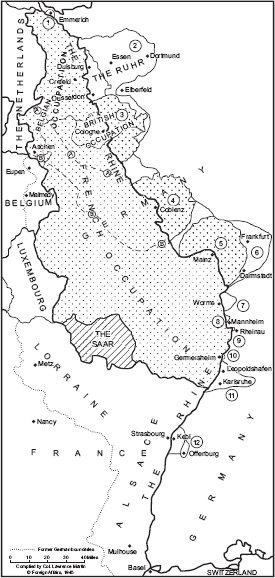
Map 3.2 Occupied zones of Rhineland, 1920–1935*. Reprinted by permission of FOREIGN AFFAIRS, (Vol. 4, No. 1, October 1925). Copyright 2014 by the Council on Foreign Relations, Inc. www.ForeignAffairs.com
*Nr 1: Emmerich temporarily occupied by Belgian troops; Nr 2: Ruhr occupied by French and Belgian troops, March 1921 and January 1923 (eventually cleared August 1925); Nr 3: Cologne bridgehead occupied by British and French troops; Nr 4: Koblenz bridgehead occupied by American, then French troops; Nr 5: Mainz bridgehead occupied by French; Nr 6: Frankfurt, April 1920 briefly occupied by French; Nr: 7–11 periodically occupied by French; Nr 12: Offenburg temporarily occupied by French; Kehl occupied by French under terms of the Versailles Treaty. Source: Wilhelm Kreutz/Karl Scherer (eds), Die Pfalz unter französischer Besetzung (Kaiserslautern 1999), p. 12 accessed at http://www.historisches-lexikon-bayerns.de/image/artikel/artikel_44493_bilder_value_3_franzbesetzung8.jpg
A theatre-cum-stadium ringed by oaks was created in the former barracks of the French occupation authorities (thus also laden with symbolism) with a capacity for 10,500. For Redslob, the layout, with the trees in the background, had the effect that the boundary between barracks and hinterland was dissolved ‘so that the hard line of demarcation that otherwise often dominates in an arena, completely disappears’. At the beginning of the event, Hindenburg arrived in an open top limousine and drove in an arch around the arena to the cheering crowd. The spectacle commenced with the lone voice of a Herald representing German Unity calling upon the great rivers of the nation to enter the arena. In groups of 500, children dressed in gold and blue entered from three separate entrances, each column representing Germany’s principal rivers: the Elbe/Weser, Weichsel/Oder and Danube. One river was missing: the Rhine. The ‘rivers’ inside the arena repeatedly called out to the missing river – only to hear the sound of rattling chains in response. The Herald after surveying the arena and the German rivers then called to Germany’s missing river whereupon the Rhine entered and stopped at the fourth entrance, the heads of the 500 children bowed ‘waiting for the signal of liberation’.146 The Herald called again and proclaimed the river’s liberation at which point the arena was suddenly flooded with groups of farmers, vintners, artisans, miners, sailors and fishermen, each group wearing traditional costumes and reciting choruses rhythmically denoting their occupations and finally drawing together in a circle chanting:
We are the people and we
Were encumbered
We want to smash
The chains of bondage!147
The massed choirs facing the chained Rhine suddenly surged forward breaking its chains with the cry: ‘Freedom!’ ‘Rhine!’ Its ‘waters’ now flooded the arena. At this point of the spectacle, the Reich flag which had been hung at half mast was fully hoisted. The effect was startling. The arena, overfilled by about 5,000 persons,148 sprang to its feet in jubilation and spontaneously broke into the Deutschlandlied, which had been banned in the zone of occupation for the past decade. For Redslob
Listeners and performers have become one, and it is as if the ring widens, as if the whole Rhineland, as if all of Germany took part in this organized celebration of the liberation of the Rhineland.149
Beethoven’s Ninth Symphony and the singing of Schiller’s ‘Freude schöner Götterfunken’ and the Deutschlandlied brought the event to a rousing and emotional close. At this point also the massed choirs turned and faced the audience moving towards it with outstretched arms
Thus once again, but now from the inside to the outside, participants and guests of the celebration form a single internally connected community.150
Redslob had successfully adapted the theatrical modernity developed by Erwin Piscator in his ‘total theatre’ to transform not just this event, but the German nation itself into a ‘total work of art’.151
The celebration also typified the ambiguity that had crept into ‘civic pedagogy’ by the beginning of the 1930s (a topic we will discuss in greater detail in Chapter 6). Deutschlands Strom both coincided with and fuelled a resurgence of anti-French sentiment and a flood of war novels glorifying war and the trench experience.152 This begs the question: What exactly was being celebrated in Wiesbaden and again in Berlin? In the libretto, Redslob made clear that the chains of oppression were broken by the Rhinelanders’ ‘will for conciliation’.153 But the message of conciliation was overwhelmed by the surge of emotional nationalism released by Deutschlands Strom. Curtius ratcheted up nationalist fervour when, in his welcome speech at the celebration in Speyer, he told his audience, ‘We are not at the end of this path. We can see this by just a glance at the Palatinate and the whole Saar’.154
The international and domestic contexts of the 1930 celebration of troop withdrawal from German soil lent nationalist overtones to both the spectacle and its reception. For the first time, the right-wing press joined liberal and social democratic editors in applauding Redslob’s effort.155 In 1930, anti-French sentiment was taking an uncomfortable course, causing concern in government circles and consternation in Paris. For this reason, Redslob was asked to exclude Mendelssohn’s Rheinweinlied, with its overt anti-French text, when staging Deutschlands Strom in Berlin.156 In cultural terms, Redslob had inadvertently contributed to the psychological revision of the Versailles Treaty: the emotional power behind the words ‘Freedom!’ and ‘Rhineland!’ sang by the choir in Wiesbaden and in Berlin could equally apply to all ‘lost’ areas resulting from the Versailles Treaty, notably the Saarland but also to that part of Silesia now in Poland. Hindenburg had dragged his feet over the issue of ratifying the borders with Poland (Part X of the Versailles Treaty and now contained in the Young Plan). His and the government’s joint declaration to the nation in June 1930 that the ‘Vow (Gelöbnis) in this solemn hour is unity! . . .‘Germany, Germany above all else!’ could be easily interpreted to mean the German lands before Versailles.157 Thus, the event also harboured the potentials for a more dangerous journey. A counsellor in the Ministry for the Occupied Areas wrote to Redslob extolling his idea of German national identity wrapped up in the currents of its rivers, he and his guests had found the Festspiel strongly emotional – adding ‘the Rhine runs through Europe!’158
Timing is everything. And in the case of the withdrawal of French and Belgian troops, it might be said the timing was unfortunate. What should have been the high point of achievement for Weimar foreign policy became instead a rallying point for those voices long hostile to the republic and its alleged ‘softness’ vis-à-vis the French in particular. Even Hindenburg exploited the evacuation and its attendant celebrations to the advantage of the nationalist right when he used the occasion to blackmail the Prussian government into lifting the ban against the Stahlhelm in the Rhineland by making this a precondition for his appearance with representatives of the Prussian government at the state celebrations held in Mainz.159 The period book-ended by the two Hague Conferences saw a revival of nationalist propaganda directed against what were portrayed as the injustices against Germany since the Versailles Treaty and behind which stood the hand of France; this material ranged from serious academic and high-level political publications to popular pamphlets.160
Unable to gain approval for his first deflationary budget, Brüning requested the dissolution of the Reichstag on 16 July and set an election for 6 September. In spite of the fact that the German Nationalists had kept up a constant and vocal opposition to Stresemann’s policy of reconciliation throughout the mid-1920s, the DNVP as a party hitherto had failed to capitalize this platform, largely because of the ambivalence within its leadership to European reconciliation.161 The wave of popular nationalism that swept across Germany in the summer of 1930 not only fed into the election, but mainly flowed in the direction of the NSDAP. Historians usually concentrate on the fact that Hitler and his acolytes were able to piggyback on the German Nationalist campaign against the Young Plan (in the form of the campaign for a plebiscite162) and the nationalist fronde that culminated in the Harzburg Rally in October 1931. As a minority in the Reichstag, its record of opposition on foreign policy matters was pretty much negligible in spite of its stridency. Its stunning performance in the September election is no doubt a consequence of its ability to exploit the unfolding economic crisis (as we will see in the following chapter). But little consideration is given to foreign policy and the possible impact of the withdrawal of French troops from the Rhineland on popular nationalism.
The election saw a sharp increase in voter participation across the Reich from 72.3 per cent in 1928 to 81.5 per cent, suggesting a strong regional mobilization which need not have been the fruit of Nazi efforts. In particular, voters in the Rhineland and the Palatinate turned out in vast numbers, and while support for Hitler’s party remained below the national average in the Rhineland, in the Palatinate the Nazis’ performance stood 4 per cent above its national gains (Tables 3.2 and 3.3), and tipping over 30 per cent in Bergzabern, Zweibrücken and Pirmasens.163
Strictly speaking, the beneficiary of the wave of popular nationalism that gripped the country that summer and autumn should have been the middling parties associated with the successful withdrawal (both Stresemann and Curtius were from the DVP). But these parties were beset with internal squabbles and divisions; the DNVP, which was never strong in either the Rhineland or the Palatinate suffered from a credibility deficit among the electorate not least because of its internal divisions on policy. In spite of the DNVP’s return to nationalist rhetoric in 1928 after Hermann Müller took over the reins of power at the head of a coalition of ‘Weimar parties’, and the party’s radicalization under the leadership of the right-wing media magnate Alfred Hugenberg, it still found itself vulnerable to Nazi encroachments onto its territory. The NSDAP had been assiduous in putting a distance between itself and the German Nationalists, thus staking out their own ground ever since Dawes.164 This now paid dividends. Hitler himself was in little doubt as to where support for the NSDAP was coming from in those halcyon months of 1930. After the Saxony Diet elections, he wrote in the Völkischer Beobachter that the Party was attracting ‘not disappointed democrats but embittered bourgeois nationalists who no longer have any trust in the parties that eternally do deals with the Marxists’.165
Table 3.2 Reichstag/Landtag elections in the Rhineland, 1928–1933 (main parties)
| Year | DNVP | DVP | Zentr. | DDP | SPD | KPD | NSDAP | Others* |
| 1928 | 9.5 | 8.2 | 34.9 | 2.9 | 17.5 | 14.2 | 1.5 | 12.1 |
| 1930 | 4.5 | 4.6 | 30.1 | 2.2 | 12.8 | 17.4 | 15.8 | 11.5 |
| 1932a | 4.2 | 1.9 | 34.6 | 0.8 | 10.1 | 15.4 | 28.3 | 4.5 |
| 1932b | 4.8 | 1.4 | 33.7 | 0.3 | 12.0 | 19.2 | 26.7 | 2.2 |
| 1932c | 6.3 | 2.0 | 33.2 | 0.2 | 11.6 | 21.3 | 23.2 | 2.0 |
| 1933 | 6.6 | 1.6 | 30.6 | 0.3 | 10.0 | 15.7 | 34.7 | 0.8 |
*Includes Wirtschaftspartei.
aPrussian Landtag in April.
bReichstag in July.
cReichstag in November. Figures rounded to nearest decimal point.
Source: http://www.gonschior.de/weimar/Preussen/Rheinprovinz/Uebersicht_RTW.html
Table 3.3 Reichstag elections in the Palatinate, 1928–1932 (main parties)
| Year | DNVP1 | DVP | Zentr. | DDP2 | SPD | KPD | NSDAP | Others |
| 1928 | 9.5 | 8.2 | 34.9 | 2.9 | 17.5 | 14.2 | 1.5 | 12.1 |
| 1930 | 0.8 | 6.6 | 24.9 | 2.3 | 22.4 | 10.5 | 22.8 | 9.7 |
| 1932a | 1.1 | 1.4 | 23.8 | 0.5 | 17.6 | 10.7 | 43.7 | 1.2 |
| 1932b | 1.8 | 2.1 | 22.5 | 0.6 | 16.1 | 12.9 | 42.6 | 1.4 |
| 1933 | 2.5 | 1.2 | 22.7 | 0.6 | 16.8 | 9.0 | 46.5 | 0.7 |
1=Konservative Schwarz-Weiß-Rot.
2=from 1930 Deutsche Staatspartei.
aJuly.
bNovember.
Source: J. Falter, Th. Lindenberger und S. Schumann, Wahlen und Abstimmungen in der Weimarer Republik (Munich, 1986), pp. 71–5.
In addition to representing a high point of Weimar foreign policy, when the republic’s authority should have consolidated the achievement at Locarno, the ending of the Rhineland occupation was also a turning point in which the republic’s authority based on a policy of ‘quiet revision’ gave way to a strident assertion of national interests.
Revitalizing authority: Risk and geopolitics in Mitteleuropa 1930–1936
The revitalization of Germany’s foreign policy had begun with Locarno after which it took on a more assertive tone. The German historian Karl Heinrich Pohl has argued that from this date policy became focused more on Eastern Europe, and this was underwritten by heavy industry interests. For Pohl, this revitalization represented a restorative moment in German foreign policy that anticipates the aggressive policy under Hitler.166
There is much to agree with in Pohl’s analysis and it helps us to better contextualize foreign policy in the three years prior to Stresemann’s death: neither Locarno nor the triumph of the Rhineland constituted a turning point in Germany’s foreign policy so much as a stepping stone on the longer path of re-establishing Germany’s former continental position.167 Before the outbreak of war, Germany had been the second leading international trading nation with 13 per cent of world trade. During the 1920s, its share of world trade had halved to 7 per cent and it had fallen behind France to occupy fourth place. Nevertheless, as a European industrial power it remained the largest on the continent, in spite of the restrictions imposed at Versailles. It was powerful enough to attempt (however briefly) to leverage France in 1926 when that country was undergoing severe economic and currency difficulties. Important too was the recognition of its vital position in Central and Eastern Europe. The agreement with Russia at Rapallo in 1922 was not simply an agreement between two outsiders of the international community, but represented a current of thought within the German Foreign Office based on a long-standing Ostpolitik which emphasized the value of trade, as well as being a deft manoeuvre for regaining German influence vis-à-vis the West by drawing Russia back into European politics.168 For Chancellor Wirth, whose policy of fulfilment seemed to bring few if any tangible political dividends, the agreement struck at Rapallo was also a means of renewing political authority albeit a risky one at both home and abroad.169
Meanwhile, Stresemann’s later resistance to finding an accommodation with Poland through an Ostlocarno was motivated by other considerations. To have agreed the borders would have stymied the ambition of putting back together the national body as it had existed before Versailles; and this particular aspect of foreign policy remained a key consideration in subsequent years.170 Thus, Stresemann was not slack when it came to defending traditional German nationalist interests. His supporters, such as his close associate Werner von Rheinbaben, defended his policy of ‘reconciliation’ as being nonetheless ‘energetic and national’.171 On a populist level, anti-Polish sentiments were never too far behind those levelled by German nationalists against France. Indeed, while Locarno marked a high point in relations with Paris, mutual recrimination and hostility underwrote relations with Warsaw throughout these years.172
If, as we have suggested, Locarno represented a ‘stepping stone’ rather than a turning point in Germany’s continental ambitions, we can better understand foreign policy in the decade from the mid-twenties by placing it into a longer time frame. This means that Stresemann’s premature death in October 1929 was less a factor in redefining the direction of foreign policy than it was in accelerating the tempo. The collapse of world trade inaugurated by Black Friday on the American Stock Exchange in the same month as Stresemann’s death created an early opportunity for Berlin to test its revitalized continental aspirations. Against this background of international economic crisis and the accompanying fallout in international relations, German foreign policy became more strident in its revisionist aims. The depression removed Washington from the European arena, diverted Britain’s attention towards its empire and weakened France, its continental political isolation sealed with the election of Leon Blum’s socialist-dominated Popular Front government in 1936 while the rest of Europe (and Britain) veered to the right.173 Diplomats in the foreign office, notably permanent state secretary Bernhard von Bülow, saw the opportunity to revive traditional ideas of a German continental strategy that dovetailed with popular sentiments on Germany’s ‘unfettered’ place, if not in the sun, then at least in Europe.174 Meanwhile, in order to shore up political authority at home at a time when domestic policies were provoking public revolt, Stresemann’s ill-suited successor Curtius focused foreign policy on ‘freedom and equality of rights’ even if that meant squandering the goodwill relationship to France.175 Speaking to the Reichstag, Curtius remarked that ‘the aims of German [foreign] policy were determined by the total situation of Germany and international conditions’. As the latter conditions deteriorated, policy (and politics) driven by a ‘patriotic wave’ at home became increasingly disposed to risk as it eventually turned to the geopolitical idea of a German Mitteleuropa which not only looked to the east but to the successor states of the Danubian basin and further beyond.176 The increasingly aggressive nature of Germany’s foreign policy revitalized the idea of Mitteleuropa authoritarian politics at home in order to succeed abroad.
*
The liberal aspiration for a German-led Mitteleuropa or ‘middle Europe’ was based on geopolitical ideas dating back to the earlier part of the previous century; it had been a key motive in the discussions for a greater-German solution to the fragmented German states in the Frankfurt Parliament during the1848 revolutions.177 Bismarck had favoured the lesser-German (kleindeutsch) solution to German unification since it gave greater authority to a Prussian-led Germany.178 Nonetheless, ideas on a German-led Mitteleuropa fed into trade policies in the final decade of the nineteenth century after Bismarck’s departure from office. His successor Leo von Caprivi favoured the idea of a free trade bloc within a mitteleuropäisch customs union that found support among Germany’s exporters. This vision was given some substance a little later with the founding of the Mitteleuropäischen Wirtschaftsverein in 1904 by the economist Julius Wolff, but in spite of extensive trade links, the dream of integration remained elusive.179 The war in 1914 revived the idea for integrating more closely trade between Berlin and its allies; a policy that was underpinned by the publication in 1915 of Friedrich Naumann’s influential book Mitteleuropa with its vision of German cultural and economic dominance.180
Naumann, who together with Hugo Preuß, Max Weber and the editor of the Berliner Tageblatt, Theodor Wolff, would found the left-liberal German Democratic Party (DDP),181 argued that Germany’s geopolitical position combined with its industrial might predisposed it for an organic union with the surrounding states, notably Austria and Hungary. The linguistic and cultural glue of this vast region was provided by Germany and the Habsburg Empire; thus, Mitteleuropa was underwritten by a cultural and linguistic heritage that placed the German ‘tribe’ (Stamm) at its centre.182 The timing of the book’s publication was not an accident. Before the war, national authority and power were measured by trade and the latter was linked to the growth of markets and their security, giving rise to the imperial rivalry that immediately preceded the war. A Mitteleuropa would balance the ‘political and economic giants’ to the east (Russia) and to the west (Britain) and ensure independence in a world constituted by empires.183
Thus, the war fought on two fronts was seen in many quarters as a defence against hostile imperial forces keen to cut off the oxygen of German trade and with this, German aspirations as a world power.184 This problem had become accentuated by the naval blockade necessitating the need to secure vital resources for the war economy in order to make Germany self-sufficient. This was Stresemann’s argument in April 1916 in an analysis of the economic origins of the war and the necessity for Germany to secure its Mitteleuropa trade bloc by militarily strengthening itself in the west and east.185 As we noted above, before the war Germany had expanded its trade to become the second greatest trading nation in the world. In his exposition to the Reichstag, Stresemann produced trade figures to show that Germany’s exports were on a par with that of Great Britain, a third of whose trade was with its empire. He was of course legitimizing the German case for colonies; but importantly, the bulk of its own trade (valued at 9 billion marks) was with its continental partners.186 Naumann’s own contribution to the debates emphasized union with Austro-Hungary as a geopolitical necessity.187 Germany’s early military successes in the east after the defeat of the Russian army at Tannenberg held out the prospect for continental hegemony, in spite of the emerging military stalemate on the western front. For these deputies, such a dominance of the continent by Germany would guarantee future stability and peace.188
The Reichstag debates featuring discussion of the German idea of Mitteleuropa revealed not only the claim to German economic dominance. Independent Socialist deputy Georg Ledebour outlined how a German-led Mitteleuropa could be transformed from a project of German imperialism into a vehicle for European peace.189 The veteran Social Democrat thinker Karl Kautsky, responding directly to Naumann’s Mitteleuropa (which had been well received in Social Democrat circles) and the annexationists’ vision of a German-led continent, was more sceptical. Like Ledebour, Kautsky believed in a union of nations based on parity and not power, seeing behind Naumann’s vision of a trading bloc at the heart of the continent the hand of German imperialism, leading him to remark: ‘Then, to reverse the well known saying from Clausewitz, Central Europe would have the task to continue the policy of war with other means in peace’.190
Already in these discussions we can see the polyvalent character of foreign policy under the republic: on the one hand, the European project based on conciliation and embodied by the ‘shuttle-diplomacy’ of Stresemann-Briand, and on the other hand, simultaneously, the restoration of continental economic hegemony that after 1933 looked more and more like Naumann’s Mitteleuropa. The terms of the Versailles Treaty curbed both its continental and its world trading position as overseas and European markets were lost, pushing Germany back into fourth place behind France. Foreign policy after 1924 steadily was geared to re-establishing its lost continental position. Thus, the attempt to fuse rump Austria and Germany in 1918/19 (desired equally by the Austrians but denied by the Treaty of St Germain), later the (thwarted) Customs Union 1930, and finally success with the Anschluss 1938, reflect the German idea of Mitteleuropa and the economic importance of Austria as a springboard to Central and Southeastern Europe.191
The importance of this region for raw materials and as a market had originated in the 1890s.192 Traditionally, Germany had traded with smaller European and Scandinavian economies such as the Netherlands and Denmark for dairy and meat products, or Sweden for wood, but also had strong trade links to England; this changed during the depression as these markets closed down. From 1932/33 using preferential bilateral tariff agreements, Berlin embarked on a vigorous trade drive into Central and Southeastern Europe that was to last the decade, buying primary products in exchange for German-made finished goods. Through a system of barter, cash-strapped Balkan economies built up large favourable balances that drew them closer to the German orbit. An early analysis written in January 1935 by the SPD leadership in exile in Prague saw in this development not so much a process based on an ‘organic organization of the European economy’ but ‘feudal-imperialist plans’ in which the ‘greater economic sphere . . . was the path to achieving power over [Central] and Southeastern Europe’.193 The report made a differentiation between traditional aims and those of the Nazis. But in reality this separation was cosmetic. Important firms such as Otto Wolff A. G., Rheinmetall, I. G. Farben, Norddeutsche Aluminium A. G., Krupp and Siemens had been expanding their activities in the Balkans since the later 1920s, often through investing technical goods and services and through intensifying the exploration for and exploitation of minerals.194 Meanwhile, the Commerzbank and Deutsche Bank took a keen interest in the investment opportunities in the region (and by proxy through the Creditanstalt in Vienna).195 Each of these corporations, like much of ‘big industry’, was a beneficiary of the change of government in 1933.196
Utilizing foreign economic policy to assert continental aspirations was not confined to the Third Reich, as evident in trade relations with Yugoslavia and with Bulgaria under the Weimar Republic.197 The intensification of trade with the six countries comprising Southeastern Europe (Bulgaria, Greece, Hungary, Romania, Turkey and Yugoslavia) from the early 1930s, as well as attention eastwards, was a central plank of policy aimed at ensuring Germany’s continental position. Rather than seeing this orientation as a break in foreign policy, it represented more a shift into a higher gear as opportunities were availed of. Nevertheless, as both Hans Paul Höpfner and Hans-Jürgen Schröder have argued, there was a difference between expansion of trade and investment under the revisionist policy of the later Weimar period and the aggressive policy after 1933. Over the following years up to 1936/37, foreign policy became increasingly focused on manoeuvring Germany into a key position of influence in Central and Southeastern Europe.
From the beginning of the 1930s, the foreign ministry took a path of action to prevent a Balkan federation (Donauföderation) – seen as a threat to Germany’s economic and political interests and favoured by Italy, France and Britain, from emerging. In a memorandum dated 2 March 1932 to the ambassador in Vienna and a second one at the end of the month circulated to his colleagues in the region, von Bülow stated categorically that there should be no ambiguity in conveying to the respective governments the negative repercussions to their economies of such an initiative were it to materialize.198 As part of this strategy, cementing closer ties with Austria, and also with Hungary, became paramount.199 From 1933, it extended to the region in general, and by the middle of the decade, the political dimensions of close economic ties to Berlin were barely disguised.200 Reporting to Berlin in 1935, the German envoy in Athens noted:
In discussing the economic exchanges, I endeavoured to make clear to the King that Greece could not live without her German customers and that in particular, a reduction or cessation of our purchases of tobacco must lead to the impoverishment of the Macedonian peasants and thus to grave disturbances in Greek domestic politics. Careful fostering of these relations [between Germany and Greece] was therefore as much an economic as a political imperative. . . . I said I assumed that the King must be much concerned that the projected re-equipping of his armed forces should transform them into an effective instrument of defence which would give Greece greater political weight, especially with her allies, and that he should be concerned to bind the armed forces to his person and thus provide himself with a reliable bulwark for his throne in the ever-changing currents of internal politics.201
Berlin’s manipulation of those countries drawn into its economic orbit was motivated by its quest to attain autarky in what it saw as a hostile world.202 Whereas the conciliatory policies of the mid-1920s had seen an amelioration of the friend-foe paradigm, from the early 1930s this thinking had returned in full force bringing policy deliberations full circle to the lesson learnt from World War I. As a foreign office circular from 1936 put it:
In future, German commercial policy will no longer be able as in the past, to leave it to the hazard of technical production or market influences to decide from which countries Germany should obtain her indispensable raw materials and foodstuffs. [She] will be intent on seeing that these articles are obtained as far as possible from such countries as will be prepared and able to continue to supply Germany even in times of economic, financial or political crisis. The safeguarding of economic and political independence therefore makes it in the long run necessary to plan systematically our imports of raw materials and foodstuffs.203
This circular typically reflects two decades of continuity in German foreign policy thinking. When Curtius made his reference to the Saarland in his Speyer speech in 1930, the vocabulary of ‘encirclement’, almost certainly not heard within government circles since the war, was re-entering the political lexicon. The revision of the Versailles Treaty from 1924 until 1929 had been largely risk free and largely in concert with the Entente Powers. After Stresemann’s death, caution was thrown to the wind as foreign policy returned to the gambling table as the German players placed bets on ever higher stakes in their quest to break the ‘shackles of Versailles’.
A gambler’s mentality appeared to seize hold of German foreign policy: it was reflected in Curtius’s abortive attempt to form a customs union with Austria and in Brüning’s announcement in 1932 that Germany could (or would) no longer pay ‘political’ reparations; it is alluded to in the private correspondence of Ernst von Weizsäcker, an undersecretary of state in the foreign office; we can see the poker-player in the cool hand of the permanent secretary of state, Bernhard von Bülow, whose reports both analysed and shaped foreign policy; like his boss Konstantin von Neurath, Bülow used bluff as a tactic when projecting German interests. The analogy to a game of poker is apposite. We saw above how Brockdorff-Rantzau played for high stakes at Versailles as if at the poker table. The discussions during the first months of Hitler’s cabinet (before its quasi reshuffling in November) set the tone for later policy. The difference between the situation in 1933 and the earlier period was the changing international climate that appeared to open up the opportunity for Germany to play a more aggressive hand in the game of diplomatic bluff. The key foreign policy issue that appeared to dominate the agenda was that of Germany’s right to equality of military security rather than the consensus of collective security encapsulated in the League of Nations and under review at the ongoing Disarmament Conference. This policy linked directly to the quest for securing vital raw materials for industry and cheap foodstuffs for the German population – the two elements that were believed to have undermined Germany’s war effort from 1916.
In a wide-ranging report to the cabinet meeting on 7 April 1933, von Neurath reiterated that Germany’s foreign policy would still be determined by the need to revise the conditions of the Versailles Treaty (within the parameters of Article 19).204 Departing by degree only from the approach of his predecessors, von Neurath claimed that the Treaty had weakened Germany much more than hitherto acknowledged, notably with regard to military parity especially vis-à-vis Poland. France was still a hostile nation; and the English could not be trusted, but following the logic of Realpolitik might be won over to support Germany in the interests of a continental balance of power. After laying out the various positions, von Neurath was confident that Germany’s geopolitical position would enable it to prepare for the eventuality of a defensive war which might arise from a shift from a ‘drip-by-drip’ policy to a bolder revision of the territorial conditions of the Versailles Treaty. To this end, Hitler was prepared to abandon the Disarmament Conference and to leave the League, and later, send German troops in March 1936 into the demilitarized zone of the Rhineland, flagrantly breaching Articles 42 and 43 of the Versailles Treaty, each time risking sanctions and even possible military intervention.205 Alan Bullock portrays Hitler’s behaviour as akin to a ‘gambler’ at the diplomatic card table; each win made him raise the stakes.206
We do not need to recount in detail the trajectory of the Third Reich’s foreign policy as sketched by von Neurath in April, only to note that his prognosis of the world situation in 1933 and the solution to it (as far as Germany was concerned) represented an intensification of rather than a break from earlier foreign policy goals that nonetheless accepted the eventuality of conflict.207 Von Neurath did not think that Germany should leave the League; nor did he think that Berlin should throw down the gauntlet to Paris; but as far as Germany’s Eastern borders were concerned, Neurath envisaged a ‘total’ rather than ‘temporary and compromise solutions’ (‘Zwischen- und Teillösungen’).208 Guiding von Neurath’s approach to Germany’s geopolitical position was the spectre of encirclement, an old theme that had underwritten policy decisions in the imperial period and which had been at the core of wartime debates in the Reichstag on military and economic security. This idea of encirclement, never far from policy formulation, had edged its way back to the centre of foreign policy by the beginning of the 1930s and had a direct impact on the nature of authority at home.
Conclusion
In 1933, traditionalists and Nazi leaders were agreed that the long-term goals of territorial revision with its attendant military risk could only be achieved provided Germany had the economic wherewithal to withstand the demands of war and, importantly, the nation was prepared for this and accordingly strengthened internally.209 In other words, national sovereignty expressed through an assertive policy of expansion through the revision of the post-war settlement required an authoritarian approach at home in order to ensure unity of national purpose. After Hitler delivered his so-called peace speech on 17 May in which he portrayed Germany being forced to take a stand over security because of allied intransigence at the Disarmament Conference in Geneva, the Reichstag resoundingly approved a motion brought by the NSDAP, Centre Party and BVP expressing its confidence in government policy.210 Seven months later, the Reichstag election and the plebiscite on the government’s foreign policy purported to display an overwhelming acclamation for Hitler. In a fawning vote of congratulations on behalf of the government, the Vice Chancellor von Papen eulogized Hitler for achieving the ‘total state’ and for bringing unity to the nation and a determination to German politics that had an impact far beyond its borders, ‘also because the necessity of a peaceful re-ordering of Europe according to the law of right and fairness (Gesetz von Recht und Gerechtigkeit) has henceforth entered a new and decisive phase’.211
The meaning of this goal of ‘re-ordering Europe’ depended in which cabinet one sat: in the early years, it meant the need to vitiate the worse aspects of punishment and exclusion under the Versailles Treaty; between 1924 and 1929, it was a matter of re-inserting Germany into the larger diplomatic picture; from 1930 onwards, ‘re-ordering Europe’ meant precisely that and it was to be achieved by the rejection of the remaining constraints of the Versailles Treaty. What remained of the Treaty in 1933 can be seen as increasingly ‘soft’ policy targets easily removed in a game of diplomatic bluff; here, Hitler gained where his predecessors had failed both bolstering his reputation as leader and statesman and stabilizing his regime.212 For the diplomats in the German foreign office, the goal was more long term: namely to complete the business of establishing a continental Mitteleuropa bloc based on Germany’s ‘natural’ geopolitical leadership that had been interrupted by defeat. Traditional and Nazi motives for pursuing this aim intersected from 1933 and required a different type of authority to that offered by Weimar’s parliamentary system, as we shall see in the final chapters of this study.
