
Mt Mabu Bush Viper,
Atheris mabuensis,
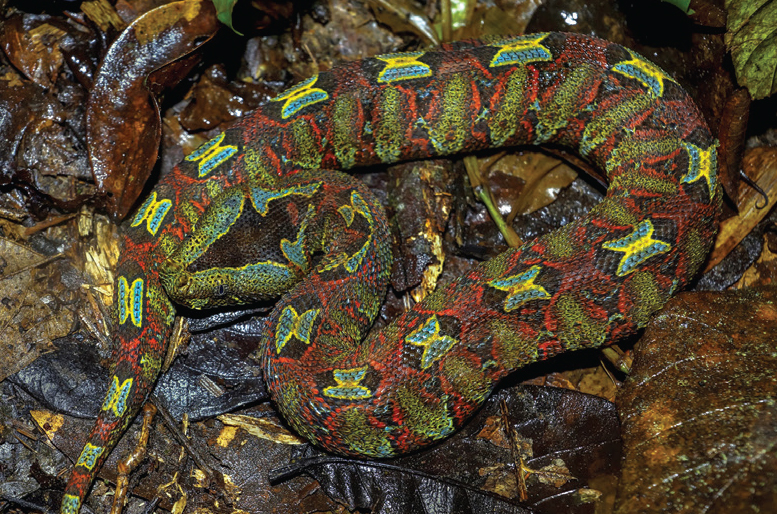
Mozambique (Bill Branch).
In this and the next section on dangerous rear-fanged and fangless snakes, we describe the 130-plus species of dangerous snakes known from Africa. Each subsection starts with a brief overview of the family, a key where relevant, the subfamily (where relevant) and a generic introduction, including a synopsis of the venom and its effects. Each species is described under the following headings: Identification, Habitat and Distribution, Natural History and Medical Significance, and Taxonomic Notes where relevant. All species are accompanied by a map and photographs, where available.
Recent taxonomic work, using both fossil evidence and DNA, has created some stimulating debate over the order of appearance of the various groups of reptiles, snakes included. However, in this book we have not followed the taxonomic order of appearance of the various groups, but have started with the most medically significant. Thus our running order is: vipers, elapids, burrowing asps, and finally dangerous rear-fanged and fangless snakes. The following section, the ‘look-alikes’, is similarly not in taxonomic order.
The two keys here should enable the technical identification of any African snake to (a) its superfamily and (b) the smaller taxonomic groups. These are then further broken down at the beginning of the relevant sections. These keys are slightly convoluted, but should enable both the separation of dangerous and harmless snake taxa, and the individual identification of the dangerous species. As we have repeated in later pages, the keys are technical; the snake will need to be dead (do not start trying to key out a living snake), and you will probably need a binocular microscope and some familiarity with snake scalation (see Figures 16–22, here).
Key to the African snake superfamilies
1aBody worm-like; head round and blunt; tail blunt; eyes visible only as minute dark dots under the head skin; body scales all the same size……Typhlopoidea, blind and worm snakes; all harmless; see pictures in the section on look-alikes
1bBody not worm-like; head not round; tail not blunt; eyes well developed; enlarged belly scales present……2
2aVentral plates as broad or almost as broad as the body; no vestigial limbs; midbody scale rows fewer than 50 ……Colubroidea, typical snakes (here)
2bVentral plates broader than the body scales but much narrower than the body; vestiges of hind limbs present as short claws on either side of the vent; midbody scale rows more than 70……3
3aSmall, adults less than 1.2m; subcaudal scales single; no obvious neck……Booidea, boas; all harmless (here)
3bLarge, adults over 1.2m; subcaudal scales paired; obvious neck……Pythonoidea, pythons; non-venomous, but some may be dangerous due to their size (here)
Key to the African families, relevant subfamilies and relevant genera of the Colubroidea
1aOne or more pairs of enlarged caniculate or tubular poison fangs present in the front of the upper jaw……2
1bNo enlarged caniculate or tubular poison fangs present in the front of the upper jaw; fangs when present usually grooved and set below the eye……5
2aPoison fangs relatively small and immobile, not folded back when not in use……3
2bPoison fangs large, moveable, folded back in a sheath when not in use……4
3aConfined to South Africa; black with a red or yellow vertebral stripe; adults always less than 65cm……Subfamily Atractaspidinae, genus Homoroselaps, harlequin snakes; slightly dangerous (here)
3bNot confined to South Africa; not black with a red or yellow vertebral stripe; adults often larger than 65cm……Family Elapidae, cobras, mambas and allies; all dangerous (here)
4aEye very small; pupil round; body usually uniformly dark (a few with white head or tail-tip markings); no loreal scale……Sub-family Atractaspidinae, genus Atractaspis, burrowing asps; all dangerous (here)
4bEye relatively large; pupil usually vertically elliptic (but round in Causus, night adders); loreal scale present……Family Viperidae, vipers; all dangerous (here)
5aNo loreal scale present; grooved rear fangs nearly always present……Subfamily Aparallactinae, African burrowing snakes (here); largely not dangerous (except Kwazulu-Natal Black Snake, Macrelaps microlepidotus, which is possibly dangerous; see account, here)
5bLoreal scale present; grooved rear fangs present or absent……Families Colubridae/Lamprophiidae/Natricidae, colubrids/Afri-can snakes/house snakes/water snakes (excluding the Aparallactinae and Atractaspidinae); a few dangerous species here, here and here)
A family of dangerous snakes with long, perfectly tubular, folding venom fangs, and of international medical significance. The vipers or adders (the names are interchangeable, although it is suggested that the name adder be restricted to those that give birth to live young) are split into three subfamilies: the Viperinae (Old World vipers), Crotalinae (pit vipers of America and Asia) and Azemiopinae (two species in one genus, curious slim Asian vipers).
Subfamily Viperinae Old World vipers
A subfamily of 13 genera and just over 100 species, found in Asia, Europe and Africa; five genera are confined to Africa and six are in both Africa and Asia. At present, some 56 species occur in Africa. The various genera, and most of the species, can be readily identified in the field using a combination of appearance, size, locality and behaviour, but we have provided technical keys below. Viper venoms tend to cause shock and have local cytotoxic or systemic haemorrhagic effects, although the venoms of some of the small southern African Bitis (and in particular the Berg Adder, Bitis atropos) are neurotoxic.
Key to the African viper genera
Note one exception to this key: a single African population of Puff Adders (Bitis arietans) is known from north of the Sahara, in Morocco and Western Sahara.
1aPupil round; nine large scales on top of the head……Causus, night adders
1bPupil vertical; many small scales on top of the head……2
2aSubcaudal scales single……3
2bSubcaudal scales paired……4
3aHead pear-shaped; usually on the ground in dry country and semi-desert of the northern half of Africa; usually shades of brown or grey……Echis, carpet or saw-scaled vipers
3bHead not pear-shaped; usually in trees and bushes, in forest and woodland of tropical Africa; usually some combination of green, yellow and black……Atheris, bush vipers
4aOn the high-altitude moorlands of central Kenya (Aberdares/Mount Kenya); slim; brown or grey with black markings……Montatheris hindii, Kenya Montane Viper
4bNot on the high-altitude moorlands of central Kenya; not slim; not brown or grey with black markings……5
5aA large single supraocular shield present; south-eastern Africa only……Proatheris superciliaris, Floodplain Viper
5bNo large single supraocular shield; not only in south-eastern Africa……6
6aIn sub-Saharan Africa, and all small species in Kenya or further south……Bitis, African vipers
6bIn the Sahel or North Africa, and all small species north of 10°N……7
7aUpper dorsals with knobbed (lumpy) keels; usually in or near the Sahara……Cerastes, North African desert vipers
7bUpper dorsals with narrow keels; usually north of the Sahara……8
8aIn the Sinai; has horns……Pseudocerastes fieldi, Western False Horned Viper
8bNot in the Sinai; without horns……9
9aSnout tip turned upwards; adults less than 60cm……Vipera latastei, Lataste’s Viper
9bSnout tip blunt; adults larger than 60cm……10
10aMidbody scale count 26–27……Daboia mauritanica, Moorish Viper
10bMidbody scale count 25 ……Macrovipera lebetina transmediterranea, North African Blunt-nosed Viper
A tropical African genus of attractive, largely green, broad-headed vipers. Most are arboreal and inhabit forest and dense woodland. They are small, never longer than 80cm. They are usually regarded as medically insignificant and appear to cause very few documented snakebites in Africa. This is for a number of reasons: they are secretive and live largely in trees, often in inhospitable areas (although they may be relatively common), and they are rarely on the ground near habitation at night or moving through farmland (although, being in a tree, if confronted they are more likely to deliver a bite to the upper body, a risk noted with arboreal pit vipers in South America).
No antivenom is produced against their bite, although African carpet viper (Echis) antivenoms seem to provide paraspecific neutralisation of their venoms. However, two species have large ranges, namely the Green Bush Viper (Atheris squamigera) and Western Bush Viper (Atheris chlorechis). The Green Bush Viper has caused some fatalities (although none with any thorough clinical details), and some alarming symptoms have been experienced following bites by the Western Bush Viper and Great Lakes Bush Viper (Atheris nitschei). So perhaps they are more dangerous than they are given credit for; a viper that feeds on mammals may well have venom that is very toxic to humans. Several bites to herpetologists and snake keepers are documented. The venom appears to be locally cytotoxic, and bites result in pain (often intense), swelling, shock, incoagulable blood and necrosis. Any doctor dealing with a bush viper bite should consider pain relief, testing for clotting abnormalities, and the possible necessity of blood transfusions. As mentioned, the use of antivenom prepared for carpet vipers can be considered.
At present, at least 15 species of bush viper are known; nine were known when the original edition of this book was published, although there is debate about the status of some forms. Their evolutionary scenario is interesting; probably one or more ancestral forms occurred through the great Central African forest, and the subsequent shrinking of the forest left populations isolated in hilltop and other relict forest patches; these populations then accumulated changes. Several forms can be instantly identified to species by their locality. These small snakes show a remarkable similarity in colour and body form to the arboreal pit vipers of Asia and Central and northern South America – an example of convergent evolution.
Key to the genus Atheris, bush vipers
1aSubcaudals fewer than 22 ……Atheris barbouri, Barbour’s Short-headed Viper
1bSubcaudals more than 22……2
2aPredominantly brown with very prickly head scales; found west of Ghana…… Atheris hirsuta, Hairy Bush Viper
2bDoes not have the above combination of characters……3
3aVentral scales fewer than 138; south of 15°S, in Mozambique…….Atheris mabuensis, Mount Mabu Bush Viper
3bVentral scales usually more than 138; north of 15°S……4
4aLateral scales serrated……5
4bLateral scales not, or only feebly and irregularly, serrated……10
5aSupraocular scales forming elongate ‘horns’……6
5bNo supraocular ‘horns’……7
6aOccurs from Udzungwa Mountains northwards in Tanzania; up to 20 transverse head scales……Atheris ceratophora, Horned Bush Viper
6bOccurs south of the Udzungwa Mountains in Tanzania; up to 28 transverse head scales……Atheris matildae, Matilda’s Bush Viper
7aFour suprarostral scales in first (or only) row; dorsals rounded at the apex; each dorsal scale tipped with yellow; in hills of central Kenya……Atheris desaixi, Mount Kenya Bush Viper
7bThree to five suprarostrals in first (or only) row; dorsals pointed at apex; dorsal scales not tipped with yellow; not in central Kenya……8
8aGular scales strongly keeled; lateral scale rows 4–6 weakly serrated; dorsum yellow-brown to purple-brown with dark-centred, pale yellowish rhombic vertebral markings……Atheris katangensis, Shaba Bush Viper
8bGular scales smooth or feebly keeled; lateral scale rows 2–6 or –8 strongly serrated; dorsum green with irregular black markings or green to blackish with symmetrical yellow markings……9
9aScales on top of head anteriorly smooth or feebly keeled; 18–20 scales across back of head between posterior supralabials; dorsal body scales with keels extending to the tip; green with variable black markings…… Atheris nitschei, Great Lakes Bush Viper
9bScales on top of head anteriorly strongly keeled; 24–26 scales across back of head between posterior supralabials; dorsal body scales with keels not extending to the tip; dorsum dark green to blackish, often with symmetrical yellow markings on back of head and zigzag yellow dorsolateral lines and spots……Atheris rungweensis, Mount Rungwe Bush Viper
10aScales across top of head between posterior supralabials usually more than 23; three or more scales between eye and nasal; midbody scale rows 25–36…… Atheris chlorechis, Western Bush Viper
10bScales across top of head between posterior supralabials fewer than 23; one or two scales between eye and nasal; midbody scale rows 14–25……11
11aScales on neck lanceolate or acuminate; lateral scale rows 2–5 frequently fused; scales across top of head between posterior supralabials 10–12……12
11bScales on neck not lanceolate or acuminate; lateral scale rows 2–5 frequently duplicated; scales across top of head between posterior supralabials 15–18…… 13
12aThree large suprarostrals; interorbitals 6–10, strongly keeled; two scales between eye and nasal; supralabials 9–10; midbody scale rows 15–18; lanceolate dorsal scales do not extend beyond midbody……Atheris hispida, Rough-scaled Bush Viper
12bTwo very large suprarostrals; five interorbitals, median ones feebly keeled; a single scale between eye and nasal; six supralabials; midbody scale rows 14; lanceolate dorsal scales extend beyond midbody……Atheris acuminata, Acuminate Bush Viper
13aUnderside checked black, blue and white; dark postocular stripe present……Atheris broadleyi, Broadley’s Bush Viper
13bUnderside not checked black, blue and white; dark postocular stripe not always present……14
14aUsually at least one labial scale in contact with the orbit; in Cameroon has 14–16 midbody scale rows……Atheris subocularis, Cameroon Bush Viper
14bUsually no labial scale in direct contact with the orbit; in Cameroon has 18–23 midbody scale rows……Atheris squamigera, Green Bush Viper
Identification: A small, stout brown forest-dwelling viper endemic to the Udzungwa and Ukinga Mountains, Tanzania. Unusually for a bush viper, it is terrestrial and thus adapted by being brown and not having a prehensile tail. It has a triangular head with a distinctly short and rounded snout; the tail is short and non-prehensile. The scales of the head and body are strongly keeled; in 19–23 rows at midbody; ventrals 115–127; cloacal scale entire; subcaudals single, 15–23. Total length of largest male 35.2cm, largest female 36.9cm; the smallest snake examined was 16.4cm long. The body is brown to dark olive above, with a pair of zigzag, pale yellow dorsolateral stripes that extend from the back of the head to the end of the tail. An irregular chain of darker rhombic blotches may be present on the back. Faint black chequering may be present on the tail. The ventrum is greenish white to olive. Females may be more speckled than males.
Habitat and Distribution: An enigmatic Tanzanian endemic, from the hills of southern Tanzania, found in mid-altitude woodland of the Udzungwa and Ukinga Mountains at around 1,700–1,900m, in thick bush and bamboo undergrowth, but also found in fields and gardens of tea farms. Known localities include Bomalang’ombe, Dabaga, Kifulilo, Lugoda, Massisiwe and Mufindi in the Udzungwa Mountains, and Madehani and Tandala in the Ukinga Mountains. Very little is known about the ecology and habitat requirements of this species; it would appear to be forest-dependent, and while it may be found in forestedge situations, such as tea plantations, or occasionally in fields, it is unlikely to survive in the absence of forest nearby, nor is it likely to survive extensive forest destruction.
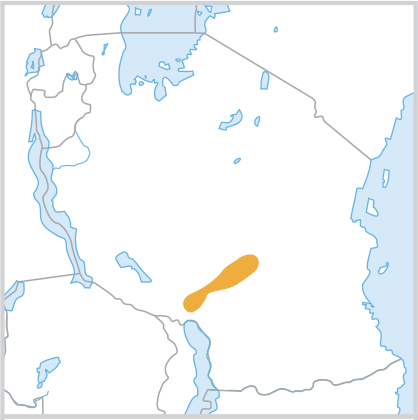
Atheris barbouri
Natural History: Very poorly known. The vertical pupil suggests nocturnal activity, but it has been observed while active in sunlight after a rainstorm. Specimens were collected in January–March, June, September and October. All recent specimens have been collected on the forest floor, but earlier specimens were recorded among agricultural plots and gardens at the edge of forest or formerly forested land. It is not adapted for climbing or burrowing, suggesting it lives in leaf litter on the forest floor. The diet appears to be earthworms, and possibly small frogs. It probably lays eggs. Three females collected in February 1930 each contained 10 eggs, the largest of which measured 10 × 6mm; a fourth was non-gravid. Three females collected at Mufindi in June 1983 held fairly large follicles, as did a female in October.
Medical Significance: Unlikely to be significant, due to its small range, rarity and small size. Nothing is known of the venom, but it is unlikely to be life-threatening. No bite cases are documented.
Barbour’s Short-headed Viper, Atheris barbouri.
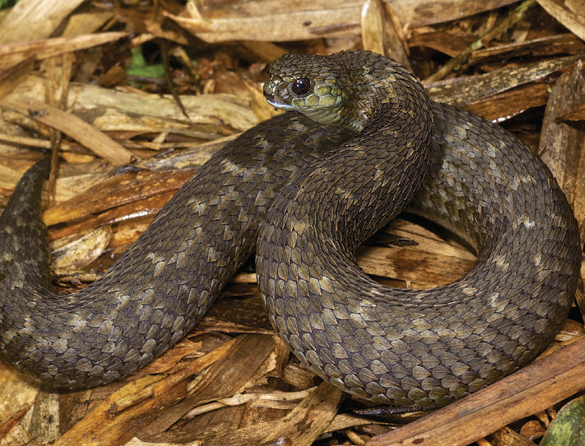
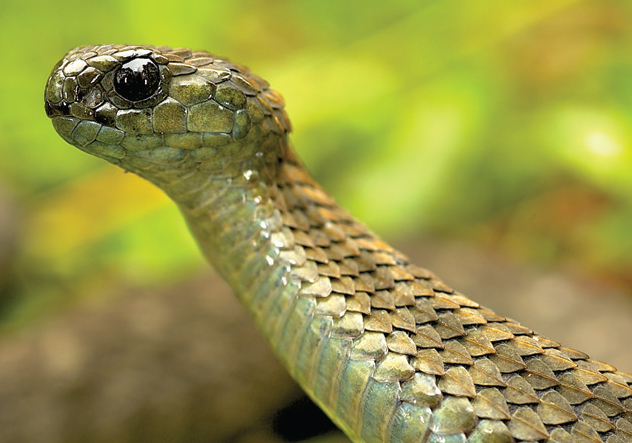
Tanzania (Michele Menegon).
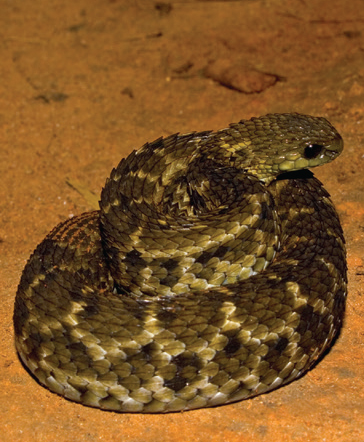
Tanzania (Luke Mahler).
Broadley’s Bush Viper Atheris broadleyi
Identification: A large bush viper that is variable in colour, from the forests of western Central Africa; first described in 1999. The head is broad, triangular and covered in small, strongly keeled scales. The small eye, with a vertical pupil, is set far forward. The tail is long and prehensile, 13–18% of total length (shorter in females). The scales are keeled; in 17–23 rows at midbody; ventrals 157–169; subcaudals 45–61 (higher counts in males). Maximum known size 77cm, average probably 45–65cm; hatchling size unknown, but probably 15–20cm. The colour is dull green or rufous; greenish animals have yellow cross-bars, and rufous animals dark cross-bars. The underside is sky blue, suffused with white, and darkening towards the tail. Juveniles have a whitish tail tip. Specimens from the eastern side of the range have a dark bar behind the eye, which broadens towards the back of the jaw.
Habitat and Distribution: In forest with palm swamps and scrub and grassy clearings, between sea level and 1,000m. Known from extreme south-west Cameroon (on the Nigerian border) eastwards to the south-western corner of Central African Republic, and south to Equatorial Guinea, north-western Gabon and north-central Republic of the Congo.
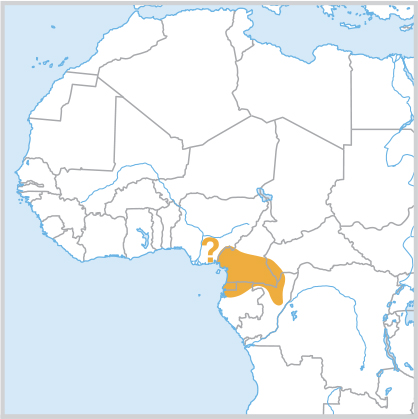
Atheris broadleyi
Natural History: A largely arboreal, nocturnal, slow-moving snake, it waits in ambush among vegetation, but has been found on the ground after rain. It has been observed to be relatively common in parts of its range (24 specimens were collected in 48 hours in Cameroon; the sample contained more females than males). Mating in captivity was in late June and early July, and 8–13 offspring were observed.
Medical Significance: Might be a significant hazard due to its large size (for a bush viper), relative abundance in parts of its range and willingness to hunt on the ground, but no bites or symptoms are documented. Symptomatic treatment is recommended, with pain relief, ensuring the bitten limb is comfortable, and monitoring for necrosis and clotting abnormalities.
Broadley’s Bush Viper, Atheris broadleyi.
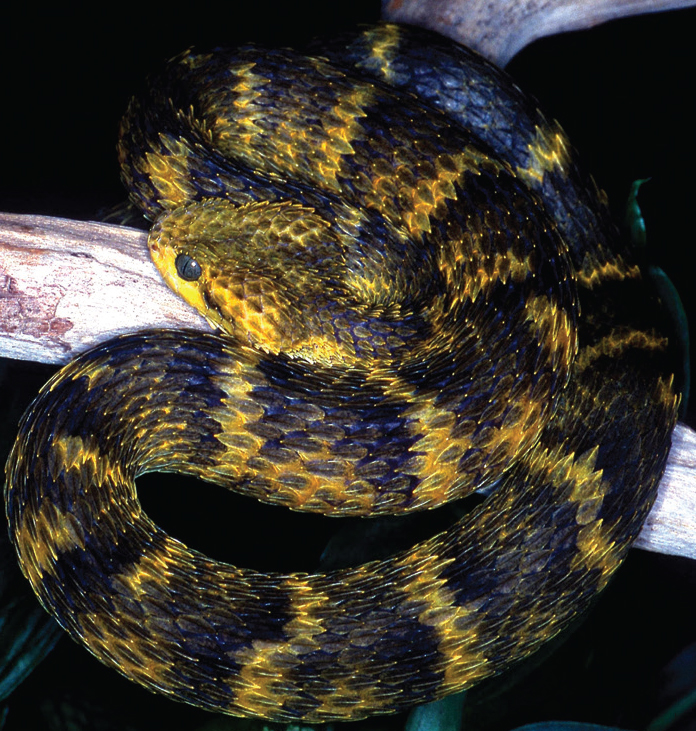
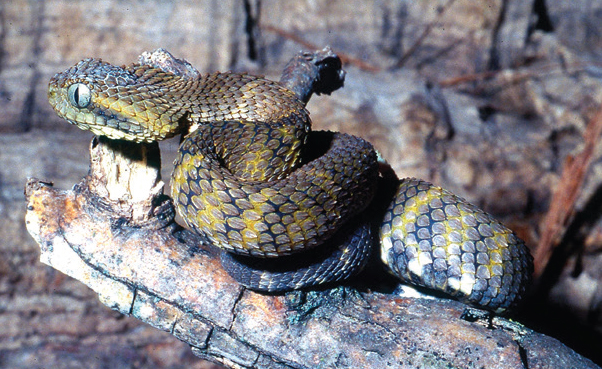
Cameroon (Dwight Lawson).
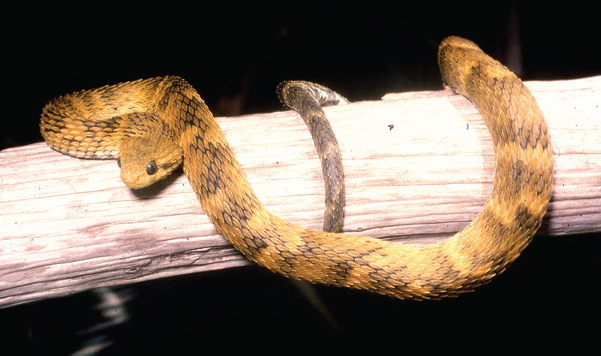
captive (Mike McLaren).
Horned Bush Viper (Usambara Bush Viper)
Atheris ceratophora
Identification: A small horned bush viper of the Eastern Arc Mountains in Tanzania, and thus unmistakable. It has a noticeably triangular head covered with small keeled scales, with a small cluster of ‘horns’ – two or three elongate scales above the eye. The neck is narrow. The dorsal scales are strongly keeled; in 19–27 rows at midbody; ventrals 134–152; subcaudals 46–58. Maximum size 55cm, average 40–50cm; hatchlings 12–16cm. The tail is prehensile. The colour is very variable; this snake may be uniform olive-green, black (with or without light cross-bars), orangey-yellow with black mottling near the tail, golden yellow with increasing dull green and black mottling towards the tail, barred black and yellow, dull brownish yellow, or bright yellow with black mottling. Hatchlings are either shiny or dull black, with a vivid yellow tail tip (which may be used as a caudal lure, waved to attract insect-eating prey). Juveniles gain their adult colours after the third moult of the skin, and at this stage their horns become noticeable.
Habitat and Distribution: Lives in forest and woodland at low to medium altitude, below 700m in the Udzungwa National Park, but over 2,000m in the Usambara National Park. This species is endemic to Tanzania, known only from the Usambara, Nguru, Uluguru and Udzungwa Mountains. A forest-dependent species, but much of its habitat is in protected areas.
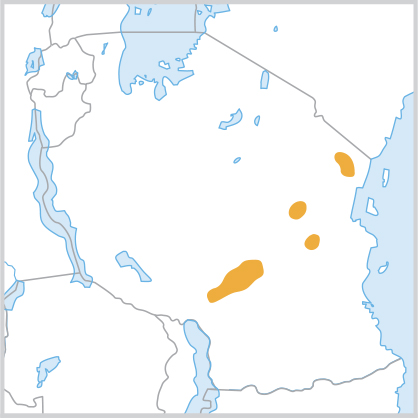
Atheris ceratophora
Natural History: Theoretically nocturnal; certainly both terrestrial and arboreal. Most specimens have been collected during the day when animals are either basking or are detected by their movement as they crawl on the forest floor. In captivity, some individuals remain motionless for weeks on the same branch. It is usually found on the ground, or coiled in a clump of vegetation up to 2m above the ground. Most specimens have been found between January and April, when it is warm; during the colder months, when minimum temperatures may drop to 6°C, the animals may go into a period of inactivity, if not true hibernation. Few details are available on its feeding in the wild; amphibians and lizards are recorded, but captive specimens take mice readily. Limited evidence suggests that breeding takes place in September and October; young have been found in April, and captured females gave birth in March. The scientific name refers to the hornlike scales (cerato = horn).
Medical Significance: Unlikely to be medically significant, being uncommon and living in remote montane forests. A known bite case caused minor pain and discolouration at the bite site. Symptomatic treatment is recommended, with pain relief, keeping the bitten limb comfortable and monitoring for necrosis and clotting abnormalities.
Horned Bush Viper, Atheris ceratophora.
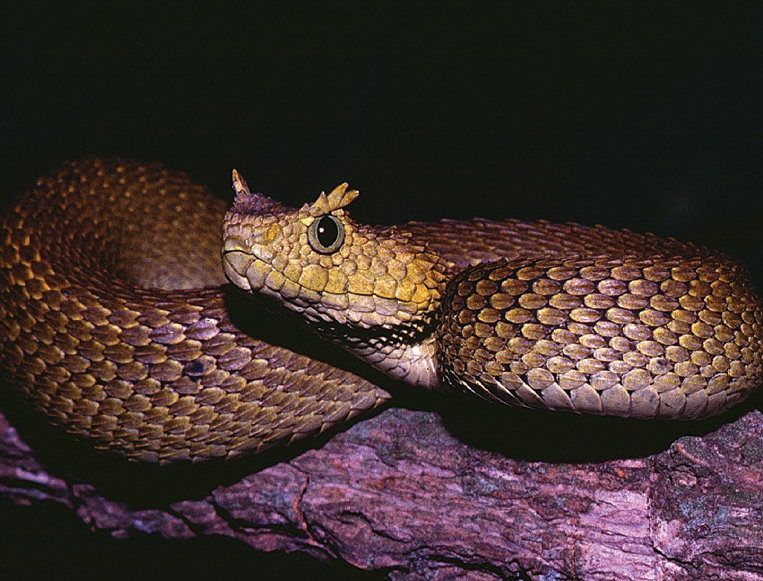
Tanzania (Lorenzo Vinciguerra).
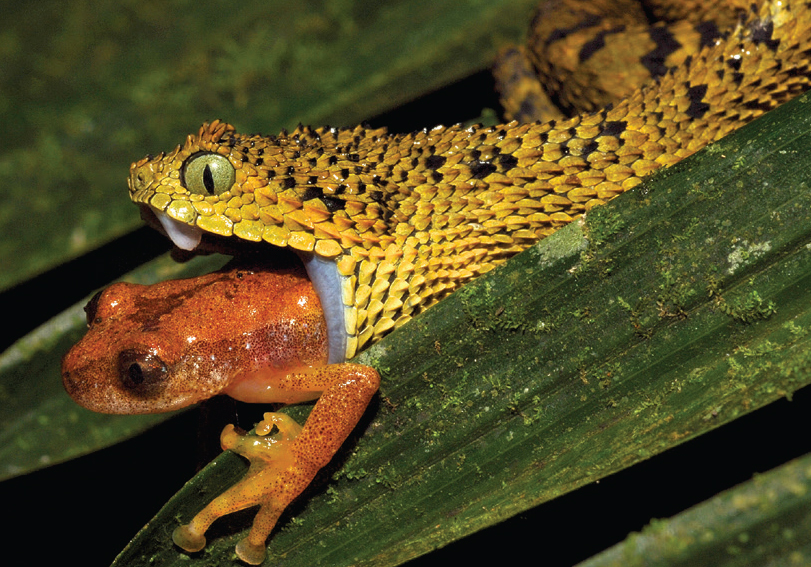
Tanzania (Michele Menegon).
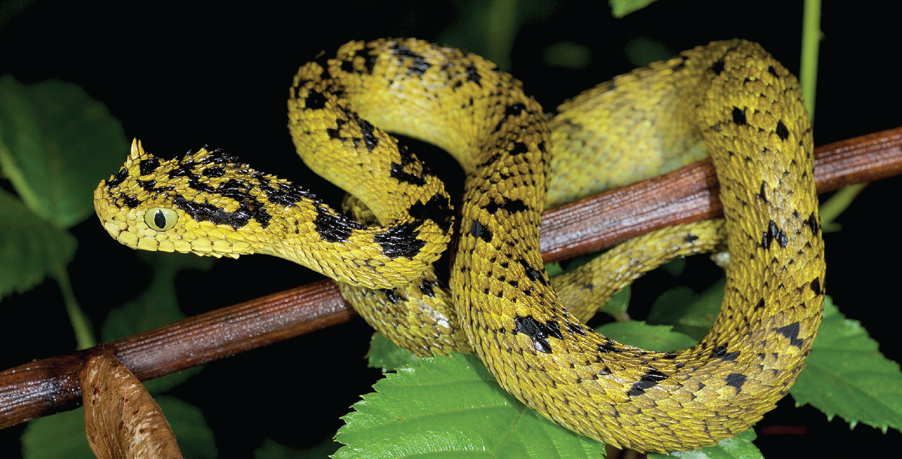
Tanzania (Michele Menegon).
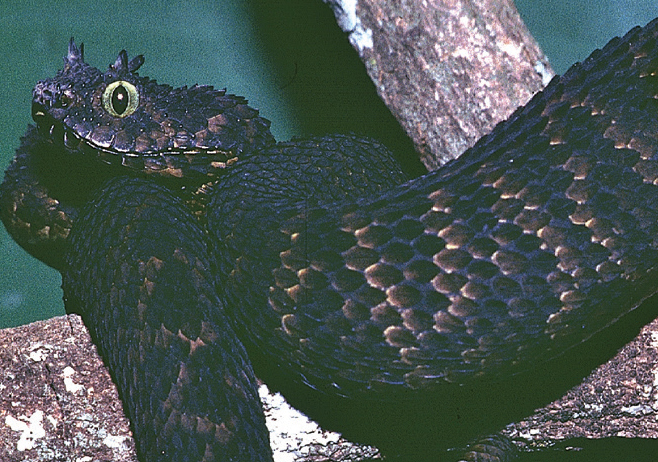
Tanzania (Lorenzo Vinciguerra).
Western Bush Viper Atheris chlorechis
Identification: A fairly large green bush viper from the forests of West Africa; the only green bush viper found west of Ghana. The head is broad, relatively deep and triangular, and covered in small, strongly keeled scales. The small eye, with a vertical pupil, is set far forward. The tail is long and prehensile, 15–19% of total length (shorter in females). The scales are keeled; in 25–37 rows at midbody; ventrals 151–165; subcaudals 48–64 (higher counts in males). Maximum known size about 70cm, average probably 40–65cm; hatchling size unknown, but probably 13–18cm. The colour is light to vivid green, uniform, or spotted or blotched to a greater or lesser extent with yellow; the tail and parts of the body are sometimes speckled black. The underside may be light green, bluish or yellow. Juveniles may be blue-grey, tan or dull green, sometimes with dark and light cross-bars and a yellow tail tip. A melanistic (black) specimen and a uniform yellow animal have been reported.
Habitat and Distribution: Lives in forest and thick woodland at low to medium altitude, from sea level to 560m. A forest-dependent species, although it will utilise secondary forest and abandoned farmland in forest. It occurs from Sierra Leone and southern Guinea eastwards to Ghana; there are a couple of records from Togo and extreme south-west Nigeria.
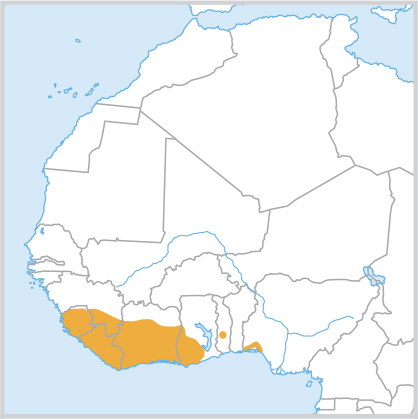
Atheris chlorechis
Natural History: Nocturnal and arboreal, although it will descend to the ground. Most specimens have been found in forests and forest clearings, on the ground or coiled in or on vegetation at heights up to 2m above the ground. An individual in an abandoned cassava plantation in Ghana dropped to the ground when approached and hid in the undergrowth. Females give birth to 5–9 live young, in March or April, at the beginning of the rainy season.
Medical Significance: This snake has a large range, but being arboreal and secretive it probably causes few bites. Little is known of the toxicity or composition of the cytotoxic venom, but it can cause severe symptoms, and yields of up to 100mg of wet venom have been reported. In a documented bite case by a captive snake, the victim experienced severe swelling, pain and coagulopathy. Impending compartment syndrome prompted a fasciotomy, but the victim then lost 5 litres of blood in six hours. Six vials of Fav-Afrique antivenom stopped the blood loss (although this antivenom was not raised using Atheris venom), but acute kidney injury had occurred and full renal function took three weeks to return. A bite from an Ivory Coast snake caused intense pain, swelling and major necrosis, and required surgical intervention. Symptomatic treatment is recommended, with pain relief, keeping the bitten limb comfortable and monitoring for necrosis and clotting abnormalities.
Western Bush Viper, Atheris chlorechis.
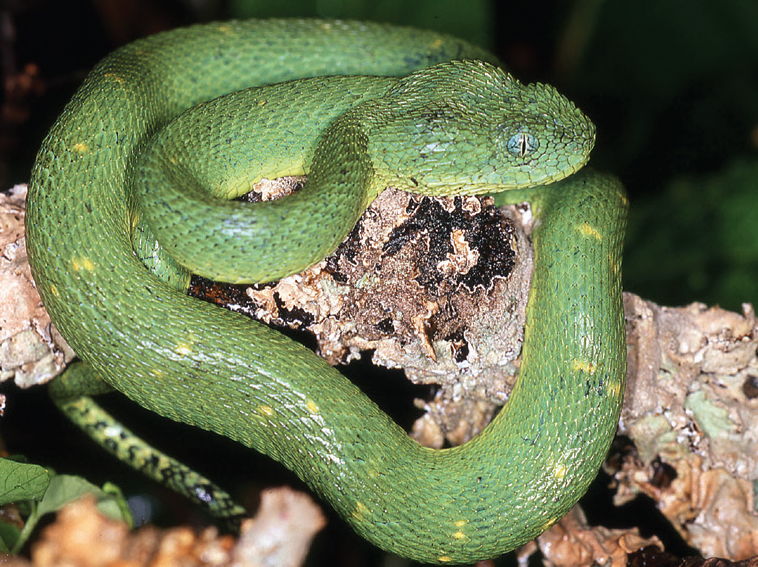
captive (Paul Freed).
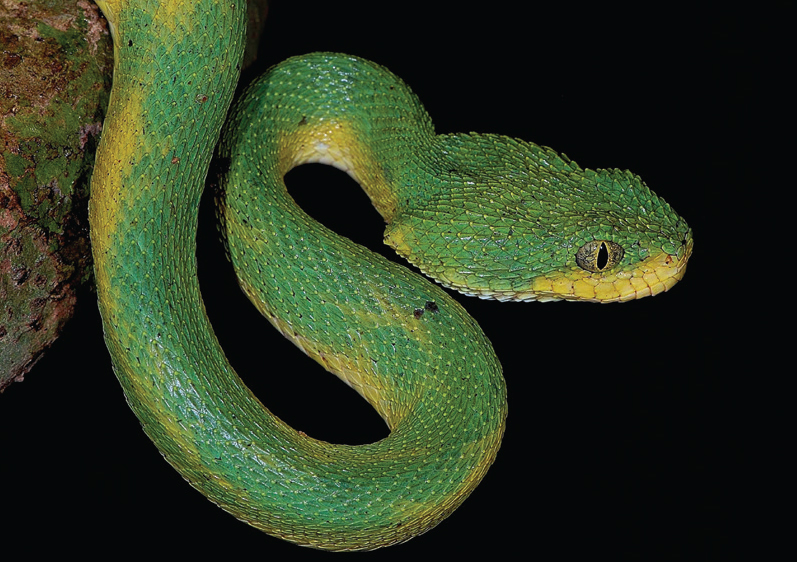
Ivory Coast (Mark-Oliver Rödel).
hatchling (Paul Freed).
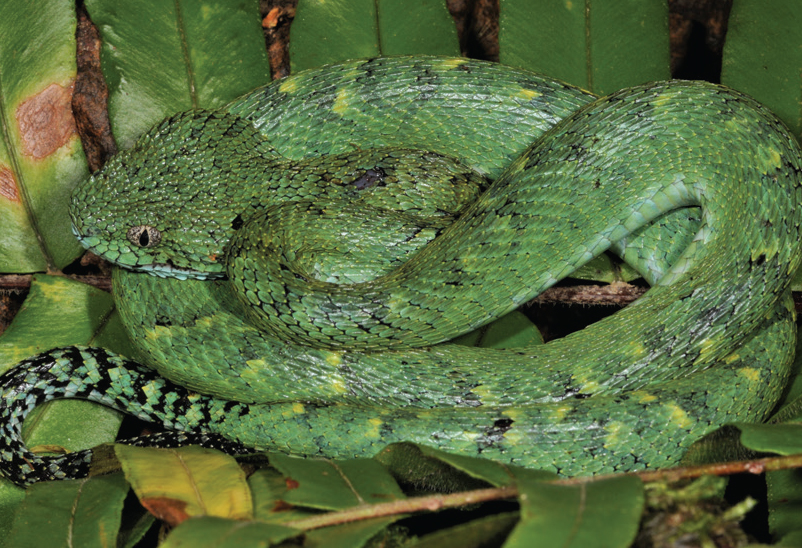
captive (Bill Branch).
Mount Kenya Bush Viper Atheris desaixi
Identification: A large, thick-bodied black and yellow bush viper, discovered in 1967 and found only in the forests of high central Kenya. The head is broad, triangular and covered in small, strongly keeled scales. The small eye, with a vertical pupil, is set far forward. The tail is long and prehensile, 13–15% of total length in females and 16–18% in males. The scales are keeled; in 24–31 rows at midbody; ventrals 160–174; subcaudals 41–54 (higher counts in males). Maximum size about 70cm, average 40–60cm; hatchlings 17–22cm. The body is greeny-black to charcoal black, each scale edged with yellow or yellowy-green, creating either a speckled effect or a series of yellow loops. On the hind body and tail the speckles may fuse into yellow zigzags. The belly is yellow on the front half, becoming progressively suffused with purplish black to the rear and under the tail; the tail tip is blotchy yellow. Occasional yellow-brown or dull green individuals occur; they have faint darker festoons. Hatchlings are predominantly yellow, with a white tail tip, but gradually darken to adult colour at around 30cm in length.
Habitat and Distribution: Endemic to the central highlands of Kenya, in mid-altitude evergreen forest between 1,000m and 1,800m. There are three populations: one in the Ngaia (Ngaya) Forest, at 1,000m on the north-east flank of the Nyambene Range; one around Igembe, at 1,300m in the northern Nyambene Range; and one in forest just west of Chuka, south-eastern Mount Kenya, between 1,500m and 1,800m. It might be more widespread in the relatively unexplored forests around the central highlands. This is a snake under threat from collecting for the pet trade and deforestation. Its distribution needs investigation and, if feasible, an area of its habitat needs rigorous protection.
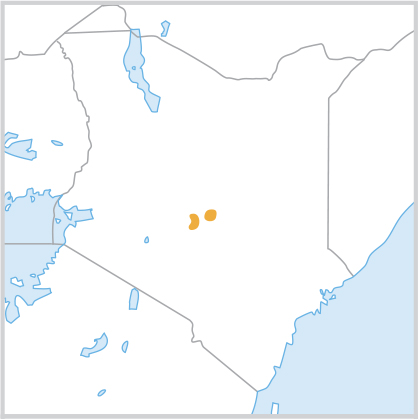
Atheris desaixi
Natural History: A slow-moving arboreal snake. Its activity patterns are not known; it might be diurnal or nocturnal, or both. It is usually found draped in low vegetation, around 2–3m from the ground, around the edges of small clearings in forest, but has been seen 15m up a tree. The Ngaya specimen was in a lantana bush at the forest edge. Some Nyambene specimens were in yam plantations. This species is perfectly camouflaged and difficult to observe. It is very willing to strike when first caught, and will form C-shaped coils like a carpet viper; the coils are shifted against each other in opposite directions, producing a hissing sound, like water falling on a hot plate. It struggles fiercely in the hand, but soon tames in captivity. Little is known of its biology, but it appears to feed on small mammals. A female from the Nyambene Range gave birth to 13 young in August; the smallest was 17.5cm and the largest 21.1cm.
Medical Significance: Unlikely to be medically significant, being uncommon and living in remote montane forests. A known bite case caused swelling and pain. Symptomatic treatment is recommended, with pain relief, keeping the bitten limb comfortable and monitoring for necrosis and clotting abnormalities.
Mount Kenya Bush Viper, Atheris desaixi.
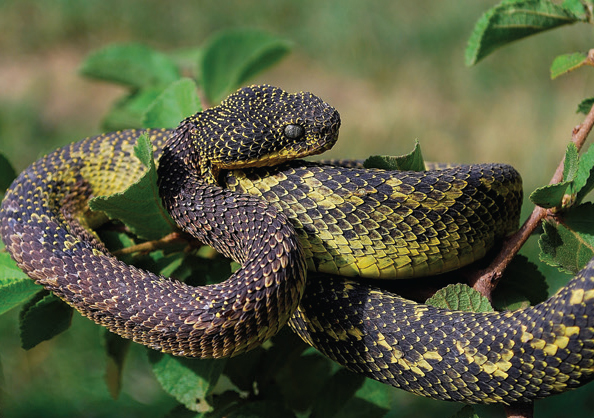
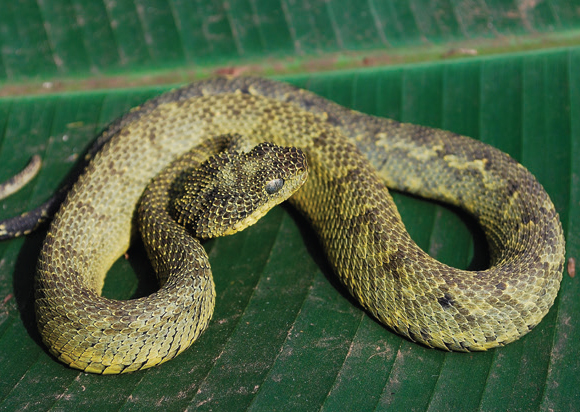
Kenya (Stephen Spawls).
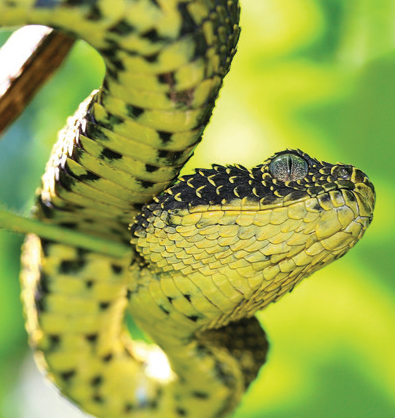
Kenya (Bio-Ken Archive).
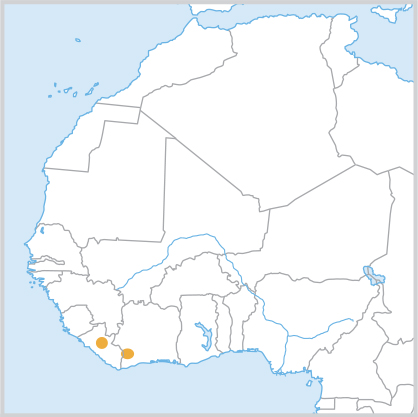
Hairy Bush Viper Atheris hirsuta
Identification: A small, slim bronze-coloured West African bush viper with spiky scales, first described in 2002 and known solely from two males, from Ivory Coast and Liberia. The head is short and ovoid, the eye is huge with a vertical pupil, and the neck is thin. There are many small scales on top of the head; the scales are noticeably raised and elevated anteriorly, particularly on the head and neck. The body is subtriangular in section and the tail is 19–20% of total length. The scales are strongly keeled; in 15–16 rows at midbody; ventrals 159–160; subcaudals 58. The dorsal scales are very elongate and taper to an elevated point. The two specimens were 43cm and 48cm long. The colour is bronze, with yellow-and dark-tipped dorsal scales forming a series of light and dark cross-bars; the underside is brownish, sparsely suffused with golden yellow.
Habitat and Distribution: The type specimen was found in the Taï National Park, extreme south-west Ivory Coast, in secondary forest at 200m; the second animal was on Mount Swa, Nimba County, central Liberia, also in secondary forest at 585m. The first specimen was on a road in the early morning after heavy rain, while the second was climbing a tree, 2m up, at night; both were found in September, which is near the end of the rainy season.
Atheris hirsuta
Natural History: In general appearance this snake resembles the Rough-scaled Bush Viper (Atheris hispida) and its habits are probably similar; that is, primarily nocturnal, mostly arboreal, gives birth to live young and feeds on small vertebrates. However, nothing is actually known. The type was described as ‘more aggressive’ than the sympatric Western Bush Viper (A. chlorechis).
Medical Significance: Nothing known. Symptomatic treatment is recommended, with pain relief, ensuring the bitten limb is comfortable, and monitoring for necrosis and clotting abnormalities.
Hairy Bush Viper, Atheris hirsuta.
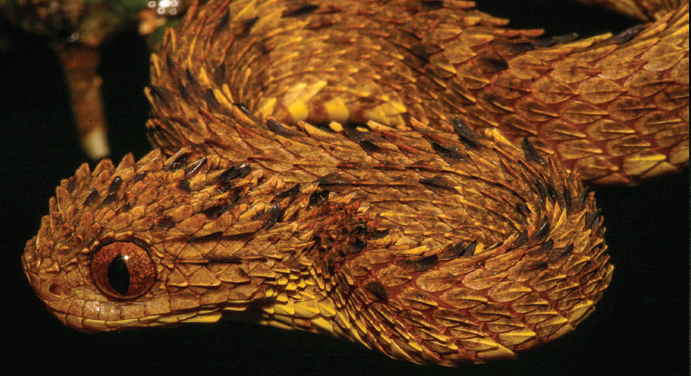
Liberia (Johannes Penner).
Ivory Coast (Mark-Oliver Rödel).
Rough-scaled Bush Viper (Prickly Bush Viper)
Atheris hispida
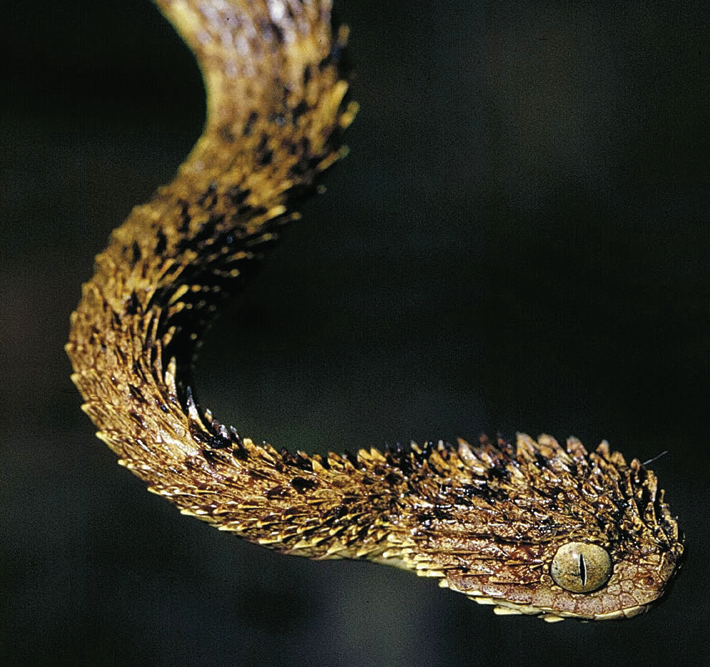
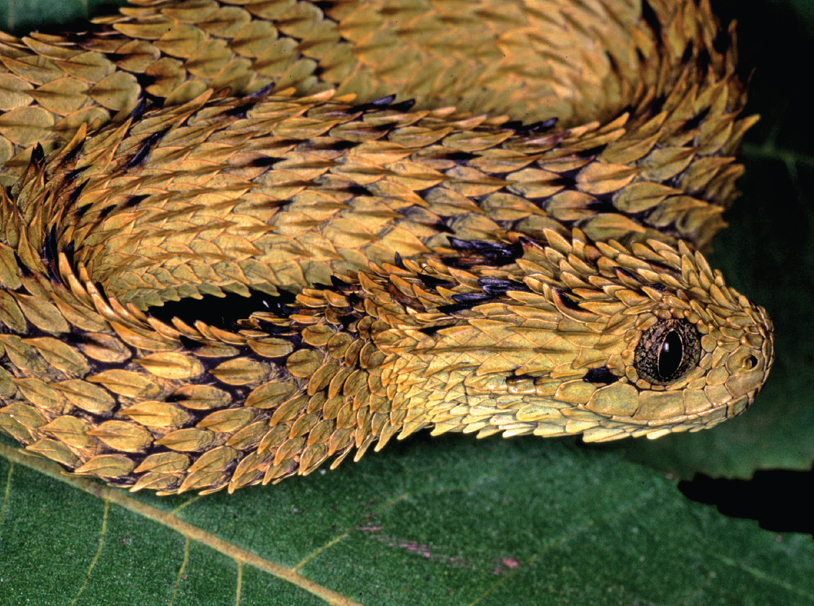
Identification: A large, slender bush viper from western East Africa, with bizarrely long scales, giving it a spiky appearance. The head is subtriangular, the eye fairly large, the pupil vertical and the iris brown, heavily speckled with black (looks uniformly dark under most conditions). There are many small scales on top of the head. The body is cylindrical in section and the tail long, 17–21% of total length. The scales are heavily keeled, prickly and leaf-shaped (this is a good field character); in 15–19 rows at midbody; ventrals 149–166; subcaudals 49–64 (high counts usually males). Maximum size just over 70cm, average 40–60cm; hatchlings 15–17cm. Males are usually olive-green, with a black mark on the nape (in the shape of an ‘H’, ‘V’ or ‘W’, or just a blotch), and sometimes a dark line behind the eye. The ventrals are greenish, darkening towards the tail. Females are usually yellowy-brown or olive-brown, with a similar dark nape mark, and yellow-brown below.
Habitat and Distribution: Associated with forest, woodland and thicket, sometimes in waterside vegetation at 900–2,400m. It has a bizarre, disjunct distribution. There is one Tanzanian (Minziro Forest, north-west) and one Kenyan (Kakamega Forest) record. In Uganda, it is known from forest patches around Mityana and in the south-west Ruwenzoris, in Kigezi Game Reserve and Bwindi Impenetrable National Park. There are no Rwandan or Burundi records, but there is a cluster of records in the eastern DR Congo, from the Ituri Forest southwards to Lutunguru, Rutshuru and Bunyakiri, west of Lake Kivu. It probably occurs in forest and forest patches in the intervening areas.
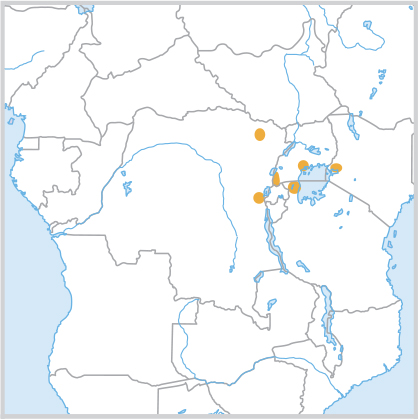
Atheris hispida
Natural History: Poorly known. It is arboreal and an expert climber, moving relatively quickly through the branches. It lives in tall grasses, Papyrus (Cyperus papyrus), bushes, creepers and small trees. In Kakamega Forest, these snakes were found slightly higher up than the sympatric Green Bush Viper (Atheris squamigera), in drier bushes, but were also found in reeds. It will bask on top of small bushes or on flowers. Although probably nocturnal, it will opportunistically strike from ambush if prey passes by. It is an irascible snake, struggling furiously if held, and forming the body into C-shaped coils like the Mount Kenya Bush Viper (A. desaixi). Its mouth is often full of small back mites. It gives birth to live young, with clutches of 2–12 recorded; two Kakamega females had clutches of two and nine young in mid-April, the time of highest rainfall. The diet is not well known; the holotype had a snail in its stomach, while captive specimens take rodents and tree frogs. Population numbers of this species in Kakamega seem to peak and crash, for reasons as yet unexplained; in some years they are abundant, while in others they cannot be found.
Medical Significance: The venom is unstudied and no bite cases are documented.
Rough-scaled Bush Viper, Atheris hispida.
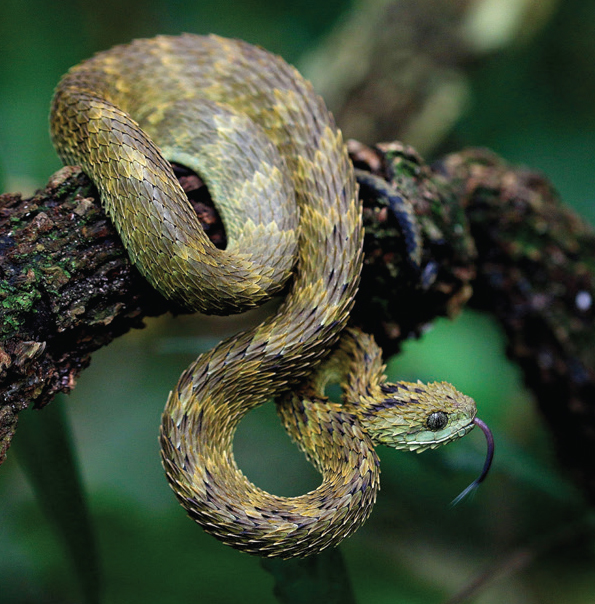
Uganda (Jelmer Groen).
captive (Paul Freed).
Identification: A small, slim bush viper, described in 1998 from a single specimen from Uganda and not seen since. The head is subtriangular, the eye fairly large, the pupil vertical and the iris mottled green, with gold bordering the pupil. There are many small scales on top of the head. The body is subtriangular in section and the tail is 18% of total length. The scales are keeled; in 14 rows at midbody; ventrals 160; subcaudals 54. The dorsal scales are very elongate and taper to a point (the name ‘acuminate’ means tapering to a point). The specimen was 44cm long, with the tail 8.1cm, and yellow-green above, with a vague H-shaped black marking on the crown and a short black blotch behind the eye. The tail was black-blotched and the belly pale greenish yellow, black-blotched posteriorly.
Habitat and Distribution: Described from Kyambura Game Reserve, adjacent to Queen Elizabeth National Park, just south of Lake George, Uganda, at an altitude of 950m, in riverine forest. There is little data in conservation terms, but it was found in a protected area.
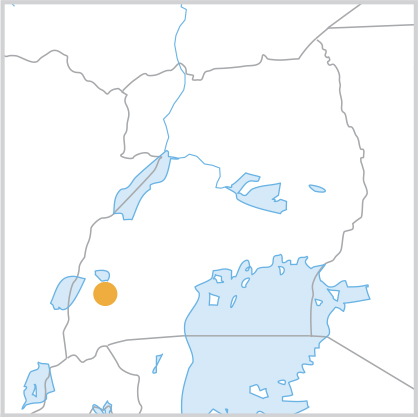
Atheris acuminata
Natural History: Nothing known. If it is a valid species, it is probably similar to the Rough-scaled Bush Viper (Atheris hispida).
Medical Significance: Nothing known.
Taxonomic Notes: This snake is virtually identical to the Rough-scaled Bush Viper, and is probably just an aberrant example of that species.
Acuminate Bush Viper, Atheris acuminata.
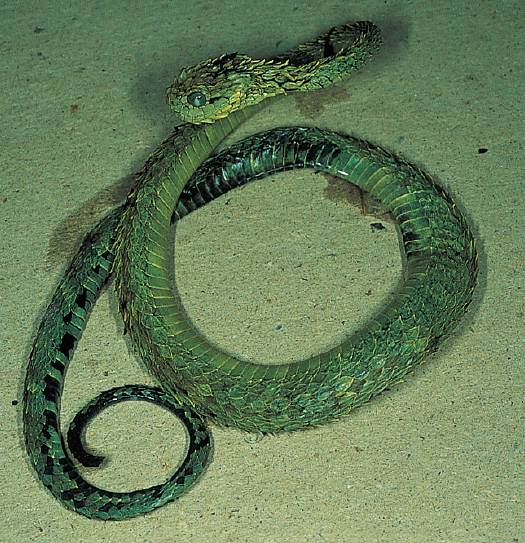
preserved type (Don Broadley).
Shaba Bush Viper Atheris katangensis
Identification: A small green or tan bush viper from south-eastern DR Congo and adjacent areas. The head is short and quite deep, the eye large, the pupil vertical and the neck thin. There are many small scales on top of the head. The body is subtriangular in section and the tail is 13–16% of total length. The scales are strongly keeled; in 24–31 rows at midbody; ventrals 133–144 (higher counts in males); subcaudals 38–42 in females and 45–49 in males. The six known specimens ranged from 22–40cm. The colour is dull green or yellow-brown, with faint lighter cross-bars or lozenges on the back; the underside is light yellow or greenish. Juveniles have a whitish tail tip.
Habitat and Distribution: Originally described from gallery forest along rivers in the Upemba National Park, in south-eastern DR Congo, between 1,250m and 1,400m. Two recent examples of this species were observed north of Mwinilunga in northwest Zambia and from north-western Angola.
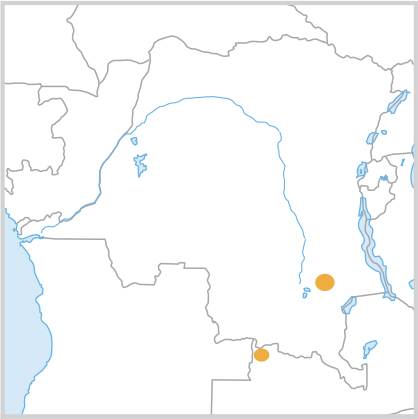
Atheris katangensis
Natural History: Nothing known, but presumably similar to other bush vipers; that is, primarily nocturnal, mostly arboreal, gives birth to live young and feeds on small vertebrates.
Medical Significance: Nothing known.
Shaba Bush Viper, Atheris katangensis.
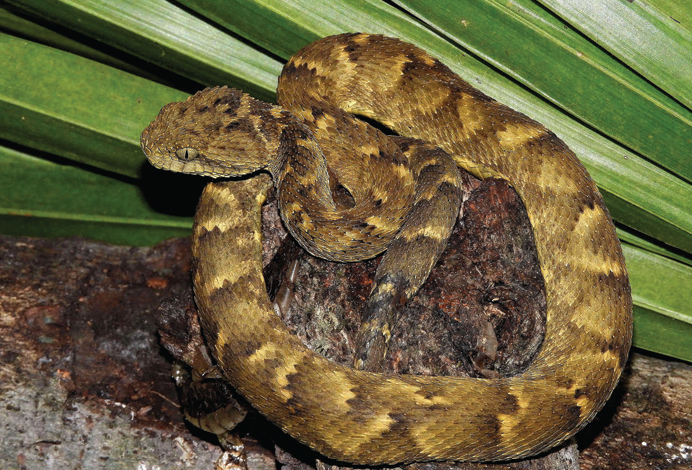
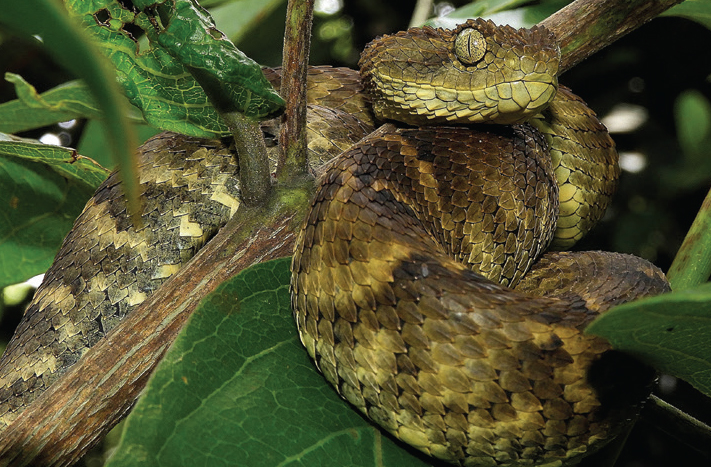
Zambia (Frank Willems).
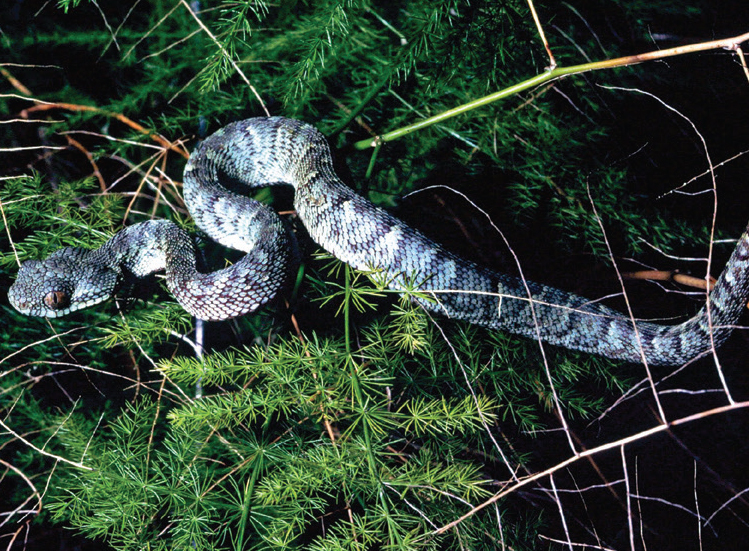
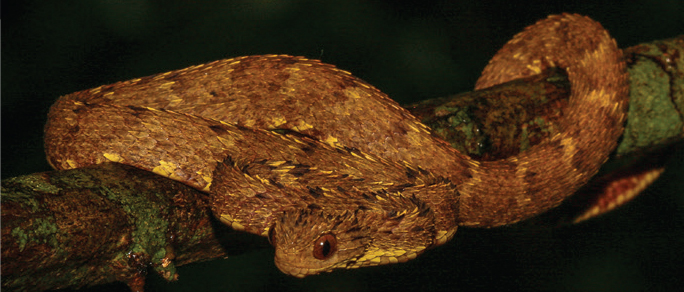
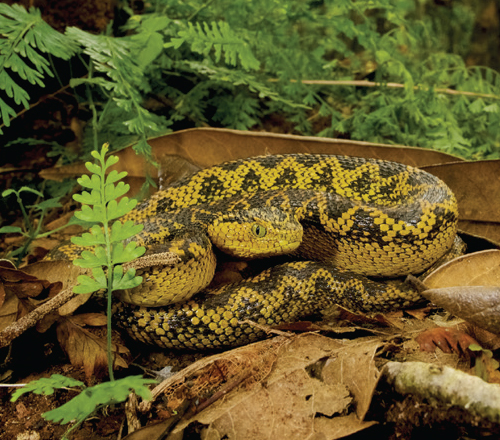
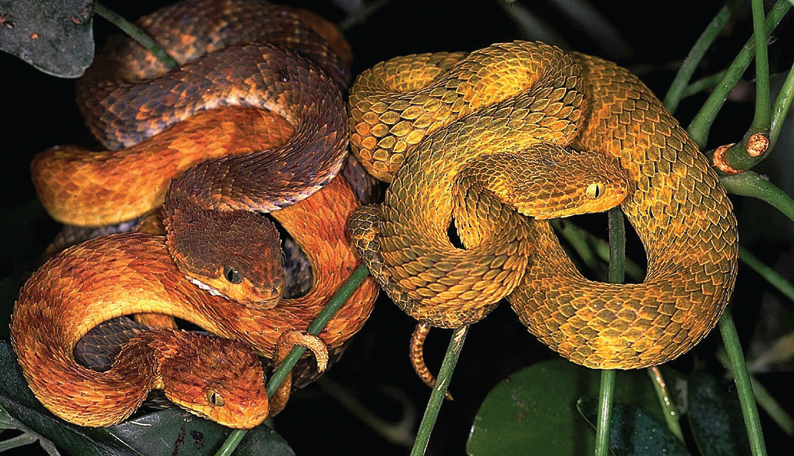
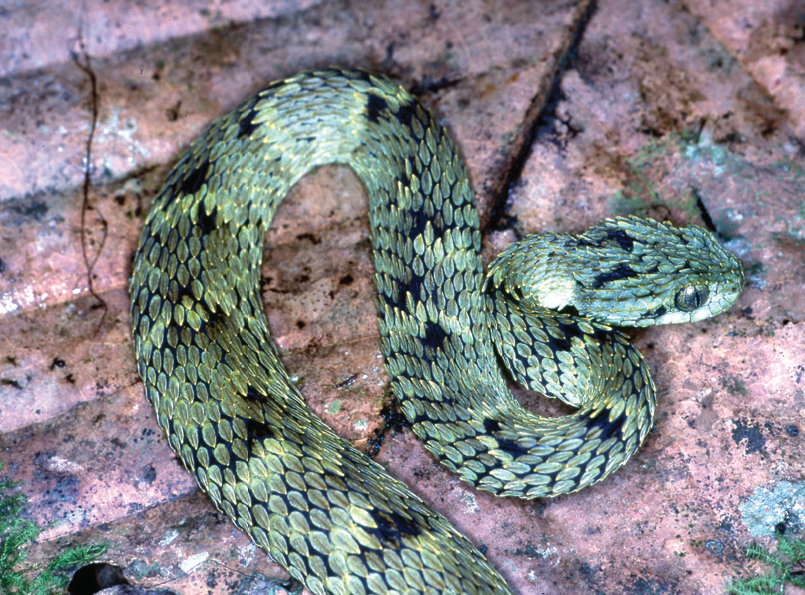
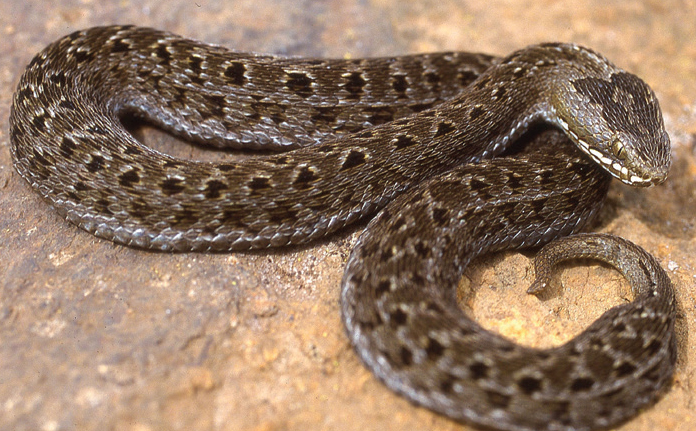
Mount Mabu Bush Viper Atheris mabuensis
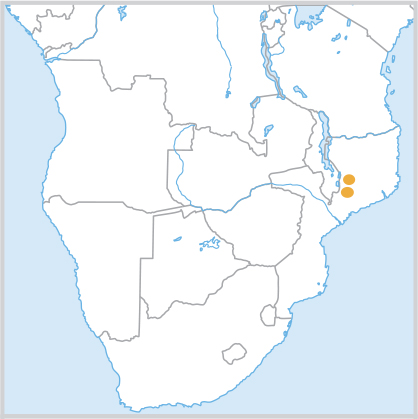
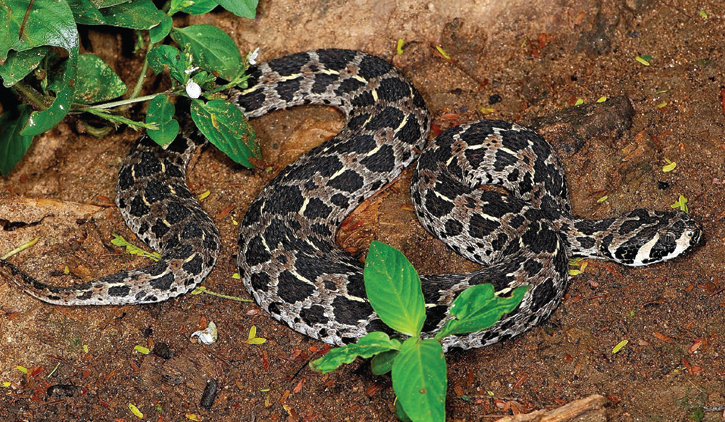
Identification: A very small brown or dull green bush viper from Mounts Mabu and Namuli in north-central Mozambique. The head is triangular, the eye large, the pupil vertical and the neck thin. There are many small scales on top of the head. The body is subtriangular in section and the tail is 14–17% of total length. The scales are strongly keeled; in 22–26 rows at midbody; ventrals 128–137; subcaudals 39–47. The five known specimens ranged from 18cm to 38cm. Some specimens have a black V-shape on the head. The dorsal colour is olive, blue-grey or brown, and along the centre of the back is a pair of light lines forming a twisted helix shape, interspersed with black blotches. In some specimens the dorsal scales have a distinctive yellow tip. The adults seem to retain the juvenile yellow tail tip. The underside is blue-grey with fine, heavy black stippling, except on the yellow tail tip.
Habitat and Distribution: All specimens were found on the forest floor in wet forest on Mounts Mabu and Namuli, Zambezia Province, north-central Mozambique, between 1,000m and 1,550m.
Atheris mabuensis
Natural History: Specimens were found on the forest floor in leaf litter during the day, and have also been found under ground cover. Captive specimens either hid themselves in leaf litter or coiled in branches or leaf clumps up to 20cm above the ground. They ate small lizards and frogs, and used the yellow tail as a lure, waving it to attract prey. The 38cm female was sexually mature. A 15cm captive grew to 36cm in three years.
Medical Significance: Little known. Local hunters describe bites from these snakes as painful but not lethal.
Mount Mabu Bush Viper, Atheris mabuensis.
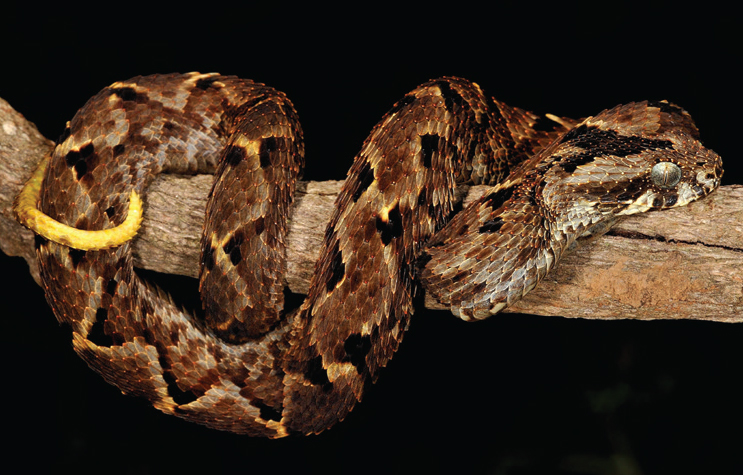
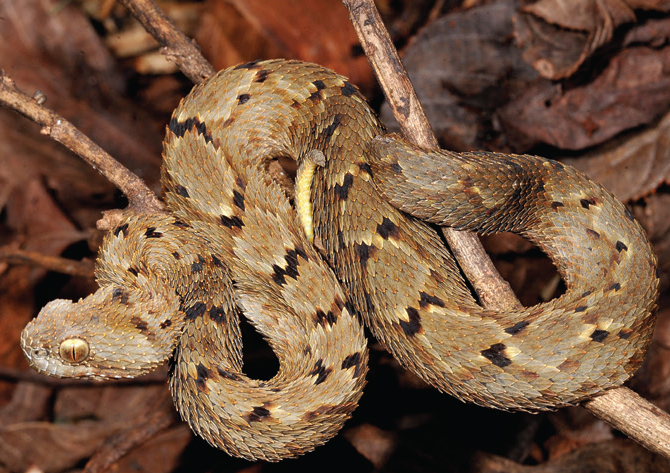
Mozambique (Bill Branch).
Matilda’s Bush Viper Atheris matildae
Identification: A relatively large, heavy-bodied bush viper from south-western Tanzania; adults often larger than 70cm. First described in 2011. The head is broad, triangular and covered in small scales. The small eye, with a vertical pupil, is set far forward. The tail is long and prehensile. The dorsal scales are strongly keeled; in 26–27 rows at midbody; ventrals 142–150; subcaudals 44–50. Maximum size is probably around 80cm. Its colouration, though quite variable, is generally black with zigzag, bright yellow dorsolateral lines running along its length. A black patch around the nasal, rostral, mental and first infralabials is present in most of the observed males, but also in a few females and immature individuals. Males in general tend to be darker, with the belly suffused with black. Adult females tend to be more yellow, in some cases with an immaculate throat and belly. The side of the head can be completely yellow or have black patches at the tips of the scales. It is distinguished from most other Atheris vipers by the presence, in both males and females, of enlarged supraciliary scales that form this species’ yellow and black horns. This species closely resembles the only other bush viper with horns, the Horned Bush Viper (Atheris ceratophora), but is larger and heavier, and has differences in scalation.
Habitat and Distribution: Known from just two forest fragments in the southern highlands of Tanzania, north of the northern tip of Lake Malawi (Lake Nyasa).
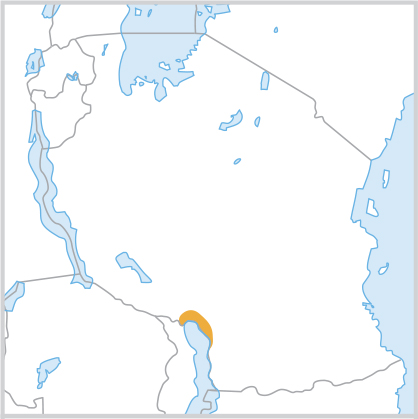
Atheris matildae
Natural History: Poorly known. Individuals were found both climbing on bushes and trees and moving on the ground; it appears that larger individuals become more terrestrial and hide in rodent burrows. It presumably feeds largely on small vertebrates and gives birth to live young.
Medical Significance: Nothing is known of the toxicity or composition of the venom, but, as with other larger bush viper species, a bite from this species might be serious. Symptomatic treatment is recommended, with pain relief, keeping the bitten limb comfortable and monitoring for necrosis and clotting abnormalities.
Matilda’s Bush Viper, Atheris matildae.
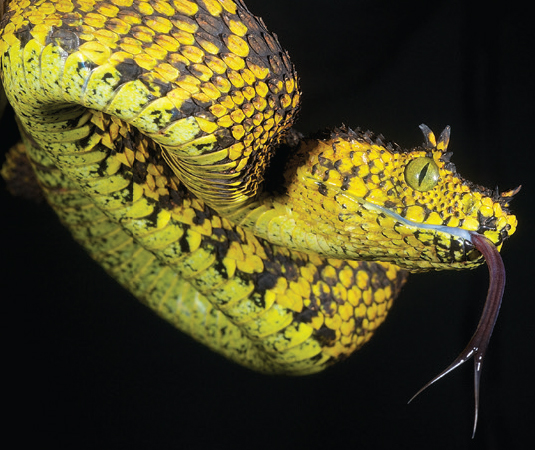
Southern Highlands, Tanzania (Michele Menegon).
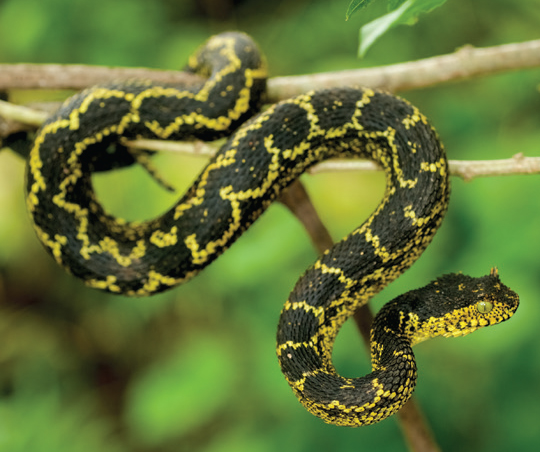
Tanzania (Michele Menegon).
Great Lakes Bush Viper Atheris nitschei
Identification: A large, stout black and green bush viper of the central Albertine Rift Valley. The head is triangular and the neck thin. The eye is fairly large, set well forward and has a vertical pupil, but this is hard to see; the whole eye just looks black, although the iris is brown. There are many small scales on top of the head. The body is cylindrical and stout, and the tail is fairly long and strongly prehensile, 15–17% of total length in males and 13–16% in females. The scales are keeled; in 23–34 rows at midbody; ventrals 140–163; subcaudals 35–59 (higher counts in males). Maximum size about 75cm, average 45–65cm; hatchlings 15–18cm. Colour various shades of green, blue-green, yellowy-green or olive, heavily speckled, blotched or barred black; there is usually a conspicuous black bar behind the eye, and a dark blotch or V-shape on top of the head. The belly is yellow or greeny-yellow. There is an ontogenic colour change: hatchlings are deep green (almost black), brown or grey-brown, with a white or yellow tail tip; after three or four months they become uniform green, and black blotches then appear gradually.
Habitat and Distribution: A characteristic species of the Albertine Rift. It lives in medium- to high-altitude moist savanna and woodland, montane forest and bamboo, sometimes associated with lakes and swamps, in waterside vegetation, between 1,000m and 2,800m. It occurs from North Kivu in DR Congo and extreme western Uganda, south along the Albertine Rift, to both sides of northern Lake Tanganyika, where it extends slightly further south on the DR Congo shore. On the eastern shore it is replaced by the Mount Rungwe Bush Viper (Atheris rungweensis).
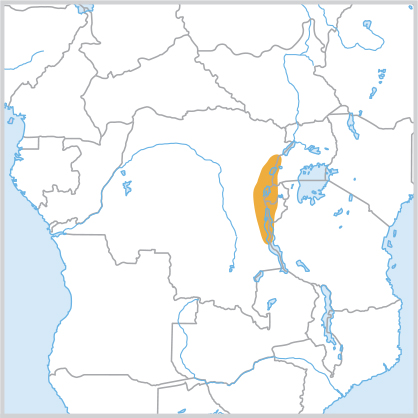
Atheris nitschei
Natural History: Arboreal, living in Papyrus (Cyperus papyrus) and reedy swamp vegetation, Elephant Grass (Pennisetum purpureum), bushes, small trees and bamboo. It will descend to the ground to hunt. It is probably nocturnal, but known to bask, at heights of 3m or more in creepers, Elephant Grass and Papyrus. If disturbed it slides quickly downwards or simply drops off its perch. In Bwindi Impenetrable National Park, it was found waiting in ambush for diurnal lizards such as Jackson’s Forest Lizard (Adolfus jacksoni), concealed in grass at the base of roadcut walls. Hatchlings used caudal luring, waving their bright tail tips to attract insect-eating prey. Some specimens are placid, but often it is bad-tempered, hissing, striking and forming C-shaped coils when threatened. It gives birth to live young in clutches of 4–15; a female from Mount Karisimbi gave birth to 12 young in February, and gravid females were collected in October and November in south-west Uganda, and in January in the Ruwenzoris. The diet includes small mammals, amphibians and lizards (including chameleons); captive specimens descended to the ground to stalk rodents.
Medical Significance: Few documented bites, but in countries like Rwanda and Burundi, with intensive agriculture, this species is likely to be present in marginal vegetation along rivers running through farmland. Bites by this species, including one in Rwanda, are characterised by extreme pain, swelling (in one case up the entire arm and onto the trunk; the victim also became unconscious), oedema, clotting abnormalities and necrosis, sometimes resulting in the loss of parts of digits. No antivenom is produced. Symptomatic treatment is recommended, with pain relief, keeping the bitten limb comfortable and monitoring for necrosis and clotting abnormalities.
Great Lakes Bush Viper, Atheris nitschei.
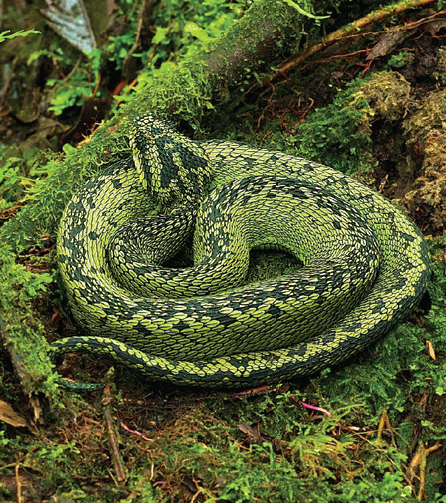
Rwanda (Michele Menegon).
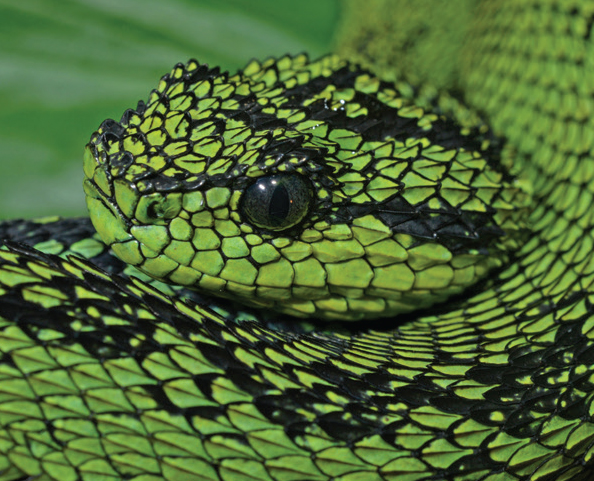
Rwanda (Max Dehling).
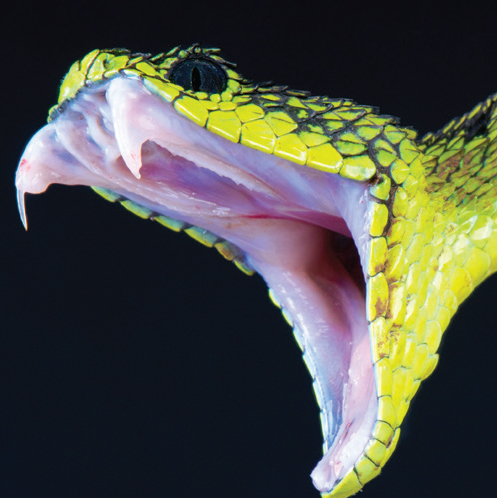
striking (Matthijs Kuijpers).
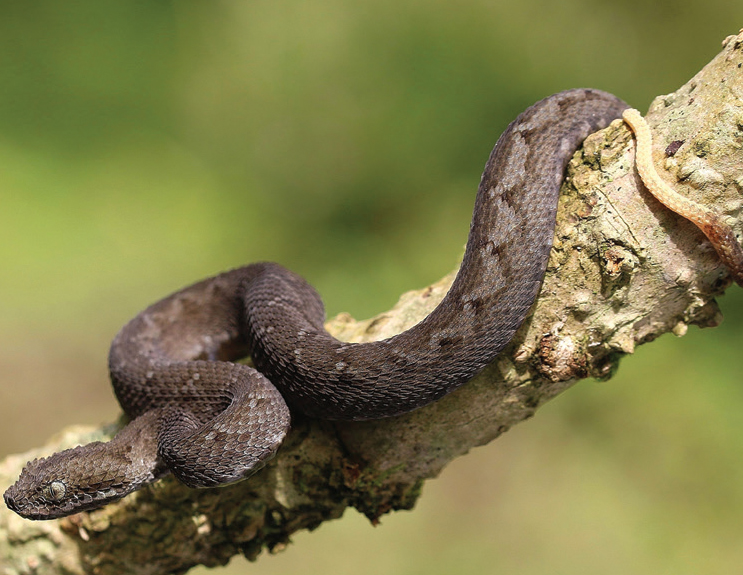
hatchling, Uganda (Jelmer Groen).
Identification: A large, attractive green and yellow bush viper of south-western Tanzania, extreme northern Zambia and Malawi. The large head is triangular in shape and rather flat in profile, with a distinct neck. The dorsals are keeled and pointed, but with keels ending before the tip; in 22–33 rows at midbody; ventrals 150–165; subcaudals 46–58. Maximum size about 65cm, average 35–55cm; hatchlings 15–17cm. The colour is predominantly light or dark green, usually with oblique yellow cross-bars, festoons or zigzags; in some specimens the upwards curve of the festoon has a black infilling. The underside is greenish yellow. Newborn animals are dark brown or grey, with a bright yellow tip to the tail. They may use this brightly coloured tail as a ‘lure’ to attract prey. After several moults, they develop a uniform green and then more patterned adult colouration.
Habitat and Distribution: Most records are from moist savanna, woodland and hill forest of south-western Tanzania, northern Zambia and Malawi, between 800m and 2,000m. It occurs southwards from the Gombe Stream National Park and Kigoma down the eastern shores of Lake Tanganyika to the Mahale Peninsula, and inland to the Ugalla River. In addition, in forest patches in the high country around Sumbawanga, between the north end of Lake Rukwa and the south end of Lake Tanganyika, and on Mount Rungwe, just north of the north end of Lake Tanganyika; it is also found in the Nyika National Park and Plateau, on both sides of the Zambia–Malawi border, around Mbala in northern Zambia and in the Matipa Complex Forest in northern Malawi.
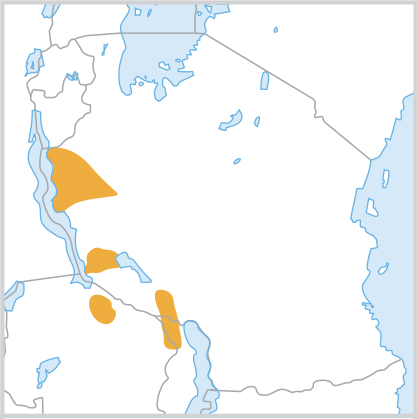
Atheris rungweensis
Natural History: Poorly known. It is arboreal, and the vertical pupil suggests it is nocturnal. An expert climber, found in bushes 1–3m above the ground, or on the ground at edges of forest. It might hunt on the ground or ambush from trees. It gives birth to live young. The diet includes small frogs, although captive animals accept mice.
Medical Significance: Nothing is known of the toxicity or composition of the venom, but, as with other large bush vipers, a bite from this species might be serious. Symptomatic treatment is recommended, with pain relief, keeping the bitten limb comfortable and monitoring for necrosis and clotting abnormalities.
Taxonomic Notes: Originally regarded as a subspecies of the Great Lakes Bush Viper (Atheris nitschei).
Mount Rungwe Bush Viper, Atheris rungweensis.
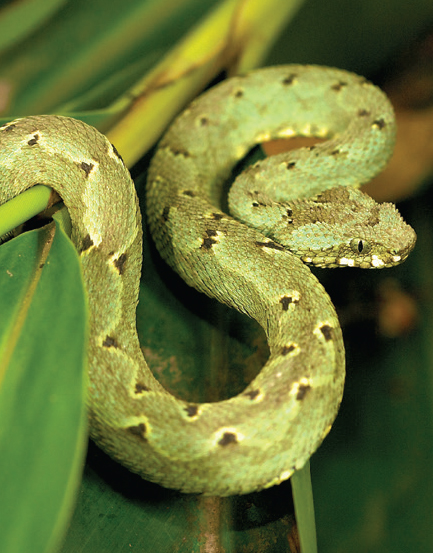
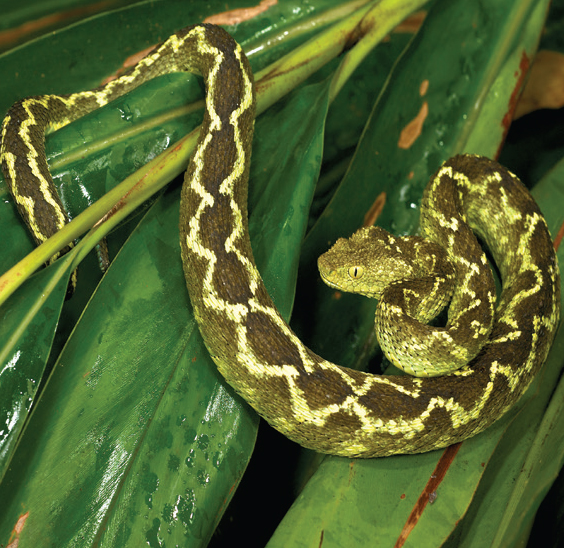
Tanzania (Michele Menegon).
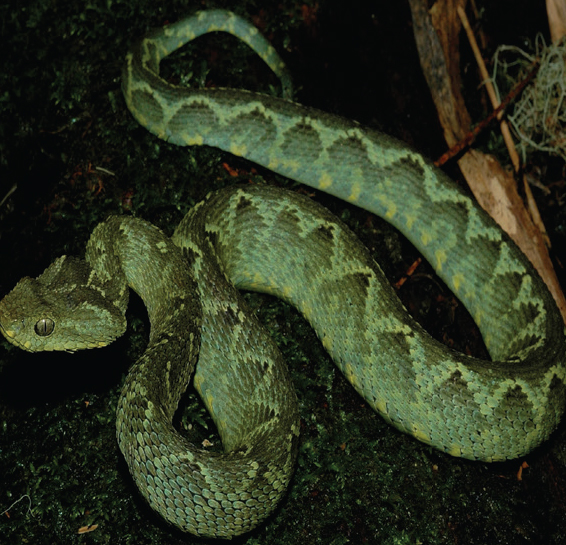
Tanzania (David Moyer).
Green Bush Viper Atheris squamigera
Identification: A large bush viper, usually green but sometimes other colours, often with fine yellow cross-bars. It has the widest range of any bush viper, occurring right across forested Central Africa. The head is broad, triangular and covered in small, strongly keeled scales. The small eye, with a vertical pupil, is set far forward. The tail is long and prehensile, 15–17% of total length in females and 17–20% in males. The scales are keeled; in 15–25 rows at midbody; ventrals 133–175; subcaudals 45–67 (higher counts in males). Maximum size about 80cm, average 40–65cm; hatchlings 16–22cm. The colour in much of its range is green or yellow-green (very occasionally brown), often becoming turquoise towards the tail. Sometimes the yellow-tipped scales form a series of fine yellow cross-bars. The belly is greenish blue, with yellow blotches. Juveniles are olive, green or yellow-green, with dark-edged, olive V-shapes on the back. Hatchlings are more strongly banded than adults, but have a bright yellow or pink tail tip, which may be used as a lure. However, in Central Africa, especially in DR Congo, several other colour morphs are known, including orange, bright and dull yellow, slate grey and blue-grey, and with or without cross-bars. The colour varies within broods; for example, a Kinshasa female gave birth to orange, yellow and green offspring.
Habitat and Distribution: All types of forest, and in well-wooded savanna, from sea level to 1,700m. In Nigeria it is found in a wide range of habitats, including suburbia, agriculture and mangroves. It seems to be separated by altitude from the Great Lakes Bush Viper (Atheris nitschei) in the country around the Albertine Rift, the Green Bush Viper usually occurring below 1,600m and the Great Lakes Bush Viper above that. Sporadically distributed from Kenya (Kakamega Forest), Tanzania (Rumanyika National Park) and central Uganda (Mount Elgon, Lake Victoria forests, and low-altitude localities along the Albertine Rift), westwards across DR Congo, Republic of the Congo and southern Central African Republic to south-eastern Nigeria, and south to northern Angola. There is an isolated record from Watoka in South Sudan. Doubt has been cast on the historical records of this snake from Ghana, Togo and Ivory Coast; there are no unequivocal recent records, so these are not shown on the map.
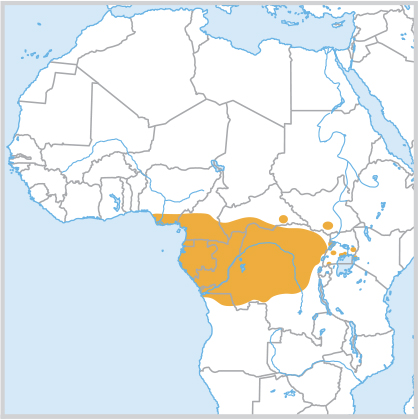
Atheris squamigera
Natural History: A largely arboreal, slow-moving snake, but it will descend to the ground at night. Largely nocturnal; it is most active between sundown and 2 a.m. It may bask on top of vegetation in clearings during the day, though is sometimes found on the ground. It is usually found in bushes and small trees, but may climb up to 6m or more above ground level. It is willing to strike when first caught and forms C-shaped coils, like carpet vipers (Echis); the coils are shifted against each other in opposite directions, producing a sizzling sound, like water falling on a hot plate. At night, it descends to low levels and waits in ambush with the head hanging down. It can also drink in this position, sipping water from condensing mist or rain running down the body. It feeds largely on small mammals and is also known to take birds, lizards, amphibians and small snakes; adults eat mostly warm-blooded prey, while juveniles eat lizards and shrews. Mating has been observed in October in Uganda; 7–9 young are born in March–April.
Medical Significance: At present this is the only species of bush viper known to have caused human fatalities, its wide range bringing it into contact with forest villagers. Chippaux and Jackson, in Snakes of Central and Western Africa, report ‘many deaths’, although without further data. The venom appears to be cytotoxic. Two documented fatal bite cases, from Central African Republic and Kenya, showed massive swelling and incoagulable blood; death occurred after six days in both cases. A Nigerian victim lapsed into a coma, but recovered. The species is said to have caused ‘a number’ of fatalities in West Africa. Local pain, often intense, swelling and coagulopathy seem to characterise most cases of bite from this viper. Specific antivenom is not available, although carpet viper antivenom has in some cases been shown to assist, so bites may need symptomatic treatment, including elevation, monitoring of clotting times, transfusions and replacement therapy.
Taxonomic Notes: Several taxa within this widespread species have been variously granted full species status, relegated back into the synonymy of Atheris squamigera, and in some cases re-elevated. These forms are largely based on slight differences of scalation and/or colour. They include A. anisolepis and A. laeviceps. However, the characters that supposedly identify these forms in their habitats are often present in typical A. squamigera from other parts of Africa. Pending a re-examination of the taxon, we leave them within the synonymy of A. squamigera.
Green Bush Viper, Atheris squamigera.
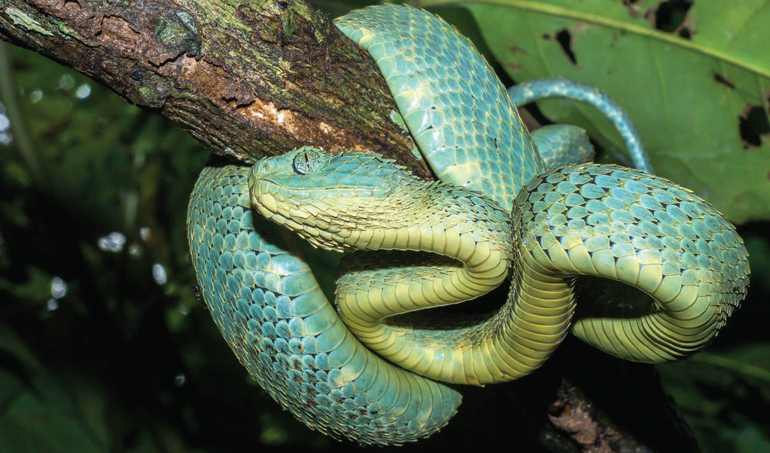
Eastern DR Congo (Konrad Mebert).
captives (Paul Freed).
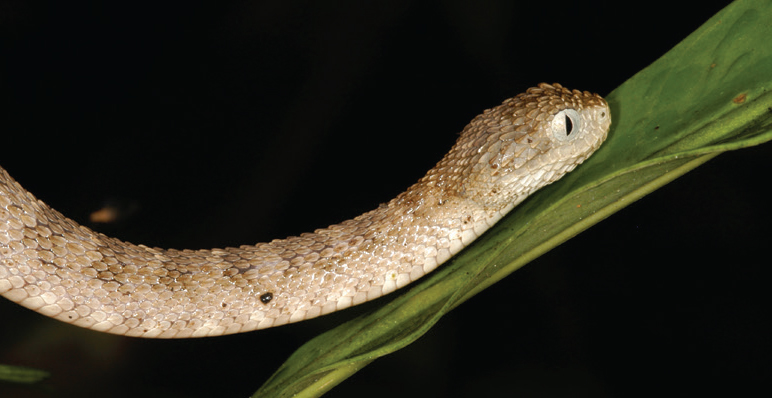
Angola (Alan Channing).
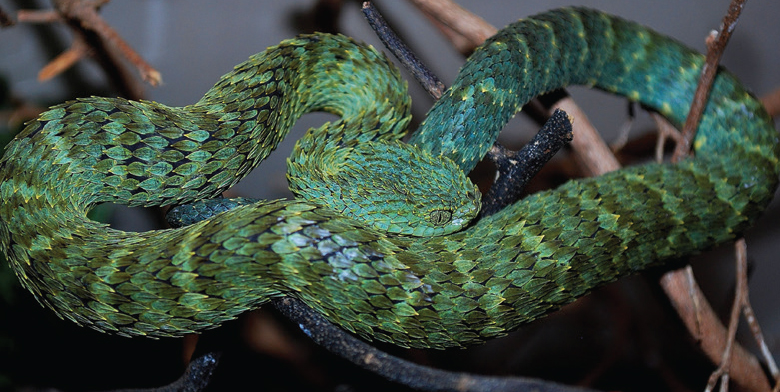
Kenya (Stephen Spawls).
Cameroon Bush Viper (Fischer’s Bush Viper)
Atheris subocularis
Identification: A small, slim green bush viper from the forests of western Cameroon. The head is short, the eye large, the pupil vertical and the neck thin. Usually there are no subocular scales, though occasionally there may be a single row or a few tiny irregular ones. There are many small scales on top of the head, some of which curve noticeably upwards, like those of the Rough-scaled Bush Viper (Atheris hispida). The body is subtriangular in section and the tail is 19–22% of total length. The scales are strongly keeled; in 14–16 rows at midbody; ventrals 152–163; cloacal scale entire; subcaudals 58–65. Maximum size about 55cm, average around 30–45cm; hatchling size unknown. The colour is dull green or yellow-brown, with faint, pale yellow cross-bars, interspersed with small dark blotches, and the underside is dull lime green, sparsely smudged with black. The head is marked with black blotches, forming an incomplete chevron. Juveniles have a yellowish tail tip; hatchlings are dark brown or black.
Habitat and Distribution: Known only from the forests of western Cameroon, in the South-West Region, between 200m and 400m.
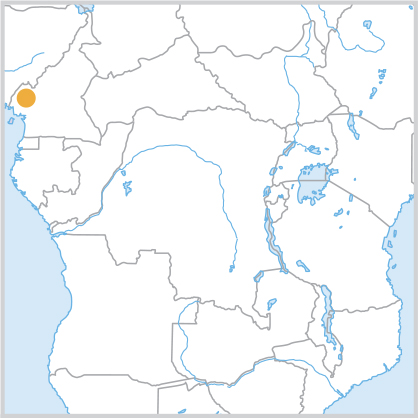
Atheris subocularis
Natural History: Nothing known, but presumably similar to other bush vipers; that is, primarily nocturnal, mostly arboreal (although the specimens used in the redescription were found crossing a road), and gives birth to live young. It presumably feeds on small vertebrates.
Medical Significance: Nothing known.
Cameroon Bush Viper, Atheris subocularis.
Cameroon (Dwight Lawnson).
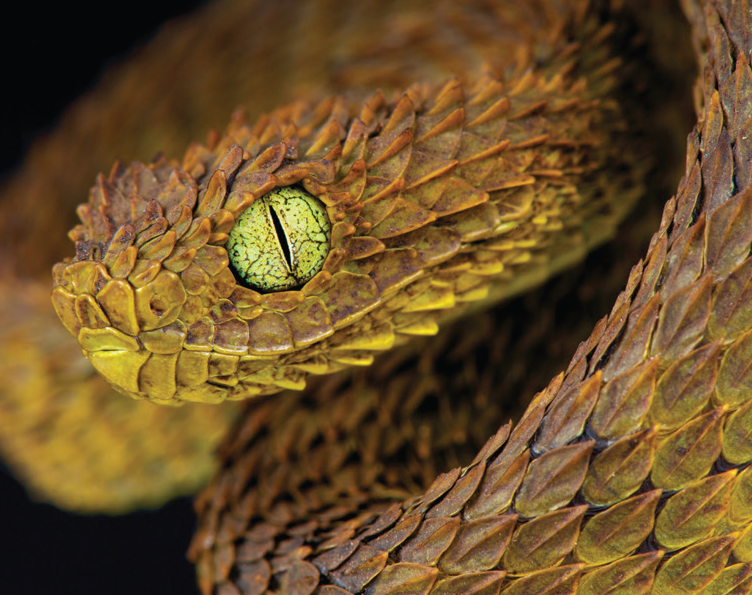
captive (Matthijs Kuijpers).
A genus containing a single species that lives at high altitude in central Kenya. Of all Africa’s dangerous snakes, it is probably the least significant medically, as it is very small, and its entire range lies on montane moorlands within two high-altitude national parks where virtually no one lives and nobody walks without shoes. No antivenom is available.
Kenya Montane Viper Montatheris hindii
Identification: A small, slender viper from the moorlands of the Aberdare Mountains and Mount Kenya. It has an elongate head, covered in small, strongly keeled scales. The small eye, with a brown iris and vertical pupil, is set far forward. The body is cylindrical and the tail short, 10–13% of total length. The scales are keeled; in 24–28 rows at midbody; ventrals 127–144; subcaudals paired, 25–36. Maximum size about 35cm, average 20–30cm; hatchlings 10–14cm. The dull grey or brown body has a paired series of triangular, pale-edged black blotches along the back. The underside is yellow, cream or grey-white, but heavily mottled black, to the extent of appearing black in places. There is an irregular, dark brown arrow- or V-shaped mark on the crown of the head. A wide, dark stripe passes through the eye to the temporal region. The upper and lower labials are white.
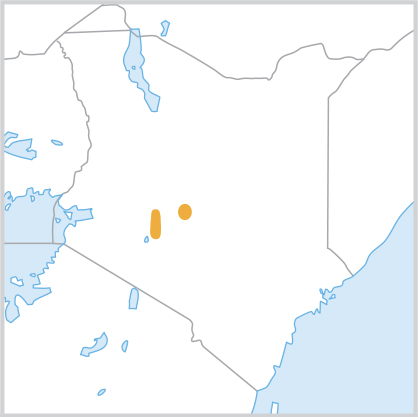
Montatheris hindii
Habitat and Distribution: This unique, beautiful tiny Kenyan endemic is found only at high altitude (2,700–3,800m) in treeless montane moorland. There is an isolated population on the Aberdare Mountains and another on Mount Kenya. It has probably the smallest range of any dangerous African snake.
Natural History: Poorly known. It is terrestrial, and somewhat sluggish unless warmed up. It is active by day, usually between 10 a.m. and 4 p.m, as the nighttime temperatures in its mountain habitat are usually below freezing. It shelters in thick grass tufts that provide cover and insulation from the extreme cold, but may also hide under ground cover (rocks, vegetable debris) or in holes. Due to the cold winds and rarefied air, much time is spent inactive in shelter. On days of warm sunshine it emerges to bask on patches of warm soil or a grass tussock, and will then hunt. It is irascible and willing to bite if threatened. A female from the Aberdares gave birth to two live young, of 13.1cm and 13.5cm in length, in late January, a captive female produced three young (length 10.2–10.9cm) in May, and small juveniles (15–17cm) were collected in February. It eats lizards, including chameleons and skinks, and small frogs, and may take small rodents as well; a Mount Kenya specimen ate a shrew while in a pitfall trap. It is quite common in suitable habitat, and females seem to be found more often than males, probably because they need to bask more frequently when gravid. The enemies of this small viper include predatory birds; Augur Buzzards (Buteo augur) have been seen to take them. The taxonomic relationships of this small viper and its evolutionary history are mysteries.
Medical Significance: Very low; see the notes on the genus (here).
Kenya Montane Viper, Montatheris hindii.
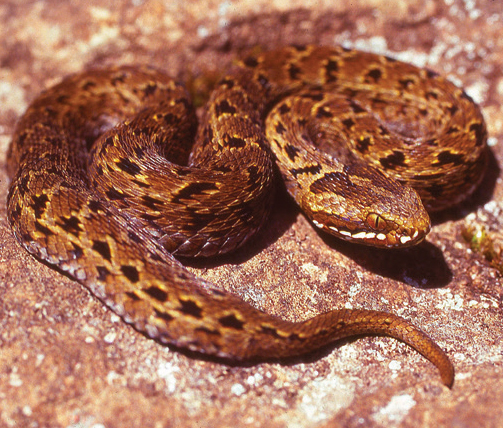
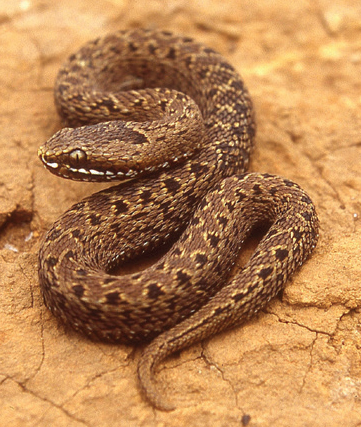
Kenya (Stephen Spawls).
Floodplain or lowland viper Proatheris
A genus containing a single medium-sized terrestrial viper, found on river floodplains in south-eastern Africa. Sometimes common, and fishermen and farmers might be at risk.
Floodplain Viper (Lowland Viper) Proatheris superciliaris
Identification: An attractive small terrestrial viper, with black spots and fine yellow stripes, associated with Lake Malawi and the rivers running out of it. It has a distinct, rather elongate triangular head that is covered with small, keeled, overlapping scales. The tail is short and distinct in females, but longer and less distinct in males. The dorsal scales are strongly keeled and overlapping, the outermost row enlarged and feebly keeled to smooth; in 27–29 (rarely 26 or 30) rows at midbody; ventrals smooth, 131–159; cloacal scale entire; subcaudals smooth, in 32–45 pairs. Maximum size about 60cm in females, 55cm in males, average 25–45cm; hatchlings 13.5–15.5cm. The dorsum is grey-brown with three rows of dark brown spots separated laterally by a series of elongate yellowish bars that form an interrupted line on either side of the body. Three dark, chevron-shaped marks cover the front of the head. The belly is off-white, with numerous black blotches in irregular rows. The lower surface of the tail is straw yellow to bright orange. The species’ colour and pattern make it extremely difficult to detect unless it is in motion.
Habitat and Distribution: Lives on floodplains and in moist savanna, between sea level and about 800m. It has a curious distribution. It occurs around the shores of the southern end of Lake Malawi, and Lake Chilwa, and south along the Shire River into Mozambique where it meets the Zambezi, then down the Zambezi to its mouth. From there it extends northwards on the Mozambique coastal plain to Quelimane, south to Beira, and inland to Muda and Gorongosa. It also occurs at the north end of Lake Malawi, just extending into Tanzania at Mwaya and Ipyana. The type, collected by Wilhelm Peters and described in 1854, was from ‘Terra Querimba’, which is taken to mean the mainland opposite the trading post on the Quirimba Islands, but this is more than 700km from the nearest documented record.
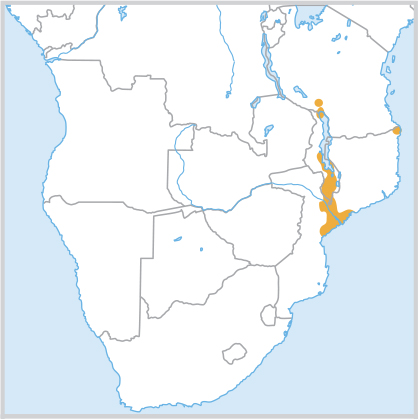
Proatheris superciliaris
Natural History: Terrestrial. Just before the breeding season, it can be seen basking at the mouths of rodent burrows. As is suggested by its vertical pupil, this snake is most active in the early evening, when its prey, mostly amphibians but also small rodents, is also active. During the cold season (April–July), when night temperatures drop to 6°C, it may bask in front of its retreat during daylight hours. When threatened, it throws its body into C-shaped coils, like egg-eaters (Dasypeltis) and carpet vipers (Echis), and can strike rapidly. Mating occurs in July, and 3–16 young are born November–December.
Medical Significance: Apparently a rare snake, with a restricted range, so not a significant cause of snakebite. No fatalities are known. No antivenom is available. However, case histories of bites inflicted on snake keepers indicate that this is a very dangerous snake; the venom has some severe effects, the victims suffering intense pain and swelling, necrosis, coagulopathy, thrombocytopenia and acute kidney injury. Recovery was relatively slow.
Floodplain Viper, Proatheris superciliaris.
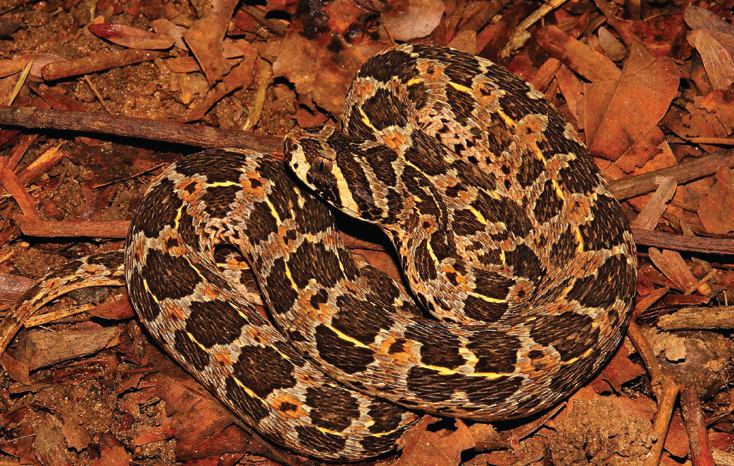
Malawi (Gary Brown).
Mozambique (Mark-Oliver Rödel).
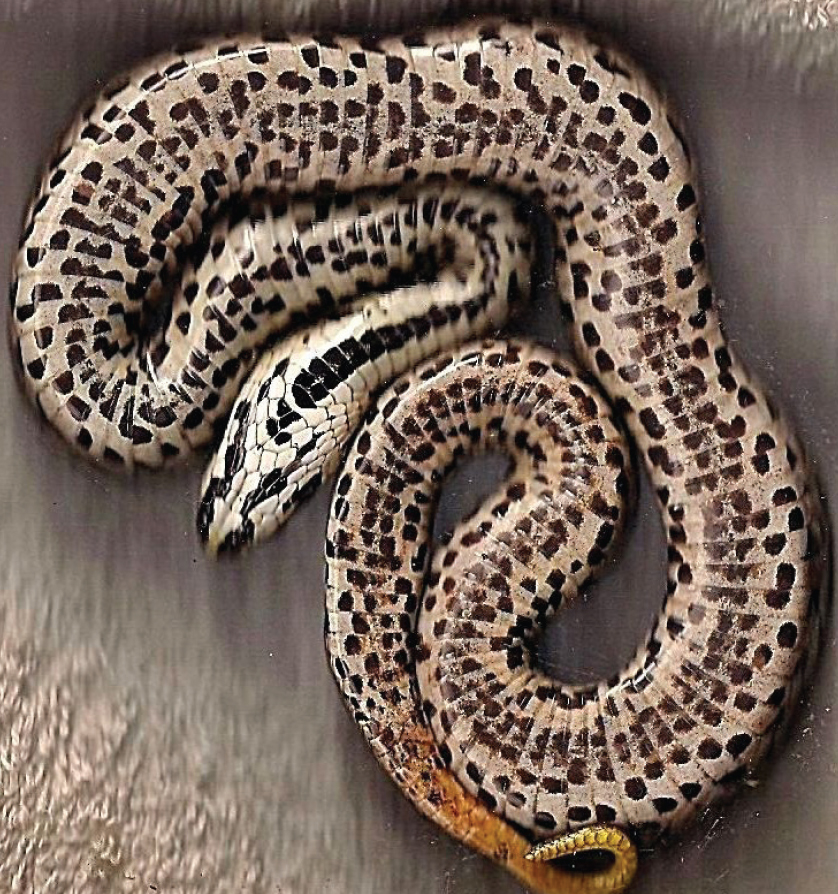
underside (Gary Brown).
A genus of stout-bodied, broad-headed, nocturnal African vipers, all beautifully marked and fairly easily identified in the field. Eighteen species are known; six are heavy-bodied and large, reaching a metre or more, while 12 are small, rarely larger than 60cm. Most of the small forms have restricted ranges in inhospitable areas; they are not very significant medically, and no definite fatalities are recorded. Of the large species, two have small ranges, both in the Ethiopian highlands, and little is known of their venom. However, the other four (Rhinoceros Viper, Bitis nasicornis; Puff Adder, B. arietans; and Eastern and Western Gaboon Vipers, B. gabonica and B. rhinoceros) have large ranges and are among Africa’s most dangerous snakes. They are slow-moving, active on the ground at night, well camouflaged and easily trodden on, and they deliver a large dose of a powerful cytotoxic venom when they strike. A bite from one is a medical emergency, and must be treated in a well-equipped hospital. Antivenom is available. Symptoms include intense local pain, swelling, blistering, compartment syndrome, shock, blood coagulation abnormalities and necrosis. The Puff Adder is arguably Africa’s most dangerous snake. It has a huge range in the savanna where people live, it is large, common and irascible, and it bites a lot of rural people and their animals.
All members of the genus give birth to live young. They all move slowly but strike quickly, from ambush, the stout body lending stability to the strike. These vipers have a curious small pocket behind the nostril, the supranasal sac. This sac is similar to the pit organ of the rattlesnake and other pit vipers. It may be able to detect radiant heat, and thus serve to help the snake target warm prey in the dark; recent experiments have shown that blinded Puff Adders can still detect and strike at warm-blooded prey.
Key to the genus Bitis, African vipers
1aProminent horns (not just raised scales) on the nose……2
1bNo prominent horns on the nose……3
2aHead pale, with a fine dark line down the centre……Bitis rhinoceros, Western Gaboon Viper
2bHead usually green or blue, with a broad black arrowhead in the centre……Bitis nasicornis, Rhinoceros Viper
3aA long (not minute) horn above the eye, consisting of a single elongate scale……4
3bNo horn above the eye, or, if present, the horn consists of a cluster of scales, or is minute……5
4aTwo light dorsolateral flank stripes enclose a double row of dark blotches; in highland Kenya……Bitis worthingtoni, Kenya Horned Viper
4bNo dorsolateral flank stripes, and a single row of central flank blotches present; in southern Africa……Bitis caudalis, Horned Adder
5aBlack with fine yellow vermiculations; in high montane forest in Ethiopia……Bitis harenna, Bale Mountains Viper
5bNot black with yellow vermiculations; not necessarily in high montane forest in Ethiopia……6
6aA pale line between the eyes; dorsal pattern consists of V-shapes pointing towards the tail……Bitis arietans, Puff Adder
6bNo pale line between the eyes; dorsal pattern not consisting of V-shapes……7
7aDorsal pattern consists of yellow butterfly shapes and dark hexagons; in highland forest in Ethiopia……Bitis parviocula, Ethiopian Mountain Viper
7bDorsal pattern does not consist of yellow butterfly shapes and dark hexagons; not in highland forest in Ethiopia……8
8aHuge, up to 1.8m; head usually pale and unmarked except for a light central line; midbody scale rows 34 or more……Bitis gabonica, Eastern Gaboon Viper
8bSmall, less than 80cm; head not pale and unmarked; midbody scale rows fewer than 34……9
9aThree-pronged trident shape between eyes; in central Angola……Bitis heraldica, Angolan Adder
9bNo three-pronged trident shape between eyes; not in central Angola……10
10aNumber of scale rows one head length behind the head equal to or slightly more than the number at midbody……Bitis xero-paga, Desert Mountain Adder
10bNumber of scale rows one head length behind the head fewer than the number at midbody……11
11aSupraorbital region of the head not raised……12
11bSupraorbital region of the head raised……13
12aOuter row of dorsal scales more or less keeled; head elongate; 11–16 scales between the eyes and 1–2 scales between the eyes and the upper labials; subcaudals smooth……Bitis atropos, Berg Adder
12bOuter row of dorsal scales smooth; head not elongate; 6–9 scales between the eyes and 2–4 scales between the eyes and the upper labials; subcaudals usually keeled towards the tail tip……Bitis peringueyi, Péringuey’s Adder
13aRestricted to southern Namibia and Little Namaqualand, extreme western Northern Cape and Western Cape, South Africa; a single minute horn-like scale above the eye……Bitis schneideri, Namaqua Dwarf Adder
13bNot restricted to southern Namibia and Little Namaqualand, extreme western Northern Cape and Western Cape, South Africa; does not have a single horn-like scale above the eye……14
14aVentrals always fewer than 131 in females and fewer than 126 in males……15
14bVentrals usually more than 130 in females and more than 126 in males……16
15aAlways more than 20 paired dorsal blotches on the body; horns usually well developed, especially in males; restricted to the southern tip of the Western Cape, South Africa……Bitis armata, Southern Adder
15bNever more than 20 paired dorsal blotches on the body; horns usually absent or represented by small conical scales; restricted to the Port Elizabeth area of the Eastern Cape……Bitis albanica, Albany Adder
16aHorns always well developed as a tuft of 4–7 elongate scales above the eye; usually 27 midbody scale rows; usually 15–16 scales around the eye; body always with prominent paired dorsal blotches, usually 25 or more……Bitis cornuta, Many-horned Adder
16bHorns absent or poorly developed; usually 29 midbody scale rows; usually fewer than 14 scales around the eye; body always brown or reddish, often patternless, or usually fewer than 24 paired dorsal blotches……17
17aHorns always absent; body usually plain yellowish brown, rarely with faint dorsal blotches; usually less than 33cm maximum, in montane grassland of the Sneeuberg Range, Eastern Cape……Bitis inornata, Plain Mountain Adder
17bHorns often absent in females and poorly developed in males; body commonly reddish, usually with 21–24 faint dorsal blotches (sometimes up to 30), rarely plain; usually over 35cm maximum; widely distributed in the western and southern part of the Northern Cape, South Africa……Bitis rubida, Red Adder
Identification: Africa’s largest viper. It occurs throughout the savanna and is a fat snake, with a broad, flat triangular head, a pale line between the eyes, and V-shapes on the back. The head is covered in small, overlapping, strongly keeled scales. The small eye, with a vertical pupil, is set far forward, and the nostrils are upturned. The neck is thin, the body fat and depressed, and the tail fairly short, 10–15% of total length in males and 6–9% in females. The dorsal scales are keeled; in 27–41 rows at midbody; ventrals 123–147; subcaudals 14–39 (usually more than 25 in males). Maximum size depends on locality; in most of Africa rarely larger than 1.2m, average 0.6–1m. Much larger examples, up to 1.8m or possibly more, occur in the dry savanna of northern Uganda, northern and eastern Kenya, Somalia and eastern Ethiopia. Hatchlings 15–23cm. The colour is variable; it may be grey, brown, rufous or yellow, usually with a series of V-shapes down the back that may morph into cross-bars. The underside is yellow or white, interspersed with short black dashes. There is usually a light line between the eyes. In highland areas, males are often brighter than females. Unusual colour morphs (snakes with vertebral stripes, no head markings, or cross-bars instead of stripes) occasionally occur.
Habitat and Distribution: Throughout the African savannas, and also in woodland, semi-desert and near-desert, from sea level to 2,200m, sometimes higher. Absent only from high altitude above 2,400m and closed forest. It occurs from southern Mauritania east to Eritrea and Somalia, and south to South Africa. There is an isolated population in Western Sahara and southern Morocco, and an extralimital one in the south-west Arabian Peninsula.
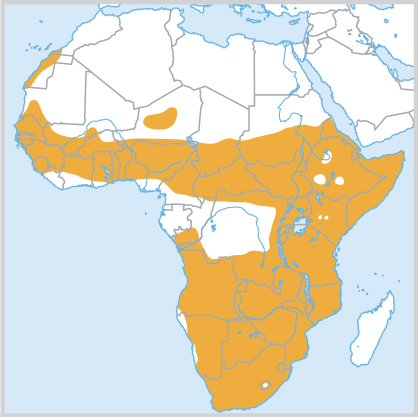
Bitis arietans
Natural History: Terrestrial, but may climb low bushes or trees. It is usually nocturnal, though is sometimes active by day in the rainy season. In high-altitude areas it may bask. It hides in thick grass, under ground cover, down holes, in leaf drifts, under bushes, etc. It is often poorly concealed under small bushes or in grass tufts, but well camouflaged and thus liable to be trodden on. It hunts by ambush, waiting for prey, which is ambushed with a rapid strike. It crawls in a straight line if unhurried (‘caterpillar crawl’), leaving a single broad track; if stressed it can move in the usual serpentine, side-to-side movement. When threatened, it inflates the body – hence the common name – hisses loudly, and raises and draws back the front third of the body. If a target is within range, a rapid strike follows. The withdrawal is equally rapid and the snake may overbalance, hence the incorrect and highly dangerous belief that Puff Adders only strike backwards and it is safe to stand in front of one. Captive individuals often remain bad-tempered and noisy. Males indulge in combat, neck-wrestling each other. Females produce a pheromone that attracts males. They give birth to live young. The clutch size depends on female size and altitude; usually 10–35 are born, but a Kenyan female had 156 young, a record for any vertebrate. The diet is varied and includes mammals (from rats up to small antelope), birds, amphibians and reptiles, including snakes and tortoises. Large prey animals are struck, released and followed; small prey may be simply seized and swallowed. This snake’s enemies include monitor lizards, large cobras, predatory birds and small carnivorous mammals.
Medical Significance: A very dangerous snake, and its relative abundance, good camouflage and disinclination to move if approached mean that rural people are often bitten, although a recent survey indicates that it is not as willing to bite as is sometimes believed. The venom is potently cytotoxic. Symptoms include severe local pain, extensive swelling and blistering, compartment syndrome, necrosis, hypovolaemia, shock and blood coagulation abnormalities. Although rapid death from Puff Adder bites is rare, and there is usually time to get the victim to hospital, treatment there may involve antivenom therapy and be prolonged, complicated and intense. A Puff Adder bite is a medical emergency; rapid hospitalisation is mandatory. Local necrosis is common, often resulting in permanent damage and occasionally death; amputation is often necessary. There is some regional variation; in West Africa, Puff Adder bites are often characterised by spontaneous bleeding, bruising and skin haemorrhages, due to thrombocytopenia. However, there is usually no coagulopathy. In East and South Africa, in addition to bleeding, bruising and swelling, coagulopathy leading to incoagulable blood has been noted, and in rare cases cerebral thrombosis. These regional differences have led to suggestions that there is more than one species of Puff Adder. However, except in unusual circumstances (venom injection directly into a blood vessel, or anaphylactic shock), rapid death is unlikely. There is some debate about how useful antivenom is for Puff Adder bites, but the consensus is that it should be used as early as possible, particularly if local swelling is spreading rapidly or is extensive. Shock should be treated with intravenous fluid replacement and antivenom. Fasciotomy is very rarely indicated.
Puff Adder, Bitis arietans.
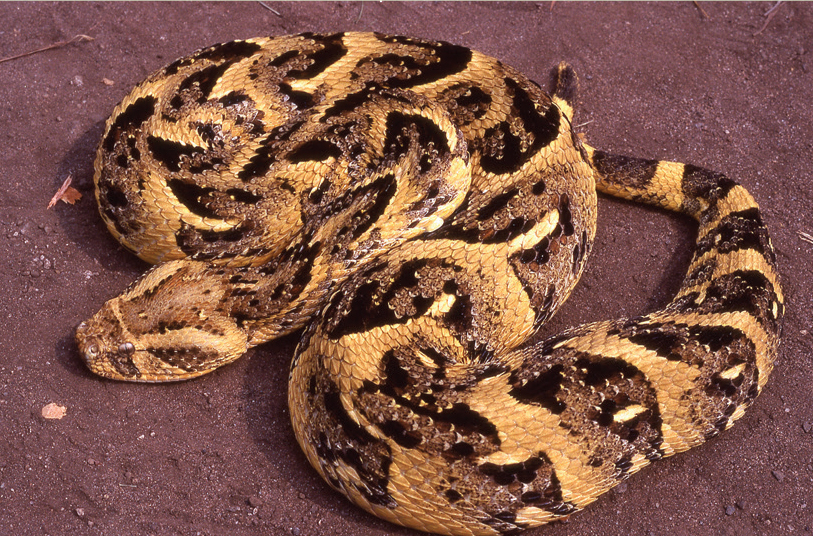
Tanzania (Stephen Spawls).
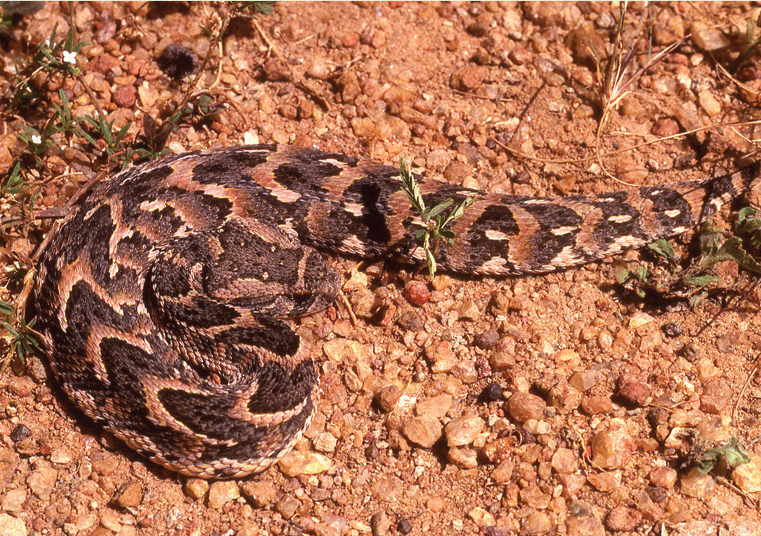
Ghana (Stephen Spawls).
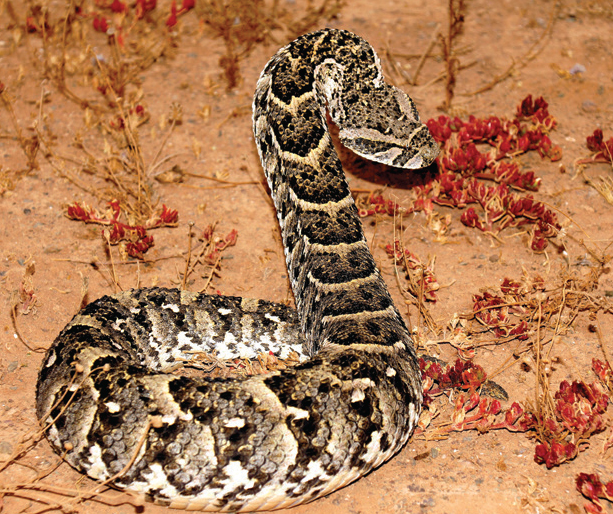
threat display, Morocco (Konrad Mebert).
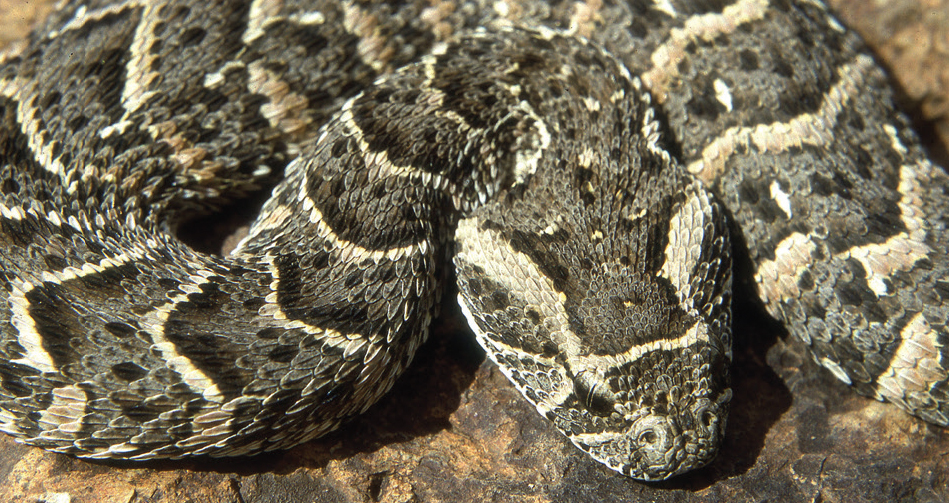
Ethiopia (Stephen Spawls).
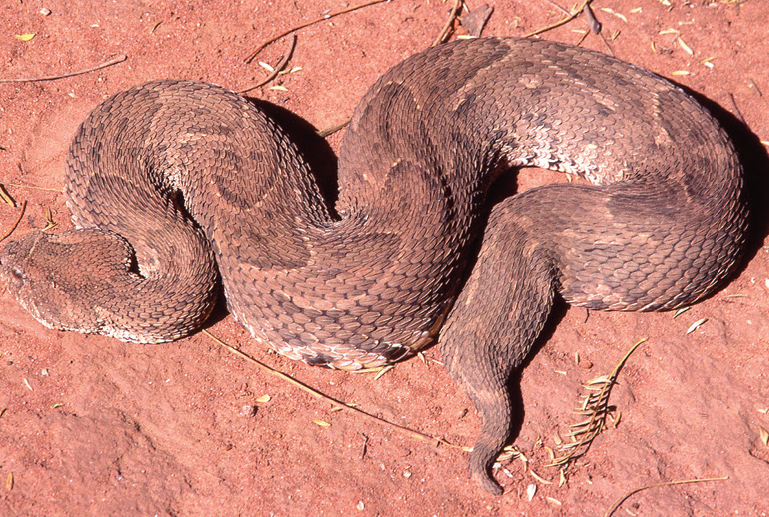
Kenya (Stephen Spawls).
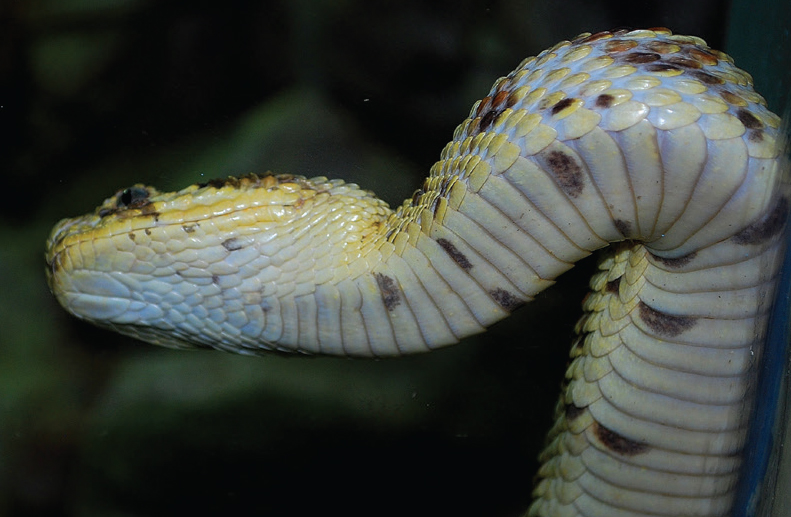
underside (Stephen Spawls).
Rhinoceros Viper (Rhino-horned Viper) Bitis nasicornis
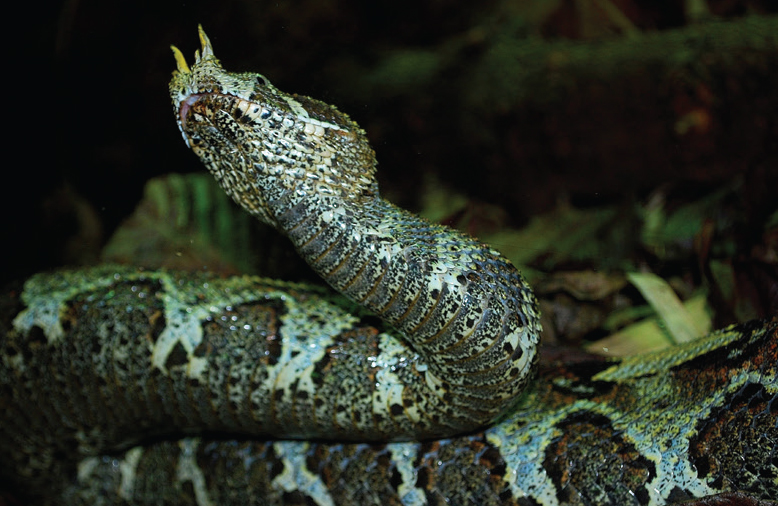
Identification: Unmistakable if seen clearly; a large, stout viper, with a narrow, flat triangular head covered in small, strongly keeled scales. On the end of the nose is a cluster of two to three pairs of hornlike scales. The small eye is set well forward, the pupil is vertical, and the iris is green or gold with black flecks. The neck is thin, the body triangular in section and the tail short, 13–18% of total length in males and 7–10% in females. The body scales are rough and heavily keeled, the keels so hard and prominent that they have been known to inflict cuts on snake handlers when the snake struggles. The scales are in 30–43 rows at midbody; ventrals 117–140; cloacal scale entire; subcaudals paired, 12–32 (higher counts in males). Maximum size about 1.4m, average 0.8–1.1m; hatchlings 18–25cm. The colour pattern is complex. Down the back runs a series of 15–18 large oblong blue or blue-green markings, each with a yellow line down the centre. Irregular black rhombic blotches enclose these markings. On the flanks are a series of dark crimson triangles, sometimes narrowly bordered with blue or green. Many lateral scales are white-tipped. The top of the head is blue or green, with a vivid black arrow mark. The belly is dirty white to dull green, extensively marbled and blotched in black and grey. Specimens from the centre and west of the range tend to be more blue, and those from the east more greenish. The tongue is black with a purple base.
Habitat and Distribution: Forest, woodland and forest–savanna mosaic of West and Central Africa, from sea level to 2,400m. A true forest snake, not usually in woodland, sensitive to habitat destruction, and usually doesn’t cling on in deforested areas. It occurs in West Africa, from southern Sierra Leone, Liberia and Guinea east to Ghana. Known from forests in Togo, and occurs east from Nigeria to western Uganda, and south to northern Angola. Isolated records exist from Bioko, the Imatong Mountains in Sudan, the north-western shore of Lake Victoria in Uganda and northern Tanzania (Minziro Forest), and the Kakamega area in Kenya. Dubious records from Lake Bangweulu in Zambia and the Usambara/Uluguru Mountains in Tanzania are not shown on the map.
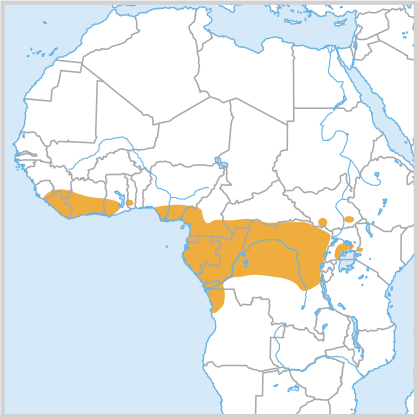
Bitis nasicornis
Natural History: Terrestrial, but regularly climbs into thickets and trees; in a series of 66 specimens from Kakamega, Kenya, over a third were taken in trees or bushes, sometimes up to 2.5m above ground level. A slow-moving snake, but strikes quickly. It swims, and has been found in shallow pools. It is nocturnal, tending to hide during the day among leaf litter, around fallen trees, in holes or among root tangles of large forest trees. It will also climb into thickets, clumps of leaves or cracks in trees. This species hunts by ambush, and probably spends most of its life motionless, waiting for a suitable prey animal to pass within striking range. It is more bad-tempered than the Gaboon vipers (Bitis gabonica and B. rhinoceros) but less so than the Puff Adder (B. arietans). If threatened, it can produce an astonishingly loud hiss – almost a shriek. The diet consists mostly of mammals (rodents and shrews) and amphibians. The females give birth to live young in March–April (start of the rainy season) in West Africa; there are few details in East Africa, but a Kakamega female had 26 young in March. From six to 38 young have been recorded.
Medical Significance: As this species is a forest snake that often climbs and spends much time motionless, bites are rare; it tends to stay out of humanity’s way. But it is a dangerous snake, present through the Central African forest, with cytotoxic venom causing extensive local swelling, necrosis and coagulopathy; the lethal dose is reportedly lower than that for both the Gaboon vipers and the Puff Adder. Bite victims need to be rapidly transported to a major hospital and treated; antivenom therapy may be necessary and clotting times need to be monitored. Many of the reported cases have involved swelling and coagulopathy, but the victims recovered. However, an American hobbyist bitten by a Rhinoceros Viper died within a few hours, as a consequence of anoxic brain damage.
Rhinoceros Viper, Bitis nasicornis.
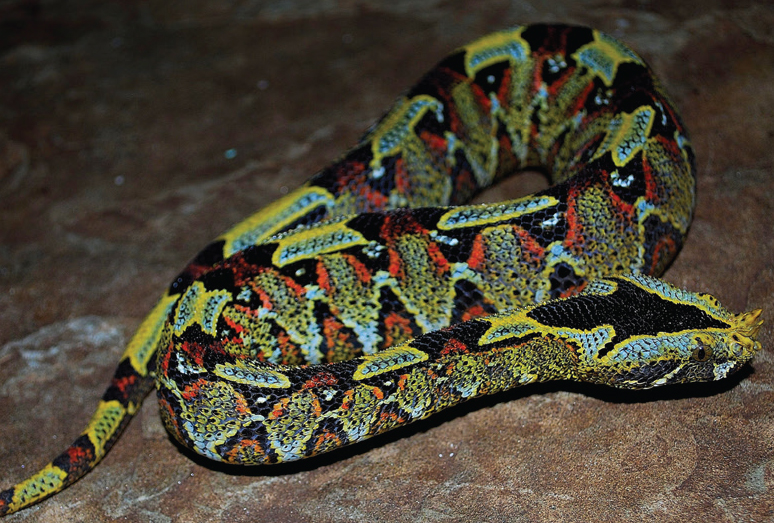
Tanzania (Stephen Spawls).
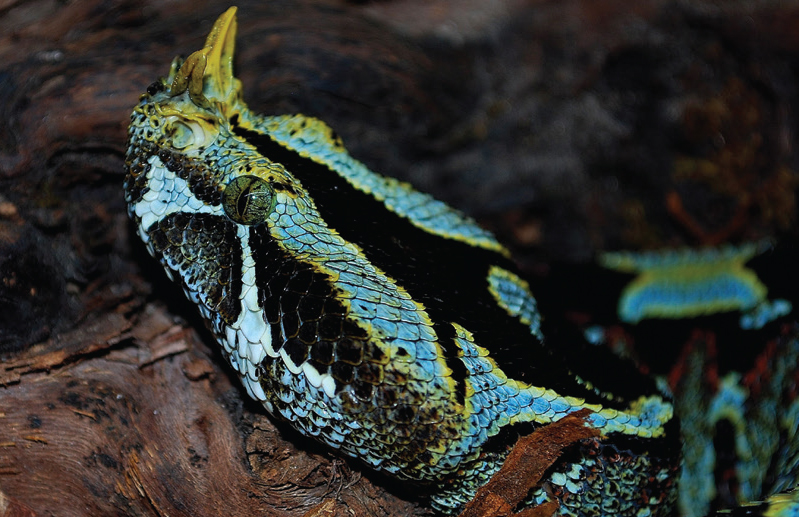
Uganda (Stephen Spawls).
Eastern DR Congo (Konrad Mebert).
underside (Stephen Spawls).
Ghana (Barry Hughes).
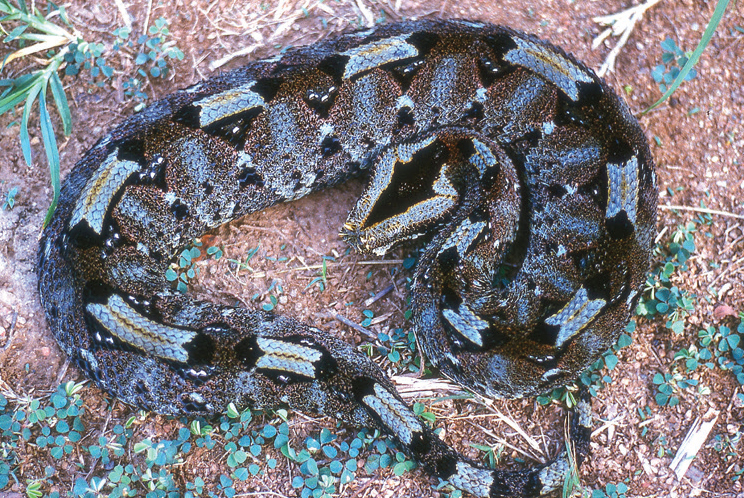
Eastern Gaboon Viper (Gaboon Adder) Bitis gabonica
Identification: Unmistakable; a fat viper of the Central and southern African forests, with a broad, flat white triangular head and a remarkable geometric pattern on its body. Between the raised nostrils is a pair of tiny horns. The small eyes, with a vertical pupil and a cream, yellow-white or orange iris, are set far forward. The tongue is black with a red tip. The body is very stout and depressed, and the tail short, 9–12% of total length in males and 5–8% in females. The scales are heavily keeled; in 35–46 rows at midbody; ventrals 124–140; subcaudals 17–33 (higher counts in males). Maximum size about 1.75m, possibly larger. Average 0.9–1.5m (the mean size of a large Nigerian collection was 1.3m), females usually larger than males; hatchlings 25–37cm. The head is white or cream with a fine, dark central line and black spots on the rear corners, and a dark blue-black triangle behind and below each eye. Along the centre of the back is a series of pale, subrectangular blotches, interspaced with dark, yellow-edged hourglass markings. On the flanks is a series of fawn or brown rhomboidal shapes, with light vertical central bars. The belly is pale, with irregular black or brown blotches. Specimens from the south-eastern area of its continuous range (Zambia, south-east DR Congo) often have a pinkish or orange cast.
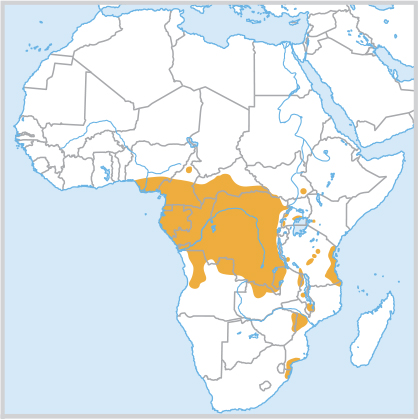
Habitat and Distribution: Coastal forest and thicket, woodland, forest–savanna mosaic, well-wooded savanna and forest, from sea level to 2,200m. It occurs eastwards from south-west Nigeria to eastern DR Congo and western Uganda, south to northern Angola and Zambia (Gaboon vipers from the West African forests are another species, the Western Gaboon Viper, Bitis rhinoceros). Apparently isolated populations occur in South Sudan (Imatong Mountains), along the Lake Victoria shore in Uganda, in the Kakamega area in Kenya, in eastern Tanzania and northern Mozambique, in parts of Malawi, from high eastern Zimbabwe across the Mozambique plain, and on the north-eastern South African coast, into southern Mozambique.
Bitis gabonica
Natural History: A slow-moving, usually placid nocturnal viper, spending much of its time motionless, hidden in leaf litter, thick vegetation, under bushes or in thickets, often near a game trail. It sometimes climbs into the understorey. Not usually in dense forest; more often in clearings, sunlit thickets and forest margins, where prey is more common. Adults largely hunt by ambush, waiting, often for a long time (a South African specimen remained motionless for 90 days), until suitable prey passes. However, juveniles actively forage, as indicated by the presence of newborn rats in their stomachs. Large prey animals are struck, released and followed; small prey may be simply seized and swallowed. Males are more active than females, especially after rain, even on cool nights. Individuals may bask in the day. Female give birth to live young; in southern Tanzania broods varied from 11 to 34, but clutches of up to 60 are known. Females do not eat while they are heavily gravid. A 35cm juvenile was taken in Kakamega Forest in September; hatchlings were found in mid-December to February in southern Tanzania. The diet is mostly small mammals, from shrews and rodents up to African Brush-tailed Porcupines (Atherurus africanus) and small antelope. Birds (several Tanzanian specimens had eaten chickens), amphibians and reptiles are sometimes taken. Males fight in the mating season, neck-wrestling, one male trying to force the other’s head down while they hiss continuously and strike with closed mouths. This species sometimes hybridises with the Puff Adder (Bitis arietans) in areas where the habitat overlaps.
Medical Significance: This is a very dangerous snake, being slow-moving and well concealed, and liable to be trodden on by those walking though vegetation. Anyone moving material on the ground is also at risk, although it is a placid snake, and often reluctant to strike. It has a deadly cytotoxic and haemorrhagic venom, although bites are rare due to its placid nature. Symptoms include spontaneous systemic bleeding, swelling, bruising, blistering, necrosis, and haemostatic and cardiovascular abnormalities (hypotension, shock, arrhythmias, ECG changes). Bites must be treated in hospital with antivenom and clinical support.
Taxonomic Notes: This snake and the Western Gaboon Viper (Bitis rhinoceros) were originally regarded as subspecies (B. gabonica gabonica and B. g. rhinoceros). However, they are reproductively isolated.
Eastern Gaboon Viper, Bitis gabonica.
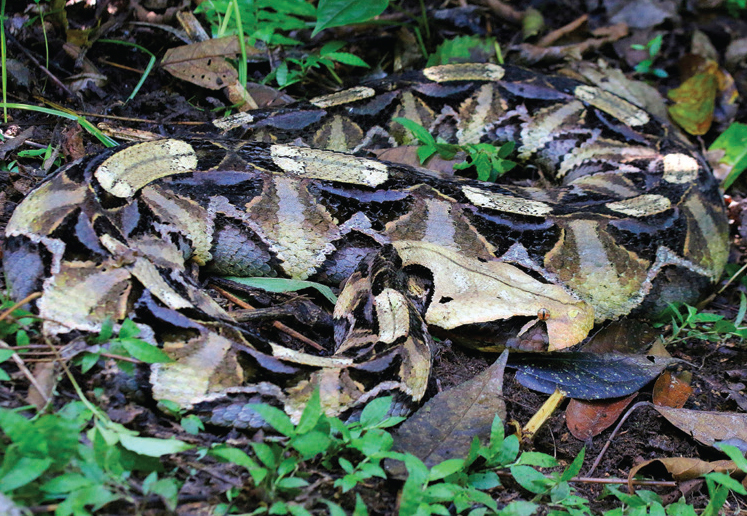
Uganda (Jelmer Groen).
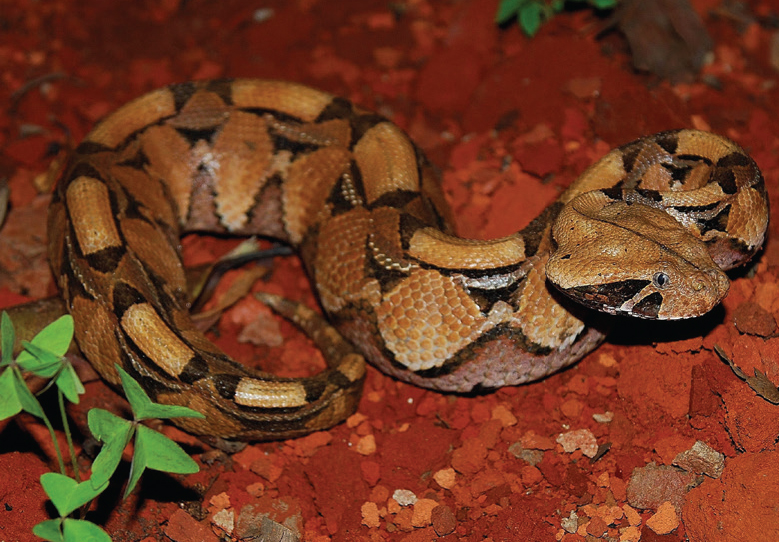
DR Congo (Colin Tilbury).
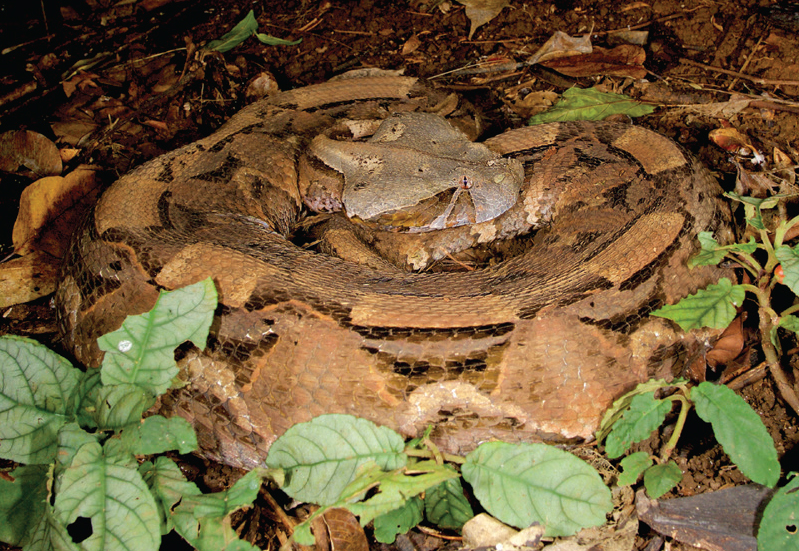
Tanzania (Michele Menegon).
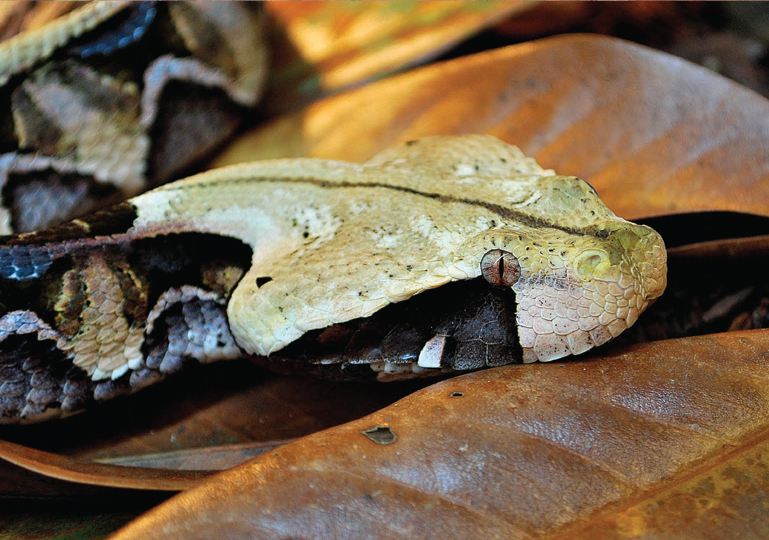
Uganda (Stephen Spawls).
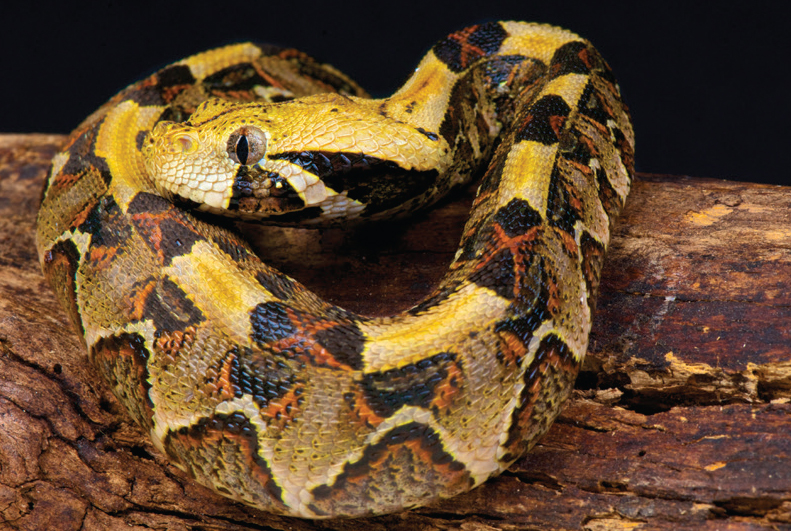
Hybrid between Eastern Gaboon Viper and Rhinoceros Viper (Matthijs Kuijpers).
Western Gaboon Viper Bitis rhinoceros
Identification: A fat viper of the West African forests, from Guinea to Togo, with a broad, flat white triangular head and a remarkable geometric pattern on its body. Between the raised nostrils is a pair of horns. The small eyes, with a vertical pupil and a cream, yellow-white or silvery iris, are set far forward. The tongue is black with a red tip. The body is very stout and depressed, and the tail short, 9–12% of total length in males and 5–8% in females. The scales are heavily keeled; in 28–46 rows at midbody; ventrals 128–147; subcaudals 17–33 (higher counts in males). Maximum size about 1.7m, possibly larger. Average 0.8–1.3m, females usually larger than males; hatchlings 25–37cm. The head is white or cream with a fine, dark central line and black spots on the rear corners, and a single dark triangle behind each eye; this is the only way this species differs externally from the Eastern Gaboon Viper (Bitis gabonica). Along the centre of the back is a series of pale, subrectangular blotches, interspaced with dark, yellow-edged hourglass markings. On the flanks is a series of fawn or brown rhomboidal shapes, with light vertical central bars. The belly is pale, with irregular black or brown blotches.
Habitat and Distribution: Coastal forest and thicket, woodland, forest–savanna mosaic, well-wooded savanna and forest. It occurs eastwards from western Guinea and Sierra Leone to Ghana; also in forests in south and central Togo. Further east it is replaced by the Eastern Gaboon Viper. A specimen was found on Legon Campus, just east of Accra, Ghana.
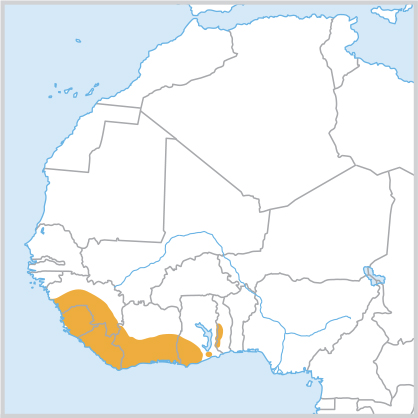
Bitis rhinoceros
Natural History: Fairly similar to the Eastern Gaboon Viper (i.e. slow-moving, nocturnal, usually motionless, hidden in leaf litter, eats mostly mammals and birds, and gives birth to live young). A fascinating study in Tai National Park in Ivory Coast made use of a habituated troop of Sooty Mangabeys (Cercocebus atys) to detect these snakes; the foraging monkey troop leapt aside and gave loud alarm calls when they found a viper. Vipers were located on average every 10 days, and it was estimated there was roughly one snake per 20 hectares (i.e. five per square kilometre).
Medical Significance: This is a very dangerous snake, with a deadly cytotoxic and haemorrhagic venom, although bites are rare due to its placid nature. Risk factors are as for the previous species. Symptoms include spontaneous systemic bleeding, swelling, bruising, blistering, necrosis, and haemostatic and cardiovascular abnormalities (hypotension, shock, arrhythmias, ECG changes). Bites must be treated in hospital with antivenom and clinical support.
Western Gaboon Viper, Bitis rhinoceros.
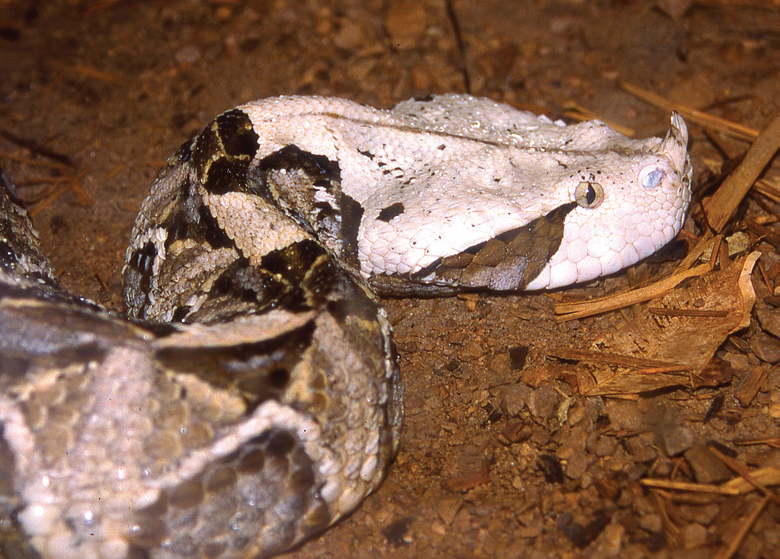
Ivory Coast (Stephen Spawls).
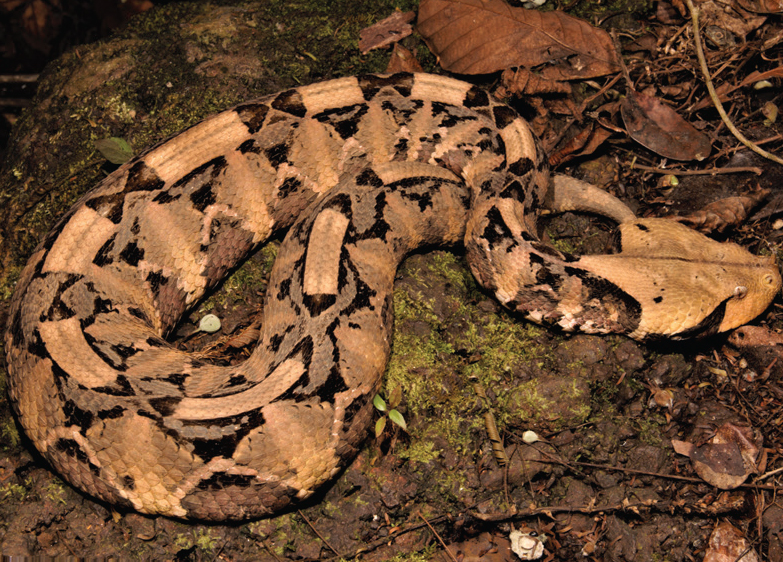
Sierra Leone (Bill Branch).
Ethiopian Mountain Viper Bitis parviocula
Identification: A fat viper endemic to the forests of southern Ethiopia. The small eyes, with a vertical pupil and a yellow iris, are set fairly far forward. The tongue is deep blue and black. The body is very stout and depressed, and the tail short. The scales are heavily keeled; in 37–39 rows at midbody; ventrals 141–146; subcaudals 20–21. Maximum size about 1.3m, possibly larger. Average 0.7–1m; hatchlings 17–24cm. The head is broad and yellow, with a dark triangle between the eyes and a vague hammer shape behind this. The ground colour is yellowish or greeny-grey, often darkening posteriorly. Along the centre of the back is a series of black hexagons, interspersed with yellow butterfly shapes, with white-spotted black subtriangular shapes below. On the flanks is a series of upward-pointing, pale-edged dark triangles. The underside is greenish or yellow, with irregular black or brown blotches.
Habitat and Distribution: Known from broadleaved forest, coffee plantations and deforested areas of southern Ethiopia. There are few formal records. West of the Ethiopian Rift Valley it is probably widespread in the area between the towns of Bedelle, Metu, Bonga and Mizan Teferi, as specimens are known from all those towns and a fair amount of forest remains; it is also known from Sheka Forest Biosphere Reserve, north of Mizan Teferi. It probably occurs in the extensive forest west of the Metu–Mizan Teferi road. East of the Ethiopian Rift Valley, a single enigmatic museum specimen is recorded from Dodolla, at 2,400m on the northern side of the Bale Mountains; the town itself is in high grassland, but suitable forest exists not far south of there. Local people in both the town of Wondo Genet (west of Dodolla) and the Harenna Forest of the Bale Mountains claimed to recognise this snake from photographs.
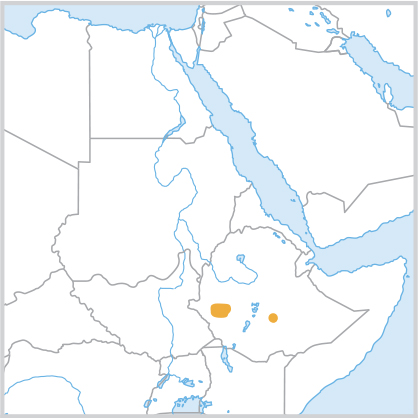
Bitis parviocula
Natural History: Poorly known, but presumably similar to the other large forest Bitis; that is, slow-moving, nocturnal, usually motionless, hidden in leaf litter, and eats mostly mammals and birds. Captive specimens seem fairly placid, and resemble Gaboon vipers (Bitis gabonica and B. rhinoceros) in temperament, although a restrained juvenile hissed and struggled furiously. Farmers in the forest east of Metu indicate that this snake is most common in valley bottoms and often shelters in cracks and recesses in large trees. A number of specimens in the pet trade were collected while coffee plantations were being cleared and burnt; in Ethiopia, coffee is grown as an understorey tree within forest. A male and female were killed near dusk just west of Bonga on a road in September; they may have been mating. Captive specimens gave birth to 11–16 offspring in May; this is near the start of the main rainy season at Bonga. Smaller and larger clutches, between 6 and 21, are informally reported, in August and September. Captive animals feed readily on rodents and chicks.
Medical Significance: Although the danger to humans posed by this snake is slight, due to its geographically very restricted range in medium- to high-altitude forest, it is a large viper, closely related to other large African vipers, and its venom is likely to be highly toxic. The people living in the Metu area, where the type specimen was collected, state that there are several fatalities every year from bites from this snake. The lethal dose is only slightly greater than that for Puff Adder (Bitis arietans) venom, and the venom has a haemorrhagic effect. Although no specific antivenom is produced for this snake, the polyvalent antivenom produced by South African Vaccine Producers (SAVP) is reported as effective against its venom. Bites are fairly unlikely, but treatment as for a Puff Adder bite should be effective; a bite by a captive specimen in the USA caused only local envenoming.
Ethiopian Mountain Viper, Bitis parviocula.
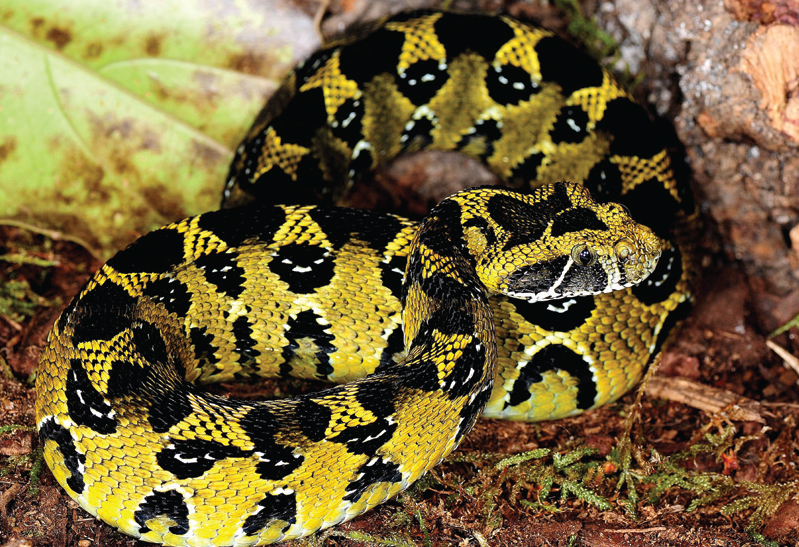
Ethiopia (Tomáš Mazuch).
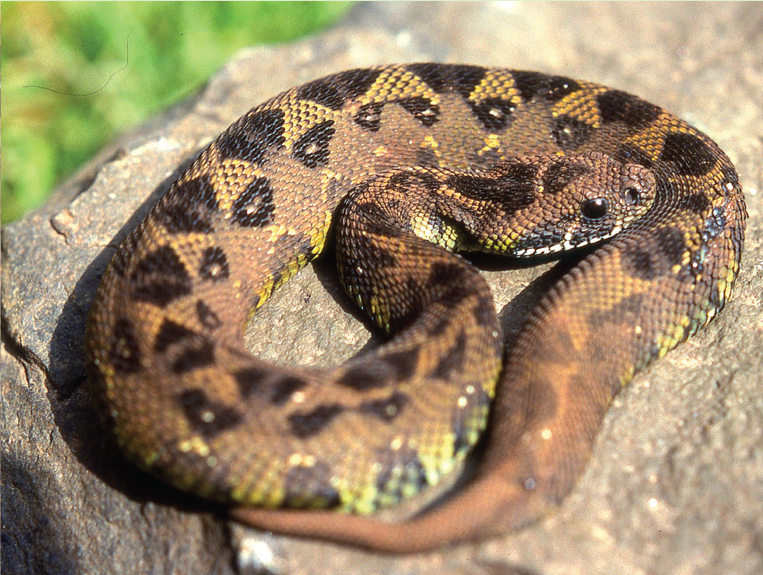
juvenile (Stephen Spawls).
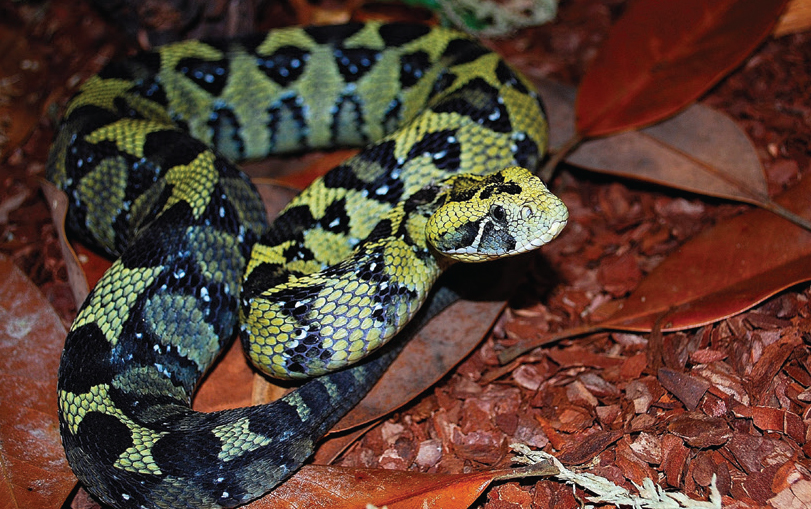
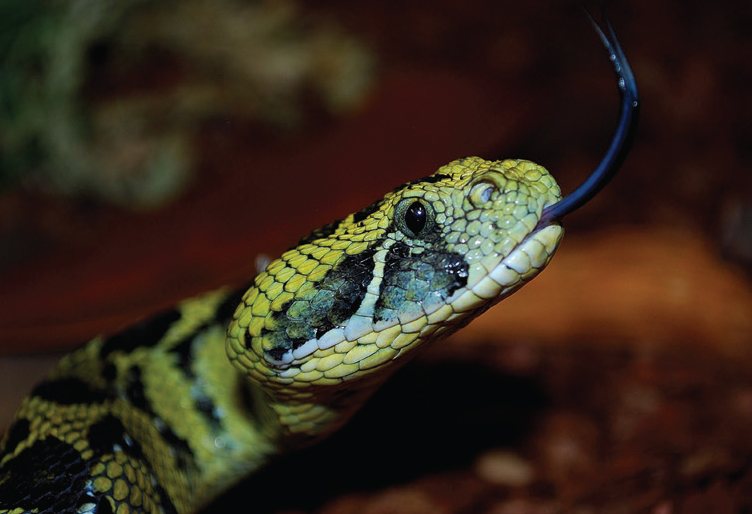
captive (Stephen Spawls).
Bale Mountains Viper Bitis harenna
Identification: A fat black and yellow viper known (so far) only from a small area of south-central Ethiopia, east of the Gregory Rift Valley. Described in 2016; only a small handful of specimens are deposited in museums. The small eyes, with a vertical pupil and a dark iris, are set fairly far forward. The body is stout and depressed, and the tail short. The scales are heavily keeled; in 38–39 rows at midbody; ventrals 145; subcaudals 20. One museum specimen is 66cm long, but uncollected specimens of about 1m have been observed; hatchlings are probably around 15–20cm. The head is black or blue-black, edged with a yellow arrowhead shape, and there is a yellow line across the head behind the eyes. The body is black, with a fine reticulate network of yellow or cream lines; the underside is cream or yellow, marked with dark subrectangular blotches.
Habitat and Distribution: Several living specimens have been observed at the edges of coniferous and broadleaved forest, so presumably it favours clearings in forest. The type specimen is labelled from Dodolla, a town in the high grasslands in the northern foothills of the Bale Mountains, Ethiopia, at 2,400m, but it may have been transported there. The living animals have all been observed in the Bale Mountains National Park, along the road that descends from the Sanetti Plateau southwards towards Dolo Mena. All were within the forest between 2,100m and 2,400m. It probably occurs throughout the forest that extends 10–30km on either side of this road, and may extend further into the forest patches to the west. Local people at Dodolla and also in the town of Wondo Genet (more than 100km to the west, on a forested hill at 2,400m) claimed to recognise this snake from photographs.
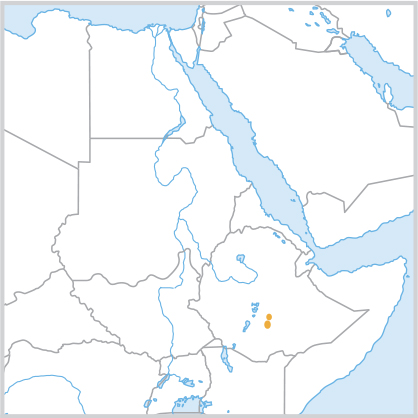
Bitis harenna
Natural History: Largely unknown, but presumably similar to the other large forest Bitis; that is, slow-moving, usually motionless, hidden in leaf litter, eats mostly mammals and birds, and gives birth to live young. Observers have remarked on its physical similarity to Puff Adders (Bitis arietans) of the same size. Its habitat is wet and relatively cold, and for several months of the year receives little sunlight, so the species may be cold-adapted, or perhaps is quick to utilise opportunities to bask. It may be selectively diurnal; specimens have been observed to be active by day.
Medical Significance: The danger to humans posed by this snake is very slight, due to its geographically very restricted range in medium- to high-altitude forest where there are relatively few people. However, it is a large viper and probably closely related to other large African vipers, so the venom is likely to be a potent cytotoxin. Although no specific antivenom is produced for this snake, the polyvalent antivenom produced by South African Vaccine Producers (SAVP) may be effective, as it has been shown to be effective against the bite of the related Ethiopian Mountain Viper (Bitis parviocula). Treatment should be as for a Puff Adder bite.
Bale Mountains Viper, Bitis harenna.
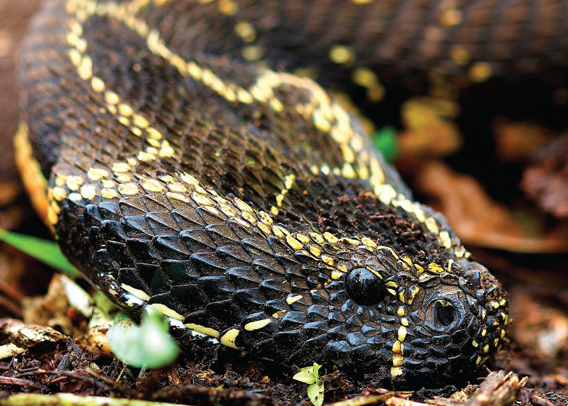
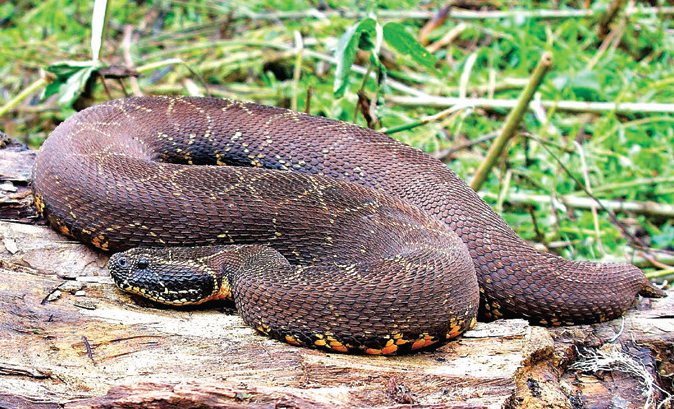
Ethiopia (Jonas Arvidsson).
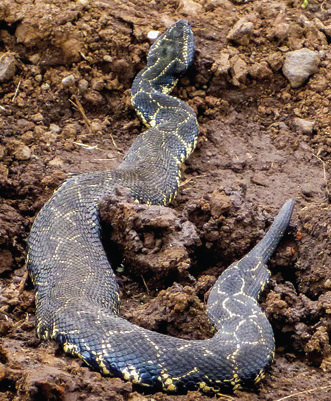
Ethiopia (Evan Buechley).
Horned Adder Bitis caudalis
Identification: A small, attractive adder of the dry country of southern Africa, with a single horn above each eye. Very rarely, hornless specimens may be found. The head is triangular, the body stout and slightly depressed, and the tail short, 7–8% of total length in females and 8–12.5% in males. The head and body scales are strongly keeled; in 21–33 (usually 23–31) rows at midbody; ventrals 120–155; cloacal scale entire; subcaudals 16–40 (higher counts usually males). Maximum length around 60cm, average 25–45cm; hatchlings 10–15cm. The colour is tremendously variable, usually shades of brown, grey or rufous, but the pattern typically consists of a series of darker subrectangular patches down the spine on a lighter background, and a line of subcircular blotches with lighter centres along the flanks. There is sometimes a vague arrow- or hammer-shaped mark on the back of the head. The underside is white or cream, with dark markings on the chin and throat.
Habitat and Distribution: In desert, semi-desert and dry or occasionally moist savanna, from sea level to over 1,600m on dry mountains. It has the largest range of any of the small Bitis species, extending south from south-western Angola almost throughout Namibia and the southern two-thirds of Botswana, down the western side of South Africa, south to the Little Karoo, and also in north-east South Africa, into Zimbabwe extending north past Bulawayo to Shangani, and from the border north to Masvingo. There is a curious record from Luanda, northwest Angola.
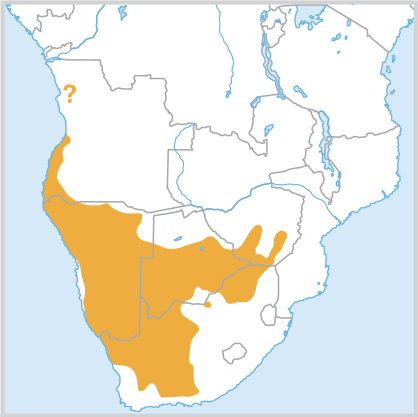
Bitis caudalis
Natural History: A fairly slow-moving terrestrial snake, although it can strike quickly. It can also sidewind, moving rapidly across sand. It is active by night; by day it conceals itself in sand, shuffling down until it is buried, either totally or with the top of the head and eyes exposed, or it may hide in shade under bushes, or up against or under ground cover, logs and rocks, etc. If approached it may flatten itself, but if disturbed it hisses loudly and strikes repeatedly. It gives birth to live young, usually 3–18 but up to 27 have been recorded. It feeds on small vertebrates, largely lizards, but occasionally rodents and frogs, which it ambushes during the day or actively hunts by night. It has been seen to lure prey animals by wriggling its tail tip, which resembles a centipede. Its relative abundance varies dramatically; 134 were collected in five months in south-west Botswana, while in Bulawayo only three were found in 25 years.
Medical Significance: This snake is widespread, well able to conceal itself, and active on the ground at night, so it poses some threat to humans, particularly in the stock farming areas of dry southern Africa. Many people in south-western Botswana had either been bitten or knew somebody who had been bitten by this snake, often while going outside to the toilet in the night during the summer months. It has a cytotoxic venom. However, few bites have been formally documented and no human fatalities are known. Bite symptoms include local swelling with intense pain, vomiting and lymphangitis. Local necrosis, almost certainly caused by bad clinical management, has been recorded. No antivenom is produced, and no known antivenom gives protection against the venom of this species. Bites should be treated conservatively by elevation and painkillers; consider antibiotics if infection is present.
Horned Adder, Bitis caudalis.
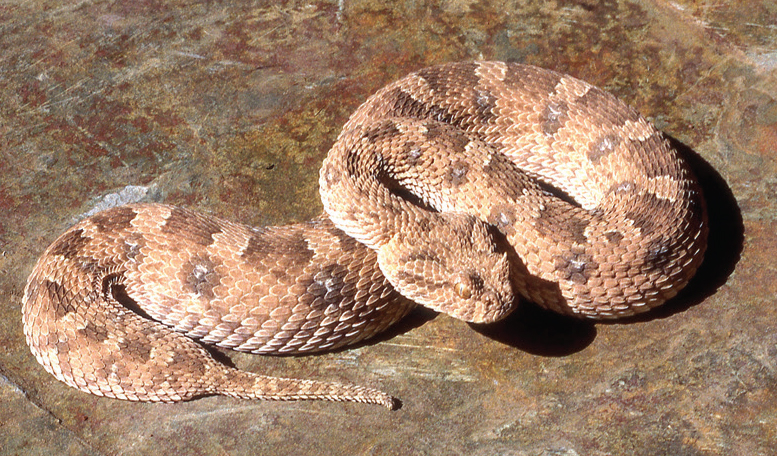
Botswana (Stephen Spawls).
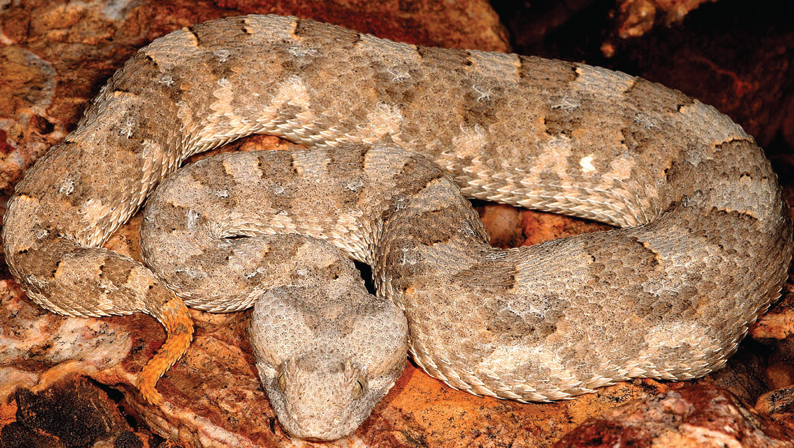
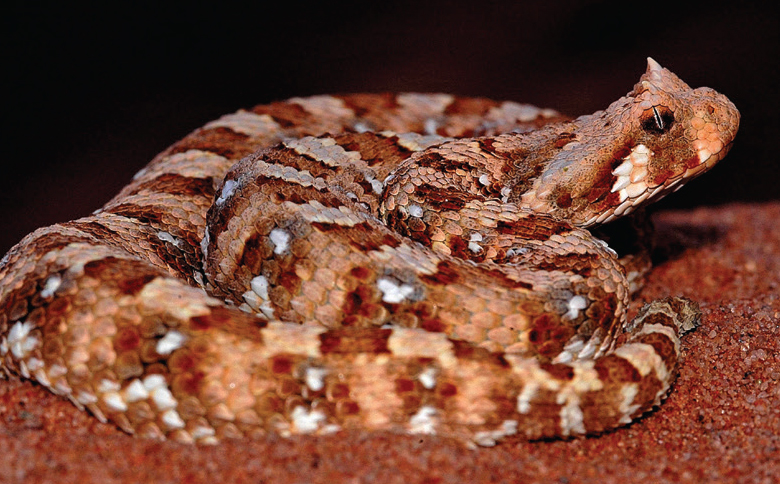
Namibia (Bill Branch).
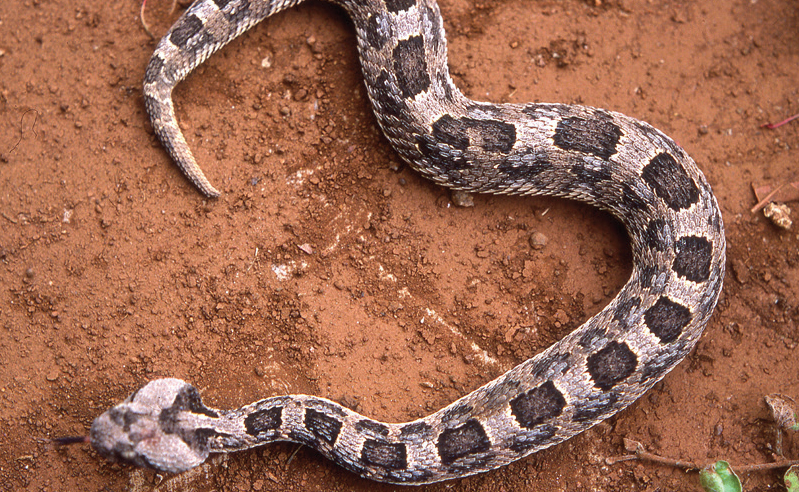
Zimbabwe (Stephen Spawls).
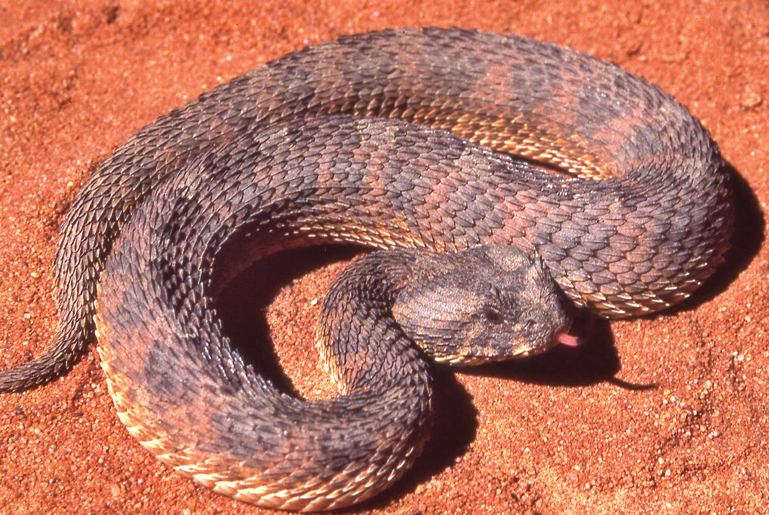
Botswana (Stephen Spawls).
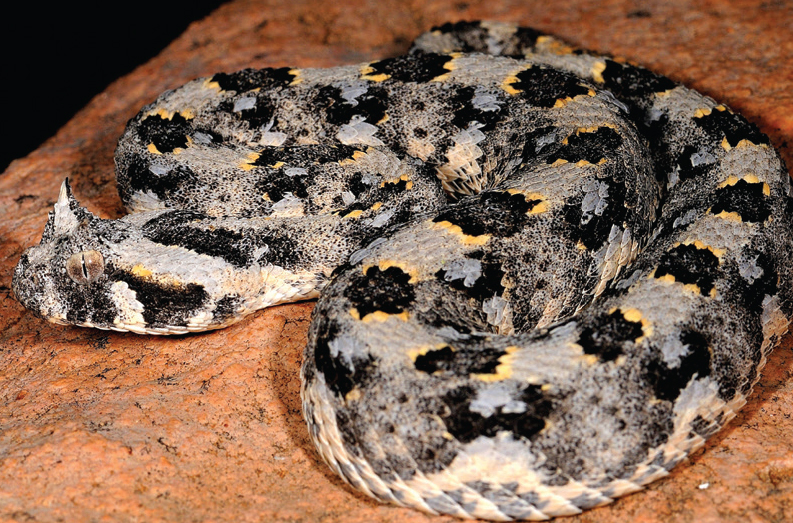
Namibia (Bill Branch).
Namaqua Dwarf Adder Bitis schneideri
Identification: A very small, stocky adder of the dry coastal strip of western South Africa and southern Namibia. The head is short, flat and triangular, sometimes with a raised scale above the eye like a blunt horn. The body is stout and slightly depressed, and the tail short, 7–10% of total length in females and 10–12.5% in males. The head and body scales are strongly keeled; in 21–27 rows at midbody; ventrals 104–129; cloacal scale entire; subcaudals 17–27 (higher counts usually males). Maximum length around 28cm, average 18–25cm; hatchlings 11–13cm. The colour often matches the sand of its habitat, being greyer in the south and more reddish in the north. The pattern consists of three rows of darker, light-centred spots, but these may be faded so the snake just looks mottled light grey. The underside is grey to dirty cream, speckled and spotted to varying extent. In some specimens the tail tip is black.
Habitat and Distribution: Occurs in semi-stable vegetated sandy regions of the southern and transitional Namib Desert, where it is a close ecological equivalent of Péringuey’s Adder (Bitis peringueyi), but lives in more stable, vegetated sand dunes, between sea level and 500m. It is found in coastal regions from Papendorp and the mouth of the Olifants River in the Western Cape, South Africa, north to Luderitz in southern Namibia. It may extend up to 60km inland in the Sperrgebiet (diamond concession) of southern Namibia.
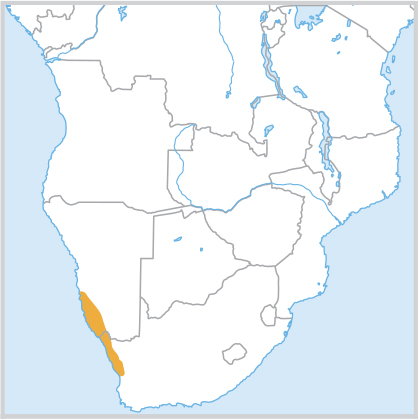
Bitis schneideri
Natural History: A fairly slow-moving terrestrial snake, although it can strike quickly. It sidewinds exceptionally well, moving rapidly across sand. It is crepuscular and nocturnal, active during early evening, at night and sometimes just after dawn. By day it conceals itself in sand, shuffling down until it is buried, either totally or with the top of the head and eyes exposed. Little is known of its reproduction. Broods are small (4–7 young). Lizards, particularly diurnal skinks and lacertids and nocturnal geckoes, form the main part of its diet, although small rodents and amphibians may also be taken. The tail is sometimes exposed and waved as a lure to attract prey.
Medical Significance: Fairly low, being a very small, secretive snake living in a sparsely inhabited sandy area, although bites have been suffered by barefoot beachgoers. No fatalities are known. The venom appears to be cytotoxic. No specific antivenom is produced, and no known antivenom gives protection against the venom of this species. Symptoms of documented bites vary considerably, from intense pain to no pain at all, from no swelling to swelling of the entire bitten area, and both local sensitivity and local numbness. In one case involving swelling there was also discolouration and oozing of fluid from the punctures and, after 24 hours, a 5mm haematoma developed at the bite site. Recovery was complete. Bites should be treated conservatively by elevation and painkillers; consider antibiotics if infection is present.
Namaqua Dwarf Adder, Bitis schneideri.
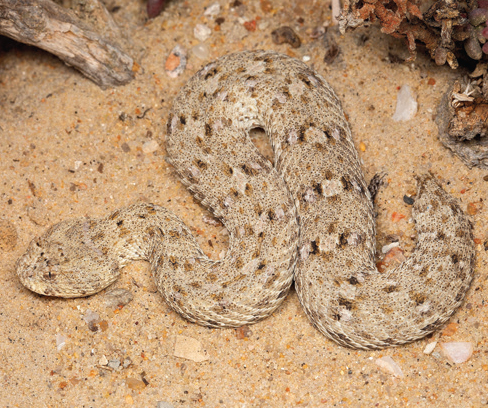
South Africa (Tyrone Ping).
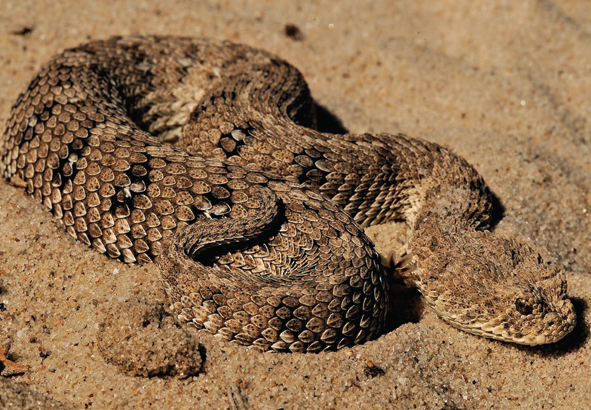
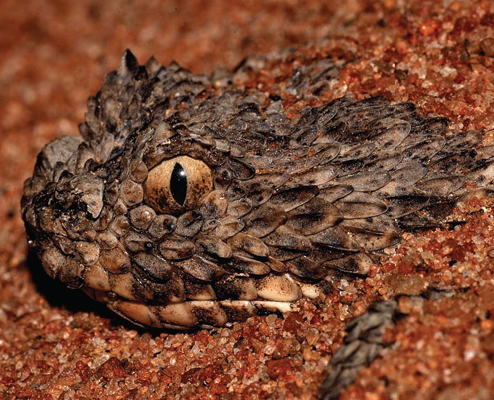
South Africa (Bill Branch).
Péringuey’s Adder Bitis peringueyi
Identification: A very small, flat adder with eyes on the top of its head, which inhabits the dry coastal strip of Namibia. In general appearance it resembles the Sahara Sand Viper (Cerastes vipera), which has also evolved to hunt concealed from sand. The head is flat and triangular, the neck thin, the body stout and depressed, and the tail very short, 6–7% of total length in females and 7–9% in males. The head and body scales are strongly keeled (except the lowest dorsal rows); in 22–31 rows at midbody; ventrals 117–144; cloacal scale entire; subcaudals 15–30 (higher counts usually males). Maximum length around 33cm, average 22–27cm; hatchlings 10–13cm. The colour often matches the sand of its habitat, being sandy-grey to yellow-grey, brown or orange-brown. The pattern consists of three irregular rows of darker spots, sometimes with light edging. The underside is white, uniform or spotted. In about 25% of specimens the tail tip is black, both above and below.
Habitat and Distribution: Lives in sparsely vegetated, loose, wind-blown dunes of the Namib Desert, and thus doesn’t extend inland much beyond 150km or so; found from sea level to around 1,000m. It occurs from the vicinity of Luderitz in southern Namibia north to the border with Angola, and might occur where the Namib Desert extends into south-west Angola in the Parque Nacional do Iona, although there are no definite Angolan records.
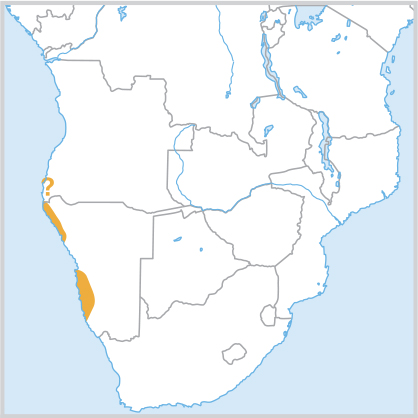
Bitis peringueyi
Natural History: A terrestrial snake, fairly slow-moving when crawling (although it can strike quickly), but it sidewinds exceptionally well, moving rapidly across sand and leaving a series of parallel tracks; it has been seen to climb 45° slopes by sidewinding. Unusually, it is active at any time of the day or night, depending upon the weather, temperature and season. It largely hunts from ambush, shuffling down into the sand until concealed, with only the eyes, top of the head and tail tip exposed; in this position it is hidden from prey and isolated from surface heat. It gives birth between February and April to 2–10 young. It feeds largely on lizards, in particular the Shovel-snouted Lizard (Meroles anchietae) and barking geckoes, sometimes waving the tail as a lure to attract prey. In a region of low, infrequent rainfall, the snake obtains most of its water from the food it eats. However, coastal fogs frequently extend 60km into the Namib and provide additional moisture. The snake flattens its body to increase the surface area, and sips droplets of condensing fog from its scales.
Medical Significance: Very low, being a very small, secretive snake living in an almost uninhabited sandy area. At risk are those who wear open-toed footwear or go barefoot. The venom is cytotoxic. No antivenom is produced, and no known antivenom gives protection against the venom of this species. Symptoms of documented bite cases included local pain, swelling and lymphangitis. A bite to a child in Namibia caused destruction of the ciliary ganglion, causing permanently dilated pupils (mydriasis). Bites should be treated conservatively by painkillers; consider antibiotics if infection is present.
Péringuey’s Adder, Bitis peringueyi.
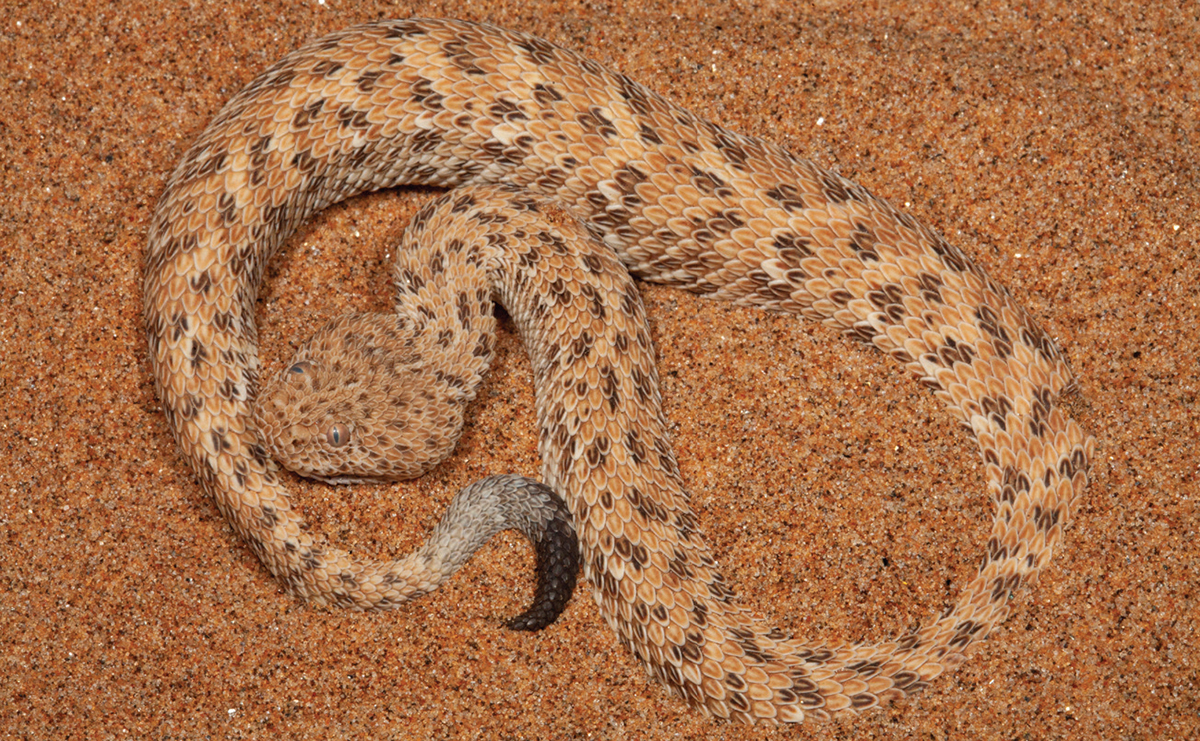
Namibia (Johan Marais).
Berg Adder Bitis atropos
Identification: A small, variable, attractive adder of the rocky hinterland, hills and mountains of the southern and eastern side of South Africa, eastern Zimbabwe and far western montane Mozambique. The head is triangular but elongate, the body stout and slightly depressed, and the tail short, 7–10% of total length in females and 10–12% in males. The head and body scales are strongly keeled; in 27–33 rows at midbody; ventrals 118–144; cloacal scale entire; subcaudals 15–31 (higher counts usually males). Maximum length around 60cm, average 35–50cm; hatchlings 10–15cm. The colour and pattern vary regionally. The ground colour is usually grey, brown or rufous. In several forms there is a dorsolateral series of triangular black markings down either side. These are edged below by a white or yellowish line, below which is another series of smaller dark spots. Between these spots are dark, Y-shaped blotches. The head bears a dark arrow-shaped mark on the crown, and two pale streaks on either side. The chin and throat are usually flesh pink or yellowish, while the ventrum is off-white with dusky infusions, or occasionally slate grey to black. The latter is particularly evident from high-altitude populations, where snowfalls are common (e.g. Swartberg in the Western Cape, and the Drakensberg in Kwazulu-Natal). Some specimens, particularly in the Mpumalanga Drakensberg, are a drab brown, while some Zimbabwe animals have vivid rufous markings.
Habitat and Distribution: Occupies a variety of habitats, but prefers cool climates with high rainfall. It is thus restricted to higher elevations in the northern parts of its range, but may occur on small rock outcrops at sea level in the Western Cape; so it ranges from sea level to over 3,000m. In the Western Cape it lives in coastal and mountain fynbos (heathland), where it experiences a Mediterranean climate (cold, wet winters and warm, dry summers). Further north it is found in montane and coarse grassland with cold but dry winters and warm, rainy summers. Its distribution is startlingly disjunct. In Zimbabwe it is found in both the Nyanga and Chimanimani Mountains, being more common in the latter, and also extends onto the Mozambique side of the mountains. It reappears close to 600km further south, as separate populations in the Mpumalanga and Limpopo Escarpment, and the Maloti-Drakensberg of Lesotho and parts of Kwazulu-Natal, Free State and Eastern Cape adjoining the Lesotho border. Further south this snake occurs in the Cape Fold Mountains of the Eastern Cape and Western Cape.
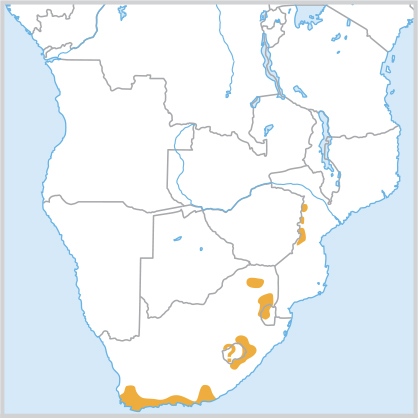
Bitis atropos
Natural History: A terrestrial snake, but it climbs rocks. It might be nocturnal, but in the montane regions of its range this small adder can often be found basking on rock ledges and in open patches, presenting a risk to mountaineers and hill walkers. It is an irascible snake when disturbed, hissing loudly and striking actively, a temperament not suited to, or attenuated by, captivity. Between 8 and 16 young are born to large females in the Western Cape, while litters range from 5 to 11 further north; birth takes place in late summer. The diet is varied, including small birds, rodents, shrews, lizards and even other snakes. Juveniles and adults are also fond of amphibians, particularly rain frogs and small toads.
Medical Significance: This snake is quite common in parts of its range, so it presents a threat to those whose work or pleasure takes them into the hills. The venom is unusual among vipers in containing a major neurotoxin, which is not neutralised by antivenom prepared against other snakes, including elapids. Its toxicity is similar to that of Horned Adder (Bitis caudalis) venom, and it is produced in similar amounts. No specific antivenom is available. Many bites are followed by a progressive ophthalmoplegia, including ocular paralysis, ptosis (drooping eyelids) and fixed dilated pupils. Associated neurotoxic symptoms of nausea, vomiting, vertigo, difficulty in breathing and the loss of taste and smell may be experienced. Respiratory paralysis has been recorded. Local symptoms include severe pain and rapidly spreading swelling. In some cases these alone occur. Tissue necrosis is rare, and the few examples have been localised to the bite site and may have been exacerbated by poor first aid. Neurological effects are usually transient, but may take several weeks to resolve; one victim spent several days on a ventilator, while another two had dilated pupils for over a year following the bite. No deaths are reliably recorded, but bites are serious and should be treated in hospital. In a study of 14 bite cases in South Africa, all 14 patients developed local cytotoxic effects and 13 of them developed systemic effects to some degree. These included prominent vomiting, disturbances in cranial nerve function that included loss of accommodation, a global decrease in motor power needing mechanical ventilation for respiratory failure, and hyponatraemia, sometimes with associated convulsions. This is an underrated dangerous snake.
Berg Adder, Bitis atropos.
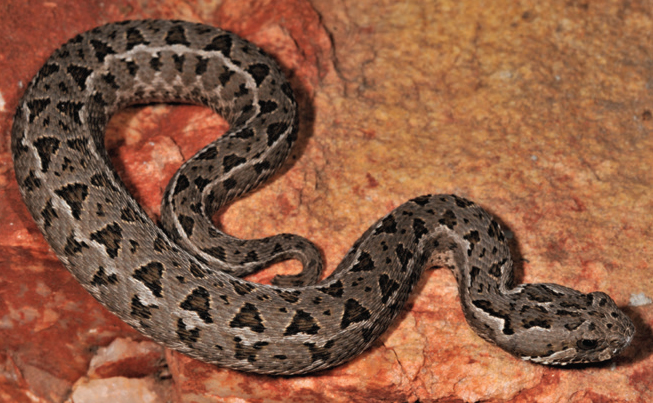
South Africa (Bill Branch).
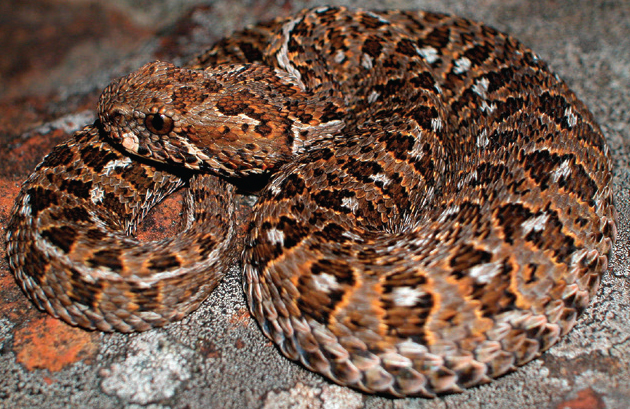
Zimbabwe (Chris Kelly).
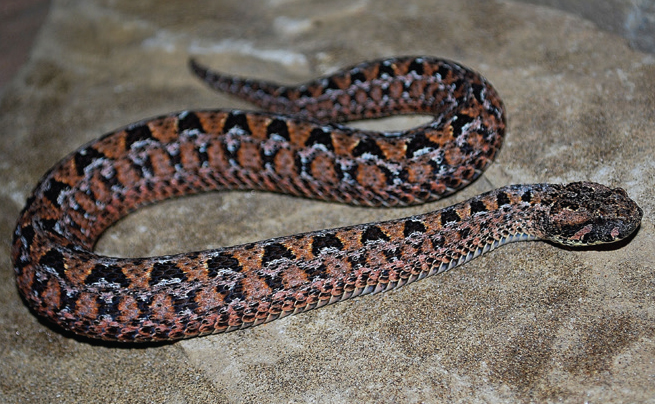
captive (Stephen Spawls).
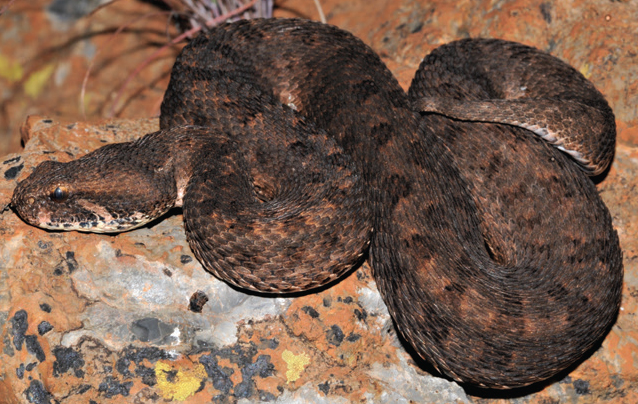
South Africa (Bill Branch).
Identification: A small, spiky-horned adder of the western coast of South Africa and extreme southern Namibia (populations further east have now been moved into other taxa). The head is short, flat and triangular, and characterised by spiky tufts of 2–7 elongate horns over the eyes. The body is stout and slightly depressed, and the tail short, 7–9% of total length in females and 10–12.5% in males. The head and body scales are strongly keeled; in 23–29 rows at midbody; ventrals 120–152; cloacal scale entire; subcaudals 18–37 (higher counts usually males). Maximum length around 55cm (although a captive female reached 75cm), average 30–50cm; hatchlings 13–16cm. The ground colour is grey, brown or rufous, with a double series of darker subquadrangular blotches down the centre of the back and a single series of similar blotches on each flank. There is sometimes a poorly defined grey dorsolateral stripe. There is a vague dark arrow-shape on the head, and often two lighter bars on the side of the head, behind and in front of the eye.
Habitat and Distribution: Lives in rocky desert, hills, rocky outcrops and gravel flatlands of the coastal plain, in the Namib Desert, into semi-desert (Karoo), and extending south into montane fynbos heathland. It occurs from Meob Bay and Mount Uri-Hauchab in Namibia south to Lambert’s Bay, South Africa, and inland to the Cederberg, western South Africa, from sea level to 800m.
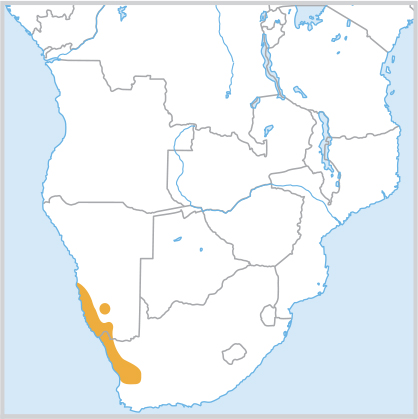
Bitis cornuta
Natural History: A fairly slow-moving terrestrial snake, although it can strike quickly. It appears to be crepuscular. It is usually found in rocky situations, although it can sidewind. On rocky hills it is usually restricted to scattered boulders on the upper slopes. It often shelters in rodent burrows or under stones. Nervous by disposition, it will hiss loudly and strike so energetically that most of the body is lifted off the ground. Mating in the Western Cape occurs in October–November, but it is earlier (May–June) in southern Namibia. From five to 12 young are born in late summer or early autumn (January–April). It eats small mammals and lizards (skinks, agamas and lacertids); birds are occasionally ambushed from cover.
Medical Significance: Fairly low, being a very small, secretive snake living in a relatively small and sparsely populated area. The venom is probably cytotoxic. No antivenom is produced, and no known antivenom gives protection against the venom of this species. No documented bite cases are known, but anecdotal evidence from pet keepers indicates that bites are characterised by pain and local swelling. Bites should be treated conservatively by painkillers; consider antibiotics if infection is present.
Taxonomic Notes: The following four species, all associated with the Cape Fold Mountains in southern South Africa, have at some time in the past each been regarded as subspecies or synonyms of this snake; a 1999 reassessment indicated that they are all evolving separately and are thus good evolutionary species, and are largely allopatric (living in separate habitats), although odd problematic intermediate specimens are known.
Many-horned Adder, Bitis cornuta.
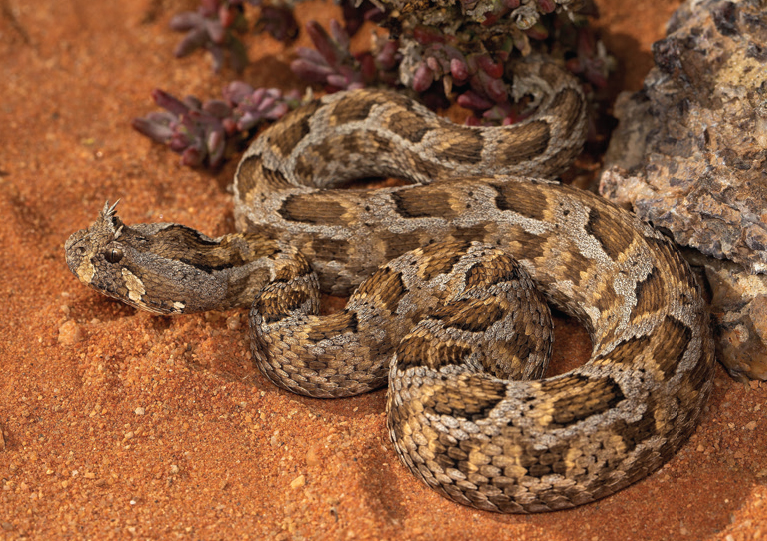
South Africa (Tyrone Ping).
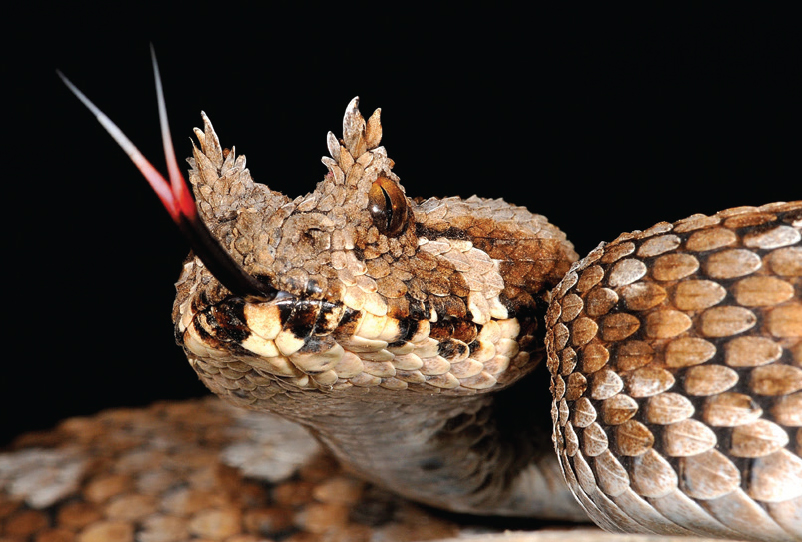
South Africa (Bill Branch).
Albany Adder Bitis albanica
Identification: A small, very rare adder with raised ‘eyebrows’ and sometimes with horns, and a minute range near Port Elizabeth in South Africa. The head is short, flat and triangular, and characterised by raised supraocular scales or short, spiky tufts of elongate horns over the eyes. The body is stout and slightly depressed, and the tail short, 8–9% of total length in females and 9.5–12% in males. The head and body scales are strongly keeled; in 27–29 rows at midbody; ventrals 120–138; cloacal scale entire; subcaudals 21–27 (higher counts usually males). Maximum length around 30cm, average 20–26cm; hatchling size unknown. The ground colour is grey, with a double series of darker subquadrangular blotches down the centre of the back, a series of lighter flank blotches and sometimes a poorly defined grey dorsolateral stripe. There is a dark arrow shape on the head. The underside is cream-grey with darker blotching.
Habitat and Distribution: Lives in the succulent thickets and grassland of the Mediterranean-type vegetation of South Africa’s southern coast, locally known as ‘bontveld vegetation’, on limestone and calcareous ancient dunes. It is endemic to the Eastern Cape, South Africa, and found from Port Elizabeth north-east past Grahamstown to Committees Drift, between sea level and 500m.
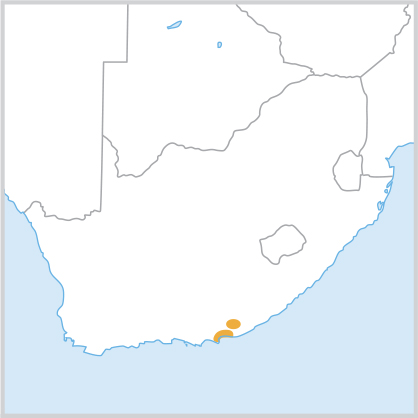
Bitis albanica
Natural History: A rare, fairly slow-moving terrestrial snake. Little is known of its habits. One specimen was found crossing a road in the daytime; others were concealed in thickets. It is presumably similar to other species previously believed to be Bitis cornuta (i.e. hunts from ambush and gives birth to live young). Lizard scales and rodent fur were found in the gut of two museum specimens.
Medical Significance: Insignificant, being a small snake with a tiny range. The venom is probably cytotoxic. No antivenom is produced; no documented bite cases are known. Bites should be treated conservatively by elevation and painkillers; consider antibiotics if infection is present.
Albany Adder, Bitis albanica.
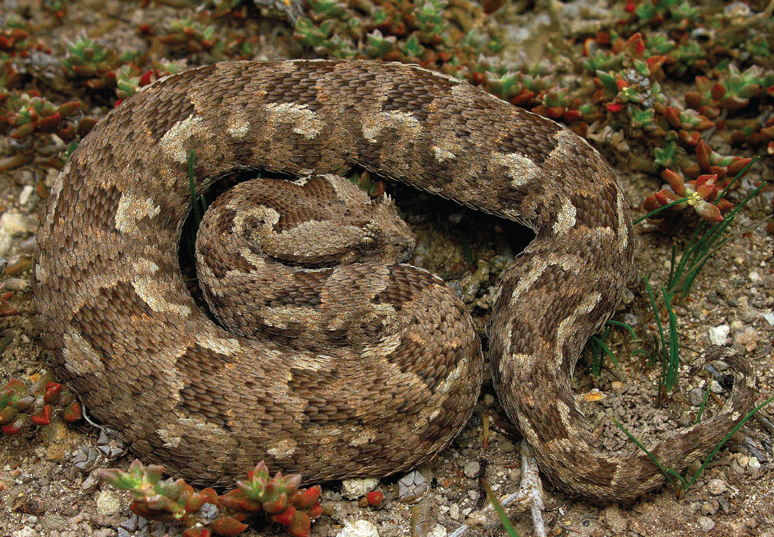
South Africa (Luke Kemp).
Southern Adder Bitis armata
Identification: A small adder with small horns above the eye, and with a small range around Cape Town, South Africa. The head is short, flat and triangular, and characterised by short, spiky horns over the eyes. The body is stout and slightly depressed, and the tail is short, 8–9% of total length in females and 9.5–11% in males. The head and body scales are strongly keeled; in 25–29 rows at midbody (usually 27); ventrals 115–128; cloacal scale entire; subcaudals 19–31 (higher counts usually males). Maximum length around 42cm, average 25–35cm; hatchlings 12–15cm. The ground colour is grey or brown, with a double series of darker, often rufous subquadrangular blotches down the centre of the back, a series of similarly coloured but narrower flank blotches, and sometimes a poorly defined grey dorsolateral stripe or series of lozenges. There is a dark, sometimes arrow-shaped mark on the head. The underside is grey-white with darker edging.
Habitat and Distribution: Lives in thickets and grassland of the Mediterranean-type vegetation, on underlying limestone, of South Africa’s southern coast. It is endemic to the Western Cape, South Africa, and found in isolated and suitable habitats from Langebaan Lagoon eastwards to De Hoop Nature Reserve and the Breede River mouth, usually at low altitude, but one record was from around 300m.
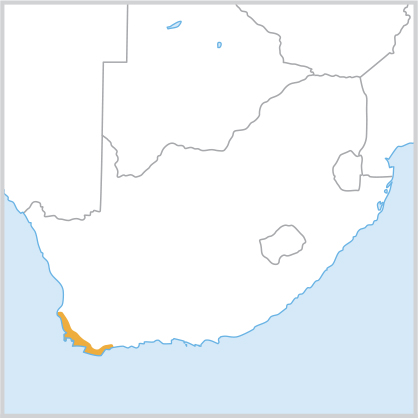
Bitis armata
Natural History: A rare, fairly slow-moving terrestrial snake. Little is known of its habits. It is said to be crepuscular, and shelters under limestone rock slabs and within thickets. Females give birth to live young; up to seven are born in the late summer. It eats lizards and small rodents.
Medical Significance: Insignificant, being a small snake with a tiny range. The venom is probably cytotoxic. No antivenom is produced; no documented bite cases are known. Bites should be treated conservatively by elevation and painkillers; consider antibiotics if infection is present.
Southern Adder, Bitis armata,
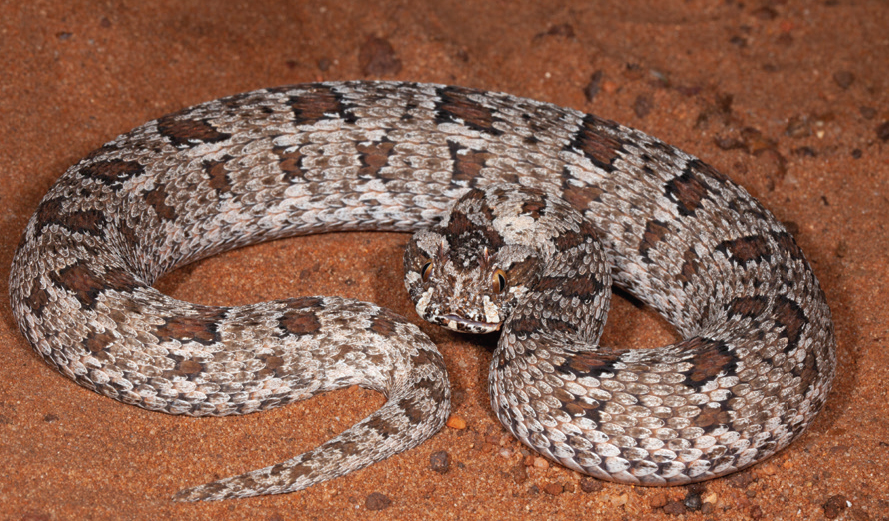
South Africa (Johan Marais).
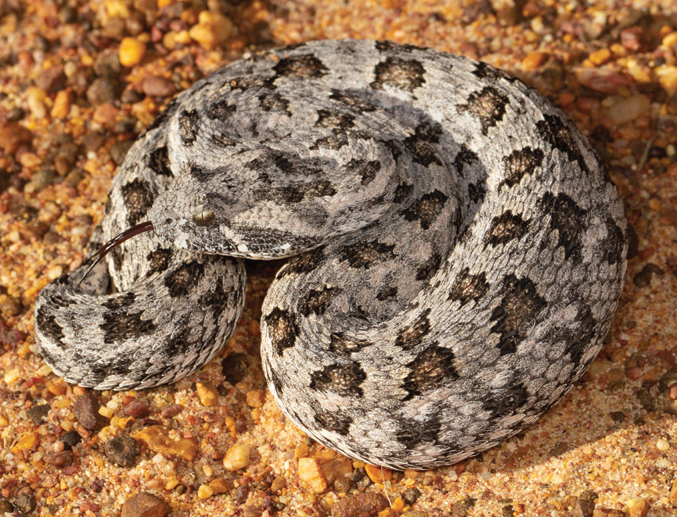
South Africa (Tyrone Ping).
Red Adder Bitis rubida
Identification: A small, often rufous adder with horns or raised ‘brows’ above the eye, and with a small range in the Western Cape and environs, South Africa. The head is short, flat and triangular, sometimes with very short, spiky horns over the eyes. The body is stout and slightly depressed, and the tail short, 8–9% of total length in females and 9.5–11% in males. The head and body scales are strongly keeled; in 25–29 rows at midbody (usually 29); ventrals 126–143; cloacal scale entire; subcaudals 22–35 (higher counts usually males). Maximum length around 48cm, average 25–40cm; hatchlings 12–16cm. The ground colour is rufous, grey or reddish brown, with a double series of darker brown subquadrangular blotches down the centre of the back. The flanks are mottled with irregular darker blotches. Some animals (especially rufous specimens) often have very subdued or near-invisible dorsal markings. There is a darker arrow-shaped mark on the head in some individuals. The underside is cream to grey with darker grey-white infusions.
Habitat and Distribution: Most records are from rocky hill and mountain slopes, but also on sparsely vegetated gravel plains, between 300m and 1,400m, in the mountain heathland (fynbos) and the dry habitat region known as Succulent Karoo. It is endemic to the Western Cape and adjacent southern areas of the Northern Cape; it occurs from the Cederberg Mountains southwards through the Cape Fold Mountains around Ceres, then eastwards through the Little Karoo to Willowmore.
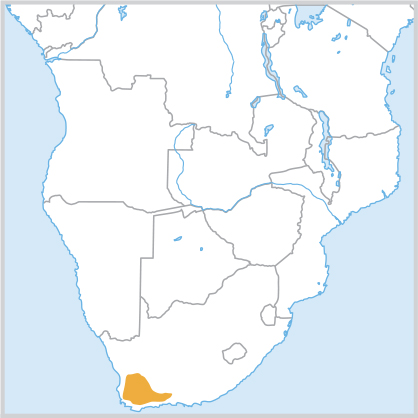
Bitis rubida
Natural History: A very rare, fairly slow-moving terrestrial snake. Little is known of its habits. It is said to be crepuscular, or possibly nocturnal in the summer. It shelters under rocks and in the lee of bushes. Females give birth to live young; up to 11 are born in the late summer. It eats lizards and small rodents.
Medical Significance: Insignificant, being a small snake with a tiny range. The venom is probably cytotoxic. No antivenom is produced; no documented bite cases are known. Bites should be treated conservatively by elevation and painkillers; consider antibiotics if infection is present.
Red Adder, Bitis rubida.
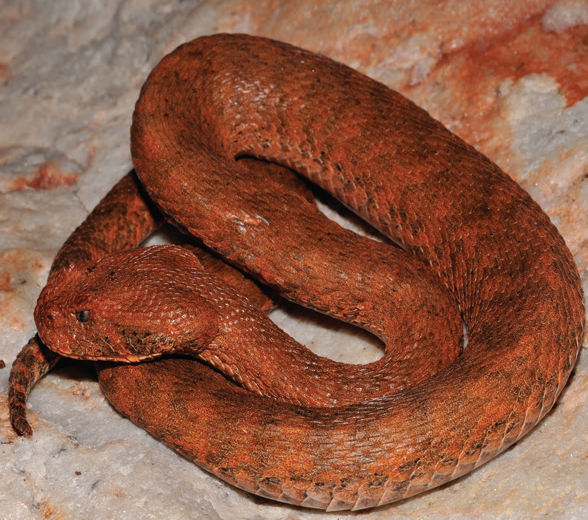
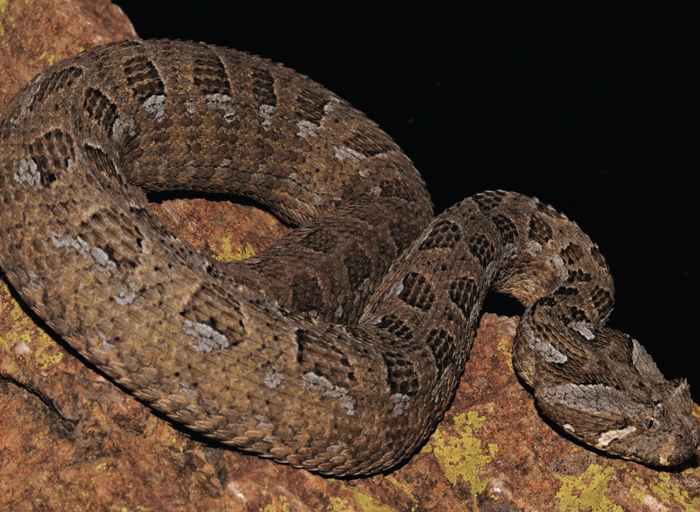
South Africa (Bill Branch).
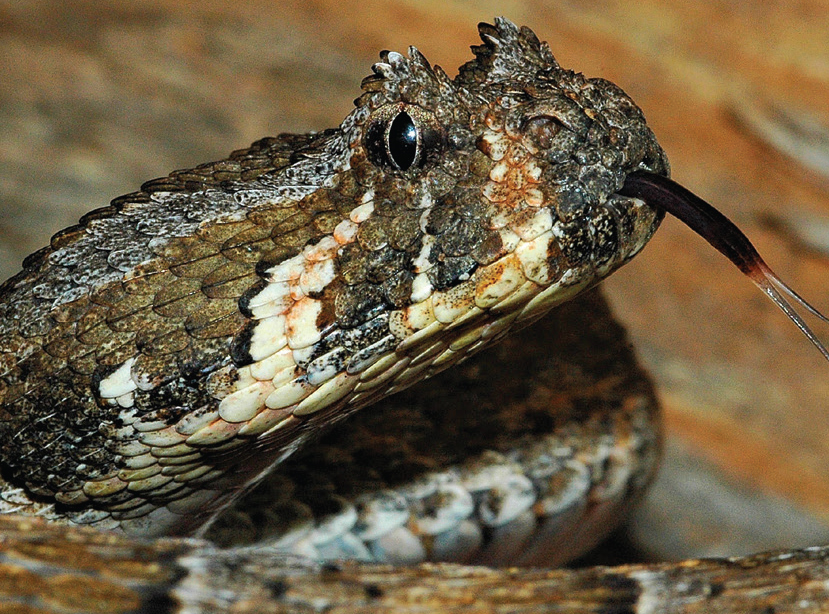
South Africa (Bill Branch).
Plain Mountain Adder Bitis inornata
Identification: A small, dull brown adder with very subdued markings, and with a tiny range in the Sneeuberg Range and vicinity, South Africa. The head is short, flat and triangular, sometimes with very small horns over the eyes. The body is stout and slightly depressed, and the tail short, 9–10% of total length. The head and body scales are strongly keeled; in 27–30 rows at midbody; ventrals 126–138; cloacal scale entire; subcaudals 21–33 (higher counts usually males). Maximum length around 33cm, average 25–30cm; hatchlings 12–15cm. The ground colour is dull brown to yellow or rufous-brown, without markings or with 19–24 very subdued or near-invisible dorsal blotches. The underside is cream to light brown, speckled to a greater or lesser extent.
Habitat and Distribution: High-altitude grassland, between 1,600m and 1,800m. It is endemic to the Eastern Cape, in the Sneeuberg Range and adjacent mountains, from north of Graaff-Reinet eastwards to the Mountain Zebra National Park, near Cradock.
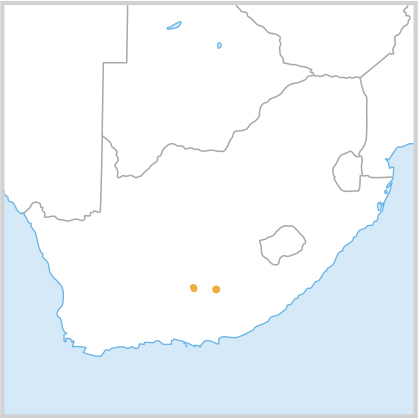
Bitis inornata
Natural History: A very rare terrestrial snake; there was a lapse of 140 years between Andrew Smith describing the first specimen and the second one being found in the Mountain Zebra National Park. It is fairly slow-moving, but hisses and strikes if disturbed. It is crepuscular, being active in the evenings and mornings during the summer months; it shelters in grass tussocks, in thickets and under rocks. It hibernates during the winter when its high-altitude habitat is affected by frost and snow. It gives birth to 5–8 live young. The diet is known to include small lizards, and it probably also takes rodents.
Medical Significance: Insignificant, being a small snake with a tiny range. The venom is probably cytotoxic. No antivenom is produced; no documented bite cases are known. Bites should be treated conservatively by elevation and painkillers; consider antibiotics if infection is present.
Plain Mountain Adder, Bitis inornata.
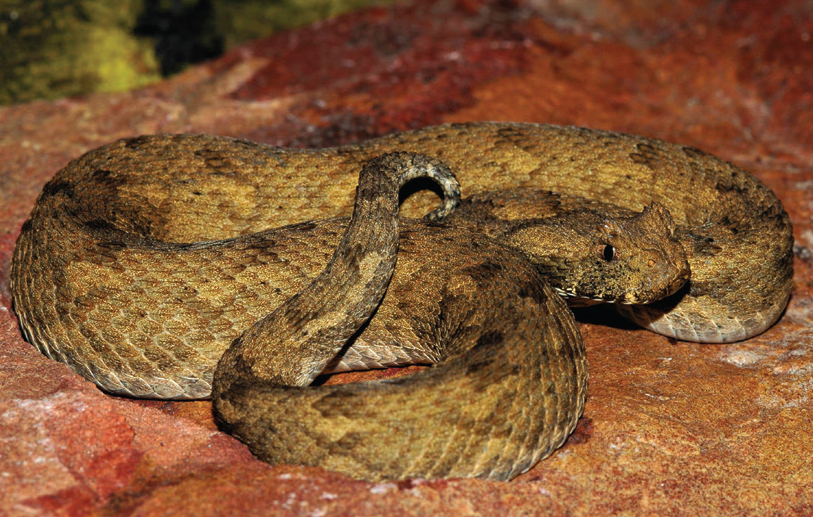
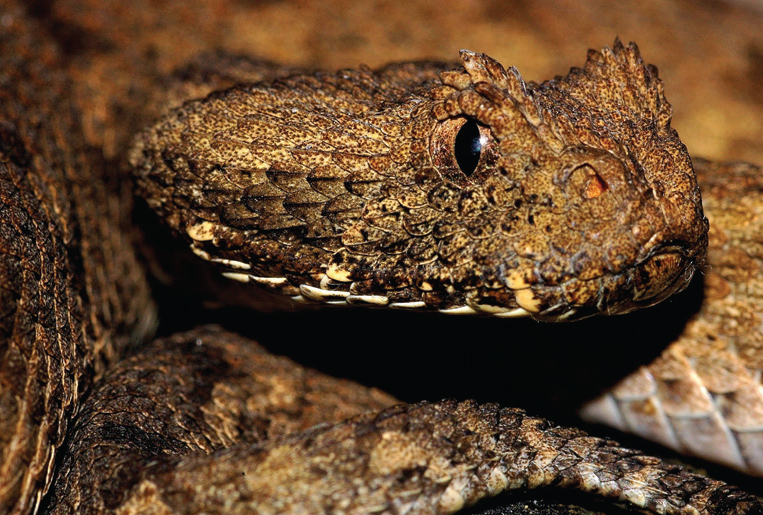
South Africa (Bill Branch).
Desert Mountain Adder Bitis xeropaga
Identification: A small, slender adder with geometric markings, found in the dry hills of the Orange River basin along the southern Namibian–South African border. The head is pear-shaped, the body relatively slim (for an adder) and the tail short, 8–10% of total length. The dorsal scales are moderately keeled; in 25–27 rows at midbody; ventrals 147–155; subcaudals 22–33. Whether sexual dimorphism occurs is uncertain as very few females have been collected. Maximum length 61cm, average 35–55cm; captive hatchlings reported to be 10–12cm. The body is ash to dark grey, occasionally light tan, with a series of 16–34 transverse, often very square-edged, dark bars, flanked on either side by whitish spots. A pale triangular mark completes the bar adjacent to the ventrals. The top of the head is vaguely speckled. The chin and throat are white, and the underside light grey to dusky, with darker speckling.
Habitat and Distribution: Inhabits sparsely vegetated rocky mountain slopes and dry plains, in semi-desert and desert, between 100m and 800m. It is found in southern Namibia and western South Africa, where it is mainly restricted to the arid mountains bordering the lower reaches of the Orange River basin, from Dreikammberg in south-western Namibia and the Richtersveld in South Africa, east to Augrabies Falls in the north-western Northern Cape. It also extends along the lower reaches of the Fish River Canyon in Namibia. There is an apparently isolated population on the mountains around Aus and Kuibis.
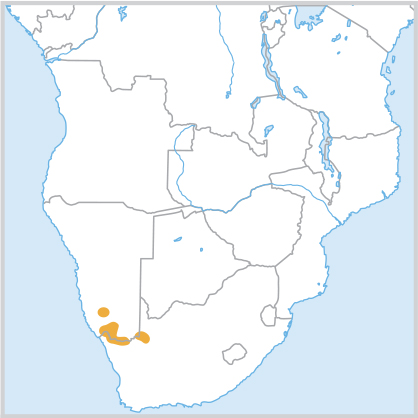
Bitis xeropaga
Natural History: A rare terrestrial snake, and fairly slow-moving, but strikes quickly. Little is known of its habits. It is likely to be nocturnal or crepuscular. It presumably shelters under rocks, although captive specimens often lie out on their cage rocks. It gives birth to 4–5 live young in the late summer (captive animals have produced broods of up to nine). Lizards and small rodents are taken readily in captivity and probably form the main part of the diet in the wild. Water is readily taken from foliage or pools.
Medical Significance: Insignificant, being a small snake with a tiny range. The venom is probably cytotoxic. No antivenom is produced; no documented bite cases are known. Bites should be treated conservatively by elevation and painkillers; consider antibiotics if infection is present.
Desert Mountain Adder, Bitis xeropaga.
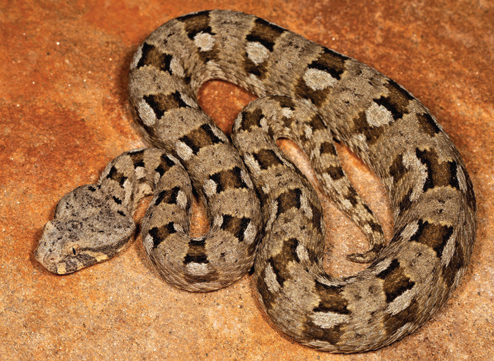
South Africa (Tyrone Ping).
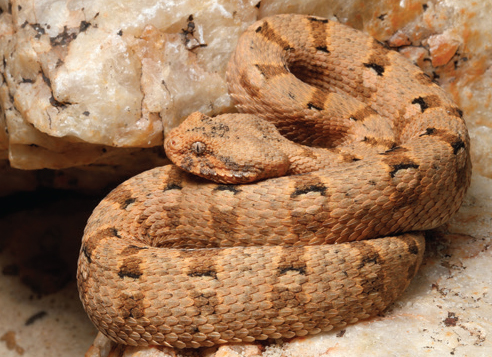
South Africa (Wolfgang Wuster).
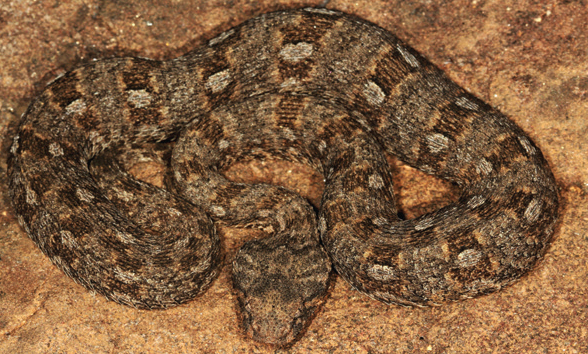
South Africa (Luke Kemp).
Angolan Adder Bitis heraldica
Identification: A small, attractive, spotted adder, endemic to the high central plateau of Angola. The head is somewhat lumpy and triangular, with fairly prominent eyes. The top of the head is covered with small overlapping, keeled scales. The body is stout and slightly depressed, and the tail short, 9–12% of total length. The head and body scales are strongly keeled; in 27–31 rows at midbody; ventrals 124–131; cloacal scale entire; subcaudals 18–25 (higher counts usually males). Maximum length around 41cm; average size unknown, but probably 25–35cm. The ground colour is a rich brown or grey, with a series of 25–40 roundish to rhombic chestnut-brown spots along the centre of the back, with rufous between them (giving the appearance of a vertebral stripe), bordered on each flank by a series of irregular dark spots, and below them a series of upward-pointing orangey chevrons. The rear of the head is darkly blotched, with what looks like a three-pronged trident between the eyes. The belly is creamy- or orangey-white, heavily marked with dark grey spots that predominate on the anterior borders of the scales. The underside of the tail is orange or yellowish white, with or without grey spots.
Habitat and Distribution: Lives on the high plateau of south-central Angola, at altitudes over 1,000m, reportedly from rocky montane and grassland areas. It is known from only a handful of localities in Huila, Bíe and Huambo Provinces; records from the north-west are now considered doubtful.
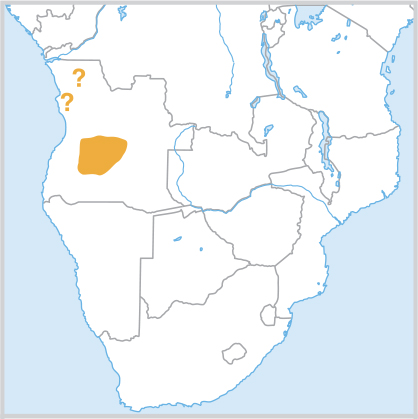
Bitis heraldica
Natural History: A rare terrestrial snake, known from just a handful of specimens. Little is known of its habits. It is likely to be nocturnal or crepuscular, and its habits are presumably like those of other small vipers (i.e. it shelters under ground cover, gives birth to live young, hunts from ambush and eats small vertebrates).
Medical Significance: Insignificant, being a small snake with a tiny range. The venom is probably cytotoxic. A 45-year-old male who was bitten on the ankle while walking in the early morning experienced localised pain, which extended across the leg, as well as considerable swelling of the afflicted area and fever; he was unable to walk for four days. Symptoms were intense for a week but resolved after a month without complications. No necrosis was observed. No antivenom is produced. Bites should be treated conservatively by elevation and painkillers; consider antibiotics if infection is present.
Angolan Adder, Bitis heraldica.
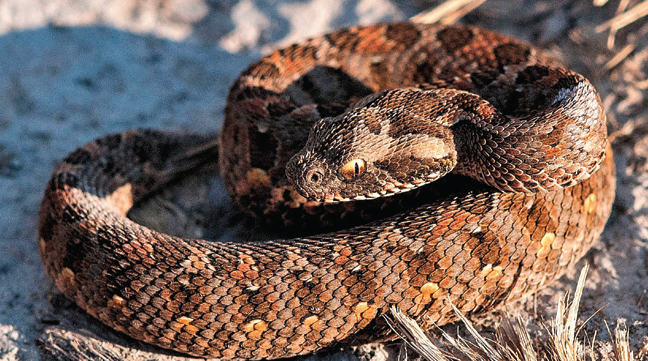
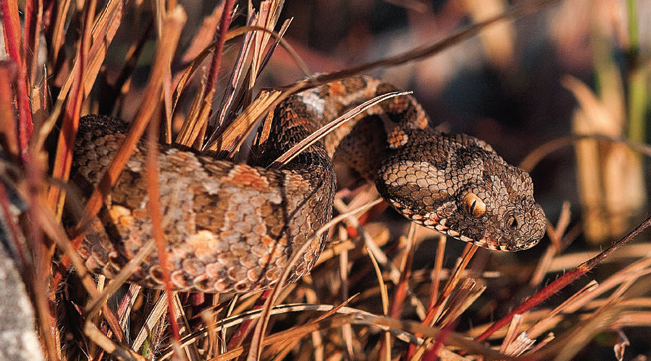
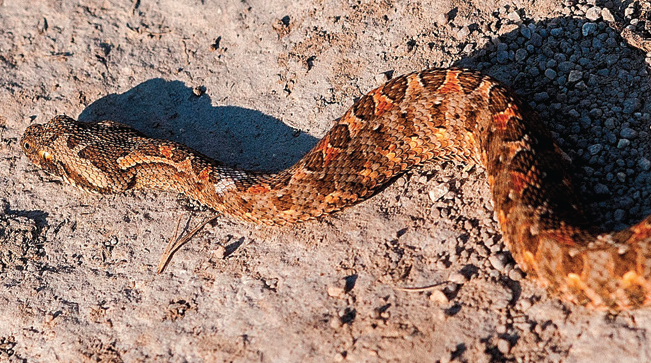
Angola (Dayne Brayne).
Kenya Horned Viper Bitis worthingtoni
Identification: A small, stout horned viper, with a broad, flat, triangular head, covered in small overlapping, strongly keeled scales. The small eye, with a vertical pupil, is set far forward; the iris is silver, flecked with black. There is a single horn on a raised ‘eyebrow’. The neck is thin, the body stout, and the tail thin and short. The scales are rough and heavily keeled; in 27–29 (occasionally 31) rows at midbody; ventrals 135–146; 19–33 undivided subcaudals. Maximum size about 50cm (possibly larger), average 20–35cm; hatchlings 10–12cm. The ground colour is grey, along each flank is a dirty white or cream dorsolateral stripe, and above and below this, on each side, is a series of semicircular, triangular or square black markings. There is a dark arrow on top of the head. The belly is dirty white, heavily stippled with grey.
Habitat and Distribution: A Kenyan endemic, found in the high grassland and scrub of the Gregory Rift Valley in Kenya. It favours broken rocky country and scrub-covered hill slopes along the edge of the escarpment, right up to the forest edge, but has also been found on the valley floor, and at the edges of acacia woodland. It is restricted to high altitudes (usually over 1,500m, but up to 2,400m) along the high central Gregory Rift Valley. The southernmost record is from the northwest Kedong Valley, from where it extends north along the floor and eastern wall of the rift valley through Naivasha and Elmenteita to Njoro. It then extends up the western wall and out of the rift to Kipkabus and Eldoret (most northerly record). It occurs on the Kinangop Plateau, around Kijabe, on the hills west of Lake Naivasha, and probably on the eastern Mau Escarpment. It might be more widespread, such as westwards towards Narok.
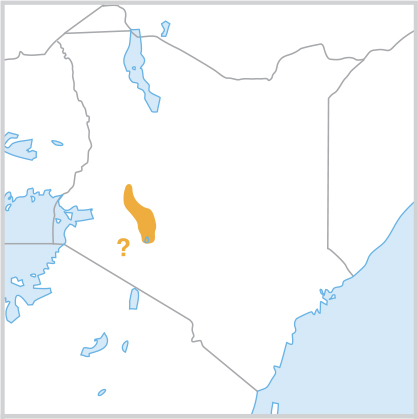
Bitis worthingtoni
Natural History: Poorly known. It is terrestrial and slow-moving, but can strike quickly. It is mostly nocturnal, prowling after dusk, but will strike from ambush at any time. This snake is often found sheltering in leaf litter among the stems of the Leleshwa shrub (Tarchonanthus camphoratus), which grows mainly along the lower rocky slopes of the escarpment edge, but it may also hide under rocks and logs, etc. Some specimens are bad-tempered when disturbed, constantly hissing and puffing, and struggling wildly when restrained, but others seem more placid; the Maasai people who know the snake say it is reluctant to strike. Captive specimens feed readily on rodents and lizards, which are struck from ambush or stalked. It gives birth to 7–12 live young in March or April, at the start of the rainy season.
Medical Significance: Low, being a very small, secretive snake living largely in ranching areas, although local herdsmen often know of people who had been bitten, and describe the bite as very painful and causing swelling, which fits with it being cytotoxic. No antivenom is produced, and no known antivenom gives protection against the venom of this species. Symptoms of a documented bite case included pain and swelling; a dog bitten in Kenya had a very swollen face. Bites should be treated conservatively by elevation and painkillers; antibiotics should be given if there are signs of infection.
Kenya Horned Viper, Bitis worthingtoni.
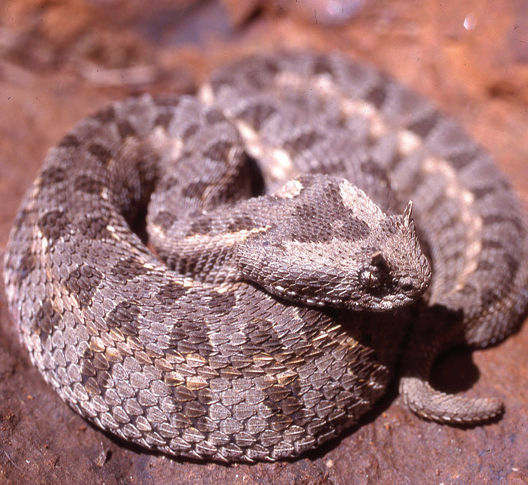
Kenya (Stephen Spawls).
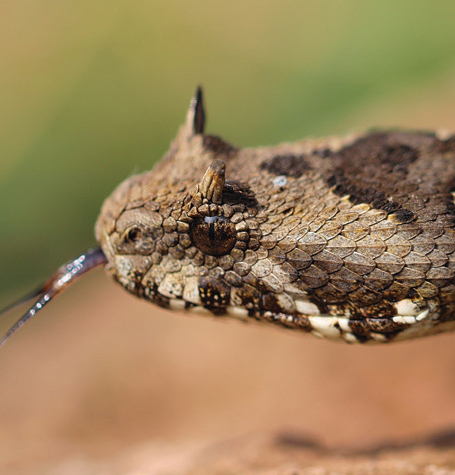
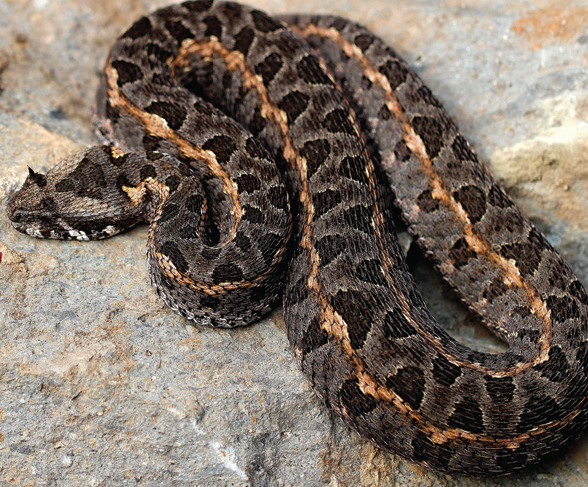
Kenya (Daniel Hollands).
These small but highly dangerous snakes are found across huge areas of the Old World, from northern Sri Lanka through India, Pakistan and the Middle East, across northern Africa from Egypt to Mauritania, and south to parts of the West African coast and to the Tana River in Kenya. They are arguably the most medically significant snakes in the world, on account of their huge range, their relative abundance in some areas, their willingness to bite and their dangerous venom (for such a small species). They are active on the ground at night and easily trodden on, and they hide in holes and under ground cover in agricultural land. They are implicated in hundreds of thousands of snakebite cases; farmers and rural people are particularly at risk. In the words of Professor David Warrell, African snakebite expert and a man precise with his words, ‘this genus of vipers is of enormous medical importance’.
They are all small snakes (none larger than 80cm or so; most specimens are between 25cm and 50cm) with pear-shaped heads covered with small scales, small eyes with vertical pupils set well forward, thin necks and fairly stout, cylindrical bodies. Most of the body scales are keeled. Most carpet vipers are grey, brown or rufous, with various patterns, often including triangles or eyespots on the flanks. All have a distinctive threat display, forming C-shaped coils with the body; they then rub their scales together, the interscale friction creating a hissing sound, like water falling on a hot plate. The purpose of this stridulation is to enable the snake to make a loud warning noise without hissing with the mouth, and thus reduce water loss in a dry area. They are confident in defence, very quick to bite and will move towards a perceived threat while striking vigorously. The African species all lay eggs, but elsewhere some species give birth to live young.
Carpet vipers feed on a variety of prey, which may be the secret of their success; their venom (both within species and from one species to another) varies according to the prey they favour and the locality. This is medically significant; in parts of their range carpet vipers have venoms that are rarely fatal (mostly on the eastern side of Africa), while in other areas they are killers. In general, their venoms cause both local and systemic envenoming. There is pain and severe local swelling, blistering and necrosis, with severe haemostatic disorders leading to spontaneous systemic bleeding, from the membranes in the mouth and the internal organs. As David Warrell says, for carpet vipers ‘coagulopathy is universal’. When death occurs it is often three to five days after the bite. Treatment for all carpet viper bites must be carried out in a well-equipped hospital, and will almost certainly involve antivenom (which is available), replacement therapy and treatment for incoagulable blood. Start with what is probably the single most effective, and one of the simplest, clinical procedures known: the 20-minute whole blood clotting test (20WBCT).
The taxonomy of the carpet vipers has changed a lot and continues to do so, as might be expected with snakes with huge ranges and often fragmented populations. Originally, all carpet vipers were considered to be of two species. One of these is Burton’s Carpet Viper (Echis coloratus), occurring in Egypt and the Arabian Peninsula. The other is the ‘typical’ carpet or saw-scaled viper, Echis carinatus. As originally defined, this snake occupied a gigantic but fragmented range, from Sri Lanka up through India, westwards to the Arabian Peninsula and right across the northern half of Africa to Mauritania. Taxonomic work has now split Echis coloratus into two species and the Echis carinatus ‘superspecies’ into 10 species to date, six of which occur in the northern half of Africa.
There is debate on the status of the African species of the ‘carinatus’ group. Some researchers take the reductionist view that there are only two species: the West African Carpet Viper (Echis ocellatus) in the savannas of West and Central Africa, and the North-east African Carpet Viper (Echis pyramidum), occurring sporadically right around the Sahara and extending into the Horn of Africa. But this is over-simplistic. However, whether all six African taxa are separate species or represent gradual variation of a widespread form over a huge range remains to be seen.
Carpet vipers are snakes of semi-desert and dry savanna, with a few exceptions (Burton’s Carpet Viper favours rocky desert, the West African Carpet Viper is in moist savanna and even forest margins, and in Kenya the North-east African Carpet Viper enters barren lava fields and rocky desert). Almost certainly a single ancestral African carpet viper had a much more continuous range during parts of the last 20 million years. The vegetation of the area that is now covered by the Sahara fluctuated, and at times would have provided suitable savanna habitat for these snakes. Subsequent climatic fluctuations between more and less arid conditions has in some cases fragmented the range of these snakes, or in other cases opened up corridors that allow separate populations to come together. Consequently, there are many apparently isolated populations (relicts) clinging on in patches of suitable habitat all over the northern half of Africa, and there is also evidence that formerly separate populations are now joined (particularly in the Sahel). Work continues; several times in the last few years populations have been moved from one taxon to another by researchers. This is a complex evolutionary scenario, not fully understood and still changing as the Earth’s climate changes.
Key to the genus Echis, carpet or saw-scaled vipers
Note: there are species here that are difficult to distinguish with a key, as intermediates and other problematic specimens exist, but the range often gives clues as to the species. Use the pictures and the maps.
1aVentrals 174–205; subcaudals 42–52; only in eastern Egypt……Echis coloratus, Burton’s Carpet Viper
1bVentrals usually fewer than 189; subcaudals 43 or less……2
2aUsually has distinctive white blotches (‘eyespots’) on flanks; largely on the western side of the northern half of Africa……3
2bUsually doesn’t have white eyespots, but often has triangular flank shapes; largely either in north-eastern Africa or north of 12°N in central and western Africa……5
3aMidbody scale rows 27; ventrals 123–143; often rufous or pinkish; in dry country from Senegal east to central Mali……Echis jogeri, Mali Carpet Viper
3bMidbody scale rows 25–33; ventrals 133–168; usually shades of brown or grey; in dry country from western Mali east to south-western Chad and possibly the south of Sudan……4
4aMidbody scale rows 25–33; ventrals 133–157; in dry country from western Mali east to north-west Nigeria……Echis ocellatus, West African Carpet Viper
4bMidbody scale rows 29–33; ventrals 146–168; in dry country from central Nigeria east to south-western Chad and possibly the south of Sudan……Echis romani, Roman’s Carpet Viper
5aMidbody scale rows 24–25; ventrals 144–149; only in extreme north-eastern Somalia…… Echis hughesi, Somali Carpet Viper
5bMidbody scale rows 25–33; ventrals 155–198; not in extreme north-eastern Somalia……6
6aUnderside white but usually without spots; occurs westwards from the western border of Sudan……Echis leucogaster, White-bellied Carpet Viper
6bUnderside white, almost always with many small red-brown spots; occurs in North and north-east Africa……Echis pyramidum, North-east African Carpet Viper
Identification: A small, robust viper with a pear-shaped head and a thin neck; in Africa, known only in eastern Egypt. The body is cylindrical and the tail short, 8–11% of total length. The scales are small on the head, rough and heavily keeled; in 31–35 rows at midbody; ventrals 174–205; subcaudals 42–52. Maximum size about 80cm (possibly slightly larger), average 30–60cm; hatchlings 12–14cm. This species is quite variable in colour and pattern, especially in Arabia, but eastern Egyptian and Sinai specimens are pale grey, brownish or biscuit-coloured, with a series of pale grey or whitish saddles along the back, rufous-brown patches between the saddles, and dark spots on the flanks. There is usually a diffuse dark stripe extending backwards from the eye.
Habitat and Distribution: Usually in rocky desert. It is fond of dry stone hills, rock pavement, dry wadis and ravines, often in areas where there is some vegetation. It seems to avoid areas of loose sand, but is sometimes found on steep slopes and often near water sources. This species is found from sea level to quite high altitudes (2,500m) in parts of its range. In Africa, it is known only from eastern Egypt. A few specimens have been collected from the hills and rocky wadis just east and south-east of Cairo; from there it extends eastwards across the Sinai Peninsula, north into Israel, and southwards along the west bank of the Gulf of Suez, just entering extreme north-east Sudan. Also on the western and southern coasts of the Arabian Peninsula.
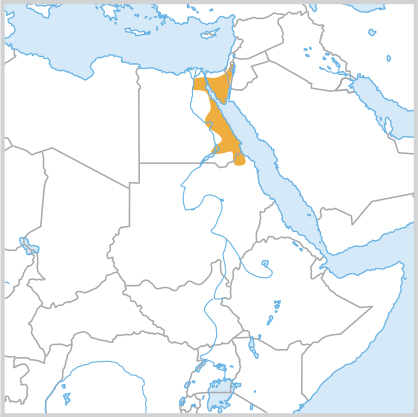
Echis coloratus
Natural History: Terrestrial. It is nocturnal, active from sunset onwards, particularly during the early hours of the night. During the day it hides in rock fissures and under large rocks, rock piles and ground cover; snakes studied in Israel chose ambush positions that were often near water, both under cover and on elevated objects (rocks, logs, etc.), and occasionally climbed into vegetation. This snake appears to be more good-natured than other carpet vipers, but if severely provoked will form a series of C-shaped coils like other carpet vipers, and shift them against each other in opposite directions; this friction between the scales produces a sound like water falling on a very hot plate. At the same time the snake may be moving backwards or forwards. If further agitated, it will strike. It lays 4–10 eggs, which are glued to hard surfaces; this is an adaptation to living in a rocky environment. The diet includes rodents, birds, lizards and frogs, indicating that it hunts by day and night, both from ambush and by prowling. One popular name of this snake (Burton’s Carpet Viper) honours the great explorer and linguist Sir Richard Burton, who collected a specimen and presented it to the British Museum.
Medical Significance: Its small range in Africa and tendency to live in rocky desert lessen the dangers posed by this snake. However, in parts of the Middle East it has been found to be common in agricultural areas, and it is active on the ground at night, increasing the risk. The venom is cytotoxic and haemorrhagic. Antivenom is available. Experimentally in mice, the venom has an IV toxicity of 0.575mg/kg. Local pain and swelling are common and, in severe cases (about 10%), swelling may involve the whole limb and is associated with bruising, haemorrhagic blisters and necrosis. Systemic symptoms appear 15–120 minutes after the bite and include nausea, vomiting, headache, and spontaneous bleeding from the gums, nose, gastrointestinal and urinary tracts and recent wounds. Most patients have incoagulable blood by the time they are admitted to hospital. Do the 20WBCT. About 20% have thrombocytopenia; a few patients develop acute renal failure. Haemostatic dysfunction persists for up to nine days unless antivenom is given. Other abnormalities include hypotension, shock, loss of consciousness, ECG changes, neutrophil leucocytosis, proteinuria and microscopic haematuria with casts. A few fatalities are reported. Compared to envenoming by other Echis species, Burton’s Carpet Viper seems to be more likely to cause thrombocytopenia and acute kidney injury, but the case fatality is lower. Administration of antivenom as late as two days after the bite may have dramatic and immediate effect. Blood clotting times should be carefully monitored in victims.
Taxonomic Notes: Snakes of this species from the extreme eastern side of its range, in eastern Oman and the United Arab Emirates, were elevated in 2004 into a new, full species, the Oman Saw-scaled Viper (Echis omanensis).
Burton’s Carpet Viper, Echis coloratus.
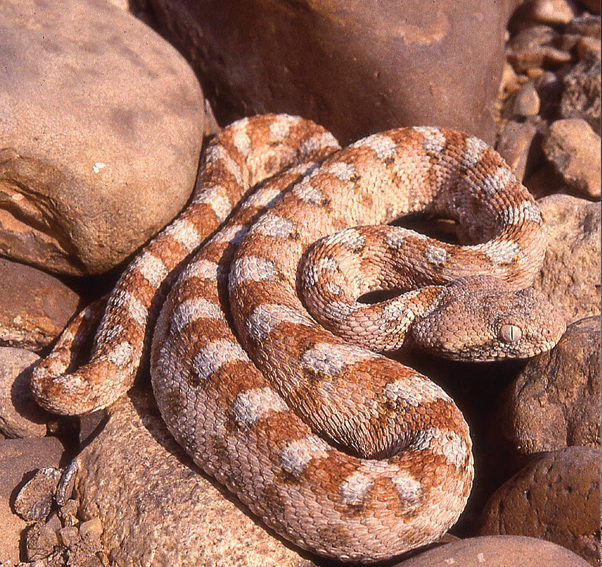
Egypt (Stephen Spawls).
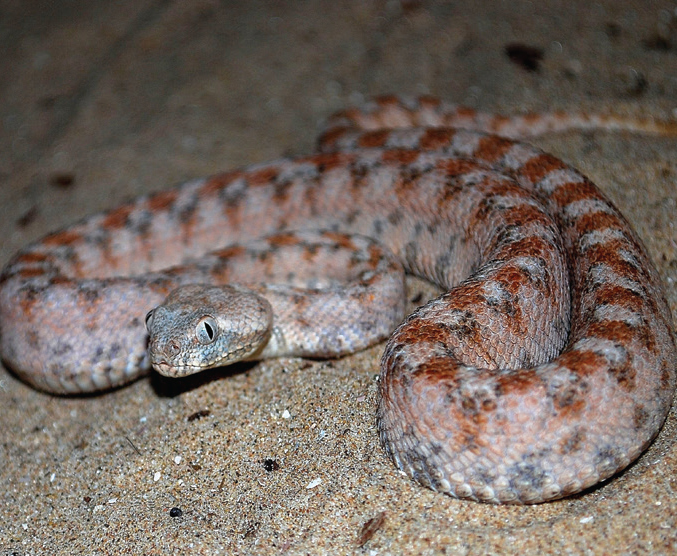
captive (Stephen Spawls).
North-east African Carpet Viper (Saw-scaled Viper) Echis pyramidum
Identification: A small, fairly stout snake of northeast Africa, with a pear-shaped head and a thin neck. The top of the head is covered with small scales, the prominent, pale yellowish eyes with vertical pupils are set near the front of the head, and the tongue is reddish. The body is cylindrical or subtriangular in section and the tail short, 10–11% of total length. The scales are rough and heavily keeled; in 25–31 rows at midbody; ventrals 155–186; subcaudals single, 27–43 (higher counts usually males). Maximum size about 65cm (possibly slightly larger), average 30–50cm; hatchlings 10–12cm. The ground colour may be yellowish, brown, grey or rufous. There is usually a series of pale, oblique cross-bars along the back, with dark spaces between, and along each side there is usually a row of dark triangular, subtriangular or circular markings with a pale or white edging. Specimens with very faded or almost invisible markings are known. The belly is pale, finely spotted brown or red.
Habitat and Distribution: Near-desert, semi-desert and dry savanna, between sea level and 1,250m. As presently defined, this snake has a disjunct distribution; this may be as a result of climatic change causing isolation, or undercollecting, although the variability of the genus also causes problems. Apparently isolated populations are known from south-west and coastal Libya, Egypt, south-west Sudan, northern Central African Republic and parts of northern Kenya. An apparently coherent population occurs from south-east Egypt into most of eastern Sudan, east to Eritrea, low north-east Ethiopia and northern Somalia. Another coherent population also occurs from extreme south-east South Sudan into south-western Ethiopia and northern Kenya, south past Lake Turkana to Lake Baringo, and east along the Uaso Nyiro River.
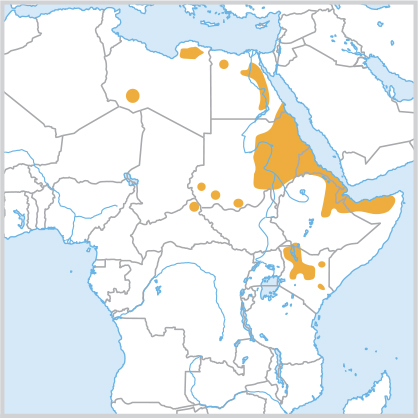
Echis pyramidum
Natural History: Terrestrial, although it occasionally climbs into low bushes to avoid hot or wet surfaces. It moves relatively quickly. It is nocturnal, active from twilight onwards. During the day it hides in holes, under or in logs, or under rocks or brush piles, or it may partially bury itself in sand or coil up in or around grass tufts. It occasionally climbs trees; in northern Kenya a snake 2m up an acacia tree bit someone. This is a spirited snake; when threatened it forms a series of C-shaped coils, which are shifted against each other in opposite directions, and this friction between the scales produces a sound like water falling on a very hot plate; at the same time the snake may be moving backwards or forwards. If further agitated, it will strike continuously and vigorously, to the point of overbalancing. It can strike a long distance, and may move towards a perceived threat. It can also sidewind at considerable speed. It lays 4–20 eggs; hatchlings have been found in July and August in Kenya. It eats a huge variety of prey; some populations eat mostly invertebrates, but most small vertebrates are also taken, including other snakes, even its own kind. This ability to feed on a wide range of prey may explain why it is abundant in places; in the Moille Hill area of northern Kenya, in an area of 6,500 square kilometres, nearly 7,000 of these snakes were collected in four months. However, in some areas it is uncommon; around Cairo, two specimens were found in 25 years.
Medical Significance: This is a dangerous snake; it is often abundant, very willing to bite if approached and active on the ground at night, and it lives in farming areas. Many people are bitten every year in its range; in some areas fatalities approach 20%. The venom is cytotoxic and haemorrhagic. Antivenom is available. Clinical features include local pain, swelling, blistering, abdominal pain, vomiting, bleeding from injection sites and recent injuries, haematuria, bleeding from the gums, haematemesis, melaena, menorrhagia, generalised bruising, periorbital bleeding, shock, fever, anaemia and leucocytosis, local pain, swelling, blistering and a generalised bleeding tendency. Bites will need to be treated in a well-equipped hospital; start with the 20WBCT. Antivenom therapy may be necessary.
Taxonomic Notes: Several subspecies or full species of this snake have been described, based on varying scale counts, colour differences, unusual localities, etc.; names used include Echis megalocephalus and Echis varius. The snakes of north-east Africa, north and eastwards from the Awash Valley, show variation that indicates there may be several evolutionary species present, each evolving separately. Our treatment reflects the situation at the time of writing.
North-east African Carpet Viper, Echis pyramidum.
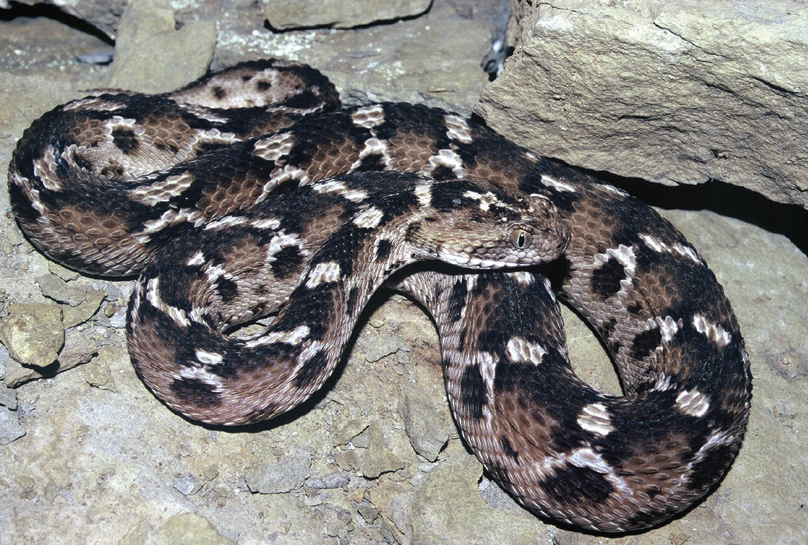
Egypt (Tomáš Mazuch).
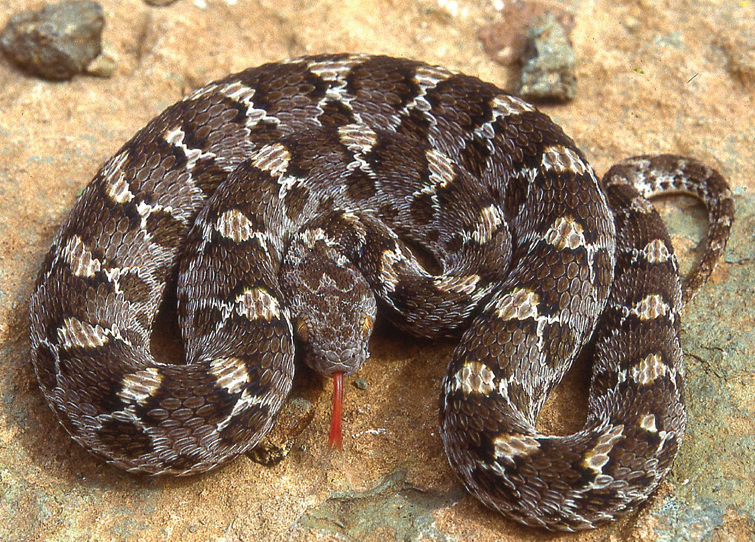
Ethiopia (Stephen Spawls).
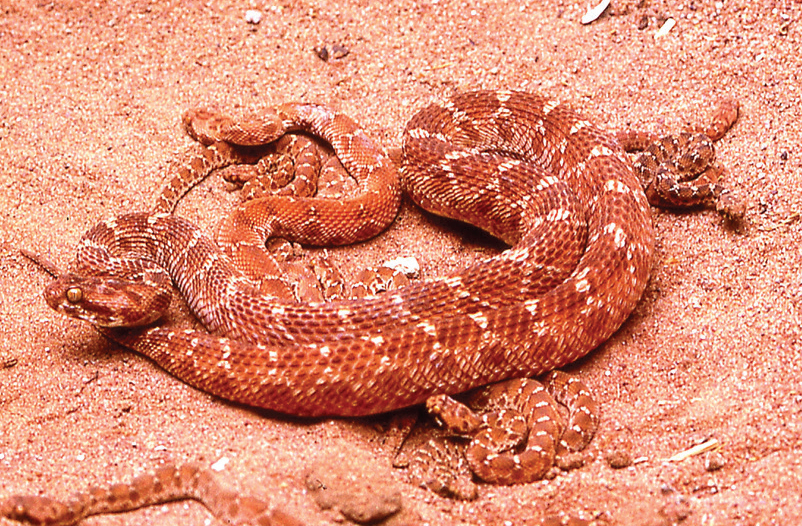
Kenya (Stephen Spawls).
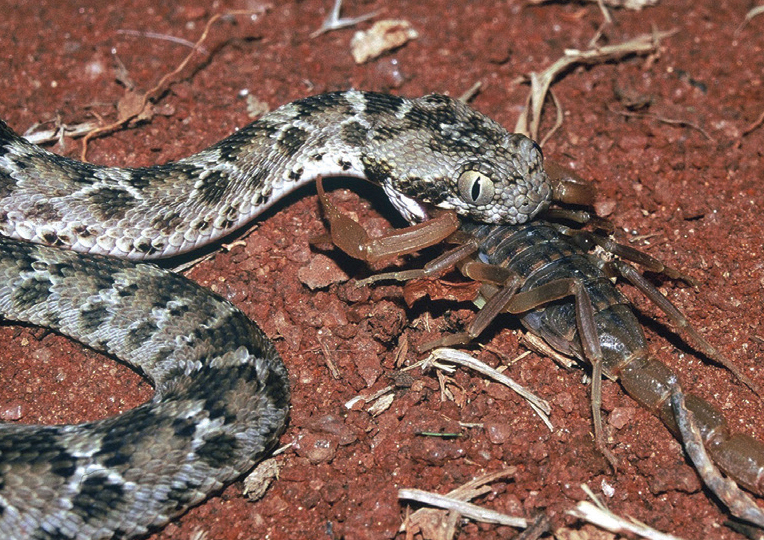
Kenya (Tomáš Mazuch).
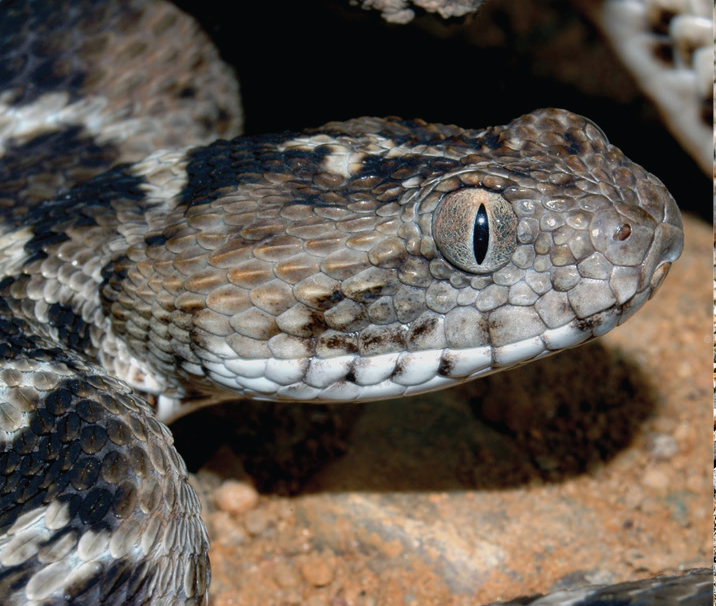
Egypt (Tomáš Mazuch).
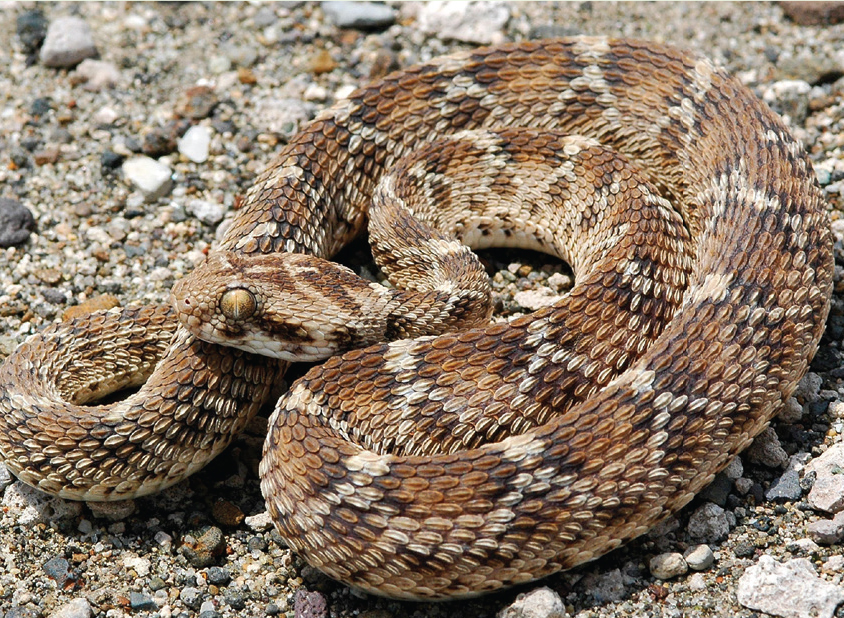
Kenya (Eduardo Razzetti).
Identification: A large, distinctly marked carpet viper of the West and Central African Sahel and further north. The body is cylindrical or subtriangular in cross section and the tail short, 10–14% of total length. The scales are small on the head, rough and heavily keeled; in 27–33 rows at midbody; ventrals 158–189; subcaudals 25–40. Maximum size about 80cm, average 30–70cm; hatchlings 12–16cm. This species is quite variable in colour and pattern; the ground colour may be brown, grey or rufous, or shades in between. There is usually a series of pale, oblique cross-bars or saddles along the back, with dark spaces between. It is paler on the side. Along each side there is usually a row of triangular, subtriangular or circular dark markings with pale or white edging. The belly is pale cream, white or ivory and is usually unspotted (but see taxonomic notes here).
Habitat and Distribution: Arid savanna, Sahel, semi-desert and well-vegetated dry riverbeds. It is not known from true desert, but occurs on the desert edge, in oases, elevated vegetated areas within deserts, etc. A snake of North, West and north-west Africa, with what appears to be a very disjunct distribution. There is a string of isolated records from Western Sahara, Morocco, Algeria, Tunisia, Libya and northern Chad; this disjunct distribution may be due to undercollecting or isolation. An apparently coherent population occurs west from east-central Chad through most of Niger to northern Burkina Faso, central Mali, Senegambia and the southern half of Mauritania, south to northern Guinea.
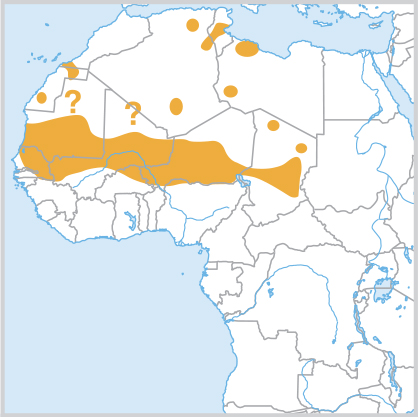
Echis leucogaster
Natural History: Terrestrial, although it occasionally climbs into low bushes to avoid hot or wet surfaces. It moves relatively quickly for a viper. It is nocturnal, being active from twilight onwards, and most active during the first few hours of the night. During the day it hides in holes, under rocks, or under or in logs, brush piles, etc. A spirited snake; when threatened, it forms a series of C-shaped coils, which are shifted against each other in opposite directions, and this friction between the scales produces a sound like water falling on a very hot plate. At the same time the snake may be moving backwards or forwards. If further agitated, it will strike continuously and vigorously, to a relatively large distance; it may strike so enthusiastically that it overbalances. It may even move towards an aggressor, a most unusual behaviour in a snake. Females lay clutches of 8–22 eggs, between August and October. Captive specimens hatched after two months. It eats a wide range of prey, including invertebrates (especially scorpions and centipedes), small mammals and reptiles.
Medical Significance: This is a dangerous snake; it is often abundant across a huge area of Africa, and it is the most common snake in northern Mali. It is very willing to bite if approached, is active on the ground at night and lives in farming areas. Many people must be bitten every year in its range, yet there seem to be few documented cases. The venom is cytotoxic and haemorrhagic. Antivenom is available. The clinical picture is probably similar to that of the previous species, with swelling, bleeding and incoagulable blood; bites will need to be treated in a well-equipped hospital, and antivenom therapy may be necessary. Start with the 20WBCT.
Taxonomic Notes: One method of distinguishing this species from the very similar North-east African Carpet Viper (Echis pyramidum) is by the absence of spotting on the underside. However, recent work indicates that E. leucogaster in Mali often do have spots, which suggests that there is a degree of overlap between the two species.
White-bellied Carpet Viper, Echis leucogaster.
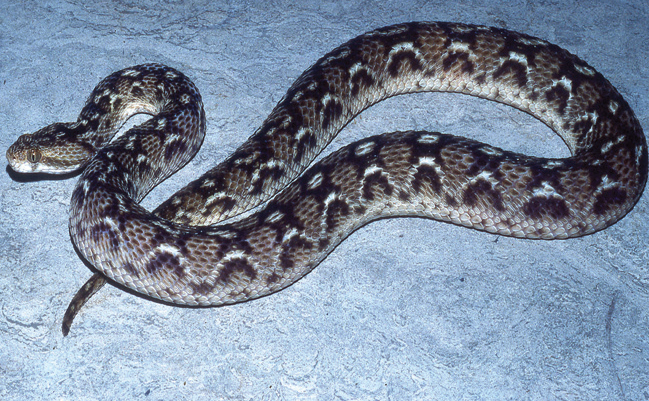
captive (Stephen Spawls).
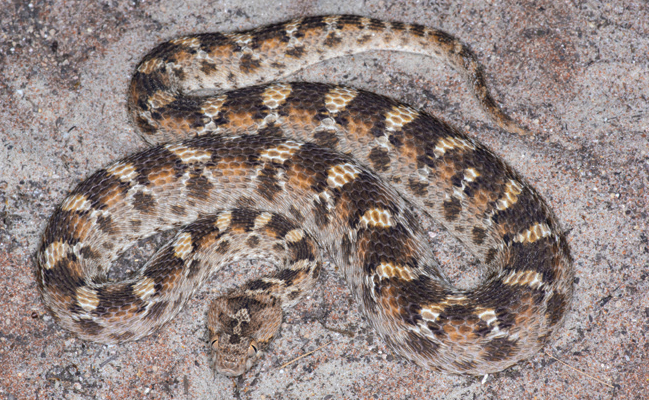
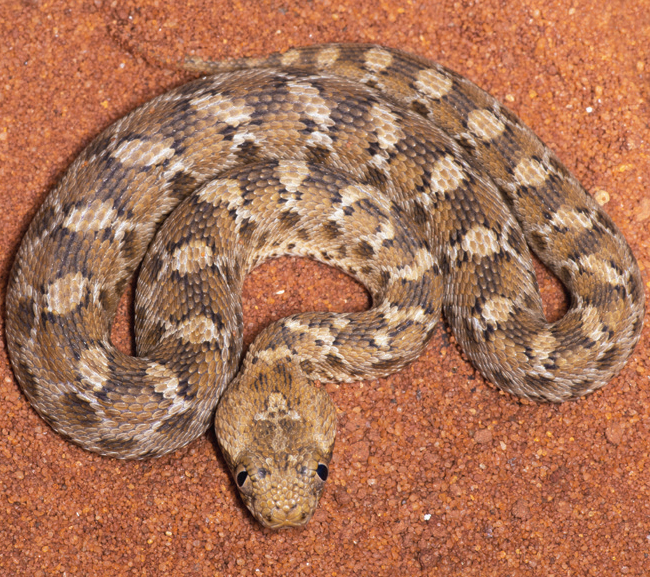
Niger (Darrell Raw).
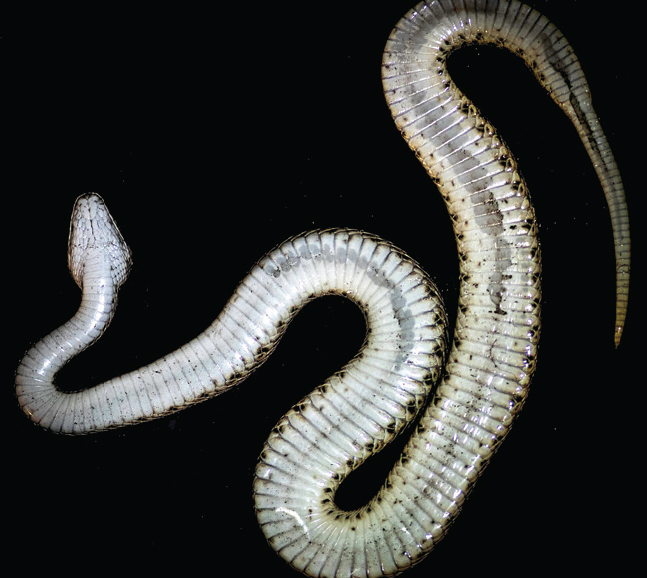
underside (Darrel Raw).
West African Carpet Viper Echis ocellatus
Identification: A distinctly marked carpet viper, usually with pale eyespots on the flanks, found in the West African savanna. The body is cylindrical or subtriangular in cross section, and the tail short, 10–14% of total length. The scales are small on the head, rough and heavily keeled; in 25–33 rows at midbody; ventrals 133–157; subcaudals 17–30. Maximum size about 60cm, average 30–50cm; hatchlings 10–13cm. The ground colour is usually brown or grey or shades in between. Individuals usually show one of two main dorsal patterns: one is a series of dark irregular cross-bars on a lighter background; and the other is a series of pale saddles with darker interspaces. The lower flanks are lighter. Most specimens (but not all) have a diagnostic line of small white eyespots along the flanks. The belly is pale, and usually covered with brown or reddish spots.
Habitat and Distribution: Semi-desert and dry and moist savanna, even into forest margins; between sea level and 1,100m. A snake of the central West African savanna; it occurs from western Nigeria west to north-east Guinea, and southwards in the Dahomey Gap to the coast. An isolated record exists from Trarza Region, extreme south-west Mauritania. As originally defined, this snake had a far larger range, but snakes from central Nigeria eastwards are now assigned to Roman’s Carpet Viper (Echis romani), and those west of Mali are largely the Mali Carpet Viper (E. jogeri).
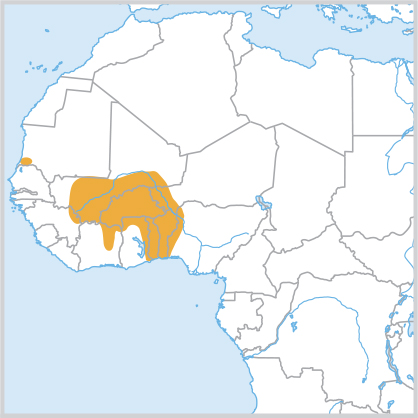
Echis ocellatus
Natural History: As with other carpet vipers, it is terrestrial, but may climb low bushes to avoid hot or wet surfaces. It moves relatively quickly for a viper. It is nocturnal, being active from twilight onwards, and is most active during the first few hours of the night. During the day it hides in holes, under rocks, or under or in logs, brush piles, etc. When disturbed, it readily forms C-shaped coils, stridulates and strikes vigorously to a long distance, moving backwards or forwards; it may strike so enthusiastically that it overbalances. It may even move towards an aggressor, a most unusual behaviour in a snake. Females lay clutches of 6–28 eggs, usually in March or April; these hatch after two months, to coincide with the rainy season. It eats a wide range of prey, including invertebrates (especially scorpions and centipedes) and vertebrates (amphibians, lizards, other snakes and mammals).
Medical Significance: This is a very dangerous snake. It is often abundant across a huge area of Africa. It was found to be the most common snake in a study in north-west Ghana. It is very willing to bite if approached, is active on the ground at night and lives in farming areas. Many people are bitten every year. Antivenom is available; a district hospital in northern Ghana without antivenom had regular fatalities, while a hospital with antivenom had virtually none. The venom is cytotoxic and haemorrhagic. The clinical picture is pain and severe local swelling, blistering and necrosis, with severe haemostatic disorders leading to systemic bleeding. Bites will need to be treated in a well-equipped hospital; antivenom therapy will be necessary, and replacement therapy and blood transfusions may also be needed. Start with the 20WBCT.
Taxonomic Notes: As mentioned here, this species, as originally defined, has now been split into three West and Central African forms (Echis ocellatus, E. jogeri and E. romani) with largely mutually exclusive ranges.
West African Carpet Viper, Echis ocellatus.
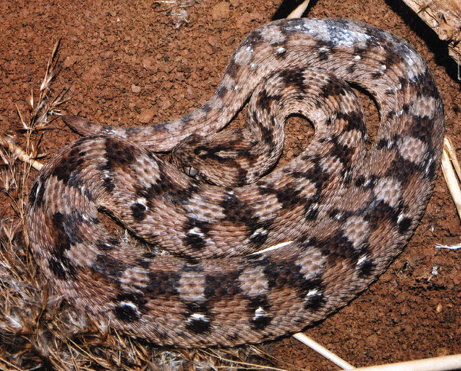
captive (Tomáš Mazuch).
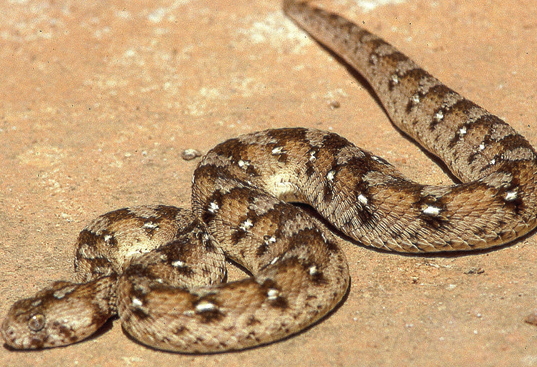
Ghana (Stephen Spawls).
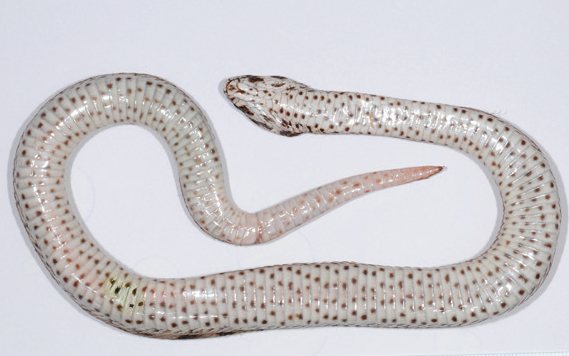
underside (Tomáš Mazuch).
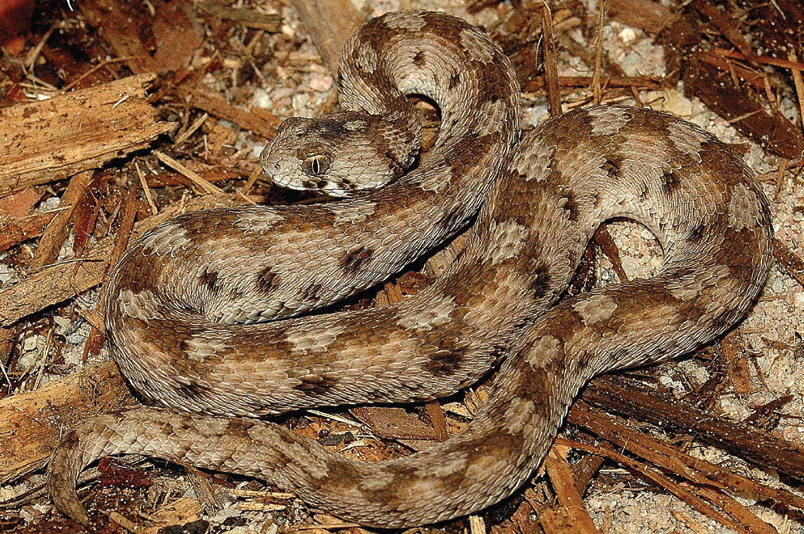
Togo (Tomáš Mazuch).
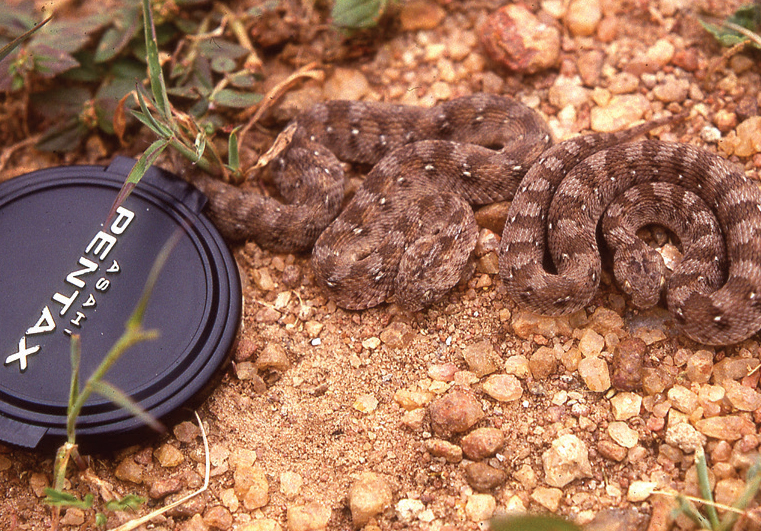
hatchlings, Ghana (Stephen Spawls).
Roman’s Carpet Viper Echis romani
Identification: A relatively large, distinctly marked carpet viper, usually with pale eyespots on the flanks and with high ventral counts, found in the West African savanna, east of Nigeria. The body is cylindrical or subtriangular in cross section, and the tail short, 7–11% of total length. The scales are small on the head, rough and heavily keeled; in 29–33 rows at midbody; ventrals 146–168; subcaudals 18–29 (higher counts in males). Maximum size about 72cm, average 30–50cm; hatchling size unknown, but a 13cm specimen was collected in May. The ground colour is usually rufous, brown or grey, with a series of grey or brown blotches along the spine, and pale eyespots on the flanks. Nigerian specimens are often distinctly rufous on the flanks. The belly is pale, and usually covered with brown or reddish spots.
Habitat and Distribution: Dry and moist savanna, even into forest margins; between 200m and 1,200m. It occurs from west-central Nigeria and extreme southern Niger eastwards to northern Cameroon, south-western Chad and north-west Central African Republic; two isolated populations are also known from southern Sudan.
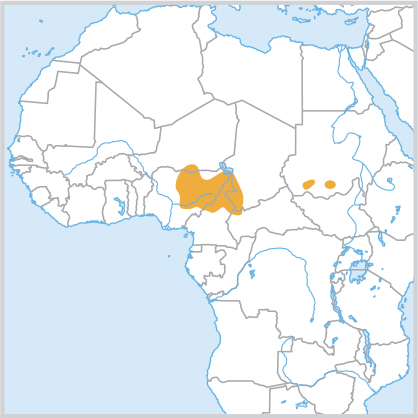
Echis romani
Natural History: As with other carpet vipers, it is terrestrial, but it may climb low bushes to avoid hot or wet surfaces. It moves relatively quickly for a viper. It is nocturnal, being active from twilight onwards, and is most active during the first few hours of the night. During the day it hides in holes, under rocks, or under or in logs, brush piles, etc. When disturbed, it readily forms C-shaped coils, stridulates and strikes vigorously to a long distance, moving backwards or forwards; it may strike so enthusiastically that it overbalances, and may even move towards an aggressor, a most unusual behaviour in a snake. This species lays eggs; Nigerian females laid 10–22 eggs, usually in March or April. Eggs hatch after two months, to coincide with the rainy season. It eats a wide range of prey, including invertebrates (especially scorpions and centipedes) and vertebrates (amphibians, lizards, other snakes and mammals).
Medical Significance: This is a very dangerous snake. It is often abundant across a huge area of Africa, and it causes huge numbers of snakebites in Nigeria and Cameroon. It is very willing to bite if approached, is active on the ground at night and lives in farming areas. Many people are bitten every year. Antivenom is available. The venom is cytotoxic and haemorrhagic. The clinical picture is pain and severe local swelling, blistering and necrosis, with severe haemostatic disorders leading to systemic bleeding. Bites will need to be treated in a well-equipped hospital; antivenom therapy may be necessary, and replacement therapy and blood transfusions may also be needed. Start with the 20WBCT.
Taxonomic Notes: As mentioned here, this species was recently elevated out of the synonymy of Echis ocellatus, and was originally regarded as the eastern population of that species. It is named after Benigno Roman, who carried out pioneering work on the snakes of Burkina Faso.
Roman’s Carpet Viper, Echis romani.
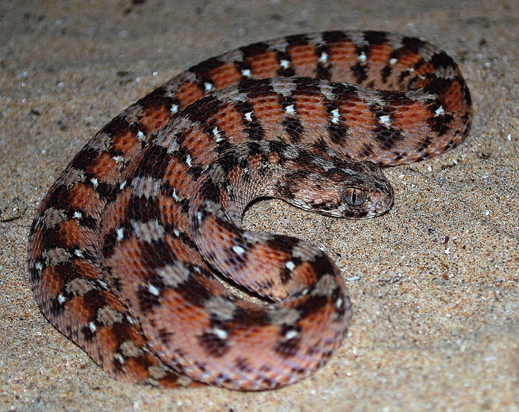
Nigeria (Stephen Spawls).
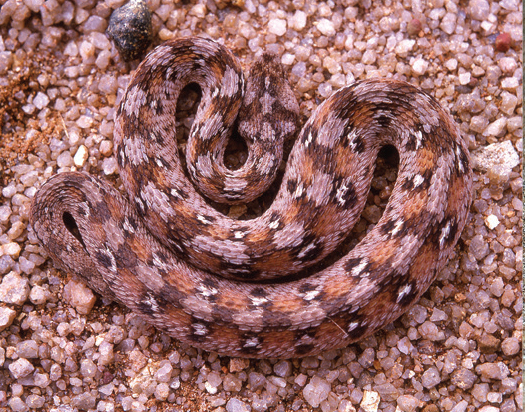
Nigeria (Gerald Dunger).
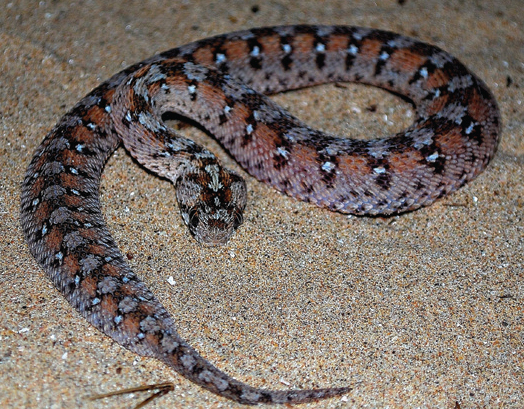
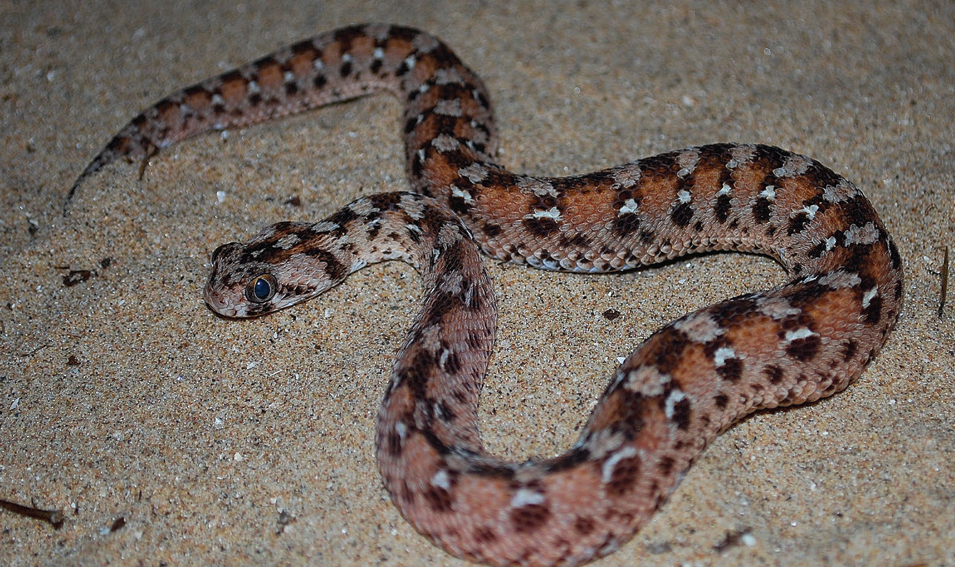
Nigeria (Stephen Spawls).
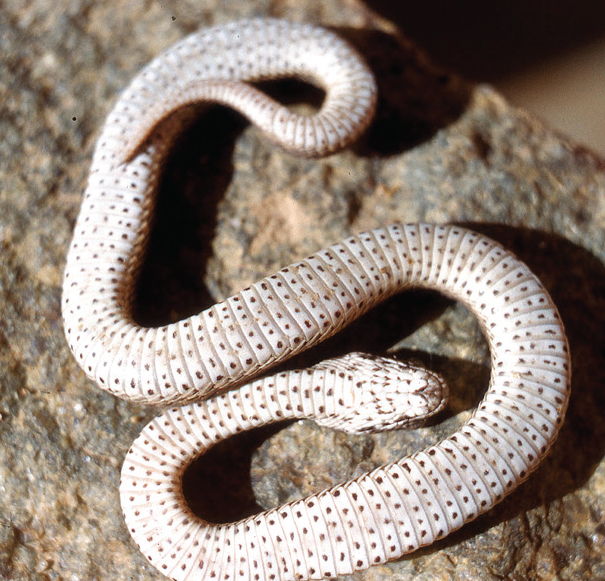
underside, Nigeria (Gerald Dunger).
Mali Carpet Viper Echis jogeri
Identification: A small, distinctly marked carpet viper, usually with pale eyespots on the flanks and with low ventral counts, found in the West African savanna, west of Burkina Faso. The body is cylindrical or subtriangular in cross section, and the tail short, 7–12% of total length. The scales are small on the head, rough and heavily keeled; in 27 rows at midbody; ventrals 123–143; subcaudals 15–30 (higher counts in males). The maximum size is about 45cm, average 20–35cm; hatchling size unknown, but probably around 9–10cm. The ground colour is usually rufous, brown or grey, with a series of vague darker cross-bars, and usually pale eyespots on the flanks. The underside is pale, and usually covered with brown or reddish spots.
Habitat and Distribution: Dry and moist savanna, between sea level and 800m. It occurs from western Senegal and the Gambia into northern Guinea and western Mali.
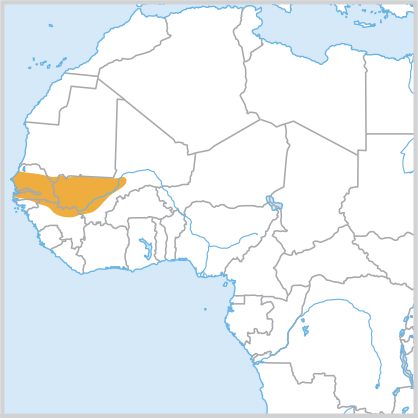
Echis jogeri
Natural History: As with other carpet vipers, it is terrestrial, but it may climb low bushes to avoid hot or wet surfaces. It moves relatively quickly for a viper. It is nocturnal, being active from twilight onwards, and is most active during the first few hours of the night. During the day it hides in holes, under rocks, or under or in logs, brush piles, etc. When disturbed, it readily forms C-shaped coils, stridulates and strikes vigorously to a long distance, moving backwards or forwards; it may strike so enthusiastically that it overbalances, and may even move towards an aggressor, a most unusual behaviour in a snake. Females lay eggs that probably hatch after two months, to coincide with the rainy season. It eats a wide range of prey, including invertebrates (especially scorpions and centipedes) and vertebrates (amphibians, lizards, other snakes and mammals).
Medical Significance: This is a very dangerous snake. It is often abundant across a huge area of Africa. It causes huge numbers of snakebites in Senegal and Mali. It is very willing to bite if approached, is active on the ground at night and lives in farming areas. Many people are bitten every year. Antivenom is available. The venom is cytotoxic and haemorrhagic. The clinical picture is pain and severe local swelling, blistering and necrosis, with severe haemostatic disorders leading to systemic bleeding. Bites will need to be treated in a well-equipped hospital; antivenom therapy may be necessary, and replacement therapy and blood transfusions may also be needed. Start with the 20WBCT.
Taxonomic Notes: As mentioned here, this species was elevated out of the synonymy of Echis ocellatus, and was originally regarded as being part of the western population of that species.
Mali Carpet Viper, Echis jogeri.
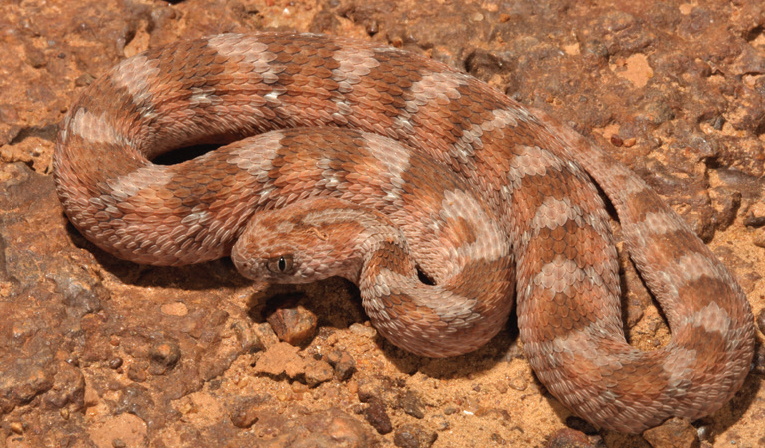
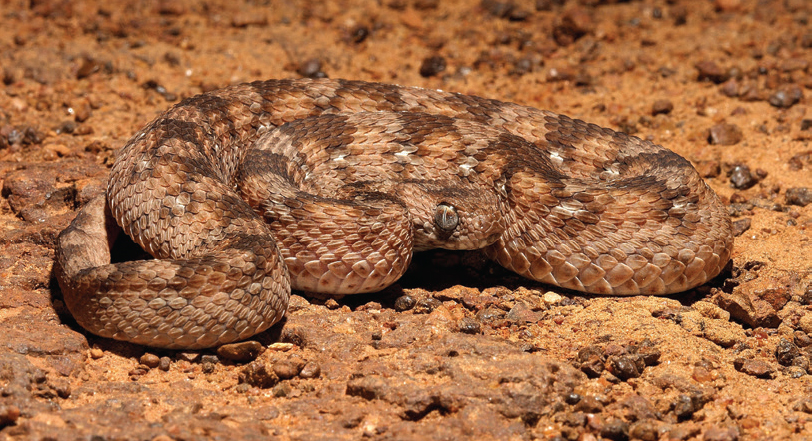
Senegal (Wolfgang Wuster).
Identification: A small, pale carpet viper, endemic to north-east Somalia. It has a pear-shaped head and a thin neck. The top of the head is covered with small scales, and the prominent, pale yellowish eyes have vertical pupils and are set near the front of the head. The body is cylindrical or subtriangular in section and the tail short, around 10–12% of total length. The scales are rough and heavily keeled; in 24–25 rows at midbody; ventrals 144–149; subcaudals single, 28–30. Maximum known size about 35cm. The ground colour has never been described in living animals, but is probably grey or brown; there is usually a series of pale, oblique cross-bars along the back, with darker blotches, often with even darker edging, in between. The flanks are marked with irregular darker blotches of varying size. The underside is white, with occasional reddish spots near the ventral scale margins.
Habitat and Distribution: Dry savanna and semi-desert, at low altitude. It is known only from Bari and Nugal Regions of north-east Somalia.
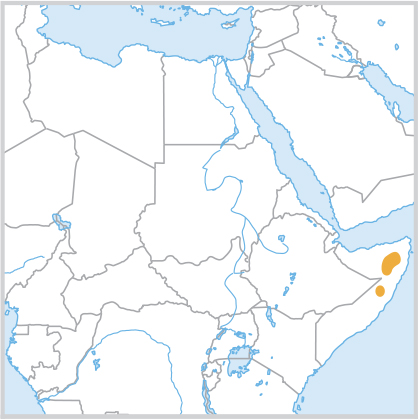
Echis hughesi
Natural History: Unknown, but presumably similar to other members of the genus: nocturnal and terrestrial, shelters in holes and under ground cover, forms C-shaped coils when disturbed and strikes readily, lays eggs, and eats a range of small vertebrates and possibly invertebrates.
Medical Significance: Unknown, but the venom is probably similar to that of the North-east African Carpet Viper (Echis pyramidum).
Taxonomic Notes: Described in 1990, it differs from the North-east African Carpet Viper, which occurs further west, only in having fewer ventral scales. It might just be an ecotype of that species, but it does seem to be an isolated population, and a number of other distinctive endemic species occur in the area. This genus is absent from most of Somalia, except the north, which is curious given the wide range of suitable habitat for these dry-country specialists.
Somali Carpet Viper, Echis hughesi.
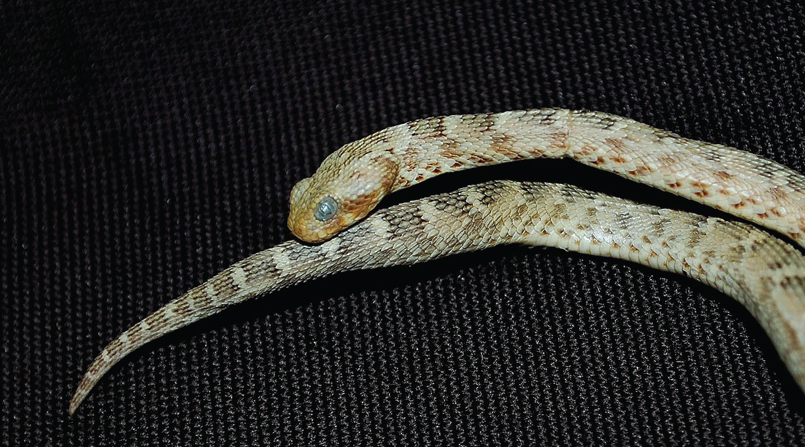
preserved specimen (Stephen Spawls).
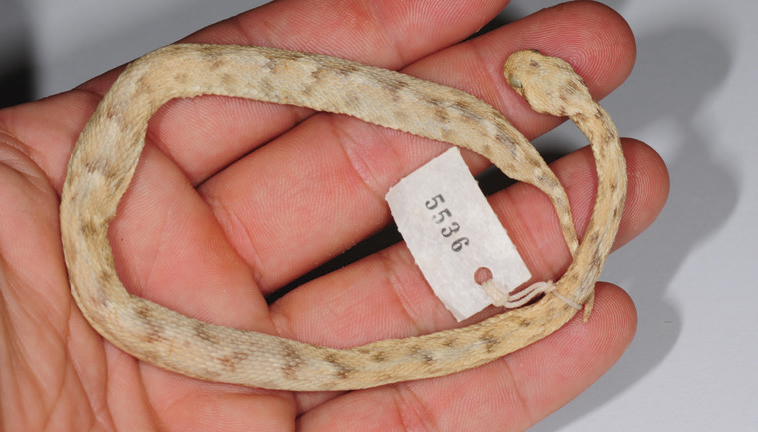
preserved specimen (Tomáš Mazuch).
A genus of broad-headed brown or biscuit-coloured desert vipers, rarely larger than 70cm. Four species are known; two are widespread over North Africa, one is confined to Tunisia, and the fourth is from the Middle East (almost reaching far eastern Egypt). Two of the three African species have huge ranges, and are implicated in many snakebite cases in North Africa. They are dangerous because they are on the ground, often well hidden in sand, and are active at dusk and in the early hours of the night, so are liable to be trodden on by people without adequate footwear. These snakes appear to have a haemorrhagic venom; bites usually result in local pain and swelling, complicated by necrosis in some cases. Nausea, vomiting, coagulopathy and spontaneous bleeding, including cerebral haemorrhage, have been observed in some cases. Although there are no credible reports of deaths in the last 100 years or so, some documented bites to snake keepers have been life-threatening. Antivenom is available.
Key to the genus Cerastes, North African desert vipers
1aHorns consist of a cluster of elongate blunt-topped scales above the eye……Cerastes boehmei, Böhme’s Sand Viper
1bEither hornless or, when present, horn consists of a single elongate spike……2
2aSmall, less than 50cm; never has horns; eyes on the junction of side and top of head; ventrals always fewer than 126…… Cerastes vipera, Sahara Sand Viper
2bLarge, up to 75cm or more; often has horns; eyes on the side of the head; ventrals always more than 129 ……Cerastes cerastes, Sahara Horned Viper
Sahara Horned Viper Cerastes cerastes
Identification: A short, stout viper, usually with prominent horns, found in the Sahara and environs. The head is broad, flat and triangular, and covered with small scales. The eye is prominent, on the side of the head, and has a vertical pupil in bright light. The neck is thin. There is often a long horn above each eye; this horn consists of a single scale, not a group of scales. Individuals without horns often have prominent brow ridges. The body is broad and flattened, and the tail short, 7–12% of total length. The scales are heavily keeled; in 23–39 rows at midbody; ventrals 130–165; cloacal scale entire; subcaudals 23–45. Maximum size in the wild about 75cm, although captive specimens have reached 90cm; most specimens 35–60cm; hatchlings 12–15cm. The ground colour is yellowish, buff, reddish or greyish brown, with a series of almost rectangular brown blotches along the back. A dark line extends backwards from each eye. The tail tip may be black in some individuals.
Habitat and Distribution: Occurs in desert and semi-desert. A versatile snake, usually found in wadi systems with vegetation and sandy soil, but it also occurs on gravel plains, in mountainous country, and even in very rocky areas so long as some sand or soil patches exist. Not usually within dunes, although found on the margins. It is found from sea level to over 1,200m, possibly higher. It occurs throughout the Sahara, from western Mauritania eastwards to Sudan and Egypt, and north to the coast (excluded from the north Moroccan and Algerian coast by the Atlas Mountains). In Egypt it extends across the Sinai; just east of there it is replaced by the Arabian Horned Viper (Cerastes gasperettii).
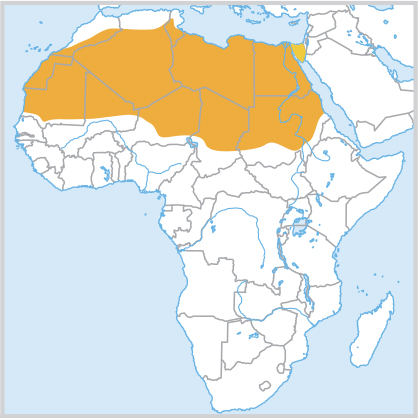
Cerastes cerastes
Natural History: Terrestrial and slow-moving, although it can strike very quickly and can also sidewind. It is nocturnal in the summer months, active from dusk onwards, but may bask during the day (especially during winter and early spring). It shelters in rodent burrows or other holes, under ground cover (wood, rocks, etc.) or hidden in a bush or among grass tufts. It often buries (or partially buries) itself in soft sand, sometimes in the lee of a bush or rock, but may simply coil up in a sheltered place out of the sun and wind, where it may be surprisingly visible. This snake is fairly placid, but can strike quickly, to some distance, and when threatened can shift its coils into C-shapes and rub them together (as do carpet vipers), producing a hissing, crackling sound; from this display it will also strike. Females lay 10–23 eggs, which hatch after 45–80 days’ incubation. This species is known to move long distances at night in search of prey. The diet includes rodents, lizards and birds (the fact that it eats birds indicates how quickly it strikes). A captive individual in Cairo Zoo took six to eight birds a year, and lived 14 years in captivity. One of the more common hieroglyphic characters in Egypt is a Sahara Horned Viper. In some areas it is greatly feared; it is believed to be able to spring a huge distance into the air to bite or even to be able to fly.
Medical Significance: This is a nocturnal terrestrial snake with a huge range. It is often near villages and encampments, and remains concealed and motionless when approached. It therefore causes a lot of bites; in countries such as Egypt the majority of bites are due to this species, although in some areas it is regarded by the local people as not being particularly dangerous, and it may be tolerated. Reports of deaths from its bite exist in older literature, but appear to be largely mismanaged cases, or possibly caused by another snake. No recent fatal cases are known and antivenom is available. However, the venom is highly toxic. Swelling, nausea, vomiting, coagulopathy and spontaneous bleeding, including cerebral haemorrhage, have been observed; in some cases necrosis has been reported. Recently, disseminated intravascular coagulation, microangiopathic haemolysis and acute kidney injury were described in two bite cases on snake keepers. It is not a fast-acting venom, but bite cases need to be treated at a well-equipped hospital and may involve antivenom therapy.
Sahara Horned Viper, Cerastes cerastes.
captive (Stephen Spawls).
Niger (Jean-Francois Trape).
Morocco (Konrad Mebert).
hornless captive (Stephen Spawls).
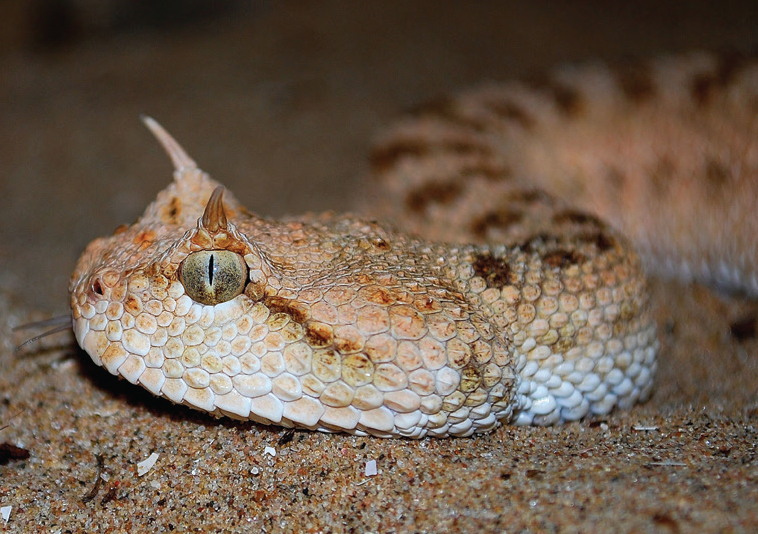
captive (Stephen Spawls).
Sahara Sand Viper Cerastes vipera
Identification: A small, flattened, stout viper with strangely angled eyes on top of its head, in sand dunes in the Sahara and environs. The head is broad, flat and triangular, and covered with small scales. The eye is prominent, on the side of the head, and has a vertical pupil in bright light. The neck is thin. The body is broad and flattened, and the tail short, 7–14% of total length. The scales are heavily keeled; in 23–29 rows at midbody; ventrals 102–125; cloacal scale entire; subcaudals 18–26. Maximum size about 50cm, but this is large; most specimens 20–30cm; hatchlings 12–15cm. The ground colour is yellowish, buff, reddish or greyish brown, with a series of almost rectangular brown blotches along the back. A dark line extends backwards from each eye. The tail tip is black in females.
Habitat and Distribution: A desert snake, usually found in dunes or other areas of soft sand; from sea level to over 1,000m, possibly higher. It occurs throughout the Sahara, from western Mauritania eastwards to northern Sudan and Egypt, north to the coast (excluded from the north Moroccan and Algerian coast by the Atlas Mountains). In Egypt it extends across the Sinai, and north into Israel.
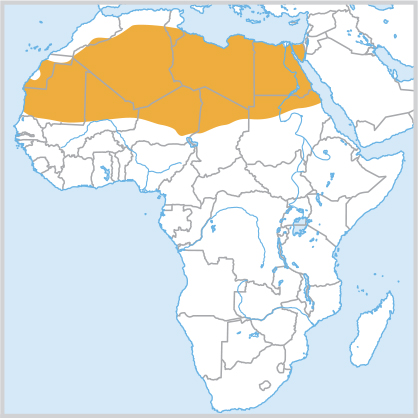
Cerastes vipera
Natural History: Terrestrial and slow-moving, although it can strike very quickly and can also sidewind. It is nocturnal in the summer months, active from dusk onwards, but may bask during the day (especially during winter and early spring), and in northern parts of its range may hibernate between November and February. It usually buries itself in soft sand, sometimes with the eyes exposed, but may hide in holes or under ground cover. This snake is fairly placid, but can strike quickly, to some distance, and when threatened can shift its coils into C-shapes and rub them together (as do carpet vipers), producing a hissing, crackling sound; from this display it will also strike. Mating occurs in April and May in Israel, and 3–6 young are born live in the latter half of August. The diet in the wild is mostly lizards, but captive snakes take rodents.
Medical Significance: This is a nocturnal terrestrial snake with a huge range, which hides by partially or totally buying itself. A number of bites probably occur every year as walkers tread on the snake. No fatalities are known; a study in Israel found that most bites resulted in only minor local swelling and small haematomas, and one victim showed slight abnormalities in his coagulation profile. However, bite victims should visit a hospital.
Sahara Sand Viper, Cerastes vipera.
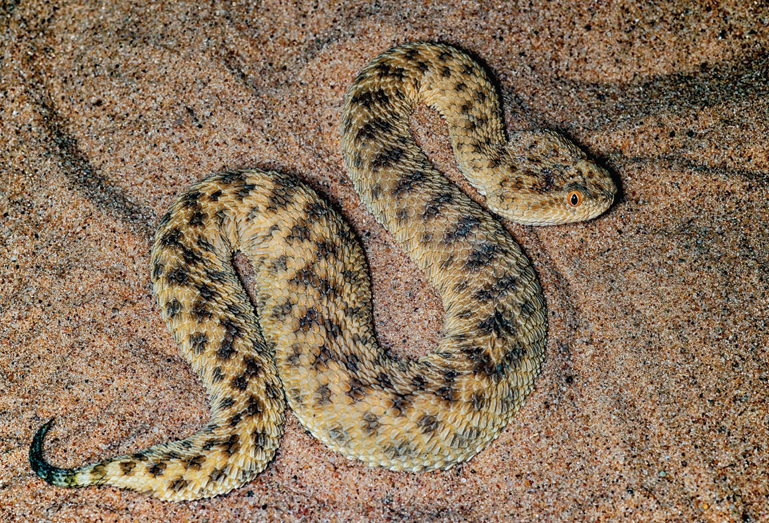
Egypt (Darrell Raw).
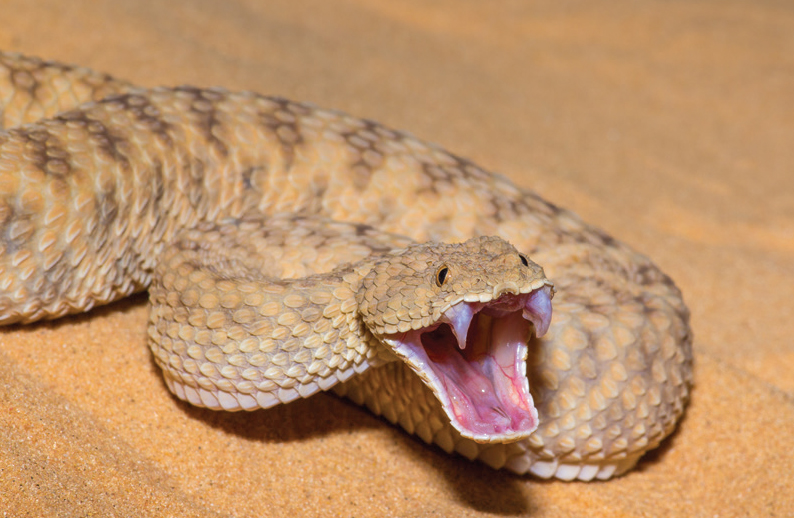
Israel (Yannick Francioli).
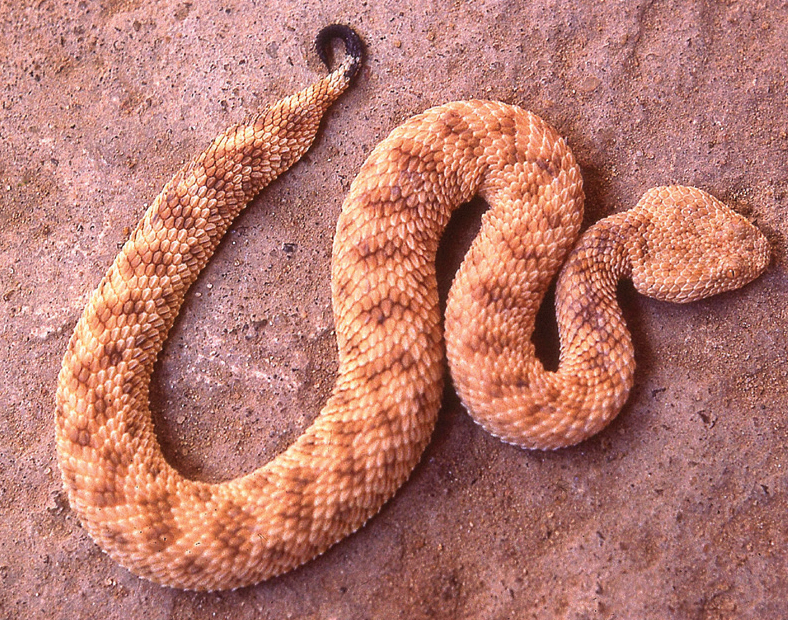
Egypt (Stephen Spawls).
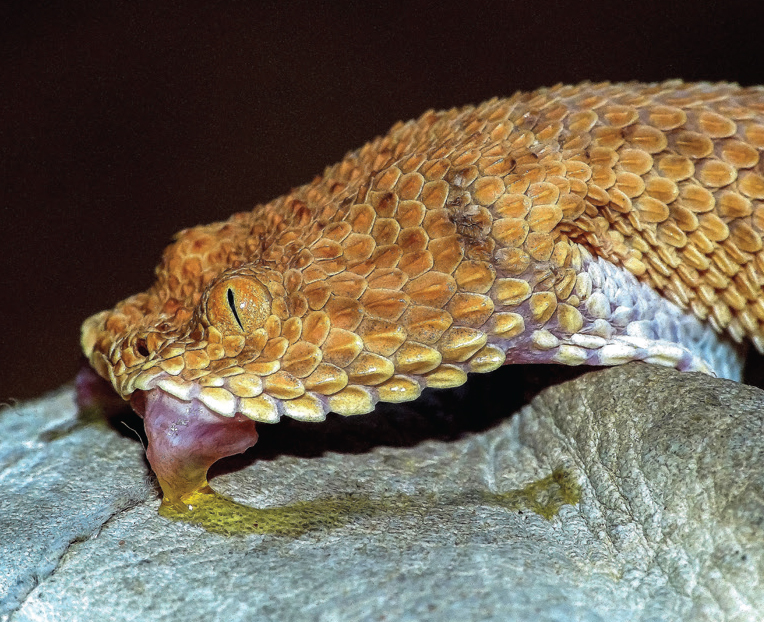
embedding its fangs into a glove (Konrad Mebert).
Böhme’s Sand Viper Cerastes boehmei
Identification: A small, flattened, stout viper, similar to the Sahara Sand Viper (Cerastes vipera) but with curious flat-topped horns. Described in 2010, from south-central Tunisia. The head is broad, flat and triangular, and covered with small scales; above the eye is a curious cluster of flat-topped scales, not like the pointed horns of the Sahara Horned Viper. The eye is prominent, on the side of the head, and has a vertical pupil in bright light. The neck is thin, and the body broad and flattened. The scales are heavily keeled; in either 21 or 26 rows at midbody (due to an irregularity of the lower scale rows in the type); ventrals 110; cloacal scale entire; subcaudals 25. The type was just under 22cm in total, and the tail 2.5cm. The ground colour is uniform sandy yellowish, with vague darker dorsal blotches. The tail tip is black and the belly white.
Habitat and Distribution: A desert snake, known from Bani Kheddache and Remada, between 300m and 500m, in south-central Tunisia.
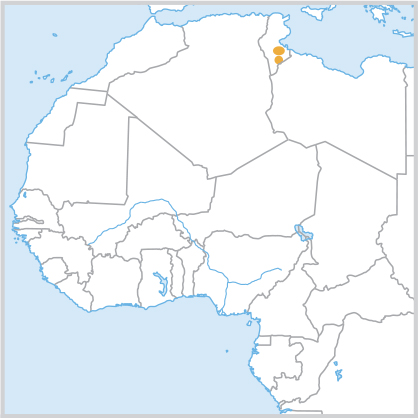
Cerastes boehmei
Natural History: Unknown, but its resemblance to the Sahara Sand Viper suggests its habits might be similar; that is, terrestrial and nocturnal, buries itself in sand or hides in holes, forms C-shaped coils when disturbed, gives birth to live young (a captive female gave birth to five young), and eats small desert lizards.
Medical Significance: The venom and its effects are probably similar to those of the Sahara Sand Viper.
Taxonomic Notes: An interesting snake; the presence of horns suggests a relationship to the Sahara Horned Viper (Cerastes cerastes), but the general habitus and low ventral count suggests it may be related to the Sahara Sand Viper; it has been suggested that it is either a hybrid or a sport. Further research and specimens may clarify the situation.
Böhme’s Sand Viper, Cerastes boehmei.
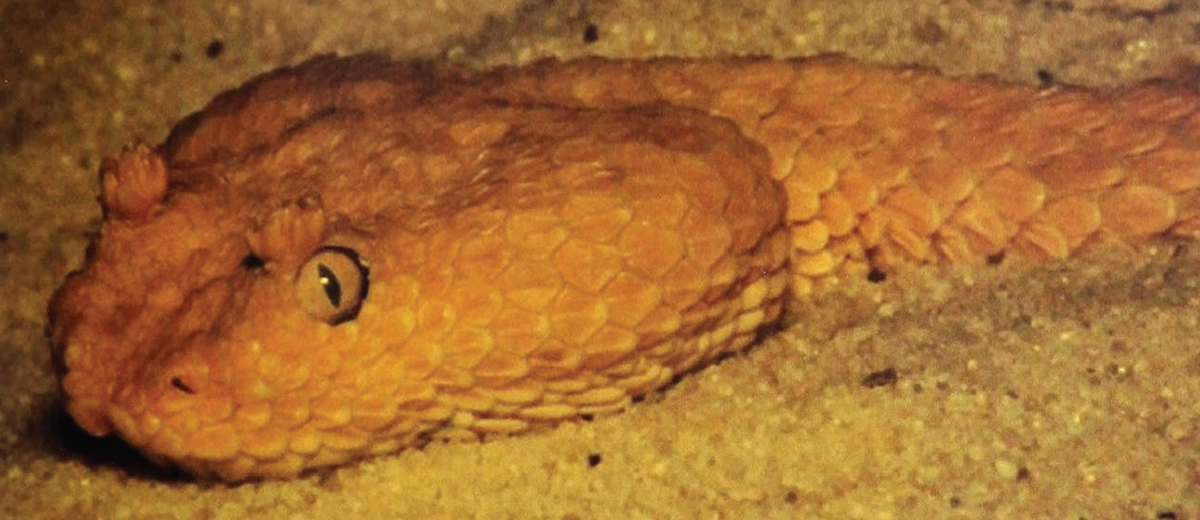
captive (Library Book Collection/Alamy Stock Photo).
A genus of small, stout, frog-eating vipers, rarely larger than 75cm or so. They are found in sub-Saharan Africa in savanna and forest, and occasionally in semi-desert along watercourses. Seven species are known. Unusually for vipers, they have a round pupil and nine large scales on top of the head (in most other vipers these are small), and they lay eggs. Despite their common name, they are active by day and night. They have a somewhat primitive fang rotation movement and their fangs are relatively short. Several species have exceptionally long venom glands that extend well down the neck; the large quantities of venom thus produced assist in envenoming large frogs.
Night adders can be common, they are active on the ground by day and by night, they are willing to bite and in some areas they are responsible for a high proportion of snakebite cases. The venom is cytotoxic, and bites usually result in local pain, sometimes rapid and intense, as well as swelling, blistering and lymphadenopathy. Necrosis has very rarely been observed, even after blister removal, no systemic effects have been noted in humans, no fatalities are recorded and no antivenom is available. However, research indicates the venom does inhibit blood coagulation; some haemorrhaging may occur and South African polyvalent antivenom, although not raised against night adder venom, does have a neutralising effect on the venom of the Rhombic Night Adder (Causus rhombeatus). Treatment for a bite consists of elevation of bitten limbs and pain relief. A study in West Africa found a surprisingly high number (30%) of bites from night adders were ‘dry’ (i.e. no venom was injected). This is probably because the night adders have very short, broad fangs and do not bite with any great force; they usually hold their struggling prey (amphibians) and wait for the venom to take effect. Thus, the venom is not injected to any great depth. It has also been suggested that the intense, immediate local pain sometimes experienced from night adder bites may serve a defensive purpose, deterring a predator (although, as mentioned in the What happens when a snake bites and how bad will it be? section, snake venom is largely not for defence).
Key to the genus Causus, night adders
1aUsually vivid green when adult……2
1bBrown, grey or dull olive-green when adult……3
2aSubcaudals single; eyes large; in forest; rostral not upturned……Causus lichtensteinii, Forest Night Adder
2bSubcaudals paired; eyes moderate in size; not in forest; rostral slightly upturned…… Causus resimus, Velvety-green Night Adder
3aSnout clearly upturned; subcaudals fewer than 19 ……Causus defilippii, Snouted Night Adder
3bSnout not upturned; subcaudals more than 14……4
4aHead narrow; usually a pair of narrow, pale dorsolateral stripes present; only in northern Rwanda and south-west Tanzania……Causus bilineatus, Two-striped Night Adder
4bHead broad; no dorsolateral stripes……5
5aUpper labials not dark-edged; ventrals 118–150; no dark bar between the eyes; dark dorsal markings very rarely edged with paler scales……Causus maculatus, West African Night Adder
5bUpper labials dark-edged; ventrals 130–166; usually a dark bar between the eyes; dark dorsal markings usually edged with paler scales……6
6aVentrals 134–166……Causus rhombeatus, Rhombic Night Adder
6bVentrals 130–132……Causus rasmusseni, Rasmussen’s Night Adder
Identification: A small adder, with a head that is narrow and long for a night adder, tapering to a narrow but rounded, not upturned, snout. The head is slightly distinct from the neck, the eye is medium-sized with a round pupil, and the top of the head is covered with nine large scales. The body is cylindrical or slightly depressed and the tail is short, 9–12% of total length. The scales are soft, velvety and feebly keeled; in 17 (occasionally 15, 18 or 19) rows at midbody; ventrals 119–149; subcaudals 18–35 (higher counts usually males). Maximum size about 65cm, average 30–50cm; hatchlings about 13–14cm. The back is brown, or it may be pinkish or greyish brown, and there are a number of irregular or vaguely rectangular black patches all along the back, interspersed with rufous or brown blotches. There are usually two distinct narrow, pale dorsolateral stripes that run the length of the body. There is a sprinkling of black scales and oblique black bars on the flanks. On the head is a characteristic V-shaped mark, which may be black, or black-edged with a brown infilling. The belly is dark-coloured to dark cream.
Habitat and Distribution: In moist savanna and woodland, between 800m and 1,800m. It occurs in extreme south-west Tanzania, at Tatanda, then south-west across north-eastern and northern Zambia and south-eastern DR Congo, into most of central Angola, with an isolated population in eastern Rwanda.
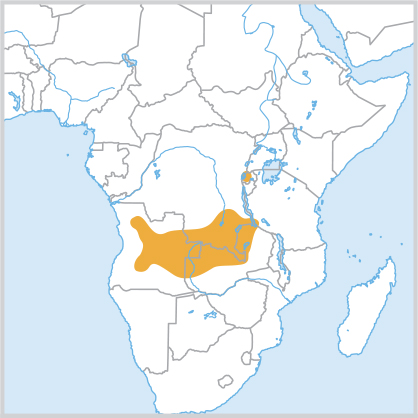
Causus bilineatus
Natural History: Little known, but probably rather similar to other night adders (terrestrial, slow-moving, active by day and night, inflates the body when threatened and hisses and puffs, and will strike if further molested). This species may be locally abundant. It is known to feed on clawed frogs, which might mean it is more aquatic than other night adders. It lays eggs. It was regarded at one time as simply a colour variant of the Rhombic Night Adder (Causus rhombeatus), but the ranges of the two species overlap throughout the Two-striped Night Adder’s range, and this species also has slightly lower ventral counts than the Rhombic Night Adder.
Medical Significance: A mildly venomous species, quite common in parts of its range (e.g. northern Zambia) and liable to be trodden on. Antivenom is not available and should not be necessary.
Two-striped Night Adder, Causus bilineatus.
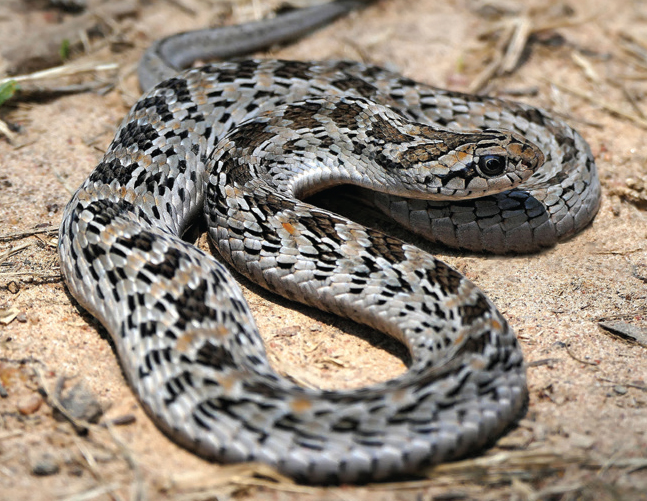
Zambia (Andre Zoersel).
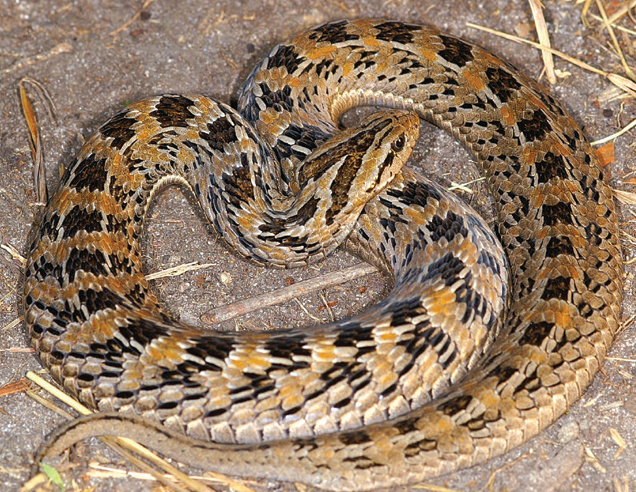
Zambia (Philipp Wagner).
Snouted Night Adder Causus defilippii
Identification: A small, stout night adder of southeastern Africa, with an upturned nose. The short head is slightly distinct from the neck, it has a medium-sized eye with a round pupil, and the top of the head is covered with nine large scales. The tip of the snout is quite distinctly upturned. The body is cylindrical or slightly depressed and the tail is short, 7–9% of total length in males and 5–7% in females. The scales are soft, velvety and feebly keeled; in 13–17 (usually 17) rows at midbody; ventrals 109–130 (higher counts usually females); subcaudals 10–19. Maximum size about 42cm, average 20–35cm; hatchlings about 10cm. The back is brown, or it may be pinkish or greyish brown, and there are 20–30 clear, dark, pale-edged rhombic blotches all along the back, and a sprinkling of black scales and oblique black bars on the flanks. On the head is a characteristic V-shaped mark, usually solid black, a black bar is often present behind the eye, and the upper lip scales are usually black-edged. The belly is cream, pearly white or pinkish grey; it may be glossy black or grey in juveniles.
Habitat and Distribution: Moist and dry savanna and coastal thicket, from sea level to about 1,800m. It occurs south from Malindi on the Kenyan coast, extending across most of south-east Tanzania, Malawi, eastern Zambia, Mozambique and parts of Zimbabwe, into northern South Africa and reaching Kwazulu-Natal on the South African coast; an unequivocal inhabitant of the eastern and southern Africa coastal mosaic.
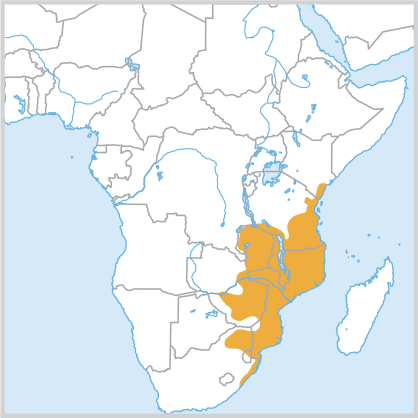
Causus defilippii
Natural History: Terrestrial, but may climb into low bushes in pursuit of frogs. It is fairly slow-moving, but strikes quickly. Despite its name, this species seems to be active during the day, as well as at twilight and at night. It is known to bask. When inactive, it hides in holes, brush piles, under ground cover, etc. If threatened, it hisses loudly, inflates the body, elevates the head and may make a determined (but often clumsy) strike. It may also lift the front part of the body off the ground, flatten the neck and move forward with the tongue extended, looking like a small cobra. It eats frogs and toads. Females lay 3–9 eggs, roughly 23 × 15mm. Hatchlings have been collected in the Usambara Mountains in May and June. In the breeding season, males are known to engage in combat, rearing up and wrestling until the weaker male is forced to the ground.
Medical Significance: A mildly venomous species, quite common in parts of its range and liable to be trodden on. Antivenom is not available and should not be necessary. Documented cases are characterised by swelling, sometimes extensive, local pain, which may be intense, often fever and sometimes lymphadenopathy. Recovery usually takes a few days. The victim in one South African case experienced difficulty in breathing, but other factors of the case suggest this was an anaphylactic reaction to the venom; the victim had three previous night adder bites.
Snouted Night Adder, Causus defilippii.
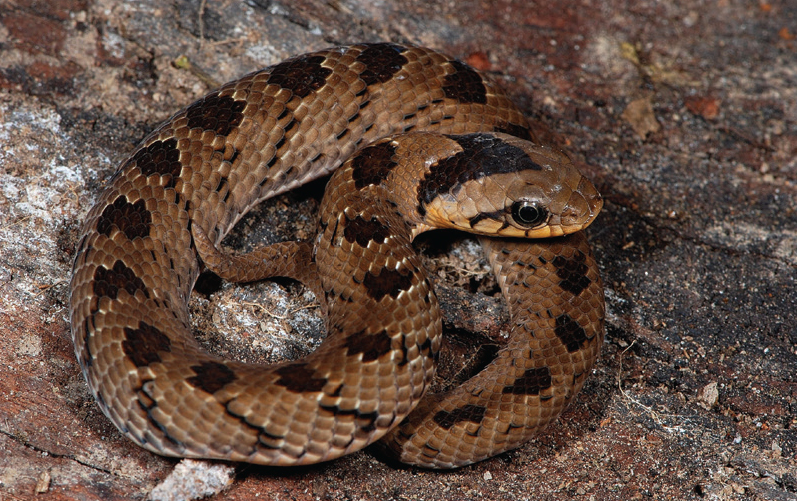
Mozambique (Mark-Oliver Rödel).
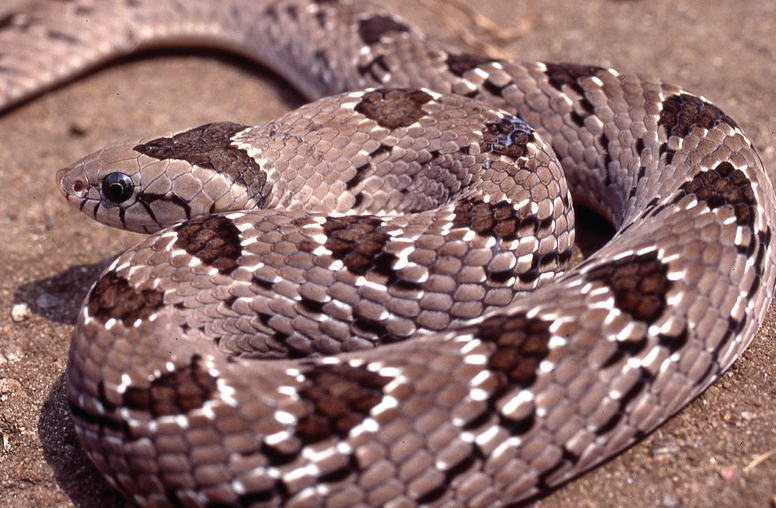
Tanzania (Stephen Spawls).
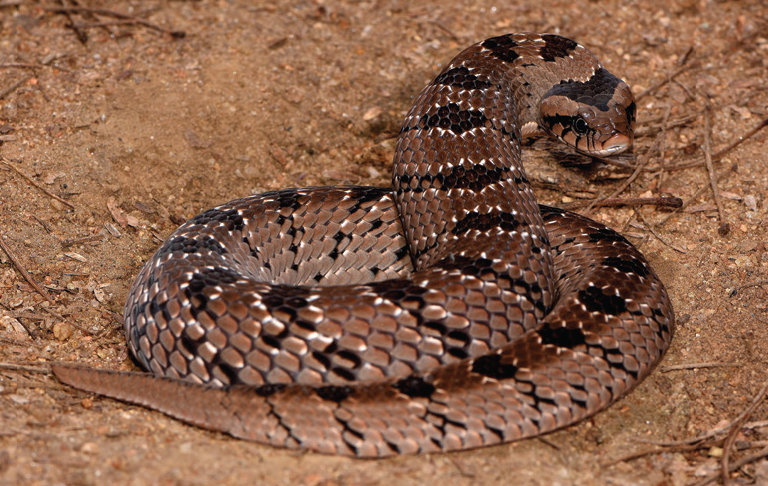
Mozambique (Mark-Oliver Rödel).
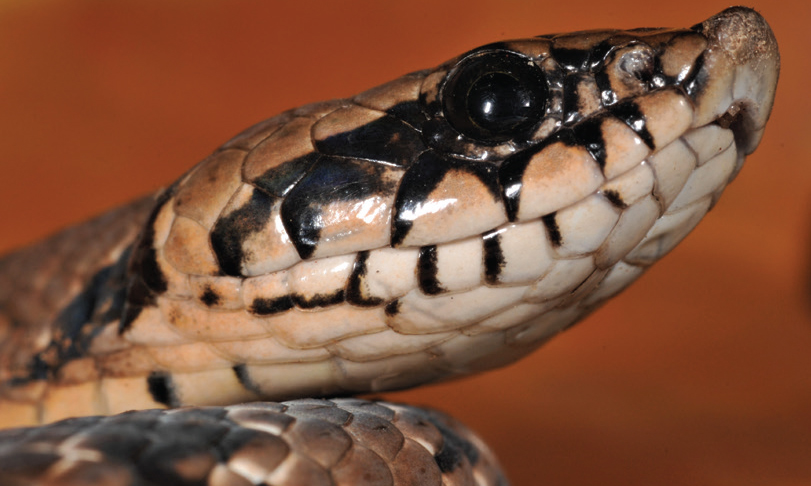
South Africa (Bill Branch).
Forest Night Adder Causus lichtensteinii
Identification: A small, relatively slim green night adder of the great forests of Central and Western Africa. The head is slightly more rounded than the usual night adder head, and is distinct from the neck. It has a prominent eye with a round pupil, and the top of the head is covered with nine large scales. The body is cylindrical or slightly depressed, and (particularly in juveniles) slimmer than in other night adders. The tail is short and blunt, 6–8% of total length in females and 8–11% in males. The scales are soft, velvety and feebly keeled; in 15 rows at midbody; ventrals 134–156 (higher counts in females). Unusually, the subcaudal scales are single; they number 14–23 (higher counts in males). Maximum size about 70cm, but this is exceptional; average 30–55cm; hatchlings about 15cm. The back is usually green, of various shades, from vivid pale green to dark or olive-green, or sometimes brown. Some individuals have two or three orange bars across the tail. There is sometimes a series of vague, pale-centred rhombic back markings, which may be obscured and appear as chevrons, facing forwards or backwards; sometimes there is a white V-shape on the neck. The belly scales are yellowish, cream or pearly. The lips are yellow, the throat is yellowish or white, usually with two or three distinct black cross-bars, and the tongue is blue at the base, then black with an orange band. Juveniles are very variable; deep green, brown or turquoise, uniform or with dark cross-bars; the lips are white. Hatchlings have a white V-shape on the neck, which fades in adults.
Habitat and Distribution: In forest and woodland, swampy areas associated with forest and recently deforested areas, from sea level to about 2,100m. It occurs from the forests of far western Kenya and the northern shore of Lake Victoria in Uganda, west and south-west from the Albertine Rift right across the Central African forests to Nigeria, and south to northern Zambia and north-east Angola; it reappears west of the Dahomey Gap in Ghana, west to southern Sierra Leone. This species is also known from the Imatong Mountains in South Sudan.
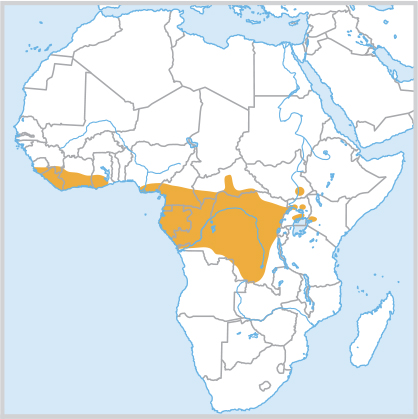
Causus lichtensteinii
Natural History: Terrestrial and secretive. Fairly slow-moving, but strikes quite quickly. Despite its name, it seems to be most active during the day among the shade and leaf litter of the forest floor. It swims well and has colonised islands in Lake Victoria. When inactive, it hides in holes, brush piles, tree root clusters, under ground cover, etc. If threatened, it responds by inflating the body with air, which makes the markings stand out, and hissing and puffing; it may then raise the forepart of the body off the ground, into a coil, with the head back, and strike. It eats frogs and toads, and lays 4–8 eggs.
Medical Significance: A mildly venomous species, quite common in parts of its range and liable to be trodden on. Antivenom is not available and should not be necessary. Documented cases are characterised by swelling that is sometimes extensive, local pain, often fever and sometimes lymphadenopathy. Recovery usually takes a few days.
Forest Night Adder, Causus lichtensteinii.
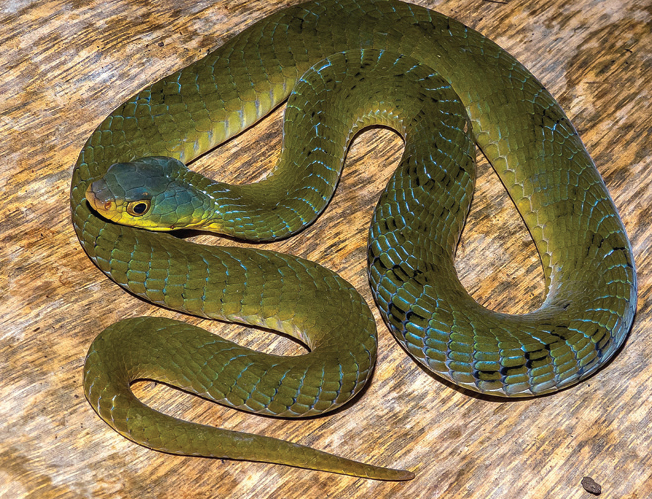
Eastern DR Congo (Konrad Mebert).
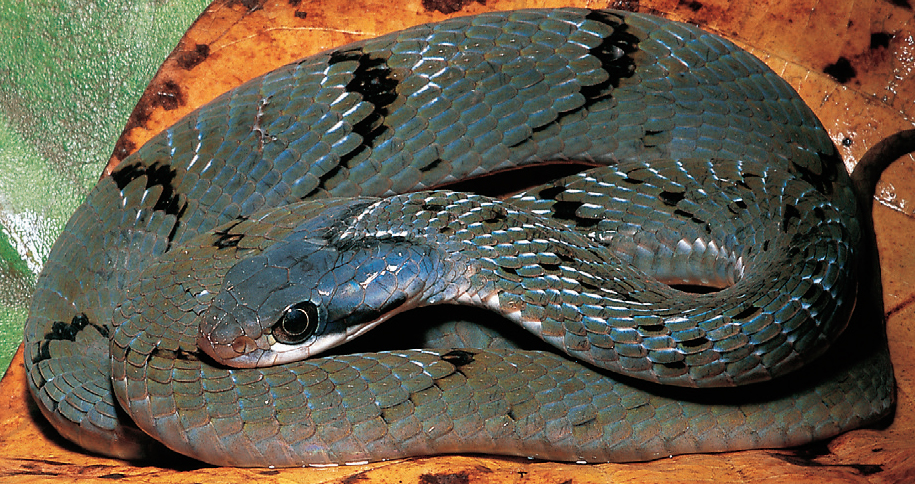
Gabon (Bill Branch).
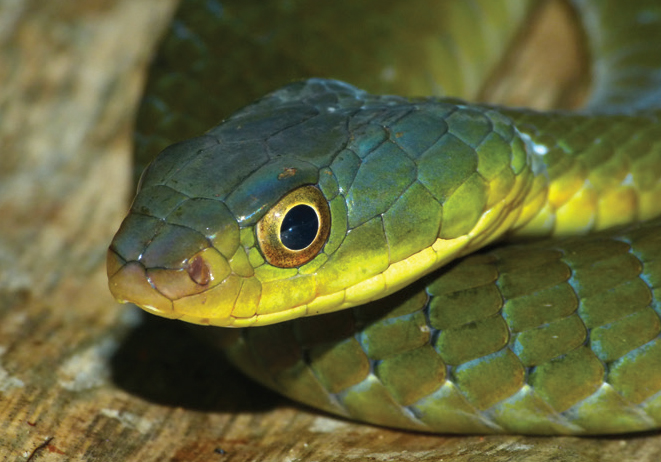
Eastern DR Congo (Konrad Mebert).
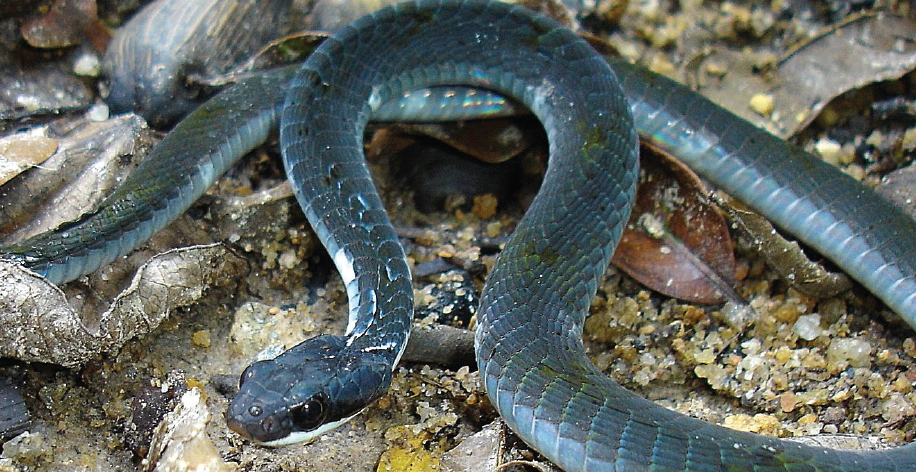
DR Congo (Harald Hinkel).
West African Night Adder Causus maculatus
Identification: A small, stout brown night adder, found in a wide range of habitats in Central and West Africa. The fairly short head is slightly distinct from the neck, and it has a rounded snout and a medium-sized eye with a round pupil. The top of the head is covered with nine large scales. The body is cylindrical or slightly depressed and the tail is short, 7–9% of total length in females and 9–11% in males. The scales are soft and feebly keeled; in 17–22 rows at midbody; ventrals 118–154; subcaudals 15–26 (higher counts usually males). Maximum size about 70cm (possibly slightly larger), average 30–60cm; hatchlings 13–16cm. The body is usually some shade of brown, pinkish brown or grey above, with dark crossbars or rhombic markings down the centre of the back and dark bars or spotting on the flanks. Occasional individuals have virtually no markings and the degree of contact between the rhombic markings and the ground colour varies greatly, even in the same area. There is usually a V-shape on the neck, extending onto the head, that is uniformly dark or with dark edges and a light centre. The underside may be white, cream or pinkish grey, uniform or with each scale black-edged so the belly looks finely barred.
Habitat and Distribution: Occurs in a huge range of habitats, from deep forest to woodland, moist and dry savanna and semi-desert; from sea level to 1,800m. It is found westwards from south-west Ethiopia, western Uganda and South Sudan, right across Central and West Africa to Senegal and south-west Mauritania, and south to north-west Angola and south-eastern DR Congo.
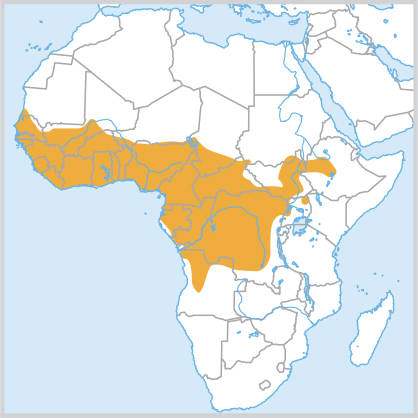
Causus maculatus
Natural History: Terrestrial, but will climb into bushes in pursuit of frogs. It is active by day, by night and at twilight. In West Africa it is most active in the rainy season, and tends to disappear in the dry season. If molested it inflates the body, hisses loudly and makes swiping strikes; it may flatten the body, looking like a small cobra, and demonstrate with an open mouth. It eats frogs and toads. Females lay 6–20 eggs, roughly 26 × 16mm; in West Africa they are laid in February–April. Hatchlings appear there in May–July. This is quite a common snake in parts of its range.
Medical Significance: A mildly venomous species, quite common in parts of its range and liable to be trodden on. Antivenom is not available and should not be necessary. Documented cases are characterised by swelling (sometimes extensive), local pain (often intense), local discolouration, often fever and sometimes lymphadenopathy. There is rarely necrosis. Recovery usually takes a few days. In a remarkable study on a Liberian rubber plantation, over 90% of all snakebites were caused by this species, and about 30% of these were ‘dry bites’, where no symptoms resulted. There were no deaths.
Taxonomic Notes: In places this snake’s range overlaps that of the Rhombic Night Adder (Causus rhombeatus), and intermediate specimens are known.
West African Night Adder, Causus maculatus.
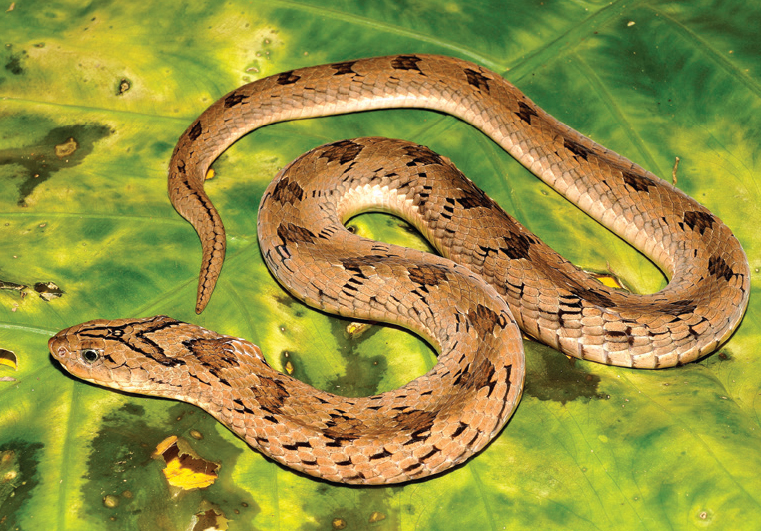
Eastern DR Congo (Konrad Membert).
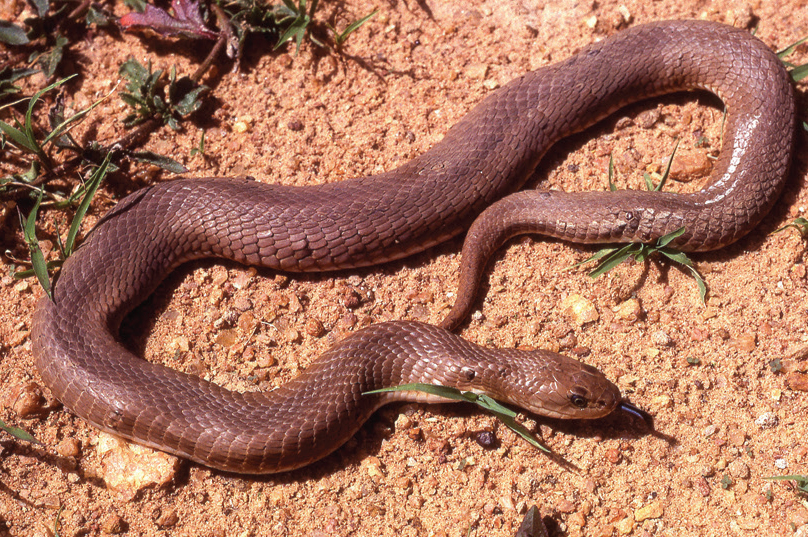
Ghana (Stephen Spawls).
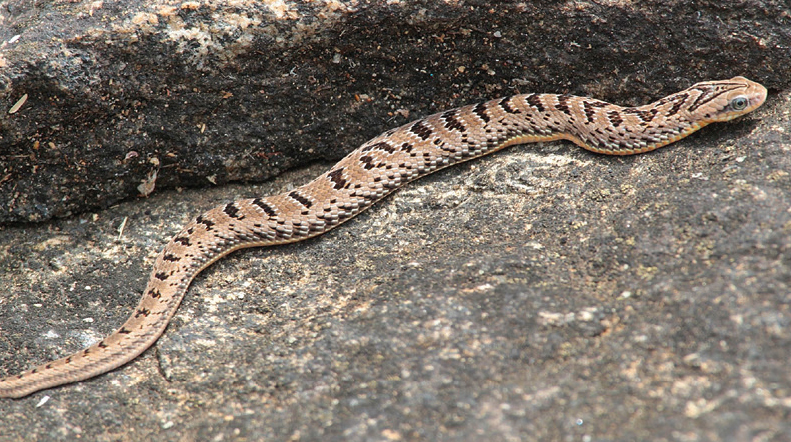
Uganda (Steve Russell).
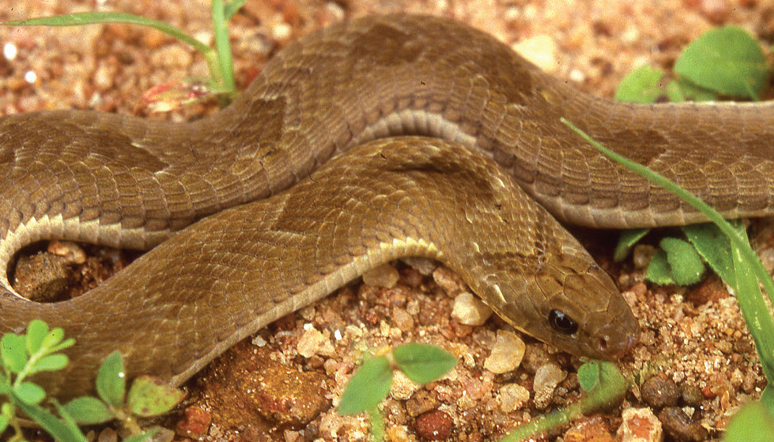
Ghana (Stephen Spawls).
Velvety-green Night Adder Causus resimus
Identification: A small, stout viper with a fairly short head that is slightly distinct from the neck, and a medium-sized eye with a round yellow pupil. The top of the head is covered with nine large scales, and the tip of the snout is slightly upturned. The body is cylindrical or slightly depressed and the tail is short, 7–9% of the total length in females and 8–10% in males. The scales are soft, velvety and feebly keeled; in 19–21 rows at midbody; ventrals 131–152; subcaudals 15–25 (males usually more than 20, females usually fewer than 20). Maximum size about 75cm, average 30–60cm; hatchlings 12–15cm. A beautiful snake; the back is usually vivid green (sometimes brown), of various shades. The chin and throat are yellow and the belly scales yellowish, cream or pearly. Black scales often form a V-shaped outline on the head (especially in juveniles), and scattered black scales may form indistinct rhomboids or V-shapes on the back and oblique dark bars on the flanks. The tongue is pale blue and black. The hidden margin of the scales is often a vivid blue, this colour appearing when the snake inflates its body when threatened.
Habitat and Distribution: Coastal savanna and thicket, dry and moist savanna and woodland, from sea level to 1,800m. It has the most curiously disjunct distribution of any African snake, with what appears to be at least five large, isolated populations. It is known from the Somali and Kenyan coast; from the Lake Victoria basin to the far slopes of the Albertine Rift; from the west coast of Angola; from central Sudan south up the Nile into South Sudan, extreme northwest Kenya and south-west Ethiopia; and in south-western Chad and eastern Cameroon. Isolated records are known from northern DR Congo, northern Central African Republic and a handful of disjunct localities in Nigeria. It seems likely that some of these may prove to be discrete species.
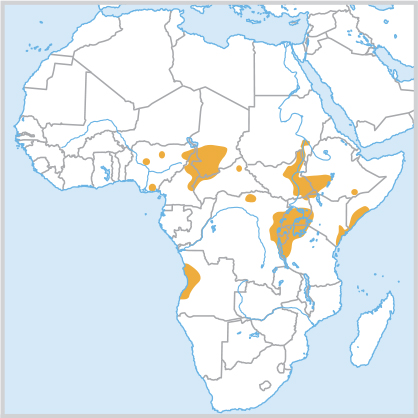
Causus resimus
Natural History: Terrestrial, but will climb low vegetation in pursuit of frogs. It is active by day and night, and will bask. This snake is fairly slow-moving, but strikes quite quickly. It swims well. When inactive, it hides in holes, brush piles, under ground cover, etc. If threatened, it responds like other night adders, hissing and puffing and striking. The diet comprises amphibians. It lays 4–12 eggs; captive specimens have been recorded producing clutches at two-month intervals, without any noticeable breeding season, but Somali females laid 4–11 eggs in July.
Medical Significance: Little is known of its venom, but it is presumably similar to that of other night adders. No antivenom is available.
Velvety-green Night Adder, Causus resimus.
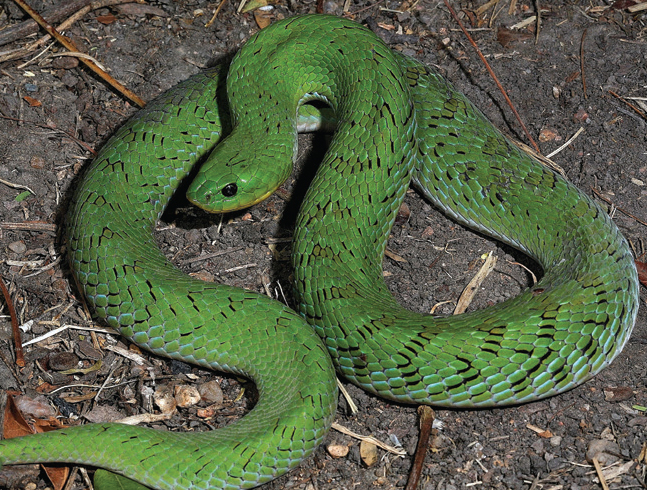
Kenya (Vincenzo Ferri).
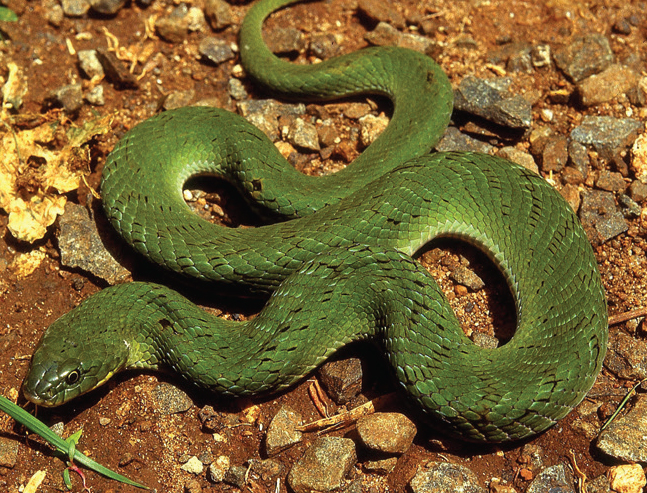
Kenya (Stephen Spawls).
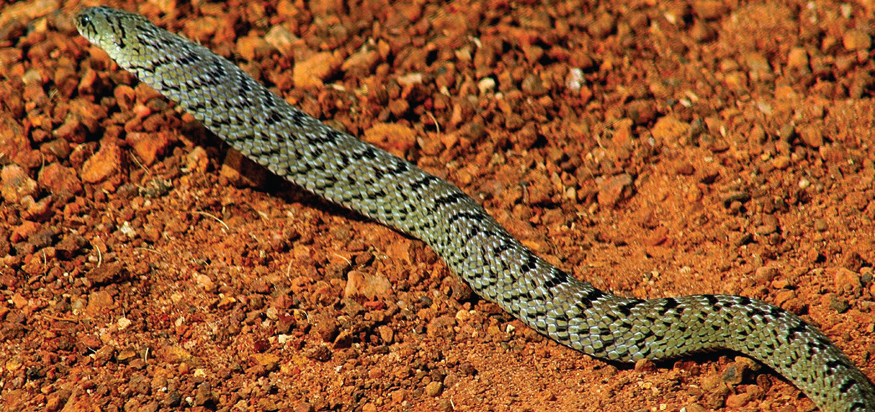
spreading hood, Sudan (Abubakr Mohammed).
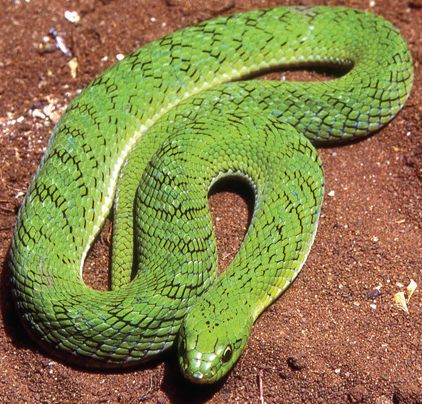
Ethiopia (Stephen Spawls).
Identification: A small, stout viper with a fairly short head that is slightly distinct from the neck, a rounded snout and a medium-sized eye with a round pupil. The top of the head is covered with nine large scales. The body is cylindrical or slightly depressed and the tail is short, 9–12% of total length. The scales are soft and feebly keeled; in 15–23 rows at midbody; ventrals 134–166; subcaudals 21–35 (higher counts in males). Maximum size about 95cm (possibly slightly larger), average 30–60cm; hatchlings 13–16cm. The body is usually some shade of brown on the back (may be pinkish or greyish brown), occasionally olive-green, and some snakes show a limited ability to change colour. There are usually 20–30 dark, pale-edged rhombic blotches all along the back, and a sprinkling of black scales and oblique black bars on the flanks. The rhombic patches may lack white edging; some snakes are quite patternless. On the head is a characteristic V-shaped mark, which may be solid black, or simply a black outline with brown inside. The belly is cream to pinkish grey; the ventral scales may be uniform, but sometimes each scale grades from light to dark and the belly thus looks finely barred.
Habitat and Distribution: In moist savanna, grassland and woodland, from sea level to 2,200m, nearly always in the vicinity of water sources. It occurs north from the Western Cape in South Africa up the eastern side of Africa, spreading west to Angola and southern DR Congo, and from East Africa westwards across the top of the forest belt to eastern Nigeria. Isolated populations occur in central Ethiopia, southern Sudan and South Sudan. It is largely absent from the south-east, where the Snouted Night Adder (Causus defilippii) occurs, and in West Africa is replaced by the West African Night Adder (Causus maculatus).
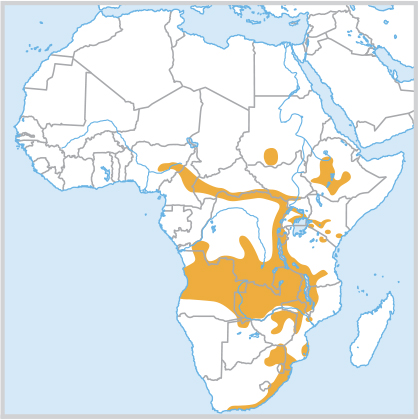
Causus rhombeatus
Natural History: Like other night adders it is terrestrial, but will climb low vegetation in pursuit of frogs. It is active by day and night, and will bask. It is fairly slow-moving, but strikes quite quickly, and it swims well. When inactive, it hides in holes, brush piles, under ground cover, etc. If threatened, it responds like other night adders, hissing and puffing and striking. It may also lift the front part of the body off the ground, flatten the neck and move forward with the tongue extended, looking like a small cobra. It eats frogs and toads, often swallowing them alive, the prey having suffered little obvious initial effect from the venom. One specimen, oddly, had eaten a bird. Females lay 7–26 eggs, roughly 26–37 × 16–20mm; in southern Africa these take about two and a half months to hatch.
Medical Significance: A mildly venomous species, quite common in parts of its range and liable to be trodden on. Antivenom is not available and should not be necessary. Documented cases are characterised by swelling, sometimes extensive, local pain, sometimes local haemorrhaging (more obvious in light-skinned victims), often fever and sometimes lymphadenopathy. There is rarely necrosis. Recovery usually takes a few days. In the early twentieth century, in southern and eastern Africa, this snake had a fearsome reputation (two of its early names were ‘death adder’ and ‘demon adder’), but no human fatalities have been reliably reported. Along with the West African Night Adder, this species has enormously elongate venom glands, and although the venom is no more toxic than that of other night adders, it is produced in larger quantities, to enable the snake to immobilise large toads. Research indicates that its venom does affect blood-clotting times (although genuinely incoagulable blood has rarely been noted following a bite from this snake) and South African polyvalent antivenom does neutralise it. Dogs, even large ones, have been killed by this snake; all showed swelling and necrosis.
Rhombic Night Adder, Causus rhombeatus.
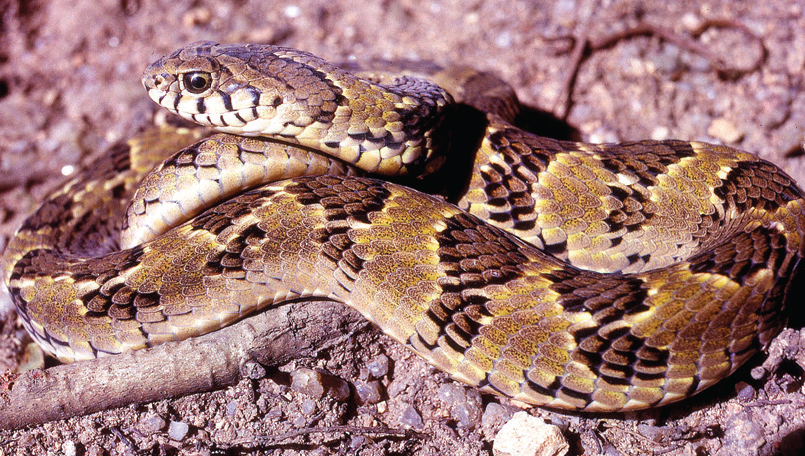
Nigeria (Gerald Dunger).
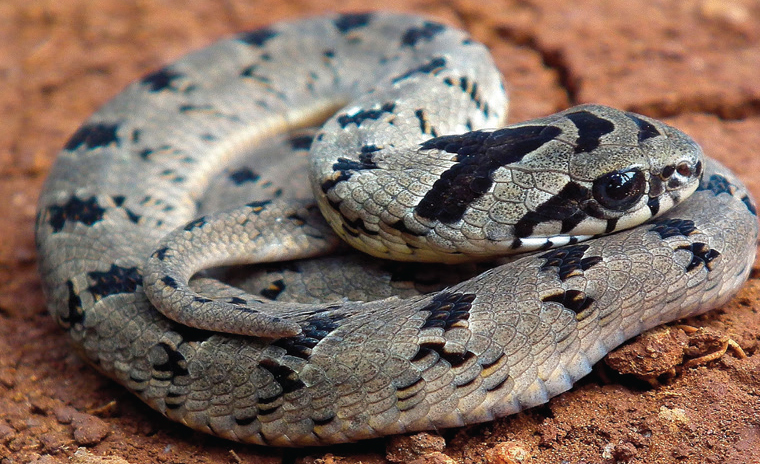
Ethiopia (Tim Spawls).
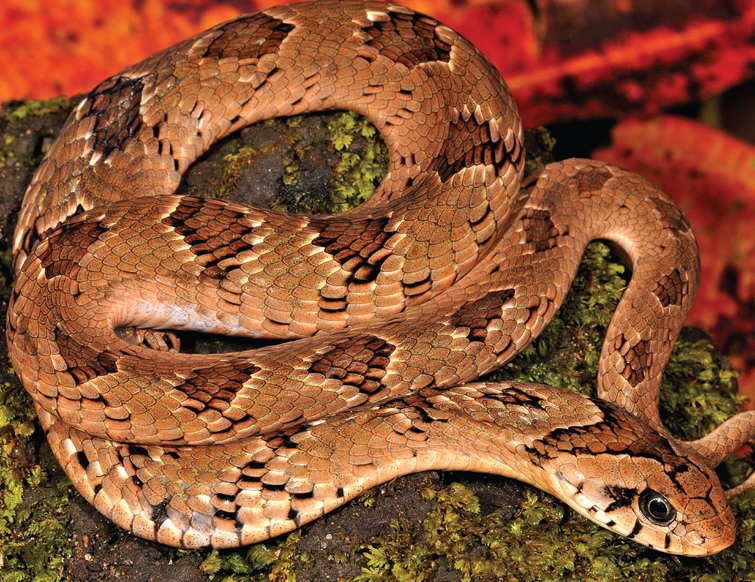
South Africa (Bill Branch).
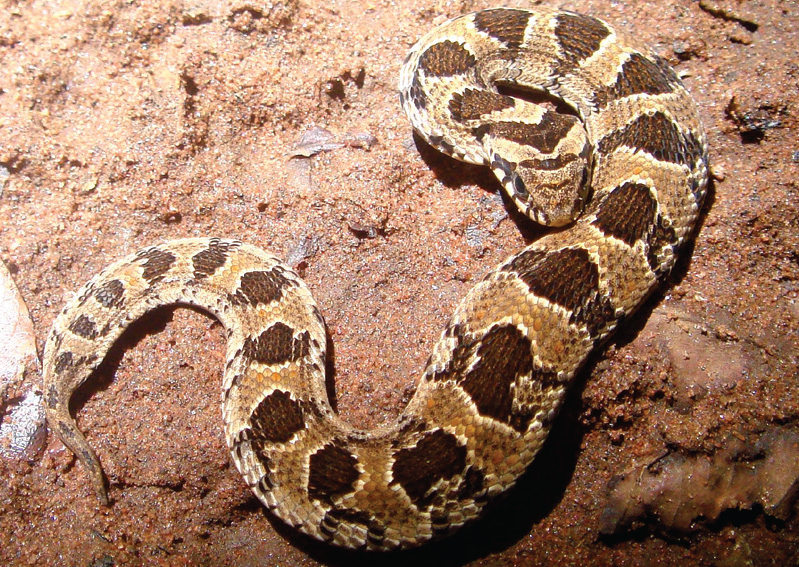
South Sudan (Alan Channing).
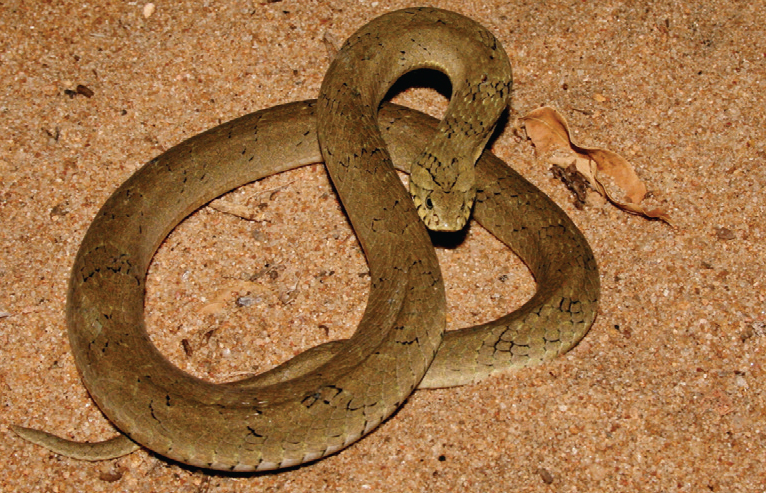
Malawi (Gary Brown).
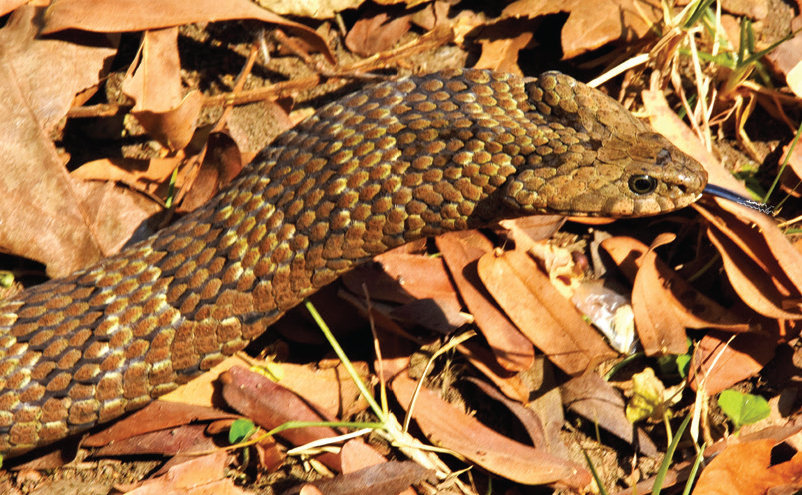
spreading hood (Colin Tilbury).
Identification: A small adder, either unpatterned or with narrow dorsal bars, described in 2014 from south-central Africa. The head is short, broad and slightly distinct from the neck, the snout is not upturned, and the eye is medium-sized with a round pupil. The top of the head is covered with nine large scales. The body is cylindrical or slightly depressed and the tail is short, 9–14% of total length (longer in males). The scales are soft, velvety and feebly keeled; in 16–18 rows at midbody; ventrals 130–139; subcaudals 24–33. The largest known specimen was 68.5cm, the others 35–55cm. Hatchling size is unknown. The back is brown or pinkish, either without markings, with very subdued markings or with narrow black cross-bars, and, like other species, with a V-shape on the head. The belly is grey to greyish white.
Habitat and Distribution: In moist savanna and woodland, between 1,200m and 1,600m. It is known from only a handful of records; the range extends from Ugalla Game Reserve in Tanzania to Mbala and Ikelenge in Zambia and Cuando Cubango in south-west Angola.
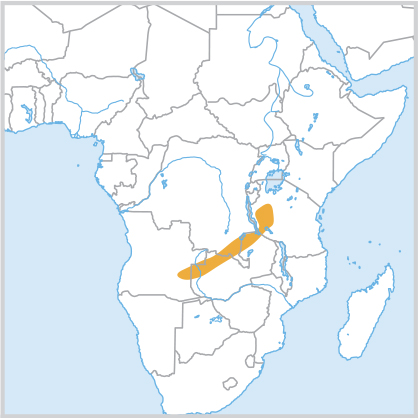
Causus rasmusseni
Natural History: Little known, but probably rather similar to other night adders (terrestrial, slow-moving, active by day and night, inflates the body when threatened and hisses and puffs, will strike if further molested, lays eggs and eats amphibians). This species is named after the Danish herpetologist Jens Rasmussen, who did major revisionary work on African snakes.
Medical Significance: Unknown, but presumably similar to other night adders. Antivenom is not available and should not be necessary.
Rasmussen’s Night Adder, Causus rasmusseni.
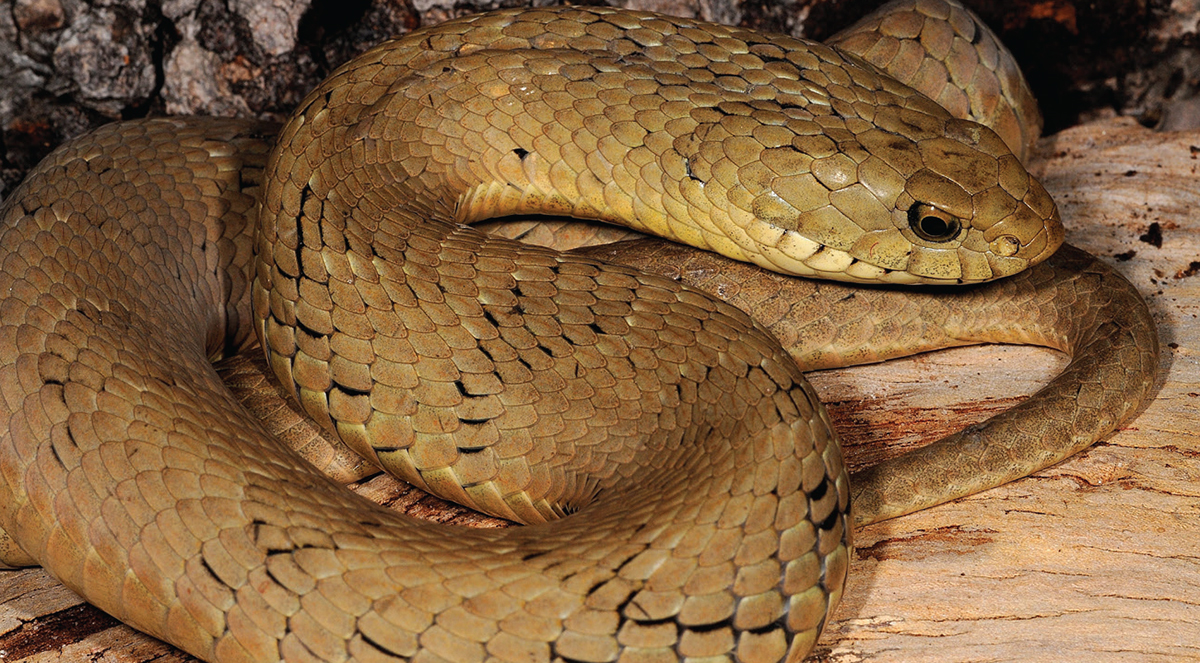
Angola (Bill Branch).
A genus of broad-headed vipers, found in eastern Egypt and the Middle East, and reaching 80–90cm. Three species are known. Originally there was only one, the False Horned Viper (Pseudocerastes persicus), the two subspecies of which have now been elevated to full species level. A third, with a bizarre spider-like tail, was described in 2006 from western Iran. The two species of false horned viper have a huge range, from Egypt east to Afghanistan. They are terrestrial, secretive and largely nocturnal, and must cause a fair number of bites to those who dwell in these dry areas, but little seems to have been documented. In the laboratory, the venom of the species that reaches Egypt, the Western False Horned Viper (P. fieldi), surprisingly not only seems to lack the coagulopathic toxins that the eastern form has, but also has neurotoxic components, which is unviperlike. The eastern form, the Persian Horned Viper (P. persicus), has a more typical viper venom. This has implications for medical treatment, as the only antivenom available for treating the bites of both P. persicus and P. fieldi, produced in Iran, is raised from venom from Iranian P. persicus.
Western False Horned Viper Pseudocerastes fieldi
Identification: A short, stout viper with prominent horns, found in the Sinai Peninsula. The head is broad, flat and triangular, and covered with small scales. The eye is prominent, on the side of the head, and has a vertical pupil in bright light. The neck is thin. There is a stout, backward-curving horn above each eye, consisting of a cluster of scales. The body is broad and slightly flattened, and the tail is fairly short, 11–16% of total length. Oddly for a viper, the flank scales show no or only very slight keeling; the middorsal scales are keeled. The scales are in 21–23 rows at midbody; ventrals 127–142; cloacal scale entire; subcaudals 35–38. Maximum size about 90cm, most specimens 40–70cm; hatchlings 15–19cm. The colour is light brown, yellowish, pinkish or mottled grey, with darker (usually brown or reddish) blotches or cross-bands, which are often very straight-edged, and a row of blotches or dots along the sides. These may be very faded, and in some individuals the markings are so faded the snake just looks a uniform colour. There is a dark line through and behind the eye. The tail tip is often black, and the belly surface is white.
Habitat and Distribution: Occurs in semi-desert and desert country, in sandy, gravelly and rocky regions, but prefers areas with some vegetation. It is rarely found in dunes or other areas of soft sand, or on very steep slopes, although it occurs on scree rubble. It tends to avoid human habitation. This species is found from sea level to over 2,200m. In Africa, it occurs in the Sinai (although not in the dune fields in the north), then eastwards to western Iran.
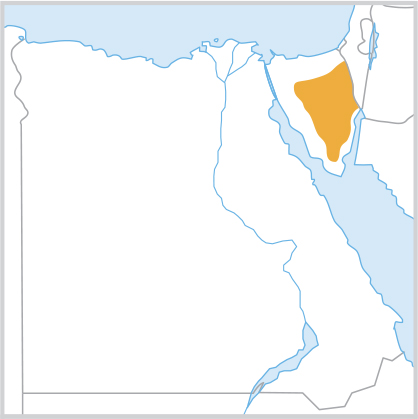
Pseudocerastes fieldi
Natural History: Terrestrial and slow-moving, although it can sidewind fairly rapidly. It is usually nocturnal, but sometimes active by day or at dusk, especially in the spring. It shelters in rodent burrows or other holes, in rock cracks or under bushes. This snake is fairly placid, but can strike quickly, to some distance. It mates in May or June, and lays 10–21 eggs in August; these contain large embryos and hatch after about a month of incubation. The diet includes mammals and birds; juveniles eat lizards.
Medical Significance: This is a nocturnal terrestrial snake, with a relatively large range. However, it lives mostly in inhospitable, sparsely inhabited country, and in Africa probably causes very few bites, although it is implicated in bite cases in Iraq and Jordan. It is a relatively large snake, so victims of suspected bites by this species should be transported to hospital. Antivenom is available, but see our comments in the generic introduction (here).
Western False Horned Viper, Pseudocerastes fieldi.
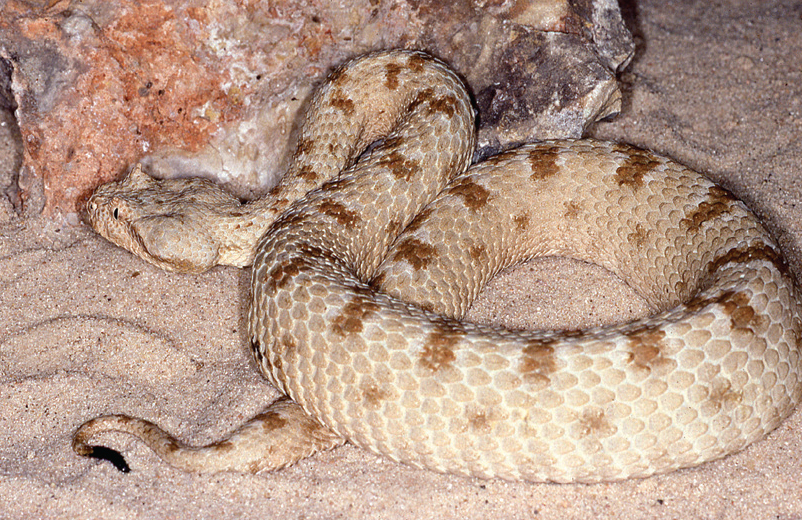
captive (Paul Freed).
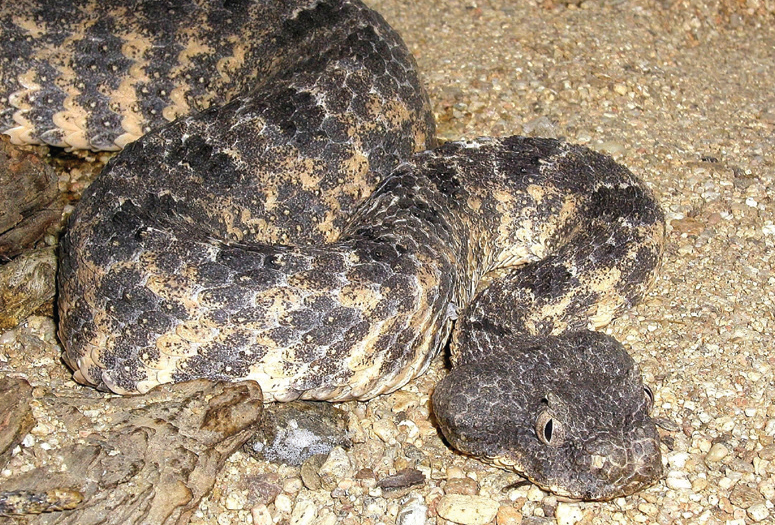
Syria (Tomáš Mazuch).
Giant Old World vipers (Afro-Asian vipers) Daboia
A genus of four large vipers, reaching 1.5m or more, that occur in North Africa, the Middle East and south Asia; one species (Russell’s Viper, Daboia russelii) is one of India’s ‘big four’ deadly snakes, and causes many bites and fatalities. A single species, the Moorish Viper (D. mauritanica), occurs in Africa. It is a major cause of snakebite in the non-desert areas of the Maghreb as it is relatively common, often in agricultural areas, remains motionless if approached, and is active on the ground at dusk or in the dark. The venom appears to be cytotoxic and haemorrhagic, and deaths from the snake’s bite have occurred. Antivenom is available, and the venom is relatively slow-acting, but this is a large snake and capable of delivering a lot of venom; a bite must be treated as an emergency and the patient taken to a well-equipped hospital.
Moorish Viper Daboia mauritanica
Identification: A large, stocky viper, uniform brown or with a zigzag pattern, in non-desert country of North Africa. The head is broad, flat and triangular, with a narrow snout, and is and covered with small scales. The eye is prominent, on the side of the head, and has a vertical pupil in bright light. The neck is thin, the body is broad and slightly flattened, and the tail is 10–14% of total length. The scales are in 26–27 rows at midbody; ventrals 157–176; cloacal scale entire; subcaudals 40–51. Maximum size about 1.8m, average 1–1.6m; hatchlings 19–28cm. The colour is very variable, but the ground colour is usually some shade of brown, grey-brown or pinkish brown, with a broad wavy or zigzag central stripe of darker brown or black; in the lighter-coloured ‘deserti’ form (this was previously regarded as a separate species) the stripe is subdued or even faded to near invisibility, and the snake looks monocoloured. The underside is white or grey, with some darker speckling.
Habitat and Distribution: Occurs in light woodland (sclerophyllous forest), steppe meadow and semi-desert, often on or near rocky hills; it prefers areas with some vegetation and preferably near open water; in Morocco often in hill valleys. It is found from sea level to over 2,000m. It occurs from northern Western Sahara through Morocco to northern Algeria, Tunisia and north-west Libya, with a credible record from north-east Libya.
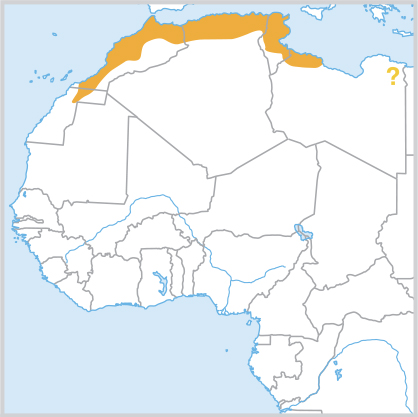
Daboia mauritanica
Natural History: Terrestrial and fairly slow-moving, but can strike rapidly, to a large distance. However, it is a fairly placid snake, although it can hiss very loudly. It is usually nocturnal, but sometimes active by day or at dusk, especially in the spring. It shelters in thickets (including of introduced prickly pear, as well as natural succulents), under bushes and in rock crevices, and is known to enter caves and abandoned mine galleries in the summer. In the higher parts of its range it hibernates in the winter. It mates in April or May, and lays 13–40 eggs in June or July; in captivity the eggs hatch after 40–60 days. The diet includes mammals and birds; juveniles eat lizards. It both hunts from ambush and actively prowls, investigating recesses for prey.
Medical Significance: This is a nocturnal terrestrial snake with a relatively large range, often in farming country in the mountains and high plateaux of north-west Africa. Studies in Morocco found the majority of snakebites reported were by this snake (although sometimes wrongly attributed to the North African Blunt-nosed Viper, Macrovipera lebetina transmediterranea, which as currently defined does not occur in Morocco). The bites were characterised by local swelling, bruising and pain; some victims had thrombocytopenia and other haemorrhagic disorders; one death involved a brain haemorrhage. Necrosis was present in some cases. This snake is relatively large, so victims of suspected bites should be transported to hospital. Antivenom is available.
Taxonomic Notes: The two colour forms of this snake (with obvious and faded/indistinct markings) were until recently regarded as separate species, Daboia mauritanica and Daboia deserti. However, recent work indicates that the two are conspecific, although isolating events as a result of climatic fluctuations during the Pleistocene have created at least seven lineages, one from central Morocco eastwards to Libya, and the rest all in western and central Morocco.
Moorish Viper, Daboia mauritanica.
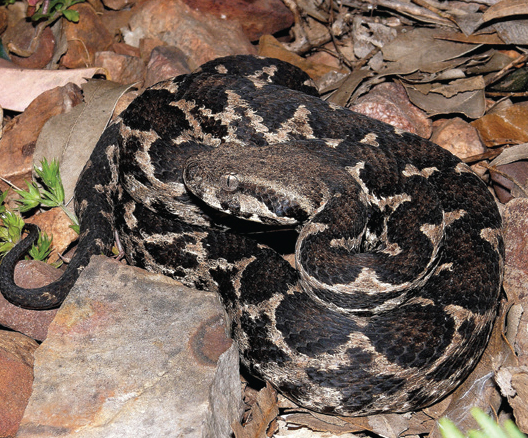
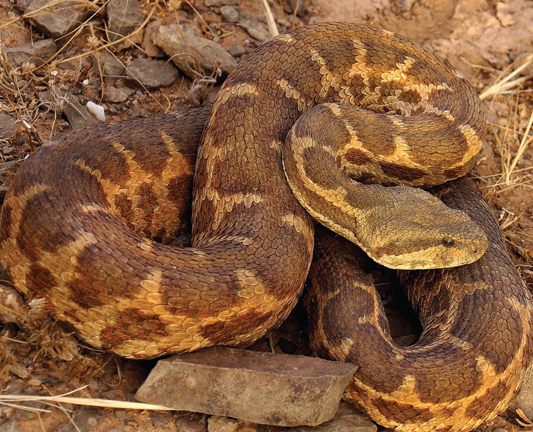
Morocco (Konrad Mebert).
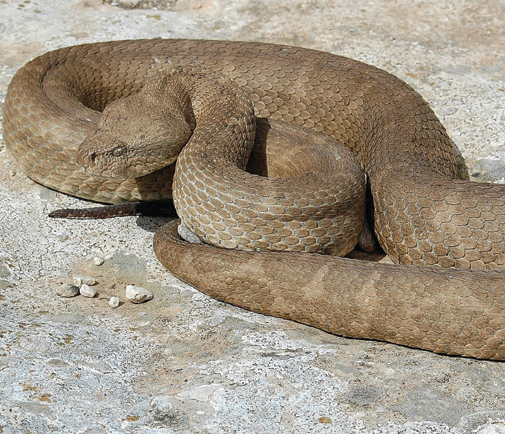
Tunisia (Tomáš Mazuch).
Large Palearctic vipers Macrovipera
A genus of three large vipers of the eastern Mediterranean and Middle East. One subspecies of the most widespread form, Macrovipera lebetina, has been described from Algeria and Tunisia, under the name M. lebetina transmediterranea. Few specimens are known. The nominate subspecies is a large, dangerous snake, and its venom causes swelling, pain, necrosis and coagulopathy; death has been caused by acute renal failure. A bite from one is a medical emergency and must be treated in a well-equipped hospital.
North African Blunt-nosed Viper Macrovipera lebetina transmediterranea
Identification: A very rare, pale, medium-sized adder, from northern Algeria and Tunisia. The head is broad and has a rounded snout, with flat sides and a pronounced angle between the top and sides of the head. The head shields, including the supraoculars, are fragmented and keeled. The neck is thin and the body stout and slightly depressed. The tail is 10–13% of total length. The dorsal scales are strongly keeled; in 25 rows at midbody; ventrals 150–164; subcaudals 37–51 (higher counts in males). The largest adults were just under 1m; the juveniles are probably around 15–20cm. This species is usually grey, with darker, usually brown cross-bars along the centre of the back; these are often offset along the actual spine. There is also a series of 34–41 vertical, tapering brown or rufous bars on the flanks.
Habitat and Distribution: Known solely from a handful of specimens from the vicinity of Oran and Algiers (Algeria) and Tunis (Tunisia), in what were oak woodlands on hill slopes near the coast. Other subspecies in Eurasia inhabit broken country, rocky hills and valleys where there is a reasonable amount of vegetation and also water sources.
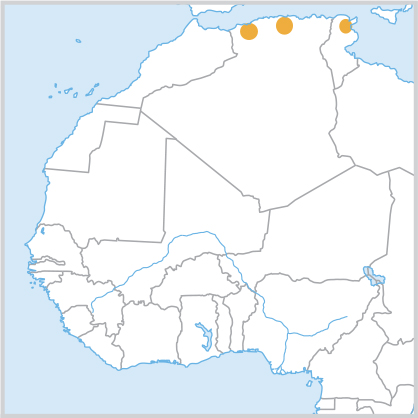
Macrovipera lebetina transmediterranea
Natural History: Described in 1988 from museum specimens, but not documented in the wild since then, so nothing is known of its biology. It is probably similar to other subspecies: largely terrestrial but may climb bushes, active by night in summer, crepuscular in cooler seasons, hunts from ambush, and eats a variety or vertebrate prey. Some subspecies lay eggs that hatch in late summer; others give birth to live young.
Medical Significance: A very rare snake, and thus unlikely to cause many snakebites, although it is highly dangerous. Bites by other subspecies of this snake are known to be life-threatening, and cause bruising, acute pain, swelling, incoagulable blood and necrosis. Antivenom is available. The venom of the typical race (Macrovipera lebetina lebetina) has an experimental IV toxicity in mice of 0.80mg/kg, and bites are potentially lethal. However, an analysis of its venom indicates it inhibits the growth of tumours and thus may have a medical use.
Taxonomic Notes: Some authorities doubt the existence of this form in North Africa, as the localities of the types are old and vague and all scale counts lie within the range of other subspecies; however, others accept it. Captive specimens are present in medical research facilities in Tunisia, although their provenance is unknown. It may have been present but now extinct, as its original habitats are now greatly altered, or it might have been introduced from elsewhere in the Mediterranean. Further research may clarify the situation.
North African Blunt-nosed Viper, Macrovipera lebetina transmediterranea.
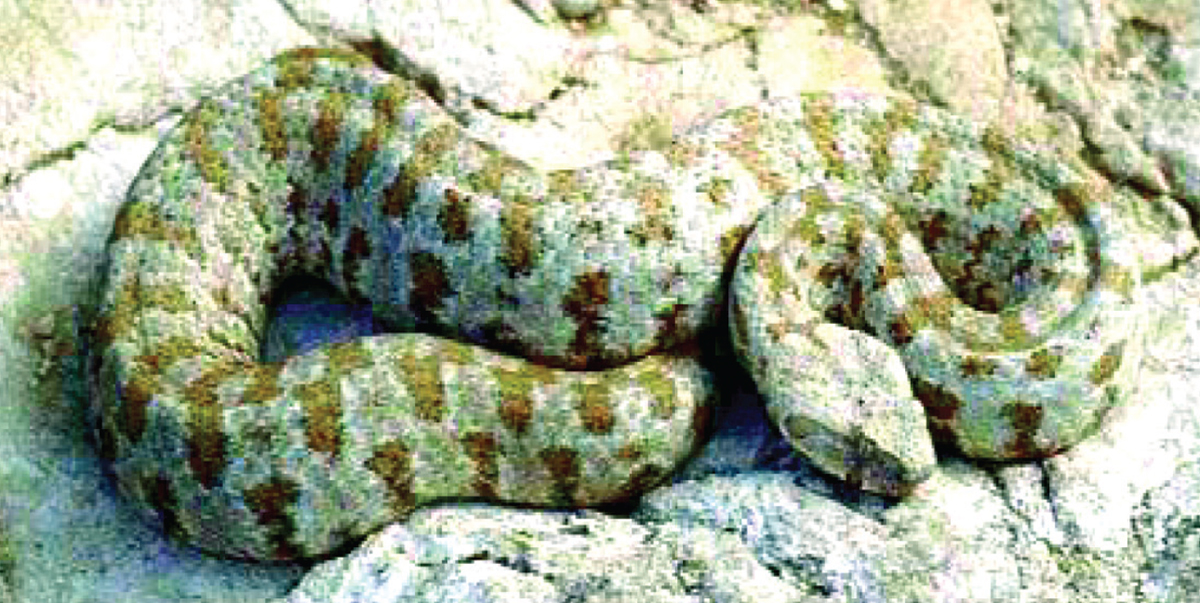
captive, Tunisia (Juan Calvete).
Palearctic vipers Vipera
A genus of over 20 species of small vipers, some with huge ranges and others with very restricted ranges, across Europe and northern Asia. Most look quite similar, either grey or brown with a wavy darker stripe down the centre of the back. They sometimes hybridise, and the status of some taxa is debated. Their venom largely causes swelling, bruising and pain, and occasionally necrosis; deaths are very unusual but a few are reported. Anaphylactic reactions sometimes occur. Originally, two species were described from North Africa, but recent research indicates that just a single, fairly variable species occurs, which includes a dwarf form that is a high-altitude ecotype.
Identification: A small viper with an upturned snout, from the high-rainfall areas north of the desert in the Maghreb. The head is distinct from the neck, and the head scales are small (apart from the supraoculars). The body is fairly stout and the tail is short, 10–14% of total length (longer tails usually males). The dorsal scales are strongly keeled; in 19–23 rows at midbody (the high-altitude populations usually 19–21); ventrals 124–138; subcaudals 29–47 (higher counts in males). The largest adults at lower altitude reach 60cm (average 25–40cm); at high altitude they rarely exceed 35cm. Juveniles are 12–16cm. The colour is grey or brown, usually with a wavy darker brown line down the centre of the back; this may break up into bars, and the dorsal markings may be so faded as to be almost invisible. The flanks are marked by large, dark, amorphous blotches. Usually a dark bar extends backwards from the eye, broadening on the neck, and this may extend down the flanks. The underside is grey, sometimes very dark, and speckled to a greater or lesser extent.
Habitat and Distribution: Occupies (or originally occupied) quite a wide range of habitats, including coastal dunes, grasslands, agricultural land, open deciduous forests, montane meadows, rocky hills and scree slopes, from sea level to over 2,900m. It occurs from the Tichka Plateau in the western High Atlas of Morocco, eastwards through the High Atlas and Middle Atlas, in the Rif Mountains and along the northern Moroccan coastline, into the Tlemcen Mountains of western Algeria. It reappears in the central Tell Atlas of northern Algeria and in the Medjerda Hills on the north-west Tunisian border. It is also found throughout most of Spain, except the extreme north.
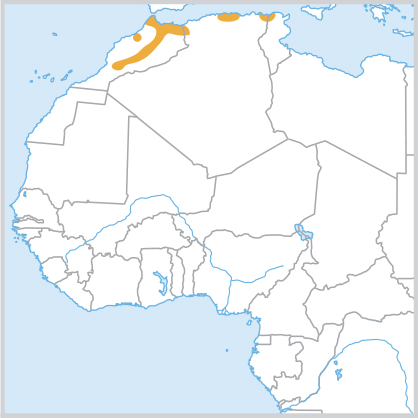
Vipera latastei
Natural History: Largely terrestrial, but it will climb rocks and trees; people in Spain have been bitten while picking fruit by vipers that had climbed trees. It is nocturnal in summer and crepuscular or diurnal in colder months, although the high-altitude animals tend to be almost wholly diurnal. It hibernates in the winter. This is a fairly slow-moving snake, although it can strike quickly and is quick to disappear if disturbed. Mating occurs in spring, and females give birth to up to 10 live young in late summer. The diet includes a wide range of vertebrates, mainly small mammals and lizards.
Medical Significance: In its North African range this is now a very rare snake, and thus unlikely to cause many snakebites. Bites by most snakes of this genus are hardly ever fatal. Symptoms include bruising, local pain and swelling, and sometimes coagulopathy. A few cases involving anaphylaxis have been noted. Although an antivenom raised directly from venom of this snake does not seem to be available, the monospecific European Adder (Vipera berus) antivenom (ViperaTAb) has been shown to be extremely effective against its bites. However, antivenom for bites by Vipera species is needed in only a small minority of very severe cases.
Taxonomic Notes: For a long time there were assumed to be two species of Vipera in North Africa, V. latastei (subspecies V. l. gaditana) and the so-called Atlas Mountain Viper (V. monticola), a dwarf species of the High Atlas Mountains. However, recent genetic work shows that, in fact, there is only a single species, and what was V. monticola is merely a dwarf, high-altitude ecotype of V. latastei, confined to the High Atlas. Unfortunately, the lower-altitude populations of this snake are virtually, if not totally, extinct and the high-altitude populations are under severe threat, due to long-term changes in land usage to agriculture and urbanisation.
Lataste’s Viper, Vipera latastei.
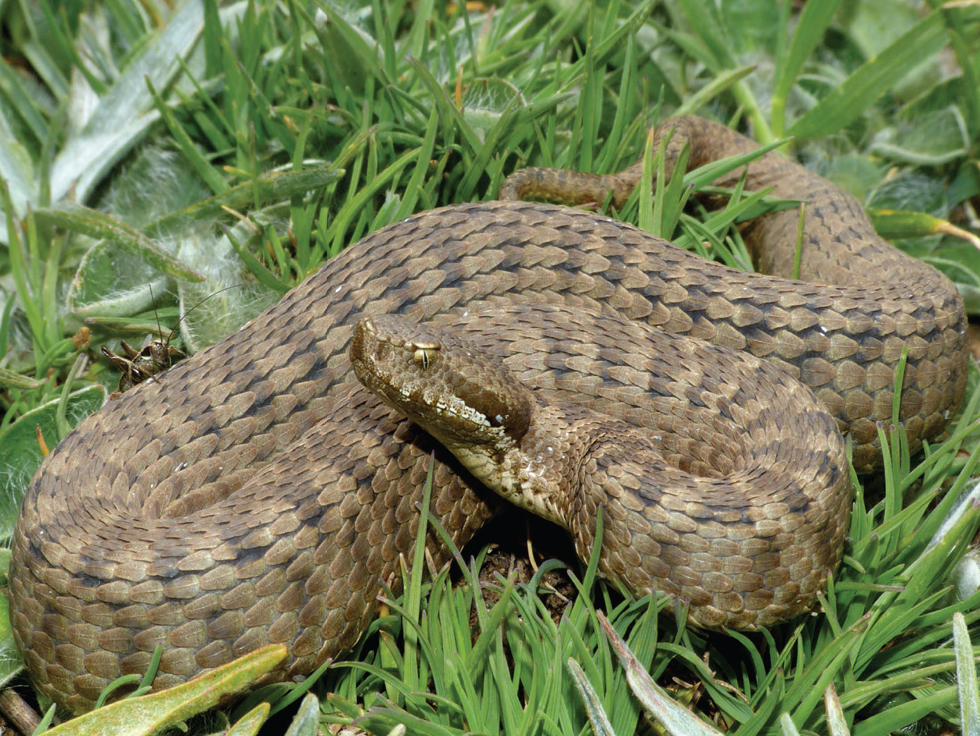
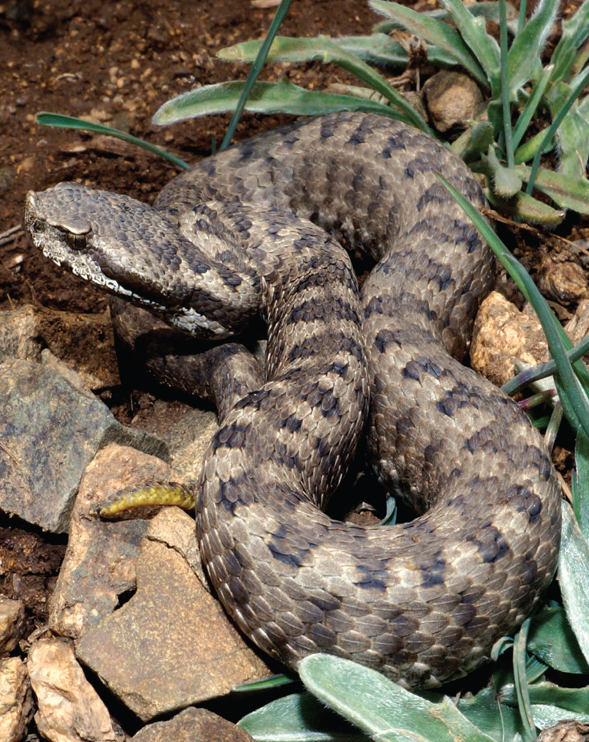
Morocco (Konrad Mebert).
Family Elapidae Elapids (cobras, mambas and relatives)
A family of dangerous snakes with short, immoveable poison fangs at the front of the upper jaw. Many are of international medical significance, and some have powerful neurotoxic venoms that can cause death rapidly if untreated. Around 375 species and over 50 genera are known worldwide in tropical regions. There are none in Europe, but there has been a remarkable radiation of elapids in Australia, where they are the largest group of snakes. Members of the family include the mambas (Dendroaspis), cobras, King Cobra (Ophiophagus hannah), kraits (Bungarus), sea snakes (Hydrophiinae), coral snakes, African garter snakes (Elapsoidea) and taipans (Oxyuranus). All African land elapids belong to the subfamily Elapinae. The subfamily Hydrophiinae consists of the Australian terrestrial elapids and the sea snakes, one species of which, the Yellow-bellied Sea Snake (Hydrophis platurus), occurs off Africa’s east-facing coasts.
Key to the African elapid subfamilies
1aTail shaped like an oar; living in the sea or stranded on the foreshore……subfamily Hydrophiinae, sea snakes
1bTail not shaped like an oar; not living in the sea……subfamily Elapinae, land elapids
Subfamily Elapinae Land elapids
There are around 42 species of land elapid in Africa, in seven genera. All African species have round pupils, lack a loreal scale and lay eggs (apart from the Rinkhals, Hemachatus haemachatus, a curious South African elapid). Most are large snakes, reaching 1.4m or more, and are highly dangerous, the exception being the small garter snakes (Elapsoidea), which are not known to have caused deaths. With care, elapids are usually identifiable by eye, using a mixture of size, location, appearance and behaviour. A number of elapids (in particular the mambas and the non-spitting cobras) have a powerful neurotoxic venom and are probably the worst snakes to be bitten by, in terms of the need to take rapid action to prevent death. The spitting cobras, which cause a lot of bites, tend to have cytotoxic venoms, often causing major long-term tissue damage; they wreak a terrible longterm toll on the health of people in the savanna. However, in broad terms, the elapids are medically less significant than the vipers, as they are largely alert species; they avoid confrontation and will move away if encountered, whereas a viper will freeze and hope to remain undetected.
Key to the African land elapid genera
1aDorsal scales strongly keeled……Hemachatus haemachatus, Rinkhals
1bDorsal scales not strongly keeled……2
2aRostral scale huge, laterally detached and shield-like……Aspidelaps, shield cobras
2bRostral scale not enlarged and shield-like……3
3aBlack; does not spread a hood; in Egypt; midbody scale rows 23…… Walterinnesia aegyptia, Desert Black Snake
3bDoes not have the above combination of characters……4
4aMidbody scales in 13 rows; adults small, less than 80cm; juveniles always with broad bands……Elapsoidea, African garter snakes
4bMidbody scales in 13 or more rows; large, adults usually more than 80cm; juveniles not banded or with narrow bands……5
5aThree preoculars; head coffin-shaped, long and narrow……Dendroaspis, mambas
5bOne to two preoculars; head not coffin-shaped, more square……6
6aDorsal scales in 13–17 rows; glossy black or brown above, black and yellow below; hood small; eye huge……Pseudohaje, tree cobras
6bDorsal scales in 17–27 rows; usually not black and bright yellow; hood usually large (except in Burrowing Cobra, Naja multifasciata); eye not huge……Naja, true cobras
Mambas Dendroaspis
Mambas occur in sub-Saharan Africa. They are all large (over 2m), agile, slender, diurnal elapid snakes with long heads. Four species are known. Three are green and live in the forests and woodlands of West, Central and East Africa. The Black Mamba (Dendroaspis polylepis) is grey or olive and mostly lives in the savanna. Mambas are greatly feared, but their reputation is largely unjustified, and based to a large extent on legend; they are not aggressive and avoid confrontation. However, all mambas have neurotoxic venoms, containing unusual proteins called dendrotoxins, which cause pins and needles, stimulation of the autonomic nervous system and muscle fasciculations. The venom causes a rapidly progressing, descending paralysis, which can appear soon after the bite and progress to fatal respiratory paralysis. As with the non-spitting cobras, early symptoms may include ptosis, double vision, and inability to open the mouth, clench the jaw, protrude the tongue or swallow. Thus a mamba bite is a medical emergency and needs immediate rapid transport to hospital and prompt and thorough medical treatment.
The three green tree mambas are secretive, tend to stay up in trees and cause very few bites. However, the Black Mamba is often on the ground, frequently lives in areas with extensive agriculture, is confident in defence and can strike rapidly, to a great distance. Trying to kill a Black Mamba is a very risky thing to do. In some countries, Black Mambas cause a great many bites and they may be the leading cause of snakebite death. Antivenom is available, and may be needed in large quantities. Although the benefits of first aid in snakebite are much debated, a mamba bite is one situation where pressure bandaging, immobilisation therapy using a local pressure pad and artificial respiration may be life-saving as the victim is transported to hospital.
Key to the genus Dendroaspis, mambas
1aOlive, grey or brown; mouth lining dark; midbody scales in 21–25 rows; widespread in savanna……Dendroaspis polylepis, Black Mamba
1aMostly or totally green; mouth lining pink; midbody scales in 13–19 rows; usually in forest and woodland……2
2aUniform light green; lip scales immaculate; midbody scale rows 17–19; in eastern and south-eastern Africa……Dendroaspis angusticeps, Eastern Green Mamba
2bDarker green; lip scales finely black-edged; midbody scale rows 13–17; in Central and West Africa……3
3aMidbody scale rows 15–17; occurs west from western Kenya to Ghana…… Dendroaspis jamesoni, Jameson’s Mamba
3bMidbody scale rows 13; occurs west from Benin to Senegambia……Dendroaspis viridis, West African Green Mamba
Eastern Green Mamba Dendroaspis angusticeps
Identification: A distinctive, vivid green mamba of the low-altitude forests and woodlands of the eastern and south-eastern coastal plains. It is a large, slender tree snake with a long head, and a relatively small eye with a round pupil; the iris is yellow. The tail is long and thin, 20–23% of total length. The scales are smooth; in 17–19 (sometimes 21) rows at midbody; ventrals 201–232; subcaudals 99–126. Maximum size 2.3m (possibly more), average 1.5–2m; hatchlings 30–40cm. The colour is bright uniform green above, sometimes with a sprinkling of yellow scales, and pale green below. Juveniles less than 60cm long are bluish green.
Habitat and Distribution: Coastal bush, thicket and forest, woodland, moist savanna, evergreen hill forest and well-vegetated plantations, mostly at low altitude (less than 500m), but up to 1,700m in parts of its range. This species is tolerant of coastal agriculture and light urbanisation in eastern and southern Africa, often occurring in cashew nut and coconut plantations, in mango trees and in bushes and garden hedges, or anywhere thick enough for the snake to rest undetected. It occurs from the Somali border and the Boni Forest south along the entire East African coastal plain to the Ruvuma River, inland to the Usambaras, along the Rufiji River system and across south-eastern Tanzania to Tunduru. There are sporadic records in Malawi. Not yet recorded from northern Mozambique, but it is probably present along the coast. It reappears in southern Malawi and central and southern Mozambique, extending west into the eastern highlands of Zimbabwe. In South Africa it occurs in the lowland forests along the Kwazulu-Natal coastline, just reaching the eastern edge of the Eastern Cape. In Kenya there are isolated populations in the Nyambene Hills, Meru National Park and around Kibwezi; in Tanzania it is known from the forests around Mount Meru and southern Mount Kilimanjaro, extending east to the Kitobo Forest in Kenya; it might be more widespread in the northern Tanzanian hill forests.
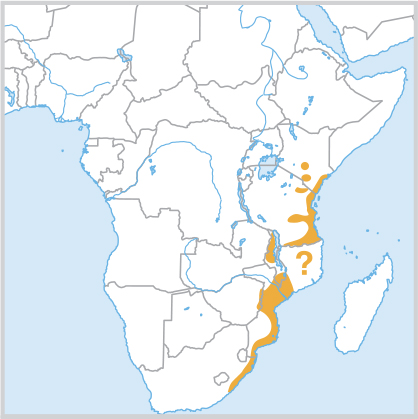
Dendroaspis angusticeps
Natural History: A fast-moving, diurnal, secretive tree snake that climbs expertly but will descend to the ground, and is sometimes seen crossing roads. It may climb very high in trees. It sleeps at night in the branches, not seeking a hole to sleep in but coiled up in a thick patch, and will also shelter in and under makuti (coconut thatch) roofs. Individuals may emerge to sunbathe in the early morning; anecdotal evidence indicates they are most active in the morning. This is an even-natured snake, not known to spread a modified hood or threaten with an open mouth like the Black Mamba (Dendroaspis polylepis). It is not aggressive; if threatened it tries to escape, and rarely tries to bite. Male combat has been observed in South Africa in June. Mating has been observed in April, May and July in southern Tanzania. It lays up to 17 eggs, roughly 30 × 60mm; these take two to three months to hatch. Hatchlings have been collected between December and February in southern Tanzania, and in June and July in Watamu, Kenya. This species feeds mostly on birds and their nestlings, rodents and bats, and occasionally lizards. Tanzanian snakes took a Lilac-breasted Roller (Coracias caudatus) and a Southern Blue-eared Glossy Starling (Lamprotornis elisabeth). Ground-dwelling rodents have been found in their stomachs, indicating they will descend to feed or hunt at low levels. Captive specimens will take chameleons. A recent study around Watamu indicates that Eastern Green Mambas spend much time waiting in ambush, but they will also forage, searching in trees, investigating holes and birds’ nests. This snake has been found in huge concentrations within parts of its range (especially coastal Kenya and south-east Tanzania); concentrations of two to three snakes per hectare (i.e. 200–300 per square kilometre) have been noted.
Medical Significance: A dangerous snake, with a potentially deadly neurotoxic venom, but being alert, tree-dwelling, diurnal and secretive, it rarely comes into contact with humans. However, bites on the coast of East and south-east Africa occasionally occur as a result of the snake sheltering in thatched roofs or hiding in fruit and nut trees; occasional bites to walkers who have trodden on or near a snake are also known. Antivenom is available. The venom contains unusual neurotoxins called dendrotoxins, which cause pins and needles, tingling and numbness, muscular contractions and a progressive paralysis. Pain and swelling, sometimes extensive, are also noted, as is dizziness, nausea, difficulty in breathing and swallowing, and swollen lymph glands. Peripheral necrosis has also been recorded, but this may be connected with bites on digits and mismanagement of the wounds. Occasional cases present with no neurotoxic symptoms; severe local swelling and blistering have been described, as well as mild coagulopathy and bleeding. Bites are rare but may need rapid hospital treatment with antivenom and respiratory support, although very few deaths are recorded. Some victims have noted sudden falls in blood pressure days after the bite.
Eastern Green Mamba, Dendroaspis angusticeps.
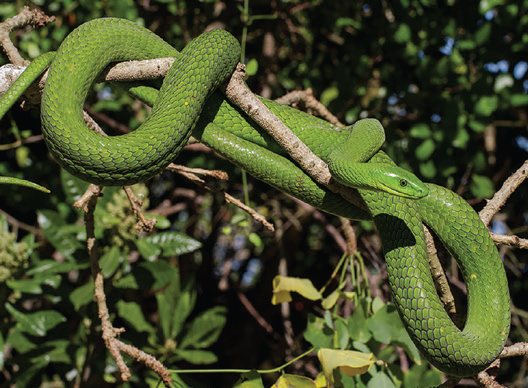
South Africa (Tyrone Ping).
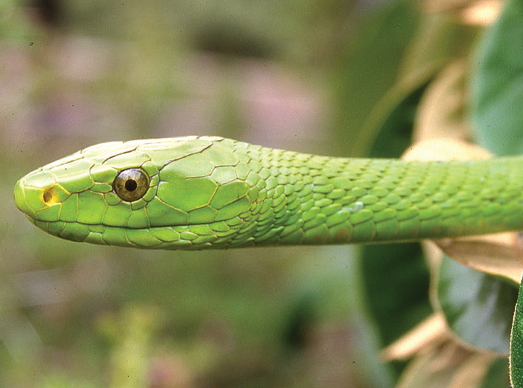
Tanzania (Stephen Spawls).
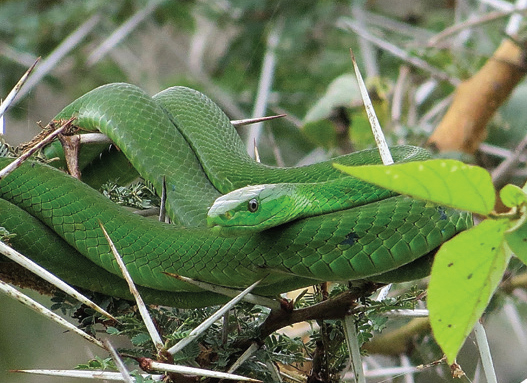
Tanzania (Elvira Wolfer).
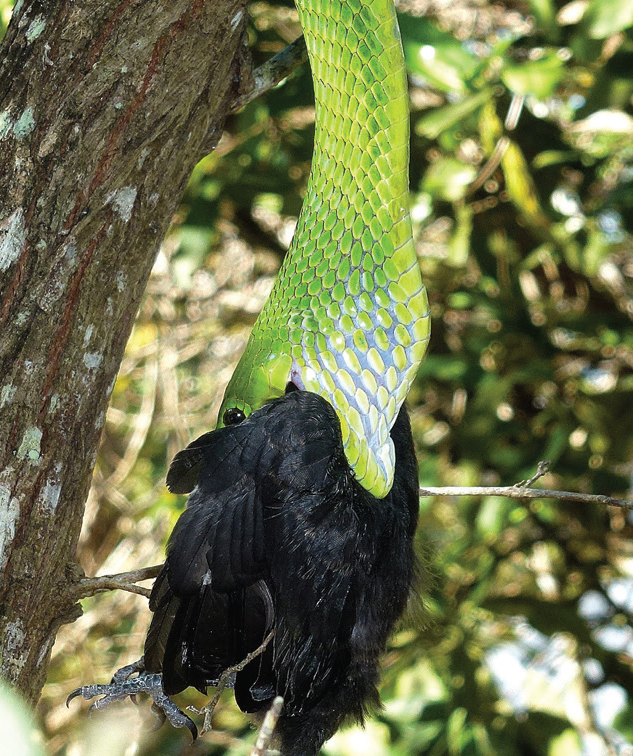
eating a bird (Bill Roland Schroeder).
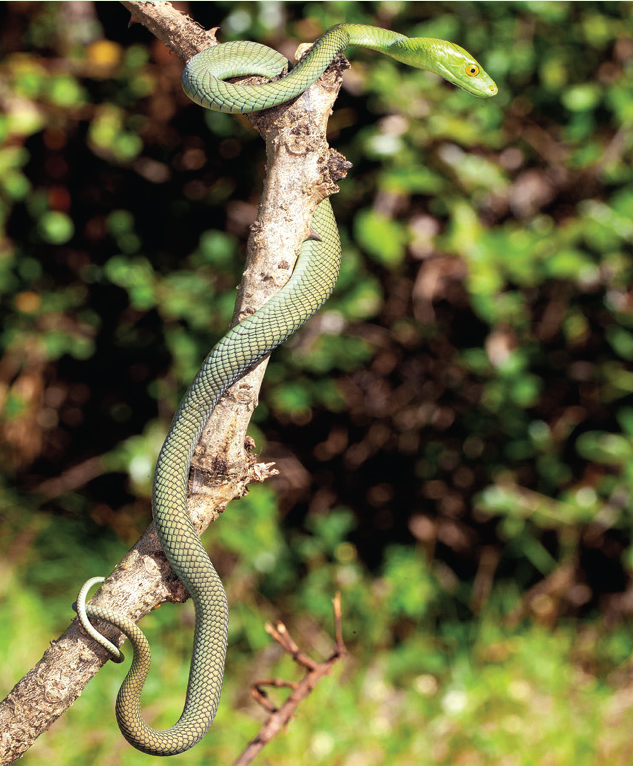
hatchling (Johan Marais).
Jameson’s Mamba Dendroaspis jamesoni
Identification: A large, slender mamba of the Central African forests, with finely black-edged head scales. The head is long and the eye small, with a round pupil. The tail is long and thin, 20–25% of total length. The scales are smooth; in 15–17 rows at midbody; ventrals 202–227; subcaudals 94–113. Maximum size 2.64m (possibly more), large specimens usually males; average 1.5–2.2m; hatchling size unknown, but probably around 30cm. The colour is dull green above, mottled with black and yellow-green, pale green below, and yellow on the neck and throat. In some specimens (particularly juveniles) the black and yellow dorsal scales form narrow bands. The scales on the head and body are narrowly edged with black. Specimens from Uganda and Kenya (subspecies kaimosae) have a black tail; those from the centre and west of the range have a yellow tail and the tail scales are black-edged, giving a netting effect; in some Central African snakes the median dorsal scales are very dark, giving the impression of a black vertebral stripe.
Habitat and Distribution: Forest, woodland, swamp forest, forest–savanna mosaic, thicket and deforested areas, from sea level to about 2,200m (up into montane woodland, although observations from the Albertine Rift suggest it doesn’t like cold forests). It will persist in areas after forest has been felled, providing there are still thickets and trees to hide in, and will move across open country to reach isolated tree clumps and thickets. It is quite often found around buildings, in and around towns within the forest, and in parks and farms. Being a secretive green tree snake, it often clings on in well-inhabited areas without being seen. It occurs westwards from the western side of the Albertine Rift across the great forests of Central Africa to Nigeria and southern Benin, south to north-west Angola. This species has also been sporadically recorded in Tanzania from Mahale Peninsula and the Minziro Forest, from the Kakamega Forest in Kenya, and in Uganda from the shore of Lake Victoria, north to Lake Kyoga, and west to Lake Edward and Budongo and Kibale Forests. There are scattered records in Rwanda and Burundi, and it is also known from the Imatong Mountains, South Sudan. West of Ghana it is replaced by the West African Green Mamba (Dendroaspis viridis).
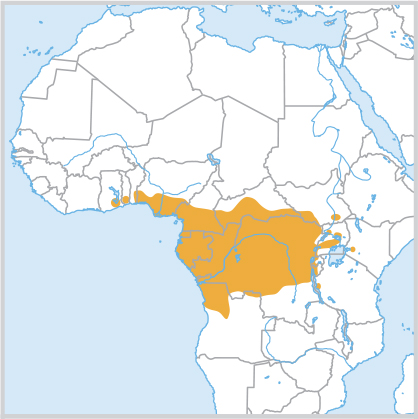
Dendroaspis jamesoni
Natural History: A fast-moving diurnal tree snake that climbs expertly but will descend to the ground. It is not aggressive; if threatened it tries to escape, but occasional specimens may flatten the neck to a narrow hood. It will reluctantly strike if provoked. However, some snake keepers have described this snake as very nervous, bad-tempered and willing to bite. It may shelter in hollow trees, cracks and tangles of vegetation. Male–male combat and mating were observed in Nigeria in the dry season, December to January; mating was observed in Kakamega Forest in Kenya in September. Females lay eggs; clutches of 5–15 have been recorded in Cameroon, laid in March, and 7–16 in Nigeria, laid mostly in April, May and June; females collected in June in Uganda showed no yolk deposition, but those collected in November contained developing eggs. The diet in Kenya is known to include rodents, birds and arboreal lizards. Studies in Nigeria found that the adults largely ate birds and some rodents, while juveniles also took cold-blooded prey; known prey items included toads, agamas, several bird species (including woodpeckers, cisticolas and doves), and squirrels, shrews and mice. Captive specimens readily take rodents but are nervous feeders. A mark–recapture study in Nigeria found this snake was sedentary, moving only a short distance between captures.
Medical Significance: A dangerous snake, with a potentially deadly neurotoxic venom that is also cardiotoxic. However, being alert, tree-dwelling, diurnal and secretive, this species rarely comes into contact with humans, although those who farm or work in forests are at risk, and it is sometimes active on the ground during the day. Local and extended swelling and respiratory paralysis have been recorded following a bite. A bite from a single fang of a juvenile snake in Uganda caused considerable facial pain, chills and sweating, followed by slurring of speech and inability to breathe. A man collecting firewood in Nasho, Rwanda, was bitten by a ‘green snake with a black tail’, probably this snake, and died in three hours. A bite victim in Nigeria with two fang marks died four hours after a bite; the symptoms included vomiting, abdominal pain, blurred vision, involuntary urination and progressive articulation problems, leading to inability to speak. Finally, breathing stopped. The correct antivenom was unavailable. Few cases are reported in the literature. Bites will need rapid hospital treatment with antivenom and respiratory support.
Jameson’s Mamba, Dendroaspis jamesoni.
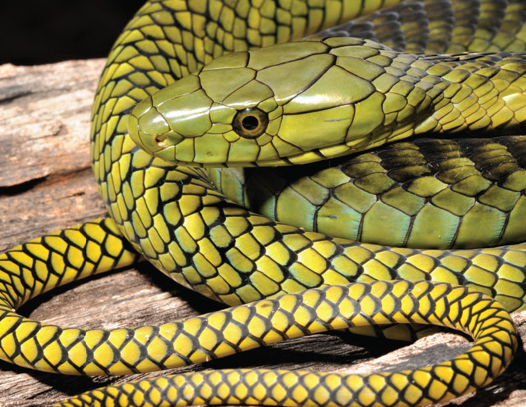
Angola (Bill Branch).
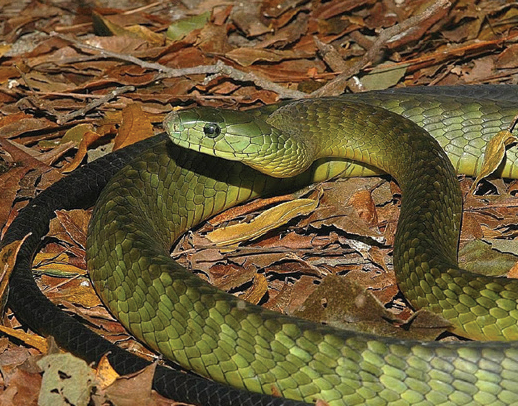
Kenya (Bio-Ken Archive).
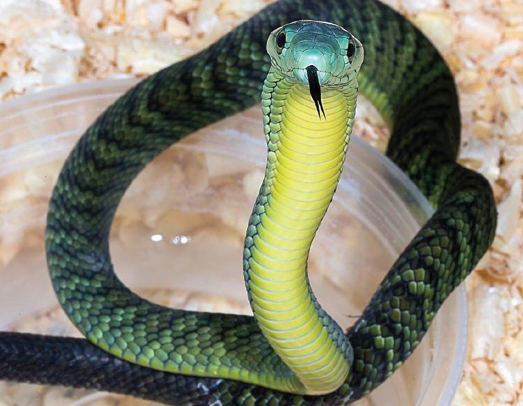
hatchling, Uganda (Mike Perry).
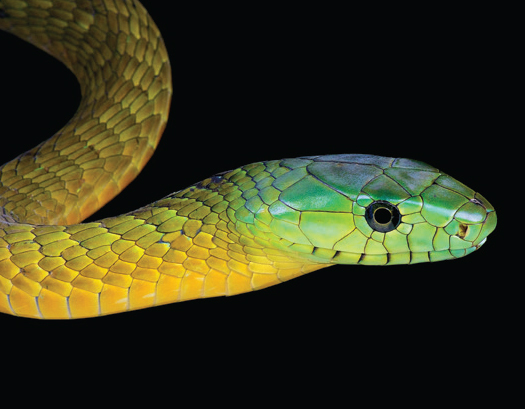
captive (Matthijs Kuijpers).
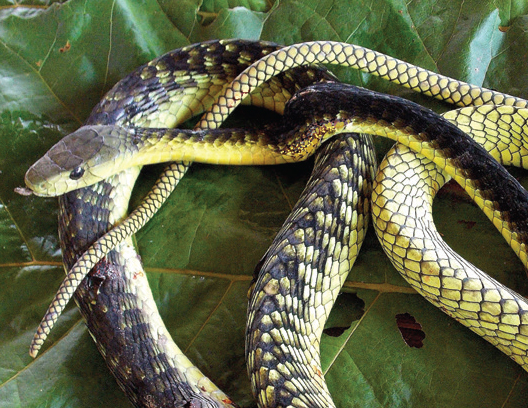
DR Congo (Eli Greenbaum).
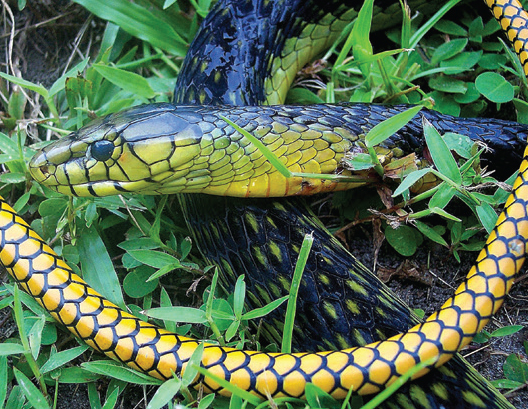
Gabon (Olivier Pauwels).
West African Green Mamba Dendroaspis viridis
Identification: A large, slender tree snake with a long head and a small eye. The pupil is round and the iris is yellow. The tail is long and thin, 20–23% of total length. The dorsal scales are smooth, and often startlingly huge; in 13 rows at midbody; ventrals 211–225 (higher counts often females); subcaudals 111–125. Maximum size 2.4m (possibly more), average 1.4–2.1m; hatchlings 35–45cm. The body is various shades of green above, or sometimes brown, yellow or blue-green. The huge, elongate dorsal scales may be black- or yellow-edged, giving the impression of oblique bars. The head scales are usually finely black-edged. The scales on the tail are usually strongly black-edged, giving a net effect. The underside is shades of green but usually pale; sometimes the ventrals are strongly black-edged, especially in juveniles.
Habitat and Distribution: Mostly in forest, thicket and woodland, but sometimes in forest–savanna mosaic, secondary forest, abandoned plantations or in riverine woodland in savanna. Usually lives at low altitude, but up to 1,400m in parts of its range. It is quite tolerant of agriculture in places, especially crops like cocoa, or even urban areas so long as parks, ornamental trees or riverine forest remain. Within forest it favours clearings. It is sporadically recorded from southern Benin, Togo and the hill country east of Lake Volta in Ghana, and found more or less continuously in the forests and fringing savanna from southern Ghana westwards to southern Senegal and the Gambia.
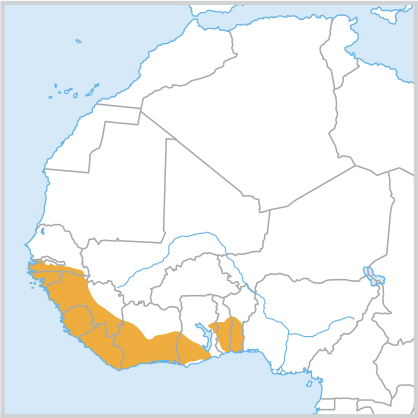
Dendroaspis viridis
Natural History: A fast-moving, secretive diurnal tree snake that climbs expertly but will descend to the ground. Not aggressive; if threatened it will try to escape, and it rarely tries to bite. It may climb very high in trees. It sleeps at night in the branches, not seeking a hole to sleep in but coiled up in a thick patch, or sometimes on the tops of palm trees or out on a limb. Individuals may emerge to sunbathe in the early morning. This species has a reputation as a nervous snake in captivity. It lays 6–14 eggs. It hunts in trees but also on the ground. The diet largely comprises small rodents, but it also takes birds and bats, and possibly squirrels; one captive individual swallowed another.
Medical Significance: A dangerous snake, with a potentially deadly neurotoxic venom that has a toxicity of 0.5mg/kg, and a wet venom yield averaging 1,200mg. However, being alert, tree-dwelling, diurnal and secretive, it rarely comes into contact with humans; it also avoids confrontation, and few bites are recorded. In general, mamba venoms cause a rapidly progressing, descending paralysis, which can appear soon after the bite and advance to fatal respiratory paralysis. A bite in Ivory Coast led to respiratory paralysis, which responded to antivenom. However, the zoologist George Cansdale noted only three bite cases in 14 years in Ghana; one received antivenom, but all recovered. A recent bite victim in Liberia suffered symptoms of local envenoming: considerable local pain, muscular pain in the head, neck, chest and limbs, tender skin, and he became unable to move his limbs. He received eight ampoules (80ml) of South African antivenom, which complicated the symptomology as he was asthmatic, but recovery was complete, although his heart rate was elevated for 14 days. This antivenom is not actually raised using venom from this snake. Bites from this snake are likely to need rapid hospital treatment with antivenom and respiratory support.
West African Green Mamba, Dendroaspis viridis.
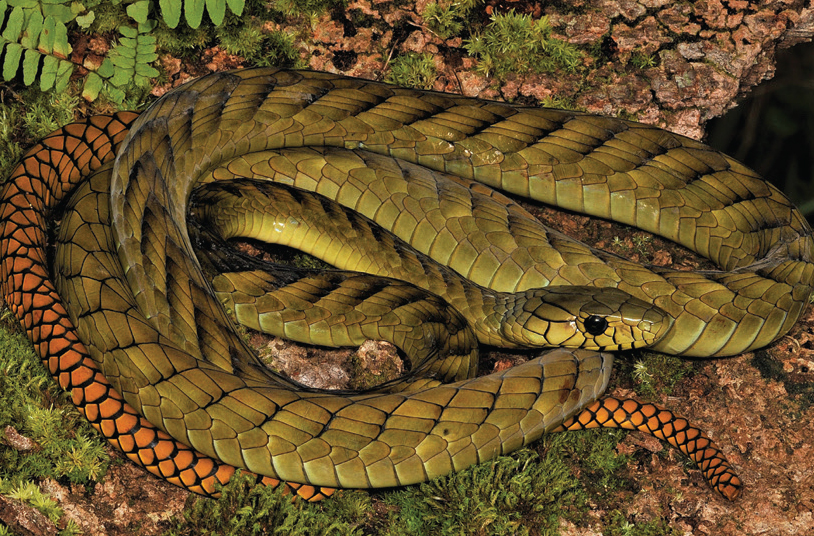
Sierra Leone (Bill Branch).
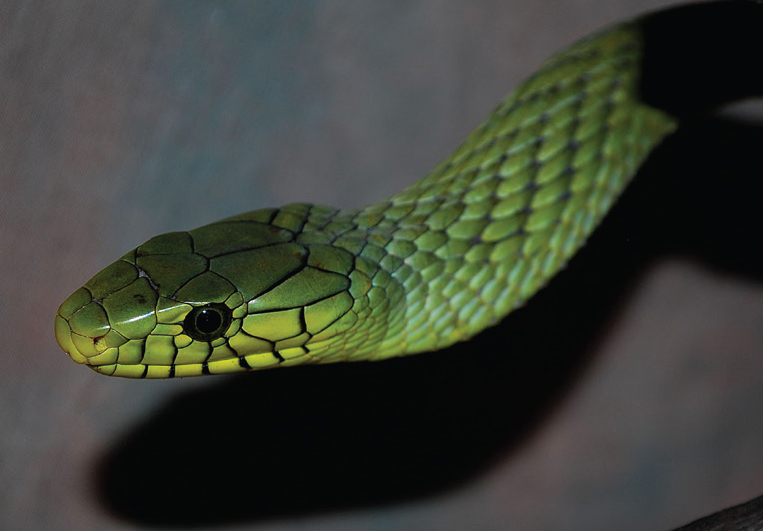
Ghana (Stephen Spawls).
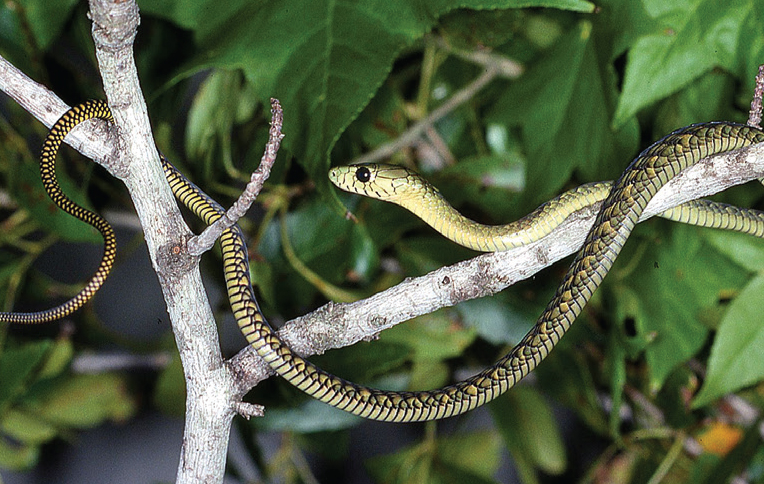
juvenile (Paul Freed).
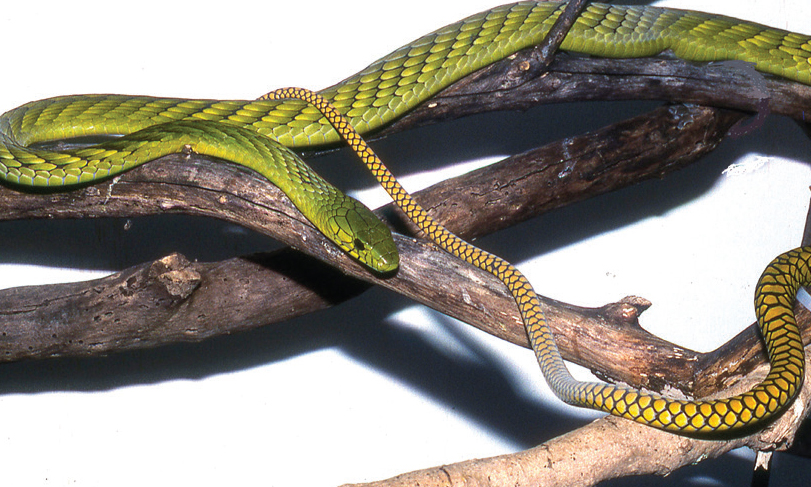
captive (Mark Largel).
Black Mamba Dendroaspis polylepis
Identification: A long, slender, fast-moving snake, with a long, narrow ‘coffin-shaped’ head, a fairly pronounced brow ridge and a medium-sized eye with a round pupil. The inside of the mouth is bluish black. The body is cylindrical and the tail long and thin, 17–25% of total length. The scales are in 23–25 (rarely 21) rows at midbody; ventrals 239–281; subcaudals 105–132. Maximum size probably about 3.5m (unsubstantiated reports of larger specimens, up to 4.3m, exist); adults average 2.2–2.7m; hatchlings 45–60cm. The juveniles grow rapidly and may reach 1.5–2m in a year. The colour is olive, brownish, yellow-brown or grey, or sometimes khaki or olive-green, but almost never black as the name suggests; this may instead be based on the black mouth lining. Juveniles are greeny-grey. The scales are smooth and have a distinct purplish bloom in some adult specimens. The belly is cream, ivory or pale green. The back half of the snake is often distinctly speckled with black on the flanks, especially in animals from drier areas. Some snakes have rows of lighter and darker scales towards the tail, giving the impression of oblique lateral bars of grey and yellow.
Habitat and Distribution: In coastal bush, woodland, moist and dry savanna and occasionally semi-desert, from sea level to about 1,600m; very rarely above this altitude. It is most common in well-wooded savanna or riverine forest, especially where there are rocky hills and large trees. It is widespread in the southern third of Africa, northwards from eastern South Africa up to Kenya (where it is absent from the central highlands and much of the dry north) and southern Somalia. There are five apparently isolated populations elsewhere: one between South Sudan and southern Ethiopia; one centred on northern Ethiopia and western Eritrea; one in eastern Ethiopia and north-west Somalia; one between north-east Cameroon and Central African Republic; and one between Senegambia and southwestern Burkina Faso. It might be more widely distributed or even continuous across the West and Central African savanna, but rare. Snakes matching its description are reported from north-west Nigeria. An experienced snake collector in Burkina Faso was killed by a Black Mamba; he had never encountered one before and assumed it was harmless.
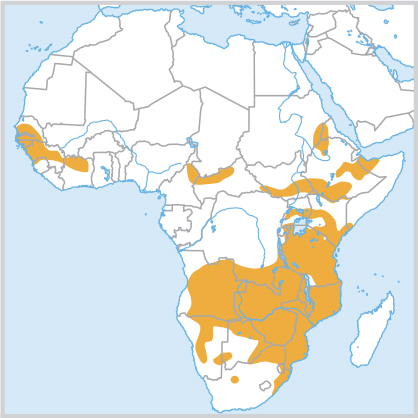
Dendroaspis polylepis
Natural History: A large, fast-moving, alert, agile diurnal snake, equally at home on the ground, climbing rocks or in trees. It often moves with the head and neck raised high. It usually moves away if approached, but if threatened it may rear up, flatten the neck into a narrow hood, hiss loudly and open the mouth to display the black interior, while shaking the head from side to side. If further antagonised, it may respond with a long upwards strike. Black Mambas shelter, often for several months, in holes, termitaria, rock fissures and tree cracks, Hamerkop (Scopus umbretta) nests, and even in tree beehives and roof spaces. In South Africa this species frequently basked between 7 a.m. and 10 a.m. and from 2 p.m. to 4 p.m. It often shares its refuges with other snakes, including cobras and pythons (Python); at Kimana in Kenya two Black Mambas shared their hole with two Egyptian Cobras (Naja haje). Black Mambas lay 6–18 eggs (although 12–18 is more usual) measuring approximately 65 × 30mm, which usually hatch after two to three months, at the beginning of the rainy season. This species takes a variety of mammals of all sizes, from mice to squirrels, bats, bushbabies, mongooses and hyraxes; it may also eat birds (especially nestlings; one ate a Peregrine Falcon, Falco peregrinus, chick) and snakes. One specimen was observed eating winged termites as they left the nest. Males indulge in combat, neck-wrestling with bodies intertwined; this has been misidentified as courtship. These snakes are often mobbed by birds and also by squirrels and Vervet Monkeys (Chlorocebus pygerythrus).
Medical Significance: This is a very dangerous snake, and probably the worst snake to be bitten by in Africa in terms of the need to take rapid action to prevent death. Although it is diurnal and alert, and tends to avoid confrontation, it is nevertheless often found around farms and homesteads in the savannas of Africa, it sometimes shelters in buildings and it is confident in defence. If it feels it is cornered, it will try to defend itself by biting and it can strike a long way. Trying to kill a Black Mamba is a very risky undertaking. The venom is a potent neurotoxin, designed to rapidly knock down relatively large mammals like hyraxes and squirrels within minutes, so it quickly affects humans. It causes nausea, vomiting, sweating, diarrhoea, thick respiratory tract secretions and fasciculations. A rapid respiratory paralysis may develop within an hour. The venom yield can be many times the lethal dose. Any Black Mamba bite is a medical emergency; rapid transport to an advanced hospital will be needed, followed by treatment with antivenom and respiratory support. A number of well-documented cases exist. Occasional ‘dry’ bites are known. A Black Mamba bite is one situation where immobilisation therapy using a local pressure pad and artificial respiration may be life-saving as the victim is transported to hospital.
Black Mamba, Dendroaspis polylepis.
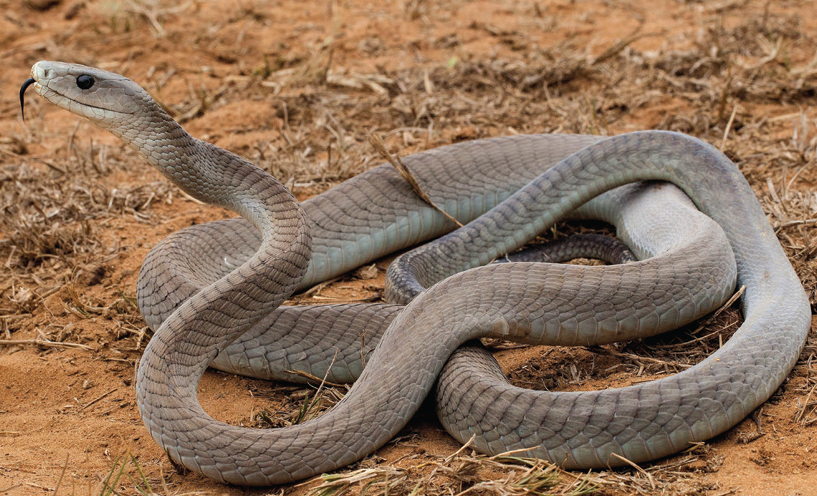
South Africa (Johan Marais).
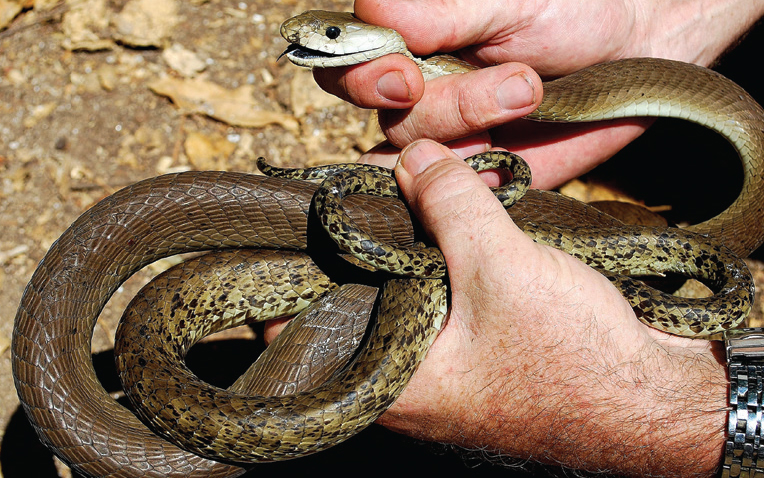
Kenya (Stephen Spawls).
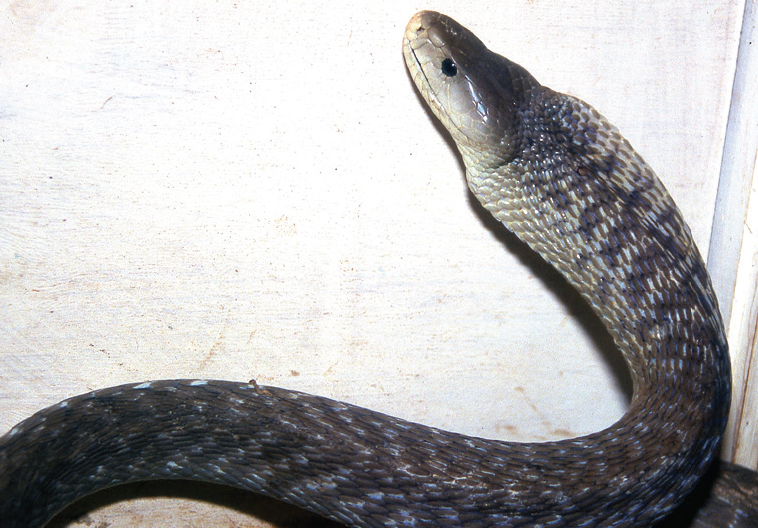
hood spreading, Kenya (Stephen Spawls).
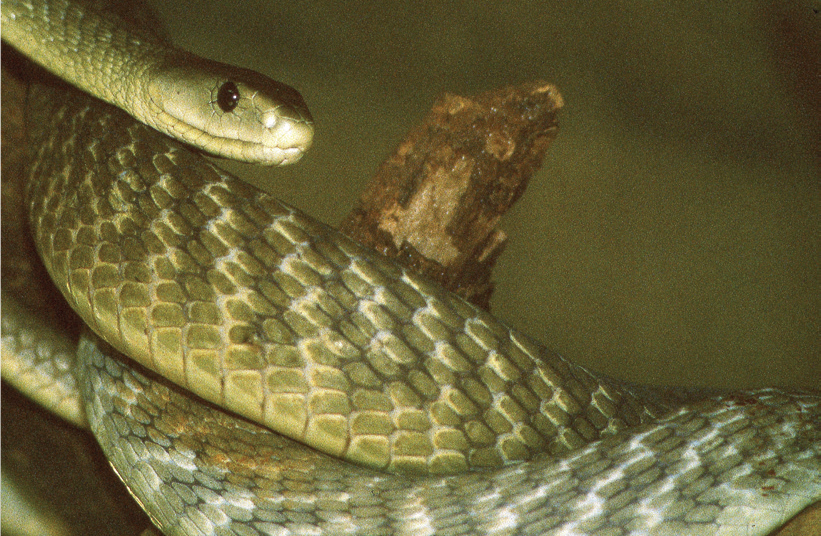
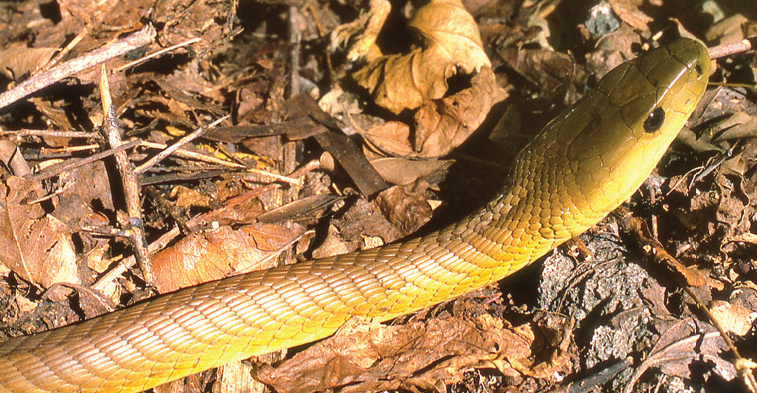
Kenya (Stephen Spawls).
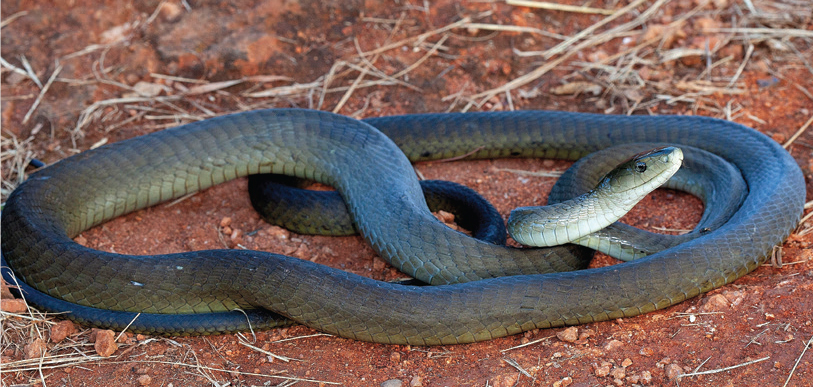
South Africa (Johan Marais).
African garter snakes Elapsoidea
A genus of small (most are less than 70cm in length), ground-dwelling, burrowing venomous elapids (not to be confused with the harmless American garter snakes, genus Thamnophis). Ten species occur in sub-Saharan Africa, but in some areas they are very hard to tell apart; it has been jokingly said that there is only a single species of Elapsoidea but a lot of variation. In several reviews by eminent herpetologists, museum specimens have been reassigned from one species to another; the situation in parts of the Sahel and south-central Africa is particularly unclear. When identifying a garter snake, the locality will give valuable clues; bear this in mind when using the key.
Garter snakes have small, blunt heads and short tails. Nearly all have vivid dorsal bands when juvenile, but in most species the band either fades or darkens in the centre as they grow; the banding may serve to stop large garter snakes eating juveniles. Garter snakes have front fangs, but these are short and the snakes are usually reluctant to bite. When disturbed, they often inflate and flatten the body, throwing the bands into prominence, and also elevate the body (either the head and neck, or the middle) and hiss; sometimes they flatten and roll the tail into a vertical plane. They are active on the ground, especially during the rainy season, so are liable to be trodden on. However, they are of no real medical significance (although domestic dogs have been killed by garter snakes).
A curious suite of symptoms from garter snake bites includes pain (sometimes rapid and sometimes intense), nausea, vomiting, swelling, lymphangitis, stiffness of the bitten limb, nasal congestion, blurred vision and loss of consciousness; some of these may be due to something other than the actual venom. However, no fatalities have been recorded from African garter snake bites and no generic antivenom is available; a bite should be treated symptomatically.
Key to the genus Elapsoidea, African garter snakes
1aKnown only from Somalia; unbanded……2
1bKnown elsewhere in Africa; usually banded……3
2aVentrals 136–141……Elapsoidea chelazziorum, Southern Somali Garter Snake
2bVentrals 165–180……Elapsoidea broadleyi, Broadley’s Garter Snake
3aSix upper labials; underside uniformly dark; in western West Africa……Elapsoidea trapei, Trape’s Garter Snake
3bSeven upper labials……4
4aSnout elongate; very variable; all records south of 22°S……Elapsoidea sundevalli, Sundevall’s Garter Snake
4bSnout rounded; virtually all records north of 20°S (except Elapsoidea boulengeri, which extends to 27°S)……5
5aJuvenile head orange; only in hill forest of north-east Tanzania and the Shimba Hills in Kenya……Elapsoidea nigra, Usambara Garter Snake
5bJuvenile head not orange; not in hill forests of north-east Tanzania or Shimba Hills of Kenya……6
6aIn West and Central African savannas, largely north of 5°N……7
6bLargely south of 5°N……8
7aEight to 17 body bands; occurs from South Sudan west to northern Cameroon; has an upper labial in contact with the prefron-tal……Elapsoidea laticincta, Central African Garter Snake
7bTen to 21 body bands; occurs from Central African Republic west to Senegambia (with a population in northern Angola); no contact between prefrontal and upper labial……Elapsoidea semiannulata (subspecies moebiusi), Northern Half-banded Garter Snake
8aIn East Africa, mostly north of 5°S; bands retained throughout life……Elapsoidea loveridgei, East African Garter Snake
8bIn southern and south-eastern Africa, mostly south of 5°S; bands not retained throughout life……9
9aDark bands and pale bands are almost equal in width……Elapsoidea guentheri, Günther’s Garter Snake
9bDark bands usually broader than pale bands……10
10aUnderside white……Elapsoidea semiannu-lata (subspecies semiannulata), Southern Half-banded Garter Snake
10bUnderside dark grey or brown……Elap-soidea boulengeri, Boulenger’s Garter Snake
Boulenger’s Garter Snake (Zambezi Garter Snake) Elapsoidea boulengeri
Identification: A small, glossy, banded snake of the savannas of south-eastern Africa. The head is short, slightly broader than the neck, and the eyes are set well forward, with round pupils. The body is cylindrical and the tail fairly short, 6–9% of total length. The scales are smooth; in 13 rows at midbody; ventrals 140–163; subcaudals 18–27 in males, 14–22 in females. Maximum size 76.6cm, average 40–70cm; hatchlings 12–14cm. Juveniles have 8–17 white, cream or yellow bands on a black or chocolate-brown body; the head is usually white with a black Y-shaped central mark. As the snake grows the bands fade to grey with white edging, then to a pair of white irregular rings, and finally they fade completely, leaving a uniformly dark grey or black adult. Sometimes a few scattered white scales remain. The chin and throat are white; the rest of the belly is dark grey.
Habitat and Distribution: In moist savanna, from sea level to 1,500m, or possibly higher. It occurs from south-eastern Tanzania south through Mozambique, much of southern Zambia and Malawi, and throughout Zimbabwe; it just enters northern Botswana and the Caprivi Strip in Namibia. It also occurs along South Africa’s northern border. There are isolated records from western Tanzania (from Kibondo south to the western side of Lake Rukwa), eastern DR Congo (Tanganyika Province) and on the south-east Botswana border. A report from the Omatako Canal in northern Namibia is probably misidentified.
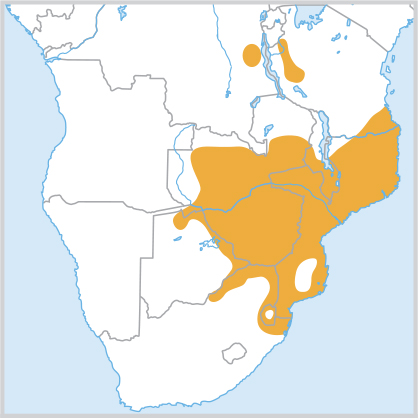
Elapsoidea boulengeri
Natural History: A burrowing snake, living in holes, it emerges on warm, wet nights to look for prey or a mate. Slow-moving and inoffensive, it doesn’t usually attempt to bite if picked up, but may hiss, inflate the body and jerk convulsively. Clutches of 4–8 large eggs have been recorded, in January and February in southern Tanzania; a hatchling was collected in June. The diet comprises other snakes (including its own species), lizards, small rodents and frogs. Zimbabwean snakes had eaten a rubber frog and a rain frog, both of which have poisonous skin secretions; Tanzanian specimens have been recorded eating snout-burrowers and squeakers.
Medical Significance: Low. The venom is not life-threatening, and neurological symptoms seem to be absent from reported cases. One recorded bite caused swelling of the bitten hand, immediate pain and transient nasal congestion; another showed pain and nasal congestion but no swelling.
Boulenger’s Garter Snake, Elapsoidea boulengeri.
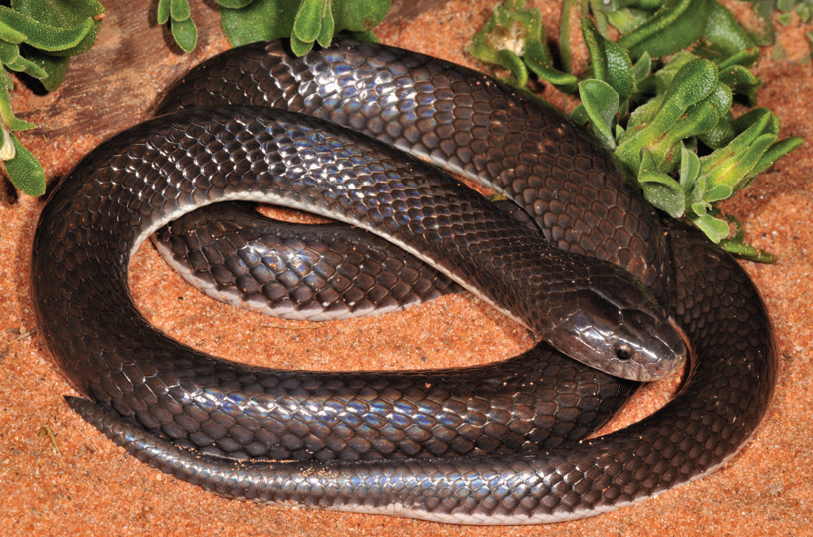
South Africa (Bill Branch).
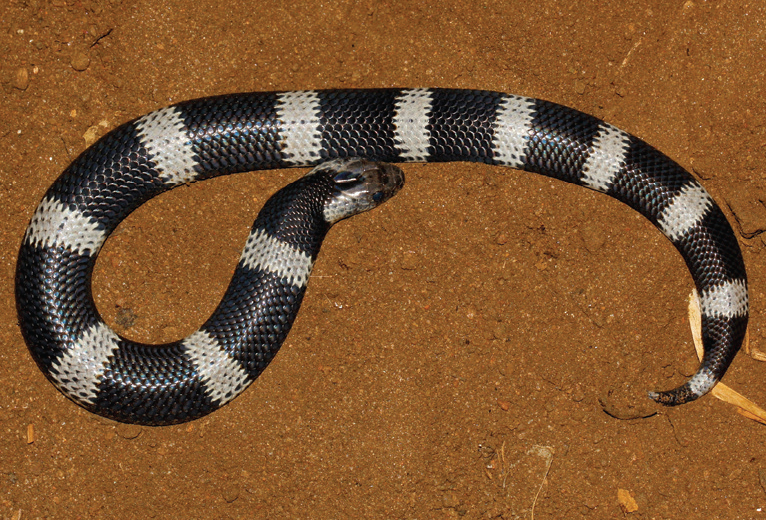
juvenile, Malawi (Gary Brown).
Broadley’s Garter Snake Elapsoidea broadleyi
Identification: A small, glossy snake with a short head that is slightly broader than the neck, and eyes that are set well forward, with round pupils. The body is cylindrical and the tail very short, 6–7% of total length. The scales are smooth; in 13 rows at midbody; ventrals 165–180; subcaudals 22–23 in males, 18 in the only known female. Maximum size 76.6cm, average 40–70cm; hatchlings 12–14cm. This species is known solely from three preserved specimens and a sight record; in preservative it is brown above and white below, without any trace of banding; the sight record was uniform blackish brown.
Habitat and Distribution: Recorded from Jilib and Afmadow, and a specimen was photographed near Kismayu, in the dry low-altitude savanna of southern Somalia.
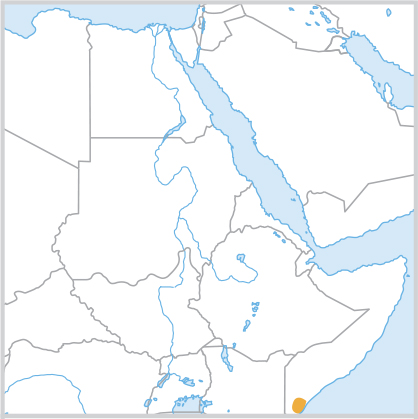
Elapsoidea broadleyi
Natural History: Unknown. It has never knowingly been seen alive, but is presumably similar to other garter snakes (i.e lives on the ground or in holes, nocturnal, lays eggs, and eats reptiles and amphibians).
Medical Significance: Its tiny range (at present) and presumably typical garter snake venom indicate it is of no real medical significance, although within its range many people don’t have closed shoes and are liable to tread on it at night in the rainy season.
Broadley’s Garter Snake, Elapsoidea broadleyi.
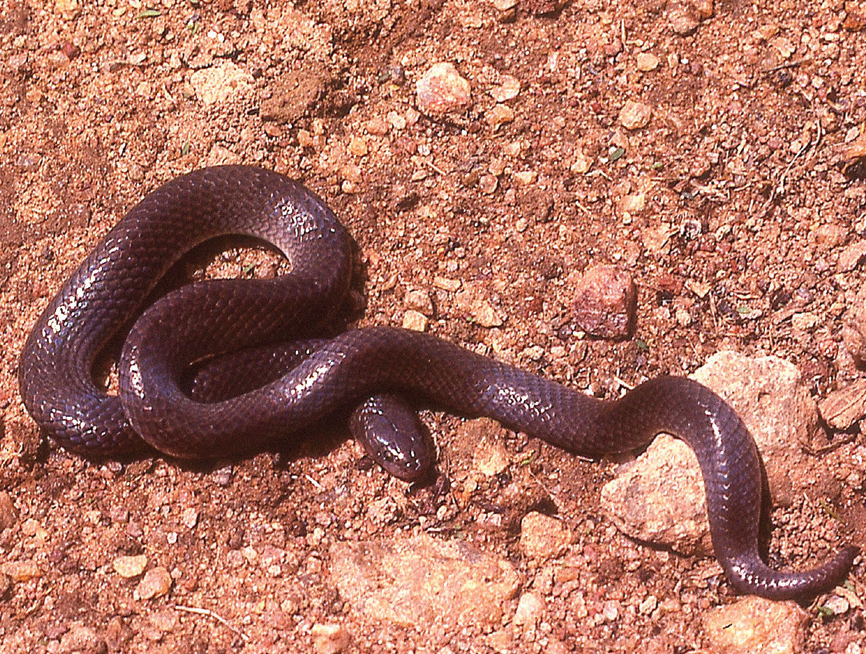
Somalia (Mike McLaren).
Southern Somali Garter Snake Elapsoidea chelazziorum
Identification: A small, glossy snake, known only from two specimens collected in Afgooye (originally Afgoi), near Mogadishu, Somalia, in the late 1970s. The head is short, slightly broader than the neck, and the eyes are set well forward, with round pupils. The body is cylindrical and the tail very short, 7–8% of total length. The scales are smooth; in 13 rows at midbody; ventrals 136–141; subcaudals 17–21. The two known specimens were 18cm and 41.5cm in total length. The adult was dark greyish brown, with the front of the head, the upper lips and the throat off-white with brownish spots; the belly was dark grey. The juvenile was black above and the head and throat were off-white above, with scattered tiny brown dots; the belly was light grey. Unusually, neither individual was banded.
Habitat and Distribution: Taken in an area of sandy soil, in dry open woodland typical of consolidated coastal dunes, at Afgooye, in the valley of the Shebelle River, in the dry low-altitude savanna of southern Somalia.
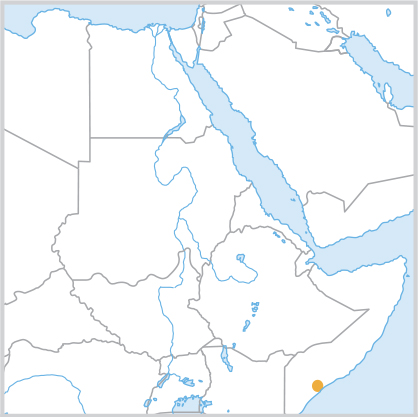
Elapsoidea chelazziorum
Natural History: Unknown. It is presumably similar to other garter snakes (i.e. living on the ground or in holes, nocturnal, lays eggs, and eats reptiles and amphibians). One specimen was active at night after the first rainstorm of the season.
Medical Significance: Its tiny range (at present) and presumably typical garter snake venom indicate it is of no real medical significance, although within its range many people don’t have closed shoes and are liable to tread on it at night in the rainy season.
Southern Somali Garter Snake, Elapsoidea chelazziorum.
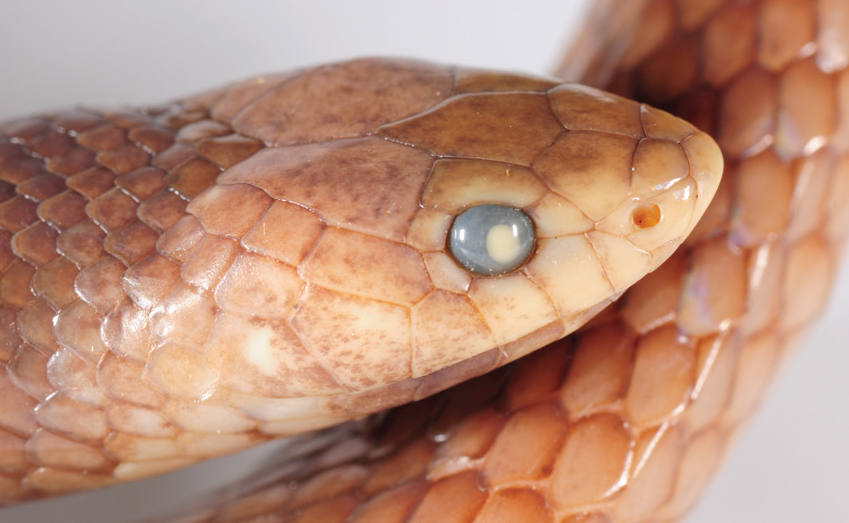
preserved specimen (Tomáš Mazuch).
Günther’s Garter Snake Elapsoidea guentheri
Identification: A small, glossy snake, with equally spaced bands, of the savannas of south-central Africa. The head is short and slightly distinct from the neck. The scales are smooth; in 13 rows at midbody; ventrals 131–156; subcaudals 15–26. Maximum size about 62cm, average 30–50cm; hatchling size unknown. Juveniles are black with 14–28 broad, pale (white or grey-white) cross-bands; the bands are the same width as the spaces between. The pale bands darken in the centre as the snake grows, and usually disappear, so that adults appear grey or black. However, some adults are grey with white-edged black bands, and others retain a series of thin white bands, where the white-edged scales that marked the outer edges of the bands are all that remain of the bands.
Habitat and Distribution: Woodland, moist and dry savanna and forest–savanna mosaic, from sea level to 1,500m or slightly higher. It occurs from central DR Congo south into the miombo woodland of northern Angola, central Zambia and Zimbabwe, just getting into south-west Tanzania, and there is an isolated record from Gorongosa, Mozambique.
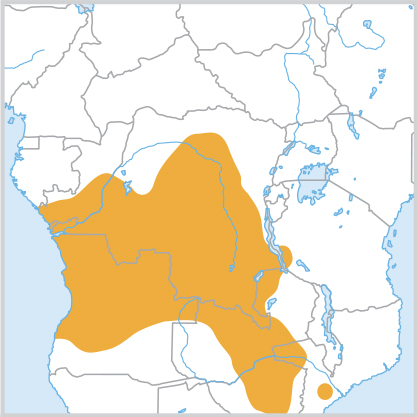
Elapsoidea guentheri
Natural History: Terrestrial and nocturnal, and fairly slow-moving. It hides in holes, under ground cover or in logs during the day, and is believed to spend much of its active time crawling about in holes, but will prowl on the surface at night, especially on damp nights after rain, and is sometimes active in the dry season. It is totally inoffensive, and many specimens will let themselves be handled freely, making no attempt to bite. However, if teased or molested it may flatten and inflate the body, showing the bands prominently, and may lift the front half of the body off the ground and jerk from side to side. It is likely to bite only if restrained. Females lay up to 10 eggs. This species eats snakes, lizards and amphibians. A small snake from DR Congo had insect larvae in its stomach, while a Zambian animal had the remains of a scorpion.
Medical Significance: A snake with a large range that lives in a well-populated area with lots of agriculture, but no bite cases are documented. No antivenom is available and it should not be necessary; treat symptomatically.
Günther’s Garter Snake, Elapsoidea guentheri.
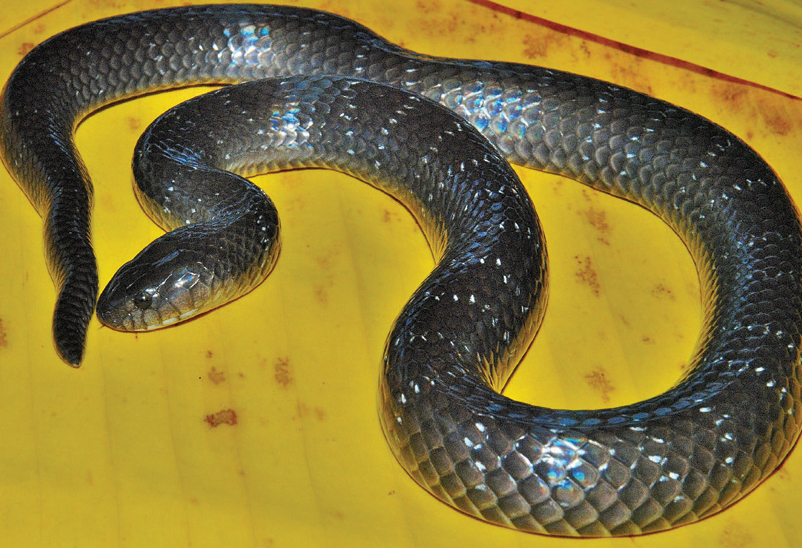
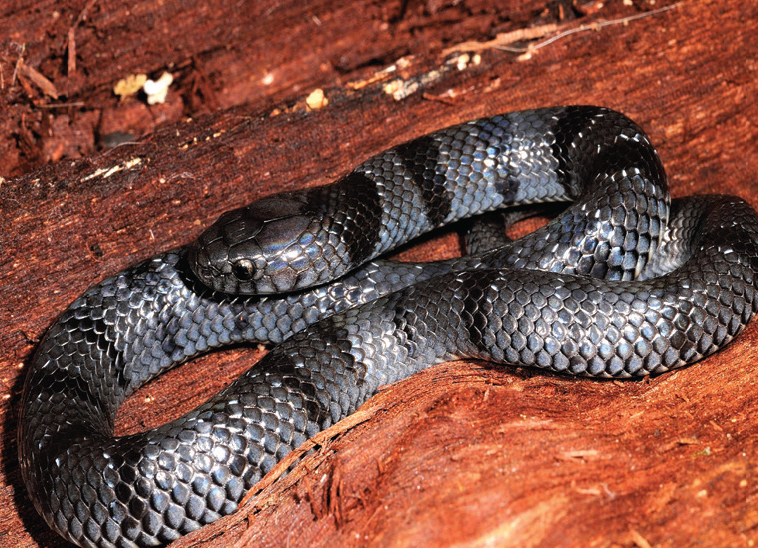
DR Congo (Colin Tilbury).
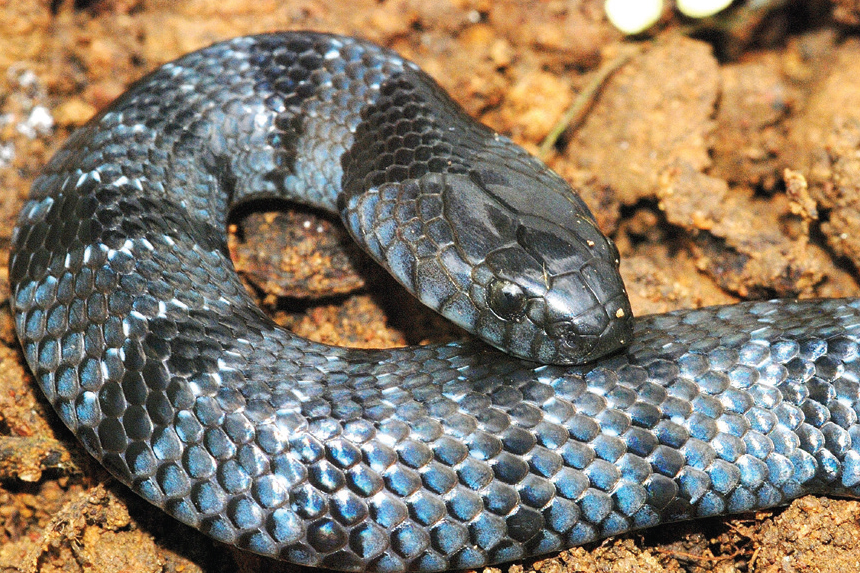
DR Congo (Colin Tilbury).
Central African Garter Snake Elapsoidea laticincta
Identification: A small, glossy snake with a short head, fairly large eyes and round pupils. The body is cylindrical and the tail fairly short, 6–9% of total length. The scales are smooth; in 13 rows at midbody; ventrals 139–151; subcaudals 13–25 (20 or more in males). Maximum size about 56cm, average 25–40cm; hatchling size unknown, but probably about 12cm. Young specimens have 8–19 pale brown or reddish-brown bands on a black body; the bands are about half as wide as the black spaces between. The belly is brownish yellow or dull orange. As the snake grows, the bands darken in the centre, but the scales at the outer edges of the bands remain pale, so that adults appear to be black with a series of fine white double rings along the body; occasional specimens lose all their markings.
Habitat and Distribution: In moist and dry savanna, woodland and forest–savanna mosaic, between 300m and over 1,000m. It occurs in northern Cameroon and southern Chad, eastwards to the extreme south of Sudan, southwards through most of South Sudan to Nimule, on the border with Uganda, and in north-east DR Congo.
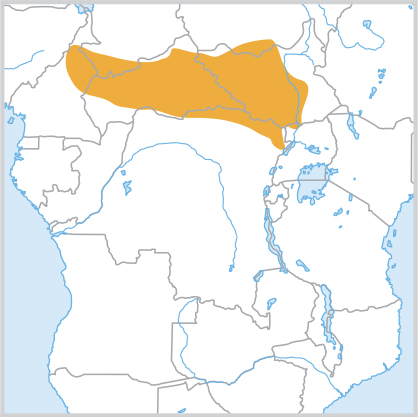
Elapsoidea laticincta
Natural History: Poorly known. It is terrestrial and fairly slow-moving, and nocturnal, emerging at dusk; it hides in holes or under ground cover during the day. It will prowl on the surface at night, especially on damp nights, after rain, and is sometimes active in the dry season. This species is totally inoffensive, and many specimens will let themselves be handled freely, making no attempt to bite. However, if teased or molested it may flatten and inflate the body, showing the bands prominently, and may lift the front half of the body off the ground and jerk from side to side. It is likely to bite only if restrained. Females lay eggs, but there is no information on size and number. The diet includes snakes, smooth-bodied lizards and frogs.
Medical Significance: A snake with a large range that lives in a well-populated area with lots of agriculture, but no bite cases are documented. No antivenom is available and it should not be necessary; treat symptomatically.
Central African Garter Snake, Elapsoidea laticincta.
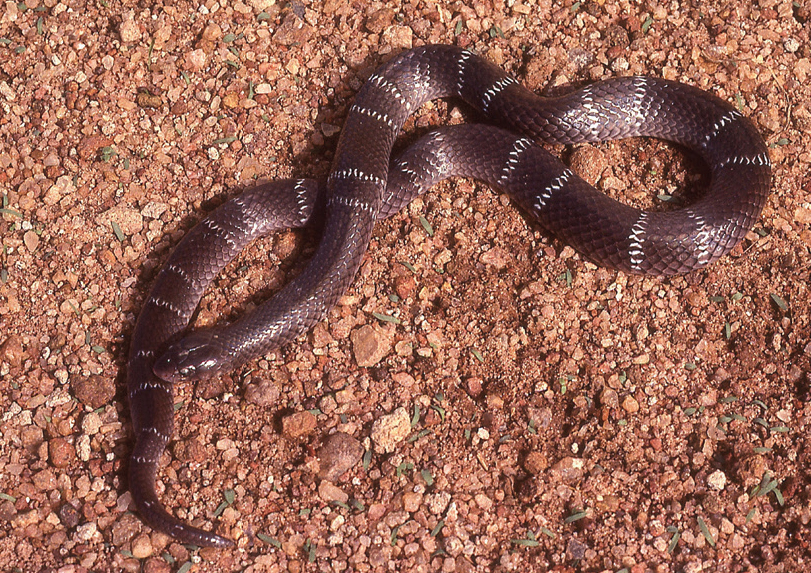
Central African Republic (Stephen Spawls).
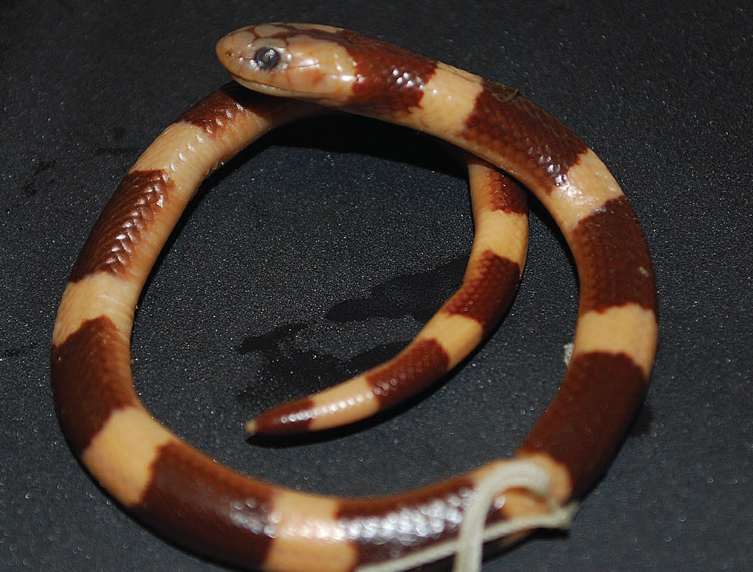
Preserved juvenile, South Sudan (Stephen Spawls).
East African Garter Snake Elapsoidea loveridgei
Identification: A small, glossy garter snake from the highlands of eastern Africa, in which the adults retain the bands on the body. The head is short and the eyes set well forward, with round pupils. The body is cylindrical and the tail fairly short, 6–9% of total length. The scales are smooth; in 13 rows at midbody. There are three subspecies. The typical, eastern form (Elapsoidea loveridgei loveridgei) occurs in central Kenya (east of the Gregory Rift Valley) and northern Tanzania, and has 14–27 bands on the body, 150–164 ventrals and 19–30 subcaudals. The many-banded central form (E. loveridgei multicincta) occurs in western Kenya, parts of northwest Tanzania, most of Uganda (not the south-west), Ethiopia and South Sudan; it has 23–40 bands or pairs of transverse white lines, 151–171 ventrals and 17–28 subcaudals. Collet’s East African Garter Snake (E. l. colleti) occurs in south-west Uganda, possibly northern Burundi (although there are only anecdotal records) and eastern DR Congo; it has 18–26 white bands, 159–172 ventrals and 17–26 subcaudals, and seems in parts of its range to be associated with the mountains of the Albertine Rift. Maximum size about 65cm, average 30–55cm; hatchling size unknown, but probably about 12–15cm. Juveniles are vividly marked with 19–36 narrow white, red or pinkish bands, or grey-brown bands with white edges, on the grey or black body; occasional individuals have yellow bands. Unlike in many other garter snakes, the bands usually persist in the adults and the band colour may vary a lot; some adults have vivid pink or red bands (particularly those from east of the Gregory Rift Valley in Kenya and northern Tanzania), others may have white-edged black bands, and in others the centre of the band darkens, leaving two fine white bands. Very rarely, specimens may become totally dark grey or black.
Habitat and Distribution: Mid-altitude woodland, moist savanna and grassland, from 300m up to 2,200m. It occurs from Kijabe and Nairobi, Kenya, south into the Crater Highlands and the vicinity of Kilimanjaro, Tanzania, and west into the Serengeti. It is widespread in high western Kenya, the northern shore of Lake Victoria in Uganda, west from Lake Victoria to the border, and south into Rwanda and northern Burundi. There are apparently isolated populations on Mount Marsabit, north and west of Mount Kenya and the Taita Hills in Kenya, and in Sekenke and Ruaha National Park in central Tanzania. It is known from four somewhat disparate localities in southern and central Ethiopia, the Imatong Mountains in South Sudan, and a handful of localities in eastern and north-eastern DR Congo. A Somali record originally attributed to this species has been described as Broadley’s Garter Snake (Elapsoidea broadleyi).
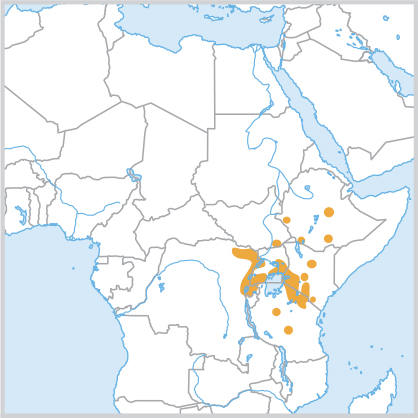
Elapsoidea loveridgei
Natural History: Terrestrial and fairly slow-moving. It is nocturnal, emerging at dusk; individuals hide in holes or under ground cover during the day. It is believed to spend much of its active time in holes, but will prowl on the surface at night, especially on damp nights after rain, which acts as an activity trigger. A number were found dead on the road just south of Nairobi in December following a heavy, unseasonable storm the previous night. It may emerge in the day; a Nairobi specimen was crawling through the grass in the afternoon, following a rainstorm. This species is inoffensive; many specimens will not attempt to bite when handled gently, but if molested may flatten and inflate the body, showing the bands prominently, and may lift the front half of the body off the ground and jerk from side to side. If restrained it may try to bite. It lays 2–6 eggs; a Ugandan female was gravid in September; hatchlings were collected in Nairobi in April, May and July. The diet includes small snakes, lizards, frogs, reptile eggs and rodents; a beetle larva and a centipede have also been recorded. A captive specimen bitten by a large Black-necked Spitting Cobra (Naja nigricollis) survived despite internal bleeding.
Medical Significance: A snake with a large range that lives in a well-populated area with lots of agriculture, so liable to be trodden on. A bite in Nairobi caused local pain, which became intense when the bitten limb was moved, as well as swelling and pain in the lymph nodes; another bite was described as causing intense local tingling pain.
East African Garter Snake, Elapsoidea loveridgei.
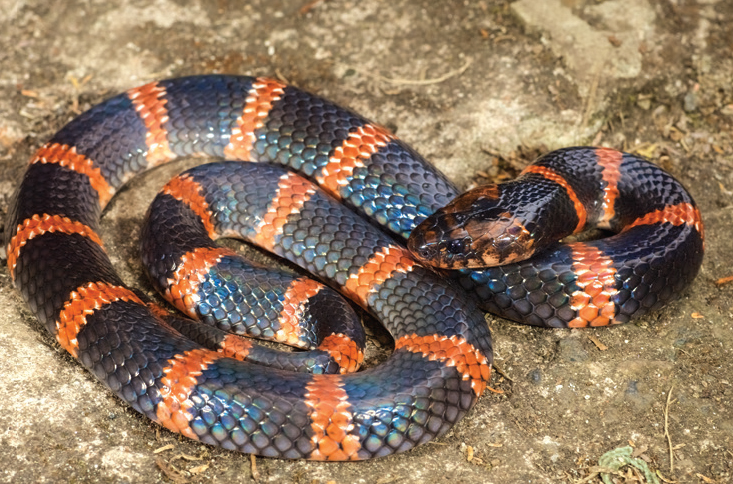
Tanzania (Michele Menegon).
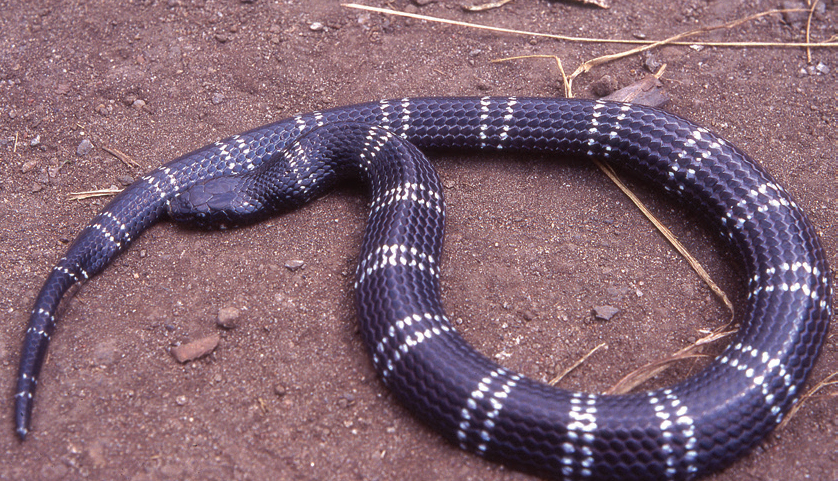
Tanzania (Stephen Spawls).
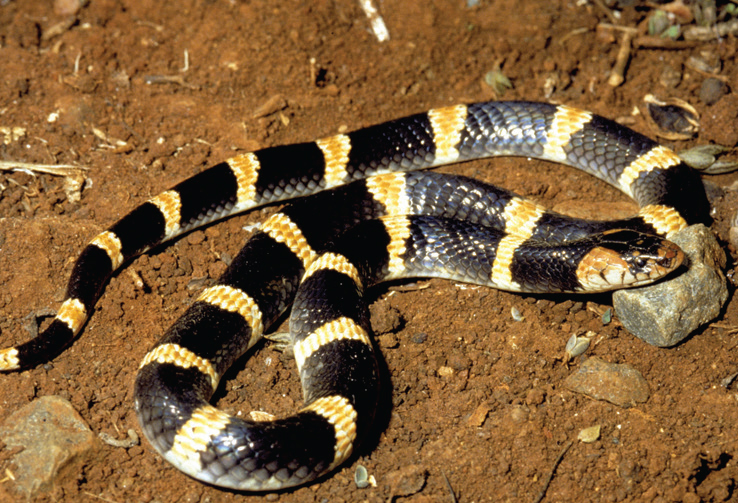
Kenya (Konrad Mebert).
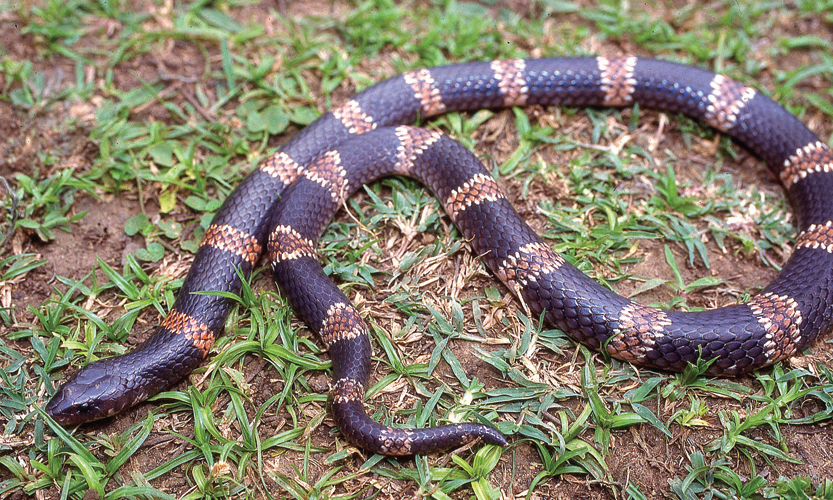
Tanzania (Stephen Spawls).
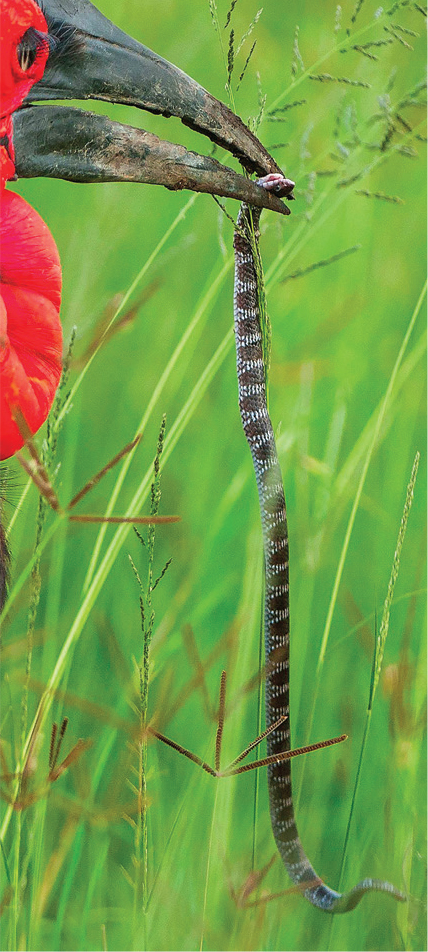
Tanzania (Mike McLaren).
Usambara Garter Snake Elapsoidea nigra
Identification: A small, glossy snake with a short, blunt head, and eyes that are set well forward, with a yellow iris and round pupils. The body is cylindrical and the tail short, 5–7% of total length. The scales are smooth; in 13 rows at midbody; 151–169 ventrals; 13–24 paired subcaudals (males usually more than 18, females fewer than 18). Maximum size about 60cm, average 30–50cm; hatchling size unknown. Juveniles are beautiful, with an orange head and the first three or four body bands orange with black in between; the rest of the bands are grey with white edging. There is a total of 18–24 bands on the body and 2–3 on the tail; the bands are the same width as the spaces between. The pale bands darken as the snake grows, so that adults simply show a series of thin white bands, where the white-edged scales that marked their outer edges are all that remain; in some individuals the bands seem to disappear. However, if a uniformly dark adult is molested, it inflates the body, exposing the concealed white scale tips.
Habitat and Distribution: An East African endemic. Mostly in high evergreen forest, but possibly in moist savanna as well, at 200–1,900m. It is confined to north-east Tanzania and extreme south-east Kenya; it is known from the Shimba Hills in Kenya, and Tanga, the North Pare Mountains, and the Usambara, Nguru and Uluguru Mountains in Tanzania. It is at conservation risk as it inhabits a restricted area of forest, but it might cope with deforestation.
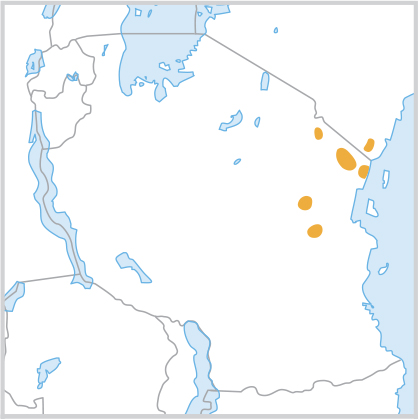
Elapsoidea nigra
Natural History: Poorly known. It is terrestrial, slow-moving and burrowing, living and hunting in holes, soft soil and leaf litter, and taking shelter in vegetation, rotten logs and under rocks, etc. It is sometimes active in the day following storms, but mostly hunts at night, emerging at dusk, especially on damp nights after rain; it is sometimes active in the dry season. This snake is inoffensive and gentle, but if molested it hisses, flattens the body and lashes about, sometimes raising coils off the ground. It is likely to bite only if restrained forcibly. Females lay 2–5 eggs, roughly 10 × 40mm; females with eggs in their oviducts have been captured mostly between October and December. This species eats mostly, or perhaps exclusively, caecilians (legless, worm-like amphibians).
Medical Significance: Nothing is known of its venom. Its tiny range and presumably typical garter snake venom indicate it is of no real medical significance, although within its range many people don’t have closed shoes and are liable to tread on it at night in the rainy season.
Usambara Garter Snake, Elapsoidea nigra.
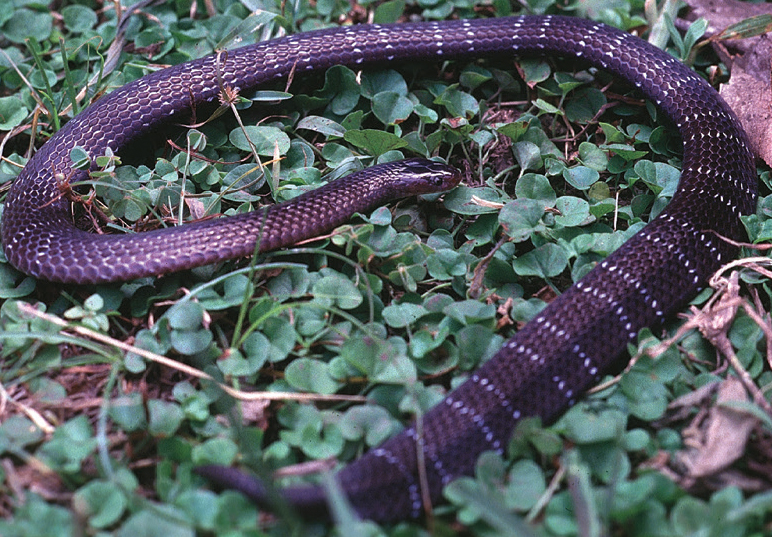
Tanzania (Lorenzo Vinciguerra).
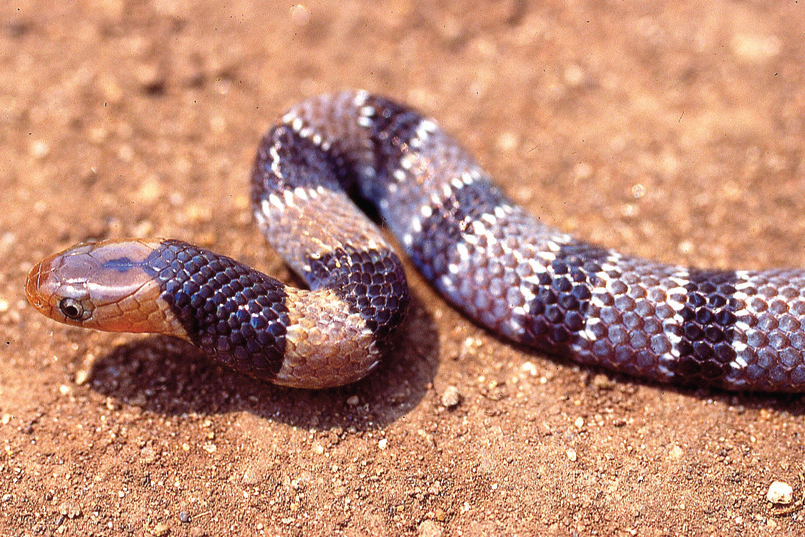
Tanzania (Stephen Spawls).
Half-banded Garter Snake Elapsoidea semiannulata
Identification: The only garter snake in most of West Africa. A small, glossy snake, neither fat nor thin, with a short head and eyes set well forward, these with round pupils. The body is cylindrical and the tail fairly short. The scales are smooth; in 13 rows at midbody. There are two subspecies: in the Northern Half-banded Garter Snake (Elapsoidea semiannulata moebiusi) the ventrals number 148–167 and subcaudals 15–28; in the Southern Half-banded Garter Snake (E. s. semiannulata) the ventrals number 136–151 and subcaudals 13–28. Maximum size about 70cm in the northern form and 60cm in the southern form; average 30–50cm; hatchlings 14–16cm. Juveniles are vividly marked with 10–21 narrow white or yellow bands on the grey or black body. The white bands are half, or less than, the thickness of the black interspaces. When the snake reaches a length of 20cm or so the bands become grey in the centre and then darken, until all that is left are pairs of fine white lines; in large adults these lines may disappear. The underside is white, or brown in some Angolan animals.
Habitat and Distribution: In moist and dry savanna, even semi-desert, and enters forest clearings and forest fringes in Central Africa. In south-central Africa it is mostly in savanna and woodland, but is also known from grassland. It is most common at low altitude, between sea level and 1,800m. The northern subspecies occurs across the West African savanna from Senegal and extreme southern Mauritania east to Central African Republic and South Sudan, and south into northern Republic of the Congo, DR Congo and Gabon; the southern form is in Angola, Namibia, northern Botswana and western Zambia. There are isolated records from eastern DR Congo and northern Republic of the Congo.
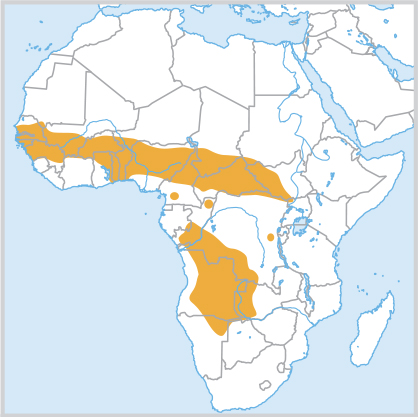
Elapsoidea semiannulata
Natural History: Terrestrial and fairly slow-moving. This species is nocturnal, emerging at dusk. It hides in holes or under ground cover during the day, and is believed to spend much of its active time crawling about in holes, but will prowl on the surface at night, especially on damp nights after rain, and is sometimes active in the dry season. It is totally inoffensive, and many specimens will let themselves be handled freely, making no attempt to bite. However, if teased or molested it may flatten and inflate the body, showing the bands prominently, and may lift the front half of the body off the ground and jerk from side to side. It is likely to bite only if restrained. Females lay 2–8 eggs. In West Africa juveniles appear in January, indicating dry season hatching. The diet includes small snakes (it has been recorded eating burrowing asps, Atractaspis, in West Africa), smooth-bodied and burrowing lizards, worm lizards (amphisbaenids) and reptile eggs; it is also known to take frogs, including species with poisonous skin secretions, and termites. It probably also eats rodents.
Medical Significance: A snake with a large range that lives in a well-populated area with lots of agriculture, but no bite cases are documented. No antivenom is available and it should not be necessary; treat symptomatically.
Half-banded Garter Snake, Elapsoidea semiannulata.
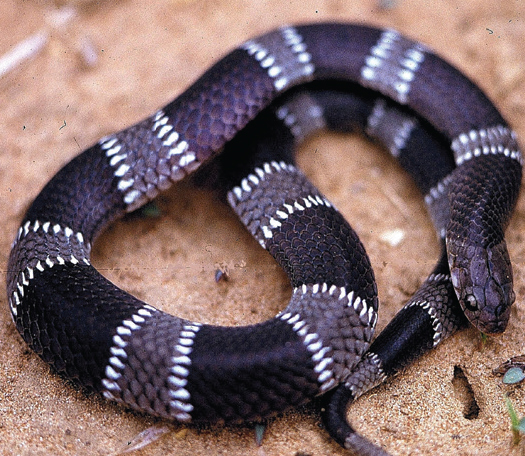
Ivory Coast (Mark-Oliver Rödel).
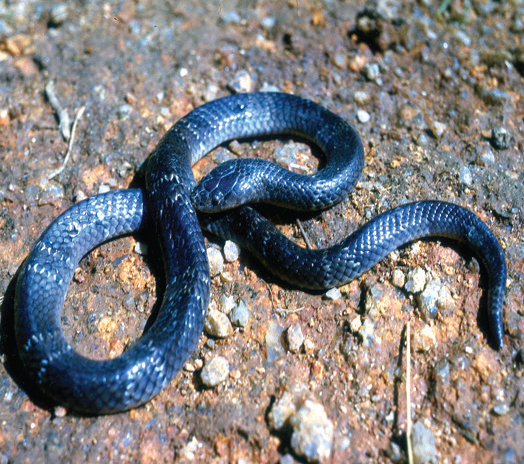
Nigeria (Gerald Dunger).
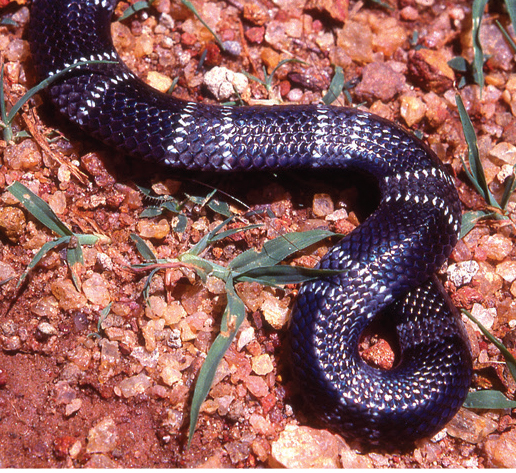
Adult flattening coils and hiding head (Stephen Spawls).
Identification: A very variable garter snake of southern Africa, with five known subspecies. It is quite a large snake; one subspecies reaches 1m, another 1.4m. The head is short and the eyes are set well forward, with round pupils. The body is cylindrical and the scales smooth; in 13 rows at midbody; ventrals 152–181; subcaudals 13–33. The juveniles (all subspecies) are strongly marked with almost equal-sized light and dark bands, the light bands being cream, rufous or pinkish, or occasionally quite red, and the dark bands black or chocolate brown, often with the dark neck band extending forward to form an arrow shape on the head. Only in adults of Sundevall’s Garter Snake (Elapsoidea sundevalli sundevalli) are the bands usually visible; the other four subspecies tend to lose all trace of banding early. The maximum size, number of bands and adult colouration for the five subspecies are as follows: Sundevall’s Garter Snake (E. s. sundevalli), 1m, 21–38 bands, these darkening centrally, leaving only the white outer scales (occasionally they disappear, leaving uniform grey adults), and the upper lips may be yellow. Kalahari Garter Snake (E. s. fitzsimonsi), 76cm, 20–24 bands, belly and lowest row of scales on the flanks white, the bands usually disappearing when the snake gets to about 35cm, adults slaty-grey with a white belly. Highveld Garter Snake (E. s. media), 63cm, 18–26 bands, these fading in specimens over 32cm to pairs of fine white lines or disappearing, leaving uniform dark brown or grey adults with a paler belly. Long-tailed Garter Snake (E. s. longicauda), 1.38m (the largest form in the genus), 19–23 bands, these disappearing when the snake reaches 33–45cm, adults black or grey, with a pale belly and upper lip scales. De Coster’s Garter Snake (E. s. decosteri), 74cm, 22–26 bands, these darkening gradually to pairs of pale white lines and disappearing when the snake reaches around 30cm, leaving a grey snake with a white belly.
Habitat and Distribution: Endemic to southern Africa. This species has radiated to occupy a wide range of habitats, from coastal woodland and dune thicket to high-altitude grassland and the slopes of the Drakensberg Mountains, moist and dry savanna, semi-desert and rocky hill country, from sea level to 1,600m. The different subspecies may be usefully identified by their locality. Sundevall’s Garter Snake occurs in southern and western Kwazulu-Natal, south-west Eswatini (Swaziland), south-east Mpumalanga and possibly the extreme Eastern Cape. The Highveld Garter Snake occurs from the west of the Northern Cape through the Free State to northern North West Province, most of Gauteng, and northern Mpumalanga and southern Limpopo. The Kalahari Garter Snake occurs in central and western Botswana and north-central Namibia. The Long-tailed Garter Snake is found in northern Limpopo, south-west Zimbabwe and southern Mozambique. De Coster’s Garter Snake occurs in north-west Eswatini, extreme southern Mozambique and northern Kwazulu-Natal.
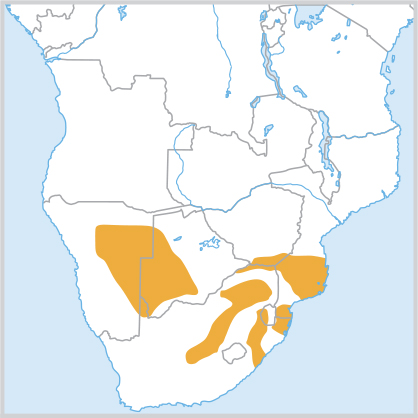
Elapsoidea sundevalli
Natural History: A fairly slow-moving, nocturnal terrestrial snake. It hides in holes, under ground cover, in termitaria or in logs during the day, and is believed to spend much of its active time crawling about in holes, but will prowl on the surface at night, especially on damp nights after rain. It is sometimes active in the dry season. This species is totally inoffensive, and many specimens will let themselves be handled freely, making no attempt to bite. However, if teased or molested it may flatten and inflate the body, showing the bands prominently, and may lift the front half of the body off the ground and jerk from side to side. It is likely to bite only if restrained. Clutches of up to 10 eggs have been recorded, roughly 20 × 10mm. Its prey includes snakes, lizards and amphibians. One Long-tailed Garter Snake had eaten a golden mole; Sundevall’s Garter Snake appears to eat mainly lizard eggs, but occasionally takes amphibians.
Medical Significance: Nothing known, though its venom is presumably a neurotoxin of the elapid type. A few bite cases have been recorded. One victim suffered only local swelling and slight pain that resolved in two days. Neurological symptoms were absent. Other victims have suffered nausea, vertigo, vomiting, weakness and swelling at the bite site; most symptoms resolved over four days. No antivenom is available. Treat conservatively by painkillers, elevation of the bitten limb and antibiotic cover. A bite from an adult Long-tailed Garter Snake might require medical intervention, as it is a large snake.
Sundavell’s Garter Snake, Elapsoidea sundevalli sundevalli.
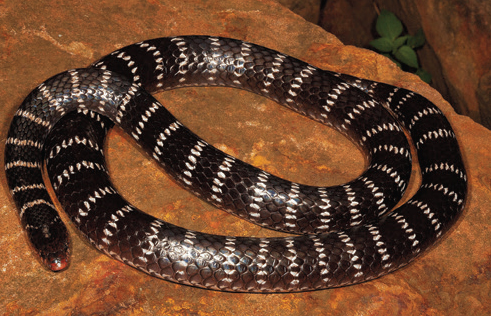
Adult, South Africa (Johan Marais).
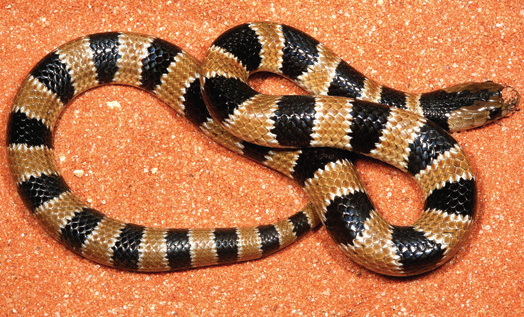
Juvenile, South Africa (Johan Marais).
Kalahari Garter Snake, Elapsoidea sundevalli fitzsimonsi.
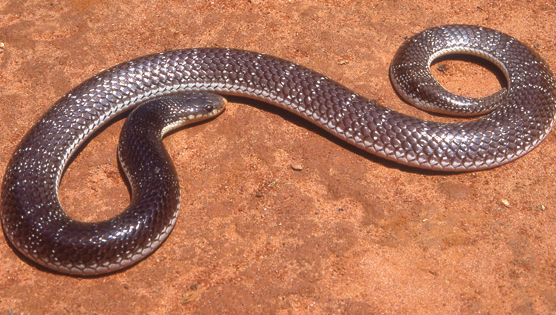
Botswana (Stephen Spawls).
Highveld Garter Snake, Elapsoidea sundevalli media.
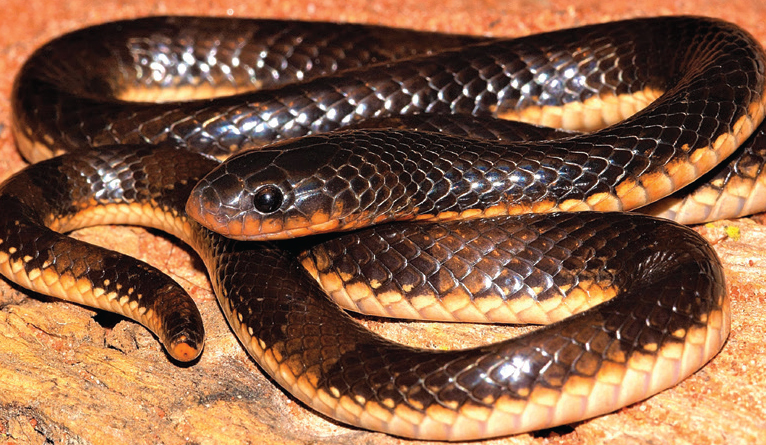
South Africa (Bill Branch).
Long-tailed Garter Snake, Elapsoidea sundevalli longicauda.
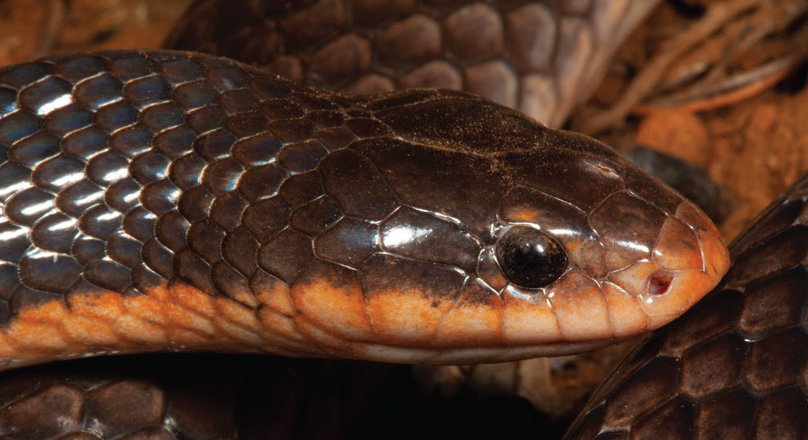
South Africa (Johan Marais).
De Coster’s Garter Snake, Elapsoidea sundevalli decosteri.
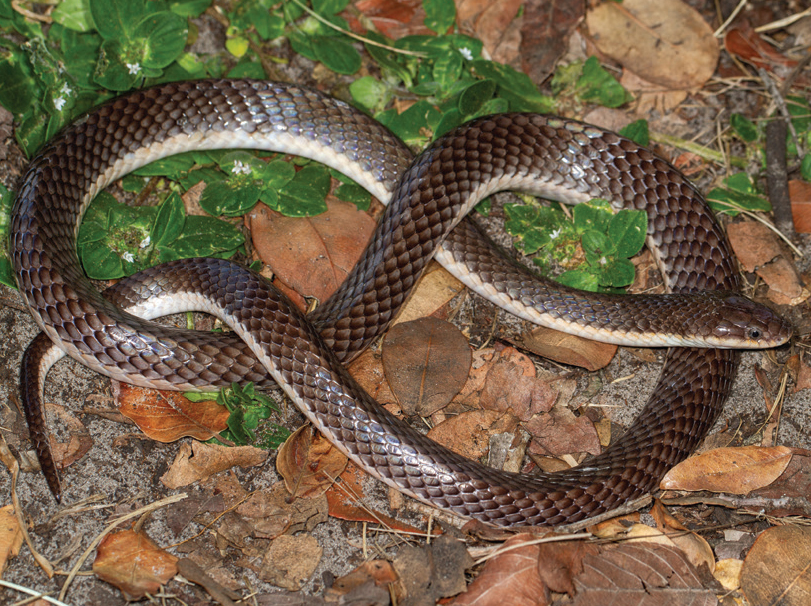
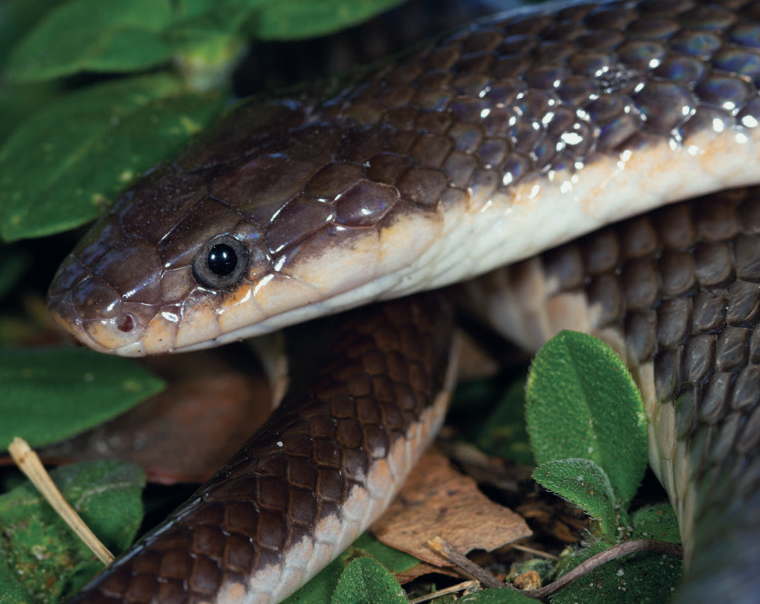
South Africa (Tyrone Ping).
Trape’s Garter Snake Elapsoidea trapei
Identification: A small, glossy snake, described in 1999 from Senegal and nearby areas in West Africa. The head is short, slightly broader than the neck, and the eyes set well forward, with round pupils. The body is cylindrical and the tail very short. The scales are smooth; in 13 rows at midbody; ventrals 155–170; subcaudals 18–27. Maximum size about 68cm, average 25–60cm; hatchling size unknown, but probably around 15cm. The colour is black, with or without white or grey-white cross-bars or bands. Juveniles are strongly banded black and white. This species differs from the northern subspecies of the Half-Banded Garter Snake (Elapsoidea semiannulata moebiusi) in that the ventral colouration is always grey-black, and from other garter snakes in possessing six upper labials; all the rest have seven.
Habitat and Distribution: In moist and dry savanna, at low altitude. It is known from Dakar in Senegal, eastern Senegal and extreme southern Mauritania, and is probably also in north-west Guinea.
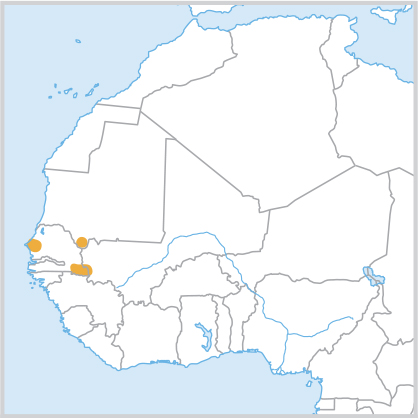
Elapsoidea trapei
Natural History: Unknown. It is presumably similar to other garter snakes (i.e. lives on the ground or in holes, is nocturnal and lays eggs). The diet is known to include snakes, lizards and centipedes.
Medical Significance: Its small range (at present) and presumably typical garter snake venom indicate it is of no real medical significance, although within its range many people don’t have closed shoes and are liable to tread on it at night in the rainy season.
Trape’s Garter Snake, Elapsoidea trapei.
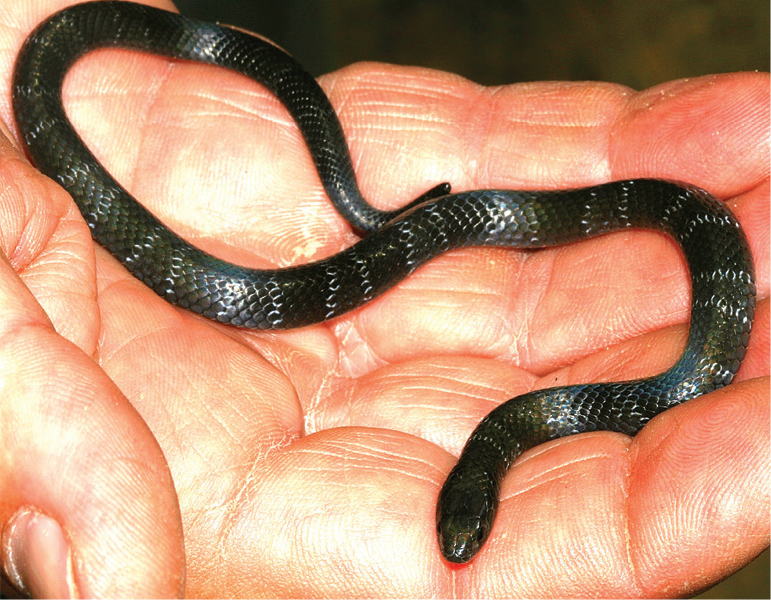
Senegal (Wolfgang Wuster).
Famous for their ability to spread a hood, and worshipped and feared in the ancient kingdoms of Egypt, the true cobras are a genus of over 30 species of highly venomous and medically significant snakes, some very large, found in Africa and Asia. For a long time, only four species were known from Africa: the Cape Cobra (Naja nivea), Black-necked Spitting Cobra (N. nigricollis), Egyptian Cobra (N. haje) and Forest Cobra (N. melanoleuca). Two water cobras (Boulengerina) and a Burrowing Cobra (Paranaja) were also known. However, ongoing taxonomic work, greatly aided by analysis of their DNA, has dramatically split the genus. As well as showing that Boulengerina and Paranaja belong in Naja, there are now seven species of spitting cobra, and the Egyptian Cobra has been split into five species (four in Africa) and the Forest Cobra into five; only the Cape Cobra has not been broken up. More splits may be on the cards.
The cobras are a major snakebite hazard in Africa. No matter where you travel in Africa (except true desert and some highland areas over 2,400m), you will find at least one species of cobra, and often more. Due to their secretive behaviour and nocturnal habits, cobras often persist in urbanised areas. They are active on the ground at night. Many are large, are willing to bite if they feel threatened, and deliver a large dose of venom. The spitting cobras have a cytotoxic venom that has hideous long-term local necrotic effects, often leading to complications that greatly reduce the quality of life, and may lead to death; see our comments in the introduction to the group (‘the spitting cobra clade’,). They are also quick to defend themselves by spitting venom, which, if it lands in the eyes, is horribly painful, and if untreated can lead to long-term damage and blindness. The non-spitting cobras (Egyptian cobra complex, Cape Cobra and forest cobra complex) largely have a potent neurotoxic venom that can kill quickly. Necrosis is rare but there may be some swelling. Classic neurotoxic symptoms may appear as early as 30 minutes after the bite and can evolve to fatal respiratory paralysis within 2–16 hours. Symptomology often starts with ptosis, double vision, then weakness of the muscles controlled by the cranial nerves. The victim cannot open the mouth, stick out the tongue, clench the jaws, swallow, protect the airway from secretions or flex the neck, and eventually cannot breathe.
A bite from a cobra is a medical emergency and victims should be transported rapidly to hospital, particularly if the bite is from one of the Egyptian or forest cobras. As with the Black Mamba (Dendroaspis polylepis), a bite from a forest or Egyptian cobra is one situation where immobilisation therapy using a local pressure pad (see Figures 48–50, here) and artificial respiration may be life-saving as the victim is transported to hospital.
Identification of cobras to species level is often possible; look at our pictures. The locality gives clues (there are rarely more than two or three species in an area), and if the snake is seen clearly, the size, colour and the patterns/bands on the neck will help. Take a photograph if it can be done safely. We have provided a technical key, although this can really only be used with a dead snake.
Key to the genus Naja, true cobras
Note: although we are fairly confident with this key, some black specimens of Naja melanoleuca and Naja subfulva from Central Africa (see couplet 13) are virtually impossible to distinguish, even in the laboratory.
1aFewer than 40 subcaudal scales; does not spread a hood……Naja multifasciata, Burrowing Cobra
1bMore than 40 subcaudals; spreads a hood when threatened……2
2aDorsal scales from spine down to ventral scales in an oblique but straight line; always associated with watercourses in Central Africa……3
2bDorsal scales from spine down to ventral scales change direction, curving or kinking on the lower flanks; not necessarily associated with watercourses in Central Africa……4
3aMidbody scale rows 21–25; where present, bands black on brown……Naja annulata, Banded Water Cobra
3bMidbody scale rows 17; bands yellow on dark brown or black……Naja christyi, Congo Water Cobra
4aUpper labials separated from the eye by subocular scales……5
4bAt least one upper labial in contact with the eye……8
5aDorsal scales usually in 25–27 rows on the neck and 21–23 at midbody; found only in West African savannas between northwest Nigeria and Senegal……Naja senegalensis, Senegal Cobra
5bDorsal scales usually in 23 or fewer rows on the neck and 21 or fewer at midbody; largely not in West African savannas between north-west Nigeria and Senegal……6
6aDorsal scales usually in 21–23 scale rows on the neck and 21 (sometimes 19) at mid-body; always north of 10°S……Naja haje, Egyptian Cobra
6bDorsal scales usually in 14–21 scale rows on the neck and usually 15–19 at midbody; always south of 10°S……7
7aDorsal scale rows usually 19 at midbody; on the eastern side of southern Africa…… Naja annulifera, Snouted Cobra
7bDorsal scale rows usually 17 at midbody; on the central and western side of southern Africa……Naja anchietae, Anchieta’s Cobra
8aSixth upper labial largest and in contact with the postoculars; one anterior temporal; do not spit venom……9
8bSixth upper labial not the largest and not in contact with the postoculars; two or three anterior temporals; all capable of spitting venom……14
9aRostral scale about as broad as deep; dorsal colour usually shades of yellow or brown; upper labials never black-edged; always south of 18°S and west of 30°E, in southern Africa……Naja nivea, Cape Cobra
9bRostral scale much broader than deep; dorsal colour usually olive, brown, black or banded yellow and black; upper labials nearly always black-edged; always north of 18°S except in South Africa, where always east of 30°E……10
10aConfined to São Tomé Island; ventral scales mostly black……Naja peroescobari, São Tomé Forest Cobra
10bOn mainland Africa or adjacent islands; ventral scales not always mostly black……11
11aAlways strongly banded in black and yellow bands of almost equal width; in West African savannas from south-west Chad west to Senegal……Naja savannula, Banded Forest Cobra
11bNot banded black and yellow, or with fairly narrow yellow bands; mostly in forest and woodland outside of the West African savannas……12
12aDorsal colour black; in forest west of Benin; midbody scale rows usually 17, sometimes 19 ……Naja guineensis, West African Forest Cobra
12bDorsal colour brown or black; in forest, woodland and moist savanna east of central Ghana; midbody scale rows usually 19, range 17–21……13
13aDorsal colour always black; ventral banding usually extends over anterior third of the belly; posterior venter black; largely confined to Central African forest areas…… Naja melanoleuca, Central African Forest Cobra
13bDorsal colour brown or black above; ventral banding usually extends over 15–20% of belly, sometimes indistinct; remainder of venter sometimes light; widespread in forest, woodland, riverine forest and moist savanna in central, eastern and southern Africa……Naja subfulva, Eastern Forest Cobra
14aAdults usually less than 1.5m; dorsal surface of entire body usually brown, maroon, rufous, red, orange or yellow; unmarked dorsally except 1–3 dark rings on the neck (often faded in adults); always north of 5°S……15
14bAdults not necessarily less than 1.5m; dorsal surface usually black, brown, olive or grey; throat bars do not form rings; not always north of 5°S……17
15aConfined to West African savannas and semi-desert west of Cameroon; ventrals 160–195; no black ‘teardrop’ marking under eye……Naja katiensis, West African Brown Spitting Cobra
15bAll specimens (apart from those from Aïr Massif, Niger) always east of Cameroon and the eastern Chad–Niger border; ventrals 192–228; usually has a black ‘teardrop’ marking under eye……16
16aDorsal colour brown, maroon, grey or olive, with 2–3 bands on the neck; mostly in north-east Africa north of 10°N……Naja nubiae, Nubian Spitting Cobra
16bDorsal colour usually orange, pink or red, sometimes pinky-grey, red-brown, yellow or steel grey, with 1–2 bands on the neck; in eastern north-east Africa, south of 10°N…… Naja pallida, Red Spitting Cobra
17aNever black; underside yellow with a single broad, deep brown throat bar; never pink on the neck; reaches 2.7m in length…… Naja ashei, Ashe’s Spitting Cobra
17bDorsal colour brown, grey or black; never has a single brown, deep throat bar; usually less than 2m in length……18
18aMidbody scale rows 23–25 (rarely 21 or 27); dorsal colour grey, olive or brown; dorsal scales usually dark-edged; black throat bars almost never more than seven scales deep……Naja mossambica, Mozambique Spitting Cobra
18bMidbody scale rows 17–21 (rarely 23); dorsal colour grey, black, olive-brown or finely banded; dorsal scales not dark-edged; a black throat bar at least 12 scales deep almost always present……19
19aUsually numerous fine, zebra-like cross-bands on body and tail……Naja nigricincta nigricincta, Zebra Cobra
19bDorsum uniform, not finely banded……20
20aVentrals 175–219……Naja nigricollis, Black-necked Spitting Cobra
20bVentrals 221–228……Naja nigricincta woodi, South-western Black Spitting Cobra
The Egyptian Cobra was long regarded as a single species, but taxonomic work has revealed that there are five species in the group, with four in Africa: the ‘typical’ Egyptian Cobra (Naja haje), the Snouted Cobra (N. annulifera), Anchieta’s Cobra (N. anchietae) and, most recently, the Senegal Cobra (N. senegalensis). Extralimitally, an Arabian form is known, the Arabian Cobra (N. arabica). Whether the two southern African forms are truly two separate species or merely a cline is uncertain; intermediates exist and the exact identity of some Zambian specimens is debated.
Egyptian Cobra Naja haje
Identification: A large, thick-bodied cobra with a broad head, distinct from the neck, a fairly large eye and a round pupil. Members of the Egyptian cobra complex have a subocular scale row, separating the eye from the upper labials. The body is cylindrical and the tail fairly long, 15–18% of total length. The scales are smooth; in 21 (very occasionally 19) rows at midbody; ventrals 191–222; subcaudals paired, 53–68. Maximum size 2.5m (possibly larger), average 1.3–1.8m; hatchlings 25–30cm. The colour is astonishingly variable. Most often it is some shade of brown or tan, but may be black (especially in Morocco and parts of West Africa), rufous (upper Nile basin), red-brown, yellow or grey. It is usually light brown, yellow or cream underneath, often with a broad grey or brown throat bar, 8–20 scales deep, which is visible when the hood is spread. There are often irregular brown or yellow blotches and speckles on the neck, back and underside. Some brown specimens are patterned with yellow scales on the back, and the light ventral colour may extend onto the flanks in irregular blotches; some East African and Ethiopian snakes have light bands on the posterior body. Juveniles may be yellow, grey, orange or reddish, with a distinctive dark ring on the neck or a black head and neck, sometimes with a cream or yellow collar. Some juveniles have fine dark back bands; others have yellow bands, with a fine dark ring in the centre of the band.
Habitat and Distribution: Mostly in semi-desert, moist and dry savanna, woodland (never forest), grassland and agricultural lands. Around the Sahara it is not in true desert but instead in vegetated wadis, agriculture, etc. In some areas (e.g. the Ethiopian Rift Valley) it is common in degraded badlands. It is found from sea level to around 1,800m. This species occurs from Western Sahara eastwards across North Africa (although it is absent from the north Moroccan and Algerian coasts, and records are lacking for parts of Algeria) to Egypt, and southwards down the Nile. It then occurs westwards across the Sahel and savanna to at least Mali (records from further west are probably the Senegal Cobra, Naja senegalensis). Its range extends south into northern Uganda, south-central Kenya and northern Tanzania, and also into Eritrea, northern Somalia and the central Ethiopian Rift Valley. It is often uncommon, or curiously absent, from pockets in its range. It may have been displaced from some areas by more successful snakes, or it might be present and simply overlooked; in other restricted areas it can be surprisingly common.
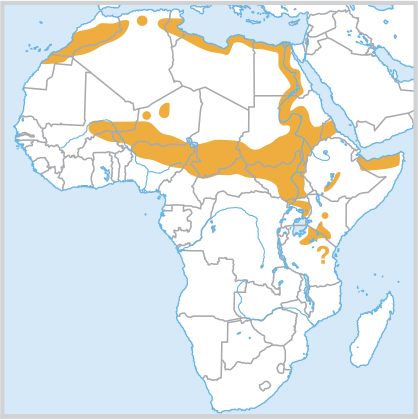
Naja haje
Natural History: Mostly terrestrial. Clumsy but quick-moving, it is active by day and night; it often basks in the day, but will hunt at any time. It often lives in termite holes, rock fissures, hollow trees or holes; in Kenya it is known to share its refuge with Black Mambas (Dendroaspis polylepis). It sometimes climbs trees. This snake is quick to rear up (usually only to 30cm or so, but sometimes it rears quite high) and spread a broad hood when threatened; if further provoked it will hiss loudly, rush and strike at the aggressor. It sometimes shams (feigns) death. Females lay up to 23 eggs, averaging 50–60 × 30–35mm; a Kenyan snake laid 23 eggs in early March, and these hatched at the end of May. This species eats a wide range of prey; it is fond of toads but will take eggs (a notorious chicken-run raider), small mammals and other snakes.
Medical Significance: This is a highly dangerous snake. It is large, and thus delivers a large dose of potent neurotoxic venom if it bites; it will rear up if molested and may cause a bite high up on the body. It is often found in agricultural areas; it raids domestic fowl runs, and may come around habitation looking for water or food. If it feels threatened it will try to bite from a short rush. Bites are reported from the Nile Valley and parts of the West African Sahel and savanna, although there are relatively few documented cases. In West Africa, this is a species favoured by snake charmers, as these snakes are alert and willing to remain reared up for a while; consequently the charmers (and members of their audiences) are often bitten. Recent work indicates that East African examples of this snake have an extremely toxic venom. Bites may cause some local swelling, but necrosis does not develop. Classic neurotoxic symptoms appear as early as 30 minutes after the bite and can evolve to the point of fatal respiratory paralysis within 2–16 hours.The neurotoxic venom causes progressive descending paralysis, starting with ptosis and paralysis of the neck and head muscles, and proceeding to paralysis of the lungs. A bite is a medical emergency and will probably need treatment with a respirator and antivenom in a well-equipped hospital. A bite from this snake is one situation where pressure bandaging, immobilisation therapy and artificial respiration may be of benefit as the victim is transported to hospital.
Taxonomic Notes: Some authorities regarded the Moroccan and Western Saharan populations of this snake as a separate subspecies, or even species, Naja (haje) legionis, but molecular analysis indicates that they cluster within the typical species, Naja haje.
Egyptian Cobra, Naja haje.
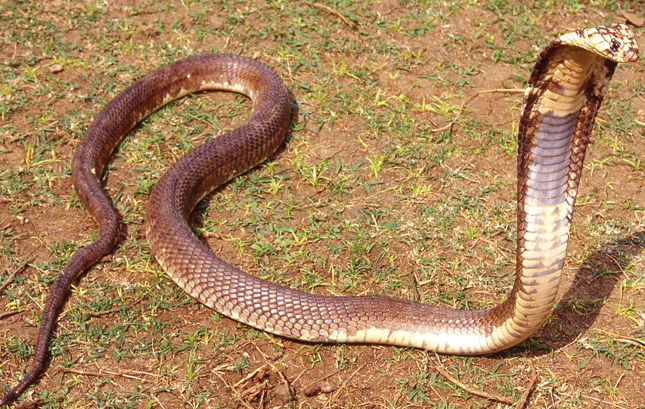
Kenya (Stephen Spawls).
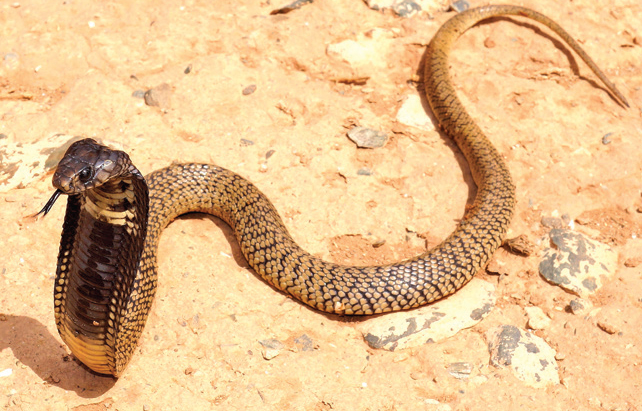
juvenile, Morocco (Konrad Mebert).
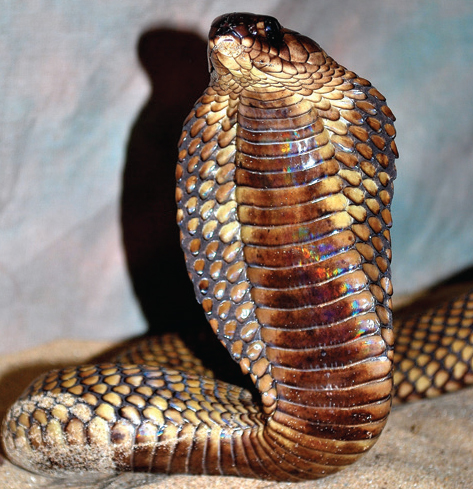
Uganda (Stephen Spawls).
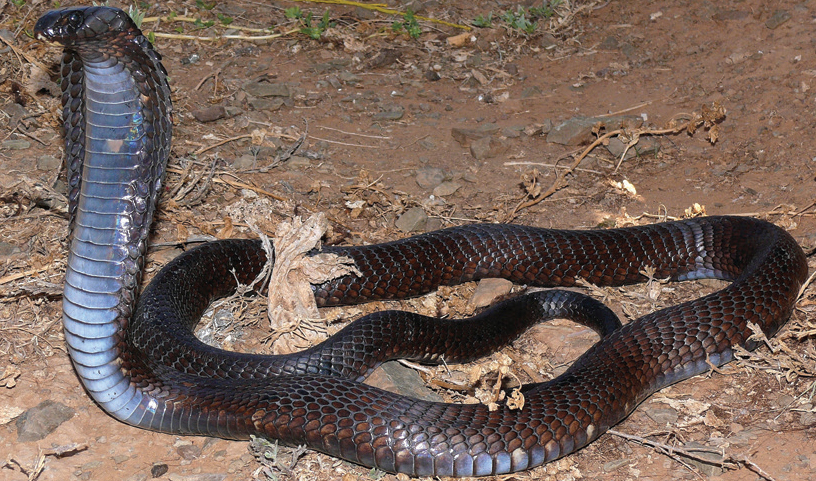
Morocco (Konrad Mebert).
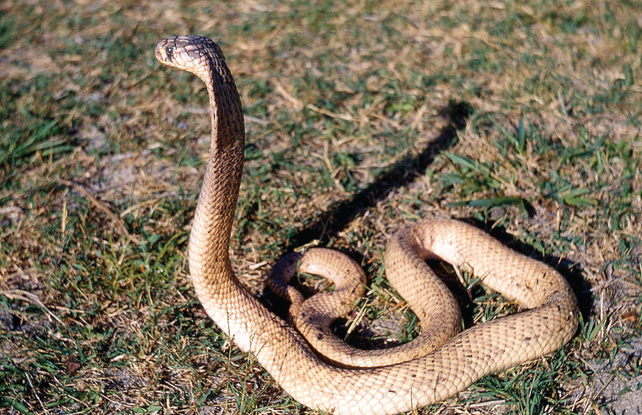
Nigeria (Gerald Dunger).
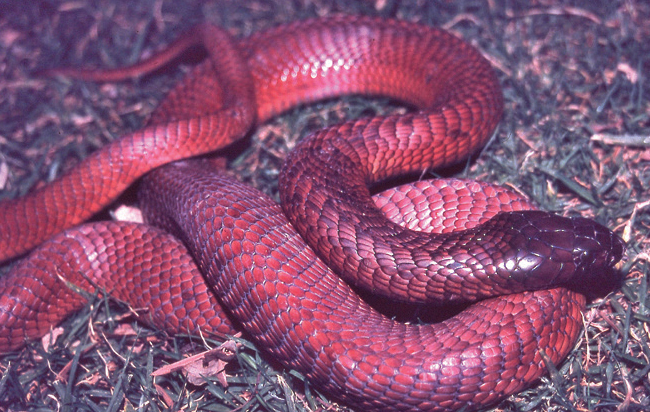
West Ethiopia (Stephen Spawls).
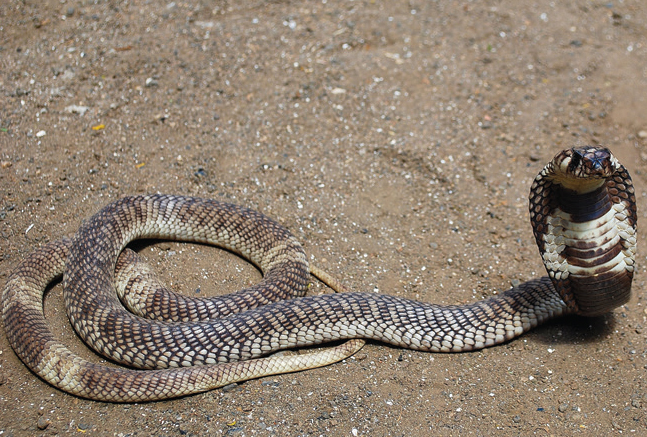
Tanzania (Stephen Spawls).
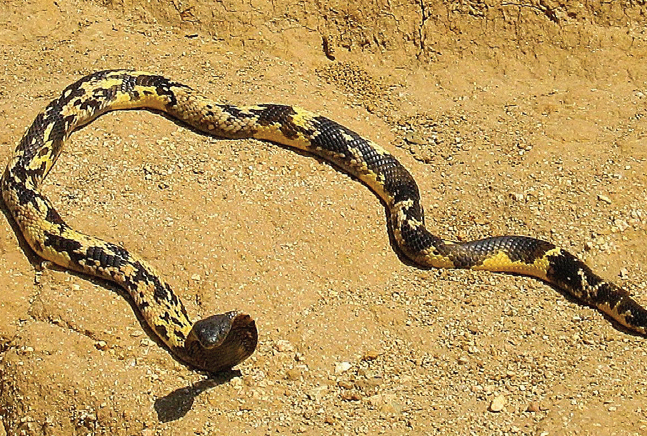
Eritrea (Tony Kamphorst).
Senegal Cobra Naja senegalensis
Identification: A recently described large, thick-bodied brown cobra, in the savanna of West Africa. The head is broad and distinct from the neck, the eye is fairly large with a round pupil, and a subocular scale separates the eye from the upper labials. The body is cylindrical and the tail fairly long, 15–19% of total length (usually longer in males). The scales are smooth; in 21 (very occasionally 23) rows at midbody and 25–27 rows on the neck (and thus it is distinguished from other members of the Egyptian cobra complex, which nearly always have 23 or fewer); ventrals 205–225; subcaudals 56–66. Maximum size 2.45m (possibly larger), average 1.3–1.8m; hatchlings probably 20–30cm. The colour is uniformly dark brown above, sometimes with light (yellow or reddish) speckling; the underside is yellow-brown, with darker speckling (especially towards the middle of the ventral scales), but the throat and neck are usually uniformly dark. The sides of the head are usually uniform brown, and this is a good field character. Juveniles are more grey to greyish brown, sometimes with faint fine cross-bars, and with a black head and neck; there is usually a distinctive pale mark on the nape and this occasionally persists in adults. The juvenile underside is unmarked (except the black head and neck barring).
Habitat and Distribution: In the Guinea and Sudan savanna of West Africa, between sea level and 600m. Local information indicates that in some areas it is often found near water sources; one was caught in a fisherman’s net. It occurs from south-western Niger, eastern Nigeria and northern Benin westwards to Senegal.
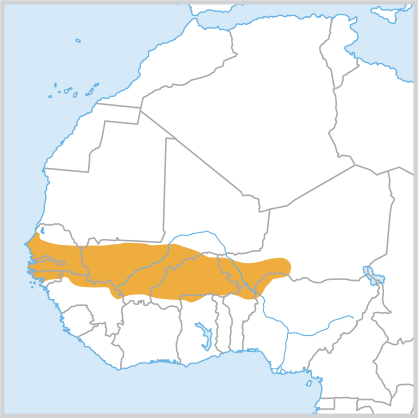
Naja senegalensis
Natural History: Presumably similar to the Egyptian Cobra (Naja haje); that is, terrestrial, quick-moving, active by day and night, and shelters in holes, rock fissures, hollow trees, etc. It presumably lays eggs. Known prey items include the Desert Toad (Sclerophrys xeros) and the Western Beaked Snake (Rhamphiophis oxyrhynchus); it probably takes a wide range of small vertebrates.
Medical Significance: Presumably similar to the Egyptian Cobra, so likely to be a major snakebite hazard within its range, being large and liable to deliver a dose of potent neurotoxic venom if molested. However, few bites are reported; a recent one from Nigeria showed a typical suite of neurotoxic symptoms. The neurotoxic venom probably causes progressive descending paralysis, starting with ptosis and paralysis of the neck and head muscles, and proceeding to paralysis of the lungs. A bite is a medical emergency and will probably need treatment with a respirator and antivenom in a well-equipped hospital. A bite from this snake is one situation where pressure pad immobilisation and artificial respiration may be life-saving as the victim is transported to hospital.
Senegal Cobra, Naja senegalensis.
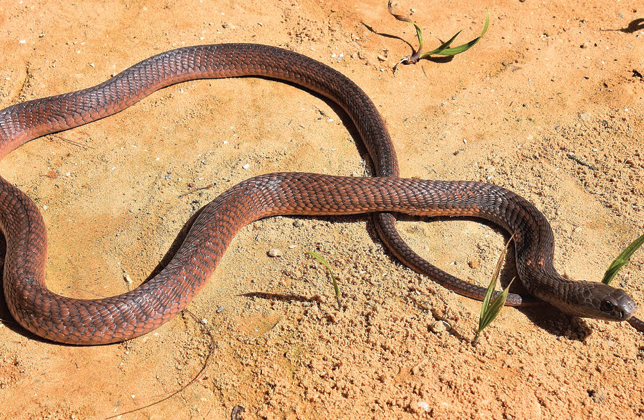
Senegal (Jean-Francois Trape).
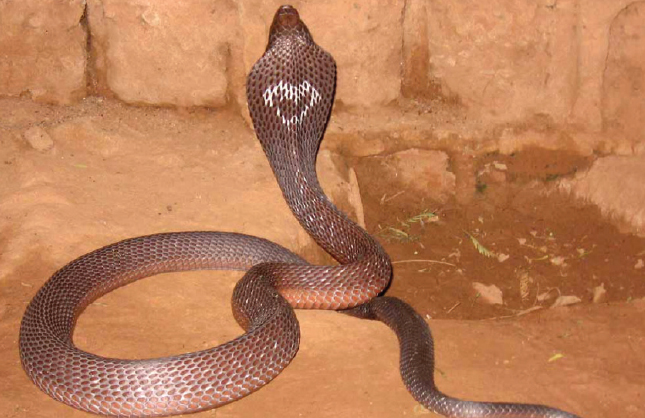
Senegal (Laurent Chirio).
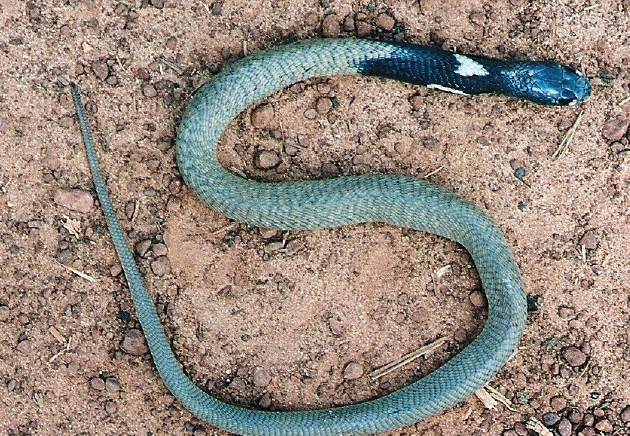
juvenile (Jean-Francois Trape).
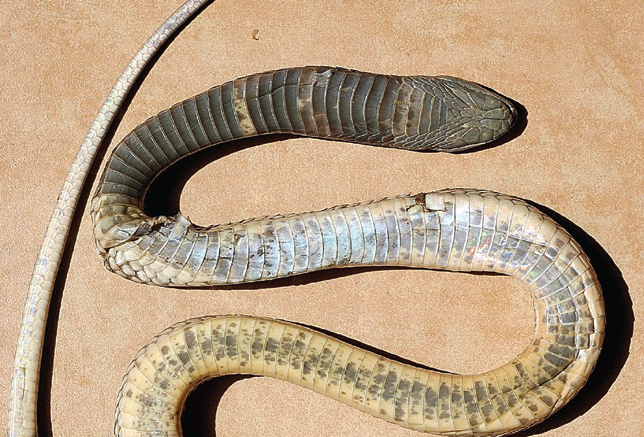
underside (Jean-Francois Trape).
Snouted Cobra Naja annulifera
Identification: A large brown, grey or banded cobra of the savannas of south-east Africa. The head is broad and distinct from the neck, the eye is fairly large with a round pupil, and a subocular scale separates the eye from the upper labials. The body is cylindrical and the tail fairly long, 14–18% of total length (usually longer in males). The scales are smooth; in 19 (very occasionally 21) rows at midbody; ventrals 175–208; subcaudals 50–67. Maximum size about 2.5m (possibly larger; anecdotal reports of 3m specimens exist), average 1.3–1.8m; hatchlings probably 22–34cm. The colour is usually shades of brown, rufous-brown, grey, tan or sometimes black. A banded morph, with brown and yellow bands, occurs throughout its range; the juveniles are unbanded but the adults develop bands at a length of 60cm or so. The underside is dull yellow, mottled or barred with dirty brown to a greater or larger extent.
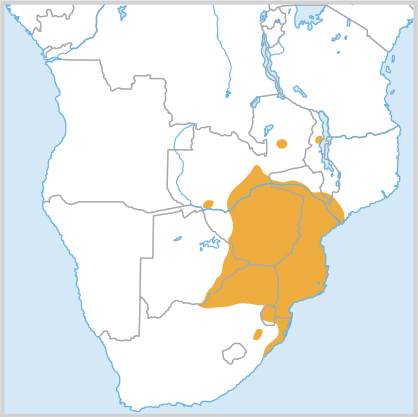
Naja annulifera
Habitat and Distribution: A snake of dry and moist savanna and woodland (‘bushveld’), between sea level and 1,600m. It occurs from central Zambia south through most of Zimbabwe, southern Malawi and the southern half of Mozambique to eastern Botswana and northern South Africa, as far south as parts of coastal Kwazulu-Natal. There are isolated northern records from Mpika in Zambia, Makuzi Lodge and Likoma Island in Malawi, and Livingstone in southern Zambia.
Natural History: A large terrestrial snake (although it will climb rocks), active by day and night – often by day in wild regions and by night in inhabited areas. It tends to have a permanent home in termite mounds, holes or rock fissures, where it may live for years if undisturbed. In the cooler months it often basks near its home, especially in the morning. It is relatively quick-moving and, although not aggressive, if confronted and unable to escape it will rear up fairly high and spread a broad hood; if further antagonised it may hiss loudly and rush forward to bite. Occasional individuals may sham (feign) death. This snake lays 8–33 eggs (roughly 30 × 50mm), in early summer in southern Africa. The diet is mostly small vertebrates, such as toads, birds, rodents and other snakes, including Puff Adders (Bitis arietans). It often raids chicken runs and can be a nuisance to poultry farmers.
Medical Significance: A dangerous snake; widespread in agricultural country, active by night and day and on the ground, will bite if inadvertently cornered, and rears up, so may deliver a bite high on the body. The neurotoxic venom causes progressive descending paralysis, starting with ptosis and paralysis of the neck and head muscles, and proceeding to paralysis of the respiratory muscles. A bite is a medical emergency and will probably need treatment with a respirator and antivenom in a well-equipped hospital. A bite from this snake is one situation where pressure pad immobilisation and artificial respiration may be life-saving as the victim is transported to hospital.
Taxonomic Notes: A member of the Egyptian cobra (Naja haje) complex, originally seen as a subspecies of that snake, but elevated to full species level by Don Broadley in 1995.
Snouted Cobra, Naja annulifera.
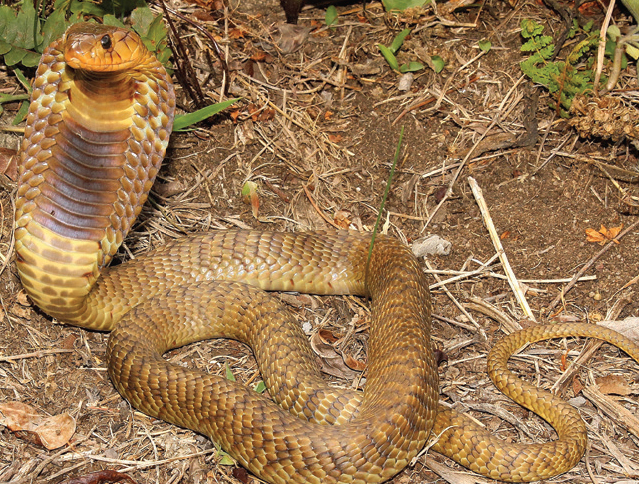
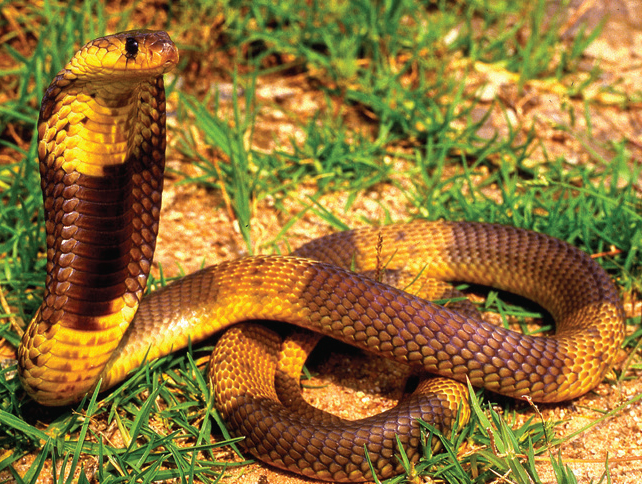
Eswatini (Swaziland) (Richard Boycott).
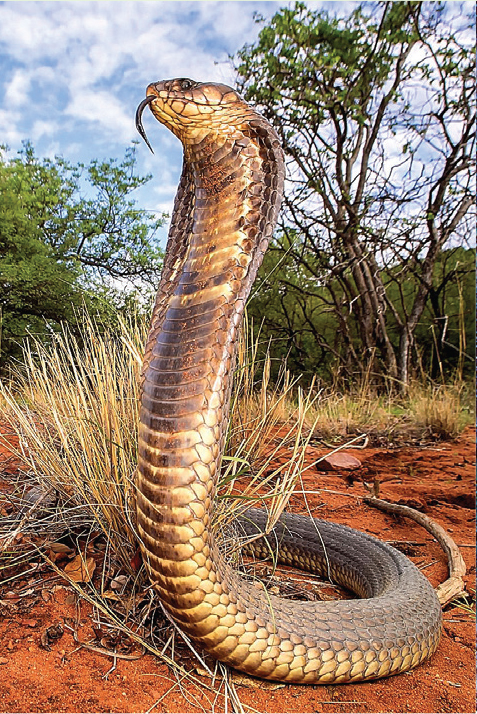
South Africa (Luke Verburgt).
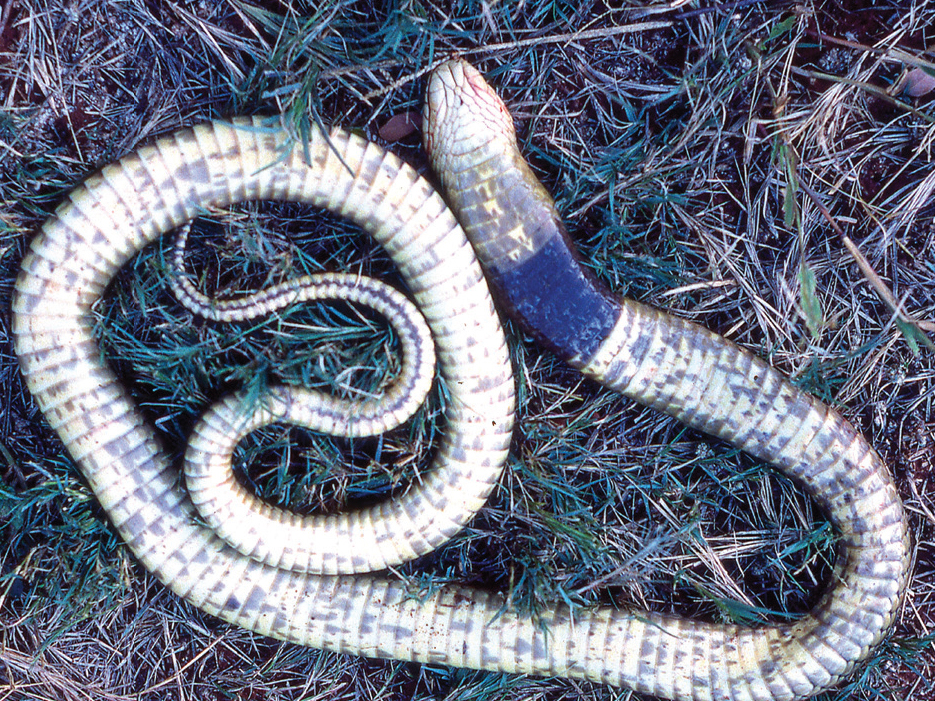
Botswana (Stephen Spawls).
Anchieta’s Cobra Naja anchietae
Identification: A large brown or banded cobra of the savannas of south-west Africa. The head is broad and distinct from the neck, the eye is fairly large with a round pupil, and a subocular scale separates the eye from the upper labials. The snout is quite noticeably pointed. The body is cylindrical and the tail fairly long, 15–19% of total length (usually longer in males). The scales are smooth; in 17 (very occasionally 15 or 19) rows at midbody; ventrals 171–200; subcaudals 49–66. Maximum size about 2.3m (possibly larger), average 1.3–1.8m; hatchlings probably 22–34cm. Both uniform and banded morphs occur. The uniform morph is usually grey or brown, although some individuals are purple-brown or almost black; juveniles are usually yellow or yellow-brown. The underside is a lighter cream, light grey, brown or tan, often with darker mottling that increases towards the tail. There is a deep, dark throat bar, which is conspicuous and forms a ring in juveniles, but fades in adults. The banded morph is yellow and brown; the yellow bands are usually narrower than the brown bands (but not always).
Habitat and Distribution: Semi-desert, dry and moist savanna and woodland, from sea level to about 1,600m, or possibly higher. It occurs from the northern Kalahari in Botswana and central Namibia, north into most of Angola and southwest Zambia. There are isolated records from the Lake Bangweulu area in Zambia and southern Haut-Katanga in DR Congo.
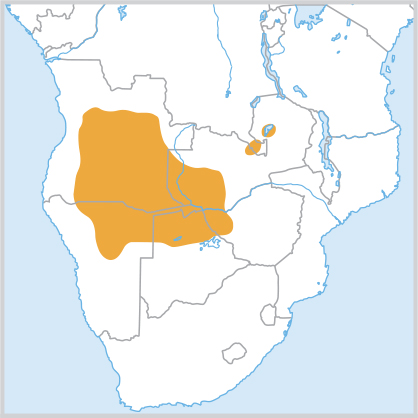
Naja anchietae
Natural History: Similar to the previous species. A large terrestrial snake (although it will climb rocks), active by day and night – often by day in wild regions and by night in inhabited areas. Juveniles seem to be more diurnal than adults. It is crepuscular at some times of the year. It tends to have a permanent home in termite mounds, holes or rock fissures, where it may live for years if undisturbed. In the cooler months it often basks near its home, especially in the morning. It tends to be more common in well-wooded areas and near water sources, but will venture into arid country. It is relatively quick-moving and, although not aggressive, if confronted and unable to escape it will rear up fairly high and spread a broad hood; if further antagonised it may hiss loudly and rush forward to bite. Occasional individuals may sham (feign) death. This species is reported as laying up to 60 eggs (roughly 30 × 50mm), in early summer in southern Africa. The diet is mostly small vertebrates, including toads, birds, rodents and other snakes. It often raids chicken runs and can be a nuisance to poultry farmers.
Medical Significance: A dangerous snake; active by night and day and on the ground, will bite if inadvertently cornered, and rears up, so may deliver a bite high on the body. The neurotoxic venom causes progressive descending paralysis, starting with ptosis and paralysis of the neck and head muscles, and proceeding to paralysis of the lungs. A bite is a medical emergency and will probably need treatment with a respirator and antivenom in a well-equipped hospital. A bite from this snake is one situation where pressure bandaging, immobilisation therapy and artificial respiration may be of benefit as the victim is transported to hospital.
Taxonomic Notes: A member of the Egyptian cobra (Naja haje) complex, originally seen as a subspecies of that snake, then as a subspecies of the Snouted Cobra (Naja annulifera); it was elevated to full species level in 2004.
Anchieta’s Cobra, Naja anchietae.
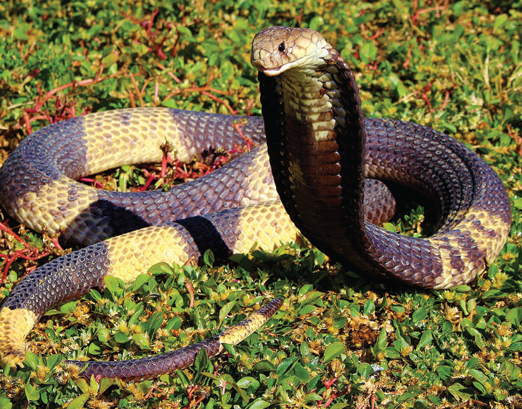
Namibia (Francois Theart).
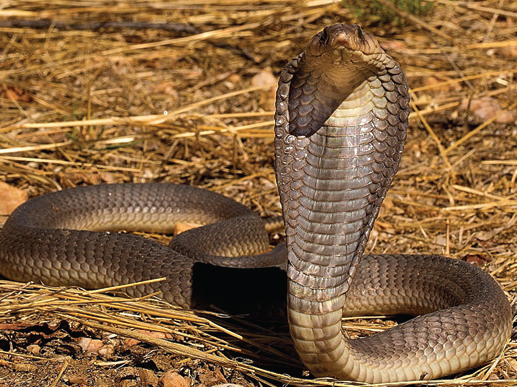
Namibia (Tyrone Ping).
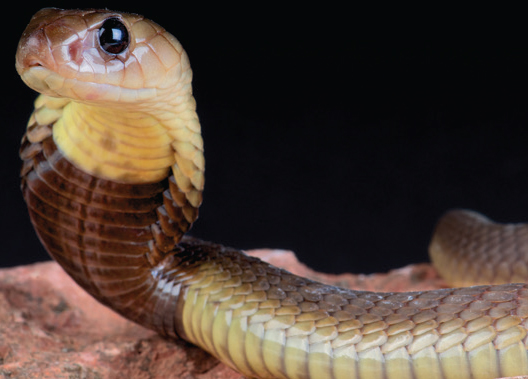
juvenile (Matthijs Kuijpers).
Cape Cobra Naja nivea
Identification: An attractive, alert cobra, often yellow or orange, endemic to the dry country of southwestern Africa. It has a broad head and medium-sized eye with a round pupil. The body is cylindrical and the tail is 14–17% of total length. The scales are smooth and glossy; in 19–21 rows at midbody; ventrals 193–227; subcaudals 50–68. The cloacal scale is undivided. Maximum size recorded 2.3m (an unusually large Western Cape specimen), average 1.2–1.5m; hatchlings 25–40cm. Several distinct colour forms exist: one is bright yellow above, sometimes orange or reddish; another is warm brown, often speckled with yellow; a third is pale brown or yellow-brown, heavily speckled both above and below with black; and a fourth is uniform shiny black. Other colour forms have also been described. Juveniles are yellow or reddish yellow, and usually have a broad black or brown neck band that fades with age.
Habitat and Distribution: Predominantly a snake of dry country, and the only cobra in much of South Africa. It occupies a variety of habitats, from sea level to highlands at 2,500m; it occurs in the fynbos and savanna (bushveld) of the Cape provinces, the high grasslands of the Free State, the semi-desert of the Kalahari in Botswana and the Karoo in the Cape, and the dry rocky hills and desert of Namibia. It is often found along dry riverbeds (dongas). Endemic to southern Africa, it occurs in extreme south-western Lesotho, throughout most of the western side of South Africa, north into the Kalahari in south-west and south-central Botswana, and north-west into north-western Namibia.
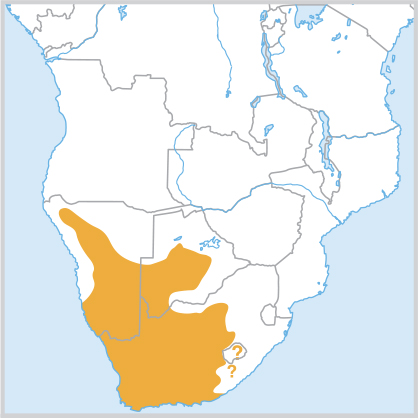
Naja nivea
Natural History: Terrestrial, but will climb trees and bushes; it is known to raid weaver bird nests in the Kalahari. It is almost entirely diurnal, emerging to bask for a while before foraging; it is occasionally crepuscular. When not active, it hides in holes, or sometimes under ground cover (brush, wood and rock piles, etc.), often remaining in the same retreat for some time. Sometimes more than one individual occupies the same refuge. It is very quick-moving and alert; it will spread a hood and look threatening at the least provocation, and if approached closely will strike without hesitation. It is also stated to be more aggressive and irritable in the mating season, during September and October. Females lay 8–20 eggs, roughly 60 × 30mm, in December–January, in a hole or termite hill or other warm, wet place. This species eats a wide variety of prey, including rodents, birds, lizards, amphibians and snakes (including young of its own kind); it will feed on dead snakes and its habit of climbing trees to get at the eggs and young of the Sociable Weaver (Philetairus socius) is well documented. It is often hounded and sometimes killed in defence by Meerkats (Suricata suricatta) and Yellow Mongooses (Cynictis penicillata) working collectively; these small mammals have a high resistance to its venom. Cape Cobras are widely but erroneously believed to drink milk from cows.
Medical Significance: Often relatively common in parts of its range and active by day in farming areas, and so a major snakebite hazard in southern Africa, both to humans and stock. In the Cape provinces this snake accounts for most human snakebite fatalities, due to the rapid onset of paralysis. It has a very potent neurotoxic venom, causing progressive descending paralysis, starting with ptosis and paralysis of the neck and head muscles, and proceeding to paralysis of the lungs. A bite is a medical emergency and will probably need treatment with a respirator and antivenom in a well-equipped hospital. A bite from this snake is one situation where pressure pad immobilisation and artificial respiration may be life-saving as the victim is transported to hospital. Antivenom is available.
Cape Cobra, Naja nivea.
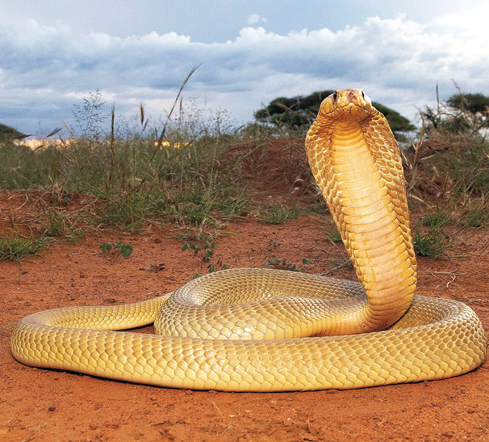
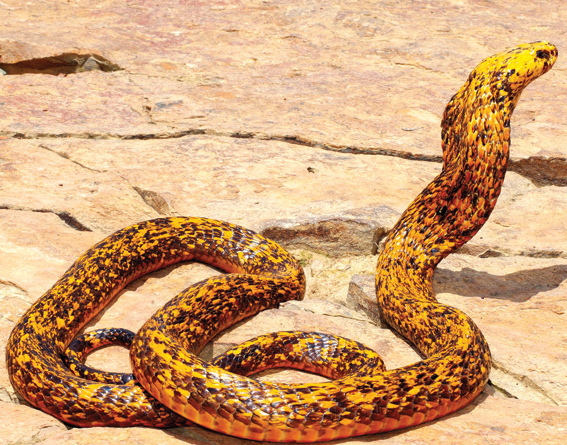
South Africa (Johan Marais).
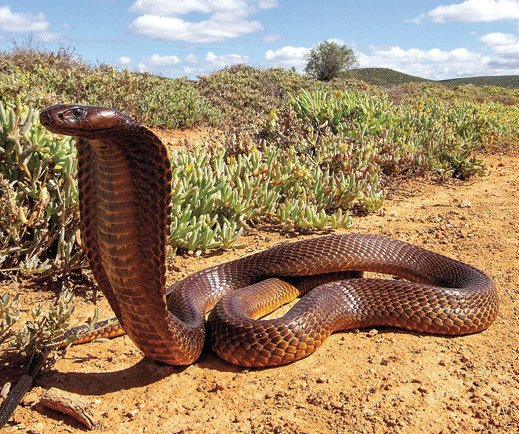
South Africa (Tyrone Ping).
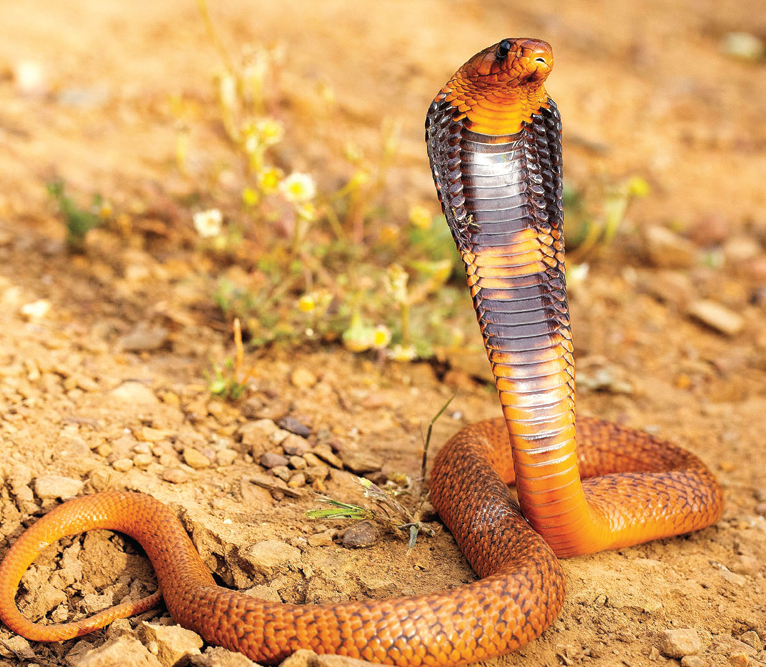
South Africa (Johan Marais).
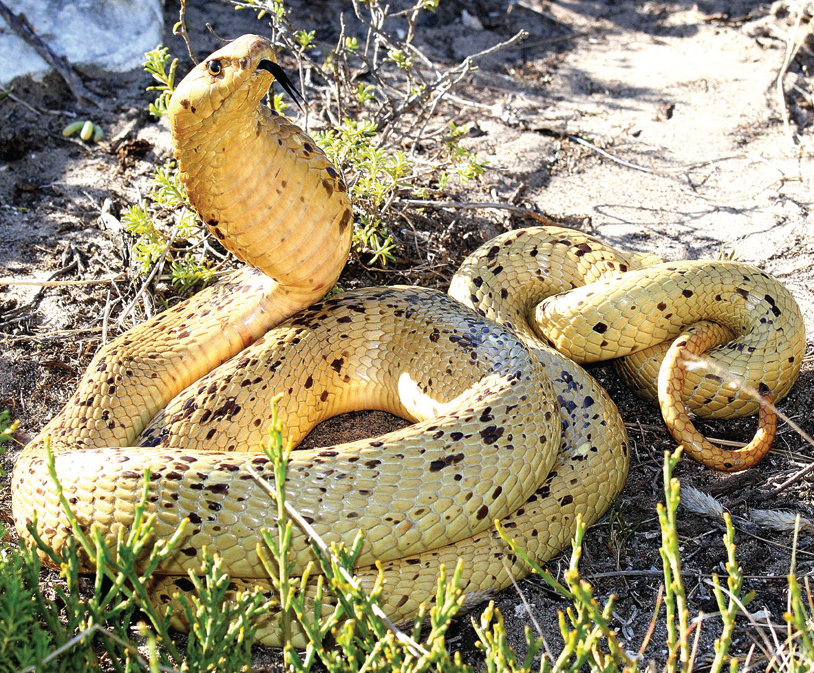
South Africa (Wolfgang Wuster).
This clade, elucidated by molecular analysis, now contains the Burrowing Cobra (Naja multifasciata, originally Paranaja), two water cobras (N. annulata and N. christyi, originally Boulengerina) and the true forest cobras, originally N. melanoleuca but now split into five species. The Burrowing Cobra and the water cobras are not very significant medically, as they rarely come into contact with humans. However, the forest cobras are another matter; see our notes on the forest cobra (N. melanoleuca) complex.
Burrowing Cobra Naja multifasciata
Identification: A small, stout cobra with high-contrast bars on the lips, from the forests of Central Africa. It doesn’t spread a hood. It has a short head and a fairly large eye with a round pupil. The sixth upper lip scale (upper labial) situated below and behind the eye is huge; the rostral is slightly prominent and it is speculated that it is used for digging. The body is cylindrical, and the tail is quite short and ends in a blunt spike. The scales are smooth and glossy; in 15 (rarely 17) rows at midbody; ventrals 150–175; subcaudals 30–39, paired. Maximum size probably about 80cm, usually 50–70cm; hatchling size unknown. Juveniles are distinctly marked, with the head black above and the snout cream and black. The upper lip scales are yellow or cream, heavily edged with black; the chin, throat and belly are cream; and the scales on the back are yellow or cream on the front half and black on the back half, so the snake appears finely barred black and yellow. Adults usually darken with age, those of 60cm or more becoming uniform dull brown or blackish, with the chin and throat yellow or yellow-brown, brownish below, and the upper lips black with dull brown blotches.
Habitat and Distribution: A snake of the great Central African forest, although work in Cameroon suggests it doesn’t occur in dense rainforest, but is found in clearings, swamps and forest–savanna mosaic. It is found between sea level and 1,500m. It occurs from southern Cameroon, Equatorial Guinea and Gabon eastwards across the forest to Bunyakiri, in South Kivu, DR Congo, not far west of the Rwandan border, and it might just extend into northern Angola (not recorded from Cabinda). It is suggested that it fills an ecological niche in the forest that is occupied in the savanna by the garter snakes (Elapsoidea) – that of a small, inoffensive, terrestrial elapid, albeit a rodent-eating one.
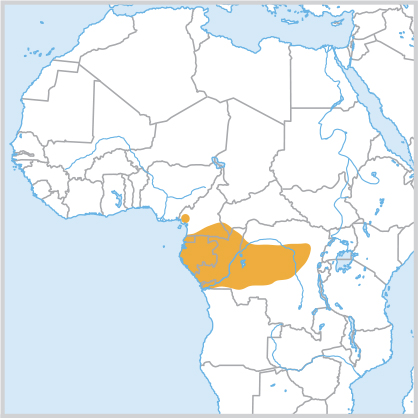
Naja multifasciata
Natural History: Little known. It is almost certainly terrestrial, and, despite the common name, burrowing behaviour is not yet reported. It moves fairly quickly and is probably diurnal, like most forest elapids. It presumably hides in holes, under ground cover or among leaf litter when inactive. A captive DR Congo specimen from South Kivu constantly tried to hide under debris in its cage, and pushed its snout into the earth. It was not aggressive and tried to bite only if restrained. A captive specimen maintained for a number of years in the UK was always calm and never tried to bite. When threatened, the DR Congo snake flattened itself to almost double its width, and raised its head in a cobra-like fashion, but without spreading a hood. It would take no prey other than small rodents; likewise, the UK captive ate only dead mice. This species might take amphibians. It presumably lays eggs, although no details are known.
Medical Significance: Unlikely to pose a threat to humans, being a small, secretive and apparently very rare species, although those who work in the forest are at risk. The venom is produced in very small amounts. However, a 12g mouse died one and a half minutes after being bitten on the flank by one of these snakes, and analysis confirms that the venom contains neurotoxins and cardiotoxins. No antivenom is available; bites should be treated symptomatically.
Burrowing Cobra, Naja multifasciata.
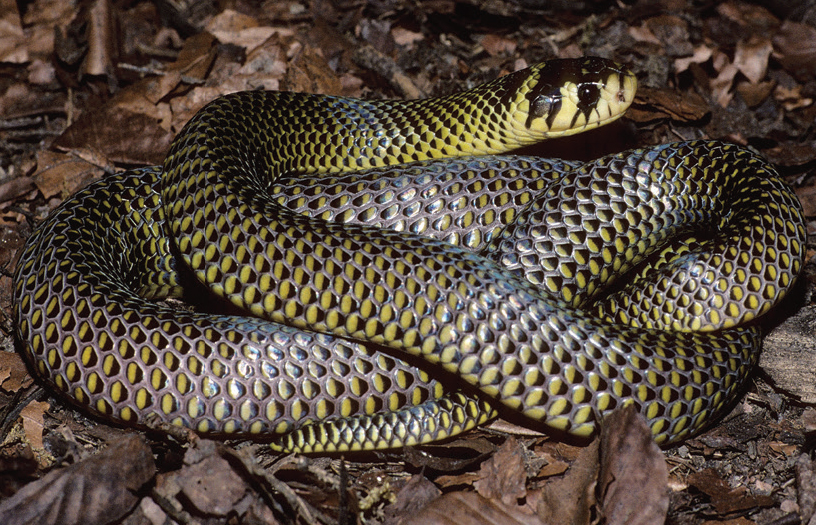
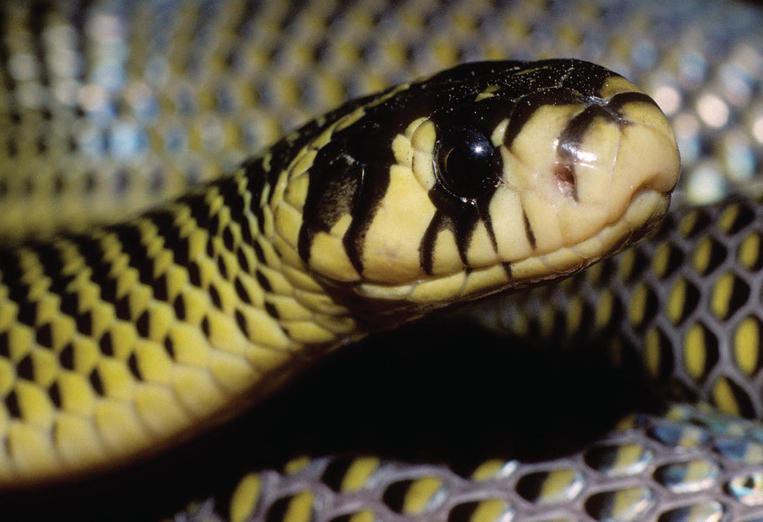
captive (Wolfgang Wuster).
Banded Water Cobra Naja annulata
Identification: A large water-dwelling cobra of Central Africa, with several distinct colour forms. It is a large, heavy-bodied snake (weighing up to 4kg), with a broad, flat head and a medium-sized dark eye with a curious small round pupil. The body is cylindrical and the tail is long, 18–23% of total length. The scales are smooth and glossy; in 21–25 rows at midbody; ventrals 192–226; cloacal scale entire; paired subcaudals 67–78. Maximum size about 2.5m (possibly larger), average 1.4–2.2m. The size of wild hatchlings is unknown, but juveniles from Lake Tanganyika measured 43–48cm. The colour is quite variable. The animals associated with Lake Tanganyika (Storm’s Water Cobra, Naja annulata stormsi) are shades of brown, with two or more black rings and a black tail; the number of rings and black dorsal blotches increases northwards, but totally banded specimens have also been found in the lake. Those from eastern DR Congo are banded black and warm brown or orange-brown, and are bright orange below. Further west, the black bands may have a yellow centre, and in occasional specimens the light cross-bars coalesce to form huge, dark-edged blotches down the centre of the back. Another colour form, which seems to be smaller (usually less than 1.4m), occurs on the lower Congo River; some adults are speckled black and white while others are black or dark grey to mottled grey-brown above and ivory below, with juveniles being heavily speckled black and white; this might prove to be another species, although at present both the scalation and the DNA places it within Naja annulata.
Habitat and Distribution: Associated with lakes and rivers, in forest and well-wooded savanna, between sea level and 1,200m. It is usually found where there is enough waterside cover to conceal a large snake, but will venture out onto open beaches and sand bars. It occurs from Lake Tanganyika westwards across Central Africa to Gabon and the mouth of the Congo River, south to northern Angola, and north to south-western Central African Republic and southern Cameroon.
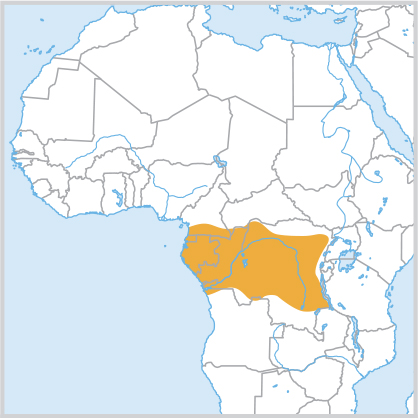
Naja annulata
Natural History: An aquatic snake that spends most of its time in the water, hunting fish by day and by night. It may bask in the morning and later afternoon. It moves somewhat ponderously on land, but is a superb, fast swimmer, spending much time underwater; it is recorded as staying down for more than 10 minutes and diving to depths of 25m. Groups of these cobras can be seen in Lake Tanganyika at a distance with their nostrils just out of the water, seemingly hanging suspended vertically. Hunting snakes also investigate recesses like rock cracks, mollusc shells and underwater holes, looking for concealed fish. They rapidly swallow small fish caught this way, without waiting for the venom to take effect. DR Congo animals are often caught in fish traps in small rivers coming downstream, leading fishermen to suggest the species may follow fish movements from large to small rivers at night, and return at dawn. When not active, it tends to hide in shoreline rock formations, in holes in banks or overhanging root clusters, or in holes of waterside trees; in such refuges it may live for long periods if not disturbed. It often makes use of man-made cover such as jetties, stone bridges and pontoons, and will also use buildings and fish-drying huts. Juveniles have been found under boats, waterside debris, logs, etc. When approached in water, this snake simply swims away, and on land will attempt to escape into water, but if cornered it will rear, spread a hood and demonstrate with an open mouth. It lays eggs; clutches of 22–24 are laid in August and September in Lake Tanganyika. A captive of the speckled form laid four elongate eggs that hatched in 70 days; the hatchlings were around 30cm. A 48cm juvenile was captured in July. Only fish have been recorded in the diet of wild snakes, but captives took amphibians and rodents.
Medical Significance: A large snake, with a potent neurotoxic venom (the lethal dose is very low compared to that of other elapids), so theoretically a risk to inhabitants of Central Africa, especially fishermen. However, there seem to be no documented bites, possibly because, being both nervous and largely tied to water where it hunts fish, this snake rarely comes into confrontational contact with humans. No specific antivenom is available; however, South African polyvalent antivenom is shown to be effective in neutralising the venom.
Banded Water Cobra, Naja annulata.
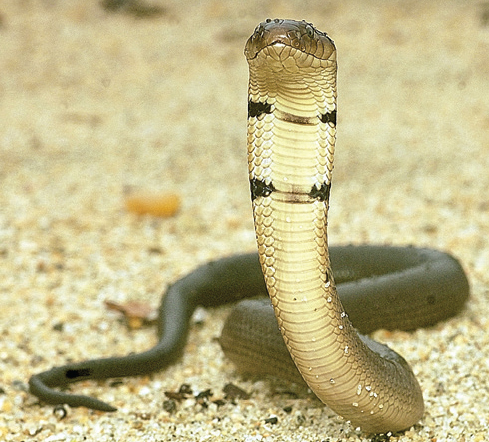
subspecies stormsi, Tanzania (Michele Menegon).
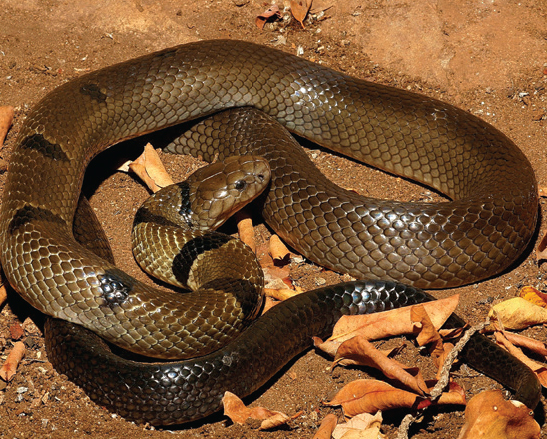
subspecies stormsi, Tanzania (Wolfgang Wuster).
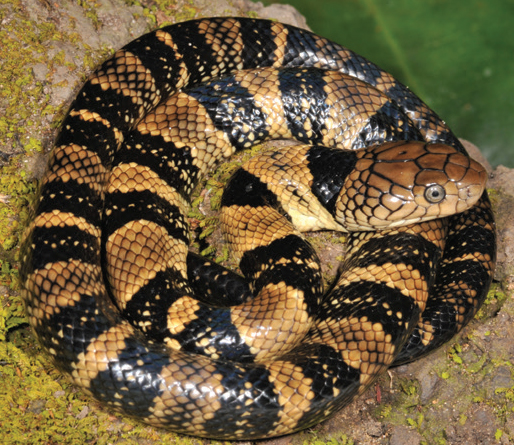
Angola (Bill Branch).
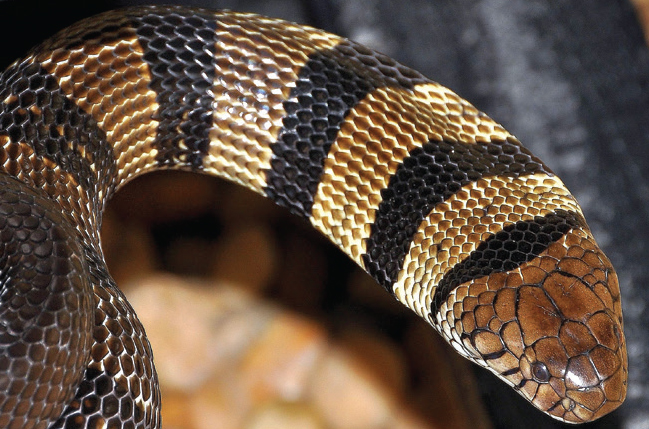
DR Congo (Václav Gvoždik).
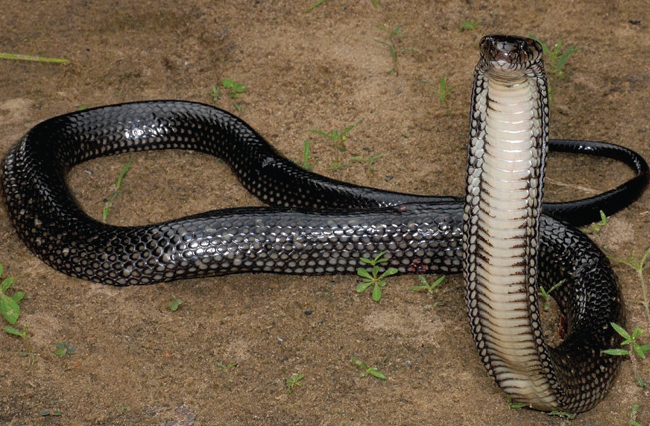
dark morph, DR Congo (Eli Greenbaum).
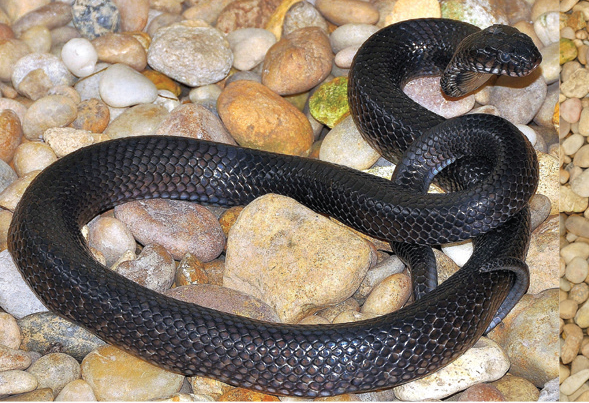
dark morph juvenile (Václav Gvoždik).
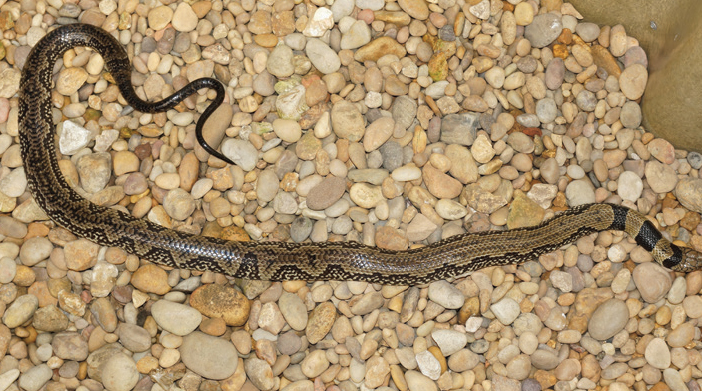
unusually marked (Václav Gvoždik).
Congo Water Cobra Naja christyi
Identification: A fairly large, semi-aquatic cobra of the lower Congo River. The head is short and subtriangular, and the eye small and set forward, with a small round pupil. The body is cylindrical and the tail is fairly long, 18–20% of total length. The scales are smooth and glossy; in 17 rows at midbody; ventrals 206–221; cloacal scale entire; paired subcaudals 67–73. Maximum size about 1.4m, average probably 80–120cm; hatchlings around 30cm. The colour is a rich brownish maroon above; some specimens have low-contrast blotches or bars, and some are very dark. The tail is black. On the neck are two to six yellow or cream rings, clearly visible on the underside of the hood. The lips and other head scales may have lightish blotches, and the upper labials are finely black-edged. The underside is brown, and the ventrals are often lightly edged yellow.
Habitat and Distribution: Known only from the lower Congo River, on both banks, from Kinshasa–Brazzaville down to the sea. Informal records indicate it extends upriver from Kinshasa, and is probably also in the tributaries of the Congo River in the region, but this is poorly documented. It might occur in Cabinda and the Zaire Province of north-west Angola.
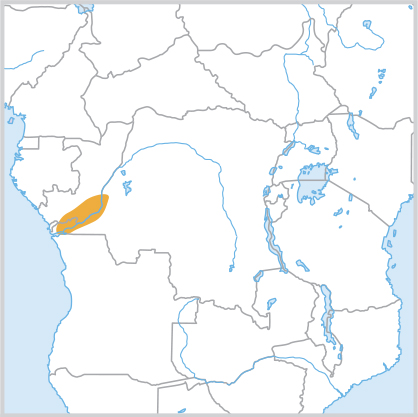
Naja christyi
Natural History: Behaviour little known. This snake is semi-aquatic, spending a lot of time in water, and moves quite quickly. It might be nocturnal or diurnal. It presumably hides in riverside holes, root clusters and holes of waterside trees, etc.; juveniles have been taken under rocks on the floodplains of the lower Congo River, and in and around small ponds with rocky banks. It swims well, and if encountered in water swims away; if cornered on land it will spread a narrow hood. It lays eggs and probably eats amphibians and/or fish. Little else is known. This species was originally placed in the genus Limnonaja, then Boulengerina.
Medical Significance: A fairly large snake, with a potent neurotoxic venom (the lethal dose is low compared to that of other elapids), so theoretically a risk to inhabitants of the lower Congo River, especially fishermen. However, there seem to be few documented bites, possibly because, being both nervous and largely tied to water where it hunts fish, this snake rarely comes into confrontational contact with humans. No specific antivenom is available; however, South African polyvalent antivenom is shown to be effective in neutralising the venom. One victim experienced only a headache following a bite.
Congo Water Cobra, Naja christyi.
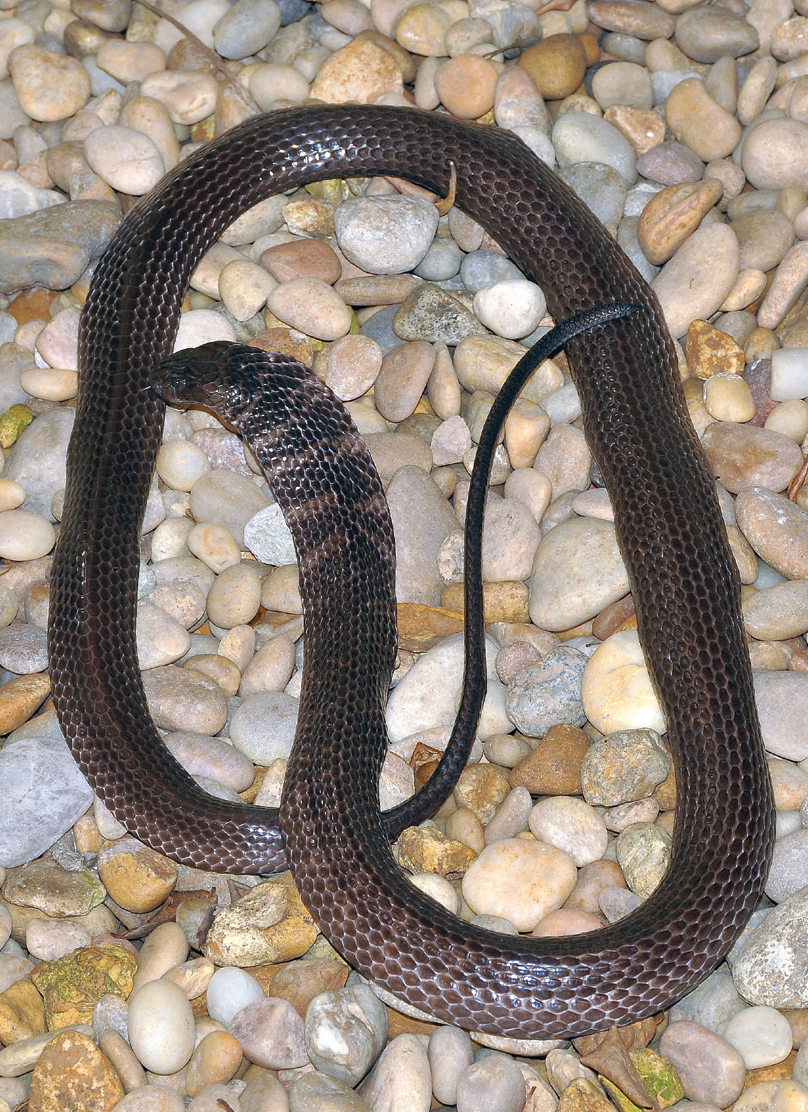
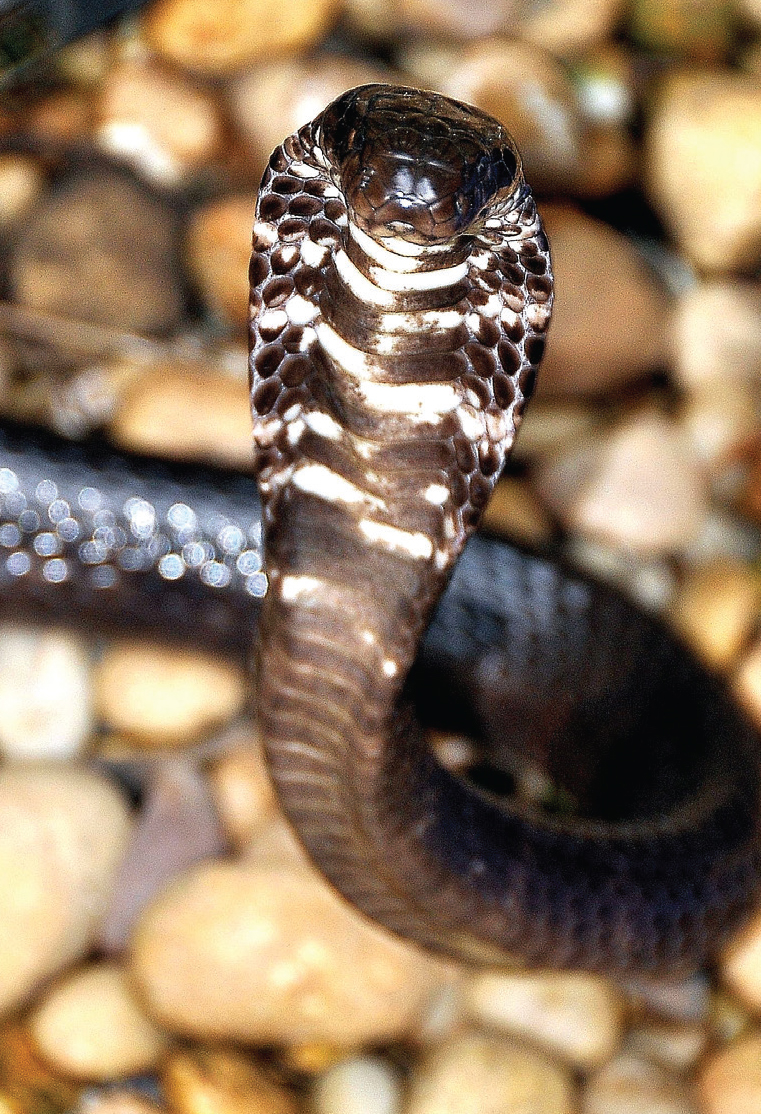
DR Congo (Václav Gvoždik).
Regarded for a long time as a single well-defined species, but quite variable in colour, this large snake has now been split, mainly on the basis of DNA, into five species. This split largely makes zoogeographic sense, and indicates separate lineages. The São Tomé Forest Cobra (Naja peroescobari) is confined to that island, while the West African Forest Cobra (N. guineensis) occurs in the forests of West Africa, west of the Dahomey Gap. The Banded Forest Cobra (N. savannula) occurs in the savannas of West Africa. However, there are problems in identifying (at least visually) some specimens of the Eastern Forest Cobra (N. subfulva) and the Central African Forest Cobra (N. melanoleuca). The ranges of these two snakes overlap widely in the Albertine Rift, parts of Central Africa, and in and around Cameroon, DR Congo and the Republic of the Congo. Even the authors of the paper that split the group struggled to allocate some specimens from these areas and state that these can be differentiated only using DNA; no key is provided in their paper.
These are medically important snakes, although bites seem to be rare. They have a huge range (most of forested and wooded tropical Africa, extending into savanna in places). They are secretive, and often occur in urban and agricultural areas; they may be active by day and by night on the ground. They are quick to rear up if molested, if they perceive themselves to be in danger they will bite, and their height means a bite may be delivered high on the body. They have a potent neurotoxic venom, causing a rapid descending paralysis and respiratory depression, leading to death from suffocation within 2–16 hours of the bite. Initial symptoms include ptosis, double vision, and inability to open the mouth, clench the jaw, protrude the tongue or swallow. These cobras are large and a bite from one is a medical emergency, needing immediate hospitalisation. However, antivenom is available, and surprisingly few bites are documented; these alert species are quick to avoid confrontation. The symptomology of forest cobra bites seems to be similar for all five species, indicating that whatever else may have changed, the venom remains much the same.
Eastern Forest Cobra (Brown Forest Cobra) Naja subfulva
Identification: A large black or brown cobra of the African woodland and forest. A fairly thick-bodied snake, it has a large head and a large, dark eye with a round pupil. The body is cylindrical and the tail fairly long and thin, 15–20% of total length. The scales are smooth and glossy; in 19 (rarely 17 or 21) rows at midbody; ventrals 196–226; subcaudals 55–71. Maximum size about 2.7m, average 1.4–2.2m; hatchlings 25–40cm. Several colour forms exist. Those from the area around Lake Victoria and parts of the Congo basin are glossy black; the juveniles are usually white-spotted and this may persist in some adults. The chin, throat and anterior part of the belly are white, cream or pale yellow, with broad black cross-bars and blotches, although in some specimens most of the underside is black. The sides of the head are strikingly marked with black and white, giving the impression of vertical black and white bars on the lips. Those from southeast Africa, the eastern and south-eastern coast and the savannas around the Central African forest are usually brownish or blackish brown above, sometimes spotted darker brown, with a darker or black tail. The underside is paler, with a yellow or cream belly, heavily speckled with brown or black; specimens from the southern part of the range have black tails. Mount Kenya snakes are yellow-brown anteriorly, becoming dark or black towards the tail, and the head lacks the black lip edging. Ventral banding is usually restricted to the anterior fifth of the underside; this may be indistinct or faded.
Habitat and Distribution: Forest, woodland, coastal thicket, moist savanna and grassland, from sea level to over 2,500m. It occurs northwards from northeastern South Africa (from Durban in Kwazulu-Natal and Kruger National Park), through parts of Mozambique, most of Malawi, northern and eastern Zambia and southern DR Congo, west to southern Gabon. It is also found in coastal Tanzania and Kenya, western Kenya, most of Uganda, Rwanda, Burundi and the watershed west of the Albertine Rift Valley in DR Congo, then across the north of the forest to south-western Chad and Cameroon; there are some old records from the Niger Delta. Records are lacking from north-east DR Congo. Isolated populations are known from the Udzungwa Mountains and the Crater Highlands in Tanzania, the forests of south-eastern Mount Kenya, the Nyambene Hills and parts of Laikipia in Kenya, the forests of south-west Ethiopia, and the Imatong Mountains and Torit in South Sudan.
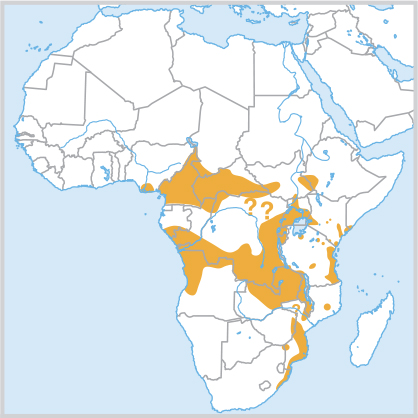
Naja subfulva
Natural History: Terrestrial, but a fast, graceful climber, known to ascend trees to a height of 10m or more. It is quick-moving and alert. It swims well and readily takes to the water; in some areas it eats mostly fish and could be regarded as semi-aquatic. It is active both by day and by night, mostly by day in uninhabited areas and by night in urban areas. When not active, it takes cover in holes, brush piles, hollow logs, among root clusters or in rock crevices, or in termite hills at forest fringes or in clearings; in some areas it is fond of hiding along riverbanks, in overhanging root systems or bird holes; in urban areas it will hide in junk piles or unused buildings. If molested it rears up to a considerable height and spreads a long, narrow hood; if further stressed and unable to retreat, it may rush forward and bite. Male–male combat has been observed. Females lay 15–26 eggs, roughly 30 × 60mm; incubation times of around two months have been recorded. This snake eats a wide variety of prey; it is fond of mammals (squirrels, mice, shrews and elephant shrews) and amphibians, and will also take fish (including mudskippers), other snakes, monitor lizards and other lizards, and birds and their eggs. Captive specimens can seem almost cunning in their timing of escape bids, and have been reported as trying to attack rather than escape. When restrained, it will jab the sharp tail tip into the handler. A zoo specimen of the forest cobra (Naja melanoleuca) complex lived 28 years in captivity.
Medical Significance: This is a dangerous snake; it is wide-ranging, secretive, large and active on the ground, often in rural areas. It will bite if cornered. It has a neurotoxic venom that causes a progressive paralysis, which can be rapid; fatalities are recorded. Antivenom is available. A bite must be rapidly hospitalised and treated with antivenom and respiratory support in hospital. As with mambas (Dendroaspis), a bite from this snake is one situation where pressure bandaging, immobilisation therapy and artificial respiration may be of benefit while the victim is being transported to hospital.
Eastern Forest Cobra, Naja subfulva.
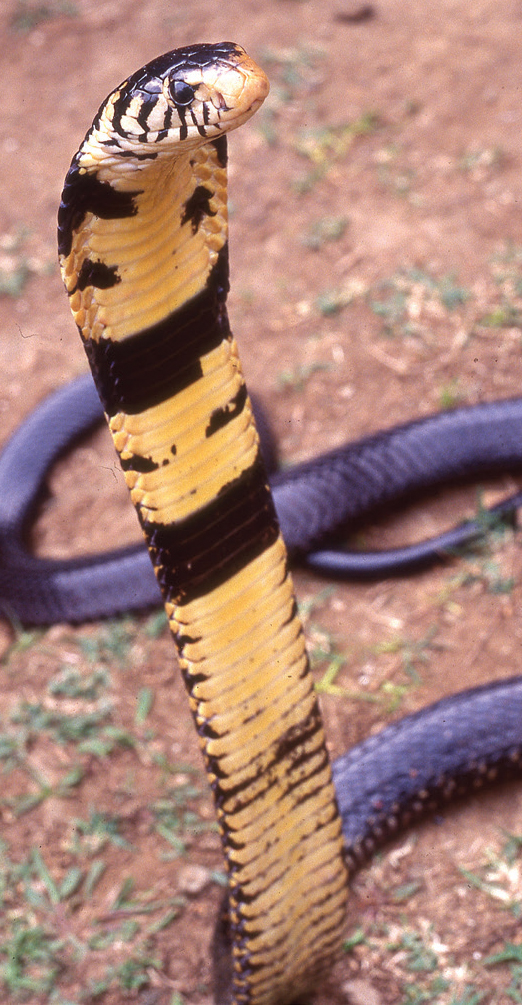
Tanzania (Stephen Spawls).
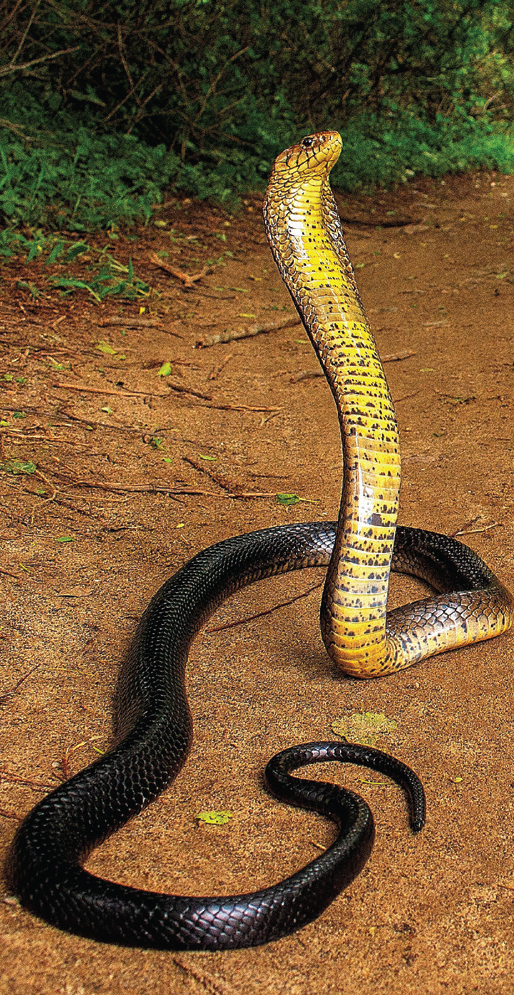
South Africa (Tyrone Ping).
South Africa (Johan Marais).
Kenya (Stephen Spawls).
juvenile, Kenya (Stephen Spawls).
Kenya (Stephen Spawls).
Central African Forest Cobra Naja melanoleuca
Identification: A large black cobra of the Central African forest. It has a large head and a large, dark eye with a round pupil. The body is cylindrical and the tail fairly long and thin, 15–20% of total length. The scales are smooth and glossy; in 17–21 rows at midbody (usually 19); ventrals 206–232; subcaudals 57–74. Maximum size about 2.7m, average 1.4–2.2m; hatchlings 25–40cm. The colour is usually black above, sometimes with white speckling, especially in juveniles. The underside of the throat and neck is cream or yellow, with black cross-bands extending over the first third of the underside; after about 100 ventrals the venter is usually uniform black. The cream cross-bars may extend to the back of the neck (thus forming rings), and sometimes there is an ocellate mark on the neck.
Habitat and Distribution: Forest and woodland, coastal thicket, moist savanna and grassland, from sea level to over 2,000m. It occurs northwards from north-west Angola through DR Congo and Gabon, north and west to southern Central African Republic, southern Cameroon, Nigeria and extreme southern Togo, and east to western Rwanda, Burundi and south-west Uganda. It might occur in Ghana; west of there it is replaced by the West African Forest Cobra (Naja guineensis).
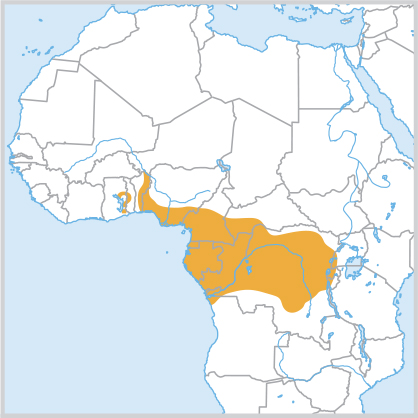
Naja melanoleuca
Natural History: As for the Eastern Forest Cobra (Naja subfulva); that is, terrestrial but also climbs, fast-moving, swims well, active by day and night, lays 12–23 eggs, and eats a wide range of vertebrate prey, including mammals, snakes, amphibians and fish. Cameroon specimens have been described as shamming (feigning) death, particularly if trapped.
Medical Significance: As for the previous species; a dangerous snake with a rapidly acting neurotoxic venom.
Central African Forest Cobra, Naja melanoleuca.
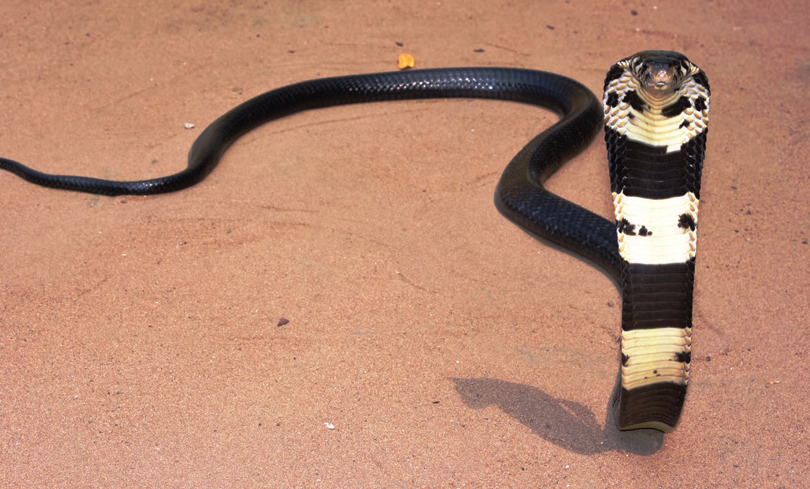
DR Congo (Jean-Francois Trape).
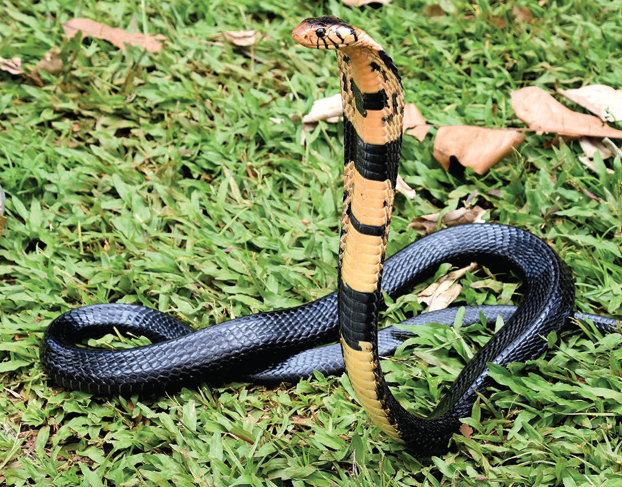
Cameroon (Jean-Francoise Trape).
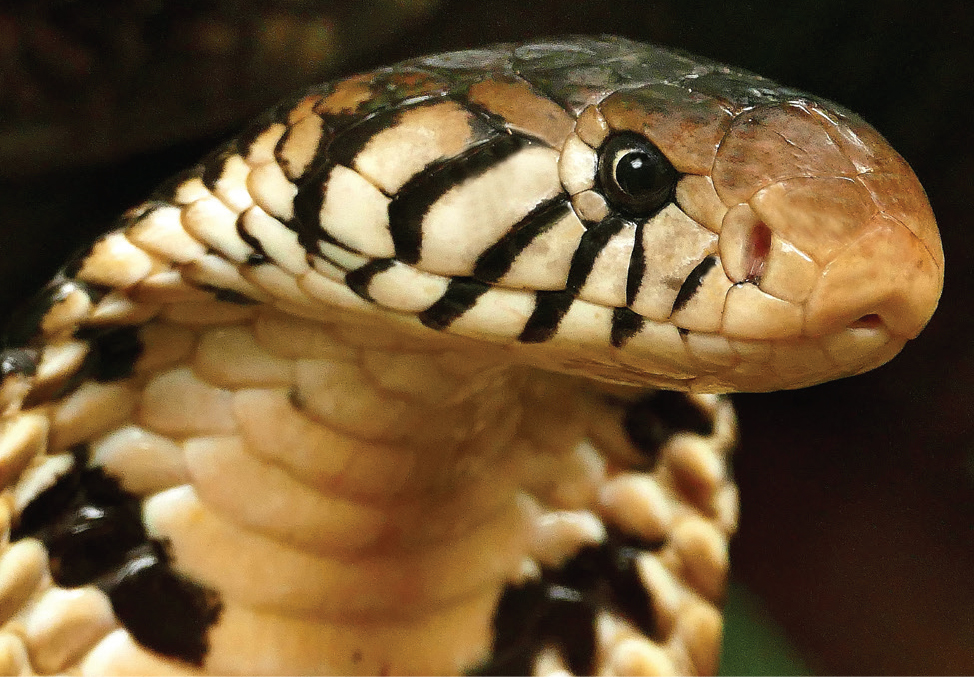
Uganda (Andre Zoersel).
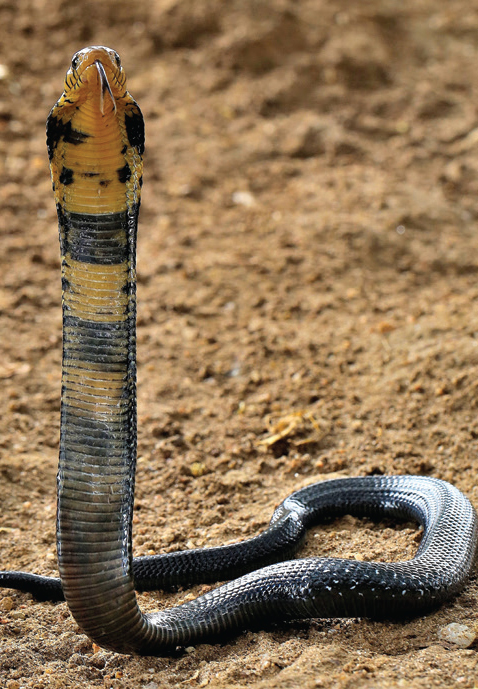
Rwanda (Harald Hinkel).
Banded Forest Cobra Naja savannula
Identification: A large, banded black and yellow cobra of the West African savanna. It has a large head and a large, dark eye with a round pupil. The body is cylindrical and the tail fairly long and thin, 15–20% of total length. The scales are smooth and glossy; in 19 rows at midbody; ventrals 211–226; subcaudals 67–73. Maximum size about 2.3m (possibly larger), average 1.3–2m; hatchling size unknown, but probably around 30cm. The colour is distinctive; the front half of the body is banded black and yellow. The yellow bands (rarely more than five) are usually slightly narrower than the black bands, sometimes with a fine black band in the centre of the yellow; sometimes the yellow bands are black-speckled. The ventral surface is vivid yellow anteriorly, with black cross-bars on the neck, gradually darkening towards the tail.
Habitat and Distribution: In the West African Guinea and Sudan savanna, from sea level to 1,250m, but most common below 600m. It is usually in the vicinity of water sources. It occurs from extreme south-west Chad through northern Cameroon and Nigeria to Senegal and the Gambia, mostly between latitudes of 10 and 14°N, except in eastern Ghana, Togo and Benin, where its range approaches the coast in the Dahomey Gap.
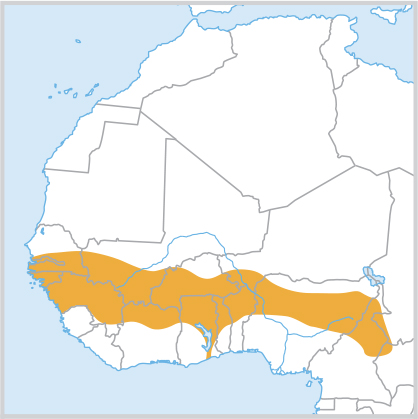
Naja savannula
Natural History: As for the Eastern Forest Cobra (Naja subfulva); that is, terrestrial but also climbs, fast-moving, swims well, active by day and night, lays eggs, and eats a wide range of vertebrate prey. A 2m specimen from Wa, north-west Ghana, had eaten an African Giant Shrew (Crocidura olivieri), a noxious-smelling mammal.
Medical Significance: Few bite cases are recorded, but, as for the previous species, this is a dangerous snake with a rapidly acting neurotoxic venom.
Banded Forest Cobra, Naja savannula.
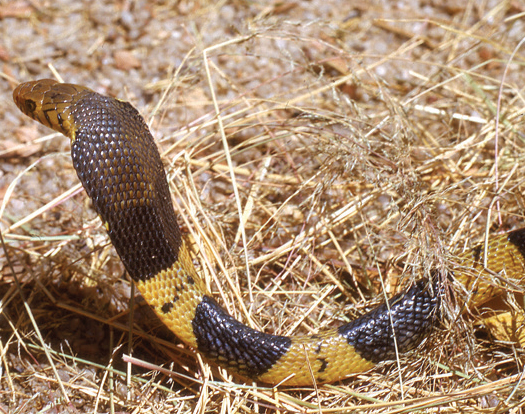
Nigeria (Gerald Dunger).
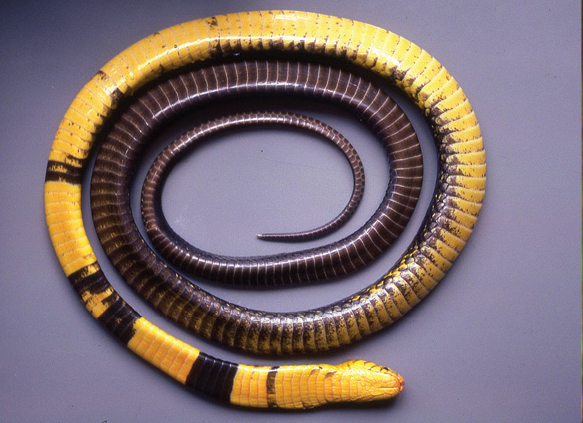
underside, Ghana (Barry Hughes).
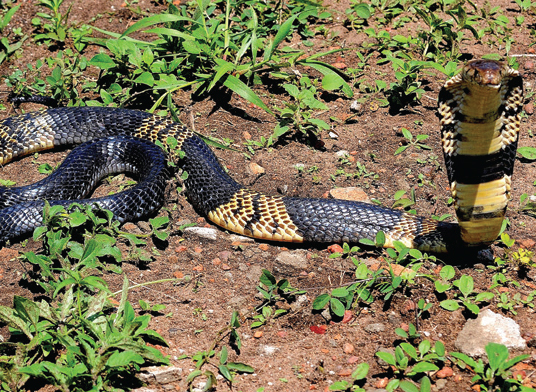
Guinea (Jean-Francois Trape).
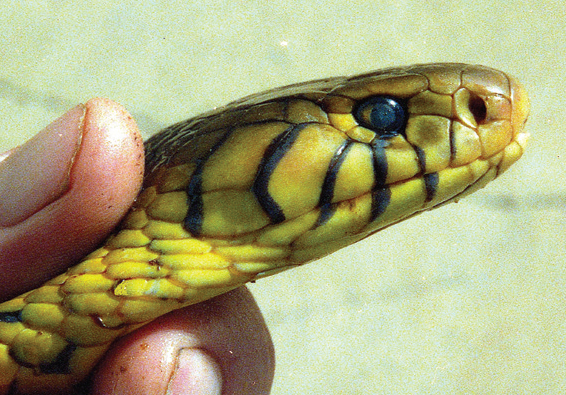
Ghana (Stephen Spawls).
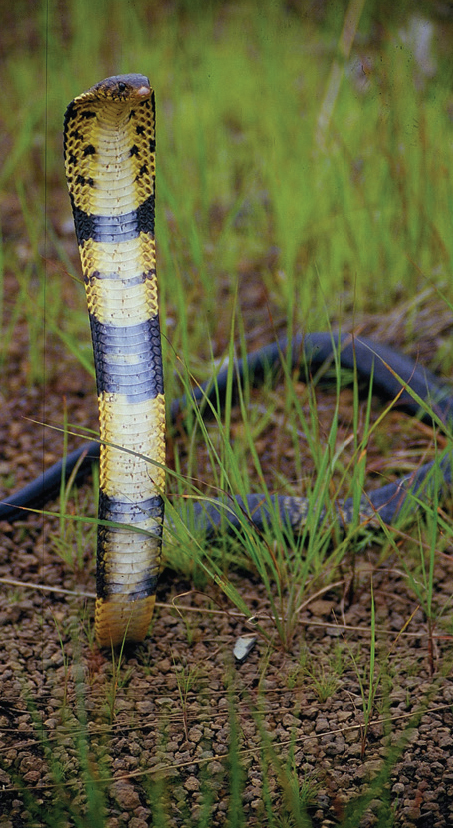
Ivory Coast (Mark-Oliver Rödel).
West African Forest Cobra (Black Forest Cobra) Naja guineensis
Identification: A large black cobra of the West African forest. It has a large head and a large, dark eye with a round pupil. The body is cylindrical and the tail fairly long and thin, 15–20% of total length. The scales are smooth and glossy; in 17–19 rows at midbody; ventrals 203–221; subcaudals 60–70. A specimen of 2.6m from Tafo, Ghana, appears to be the largest measured; average size 1.4–2.2m; hatchlings 25–40cm. The colour is usually black or brownish black above, sometimes with cross-bars (or pairs of cross-bars) of speckled white scales; juveniles may be entirely speckled. The underside is largely black with white or cream cross-bars on the throat, which may become suffused with black in large adults. Sometimes there is an ocellate mark on the neck. The lips are cream, with black edging to the scales; in large adults the lips may become entirely black. Melanistic (all-black) specimens are known.
Habitat and Distribution: Forest and woodland, coastal thicket, occasionally moist savanna and grassland, from sea level to over 2,000m. It occurs from western Togo westwards through Ghana to Liberia and Guinea, south of 10°N, except a single record (Contuboel) from Guinea Bissau.
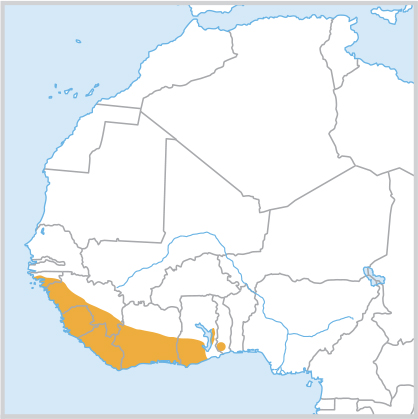
Naja guineensis
Natural History: As for other forest cobras; that is, terrestrial but also climbs, fast-moving, swims well, active by day and night, lays eggs, and eats a wide range of vertebrate prey.
Medical Significance: As for the previous species; a dangerous snake with a rapidly acting neurotoxic venom. A child in Ghana died 20 minutes after a bite from one of these snakes.
West African Forest Cobra, Naja guineensis.
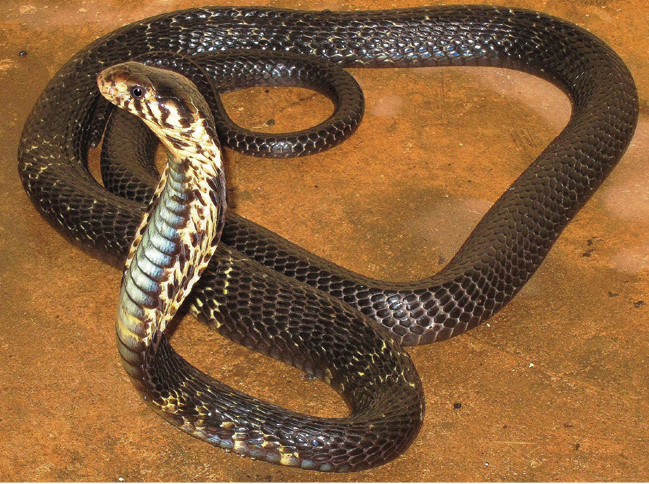
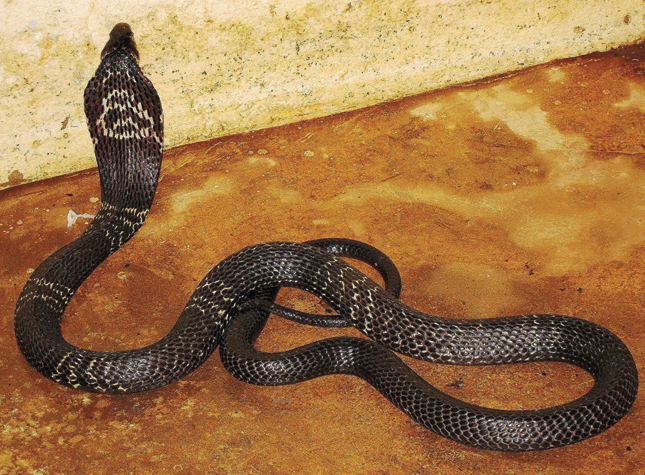
Guinea (Laurent Chirio).
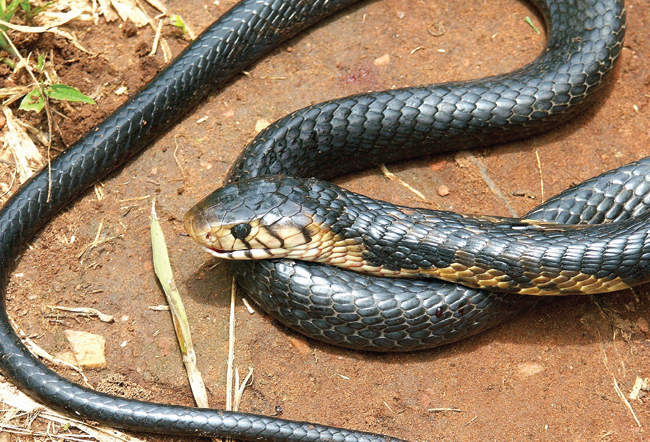
Togo (Jean-Francois Trape).
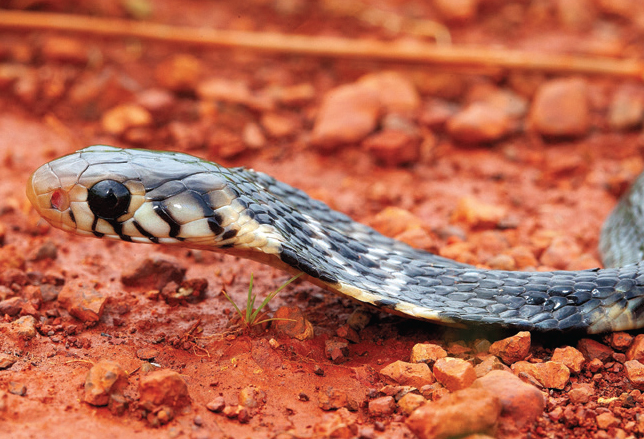
Guinea (Johan Marais).
São Tomé Forest Cobra Naja peroescobari
Identification: A large, black cobra from São Tomé Island. It has a large head and a large, dark eye with a round pupil. The body is cylindrical and the tail fairly long and thin, 15–20% of total length. The scales are smooth and glossy; in 19–21 rows at midbody; ventrals 204–215; subcaudals 52–70. Maximum size 2.6m, average probably 1.4–2.2m; hatchling size unknown, but probably 25–40cm. The colour is uniform glossy black above. The chin, throat and neck are white or cream, with lateral black blotching and irregular cross-bars, but any white on the neck is usually (but not always) confined to the first 22 ventral scales. The lips are cream, with black edging to the scales.
Habitat and Distribution: A species known only from the volcanic São Tomé Island, in the Gulf of Guinea west of Gabon. It occurs in forested areas between sea level and 1,154m, and is apparently absent from the drier north-east side of the island.
Naja peroescobari
Natural History: As for other forest cobras; that is, terrestrial but also climbs, fast-moving, swims well, active by day and night and lays eggs. It is most often seen basking on roads during the daytime, and is said to prefer shaded, moist habitats. Known prey animals include a weasel and a Black Rat (Rattus rattus), but it probably takes a range of vertebrates, like other members of the group.
Medical Significance: No bite cases seem to have been formally documented, but it probably has, like other members of the complex, a potent neurotoxic venom capable of causing paralysis. The inhabitants of the island state that it is highly venomous and capable of causing death in hours; a local saying about this snake translates as ‘man bitten, man lost’, and a local tradition is that to survive a bite, the victim must immediately cut the limb off. Palm-wine tappers are reported to jump from the tree if they encounter this snake.
São Tomé Forest Cobra, Naja peroescobari.
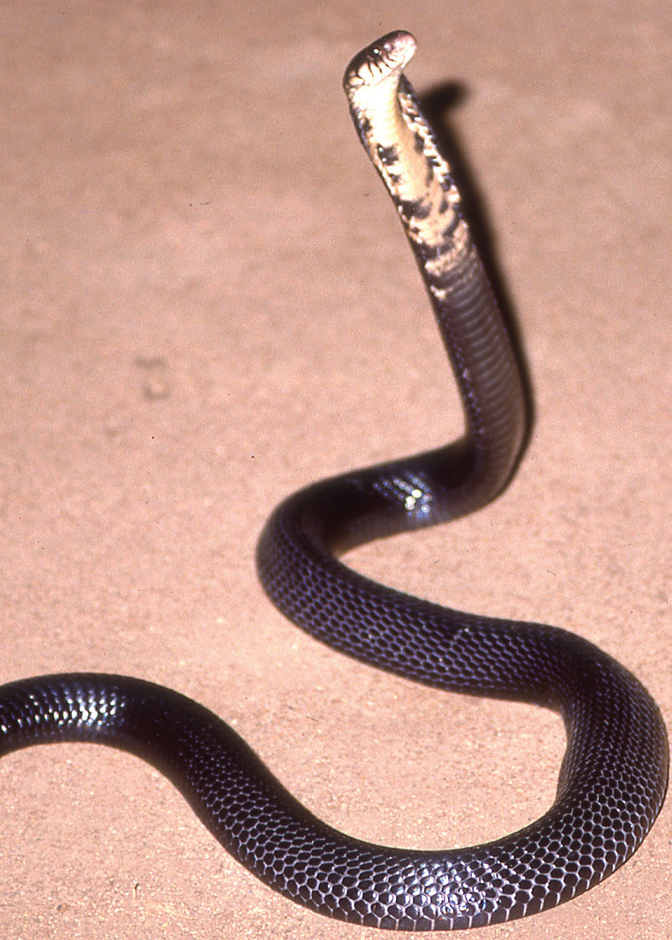
São Tomé (Barry Hughes).
The spitting cobra clade
A group of elapid snakes able to squirt venom from their fangs, to a distance of 2m or 3m; if the venom enters the eyes it is intensely painful. The snakes also bite. Unusually, the use of venom for spitting is the only situation where snake venoms have a defensive purpose, deterring a potential predator. Spitting probably evolved for defence against predatory birds such as ground hornbills and Secretary Birds (Sagittarius serpentarius), since spitting cobras appear in the fossil record at least 15 million years ago, before humans.
For a long time, all African spitting cobras were believed to be a single, fairly variable species, and the various new taxa that were found were regarded as subspecies or varieties from 1843 until 1968, when Don Broadley elevated the Mozambique Spitting Cobra (Naja mossambica) to full species status. More splits followed; at least seven species are now recognised. Spitting cobras show wide variation (within the constraints of being true cobras); some are huge, 2.5m or more, and others a maximum of 1m or so. However, they form a monophyletic clade; they have a single common ancestor that lived about 15 million years ago. We have provided separate entries for the two subspecies of the South-western Black Spitting Cobra (N. nigricincta) as they look very different, although intergrades exist.
These are medically important snakes. Their venom rarely shows neurotoxic effects, unlike that of the forest and Egyptian cobras. It is potently cytotoxic. There is usually immediate pain after a bite, often followed by vomiting within six hours, and extensive local swelling. Over the next few days a horrible local shallow necrosis develops, involving the skin and connective tissue, often with skip lesions. This then leads to long-lasting disfigurement and complications that may cause death. In parts of West Africa, these species are a major cause of snakebite and suffering. A large proportion of bites occur inside houses while the victims are asleep. Recent evidence has uncovered a spate of bites in southern Africa, by the Mozambique Spitting Cobra, where the snake may have deliberately bitten the victim (most snakebites are in defence), possibly under the impression that they were prey. If threatened, a spitting cobra’s first line of defence is to spit venom, and if this gets in the victim’s eyes it can cause irreversible damage; there is intense local pain, blepharospasm, swelling and watering. In theory, if the venom is rapidly washed out with quantities of water and the eyes medically monitored, no lasting harm should result, although some corneal erosion may occur. But in reality the harsh conditions of everyday life in remote Africa often mean that victims cannot get water easily, and a frightful slew of inappropriate local remedies can sometimes leave them with permanent damage to their sight.
Black-necked Spitting Cobra Naja nigricollis
Identification: A large spitting cobra, widespread in the savannas of tropical Africa. It has a broad head, a cylindrical body and smooth scales; the tail is 15–20% of total length. Midbody scale count is 17–23; ventrals 175–212; subcaudals 50–70. Maximum size seems to vary; over most of Africa 1.8m is about as large as it gets, averaging 1.2–1.5m; hatchlings 33–36cm. However, savanna snakes from immediately west of the Gregory Rift Valley in Kenya and Tanzania, and in north-east Tanzania, seem to get much larger, reaching 2.3m or even more. The colour is variable. In most of Africa adults are black (sometimes grey or sometimes dark brown), and juveniles are grey. The upper neck is black above, and the throat is barred black and either red, orange or pink (or occasionally yellow, pale grey or white). In highland Kenya, adults may be copper-coloured, pinky-grey, rufous or rufous-brown, but most have red and black throat bars. A large all-black (above and below) colour form occurs west of the central Gregory Rift Valley in Kenya and in north-west Tanzania. Some individuals of this form have white blotching on the underside, and some juveniles have red throats.
Habitat and Distribution: Moist and dry savanna and woodland, but rarely semi-desert or forest, although it will colonise forest clearings and fringes and follow rivers into dry country; it is often in suburbia if there are suitable refuges and prey. This species is found from sea level to above 1,800m. It occurs east from southern Mauritania across the savannas of West and Central Africa to western Ethiopia, then south down the eastern side of Africa, southwestwards to southern Zambia, Angola and extreme northern Botswana; south of there it is replaced by the Zebra Cobra (Naja nigricincta nigricincta). It is known on the lower Congo River, and there is an isolated population on Jebel Marra, western Sudan.
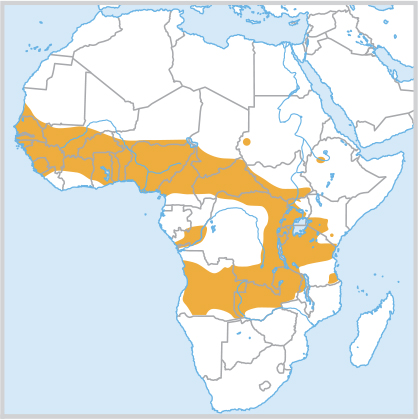
Naja nigricollis
Natural History: Terrestrial, but it climbs readily and will even attempt to escape up trees or up into rocks. It is quick-moving and alert. Large adults are mostly active at night, but will also hunt or bask during the day, especially in uninhabited areas. Juveniles are often active during the day. When not active, this snake takes cover in termitaria, holes, hollow trees, old logs or brush piles, etc. When threatened, it rears and spreads a hood and will spit if further molested, but may also spit without actually spreading a hood. Large adults can spit 3m or more. They tend to stand their ground when threatened, rather than rush forward as the forest and Egyptian cobras may do. Male–male combat has been observed, with the snakes intertwined and neck-wrestling. Females lay 5–20 eggs, roughly 25 × 40mm, often in termitaria; the larger the female, the more eggs she lays. Hatchlings have been collected in Nairobi in April and May, and in May and June in West Africa. This species eats a wide variety of food, including amphibians, various mammals, lizards, snakes and even fish; it will raid chicken runs and will take eggs and chicks. It is quick to exploit suitable habitats, aided by its secretive nocturnal habits. In Nigeria it has been observed moving into what were previously forested areas, and in urbanised areas the disappearance of vipers has allowed this snake to become common. In Kenya it is known to exploit urban areas; in the satellite suburbs around Athi River it has displaced the Egyptian Cobra (Naja haje), while on the southern side of Nairobi, in areas where both this snake and the Puff Adder (Bitis arietans) were common, the Puff Adders are long gone but the spitting cobras persist.
Medical Significance: One of Africa’s most dangerous species, on account of its huge range, relative abundance and potent cytotoxic venom. It is active on the ground at night and tolerates suburbia, where it can remain undetected due to its habit of living in holes and emerging only after dark; it is often also in agricultural land. Many bites occur inside houses. There is immediate pain followed by vomiting within six hours, extensive local swelling, local blistering in 60% of cases and local tissue necrosis in 70% of envenomed cases. Necrosis usually involves only the skin and subcutaneous connective tissues. In Nigeria 20% of bite victims had permanent disability. Bite victims should be transported rapidly to hospital. Rapid death is very rare in bites from this snake, but this has the unfortunate result that victims are not taken to hospital as the venom seems to be local in its effects. As time goes by, frightful medical complications arise from the necrotic effects of the venom and these can become life-threatening; they include spontaneous haemorrhage. Antivenom is available, but treatment for any bite must also address the local tissue damage. Venom in the eye can be treated by careful flushing with large volumes of water; there is no need to inject antivenom. However, the more rapidly the eye is flushed out, the better; see our section on ‘Spitting snakes: first aid for venom in the eyes’. Anyone who has been spat at should visit a hospital or eye clinic for an assessment of the damage to the eye.
Black-necked Spitting Cobra, Naja nigricollis.
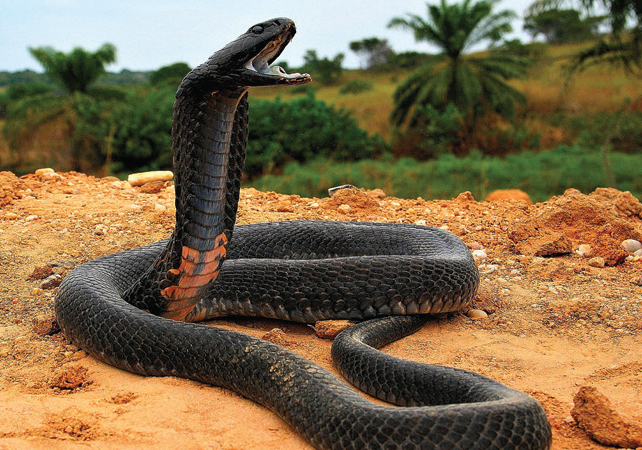
Angola (Warren Klein).
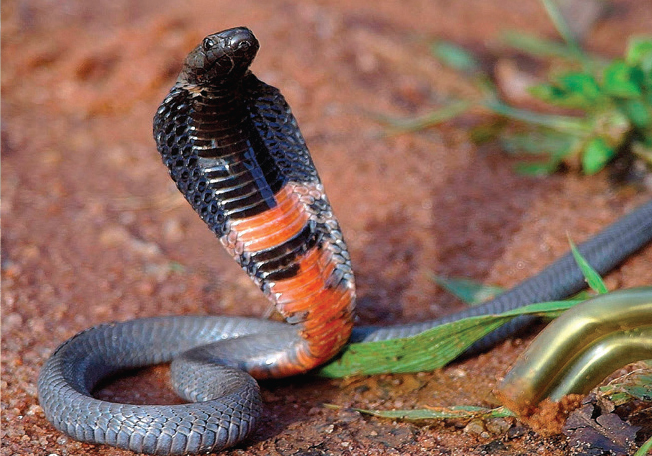
juvenile, Benin (Jordan Benjamin).
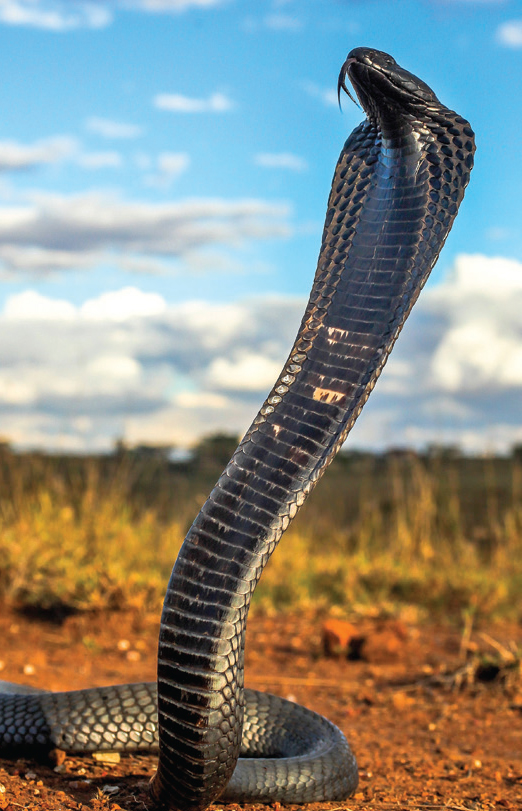
Kenya (Anthony Childs).
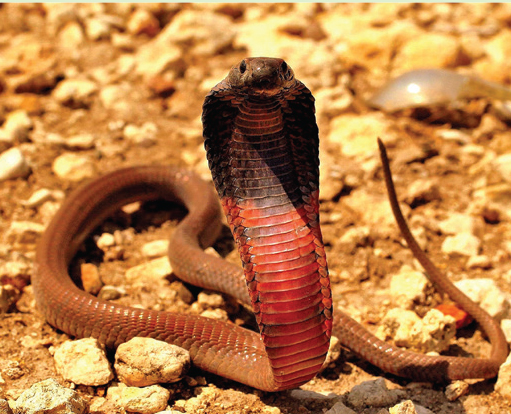
juvenile, Kenya (Anthony Childs).
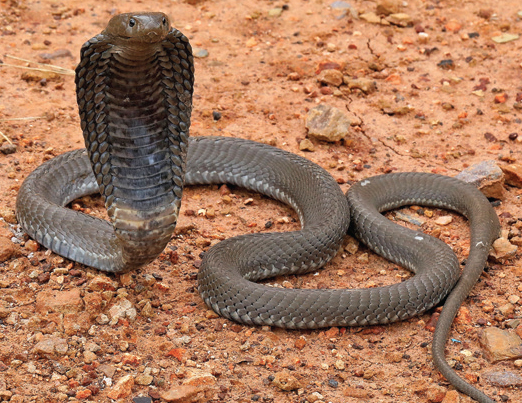
DR Congo (Johan Marais).
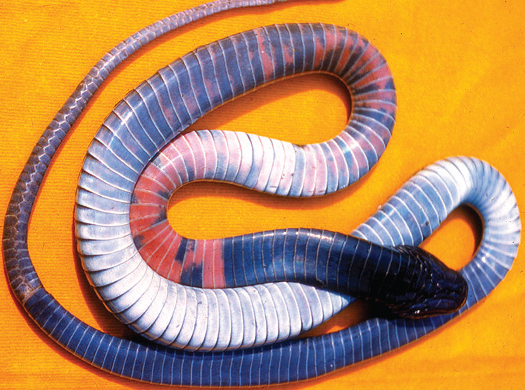
underside, Nigeria (Gerald Dunger).
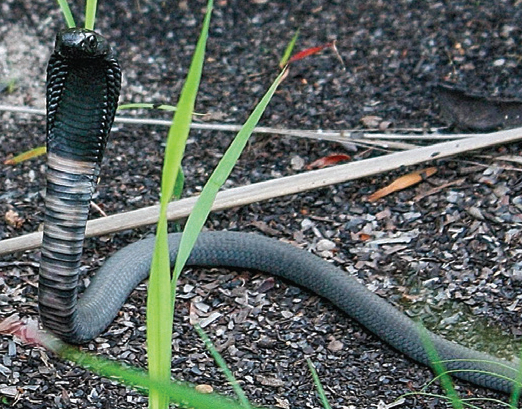
Tanzania (Caspian Johnson).
Ashe’s Spitting Cobra (Large Brown Spitting Cobra) Naja ashei
Identification: A recently described, huge brown spitting cobra of the coast and dry country of eastern Africa. The eye has a round pupil and orange-brown iris. The body is cylindrical and the tail fairly long, 15–18% of total length. The scales are smooth; in 20–23 rows at midbody; ventrals 192–207; subcaudals 55–65. Maximum size about 2.7m (maybe larger), average 1.2–1.8m; hatchlings 35–38cm. The dorsal colour is various shades of brown or olive, or sometimes grey; some specimens can be quite yellow-brown, others uniform, and others have a sprinkling of yellow scales, which may form narrow yellow dorsal bars. The underside is dull light yellow, each ventral scale edged with light brown; there is usually a deep, dark brown bar on the underside of the neck, but this may be fragmented into several bars with yellow scales between. Inland juveniles are light grey-brown; the throat bar is dark brown or black and the head deep brown. Juveniles from Kenya’s north coast have a shiny black head and neck, which fades in their second year. This species is named after James Ashe, a charismatic Kenyan herpetologist.
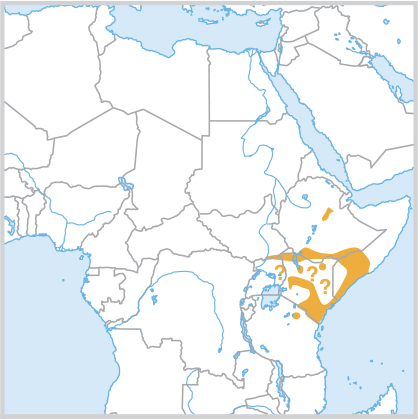
Naja ashei
Habitat and Distribution: Dry savanna, semi-desert and coastal thicket, from sea level to about 1,300m. It occurs from southern Somalia into Kenya, south down the coast to the Tanzanian border, and west across large areas of eastern and northern Kenya (it probably occurs throughout most of dry country Kenya, although records are sporadic at present), just reaching Uganda at Amudat in the east. In Tanzania it is known only from around Ndukusi, a village near Lolkisale Mountain south-east of Arusha, so is possibly in Tarangire National Park. It should also be on the extreme north Tanzanian coast as it is recorded from Lunga-Lunga. It has also been recorded from extreme south-east South Sudan (Torit area). In Ethiopia it is known from the lower Omo River area, north to Arba Minch; there is a cluster of records from in and around Awash National Park, and also from Gode in the Ogaden.
Natural History: Terrestrial, but it may climb into bushes and low trees; a specimen on the road in Meru National Park climbed an acacia when pursued. This species is quick-moving and alert. Adults in undisturbed habitat seem to be both nocturnal and diurnal; one was found mid-morning pursuing frogs on the edge of a dam near Mount Kasigau, and when approached also climbed an acacia tree; several have been photographed active by day in Laikipia. Juveniles in the Shimba Hills and at Lunga-Lunga were active by day. When inactive, this snake shelters in holes (particularly in termite hills), old logs or under ground cover. When disturbed it rears up, spreads a broad hood and may spit twin jets of venom; it can spit up to 3m. Females lay eggs. This species eats a range of prey, taking mammals, birds, amphibians and reptiles; known prey items include a domestic cat, chickens and whole nests of chicken eggs, Red Spitting Cobras (Naja pallida), White-throated Savanna Monitors (Varanus albigularis) and Puff Adders (Bitis arietans). A Watamu specimen ate a Puff Adder so large it could subsequently crawl only in a straight line. They will also take carrion, including chicken heads and roadkilled snakes; one ate a dead egg-eating snake (Dasypeltis) that was maggot-ridden and decomposing.
Medical Significance: A dangerous species, widespread in parts of eastern Africa, and in some areas (particularly Kenya’s north coast) relatively abundant. It has a potent cytotoxic venom produced in huge quantities (6ml were milked from one snake), which contains proteins not described from other African spitting cobras. This snake is active on the ground at night and tolerates suburbia, where it can remain undetected due to its habit of living in holes and emerging only after dark; it is often also in agricultural land. Bite victims should be transported rapidly to hospital. Antivenom is available, but treatment for any bite must also address the local tissue damage. Note that this snake spits readily; the venom is produced in huge quantities and is damaging to the eyes. Venom in the eye can be treated by gentle flushing with large volumes of water; there is no need to inject antivenom. However, the more rapidly the eye is flushed out, the better; see the relevant section on ‘Spitting snakes: first aid for venom in the eyes’. Anyone who has been spat at should visit a hospital or eye clinic for an assessment of the damage to the eye.
Ashe’s Sptting Cobra, Naja ashei.
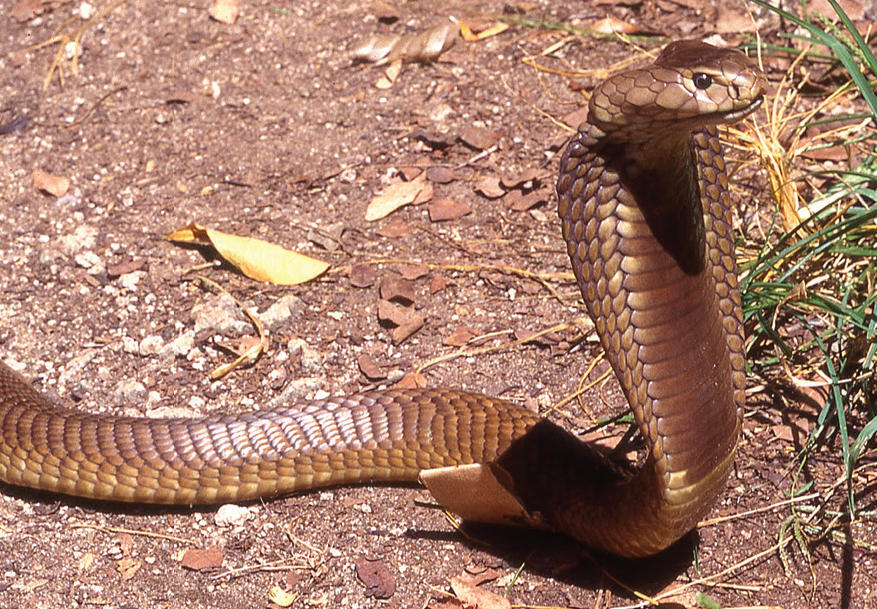
Kenya (Stephen Spawls).
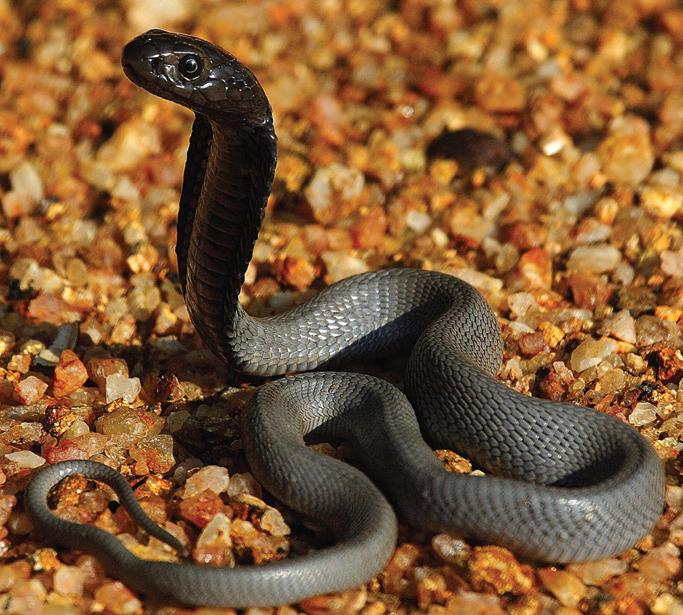
juvenile, Kenya (Bio-Ken Archive).
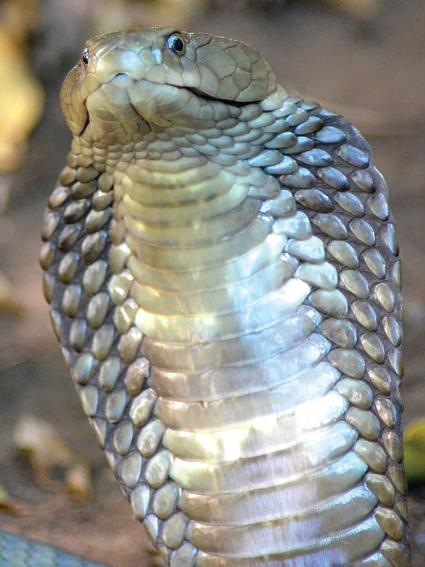
Kenya (Stephen Spawls).
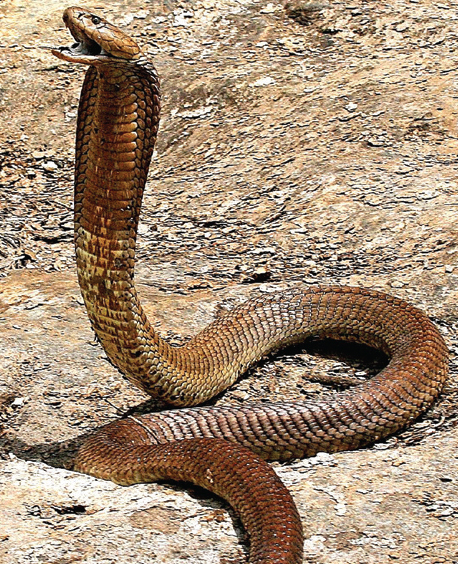
Kenya (Anthony Childs).
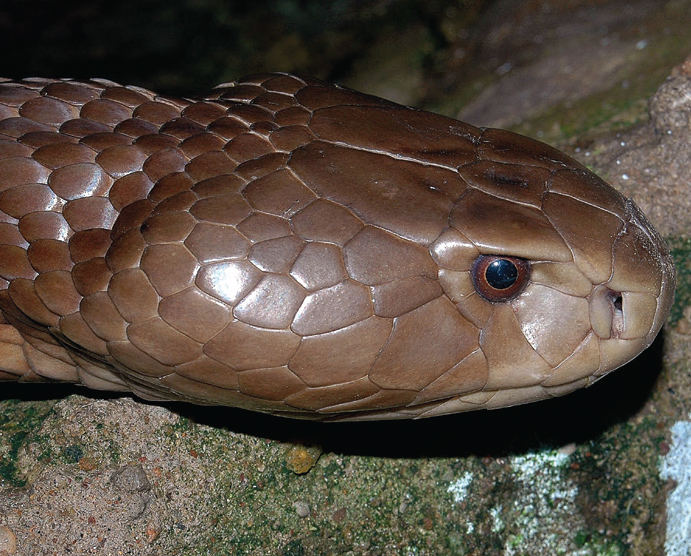
Ethiopia (Tomáš Mazuch).
Zebra Cobra (Zebra Snake/Western Barred Spitting Cobra) Naja nigricincta nigricincta
Identification: A relatively small, attractively banded cobra of dry Angola and Namibia. It has a fairly large head and a large, dark eye with a round pupil. The body is cylindrical and the tail fairly long and thin, 17–19% of total length. The scales are smooth and glossy; in 21 (sometimes 23) rows at midbody; ventrals 192–226; subcaudals 57–73. Maximum size about 1.9m, but this is unusually large; most adults are 0.8–1.1m; hatchlings 28–35cm. Adults are strikingly banded black and white (hence the common Namibian name ‘Zebra Snake’), although the ground colour may be light brown or pinkish. The neck is usually black. Angolan animals are often rufous-brown with faded cross-bars. In intergrades from central and southern Namibia the clarity of the bands fades.
Habitat and Distribution: Inhabits dry savanna, semi-desert and desert, often in rocky areas, between sea level and 1,800m, or occasionally higher (for example, in the Brandberg). It occurs from south-west Angola south through north and central Namibia (largely to the west, not quite reaching Botswana); south of 22°S it starts to intergrade with the South-western Black Spitting Cobra (Naja nigricincta woodi).
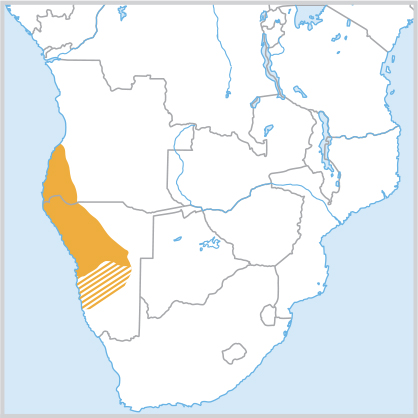
Naja nigricincta nigricincta
Natural History: Terrestrial, but it climbs well and often attempts to escape up trees. It is active by day and night, adults usually by night and juveniles particularly by day. Individuals shelter in holes, under ground cover or in rock fissures, tree cracks and termite mounds. When threatened it will try to escape, but if cornered it will rear up and spread a broad hood, and will spit venom to 2m or more. It may also bite. Between 10 and 24 eggs are laid. This snake feeds on small vertebrates, including mammals, frogs, lizards and other snakes, including its own kind. It is often relatively common; around Windhoek it was the second most common species relocated.
Medical Significance: A dangerous species in the northern half of Namibia; it is relatively abundant and has a potent cytotoxic venom that causes major damage to superficial tissues. This snake is active on the ground at night and tolerates suburbia, where it can remain undetected due to its habit of living in holes and emerging only after dark; it is often also in agricultural land. Bite victims should be transported rapidly to hospital. Antivenom is available, but has a limited effect; it does not neutralise some systemic symptoms and treatment for any bite must also address the local tissue damage, which does not seem to be affected by antivenom. Note that this snake spits readily; the venom is damaging to the eyes. It can be treated by gentle flushing of the eye with large volumes of water; there is no need to inject antivenom. However, the more rapidly the eye is flushed out, the better; see our section on ‘Spitting snakes: first aid for venom in the eyes’. Anyone who has been spat at should visit a hospital or eye clinic for an assessment of the damage to the eye.
Zebra Coba, Naja nigricincta nigricincta.
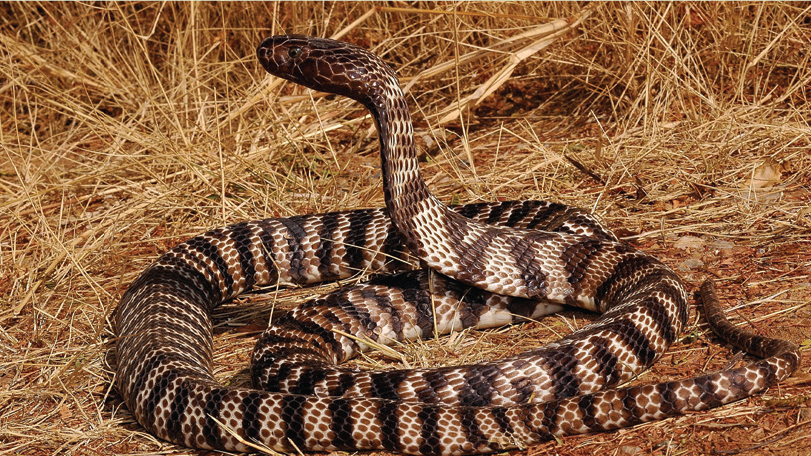
Namibia (Bill Branch).
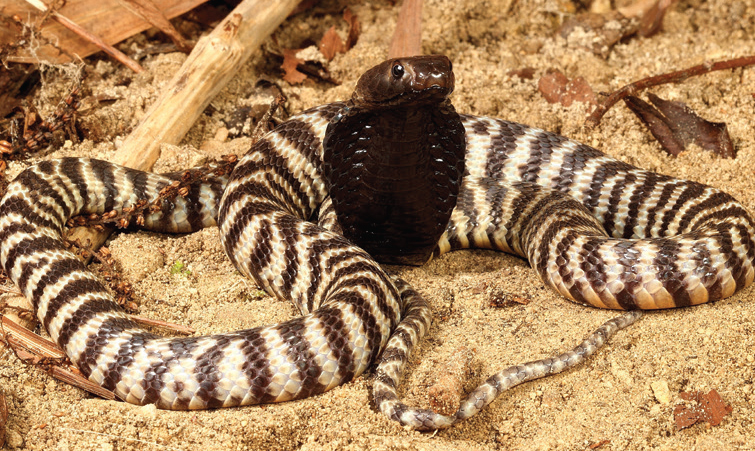
Namibia (Wolfgang Wuster).
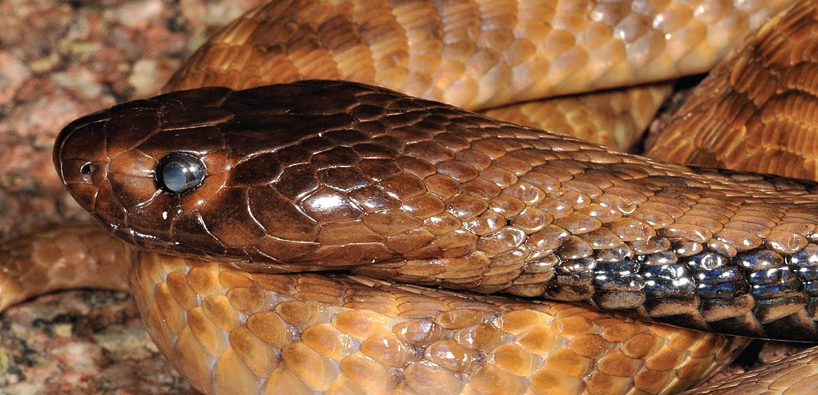
Angola (Bill Branch).
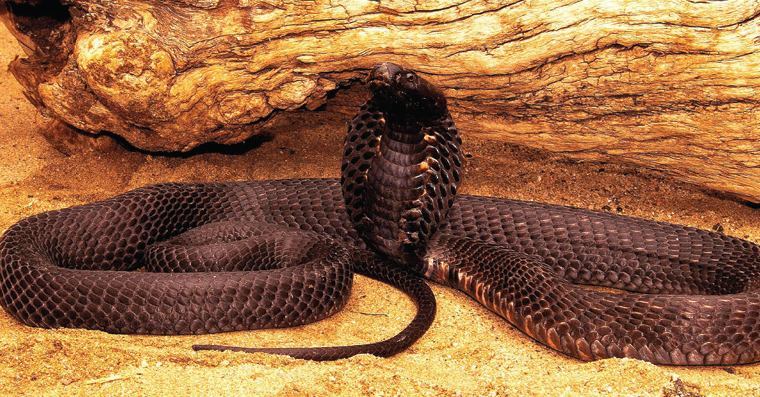
intergrade (Francois Theart).
Identification: A black spitting cobra of dry southern Namibia and western South Africa. It has a fairly large head and a large, dark eye with a round pupil. The body is cylindrical and the tail fairly long and thin, 15–20% of total length. The scales are smooth and glossy; in 21 rows at midbody; ventrals 221–228; subcaudals 65–74. Maximum size about 1.8m, average 0.9–1.4m; hatchlings 35–38cm. Adults are shiny black above and below, and juveniles purply-grey or grey with a black throat, darkening when around 70–80cm in length. North into Namibia, the bands appear.
Habitat and Distribution: Lives in rocky desert, hills, rocky outcrops and semi-desert, extending south into the shrublands and heathlands (fynbos) of Northern Cape and Western Cape, between sea level and 1,000m. It occurs west from Kimberley in South Africa, and north from Citrusdal up into Namibia, where it meets and intergrades with the Zebra Cobra (Naja nigricincta nigricincta) between 22°S and 25°S.
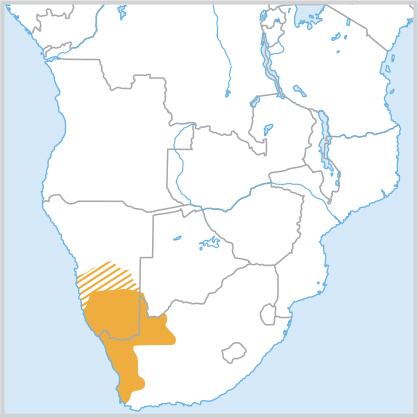
Naja nigricincta woodi
Natural History: Terrestrial, but it climbs well and often attempts to escape up trees. It is active by day and night, adults usually by night and juveniles particularly by day. Individuals shelter in holes, under ground cover or in rock fissures, tree cracks and termite mounds; they are often seen in dry riverbeds and crossing roads. When threatened, it will try strenuously to escape; it will spread a hood and spit if totally cornered, but does so reluctantly. It can also bite. Between 10 and 20 eggs are laid. This snake feeds on small vertebrates, including mammals, frogs, lizards and other snakes.
Medical Significance: A dangerous species in the southern half of Namibia and parts of the Northern Cape and Western Cape; it has a potent cytotoxic venom causing major damage to superficial tissues. This snake is active on the ground at night. However, its rarity and remote habitat mean it doesn’t often come into contact with humans. Bite victims should be transported rapidly to hospital. Antivenom is available, but treatment for any bite must also address the local tissue damage. Venom in the eyes should be treated by gently flushing the eye with large volumes of water; there is no need to inject antivenom. However, the more rapidly the eye is flushed out, the better; see our section on ‘Spitting snakes: first aid for venom in the eyes’. Anyone who has been spat at should visit a hospital or eye clinic for an assessment of the damage to the eye.
South-western Black Spitting Cobra, Naja nigricincta woodi.
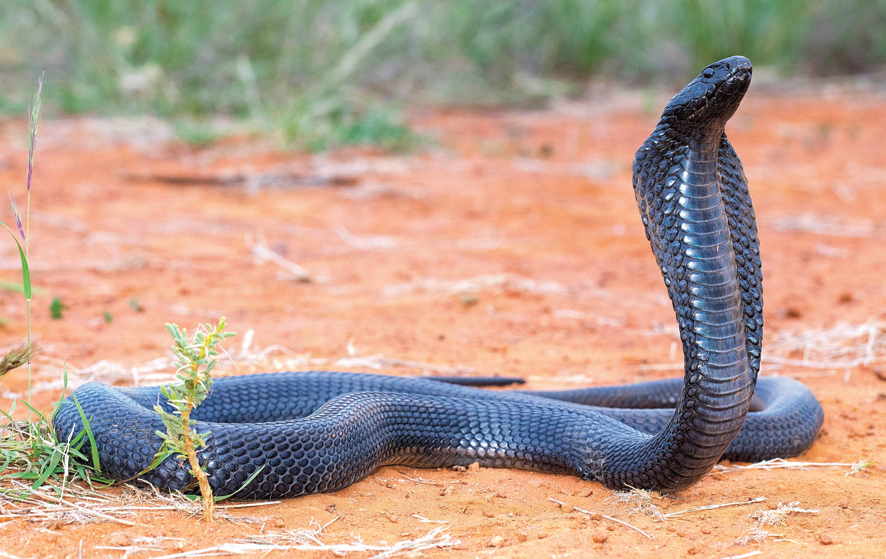
South Africa (Johan Marais).
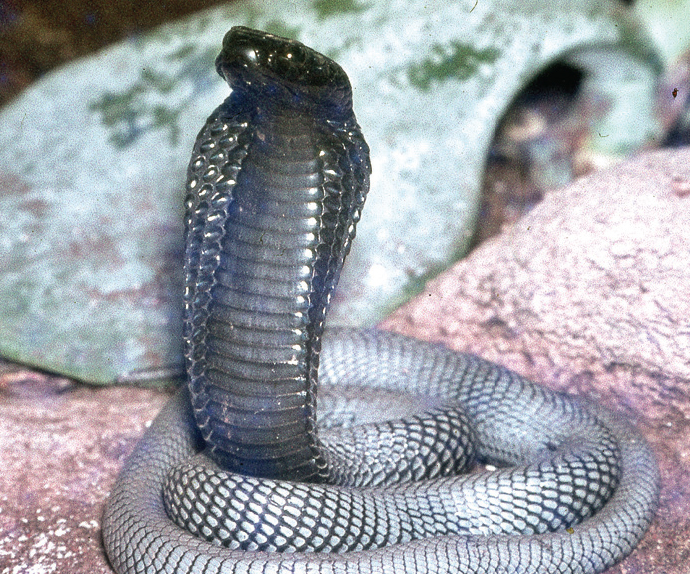
juvenile, South Africa (Richard Boycott).
Mozambique Spitting Cobra Naja mossambica
Identification: A medium-sized brown cobra of the savannas of south-eastern Africa. The head is blunt and the eye medium-sized, with a round pupil. The body is cylindrical and the tail quite long, 15–20% of total length. The scales are smooth; in 23–25 rows at midbody; ventrals 177–205; subcaudals 52–69. Maximum size usually about 1.5m (an unusual recent specimen was 1.8m), average 0.8–1.3m; hatchlings 23–25cm. The back colour is usually some shade of brown, or occasionally pinkish; juveniles may appear olive-green, while large adults may be very dark brown or grey. The underside is pale brown, orange, pinkish or grey; on the neck, throat and anterior third of the belly there is a mixture of black bars, half-bars, blotches and spots. Some specimens have only a few small markings; others have the throat heavily mottled with black. In some individuals the ventral scales are very dark. The skin between the scales is blackish and visible, giving a ‘net-like’ appearance in some specimens, and the scales on the side of the head (especially the lips) are usually black-edged.
Habitat and Distribution: Occupies a wide range of habitats, including coastal forest, woodland, thicket, moist and dry savanna and semi-desert, between sea level and about 1,800m. The northernmost records are of isolated populations on Pemba and Zanzibar Islands. From there, it occurs south and west from Morogoro across south-eastern Tanzania, southern Malawi and the southern quarter of Zambia, through virtually all of Mozambique (records are sporadic in the south) and Zimbabwe, to south-east Angola, most of northern and eastern Botswana, and northern South Africa, in Kwazulu-Natal.
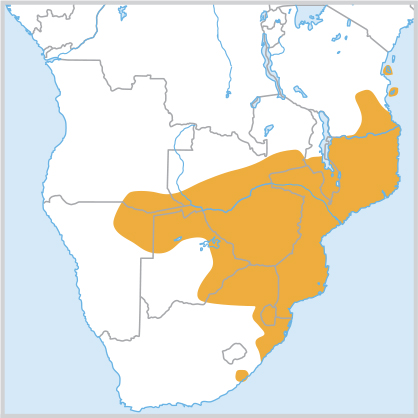
Naja mossambica
Natural History: Mostly terrestrial, but able to climb well; adults readily ascend low trees and even sleep in them. Adults are mostly active at night, but sometimes by day; juveniles are often active during the day, presumably to avoid competition with adults and/or to avoid being eaten by them. When not active, individuals shelter in termite hills, holes, rock fissures or under ground cover such as logs and brush piles. This species is very quick and alert; if molested it may rear up (sometimes quite high), spread a hood and spit readily (it can also spit without spreading a hood) to a distance of 2m or more. It sometimes pretends to be dead. Females lay 10–22 eggs, roughly 35 × 20mm, in December/January (summer) in southern Africa. The diet is quite varied; it is fond of amphibians but also takes lizards, rodents, other snakes (including its own kind) and even insects. It is often common; in a large snake collection from south-east Botswana it was the most abundant species.
Medical Significance: This snake represents a major snakebite hazard in southeastern Africa; in some areas it causes the majority of serious snakebites. It is common, adults are active on the ground at night, it tolerates suburbia due to its secretive habits, and it is often present in and around villages, smallholdings and even within large towns. It will spit in defence if it feels cornered, and is liable to be trodden on. In some curiously disturbing recent cases, particularly in South Africa, the snake entered a building and apparently bit a sleeping victim unprovoked, often multiple times. Bites were experienced almost anywhere on the body, including the face and the torso. This is unusual, as most snakebites result from a snake perceiving itself to be threatened and biting in defence. Possibly a sleeping human gives off some sort of signal (warmth or smell) that this snake associates with prey, although it might be that the snake was inadvertently restrained by the sleeper. The venom is predominantly and potently cytotoxic, causing agonising pain, swelling (which may involved the entire limb and spread to the trunk), discolouration, blistering and serious local long-term tissue damage. Occasionally, effects such as drowsiness occur. Deaths are rare, but treatment for the necrosis is often prolonged, complicated and very expensive. Antivenom is available. A bite is a medical emergency; it must be treated in a well-equipped hospital, and vigorous action to reduce the amount of tissue damage, probably involving early antivenom administration, must be taken. Venom in the eye is also a frequent result of an encounter with this snake, causing agonising pain, and, if untreated, corneal lesions and complications. The affected eye must be gently irrigated with large quantities of water. See our section on ‘Spitting snakes: first aid for venom in the eyes’. Anyone who has been spat at should visit a hospital or eye clinic for an assessment of the damage to the eye.
Mozambique Spitting Cobra, Naja mossambica.
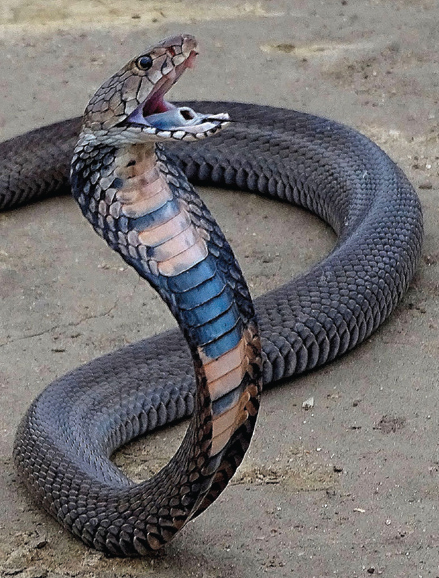
Mozambique (Mark-Oliver Rödel).
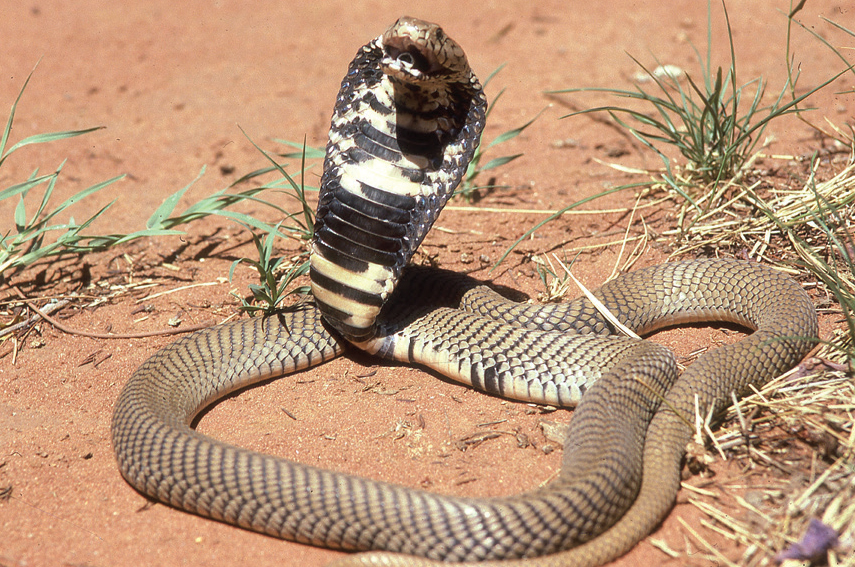
Botswana (Stephen Spawls).
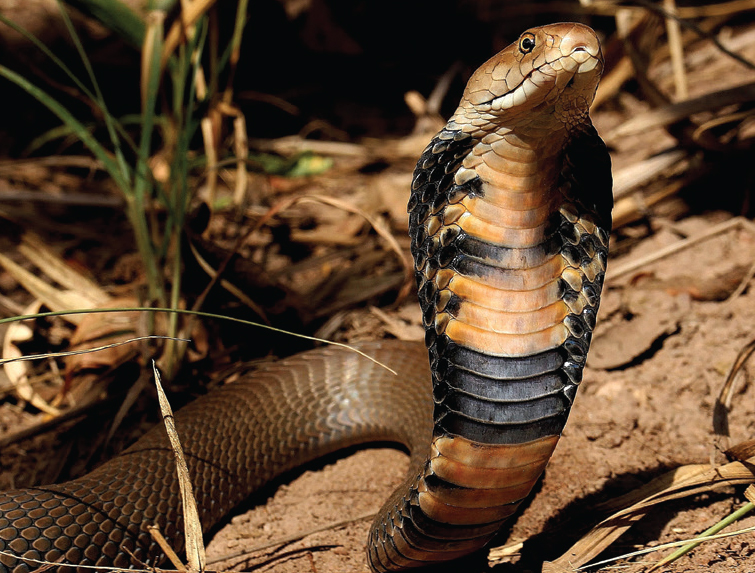
Malawi (Gary Brown).
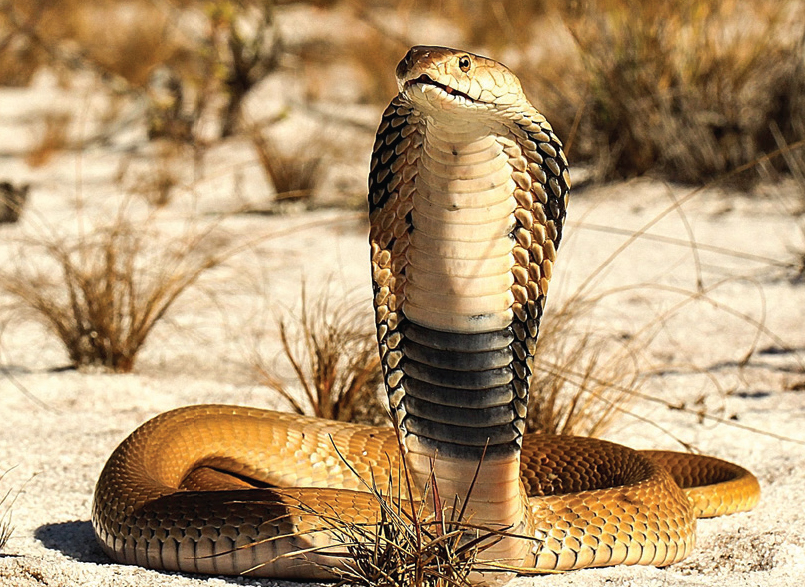
Northern Mozambique (Luke Verburgt).
West African Brown Spitting Cobra Naja katiensis
Identification: A small red-brown cobra of the West African savanna, between 10°N and 15°N. It is moderately thick, and has a small head and a large eye with a round brown pupil. The body is cylindrical and the tail fairly long. The scales are smooth; in 21–27 rows (usually 25) at midbody; ventrals 160–195; cloacal scale entire; subcaudals 42–65. Maximum size just over 1m (possibly more; there is an unsubstantiated report of a 1.4m specimen), average 50–80cm; hatchling size unknown, but probably 14–16cm. Usually reddish brown, warm brown or maroon, orange-brown on the flanks, and light orange-brown underneath. There is a broad dark band on the underside of the neck; this may form a ring, which may fade on large specimens.
Habitat and Distribution: Sudan savanna and semi-desert (Sahel), penetrating into the northern Guinea savanna, between sea level and about 900m. For example, in Nigeria it occurs at Zonkwa but not at Jos. It is not found in desert or dense woodland. It occurs from northern Cameroon westwards through northern Nigeria across to Senegal. Oddly, it is as yet unrecorded for Niger, but it probably occurs there as it is known immediately west in Burkina Faso.
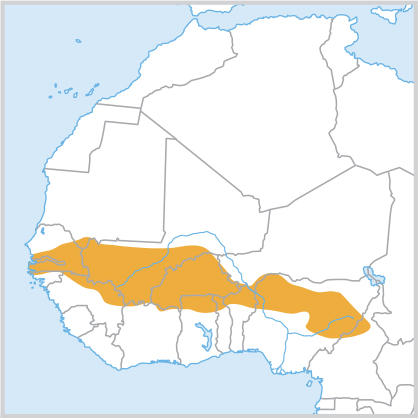
Naja katiensis
Natural History: Mostly terrestrial, but it will climb into low bushes. This snake is fast-moving and alert. It is active both by day and night, juveniles often moving around in the day. It shelters under logs, rocks and similar ground cover, or in holes. When disturbed it will usually try to make off, but if cornered it rears up and spreads a small, narrow hood; if further molested it will spit twin jets of venom at its adversary, to a distance of nearly 2m. It lays eggs, but no clutch details have been published. It eats mostly amphibians, but will take lizards, other snakes, birds and their eggs and rodents; insect remains were found in a Senegal snake, but these may have originated from an amphibian that the snake ate.
Medical Significance: Often common in parts of its range, active on the ground at night and liable to be trodden on, so probably a significant hazard, although there seem to be very few documented bites from this snake. An average wet venom yield of 100mg has been reported, and other cobras in this clade have predominantly cytotoxic venoms, causing swelling and local necrosis. The venom is probably produced in large quantities. As with other spitting cobras, a bite should be treated in a well-equipped hospital. Antivenom is available. Venom in the eye is also a frequent result of an encounter with this snake, causing agonising pain, and, if untreated, corneal lesions and complications. The affected eye must be gently irrigated with large quantities of water. Anyone who has been spat at should visit a hospital or eye clinic for an assessment of the damage to the eye.
West African Brown Spitting Cobra, Naja katiensis.
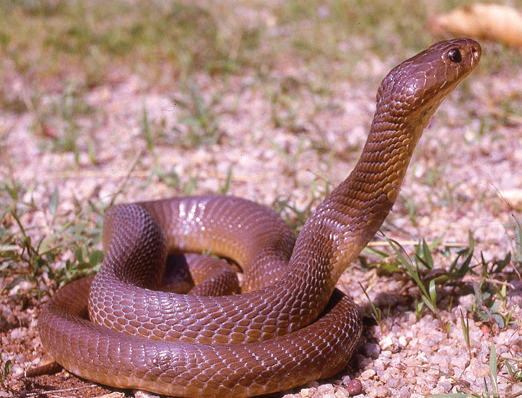
Nigeria (Gerald Dunger).
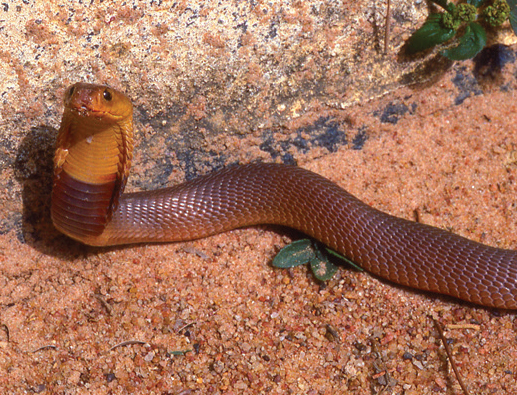
Ghana (Stephen Spawls).
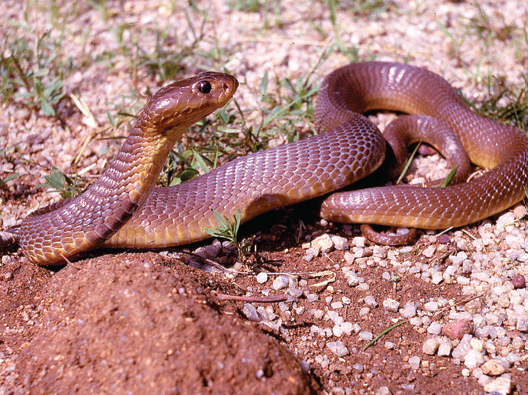
Nigeria (Gerald Dunger).
Red Spitting Cobra Naja pallida
Identification: A relatively small, usually reddish cobra of the dry country of the Horn of Africa. It has a smallish head and a large eye with a round pupil. The body is cylindrical and the tail fairly long, 15–19% of total length. The scales are smooth; in 21–27 rows at midbody; ventrals 192–228; subcaudals 56–81. Maximum size about 1.5m (possibly larger), most adults 0.7–1.2m; hatchlings about 16–20cm. The colour is variable; specimens from northern Tanzania and eastern and southern Kenya (especially those from red soil areas) are orange or red, with a broad black throat band several (sometimes two or three) scales deep, and a black ‘suture’ on the scales below the eye, giving the impression of a teardrop. They are reddish below, sometimes with a white chin and throat. Specimens from other areas may be pale red, pinkish, pinky-grey, red-brown, yellow or steel grey. Most, however, have the dark throat band. In large adults, this band may fade or disappear. Red specimens become dull red-brown with increasing size.
Habitat and Distribution: Dry savanna and semi-desert, from sea level to about 1,200m. This species occurs from Djibouti and northern Somalia south throughout Somalia and the Ogaden (and back up the Ethiopian Rift Valley to Awash National Park). It is found in extreme southern Ethiopia and most of northern and eastern Kenya, although it does not reach the coast. From Tsavo West National Park in Kenya it extends south into Mkomazi, in north-east Tanzania, and from Amboseli it occurs west in Kenya’s southern Gregory Rift Valley, through Magadi and Olorgesailie to Mount Suswa, and south into Tanzania past Lake Natron to Olduvai Gorge. It has also been recorded from Mjohoroni, just south of Mount Kilimanjaro. It is probably widespread in extreme south-east South Sudan, as it is known from near Torit and just across the border on the lower Omo River in Ethiopia; likewise, it is probably in north-east Uganda, but there are few records from those areas. A small yellowish cobra, possibly this species, was photographed in eastern Central African Republic (not shown on the map).
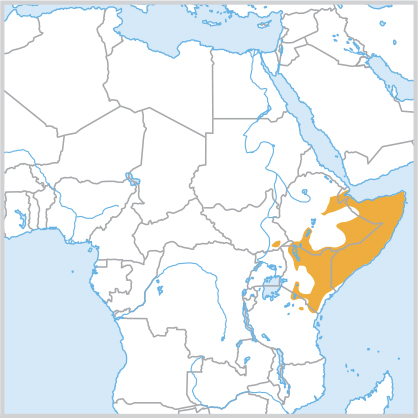
Naja pallida
Natural History: Terrestrial, but it may climb into bushes and low trees. It is quick-moving and alert. Adults are mostly nocturnal, hiding in holes (particularly in termite hills), brush piles, old logs or under ground cover during the day, but juveniles are often active during the day. When disturbed, it rears up relatively high and spreads a long, narrow hood, and may spit twin jets of venom to distances of 2–3m. It lays 6–15 eggs, about 50 × 25mm. A juvenile was taken on the eastern Tharaka Plain, Kenya, in October and at Olorgesailie in July. Amphibians are its favourite food; when the storms arrive in the dry country where this snake lives, the frogs all come out and the snake gorges itself. A specimen in Tsavo was found at night up in a thorn tree, eating foam-nest tree-frogs. It also takes rodents and birds, is known to raid chicken runs, and probably eats other snakes. It will come around houses in dry country looking for water, and for frogs that live in or near water tanks.
Medical Significance: Often common in parts of its range, active on the ground at night and liable to be trodden on, so probably a significant hazard, but there seem to be very few documented bites from this snake. The venom is cytotoxic, causing swelling and local necrosis. The venom is probably produced in large quantities. As with other spitting cobras, a bite should be treated in a well-equipped hospital. Antivenom is available. A surprising number of bites from this snake result from the snake entering buildings at night; it is feasible that, as with the Mozambique Spitting Cobra (Naja mossambica), a sleeping human gives off some signal (warmth or smell) that the snake associates with prey. A child treated in Garissa in Kenya for a bite on the elbow had no pain, but after 18 hours considerable swelling prompted incisions on the hand and elbow. There was no subsequent necrosis and recovery was complete. A bite at Voi in Kenya, on the sole of the foot, caused considerable pain; the patient received antivenom and an immediate anaphylactic reaction complicated matters; this was treated. Subsequent pain and swelling lasted four days and necrosis caused a 2cm hole around the bite puncture, which took months to heal. Many of the Somali people living around Wajir, in Kenya, had friends or relatives who had been bitten by this snake, but nobody knew of anyone who had died from a bite; the usual treatment was to eat something that caused vomiting. Venom in the eye is also a frequent result of an encounter with this snake, causing agonising pain, and, if untreated, corneal lesions and complications. The affected eye must be gently irrigated with large quantities of water. Anyone who has been spat at should visit a hospital or eye clinic for an assessment of the damage to the eye.
Red Spitting Cobra, Naja pallida.
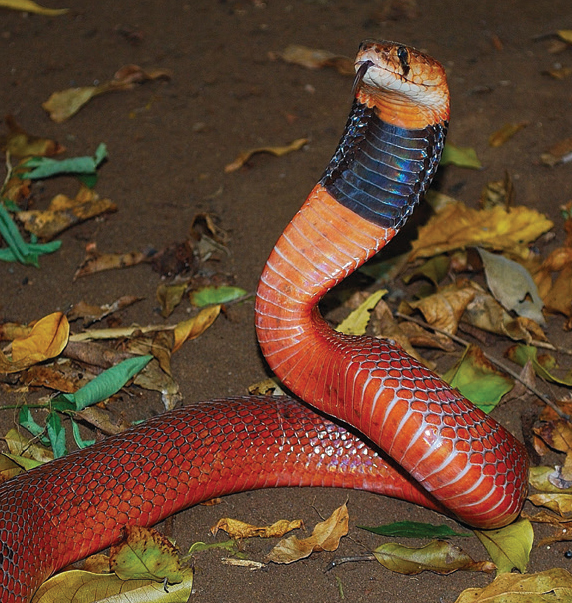
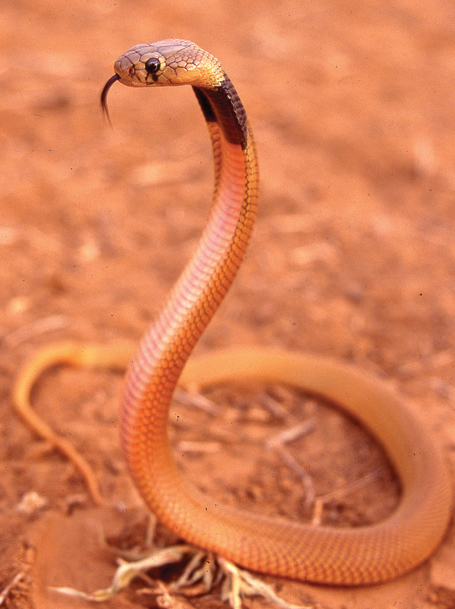
Kenya (Stephen Spawls).
Kenya (Sebastian Kirchof).
Kenya (Johan Kloppers).
Kenya (Konrad Mebert).
Nubian Spitting Cobra Naja nubiae
Identification: A relatively small, usually brown or grey cobra of the Nile Valley and north-east Africa. It has a smallish head and a large eye with a round pupil. The body is cylindrical, and the tail fairly long, 15–19% of total length. The scales are smooth; in 23–27 rows at midbody; ventrals 207–226; cloacal scale entire; subcaudals 58–72. Maximum size about 1.5m (possibly larger), most adults 0.7–1.2m; hatchlings about 16–20cm. The colour is variable, from warm brown to maroon, grey or olive; juveniles are usually lighter. The scales are sometimes black-edged, giving a net-like effect. There is usually a dark band on the neck, which may cross the underside of the hood, and below this are two dark bands that always cross the throat. There is a black ‘teardrop’ created by the black edging of the labial scales below and behind the eye. The underside is white, cream or brown.
Habitat and Distribution: Dry savanna, semi-desert, vegetated rocky hills and riverside vegetation, from sea level to about 1,500m. This species occurs from Asyut in Egypt, on the Nile, south along the Nile Valley to Khartoum in Sudan, and possibly further south. It is also found in extreme eastern Sudan and Eritrea. Apparently isolated populations are known from Gebel Elba in south-east Egypt, on Jebel Marra in western Sudan, in the Ennedi Massif in north-east Chad and in the Air Mountains in northern Niger; this distribution suggests these snakes were more widespread when the Sahara area was wetter and have become isolated in pockets of highland with higher rainfall than the surrounding desert.
Naja nubiae
Natural History: Terrestrial, but it may climb into bushes and low trees. This snake is quick-moving and alert. Adults are mostly nocturnal, hiding in holes, rock fissures or under ground cover during day, but juveniles are often active during the day. When disturbed, it rears up and spreads a hood, and may spit twin jets of venom. It apparently swims well. Females lay eggs. The diet is probably similar to that of the Red Spitting Cobra (Naja pallida), although captive animals feed readily on mice. This species is often used by Egyptian ‘snake charmers’, despite the fact that it can spit and thus represents a hazard to all observers.
Medical Significance: Fairly common in parts of its range, active on the ground at night and liable to be trodden on, so probably a significant hazard, but there seem to be very few documented bites from this snake. The venom is cytotoxic, causing swelling and local necrosis. The venom is probably produced in large quantities. As with other spitting cobras, a bite should be treated in a well-equipped hospital. Venom in the eye is also a frequent result of an encounter with this snake, causing agonising pain, and, if untreated, corneal lesions and complications. The affected eye must be gently irrigated with large quantities of water. Anyone who has been spat at should visit a hospital or eye clinic for an assessment of the damage to the eye.
Nubian Spitting Cobra, Naja nubiae.
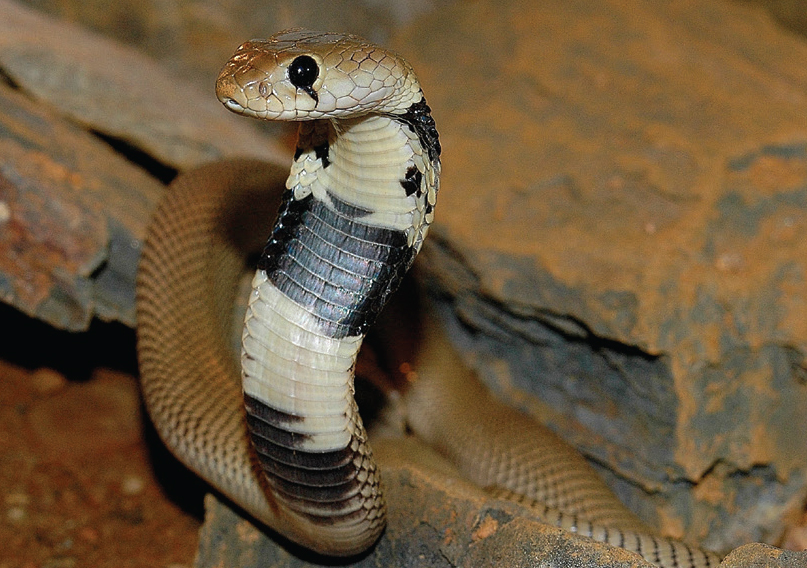
hatchling (Tomáš Mazuch).
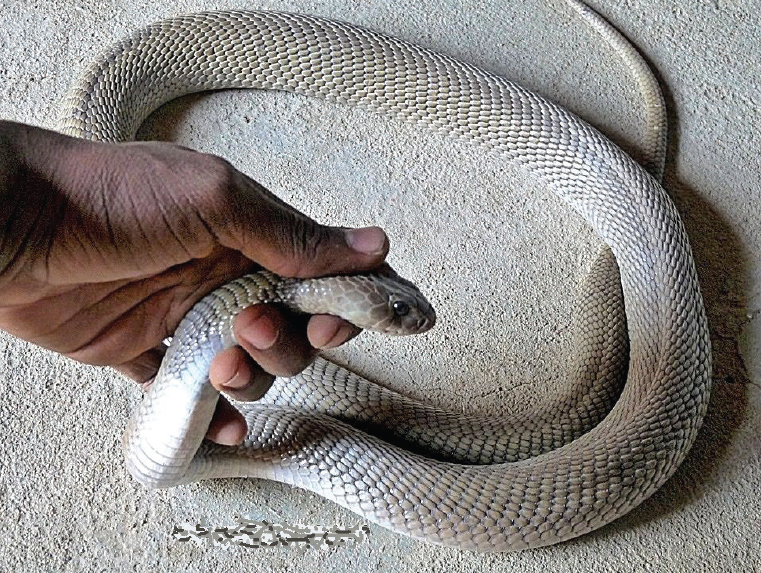
Sudan (Abubakr Mohammed).
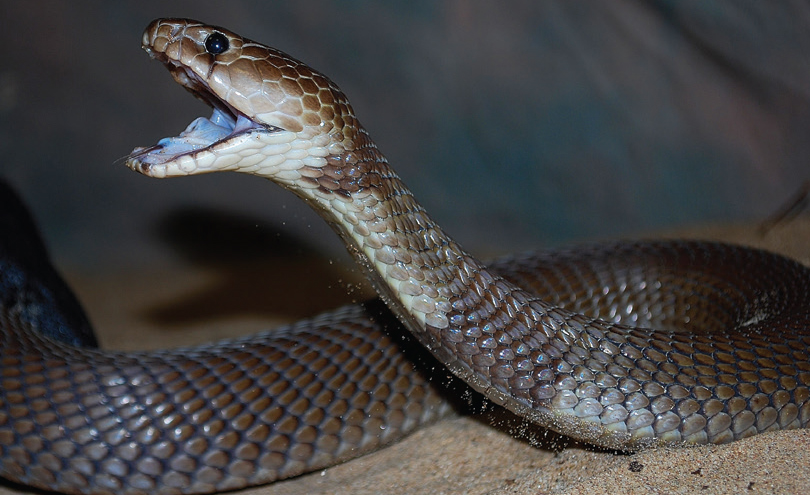
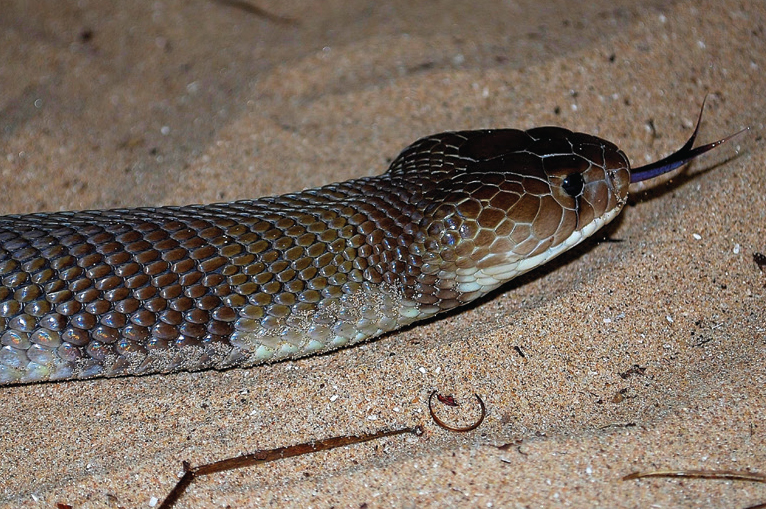
Egypt (Stephen Spawls).
Tree cobras occur in forested tropical Africa. Two species are known. They are large, agile black or dark brown tree snakes with huge eyes. They look like a cross between a mamba (Dendroaspis) and a cobra; recent molecular work indicates they are the sister species to true cobras. In medical terms they are not very significant; being alert tree snakes that live in forest, they rarely come into contact with people. They have potent neurotoxic venoms, presumably causing a descending paralysis. A bite victim in DR Congo died in 12 hours. No antivenom is available, but the polyvalent antivenom produced by South African Vaccine Producers (SAVP) is reported to be effective at neutralising tree cobra venom.
Key to the genus Pseudohaje, tree cobras
1aScales usually in 13 rows on the anterior body; ventrals 180–187; occurs mostly west of the Dahomey Gap……Pseudohaje nigra, Black Tree Cobra
1bScales usually in 15–17 rows on the anterior body; ventrals 185–205; occurs mostly east of the Dahomey Gap……Pseudohaje goldii, Gold’s Tree Cobra
Gold’s Tree Cobra Pseudohaje goldii
Identification: A large, thin-bodied, shiny tree cobra with a short head. The eye is huge and dark, with a round pupil. The body is cylindrical and the tail long and thin, 22–25% of total length; it ends in a spike, which is probably a climbing aid. If held by the head this snake will drive the spike into the restraining arm. The scales are smooth and very glossy; in 15 rows (occasionally 13 or 17) on the front half of the body, reducing to 13 rows slightly past midbody; ventrals 185–205; subcaudals 76–96. Maximum size 2.7m (perhaps slightly larger); most adults average 1.5–2m; hatchlings 40–50cm. The skin is very fragile, and tears or abrades easily. The body is glossy black above, and the scales on the chin, throat and side of the head are yellow edged with black. Juveniles have several yellow cross-bars or bands, narrowing towards the tail, becoming scattered yellow scales on the back half; some juveniles have upward-pointing yellow triangles low on the flanks, coincident with the cross-bars.
Habitat and Distribution: In primary and altered forest, forest islands, swamp and mangrove forest and, surprisingly, in suburbs and even wooded savanna, between sea level and about 1,700m. It occurs from the Albertine Rift, westwards across the great Central African forests to south-eastern Nigeria, south to north-west Angola, and north into scattered woodlands in Central African Republic. There are isolated records from the Kakamega area in Kenya, the shore of Lake Victoria, Mabira Forest and the Kibale area of Uganda, and from forests in southern Ghana; there is a curious record from Ivory Coast, and this species is historically reported from Bioko Island.
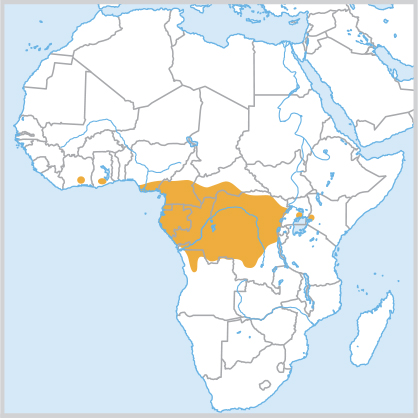
Pseudohaje goldii
Natural History: Very poorly known. This snake is arboreal, but will descend to the ground. It is quick and alert, climbs fast and well, and moves rapidly on the ground, often with the head raised. It is active during the day, but might also be nocturnal. In Kenya, specimens have been found in squirrel traps and in trees along rivers, specimens in eastern DR Congo are reportedly common in oil palm plantations, in West Africa this species has been found in fish traps, and a survey in Nigeria found most individuals fairly close to waterbodies. Gold’s Tree Cobra is not an aggressive species, but if molested or restrained it can flatten the neck into a very slight hood (nothing like as broad as a cobra’s), and may move forward with the head raised and try to bite; specimens have been seen to make rapid direct strikes. If disturbed, this snake will pause with the head up, moving it from side to side like a metronome. Male–male combat has been observed in Nigeria in January. Females lay 10–20 eggs, approximately 50 × 25mm. A hatchling was captured in September in the Ituri Forest in DR Congo. Nigerian specimens had eaten frogs, mudskippers and other fish, a small hinged tortoise and rats; specimens were taken in squirrel traps in Kakamega, suggesting it eats arboreal mammals. It has been reported as descending to the ground to feed on terrestrial amphibians, but ascending to then digest its prey. It is prized as a human food in eastern DR Congo, but in the same area it has a fearsome reputation, being said to retaliate readily if molested. Captive animals remain alert and are quick to attempt to escape.
Medical Significance: Rarely comes into contact with humans, being an alert diurnal tree snake with good eyesight; it moves rapidly away from confrontation, although a collector described it as being quick to try to bite if it thinks it is cornered. The venom is a potent neurotoxin; a snake collector in eastern DR Congo was bitten during a demonstration and died within 12 hours. South African Vaccine Producers (SAVP) polyvalent antivenom, although not prepared for this snake, is reportedly effective against the venom. A bite case would need to be transported rapidly to hospital, and respiratory support may be needed.
Gold’s Tree Cobra, Pseudohaje goldii.
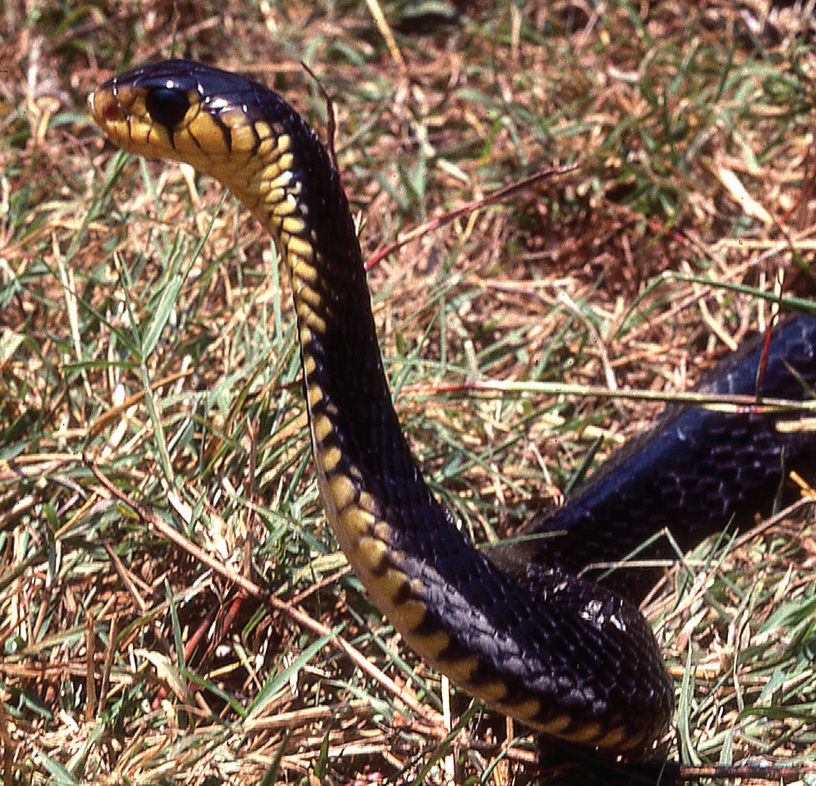
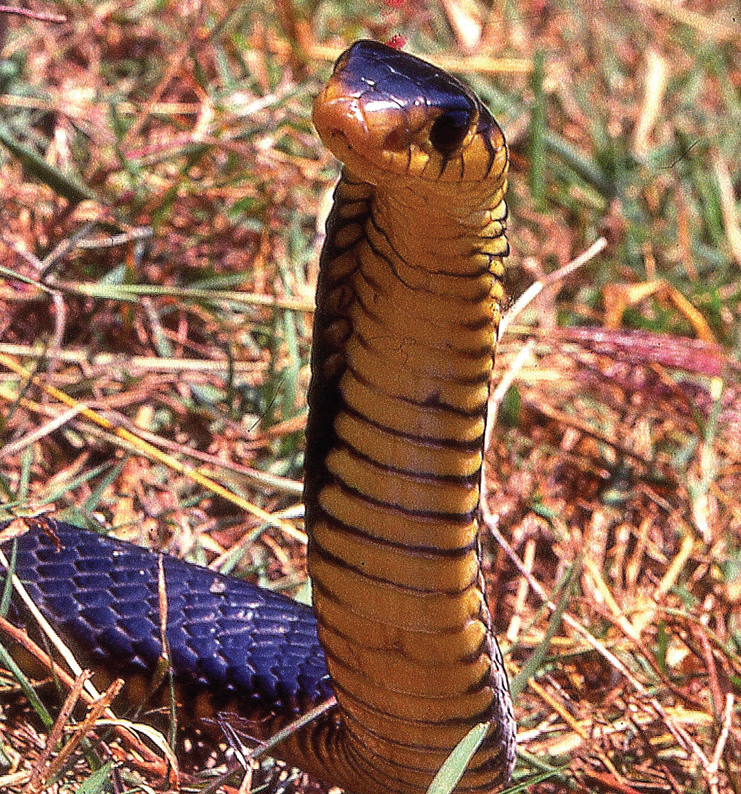
Kenya (Stephen Spawls).
Identification: Virtually identical to Gold’s Tree Cobra (Pseudohaje goldii). A large thin-bodied, shiny tree cobra with a short head. The eye is huge and dark, with a round pupil. The body is cylindrical and the tail long and thin, 20–22% of total length; it ends in a spike. The scales are very smooth and glossy; in 15 rows on the neck but 13 rows at midbody; ventrals 180–187; subcaudals 74–82. Maximum size 2.2m (possibly larger); most adults average 1.6–2.1m; hatchling size unknown, but probably 35–45cm. The colour is black, shiny brownish black or shiny deep brown above, and the scales on the chin, throat and side of the head are yellow edged with black.
Habitat and Distribution: Forest or thick woodland, between sea level and about 800m, or possibly higher. It is often found near rivers, and might extend out of the forest proper in riverine forest; a specimen from Kintampo in Ghana was in Guinea savanna woodland with stands of tall trees and almost continuous canopy. This is essentially a West African forest snake; it occurs from Ghana west to Sierra Leone and Guinea (although records are lacking from Ivory Coast.). There are isolated records from hill forests on the Ghana–Togo border, and from Enugu in Nigeria, although recent research in Nigeria failed to find the species and suggests it might no longer occur there.
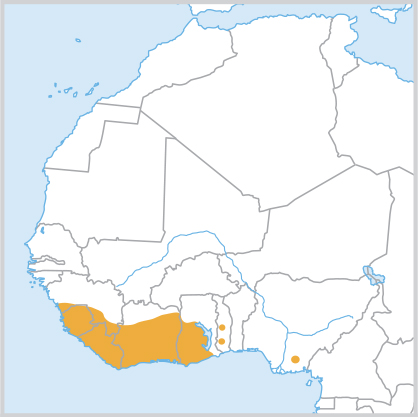
Pseudohaje nigra
Natural History: Very poorly known; almost nothing is published, but it is probably similar to Gold’s Tree Cobra. It is presumably arboreal, but will descend to the ground. It is very quick-moving in trees, climbing fast and well, and moves rapidly on the ground, often with the head raised and alert; if disturbed it will pause with the head up. Both active and resting specimens have been captured during the day, and it might be predominantly diurnal or nocturnal. This snake has been described as ‘a cross between a mamba and a cobra’. It might be able to flatten the neck slightly, as can Gold’s Tree Cobra. Females lay eggs. This snake probably eats amphibians, and maybe mammals.
Medical Significance: As for the previous species.
Black Tree Cobra, Pseudohaje nigra.
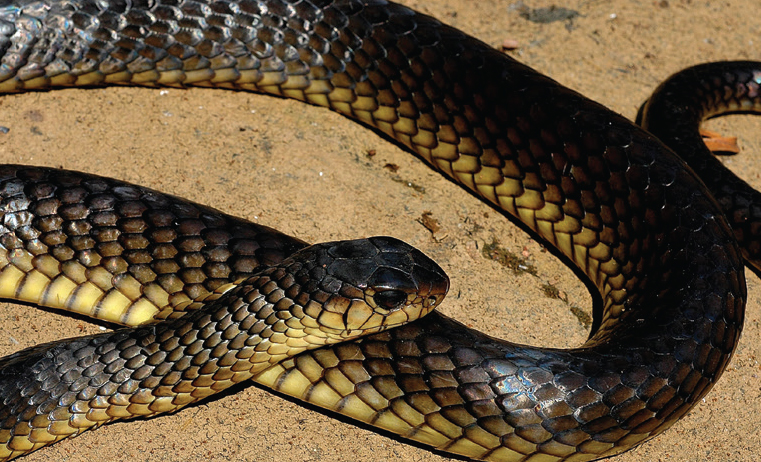
Guinea (Jean-Francois Trape).
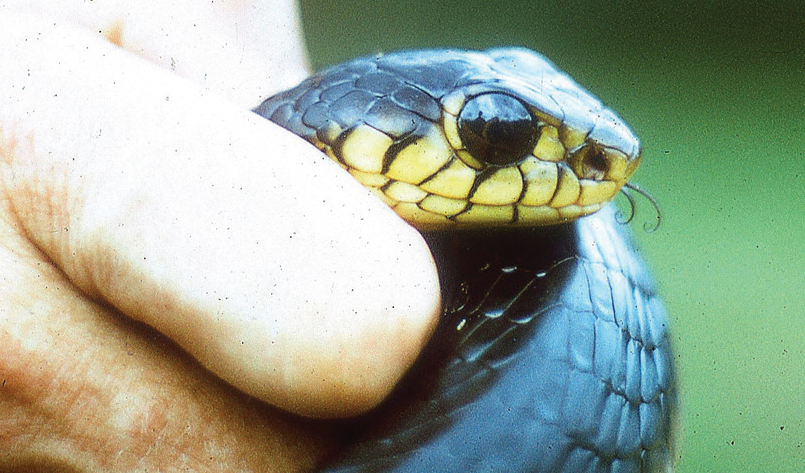
Ghana (Barry Hughes).
Black desert elapids; two species occur in the dry country and deserts of Egypt and the Middle East, the eastern species (Walterinnesia morgani) being recently elevated from the synonymy of the western form (Walterinnesia aegyptia). They are fairly large, quick-moving black elapid snakes with a medium-sized, broad head. The body is stocky and cylindrical, and the scales smooth. Although rare, they are alert and will bite if cornered; a few bite cases are documented. They are not aggressive, but can strike a long way. The venom is neurotoxic and has caused deaths, although no recent fatalities are documented. They are closely related to cobras but do not spread a hood, so the name ‘black desert cobras’, although widely used, is not appropriate as it may lead to confusion with black-coloured Egyptian Cobras (Naja haje).
Desert Black Snake Walterinnesia aegyptia
Identification: A large black snake of the Egyptian desert, usually active at night. It has a fairly broad head, slightly distinct from the neck, and a smallish, dark eye with a round pupil (which is hard to see). The body is cylindrical and the tail long and thin, 12–15% of total length, ending in a spike. The scales are smooth and glossy; in 23 rows at midbody; ventrals 186–198; subcaudals 43–53, largely single but, unusually, some are often in pairs. Maximum size about 1.3m, average 0.8–1.2m; hatchlings 20–35cm. The colour is black or dark grey, often with a bluish sheen, and paler whitish grey or sometimes yellow-brown beneath. This snake becomes grey before sloughing. The sides of the head and lip scales are often lighter in Egyptian animals, becoming light grey or yellow-brown on the snout.
Habitat and Distribution: Known from rocky desert, gravel or sandy plains, vegetated wadis and hilly and mountainous desert. However, it is seemingly more common near agriculture and irrigated areas, and in and around desert and desert-fringe settlements and oases (although this might be simply due to the fact that the collectors favoured these spots rather than deep desert). It is absent from extensive areas of soft sand and dunes. This species occurs between sea level and 1,200m (possibly higher; Walterinnesia morgani ascends to over 2,000m in mountains). In Africa, it occurs eastwards and north-eastwards from Cairo into the Sinai Peninsula (there are few records from the interior of the Sinai), then into Israel, Jordan and the north-west corner of Saudi Arabia; Walterinnesia morgani occurs further east. There are no credible records west of the Nile, but it might occur in Egypt’s eastern desert, as people living there know of a large black desert snake.
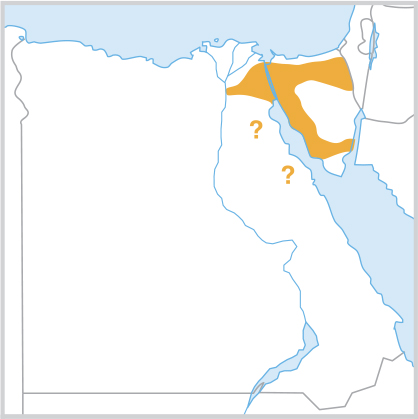
Walterinnesia aegyptia
Natural History: Secretive, terrestrial and largely nocturnal, it lives in holes, rock fissures and under ground cover. It emerges at night to hunt, and is known to be active on relatively cold nights. This is a quick-moving and alert snake; if confronted, it hisses loudly and raises the body, preparing to strike, but in an angled S-shaped coil, not vertically elevated like in a cobra. If teased it may also vibrate the tail vigorously, and then hide the head and neck under its coils, defecate and release a foul-smelling fluid from the cloaca. However, it seems reluctant (at least in captivity) to actually strike, tending instead to bang the aggressor with the mouth closed. It lays 2–20 eggs; captive animals laid in May and the eggs hatched 74–77 days later, which fits with the idea of the newborns being able to put on weight before the winter. This snake feeds on a wide range of vertebrates; it is fond of toads around oases, and in the desert feeds on dabb or spiny-tailed lizards, and is often found in areas where these lizards occur. Captive juveniles are very reluctant feeders but accepted lacertid lizards and dead carpet vipers (Echis); most African elapids will eat other snakes. This species is sometimes used by snake charmers (including one who thought it was harmless). Animal collectors exporting these snakes from Egypt often flush them from their holes using petrol or exhaust fumes, leading to damage to, and subsequent high mortality of, captive animals.
Medical Significance: A seemingly rare snake, and apparently reluctant to bite, so not of major clinical significance. However, it is active on the ground at night and liable to be trodden on, and a few daytime bites are also recorded, where the snake was disturbed during building or agricultural work. The venom is neurotoxic, and laboratory studies also indicate some haemorrhagic activity. Antivenom is available. A series of bite cases in Israel resulted in localised pain and swelling, fever, generalised weakness, nausea and vomiting; there were no fatalities. A bite in Iraq from Walterinnesia morgani caused severe weakness, intense numbness at the bite site, respiratory distress and double vision; the victim was treated with antivenom and recovered completely. A known fatal case occurred in Iraq in the 1930s; the victim died several hours after the bite. As with other large elapids, a bite should be treated in a well-equipped hospital.
Desert Black Snake, Walterinnesia aegyptia.
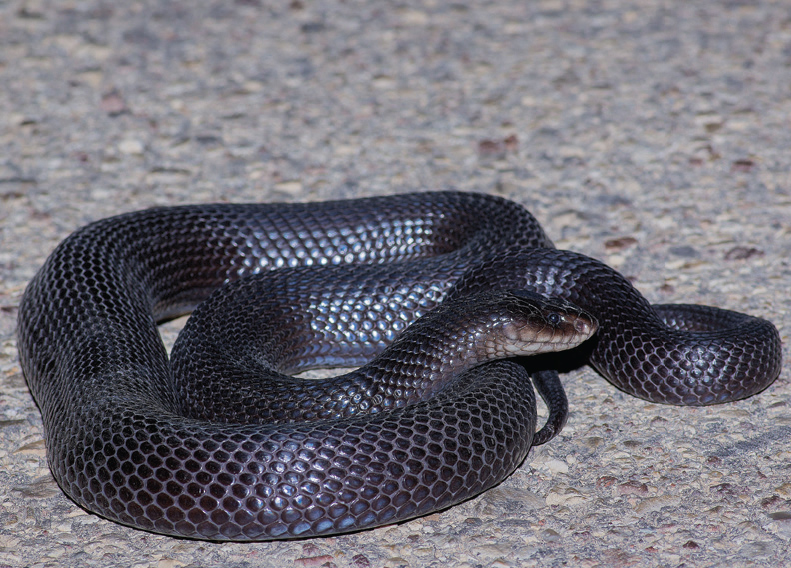
Israel (Yannick Francioli).
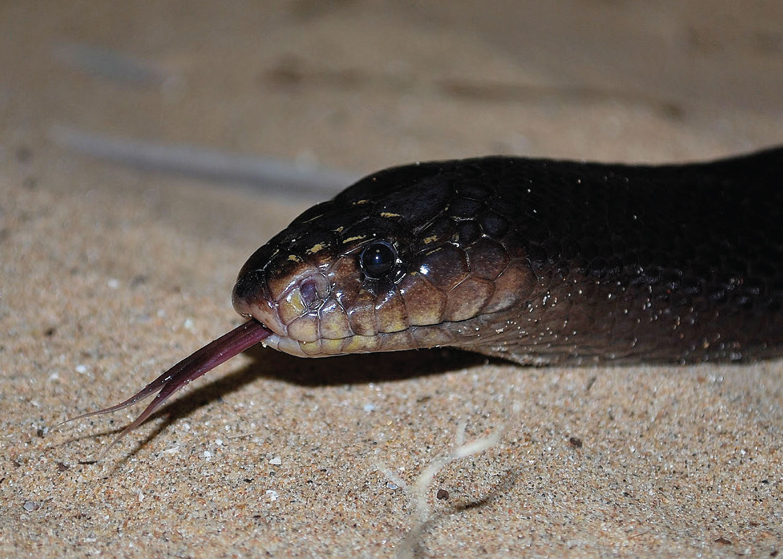
Egypt (Stephen Spawls).
A genus containing two small, attractive, rather stout nocturnal elapids of southern Africa, originally known as the Coral Snake and the Shield-nose Snake. They have a large, prominently protruding rostral scale that shields the nose, hence the name. Although not true cobras, they will rear up and spread a very narrow hood. They lie within a clade that includes all true cobras, and their closest relatives (at present) appear to be the desert black snakes, Walterinnesia. They are not regarded as medically significant, as they are secretive and nocturnal. However, they can be locally common, especially in the rainy season, and they are active on the ground at night and willing to bite. No antivenom is available. There are conflicting reports about their venom, with reports of both cytotoxic and neurotoxic effects, and at least one is known to have caused the death of a child. They need to be treated with care.
Key to the genus Aspidelaps, shield cobras
1aVentral scales 139–179; dorsal surface usually finely banded; usually found south of 27°S (except in Namibia)……Aspidelaps lubricus, Coral Shield Cobra
1bVentral scales 108–125; dorsal surface usually blotched or speckled but not finely banded; usually found north of 27°S……Aspidelaps scutatus, Speckled Shield Cobra
Coral Shield Cobra (Coral Snake) Aspidelaps lubricus
Identification: A small, stocky snake, often banded, of the dry country of south-western Africa. It has a short head with a prominent rostral scale, and a huge dark eye with a round pupil. The body is cylindrical and the tail relatively short, 9–14% of total length. The scales are smooth and glossy; in 19–21 rows at midbody; ventrals 139–179; cloacal scale entire; subcaudals 17–38. Maximum size just under 80cm; most adults average 40–60cm; hatchlings 15–20cm. The colour is variable; southern animals of the subspecies Aspidelaps lubricus lubricus are orange with black bands, and with a black bar on the head through the eyes, leading to the jocular name ‘bandit snake’. In large adults the dorsal banding may be less prominent. The bands fade going northwards, and some northern Namibian and Angolan animals are uniform grey or grey-brown; this is the subspecies A. l. cowlesi. The bars extend to the underside, which is thus barred black and cream or white.
Habitat and Distribution: In shrub and heathland (fynbos), on rocky hills, and in dry, stony soil or sandy regions in dry savanna, semi-desert and desert, between sea level and 1,800m, or sometimes slightly higher. It extends westwards from the eastern Free State and Port Elizabeth in the Eastern Cape to the western coastline in South Africa, then north up through Namibia. Aus is about the northernmost record for the subspecies Aspidelaps lubricus lubricus; the subspecies A. l. cowlesi occurs north of about 25°S, extending into south-western Angola.
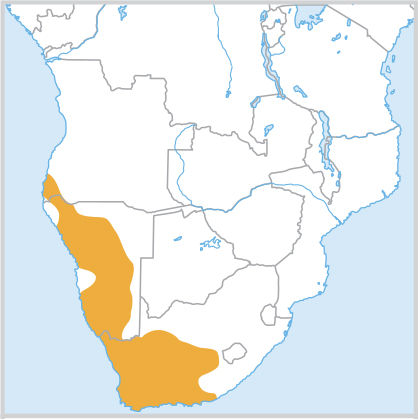
Aspidelaps lubricus
Natural History: A nocturnal terrestrial snake, said to be active throughout the night, even at relatively low temperatures; a number of specimens have been captured while crossing roads at night. It shelters during the day under rocks or in holes, abandoned termitaria and rock crevices. Captive animals have been observed excavating shelters beneath rocks by digging with the nose and scooping the sand with the neck. When threatened, this snake rears up and flattens the neck like a true cobra, presenting a narrow hood. If further molested, it will produce a loud, short, explosive hiss and may lunge forward in an attempt to bite. Male–male combat is recorded. Mating occurs in the southern spring. Three to 11 eggs are laid, roughly 20 × 30mm, and hatch in around two months. The diet includes lizards, small snakes, reptile eggs and rodents; captive snakes take rodents readily.
Medical Significance: Its fairly small range, mostly in inhospitable country, lessens the danger posed by this snake. However, it is active on the ground at night, and sometimes present in numbers, which increases the risk. Its venom is neurotoxic. Early work found the venom caused respiratory distress, leading to death in mice. Lethal doses similar to that of the Black Mamba (Dendroaspis polylepis) were recorded, although the amounts produced were very small. No antivenom is available. Although most bites on humans seem to cause only pain, and no definite fatalities are reported, a snake keeper who was bitten twice was vomiting an hour after the bite; his upper body muscles became paralysed and he stopped breathing and needed respiratory support. Twelve hours later the symptoms resolved. In addition, one of these snakes was found in a dwelling in northern Namibia where two children had died from snakebite, although another snake might have been responsible. Bite victims should visit a hospital, where symptomatic treatment can be given.
Coral Shield Cobra, Aspidelaps lubricus.
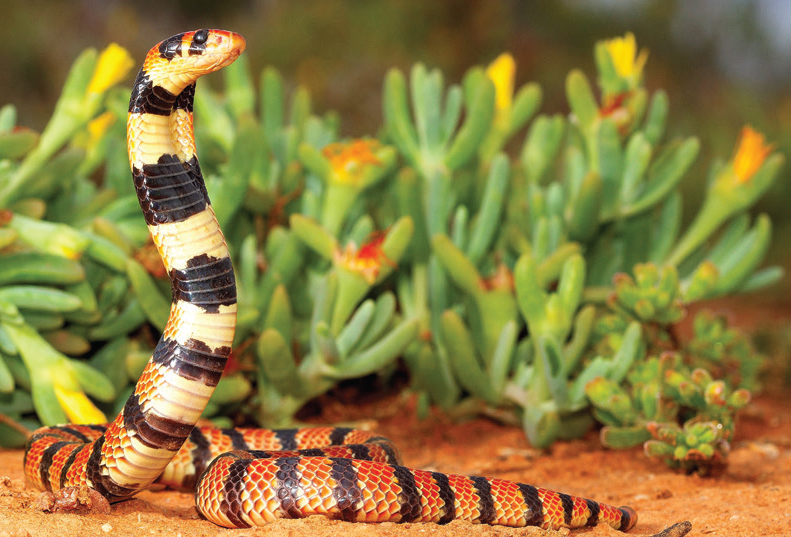
South Africa (Tyrone Ping).
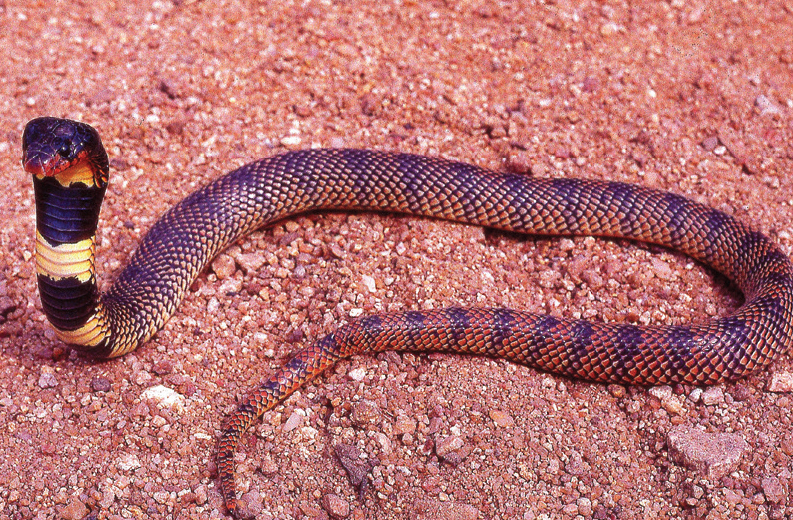
Namibia (Stephen Spawls).
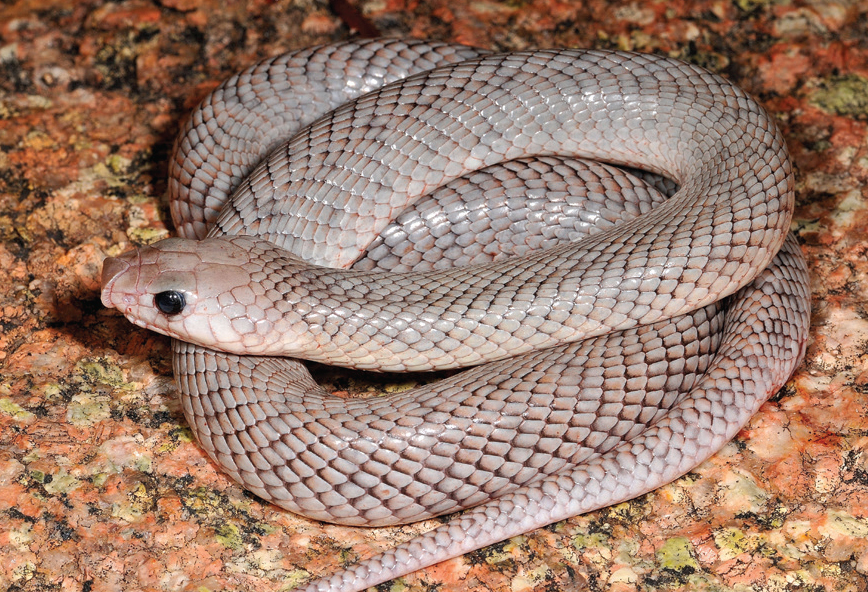
Angola (Bill Branch).
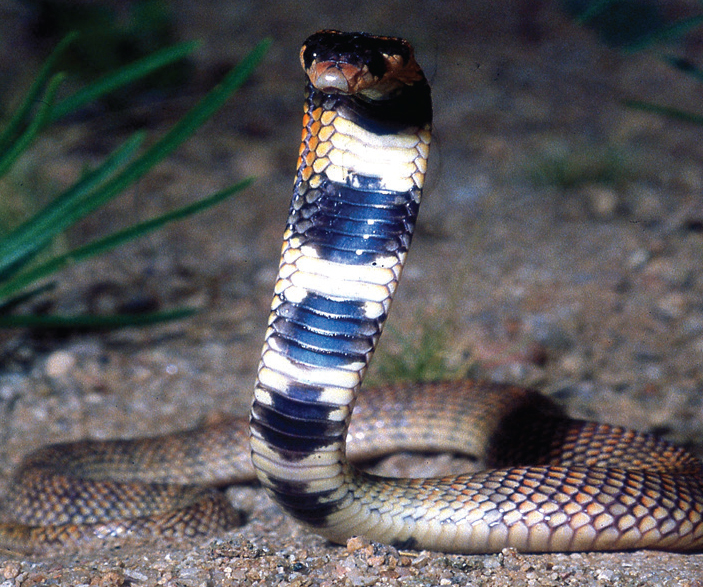
Namibia (Richard Boycott).
Speckled Shield Cobra (Shield-nose Snake) Aspidelaps scutatus
Identification: A small, stocky snake, often with a black neck, of the savannas and semi-desert of southern Africa. It rears up like a cobra. It has a short head with a prominent rostral scale, and a huge dark eye with a round pupil. The body is cylindrical and the tail relatively short, 12–17% of total length. The scales are smooth and glossy; in 21–23 rows at midbody; ventrals 108–125; cloacal scale entire; subcaudals 19–39. Maximum size around 75cm; most adults average 40–60cm; hatchlings 14–20cm. The colour is variable. The two main subspecies (Aspidelaps scutatus scutatus and A. s. intermedius) are both usually various shades of brown or pinky-brown, or sometimes orange or grey, and uniform or spotted or speckled to a greater or lesser extent. In some individuals (especially of the extreme eastern subspecies, A. s. fulafula) the back has large black spots that almost become cross-bars. The head and neck are often black, to a greater or lesser extent, and the underside is cream, white or grey, usually with a broad, deep black neck bar.
Habitat and Distribution: In semi-desert and moist and dry savanna, between sea level and 1,400m, or sometimes slightly higher. It occurs in northern Namibia, most of Botswana except the south-west corner, the northern provinces of South Africa, southern Mozambique, and western, southern and south-east Zimbabwe. Those in eastern Mpumalanga and Limpopo are the subspecies Aspidelaps scutatus intermedius; those in south-eastern Zimbabwe and Mozambique are the subspecies A. s. fulafula; and those in the remainder of the range are the nominate subspecies, A. s. scutatus.
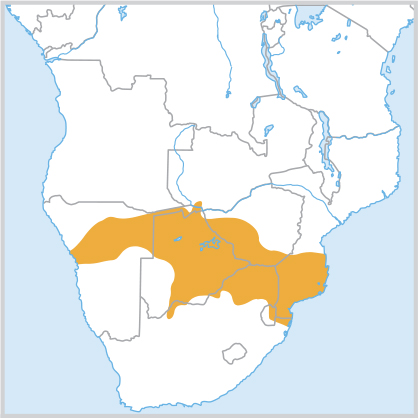
Aspidelaps scutatus
Natural History: A nocturnal and terrestrial snake, said to be active throughout the night, even at relatively low temperatures; a number of specimens have been captured while crossing roads at night. It shelters during the day under ground cover, in holes and in abandoned termitaria, and may bury itself in leaf litter or loose sand. When threatened, this snake rears up and flattens the neck like a true cobra, presenting a narrow hood. If further molested, it will produce a very loud, short, explosive hiss and may lunge forward in an attempt to bite. If repeatedly teased, it may sham (feign) death. Male–male combat is recorded. Mating occurs in the southern spring. Four to 11 eggs are laid, roughly 20 × 30mm, and hatch in just over two months. This species seems to feed readily on most small vertebrates, including snakes. Six individuals were found in a single night in south-east Zimbabwe, waiting in ambush for gerbils; they have also been observed taking winged termites. Captive animals readily eat rodents and toads.
Medical Significance: This snake is quite widespread in southern Africa, and parts of its range are densely populated; it is also active on the ground at night, and sometimes present in numbers, which increases the risk. On one wet night in Mpumalanga five were found on the road. There are conflicting reports on the effects of its venom; it has caused both cytotoxic (swelling and local pain) and neurotoxic symptoms (facial muscle weakness and respiratory distress). The lethal dose for a mouse was about twice that of a Cape Cobra (Naja nivea). No antivenom is available. A single fatality is documented: a four-year-old child died 16 hours after a bite from this snake; she stopped breathing. Bite victims should visit a hospital, where symptomatic treatment can be given.
Speckled Shield Cobra, Aspidelaps scutatus.
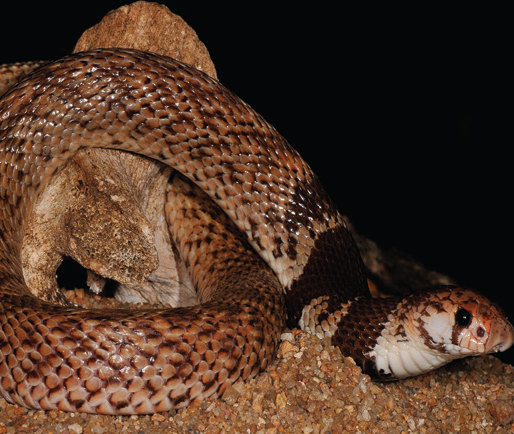
South Africa (Bill Branch).
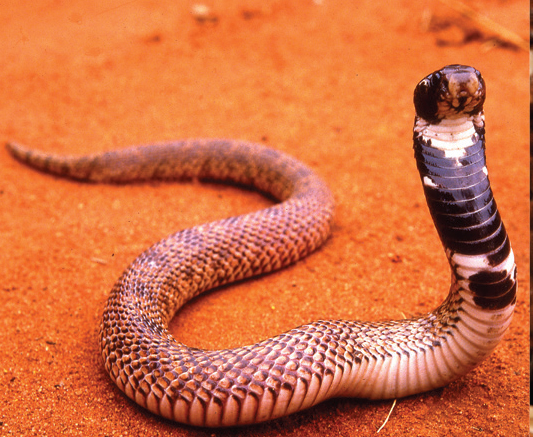
Botswana (Stephen Spawls).
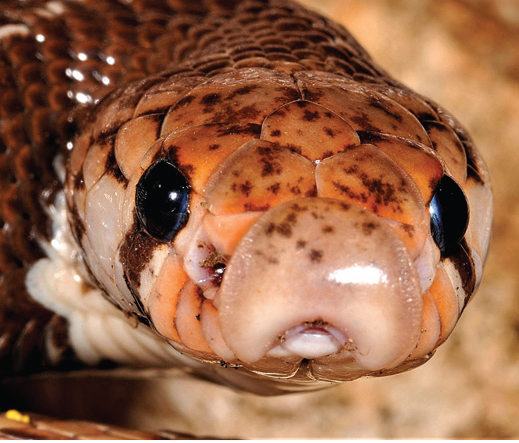
South Africa (Bill Branch).
Rinkhals Hemachatus
A monotopic genus containing a single species, a stocky southern African endemic that looks identical to a true cobra; in defence it rears up and spreads a broad hood. If differs from true cobras in having keeled scales, giving birth to live young and having a maxillary (upper jaw) bone with fangs but without solid teeth. It can spit its venom. It lies within a clade that includes all true cobras (Naja), but split from them more than 30 million years ago. It is a medically significant species, as it is widespread across a wide area of well-populated South Africa, is tolerant of urbanisation and can be locally common. Antivenom is available. The venom is both cytotoxic and neurotoxic.
Rinkhals Hemachatus haemachatus
Identification: A medium-sized, stocky relative of the cobras, of temperate southern Africa, with a minute relict population in Zimbabwe. It has a short head and a large, dark eye with a round pupil. The body is cylindrical and the tail 15–19% of total length (usually longer in males). The dorsal scales are largely keeled; in 17–19 rows at midbody; ventrals 116–150; cloacal scale entire; subcaudals 30–47. Maximum size around 1.5m; most adults average 0.9–1.3m; hatchlings 16–22cm. The colour is variable, usually olive, brown or dull black above, with one or two (sometimes three) white or yellow cross-bars on the throat. A black form with yellow, tan or white bands also exists. The underside is usually dark brown, grey or black.
Habitat and Distribution: In grassland, including high montane areas, moist savanna, rocky outcrops, lowland forest and heathland (fynbos), between sea level and 2,500m. It occurs from sea level in the Western Cape, South Africa, all around Cape Town, then through the Cape Fold Mountains into the Eastern Cape, although it is seemingly absent from some areas. From the Eastern Cape it spreads northwards along the eastern escarpment through Kwazulu-Natal and the Lesotho and Free State grasslands, into Gauteng, eastern North West Province, Mpumalanga and western Eswatini (Swaziland). It has been reported from Kimberley, but there are no recent records. An isolated population occurs around the Nyanga National Park in the highlands of eastern Zimbabwe, mostly over 1,500m, in grassland and stunted miombo woodland. It is speculated that this population may be extinct; no specimens have been collected there for over 25 years.
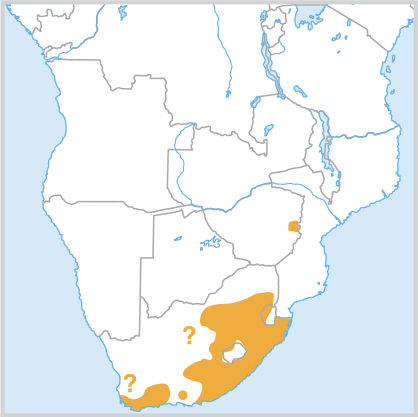
Hemachatus haemachatus
Natural History: A largely terrestrial snake, but a good climber and quick to escape up trees. Mostly active by day, it basks in the morning before hunting, but it is also active on summer nights. It is quick-moving and alert, and will usually try to escape, often to a nearby refuge. If cornered, it rears up and spreads a hood, displaying the white throat bands; if approached it will spit venom, to a distance of over 3m, while hissing and lunging forward. If further threatened, it will often play dead, dropping down and twisting sideways or upside down, with the mouth open and tongue hanging out. If may remain limp if handled, or suddenly try to bite. It gives birth to usually 20–30 live young, but as many as 63 have been recorded. A variety of small vertebrates are eaten; it is fond of toads but also takes rodents, birds and their eggs, lizards and snakes. In South Africa it seems very tolerant of urbanisation, still being present in the Greater Johannesburg area, living near dams and grassy areas, especially those with open water or swamps (vleis); it has been found living in rockeries right next to major highways.
Medical Significance: This snake is quite widespread in South Africa and is tolerant of urbanisation, clinging on because of its secretive habits. Parts of its range are densely populated, and it is active on the ground by day and night, so it represents a significant snakebite hazard. A polyvalent antivenom is available and effective. The venom is both cytotoxic and neurotoxic, with a curiously broad symptomology that includes painful swelling of the bitten limb, nausea, dizziness and respiratory distress. However, there are no credible recent reports of any fatalities. As with other large elapids, a bite should be treated in a well-equipped hospital. Venom in the eye is also a frequent result of an encounter with this snake, causing agonising pain, and, if untreated, corneal lesions and complications can occur. The affected eye must be gently irrigated with large quantities of water. Anyone who has been spat at should visit a hospital or eye clinic for an assessment of the damage to the eye.
Rinkhals, Hemachatus haemachatus.
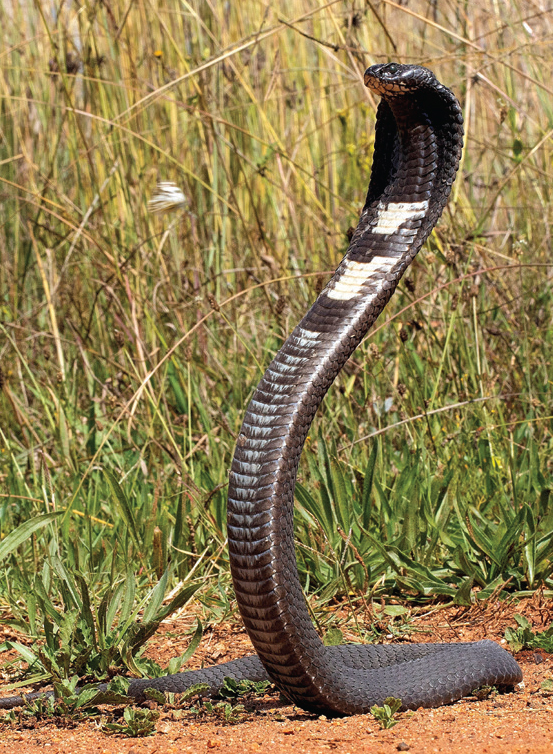
South Africa (Johan Marais).
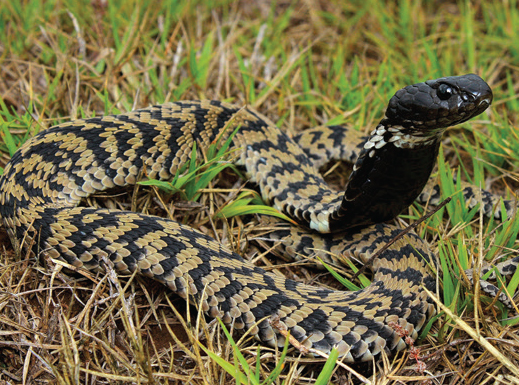
banded form (Johan Marais).
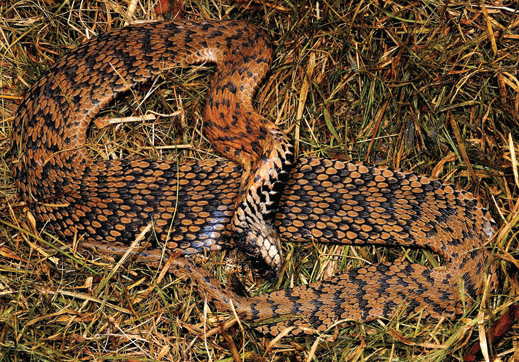
shamming death (Bill Branch).
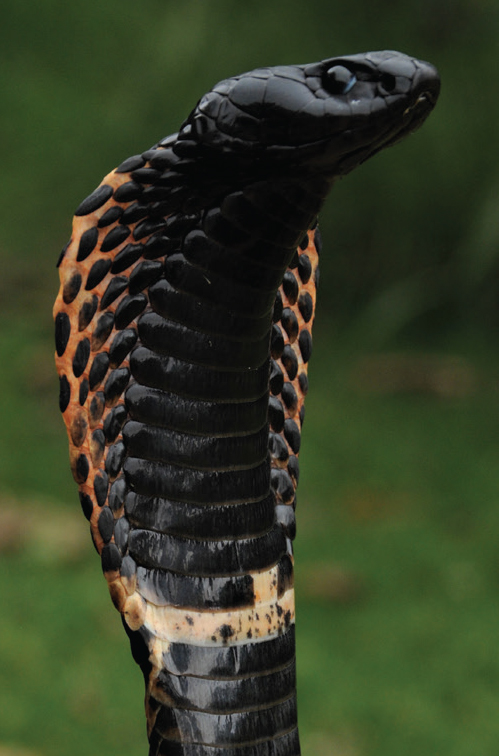
close-up of hood (Bill Branch).
Subfamily Hydrophiinae
Viviparous sea snakes and Australian land elapids
A family of front-fanged, venomous snakes, living on the land and in the sea; the terrestrial species look quite different from the marine ones. Their taxonomy is still under investigation, but at present there are around 50 species in the genus Hydrophis (sea snakes). One species, the Yellow-bellied Sea Snake (Hydrophis platurus), occurs in the western Indian Ocean and occasionally comes ashore on the eastern coasts of Africa. No other sea snakes are known from the shores of mainland Africa; reports of other sea snakes on African coasts are invariably either snake eels or moray eels. These may be told from sea snakes by their pointed tails; the sea snake has an oar-like tail. In general, sea snakes are not a hazard to those who work on or near the sea as they avoid confrontation in the water and are clumsy on land. A few bites are documented.
Yellow-bellied Sea Snake Hydrophis platurus
Identification: A medium-sized black and yellow sea snake. The head is long and tapering, the eye is small with a round pupil, and the nostrils are on top of the head. The body is laterally compressed and the tail is short, vertically flattened and oar-like, about 10% of total length. The scales are smooth; in 49–76 rows at midbody; ventrals 264–406. Maximum size about 90cm, average 60–85cm; hatchlings 24–25cm. It has bright warning colours; the broad dorsal stripe is usually black, greeny-black or very dark brown, the belly is yellow, and the tail is spotted black and cream or yellow. The dorsal stripe may be straight-edged (most African specimens are this colour), wavy, break up into black saddles or totally disappear.
Habitat and Distribution: Widespread across the Indian and Pacific Oceans; in all tropical seas except the Atlantic. It is not recorded from the Red Sea, but is found from Djibouti southwards all along the coast to Cape Town in South Africa; a few vagrants have been recorded further north on the Atlantic coast of South Africa and Namibia (not shown on map). This species is also known from Madagascar and the Seychelles.
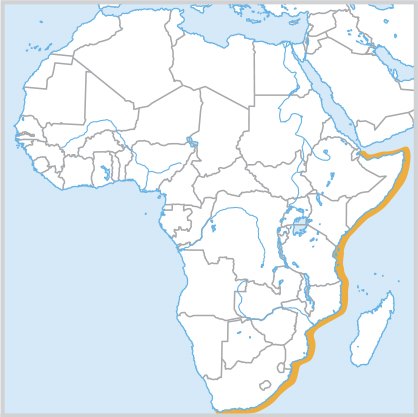
Hydrophis platurus
Natural History: Lives mostly in open water, not around reefs, but usually within 300km of land. It is usually washed ashore only when dying or accidentally in storms; it can only wriggle in an ungainly fashion on land. It is a superb swimmer, moving with side-to-side undulations like a snake on land, but it can swim backwards and forwards and is capable of very rapid bursts of speed. This species is often found in the vicinity of sea slicks (long, narrow lines of floating vegetation and accumulated debris on the sea surface), where it waits quietly to ambush fish; it may attack individual fish or rush into a small shoal, indiscriminately biting everything it can grab. It is afraid of humans and moves off if approached by swimmers. Three to eight young are born live; gravid females have been collected between March and October off the South African coast. Concentrations of up to 10 snakes have been seen in East African waters; a group of six was found in Turtle Bay, Watamu, Kenya. The sea snake sloughs its skin as do land snakes, but since it doesn’t have convenient objects to rub against, it forms tight loops, rubbing coil against coil; in this way it also frees itself from sea animals like barnacles.
Medical Significance: This is a dangerously venomous snake, although bites are extremely rare (and often not noticed). Those at risk are fishermen who may mishandle the snake while emptying their nets; a snakebite to a swimmer, diver or snorkeller is unheard of. The venom is a powerful neurotoxin, and a bite may lead to paralysis, muscle destruction, renal failure and cardiac arrest. Early symptoms include headache, a thick feeling of the tongue, thirst, sweating and vomiting, then pain, stiffness and tenderness, followed by paralysis as in other neurotoxic poisoning; this may lead to respiratory failure. There is no swelling. No antivenom is produced in Africa, but it is available in Australia.
Yellow-bellied Sea Snake, Hydrophis platurus.
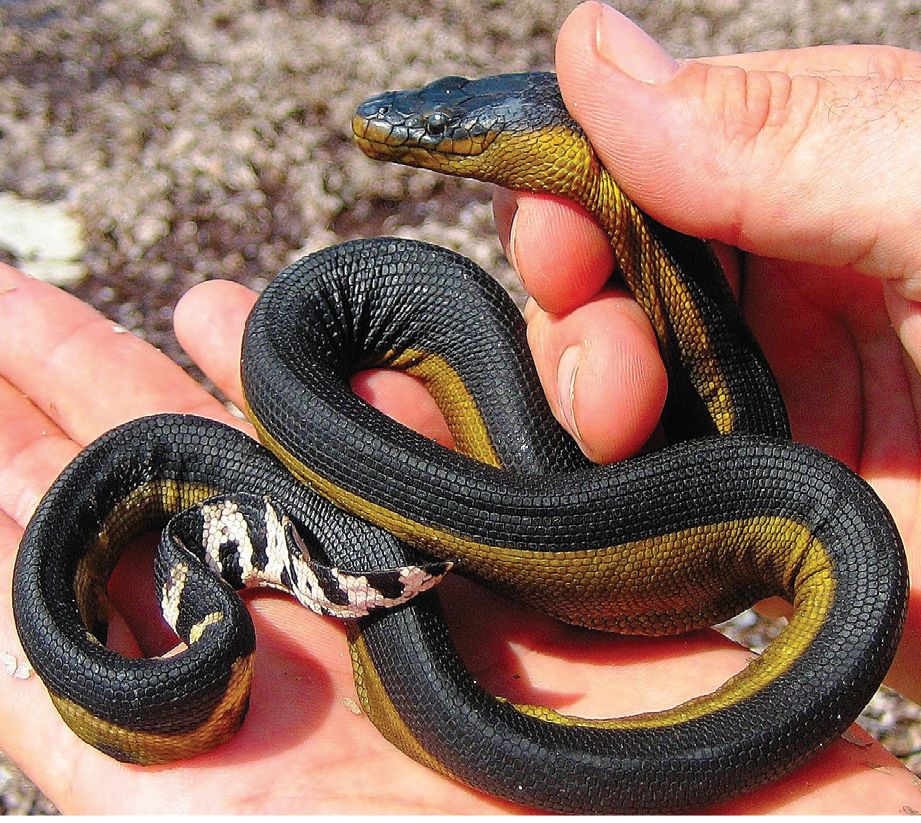
Kenya (Royjan Taylor).
African snakes (house snakes and allies)
A family of African, Madagascan and Asian snakes, with eight subfamilies and over 50 genera; over 30 are mainland African. Most are harmless or rear-fanged, but the burrowing asps (Atractaspis) and harlequin snakes (Homoroselaps) are front-fanged.
Subfamily Atractaspidinae
Burrowing asps and harlequin snakes
A subfamily of two genera and 24 species, found in Africa, with a limited penetration into the Arabian Peninsula. The two genera are easily distinguished (see the following key).
Key to the genera of the Atractaspidinae
1aFangs short and immoveable; has a yellow or red dorsal stripe; found only in South Africa……Homoroselaps, harlequin snakes
1bFangs large and moveable; never has a yellow or red dorsal stripe; found throughout Africa……Atractaspis, burrowing asps
Burrowing asps Atractaspis
A genus of just over 20 species of small (usually less than 70cm), dark, blunt-headed nocturnal snakes, with cylindrical bodies and a tail that ends in a short spike. They all look very similar: most are black, dark brown or grey, although just before sloughing they become silvery-grey. They have hollow, hinged front fangs, and were thus thought to be vipers, but are now recognised as specialised members of the Lamprophiidae (African snakes) within their own subfamily, the Atractaspidinae. The confusion over their status has resulted in numerous different common names being used for the group, including burrowing vipers, burrowing asps, mole vipers, stiletto snakes (or just ‘stilettos’), side-stabbing snakes and back-stabbing snakes. We have opted for the name ‘burrowing asps’, which avoids confusion with vipers. The taxonomy of the genus is incomplete, hampered by the lack of museum specimens of these secretive, burrowing snakes. Some species are known from a handful of specimens alone; others have several subspecies, often based on minor (possibly insignificant) scalation differences. The status of some taxa is uncertain.
Burrowing asps are widely distributed across Africa, and two (possibly three) species occur in the Middle East. They spend much time underground in holes, and feed largely on small vertebrates. Females lay eggs. These snakes can be hard to identify, as they very closely resemble purple-glossed snakes (Amblyodipsas), the Kwazulu-Natal Black Snake (Macrelaps microlepidotus) and, to a lesser extent, wolf snakes (Lycophidion), dark centipede-eaters (Aparallactus), snake-eaters (Polemon) and blind snakes (Afrotyphlops). Even expert herpetologists have been bitten by misidentified burrowing asps. Have a look at our pictures of similar species in the look-alikes section. But even when you have established you are looking at a burrowing asp, identification to species level is not easy. You will need a binocular microscope to count scales on a dead specimen (important; see the next paragraph), although the range may give some clues. Living animals often exhibit a curious and distinctive display, arching the neck and pointing the head at the ground, looking like a croquet hoop or an inverted ‘U’. They may also release a distinctive-smelling chemical from the cloaca (which might serve to stop one burrowing asp eating another). If further teased, they may wind the body into tight coils, or turn the head and neck upside down, lash from side to side or jerk violently, often springing some distance; this may have a defensive purpose.
Burrowing asps cannot, under any circumstances, be held safely by hand. Their heads are too short and their fangs too long; this enables them to bite any restraining finger, no matter how tight the grip. Do not try it. The snake can slide a fang out of its mouth, without actually opening the mouth. The fang is then driven into the finger by a downwards stab. Such bites consequently usually show a single fang puncture. If held by the tail they can jerk upwards and bite the hand. The fangs are primarily used for stabbing and manipulating their prey, an adaptation that may be useful for feeding in holes, and they have been reported to enter a rodent nest and stab all the young before commencing feeding. Apart from the fangs, burrowing asps are virtually toothless, and thus struggle to ingest prey, having to flex the neck and body to swallow (other snakes manipulate prey with their solid teeth, a process called cranial kinesis).
Burrowing asps are not aggressive snakes, and move away from humans; even if teased they do not open their mouths and lunge forwards. However, they are medically significant; they cause a lot of bites, particularly in Africa’s warm tropical lowlands. This is for several reasons. They have a huge range; you will find at least one species of burrowing asp virtually everywhere in sub-Saharan Africa (except true desert and some highland areas), and often more. They are often relatively common, and they emerge from their holes and move around on the ground at night, particularly during the wet season. Being slim and active, they often enter buildings and shelters, and people tread on them, roll on them in their sleep or otherwise inadvertently restrain them. The snake turns and bites immediately. In the daytime, people farming or gardening with short tools are also at risk.
Burrowing asps have very long venom glands. Their venom is largely cytotoxic, although a handful of species have been shown to have sarafotoxins (which constrict coronary blood vessels, causing angina–endothelin-like effects) in their venom. The potential effects of the sarafotoxins on humans are as yet unquantified, but some bite victims have shown elevated blood pressure, ECG changes and anaphylaxis. Bite symptoms nearly always include swelling, pain, lymphadenitis and discolouration, often with some local necrosis; symptoms usually resolve in a couple of weeks. Occasionally amputation has been needed. Fever is often present. No antivenom is available for African species (one has been produced for the Arabian Small-scaled Burrowing Asp, Atractaspis andersonii, but this is not commercially available at the time of writing); bites are treated symptomatically.
African burrowing asps are not generally regarded as deadly, although several recent deaths are recorded for the Arabian Atractaspis andersonii. In southern Africa, to date, no fatalities have been recorded from burrowing asp bites, although they cause a lot of pain and suffering. A few fatal cases (some recent, most not) have been recorded from other areas of Africa, but these largely lack enough clinical details to guarantee that the venom was solely responsible or that unusual factors were not involved. But a note of caution is in order. In virtually all documented fatal cases, systemic symptoms appeared within minutes. Acute abdominal pain, profuse salivation and comas were features. Death occurred in hours. In recent years a few fatalities have occurred, leading to speculation that, in certain circumstances, burrowing asp venom may be more dangerous than is generally thought. Professor David Warrell regards burrowing asps as the African equivalent of the Asian kraits (Bungarus), as both enter homes and bite people in their sleep, as well as biting people walking home after dark and heavy rain. Perhaps their danger is underplayed.
The technical key below will help identify burrowing asps to specific level, we hope. It should never be used on a living animal; they cannot be safely held. You will also need a binocular microscope and some knowledge of head and body scalation (see Figures 16–22, here), but even identification is not easy. Note well: some species are very hard to tell apart, but the locality and general appearance may give clues. The final identification is not important where a burrowing asp bite is concerned, however, as no antivenom is available at present and bites are therefore treated symptomatically, regardless of the species.
Key to the genus Atractaspis, burrowing asps
1aIn our area, known only from the Sinai Peninsula……Atractaspis engaddensis, Palestine Burrowing Asp
1bNot in Sinai, but elsewhere in Africa……2
2aWhite markings on the head; always in the Horn of Africa……3
2bNo white markings on the head……4
3aVentrals 215–230; no white vertebral stripe……Atractaspis scorteccii, Somali Burrowing Asp
3bVentrals 230–243; has a white vertebral stripe……Atractaspis leucomelas, Ogaden Burrowing Asp
4aVentral counts more than 300……Atractaspis reticulata, Reticulate Burrowing Asp
4bVentral counts fewer than 300……5
5aFound only south of 20°S; snout profile distinctly curved……Atractaspis duerdeni, Duerden’s Burrowing Asp
5bEither found north of 20°S, or, if south of there, snout profile pointed and shark-like……6
6aCloacal scale divided……7
6bCloacal scale entire……10
7aIn southern Somalia and north-east Kenya; midbody scale rows 19 ……Atractaspis engdahli, Engdahl’s Burrowing Asp
7bNot in southern Somalia or north-east Kenya; midbody scale rows 19–27……8
8aVentral scales more than 275……Atractaspis branchi, Bill Branch’s Burrowing Asp
8bVentral scales fewer than 265……9
9aMidbody scale rows 21–27 (usually 23–27); mental separated from chin shields; usually north of 5°S; usually in forest……Atractaspis irregularis, Variable Burrowing Asp
9bMidbody scale rows 19–23 (usually 19–21); mental in contact with the chin shields; usually south of 5°S; usually in savanna…… Atractaspis congica, Congo Burrowing Asp
10aOne anterior temporal scale; often slim; usually in moist savanna or forest……11
10bTwo anterior temporal scales; often stocky; in savanna and semi-desert……15
11aSecond pair of lower labials is absent (fused to the chin shields)……Atractaspis corpulenta, Fat Burrowing Asp
11bSecond pair of lower labials is present (and distinct from the chin shields)……12
12aMidbody scale rows 29–35……Atractaspis dahomeyensis, Dahomey Burrowing Asp
12bMidbody scale rows fewer than 27……13
13aFirst upper labial is in contact with the posterior nasal……Atractaspis aterrima, Slender Burrowing Asp
13bFirst upper labial is not in contact with the posterior nasal……14
14aMental scale separated from the chin shields by the first pair of lower labials; subcaudals single; in savanna south of 5°S……Atractaspis bibronii, Bibron’s Burrowing Asp
14bMental scale in contact with the chin shields by the first pair of lower labials; some subcaudals paired; in forest almost always north of 5°S……Atractaspis boulengeri, Central African Burrowing Asp
15aFound west of 25°E……16
15bFound east of 25°E……18
16aMore than seven lower labials……Atractaspis watsoni, Watson’s Burrowing Asp
16bFewer than seven lower labials……17
17aDorsal scale rows 29–33; subcaudals 21–26; only in Mauritania and Senegambia……Atractaspis microlepidota, Western Small-scaled Burrowing Asp
17bDorsal scale rows 25–27; subcaudals 26–32; widespread across the Sahel…… Atractaspis micropholis, Sahelian Burrowing Asp
18aMidbody scale rows 25–27 (rarely 29); largely north of 15°N……Atractaspis magrettii, Magretti’s Burrowing Asp
18bMidbody scale rows 27–37; largely south of 15°N……19
19aVentral counts strongly sexually dimorphic, much higher in males (246–252) than females (211–238); occurs in Sudan, South Sudan and low western Ethiopia……Atractaspis phillipsi, Sudan Burrowing Asp
19bVentral counts not strongly sexually dimorphic, with males (227–246) little different from females (229–257); occurs in South Sudan, eastern Ethiopia, Somalia, Kenya and northern Tanzania……Atractaspis fallax, Eastern Small-scaled Burrowing Asp
Slender Burrowing Asp Atractaspis aterrima
Identification: A small, slim, fast-moving burrowing asp. The head is blunt and the eyes tiny. The tail is short and blunt, 3–5% of total length, and ends in a pointed cone. The scales are in 19–21 (rarely 23) rows at midbody; ventrals 239–300; cloacal scale entire; subcaudals single, 17–26. Maximum size about 80cm, average 30–50cm; hatchling size unknown, but a Garamba juvenile was 20cm. The colour is usually black or blackish grey (occasionally blackish brown or blackish purple), both above and below; juveniles may be brown. Some West African specimens have a white dot near the tail tip.
Habitat and Distribution: Has an unusually wide choice of habitat; it is known from dry and moist savanna, woodland and forest, from sea level to 2,000m. It occurs from Senegal (south of the Gambia River) eastwards through Nigeria, across the top of Central Africa to the extreme south of South Sudan and north-west Uganda, and is also known from three isolated localities (Udzungwa and Uluguru Mountains and Mwanihana Forest Reserve) in Tanzania.
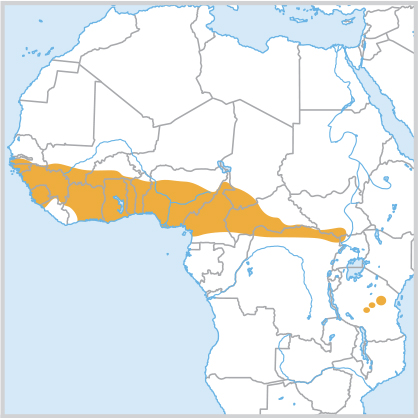
Atractaspis aterrima
Natural History: Poorly known. This species lives and hunts in holes, but may emerge at night (especially during or after rain) and move around on the ground. If molested, it shows the distinctive responses mentioned in the generic introduction (pointing the head, releasing a chemical, and jerking and lashing). The diet is mostly rodents and smooth-bodied reptiles in the west of its range, but Tanzanian specimens have been recorded eating caecilians, and some captive specimens are reported to eat invertebrates. Females lay eggs, but the details are unknown.
Medical Significance: A widespread species that is sometimes common, is active on the ground at night and may enter buildings; it is also found in agricultural land where people farm with short tools, so is a significant snakebite hazard within parts of its range. Swelling, pain and subsequent lymphadenopathy resulted from a bite, with some slight local necrosis. No antivenom is available, and the use of polyvalent antivenom is contraindicated; treat bites symptomatically.
Slender Burrowing Asp, Atractaspis aterrima.
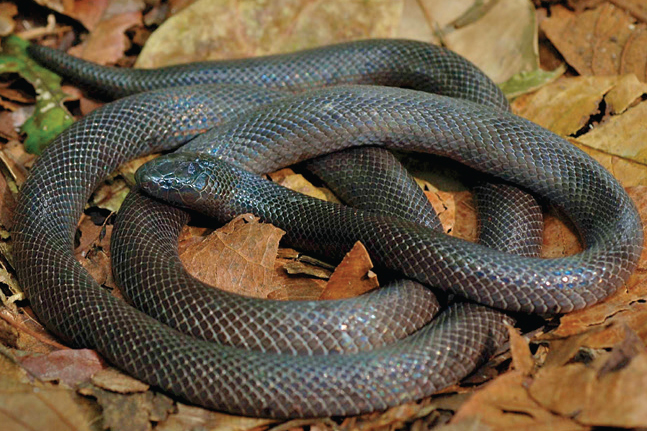
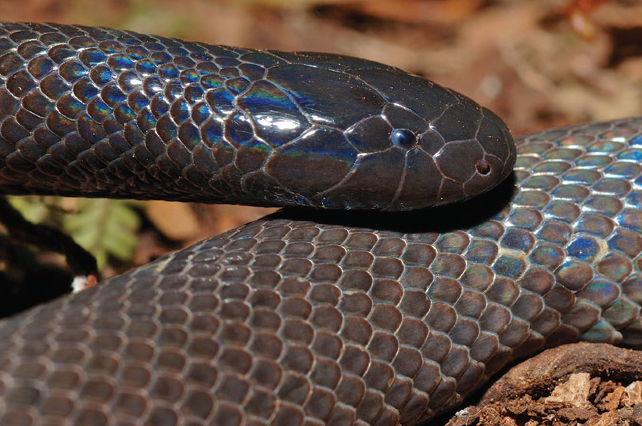
Tanzania (Michele Menegon).
Bibron’s Burrowing Asp Atractaspis bibronii
Identification: A small, fairly slim, dark, slow-moving snake with a prominent snout. The tongue is white. The body is cylindrical and the tail is short and blunt, 5–7% of total length, ending in a pointed cone. The scales are in 19–25 rows at midbody; ventrals 213–262; cloacal scale entire; subcaudals single, 18–28. Maximum size about 70cm, average 30–50cm; hatchlings 20cm. The body may be black, brown, pinkish or purplish brown (especially in Kenyan coast animals), or grey, often with a purplish sheen on the scales, and the belly may be lead grey, brownish, white or pale with a series of dark blotches. Animals with dark ventrals may have white patches on the chin and throat, or around the tail base (see the bottom picture, opposite). If the belly is pale, the pale colour may extend up to the lowest two to three scale rows on the sides and onto the upper labials.
Habitat and Distribution: In semi-desert, dry and moist savanna, woodland and coastal thicket; not in closed forest. This snake is found from sea level to about 1,800m. It occurs south from the north Kenyan coast, inland in Tanzania, then north-west to Rwanda, Burundi and across the south of DR Congo to northern and western Angola, and south to Botswana, most of Namibia and northern and eastern South Africa. There are sporadic records further south and west, along with isolated records in Kenya from Kitui, Kitobo Forest and the Maasai Mara, and from the Afgooye area (formerly Afgoi) in southern Somalia. A specimen from Garamba National Park in north-east DR Congo has been reidentified as the Slender Burrowing Asp (Atractaspis aterrima).
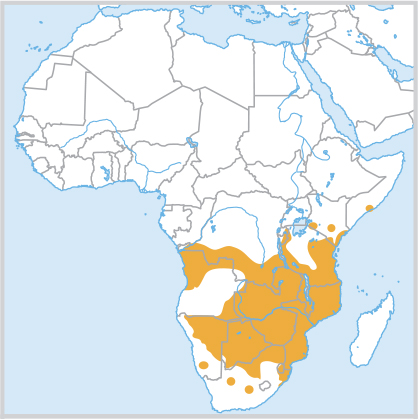
Atractaspis bibronii
Natural History: Nocturnal and terrestrial, spending much time in holes, in rotting logs or under ground cover, but it is active on the ground on wet nights. Like the previous species, when molested it shows a distinctive response, arching the neck, pointing the snout into the ground, jerking convulsively and releasing a distinctive chemical smell. Clutches of 3–8 eggs have been recorded, roughly 35 × 15mm. Known prey items for this species include rodents, shrews, burrowing skinks, skink eggs, snakes and worm lizards.
Medical Significance: A widespread species that is sometimes common, is active on the ground at night and may enter buildings; it is also found in agricultural land, where people farm with short tools, so is a significant snakebite hazard within parts of its range. In a survey in Kwazulu-Natal, South Africa, six out of eight people bitten by this snake trod on it; three of these were inside a building, and one rolled on the snake while sleeping. The venom manifests itself as largely cytotoxic. Swelling, pain, skin discolouration, lymphangitis, subsequent lymphadenopathy and occasionally necrosis (especially to digit tips), as well as systemic symptoms like angioedema, resulted from bites. No antivenom is available, and the use of polyvalent antivenom is contraindicated; treat bites symptomatically. In coastal South Africa and Tanzania this snake is responsible for many bites, but no fatalities are recorded.
Taxonomic Notes: Recent analysis of this small, widespread snake suggests that it represents a species complex and it may be split in the future; the northern animals (originally regarded as a subspecies, Atractaspis bibronii rostrata) form a separate clade.
Bibron’s Burrowing Asp, Atractaspis bibronii.
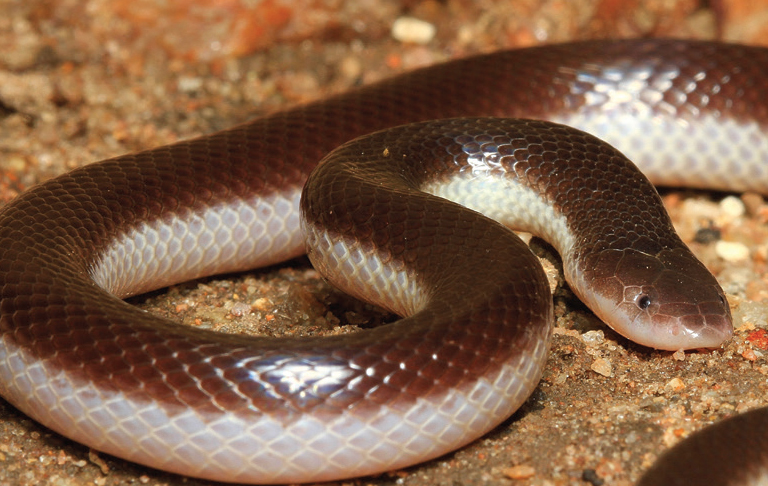
South Africa (Wolfgang Wuster).
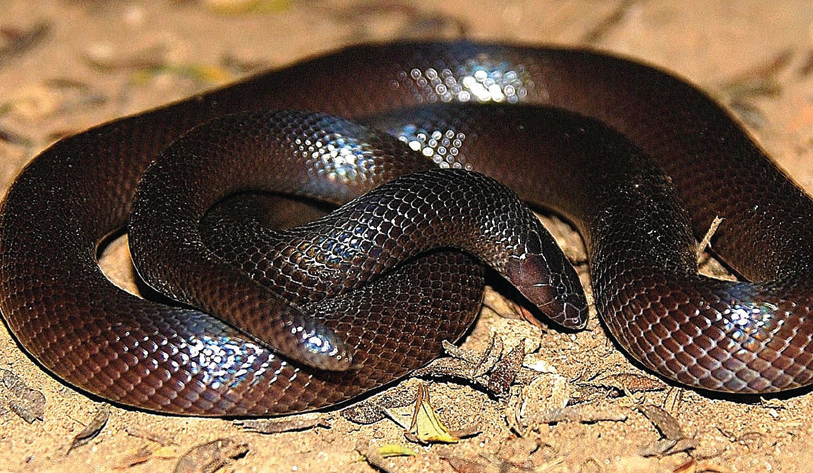
DR Congo (Colin Tilbury).
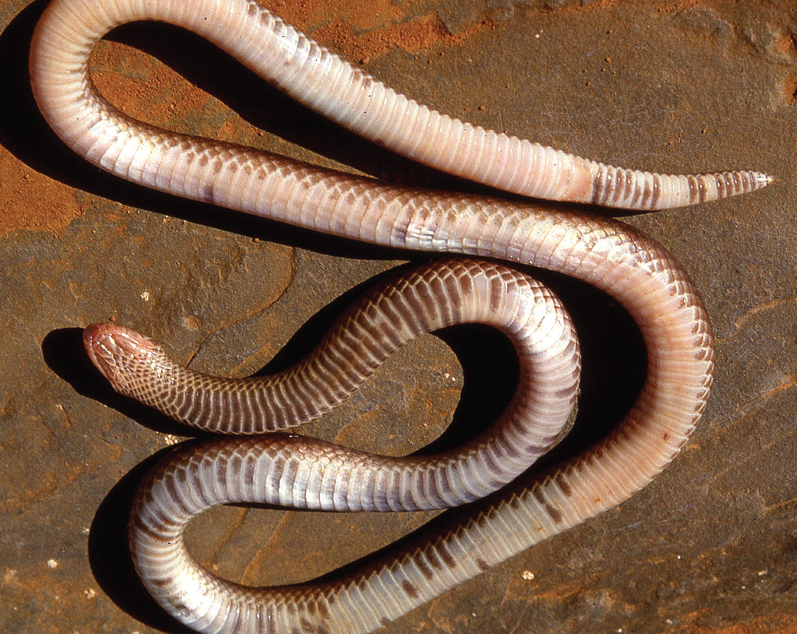
underside, Botswana (Stephen Spawls).
Identification: A medium-sized burrowing asp of the Central African forest. The head is blunt and the eyes tiny. The tail is short and blunt, 6–8% of total length, ending in a pointed cone. The scales are in 21–25 rows at midbody; ventrals 192–218; cloacal scale entire; subcaudals usually paired but sometimes single, 22–27. Maximum size about 65cm, average 30–50cm; hatchling size unknown. The colour is usually black or blackish grey above, and paler below.
Habitat and Distribution: Essentially a forest snake. It occurs from southern Cameroon eastwards to the western watershed of the Albertine Rift, south to about 5°S. It extends south almost to the Angolan border; its distribution on the lower Congo River is uncertain. There are no definite records from Angola, but it might occur there. It is reported rather doubtfully from northern Cameroon.
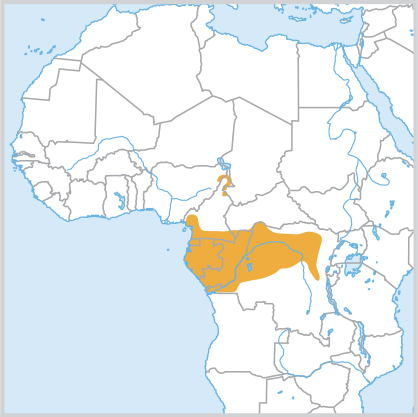
Atractaspis boulengeri
Natural History: Poorly known. It lives and hunts in holes, but may emerge at night (especially during or after rain) and move around on the ground. If molested, it shows the distinctive responses mentioned in the generic introduction (pointing the head, releasing a chemical, and jerking and lashing). Females lay eggs, but the details are unknown.
Medical Significance: A widespread species that is sometimes common, is active on the ground at night and may enter buildings; it is also found in agricultural land where people farm with short tools, so is a significant snakebite hazard within parts of its range. No antivenom is available, and the use of polyvalent antivenom is contraindicated; treat bites symptomatically.
Central African Burrowing Asp, Atractaspis boulengeri.
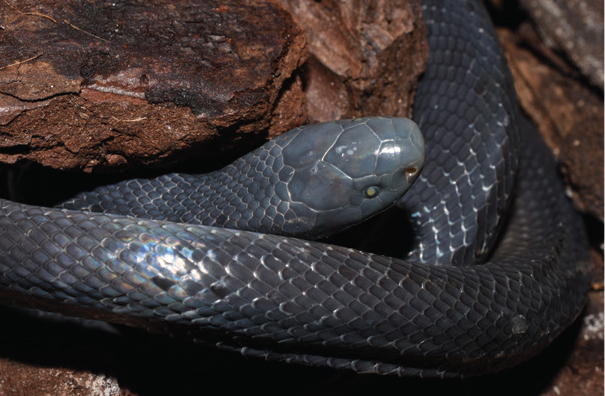
Central African Republic (Jean-Francois Trape).
Bill Branch’s Burrowing Asp Atractaspis branchi
Identification: A small, slender burrowing asp, recently described from the West African forest. The head is blunt and the eyes tiny. The tail is fairly short and blunt, 4–6% of total length, ending in a pointed cone. The scales are in 19–20 rows at midbody; ventrals 276–288; cloacal scale divided; subcaudals single, 19–25. Described from two specimens, one 28cm, the other 72cm (a third animal was too damaged to use). The colour is pinky-grey and iridescent, the dorsal scales with a paler margin.
Habitat and Distribution: Known from only three specimens, one collected in forest in extreme north-west Liberia, and the other two from agriculture in a deforested area of southern Guinea, between 300m and 500m.
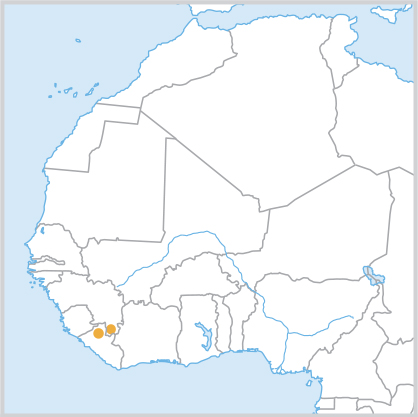
Atractaspis branchi
Natural History: Unknown, but presumably similar to other burrowing asps (i.e. nocturnal, terrestrial, etc.). The type was crawling along the banks of a creek at night; when picked up, it tried to hide its head under its coils, and to strike. It tried to crawl away and abruptly coiled and uncoiled, often springing distances almost equal to its body length. This species was described in 2019, and named after Dr William Roy (Bill) Branch, one of the authors.
Medical Significance: It has a small range, and its venom is probably similar to that of other burrowing asps, so it is not a major hazard. No antivenom is available, and the use of polyvalent antivenom is contraindicated; treat bites symptomatically.
Bill Branch’s Burrowing Asp, Atractaspis branchi.
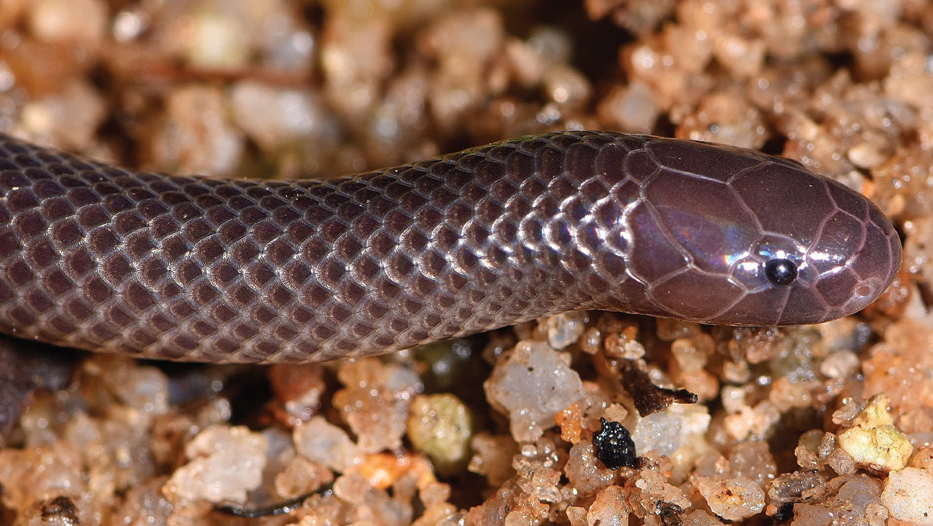
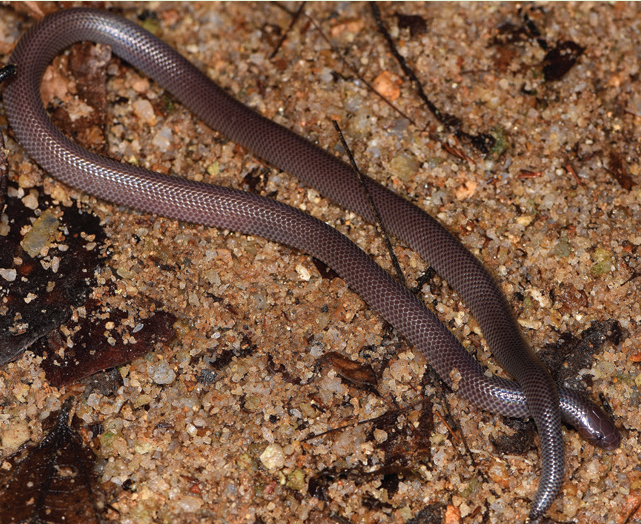
Liberia (Mark-Oliver Rödel).
Congo Burrowing Asp (Eastern Congo Burrowing Asp) Atractaspis congica
Identification: A medium-sized burrowing asp of south-central Africa. The head is blunt and the eyes tiny. The tail is short and blunt, 5–8% of total length, ending in a pointed cone. The scales are in 19–21 (sometimes 23) rows at midbody; ventrals 190–237; cloacal scale divided; subcaudals paired, 18–25. Maximum size about 55cm, average 30–45cm; hatchling size unknown. It is quite variable in colour for a burrowing asp, being black, blue-black, steel grey or pinkish grey; the scales (especially on the forepart of the body) are light-edged.
Habitat and Distribution: Forest and moist savanna, from sea level to 1,600m, or maybe higher. It occurs from the lower Congo River south to south-central Angola, east to the western shore of Lake Tanganyika, and also in north-west and northern Zambia. An isolated population occurs in the Caprivi Strip, Namibia, and in southern Cameroon; this species seems to be absent from Gabon.
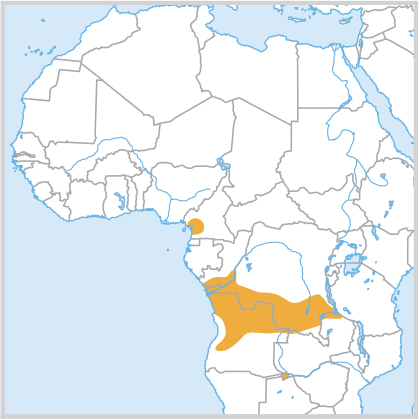
Atractaspis congica
Natural History: Poorly known. This snake lives and hunts in holes, but may emerge at night (especially during or after rain) and move around on the ground. If molested, it shows the distinctive responses mentioned in the generic introduction (pointing the head, releasing a chemical, and jerking and lashing). It lays 3–6 eggs. The diet includes rodents and other small vertebrates.
Medical Significance: A widespread species that is sometimes common, is active on the ground at night and may enter buildings; it is also found in agricultural land where people farm with short tools, so is a significant snakebite hazard within parts of its range. No antivenom is available, and the use of polyvalent antivenom is contraindicated; treat bites symptomatically. A bite victim in Zambia suffered pain (initially intense), swelling, lymphadenitis and blistering.
Congo Burrowing Asp, Atractaspis congica.
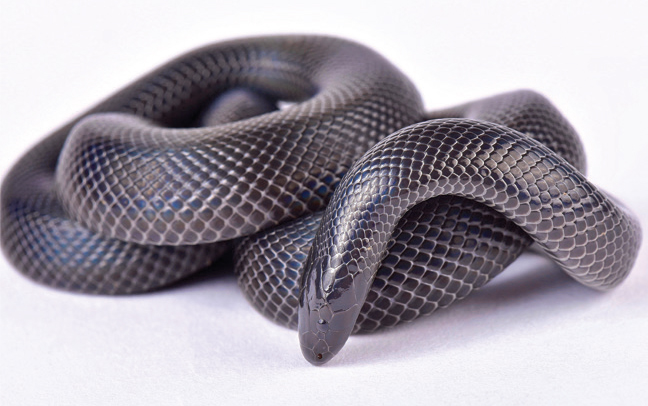
captive (Matthijs Kuijpers).
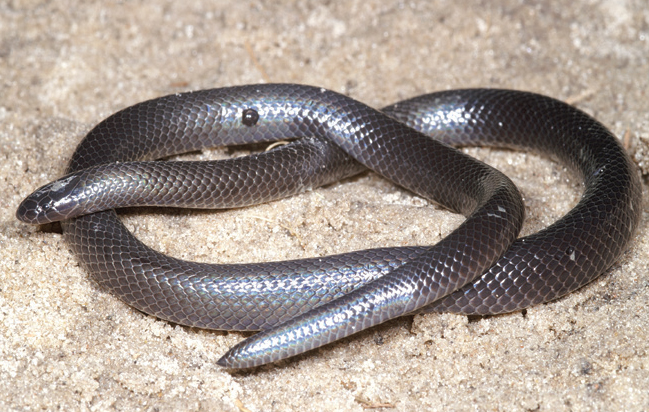
Zambia (Philipp Wagner).
Angola (Warren Klein).
DR Congo (Konrad Mebert).
Fat Burrowing Asp Atractaspis corpulenta
Identification: A medium-sized, stocky, slow-moving snake. The scales are in 23–29 rows at midbody; ventrals 178–208; cloacal scale entire; subcaudals single, 22–28. Maximum size about 70cm, average 30–50cm; hatchling size unknown. The colour is dark brown, slaty grey or black; occasional specimens from parts of its West African range (Cote D’Ivoire and Ghana) may have a white tip to the tail. Grey individuals may have a bluish sheen to the scales. The body is paler below.
Habitat and Distribution: Its range indicates it is a forest snake. It occurs in two populations separated by the Dahomey Gap: in West Africa from Ghana westwards to Liberia and south-east Sierra Leone; and from Nigeria eastwards to north-eastern DR Congo, south on the coast of Central Africa into Gabon. It is found below 1,000m.
Atractaspis corpulenta
Natural History: Poorly known, but presumably similar to other burrowing asps.
Medical Significance: A widespread species that is sometimes common, is active on the ground at night and may enter buildings; it is also found in agricultural land where people farm with short tools, so is a significant snakebite hazard within parts of its range. No antivenom is available, and the use of polyvalent antivenom is contraindicated; treat bites symptomatically. Most reported cases involved only pain, local swelling, paraesthesia, feverishness and lymphadenopathy; one case showed haematuria. However, a recent fatality was reported for this snake in Republic of the Congo. The victim had initial severe pain, swelling, shortness of breath, vomiting and diarrhoea. He received antivenom, but two and a half hours after the bite, he went into cardiorespiratory arrest. The actual cause of death was not certain; it was possibly due to anaphylaxis from the venom, but might have been caused by the effect of the venom on the myocardium.
Fat Burrowing Asp, Atractaspis corpulenta.
Cameroon (Jean-Francois Trape).
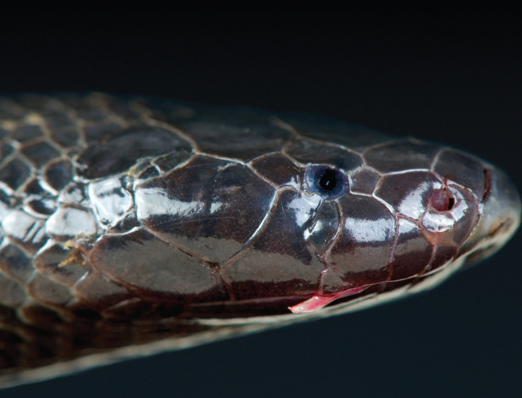
captive (Matthijs Kuijpers).
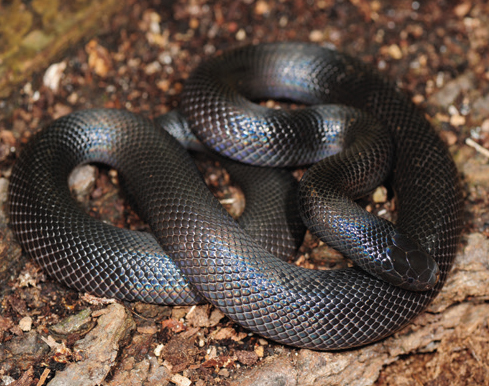
Gabon (Tomáš Mazuch).
Dahomey Burrowing Asp Atractaspis dahomeyensis
Identification: A medium-sized snake; juveniles are fairly thin but large adults can become very stout. The tail is 5–9% of total length. The scales are in 29–35 rows at midbody; ventrals 210–250; cloacal scale entire; some subcaudals single, some paired, 22–30. Maximum size about 60cm, average 30–50cm; hatchling size unknown, but probably 14–16cm. The body is dark brown, grey, pinky-grey or black, and paler below. An albino specimen has been recorded from Ghana.
Habitat and Distribution: In woodland and moist and dry savanna, between sea level and 1,400m, or sometimes higher. There are a few records from within forest. This species occurs from the Gambia and Senegal eastwards to north-east Nigeria, mostly north of the forest, reaching the coast in the Dahomey Gap. There are few records for Cameroon, except the extreme south-west, but it is known from south-western Chad. It is doubtfully listed from southern Niger. Specimens reported from the northern Central African Republic are Watson’s Burrowing Asp (Atractaspis watsoni).
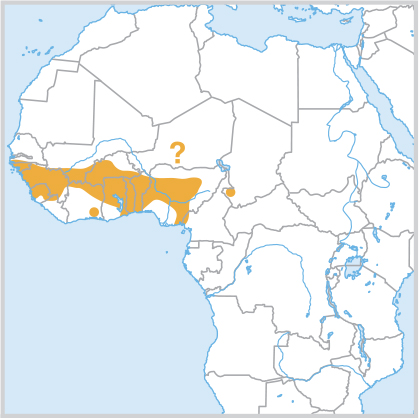
Atractaspis dahomeyensis
Natural History: Terrestrial and nocturnal; it lives underground but emerges at night in the rainy season. It is a rather slow-moving snake, but quick to bite if restrained. Females lay eggs. The diet consists of small vertebrates.
Medical Significance: A widespread species that is sometimes common, is active on the ground at night and may enter buildings; it is also found in agricultural land where many people farm with short tools, so is a significant snakebite hazard within parts of its range. No antivenom is available, and the use of polyvalent antivenom is contraindicated; treat bites symptomatically. In a series of cases from Nigeria, victims experienced pain at the bite site and developed local swelling, which reached its maximum within 24 hours and usually resolved within five days. Some patients had enlarged and tender lymph nodes and mild fever. No necrosis was observed.
Dahomey Burrowing Asp, Atractaspis dahomeyensis,
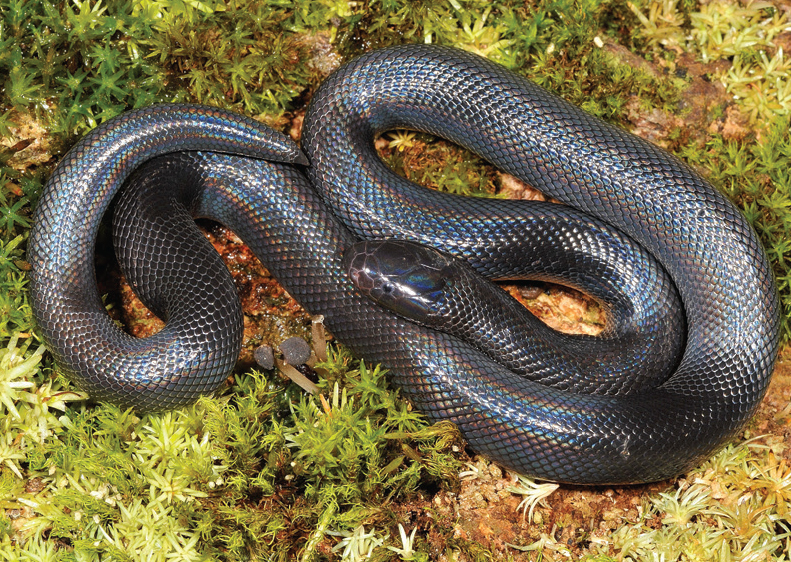
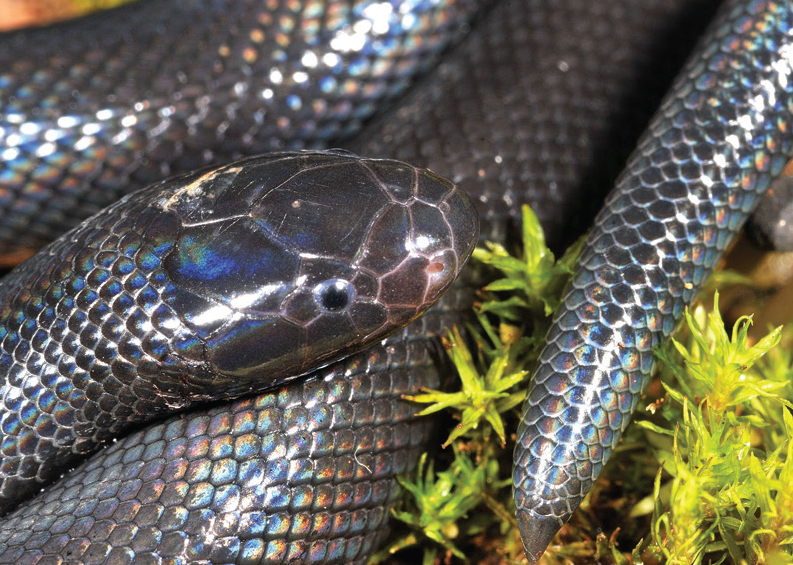
Sierra Leone (Bill Branch).
Duerden’s Burrowing Asp Atractaspis duerdeni
Identification: A medium-sized, moderately thick snake with a distinctly rounded snout, in disjunct populations in southern Africa. It has a short, deep head. The scales are in 21–25 (usually 23) rows at midbody; ventrals 193–225; cloacal scale entire; subcaudals single, 19–27. Maximum size about 55cm, average 30–45cm; hatchling size unknown. The body is black, greyish black or grey, and white, cream or pinkish below, the paler colour extending up onto the lower scale rows on the flanks and the lips.
Habitat and Distribution: In sandy soils in dry savanna and grassland, at 1,100–1,500m; this species is absent from true Kalahari sands. It is found in five discrete populations on opposite sides of the Kalahari, one in north-central Namibia, two in Botswana (around Serowe, and between Otse and Gaborone) and two in South Africa (western Limpopo and Gauteng, and north of the Northern Cape); it is speculated that it lived on the shores of a massive ancient lake in the central Kalahari, which has now shrunk.
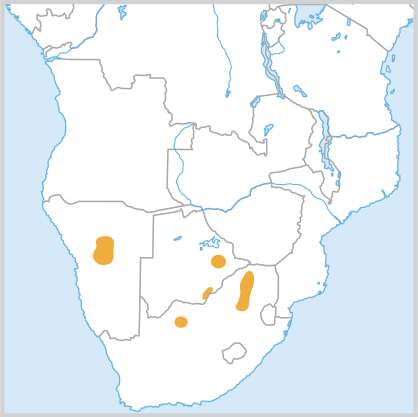
Atractaspis duerdeni
Natural History: Terrestrial and nocturnal; it lives underground but emerges at night in the rainy season, and is active mostly during the summer (October to April). It is a rather slow-moving snake, and quite good-natured for a burrowing asp, being surprisingly reluctant to bite. It lays eggs. The diet consists of small vertebrates; known prey items include lacertid lizards and snakes. It is less common than Bibron’s Burrowing Asp (Atractaspis bibronii) within its range.
Medical Significance: It has a small range, and its venom is probably similar to that of other burrowing asps, so it is not a major hazard. No antivenom is available, and the use of polyvalent antivenom is contraindicated; treat bites symptomatically.
Duerden’s Burrowing Asp, Atractaspis duerdeni.
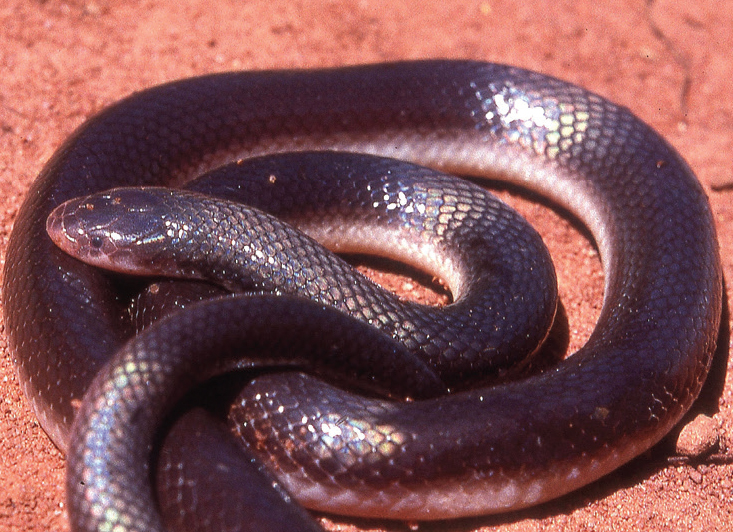
Botswana (Stephen Spawls).
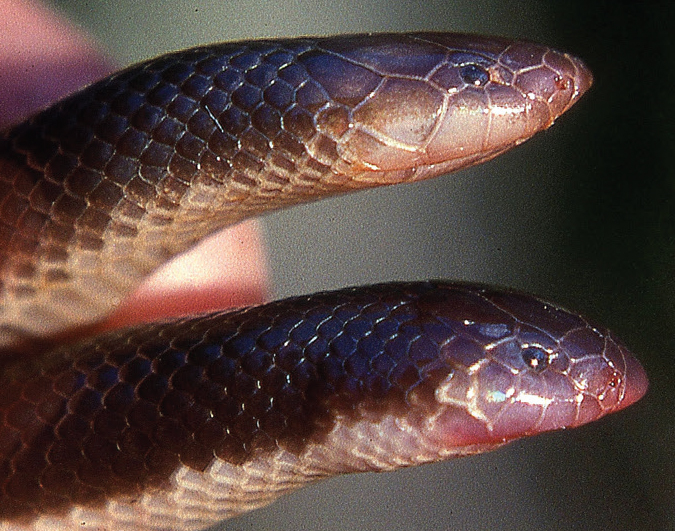
head profiles: A. bibronii, above; A. duerdeni, below (Stephen Spawls).
Palestine Burrowing Asp Atractaspis engaddensis
Identification: A relatively large burrowing asp, and the only one in Egypt. The body is cylindrical and the tail short, 7% of total length. The scales are in 25–29 rows at midbody; ventrals 263–284 (usually 275–282 in Egypt); cloacal scale entire; subcaudals single, 32–40 (usually 34–36 in Egypt). Maximum size over 80cm (the largest Egyptian snake measured 68.5cm), average 40–60cm; hatchling size unknown, but probably about 15cm. The colour is shiny black, above and below.
Habitat and Distribution: Semi-desert, often in large wadis and around oases. It is not found on mainland Africa, but has been recorded from Wadi Feiran and the Mount Sinai area in the Sinai Peninsula, at around 200–300m. It also occurs in western Jordan, southern and eastern Israel, and western Saudi Arabia.
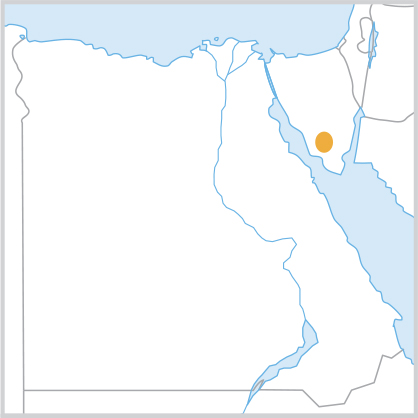
Atractaspis engaddensis
Natural History: Terrestrial and nocturnal, and active by night in the warmer months of the year; it hides under ground cover and in holes during the day. If threatened, it shows the typical nose-pointing behaviour, then hides its head under its coils and may elevate and wave the tail. Three to four eggs are laid between September and November; incubation time is three months. This species feeds mostly on smooth-bodied lizards and snakes, but will take rodents.
Medical Significance: It has a small range in inhospitable country, so relatively few bites occur. However, some severe cases are documented, including fatalities, and may be connected with the sarafotoxins present; this is probably the most dangerous African species. The usual burrowing asp symptomology of immediate pain, swelling, paraesthesia and lymphadenitis is often present, but more alarming effects sometimes seen include violent autonomic symptoms (nausea, vomiting, abdominal pain, diarrhoea, muscle weakness, breathing difficulties, sweating, profuse salivation and sudden elevation of blood pressure) within minutes of the bite. One patient developed severe dyspnoea with acute respiratory failure, one had weakness, impaired consciousness and transient hypertension, and in three there were electrocardiographic changes. A child bitten by this snake in Saudi Arabia died following an atrioventricular block. At present, no antivenom is available, and the use of polyvalent antivenom is contraindicated; treat bites symptomatically.
Palestine Burrowing Asp, Atractaspis engaddensis.
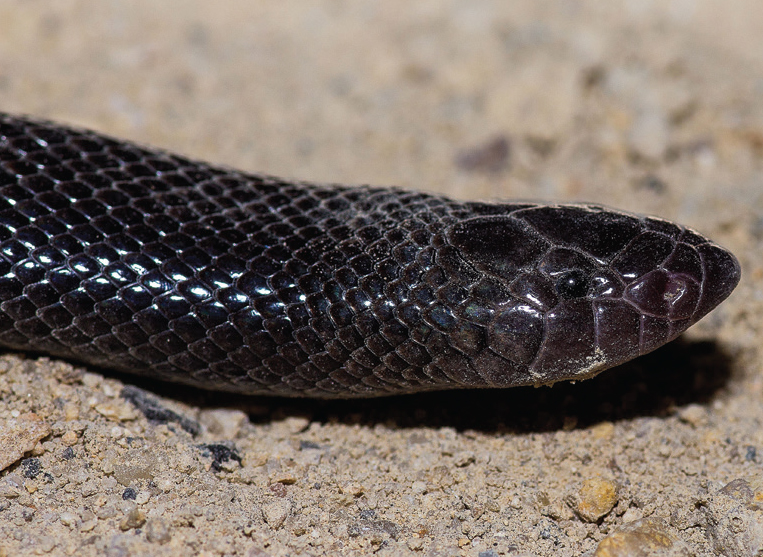
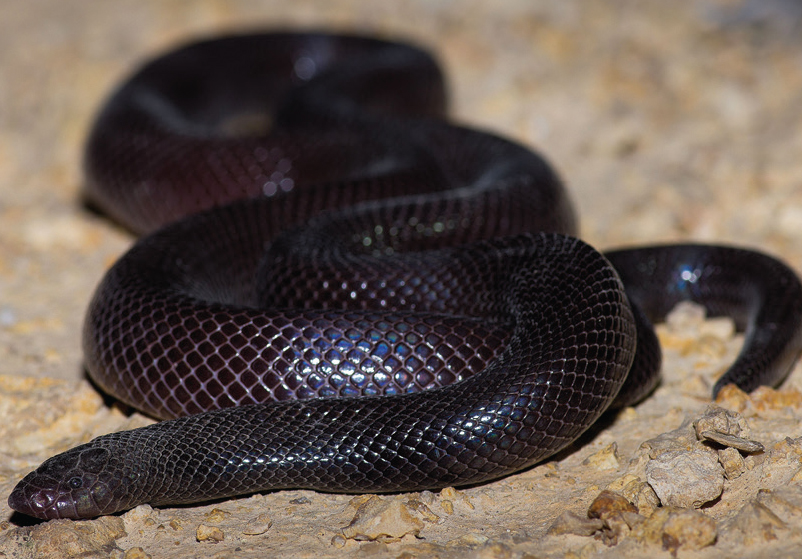
Israel (Yannick Francioli).
Engdahl’s Burrowing Asp Atractaspis engdahli
Identification: A small burrowing asp of the dry country of north-eastern Kenya and southern Somalia. The snout appears rounded from above but shark-like in profile. The body is cylindrical and the tail short, 5–6% of total length. The scales are in 19 rows at midbody; ventrals 219–232; cloacal scale divided; subcaudals paired, 19–23. Maximum size about 45cm, average 25–40cm; hatchling size unknown, but probably about 15cm. The body is black, blue-black or red-brown (juveniles can be quite light brown), and paler below.
Habitat and Distribution: Endemic to the Horn of Africa. It occurs in coastal plain, thicket, grassland, dry savanna and semi-desert, from sea level to 250m. In Kenya, it is known only from a single specimen from Wajir Bor, 50km east of Wajir in the north-east; it is also known from the middle and lower Juba River and Kismayu in Somalia. Its distribution is probably continuous, but there are few specimens.
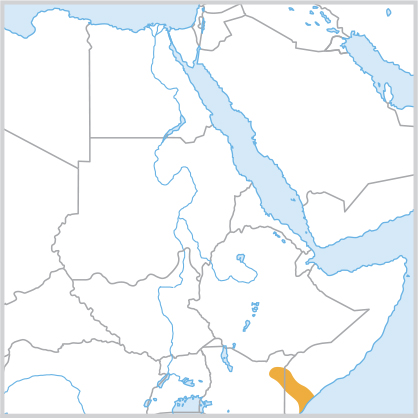
Atractaspis engdahli
Natural History: Poorly known, but it is presumably similar to other Atractaspis, living underground and eating largely smooth-bodied reptiles. Specimens have been captured in termitaria, in holes and prowling in semi-desert at night; the Wajir Bor specimen was in a dry well.
Medical Significance: It has a small range, and its venom is probably similar to that of other burrowing asps, so it is not a major hazard. No antivenom is available, and the use of polyvalent antivenom is contraindicated; treat bites symptomatically.
Engdahl’s Burrowing Asp, Atractaspis engdahli.
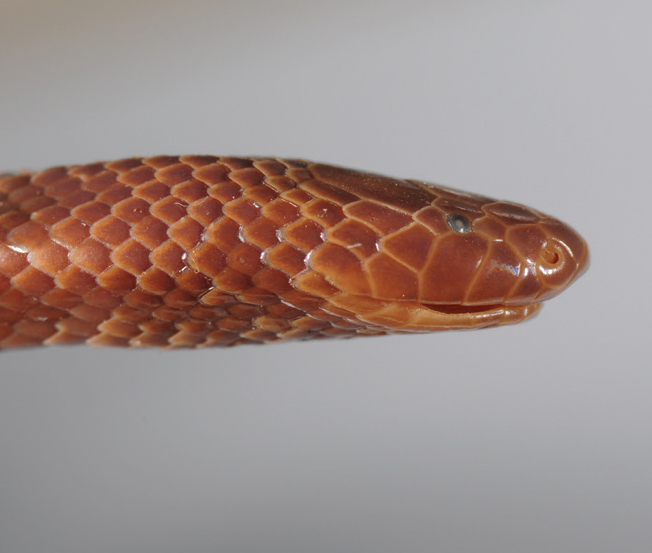
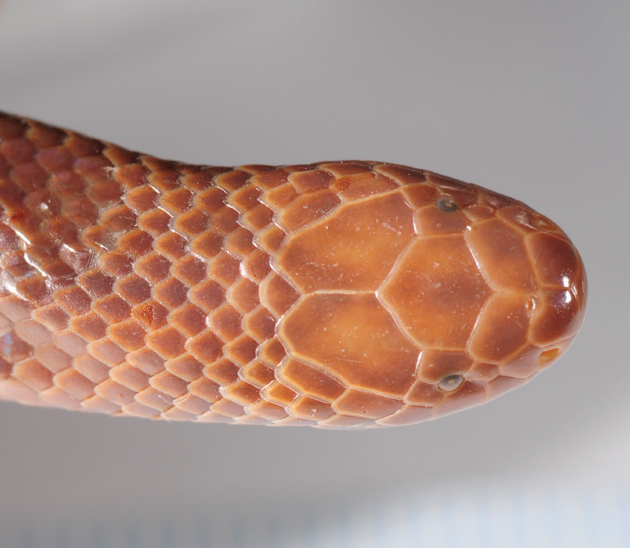
preserved specimen (Tomáš Mazuch).
Variable Burrowing Asp Atractaspis irregularis
Identification: A small burrowing asp of the great Central and West African forest. The body is cylindrical and the tail short, 5–8% of total length, ending in a pointed cone. The scales are smooth; in 23–27 rows at midbody (occasionally 21 but usually 23 on the eastern side, and 25–27 on the western side); ventrals 213–263; cloacal scale divided; subcaudals paired, 20–32 (higher counts in males). Maximum size about 66cm (possibly larger; see the taxonomic notes), average 30–50cm; hatchling size unknown. The body is usually shiny black or blackish grey, and the scales are iridescent. The ventrals are dark grey, black or rufous, sometimes with white edging.
Habitat and Distribution: Moist savanna, woodland, forest–savanna mosaic and forest, from sea level to 1,800m. It occurs from southern Ghana westwards to Liberia and southern Guinea, and from south-western Nigeria east to South Sudan, parts of central Uganda, Rwanda and Burundi, just reaching northwest Tanzania, and south to north-west Angola. There are isolated populations in southern Togo, Jos in Nigeria, parts of the western and central highlands of Kenya, Mount Bizen in Eritrea, and the Chercher Mountains and the forest of south-west Ethiopia. Oddly, there seem to be virtually no records from Gabon, although this snake occurs in Cameroon right up to the border, and there are few records from central DR Congo.
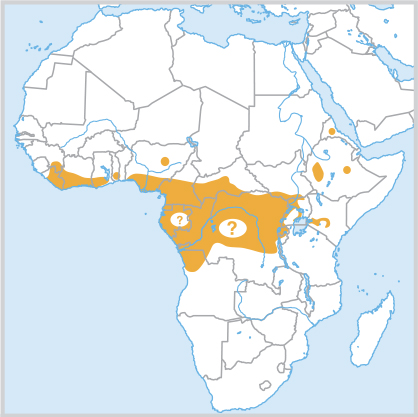
Atractaspis irregularis
Natural History: Nocturnal and terrestrial, spending much time in holes or under ground cover, but it is active on the ground on wet nights. It shows the nose-pointing response if molested. A female from the Mabira Forest in Uganda contained six eggs; mating was observed there in September. This species is known to eat rodents as well as small reptiles.
Medical Significance: A widespread species that is sometimes common, is active on the ground at night and may enter buildings; it is also found in agricultural land where many people farm with short tools, so is a significant snakebite hazard within parts of its range. It is said to be a major cause of snakebite in DR Congo. No antivenom is available, and the use of polyvalent antivenom is contraindicated; treat bites symptomatically. In most documented cases, the usual symptoms of pain, swelling and lymphadenopathy are present. More extensive general muscle pain may be experienced, and elevated heart rates have been noted, which may be due to the sarafotoxins. There have been two recorded fatalities, both of which involved exceptional circumstances and an incomplete clinical picture. In the first, a victim in Liberia was bitten a number of times after rolling on the snake in his sleep; he died quickly without treatment. In similar circumstances, a 10-month-old baby was bitten while asleep and died within minutes.
Taxonomic Notes: In 1959, Gaston de Witte described Atractaspis battersbyi from Bolobo, on the lower Congo River. The two specimens were 82.5cm and 52.5cm; midbody scale count 23; ventral scales 341 and 348; subcaudals 22 and 23. Most authorities regard these specimens as aberrant examples of Atractaspis irregularis, despite the large size of one animal and high ventral counts. Likewise, in 1960 Jean-Luc Perret described Atractaspis coalescens from south-west Cameroon, on the basis of head scalation that differed very slightly from A. irregularis; no more specimens have been found, and it seems A. coalescens is probably an aberrant example of A. irregularis.
Variable Burrowing Asp, Atractaspis irregularis.
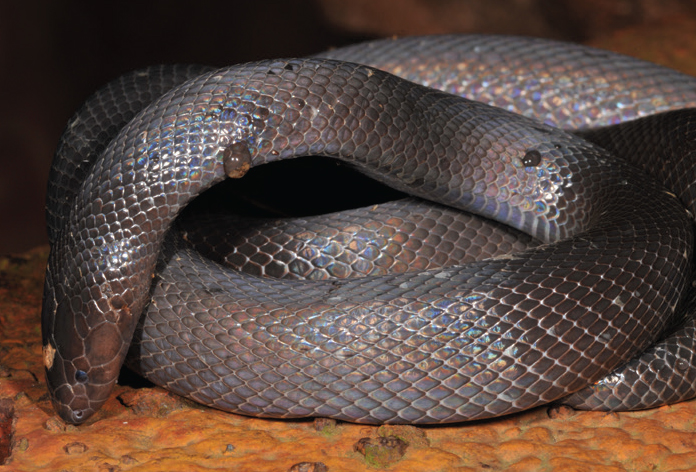
Liberia (Bill Branch).
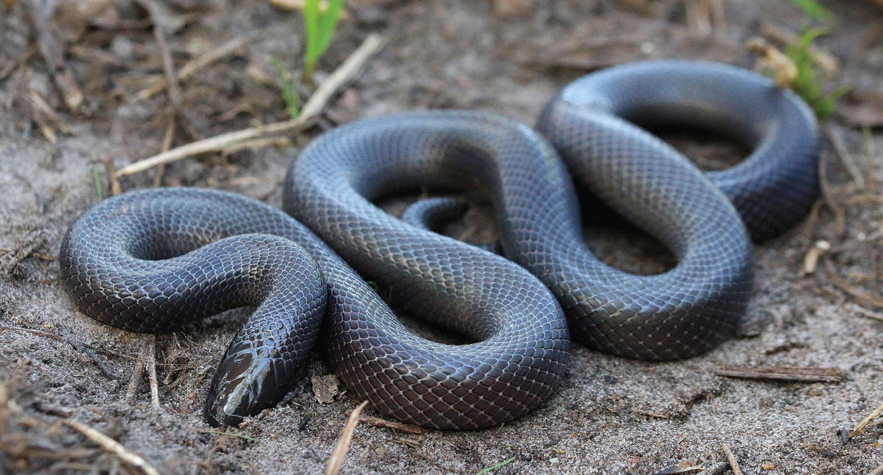
Uganda (Jelmer Groen).
Identification: A small, slim burrowing asp of the northern Horn of Africa, with a white head and white vertebral stripe. The scales are in 23 rows at midbody; ventrals 230–243; cloacal scale entire; subcaudals single, 27–29. Maximum size uncertain, but probably around 50cm, average 20–30cm. It is distinctly marked, with a white or pale head and a dark crown; the back is dark with a fine yellow-white vertebral stripe. The four lowest scale rows and the ventrals are white, with a broad black throat band. This is one of two distinctly marked burrowing asps from the Horn of Africa; this species and the Somali Burrowing Asp (Atractaspis scorteccii) are the only burrowing asps to have any sort of large-scale markings, all the rest being uniform in colour.
Habitat and Distribution: Known from two specimens alone, from dry savanna and grassland: one from the Ogaden in eastern Ethiopia (although the exact locality is unknown); the second on the Somali–Djibouti border, in a region of sandy soil with grass and stunted thornbush at an altitude of 300m.
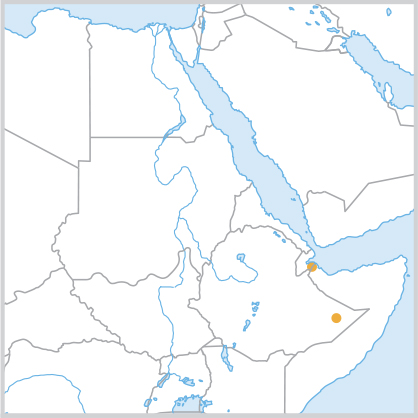
Atractaspis leucomelas
Natural History: Nothing is known of its biology, and most of its range lies within a militarily unsafe area. One specimen is reported as having been captured during the day, but it is not stated if the snake was active or not; burrowing asps are usually nocturnal. Its habits are presumably similar to those of other burrowing asps.
Medical Significance: A small, rare snake with a small range, so it is unlikely to deliver much venom in a bite; the venom is probably similar to that of other burrowing asps, so it is not a major hazard. No antivenom is available, and the use of polyvalent antivenom is contraindicated; treat bites symptomatically.
Ogaden Burrowing Asp, Atractaspis leucomelas.
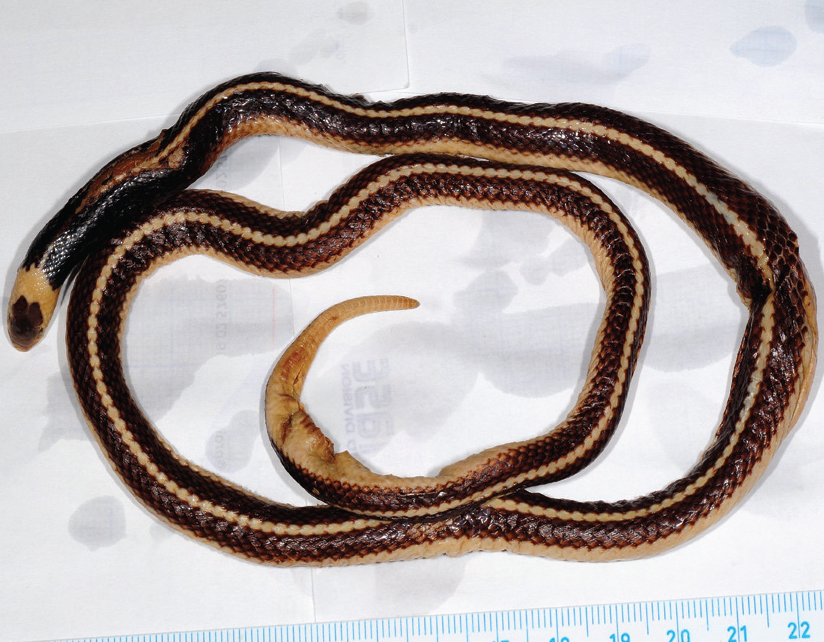
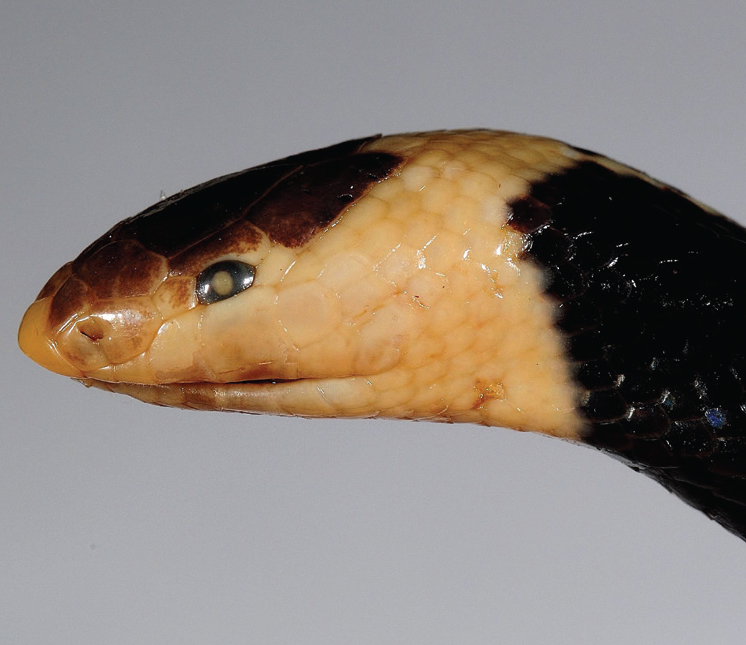
preserved specimen (Tomáš Mazuch).
Identification: A large, stout burrowing asp with a white head, from the dry country of far north-east Africa. The scales are in 23–25 rows at midbody; ventrals 215–230; cloacal scale entire; subcaudals single, 30–34. Maximum size about 85cm, average 50–75cm; hatchling size unknown. The colour is usually black or dark brown, with a broad white ring right around the neck. The top of the head is mottled dark brown. The lips, chin and throat are white, and there is often a dark patch behind and slightly below the eye. The belly is white, mottled with dark brown, and the outer edges of the belly scales are dark. This is one of two distinctly marked burrowing asps from the Horn of Africa; this species and the Ogaden Burrowing Asp (Atractaspis leucomelas) are the only burrowing asps to have any sort of large-scale markings, all the rest being uniform in colour.
Habitat and Distribution: Known from only a handful of specimens from sandy and stony country in the dry grassland and semi-desert of eastern Ethiopia and northern Somalia, between 600m and 1,100m.
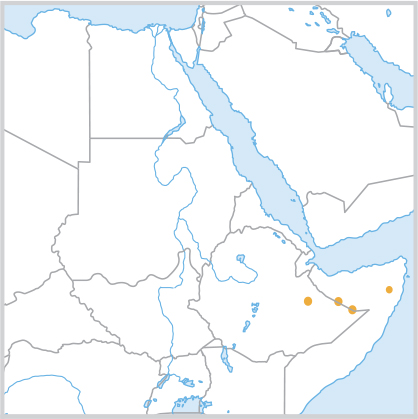
Atractaspis scorteccii
Natural History: First described in 1949, but virtually nothing is known of its biology, and most of its range lies within a militarily unsafe area. The significance of the white neck band is unknown, but another African snake with a near-identical pattern, the Pale-collared Snake-eater (Polemon graueri), found in the forested lake regions of western Uganda and DR Congo, feeds on snakes, suggesting that the Somali Burrowing Asp may do so too.
Medical Significance: A rare snake with a small range; the venom is probably similar to that of other burrowing asps, so it is not a major hazard. No antivenom is available, and the use of polyvalent antivenom is contraindicated; treat bites symptomatically.
Somali Burrowing Asp, Atractaspis scorteccii.
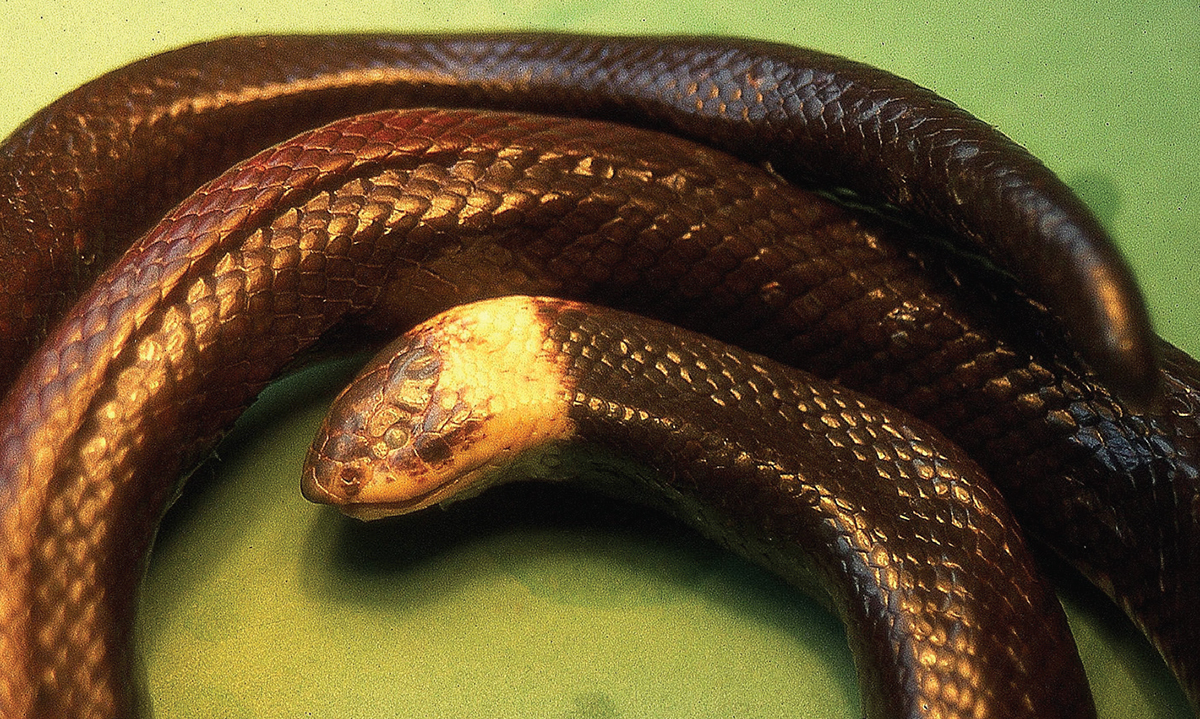
Preserved specimen (Stephen Spawls).
Reticulate Burrowing Asp Atractaspis reticulata
Identification: A huge, broad-headed burrowing asp of Central Africa. The head is short and broad. The scales are in 21–23 (occasionally 19) rows at midbody; ventrals 308–344; cloacal scale divided; subcaudals paired, 21–26. Maximum size about 1.14m, average 60–90cm; hatchling size unknown. The body is usually grey, and the dorsal scales are pale-edged, giving the snake its reticulate or ‘net-like’ appearance.
Habitat and Distribution: Forests and moist savanna, between sea level and 1,400m. It occurs from southern Cameroon eastwards, just reaching south-west Central African Republic, across DR Congo to the southern Albertine Rift, and southwards to north-west Angola. There are isolated records from Mbeya in Tanzania and Bauchi in Nigeria, and a possible record from Ghana.
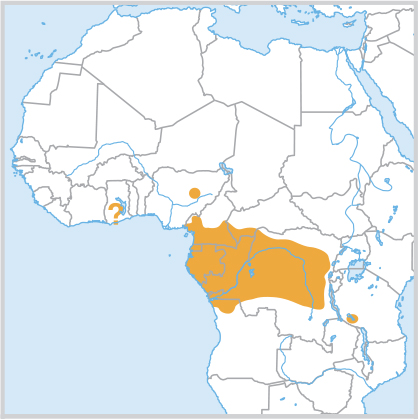
Atractaspis reticulata
Natural History: Poorly known, despite its huge range. It is terrestrial and nocturnal, and lives underground but emerges at night in the rainy season. It lays eggs. The diet consists of small vertebrates.
Medical Significance: A widespread species that is sometimes common, is active on the ground at night and may enter buildings; it is also found in agricultural land where many people farm with short tools, so is a significant snakebite hazard within parts of its range. The symptomology is probably similar to that of other burrowing asps, with pain, swelling and lymphadenopathy. No antivenom is available and the use of polyvalent antivenom is contraindicated; treat bites symptomatically.
Reticulate Burrowing Asp, Atractaspis reticulata.
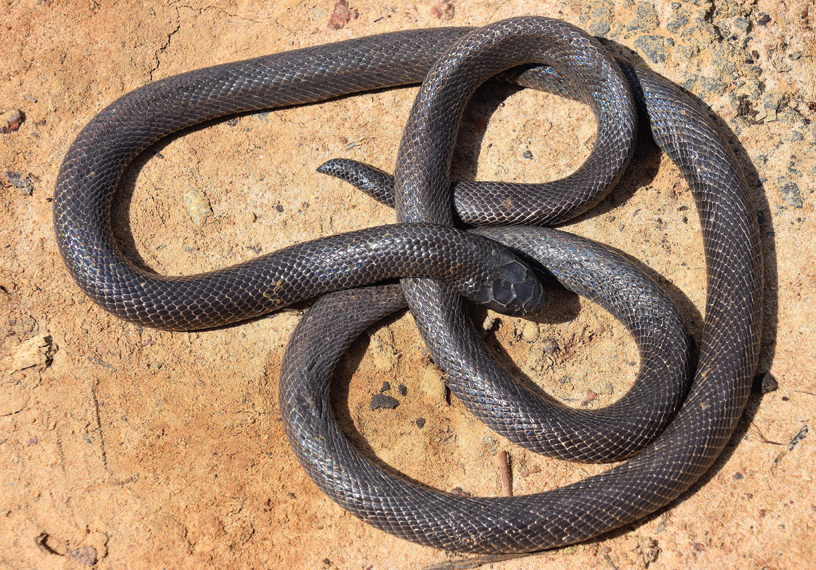
Cameroon (Jean-Francois Trape).
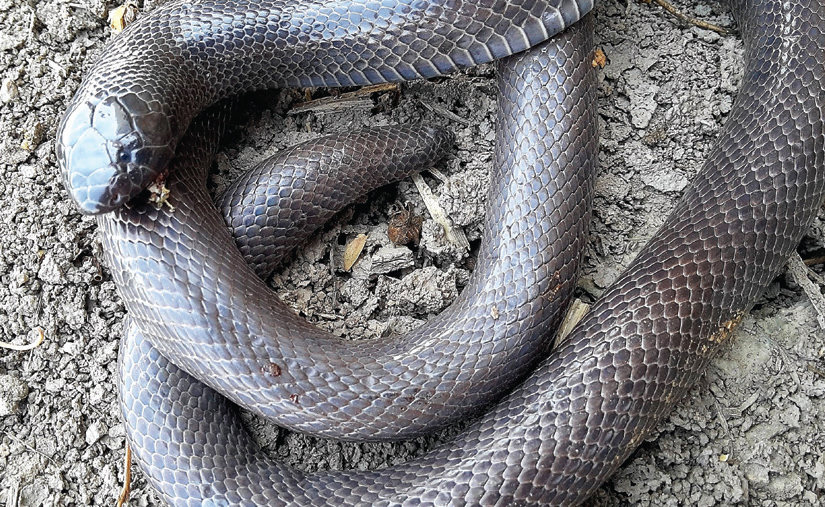
Tanzania (Ignas Safari).
This is a complex of six species of relatively large, stocky, broad-headed burrowing asps. They occur eastwards from Senegal across the Sahel and savanna of West and Central Africa, encircle the Ethiopian highlands and extend south to northern Tanzania. They were all regarded as subspecies of Atractaspis microlepidota for a long time (or even just differing examples of a single, rather variable species). But recent systematic and molecular work suggests that at least six taxa are involved. However, exactly where one taxon ends and another begins is not certain. Many specimens in the low country surrounding high central Ethiopia are problematic, where the various taxa are separated by slight differences in lepidosis. Where the identity of specimens is equivocal, we have assigned them zoogeographically, which may differ slightly from some published data. Historically, members of this complex have caused some deaths, although no recent, clinically well-documented cases that indicate the venom was directly responsible for the fatality are known.
Western Small-scaled Burrowing Asp Atractaspis microlepidota
Identification: A fairly large black burrowing asp of the savanna of western West Africa. It is a stocky snake with a short, broad head. The body is cylindrical and the tail short, about 7% of total length, ending in a spike. The scales are smooth; in 29–33 rows at midbody; ventrals 198–222; cloacal scale entire; subcaudals single, 21–26. Maximum length 67cm, average 40–60cm; hatchling size unknown. The dorsal colour is glossy uniform black, and the underside is usually lighter, often grey.
Habitat and Distribution: In the Sudan savanna and Sahel of West Africa, at low altitude, between sea level and 200m. This species is known only from Senegal, the Gambia, and southern and south-western Mauritania.
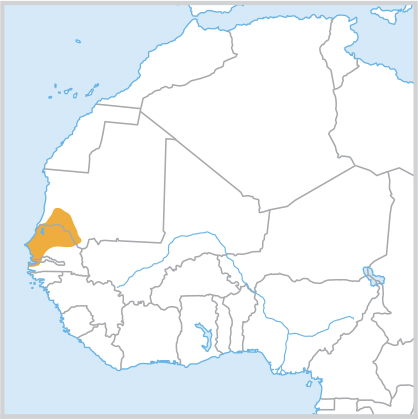
Atractaspis microlepidota
Natural History: Poorly known. It is nocturnal and terrestrial, usually underground, but active at night on the ground in the rainy season. If molested, it shows the usual distinctive burrowing asp response, arching the neck and pointing the head at the ground, looking like an inverted ‘U’, then writhing and hiding the head. It may also release a distinctive-smelling chemical from the cloaca. It presumably lays eggs. The diet is toads, lizards and small snakes, and it might take rodents.
Medical Significance: A snake with a small range, and whose venom is probably similar to that of other burrowing asps (i.e. causes pain, swelling, etc.), so it is probably not a major hazard. However, it can grow fairly large, and a similar species has caused fatalities, so a bite needs to be monitored and, if necessary, treated at a competent hospital. No antivenom is available, and the use of polyvalent antivenom is contraindicated; treat bites symptomatically.
Western Small-scaled Burrowing Asp, Atractaspis microlepidota.
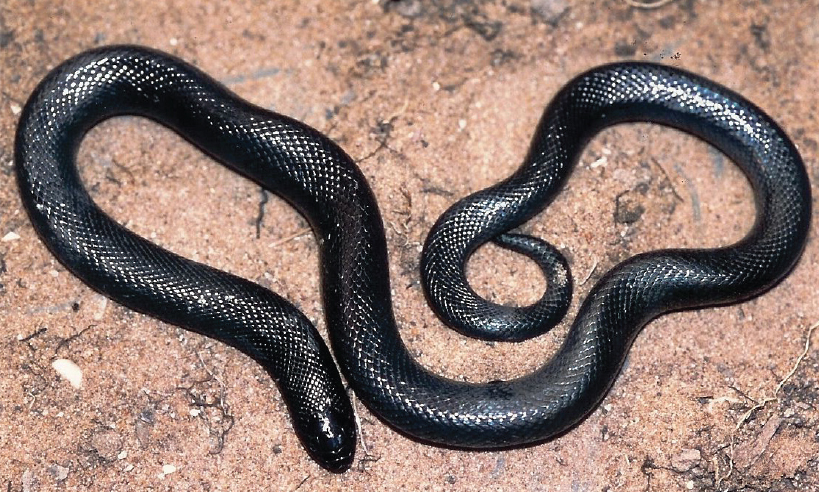
Senegal (Jean-Francois Trape).
Sahelian Burrowing Asp Atractaspis micropholis
Identification: A fairly large brown burrowing asp of the Sahel. It is a stocky snake with a short, broad head. The body is cylindrical and the tail short, less than 10% of total length, ending in a spike. The scales are smooth; in 25–27 rows at midbody; ventrals 211–230; cloacal scale entire; subcaudals single, 26–32. Maximum length 90cm, average 40–75cm; hatchling size unknown. The dorsal colour is shiny brown, and the back and lower edges of the dorsal scales are pale, especially on the flanks, giving the snake a speckled appearance. The underside is usually light, clear brown.
Habitat and Distribution: In the Sudan savanna and Sahel of West Africa, at low altitude, between sea level and 800m. It occurs eastwards from Senegal and the Gambia through Mali, Burkina Faso, northern Nigeria and Niger to western Chad, with an apparently isolated population in eastern Chad; it is nearly always between 11°N and 17°N. A curious record from south-western Cameroon is not shown on the map.
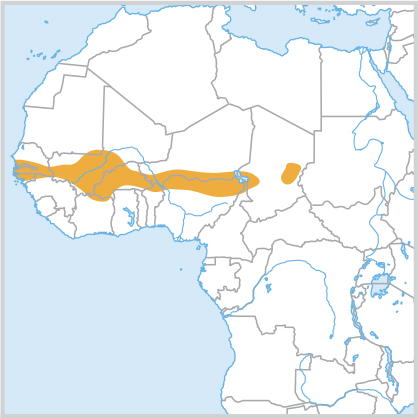
Atractaspis micropholis
Natural History: Poorly known. It is nocturnal and terrestrial, usually underground, but active at night on the surface in the rainy season. If molested, it shows the usual distinctive burrowing asp response, arching the neck and pointing the head at the ground, looking like an inverted ‘U’, then writhing and hiding the head. It may also release a distinctive-smelling chemical from the cloaca. It presumably lays eggs. The diet comprises mostly lizards, but it might take other small vertebrates. It has been reported to be more common in Senegal than elsewhere.
Medical Significance: A snake with a small range, and whose venom is probably similar to that of other burrowing asps (i.e. causes pain, swelling, etc.), so it is probably not a major hazard. However, it can grow fairly large; a bite needs to be monitored and, if necessary, treated at a competent hospital. No antivenom is available, and the use of polyvalent antivenom is contraindicated; treat bites symptomatically. A French soldier bitten by a large example of this snake in Senegal died in under an hour.
Sahelian Burrowing Asp, Atractaspis micropholis.
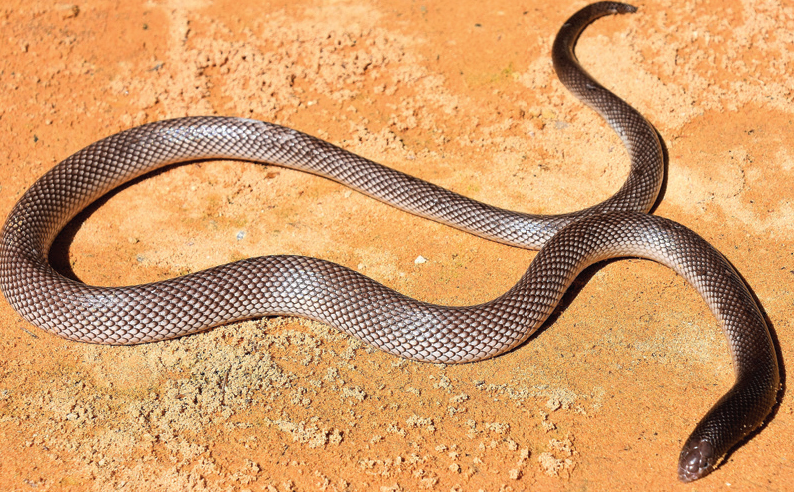
Senegal (Jean-Francois Trape).
Watson’s Burrowing Asp Atractaspis watsoni
Identification: A fairly large black burrowing asp of the savanna and Sahel of West and Central Africa. It is a stocky snake with a short, broad head. The body is cylindrical and the tail short, less than 10% of total length, ending in a spike. The scales are in 29–31 (occasionally 27) rows at midbody; ventrals 213–242; cloacal scale entire; subcaudals single, 21–30. Maximum recorded length 72cm, average 30–65cm; hatchling size unknown. The colour is black or brownish black above, and slightly lighter beneath.
Habitat and Distribution: The Sudan savanna and Sahel of West Africa, at low altitude, between sea level and 800m. It occurs eastwards from the Senegal–Mauritania border country through Mali, Burkina Faso, southern Niger and northern Nigeria to northern Cameroon, southern Chad and the extreme northern Central African Republic. A British Museum specimen from Juba, South Sudan, is probably another species.
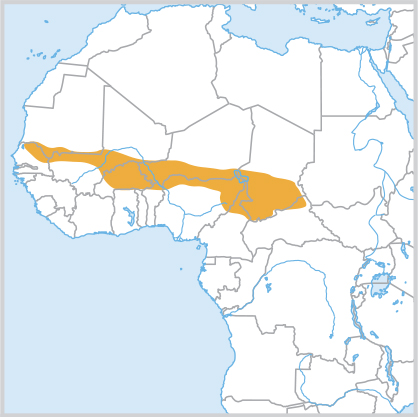
Atractaspis watsoni
Natural History: Poorly known. It is nocturnal and terrestrial, usually underground, but active at night on the ground. If molested, it shows the usual distinctive burrowing asp response, arching the neck and pointing the head at the ground, looking like an inverted ‘U’. It may also release a distinctive-smelling chemical from the cloaca. It presumably lays eggs. The diet comprises mostly reptiles, but it might take other small vertebrates.
Medical Significance: A large burrowing asp with a huge range, including populated areas, so it may well be a snakebite hazard. The venom is probably similar to that of other burrowing asps (i.e. causes pain, swelling, etc.), and is reported to cause local necrosis. Such a large snake may deliver a lot of venom (it may have large venom glands), so bites need to be monitored and, if necessary, treated at a competent hospital. No antivenom is available, and the use of polyvalent antivenom is contraindicated; treat bites symptomatically.
Watson’s Burrowing Asp, Atractaspis watsoni.
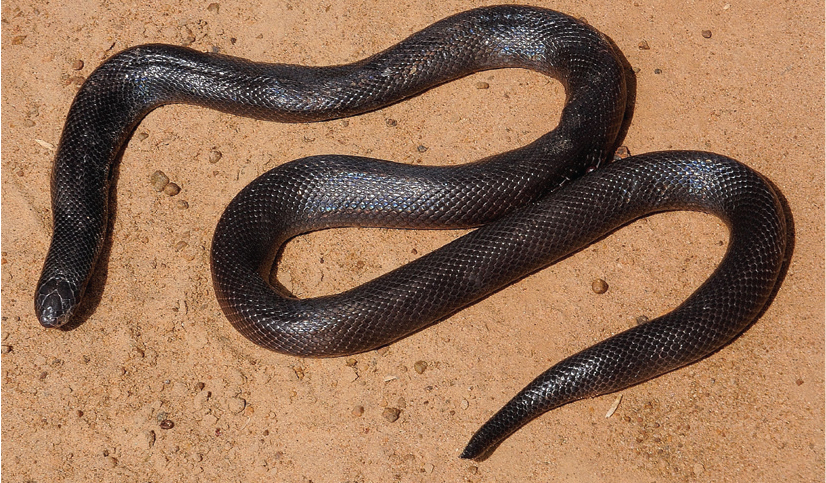
Chad (Jean-Francois Trape).
Magretti’s Burrowing Asp Atractaspis magrettii
Identification: A rare burrowing asp from Eritrea and nearby Sudan, and possibly Somalia and Ethiopia. It is a stocky snake with a short, broad head. The body is cylindrical and the tail short, less than 10% of total length, ending in a spike. The scales are in 25–29 rows at midbody; ventrals 228–248; cloacal scale entire; subcaudals single, 31–33. Maximum recorded length 65cm, average 30–60cm; hatchling size unknown. The colour is uniformly black above, and slightly lighter beneath.
Habitat and Distribution: Known from semi-desert, dry savanna and semi-arid high plateau, between 400m and 2,400m. It has been recorded from a handful of localities in Eritrea and adjacent Sudan at Kassala. The type came from Mandafena, near Adi Keyh, at 2,400m in the mountains of central Eritrea, a curiously high-altitude location for a large burrowing asp. A handful of specimens from the border area between the northern Ogaden in Ethiopia and Somalia are tentatively also assigned to this species.
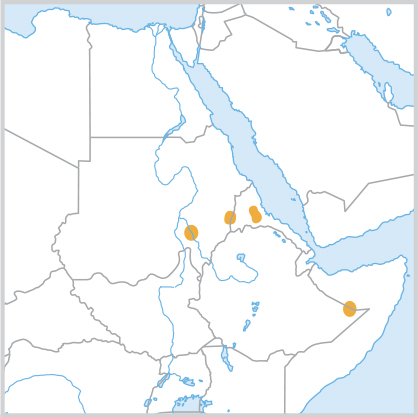
Atractaspis magrettii
Natural History: Essentially unknown, but presumably similar to other burrowing asps.
Medical Significance: As for other burrowing asps with restricted ranges.
Sudan Burrowing Asp Atractaspis phillipsi
Identification: A fairly large steel-grey or black burrowing asp of central Sudan, South Sudan and western Ethiopia. It is a stocky snake with a short, broad head. The body is cylindrical and the tail short, less than 10% of total length, ending in a spike. The scales are in 29–33 rows at midbody; ventrals 222–252 (possibly as low as 211); cloacal scale entire; subcaudals single, 23–33. Maximum recorded length about 90cm, average 50–70cm; hatchling size unknown. The colour is uniform black, steel grey or grey-black above and below.
Habitat and Distribution: Dry savanna, grassland and swamp, between 400m and 600m on the plains of the Sudanese and South Sudanese Nile. It occurs south from Khartoum, up the Blue Nile to Sinjah, up the White Nile to Juba, and east to Gambela and western Benishangul-Gumuz in Ethiopia.
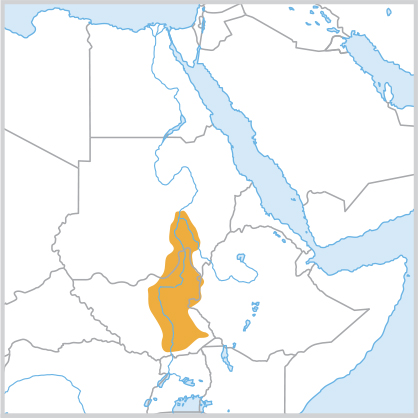
Atractaspis phillipsi
Natural History: Essentially unknown, but presumably similar to other burrowing asps.
Medical Significance: As for other burrowing asps with restricted ranges. Two victims who were bitten by the same 25cm snake received injections of antivenom. One recovered uneventfully, while the other lost the nail and tip of the finger to necrosis.
Taxonomic Notes: This species was re-elevated to species status from the synonymy of Atractaspis microlepidota by Don Broadley in 1994, following an examination of a snake collection from Al Jazirah State, Sudan.
Sudan Burrowing Asp, Atractaspis phillipsi.
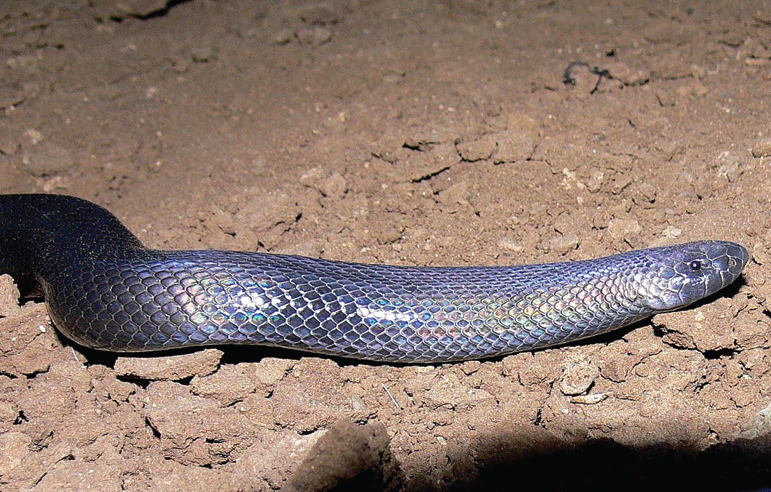
Sudan (Sebastian Kirchof).
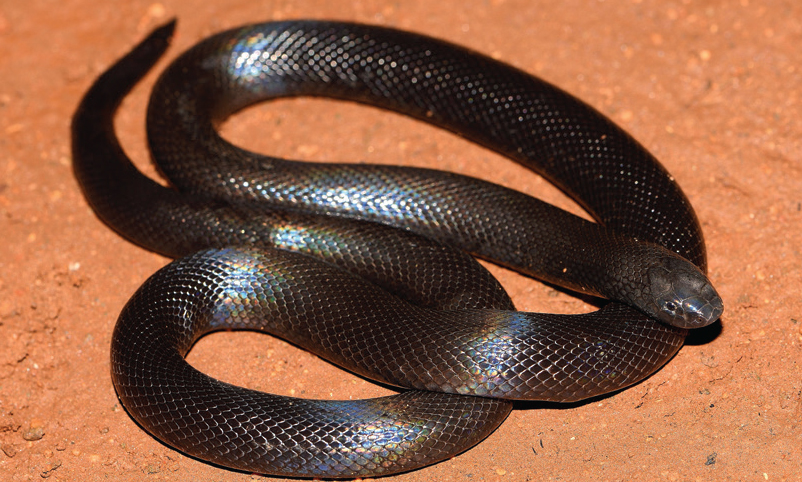
Ethiopia (Tomáš Mazuch).
Eastern Small-scaled Burrowing Asp Atractaspis fallax
Identification: A really large burrowing asp of the Horn of Africa and north-east East Africa. It is often stout, with a broad, blunt head. The body is cylindrical and the tail short, 7–9% of total length. The scales are smooth; in 27–37 rows at midbody; ventrals 227–257; cloacal entire; subcaudals single (occasionally paired, or a mixture of both), 20–39. One of the largest burrowing asps, reaching 1.1m in eastern Kenya; there are anecdotal reports of larger specimens, up to 1.3m, on the Kenyan coast. Average size 60–90cm; hatchling size unknown. The colour is quite variable, being black, grey, brown or often distinctly purple-brown; the scales may be iridescent. Coastal specimens are often light purple-brown, darkening towards the head, with the head and the neck black. Juveniles are often light brown. The belly is usually dark.
Habitat and Distribution: Coastal bush and thicket, dry and moist savanna, grassland and semi-desert, from sea level to about 1,800m, but most common in dry savanna below 1,000m. It occurs from northern Somalia and the Ogaden in Ethiopia, southwards through Somalia into northern and eastern Kenya and north-east Tanzania. There are seemingly isolated records along the lower Awash River in Ethiopia, the Maasai Mara and Serengeti in Kenya and Tanzania, and parts of north-west Kenya. South Sudanese records of this species are probably best assigned to the Sudan Burrowing Asp (Atractaspis phillipsi).
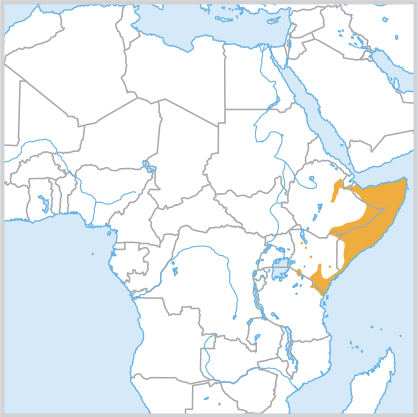
Atractaspis fallax
Natural History: Nocturnal and terrestrial; it is usually underground, but active at night on the surface in the rainy season. It is sometimes active by day. If molested, it shows the usual distinctive burrowing asp response, arching the neck and pointing the head at the ground, looking like an inverted ‘U’, then writhing and hiding the head. It may also release a distinctive-smelling chemical from the cloaca. Captive specimens have been photographed elevating the head and flaring the neck into a moderate hood, like a cobra. A Kenyan female laid eight eggs. The diet is snakes, smooth-bodied lizards and occasionally rodents. This species is said to be relatively common in parts of its range, especially the north Kenyan coast, from Kilifi to Malindi. In Somali areas it is known as ‘Jilbris’, ‘the snake of seven steps’ (meaning that if you are bitten, you take seven steps and die), or ‘father of 10 minutes’ (for obvious reasons). It is a very difficult snake to catch; large adults are strong, active and bite furiously if restrained.
Medical Significance: Widespread in the low and coastal regions of Kenya and Somalia, sometimes common, active on the ground at night and may enter buildings; it is also found in agricultural land, where people farm with short tools, so it is a significant snakebite hazard within parts of its range. The venom manifests itself as largely cytotoxic; swelling, pain, skin discolouration, subsequent lymphadenopathy and occasionally necrosis (especially to digit tips) resulted from bites. Occasional bites in Kenya have caused necrosis requiring excision or amputation. No anti-venom is available, and the use of polyvalent antivenom is contraindicated; treat bites symptomatically. The large size of some adults means that bites may need effective symptomatic treatment.
Eastern Small-scaled Burrowing Asp, Atractaspis fallax.
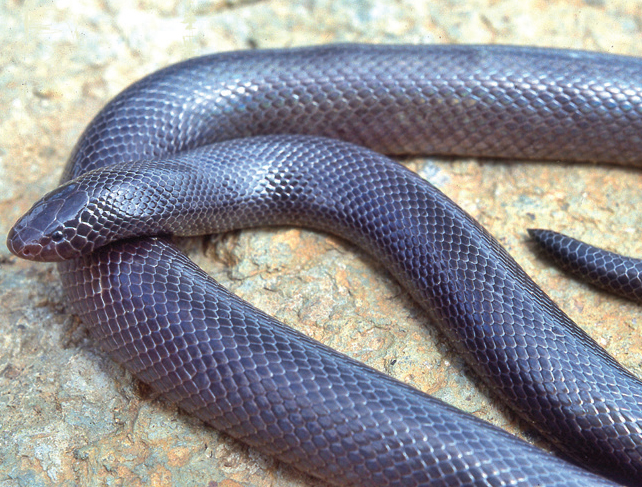
Ethiopia (Stephen Spawls).
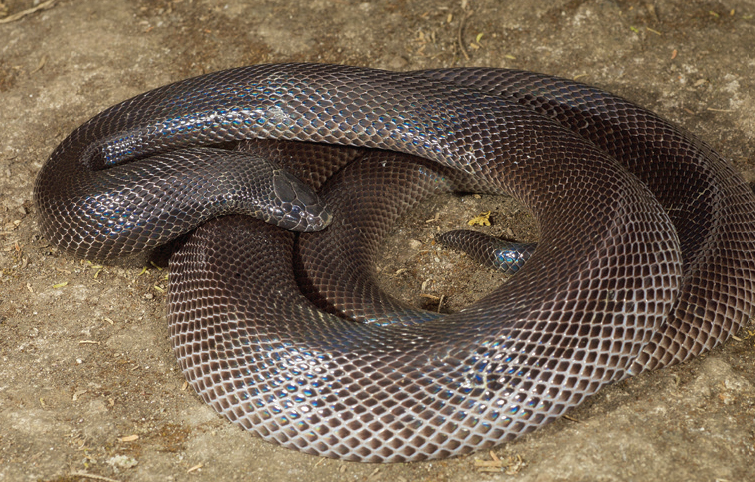
Tanzania (Michele Menegon).
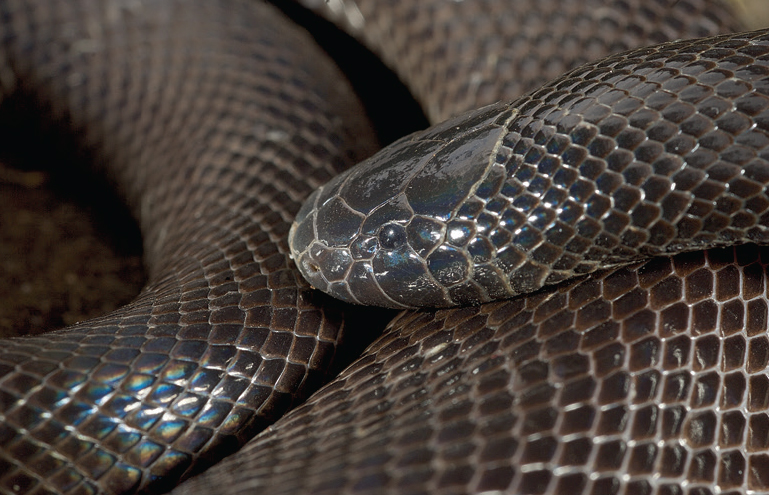
Tanzania (Michele Menegon).
Two species of colourful, small, slender front-fanged snakes, both endemic to southern Africa. They have been classified as elapids (their original common name was ‘dwarf garter snake’), but molecular work now indicates they belong in the subfamily Atractaspidinae. Due to their small size, restricted distribution and secretive way of life, they are of minor medical importance. No antivenom is available and no fatalities are recorded; a bite can be treated symptomatically.
Key to the genus Homoroselaps, harlequin snakes
1aVentral scales 160–215; markings variable, red and/or yellow on a black back-ground……Homoroselaps lacteus, Spotted Harlequin Snake
1bVentral scales 215–240; always with a well-defined single yellow vertebral stripe……Homoroselaps dorsalis, Striped Harlequin Snake
Spotted Harlequin Snake Homoroselaps lacteus
Identification: A small, slim, vividly marked black, yellow and often red snake of southern and eastern South Africa. The head is small and bullet-shaped, and the eyes are small and dark. The tail is 9–16% of total length (longer in males). The scales are in 15 rows at midbody; ventrals 160–209; cloacal shield divided; subcaudals 23–43. Maximum size about 65cm, average 30–40cm; hatchlings 13–15cm. The colour is quite variable, usually a mix of yellow, black and often red. The ground colour is usually dark, heavily speckled with yellow or cream, sometimes with a black collar and a vertebral stripe of either speckled yellow or orangey-red. In some specimens the vertebral stripe is broken by black bars; others are barred black and yellow. The underside is often yellow or cream, usually with a darker midventral line, but may be uniform black.
Habitat and Distribution: In grassland, semi-desert, dry and moist savanna, thicket and heathland (fynbos), between sea level and 1,800m. This species is endemic to southern Africa. In South Africa it is found in most of the Western Cape and Eastern Cape, the southernmost part of the Northern Cape, Kwazulu-Natal, the eastern side of the Free State, Gauteng, Mpumalanga and central Limpopo; there is an isolated population on the north-western coast in the Port Nolloth/Kleinsee area, and some historical records from around Kimberley. It is also found in western Eswatini (Swaziland) and on the western border of Lesotho.
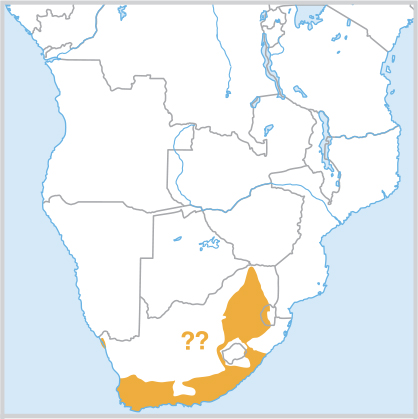
Homoroselaps lacteus
Natural History: A ground-dwelling snake, usually in holes and rarely on the surface, except after rainstorms. It shelters in termite mounds, under rocks and in holes. If molested, it usually does not try to strike, but wriggles violently to try to get away. If handled, it will try to inflict slow, deliberate bites. It lays 6–16 eggs in the summer (December or January); these take about 50 days to hatch. The diet is mostly small snakes and lizards, including worm lizards.
Medical Significance: A rare, secretive snake with a relatively small range. No antivenom is available. No fatalities are reported and the use of polyvalent antivenom is contraindicated; treat bites symptomatically. A few bite cases were characterised by local pain, sometimes severe, swelling that was sometimes slow to resolve and lymphadenitis; one victim had a persistent headache, while another had local numbness. The venom does not seem to have been analysed, but the symptomology is similar to that from burrowing asp bites – perhaps not unexpectedly, as they are in the same clade.
Spotted Harlequin Snake, Homoroselaps lacteus.
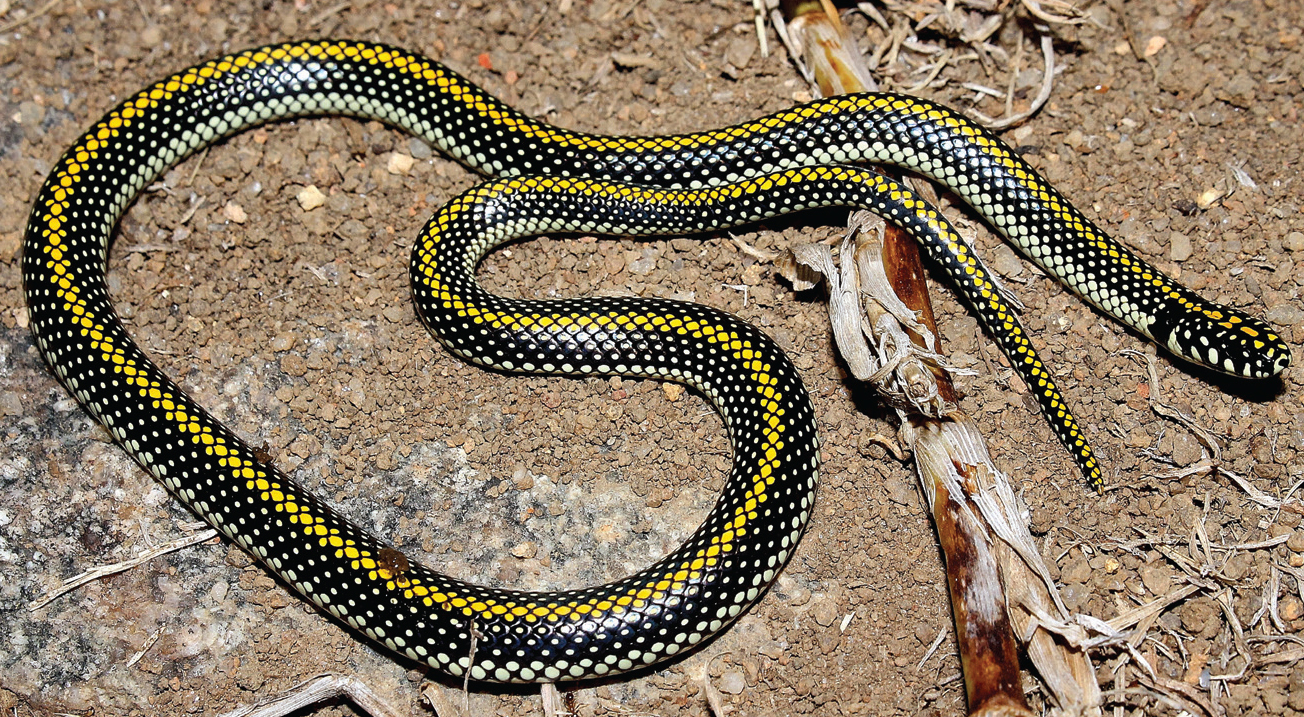
Eswatini/Swaziland (Richard Boycott).
Spotted Harlequin Snake, Homoroselaps lacteus.
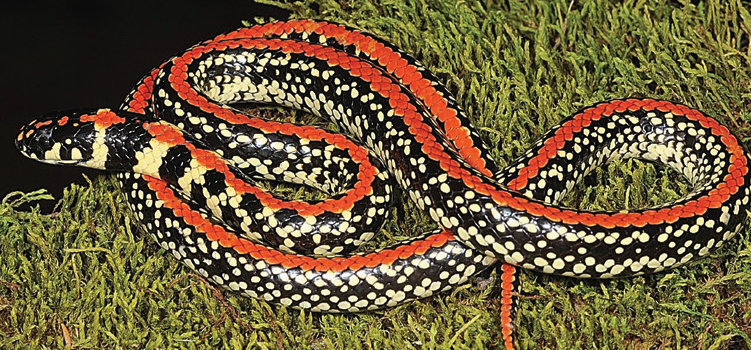
South Africa (Bill Branch).
Striped Harlequin Snake Homoroselaps dorsalis
Identification: A small, slim, vividly striped yellow-on-black snake of northern and eastern South Africa. The head is small and bullet-shaped, and the eyes are small and dark. The tail is 8–11% of total length (longer in males). The scales are in 15 rows at midbody; ventrals 210–239; cloacal shield divided; subcaudals 22–33. Maximum size about 32cm, average 20–25cm; hatchling size unknown. The colour is black above, with a broad yellow stripe extending from the tip of the nose to the tip of the tail. The lips, underside and lower scale rows on the flanks are cream to pale yellow, becoming more vivid chrome yellow posteriorly.
Habitat and Distribution: In grassland, dry and moist savanna and coastal thicket, between sea level and 1,800m. This species is endemic to the eastern side of southern Africa. In South Africa it is found in the central Free State, Kwazulu-Natal, Gauteng, central Limpopo and north-eastern Mpumalanga, and it also occurs in western Eswatini (Swaziland).
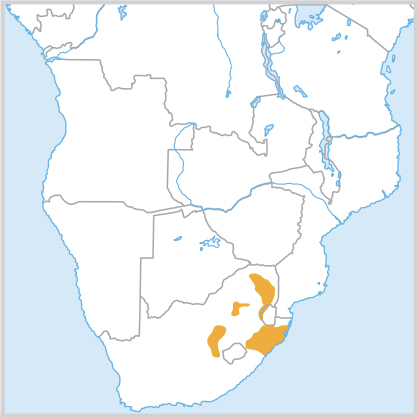
Homoroselaps dorsalis
Natural History: A ground-dwelling snake, usually under cover and rarely on the surface, except after rainstorms. It shelters in termite mounds, under rocks and in holes. If molested, it does not try to bite, but wriggles violently to try to get away. It lays 2–4 eggs in the summer (December or January). It eats worm snakes of the family Leptotyphlopidae.
Medical Significance: A rare, secretive snake with a relatively small range. No antivenom is available. No bites or fatalities are reported and the use of polyvalent antivenom is contraindicated; treat bites symptomatically.
Striped Harlequin Snake, Homoroselaps dorsalis.
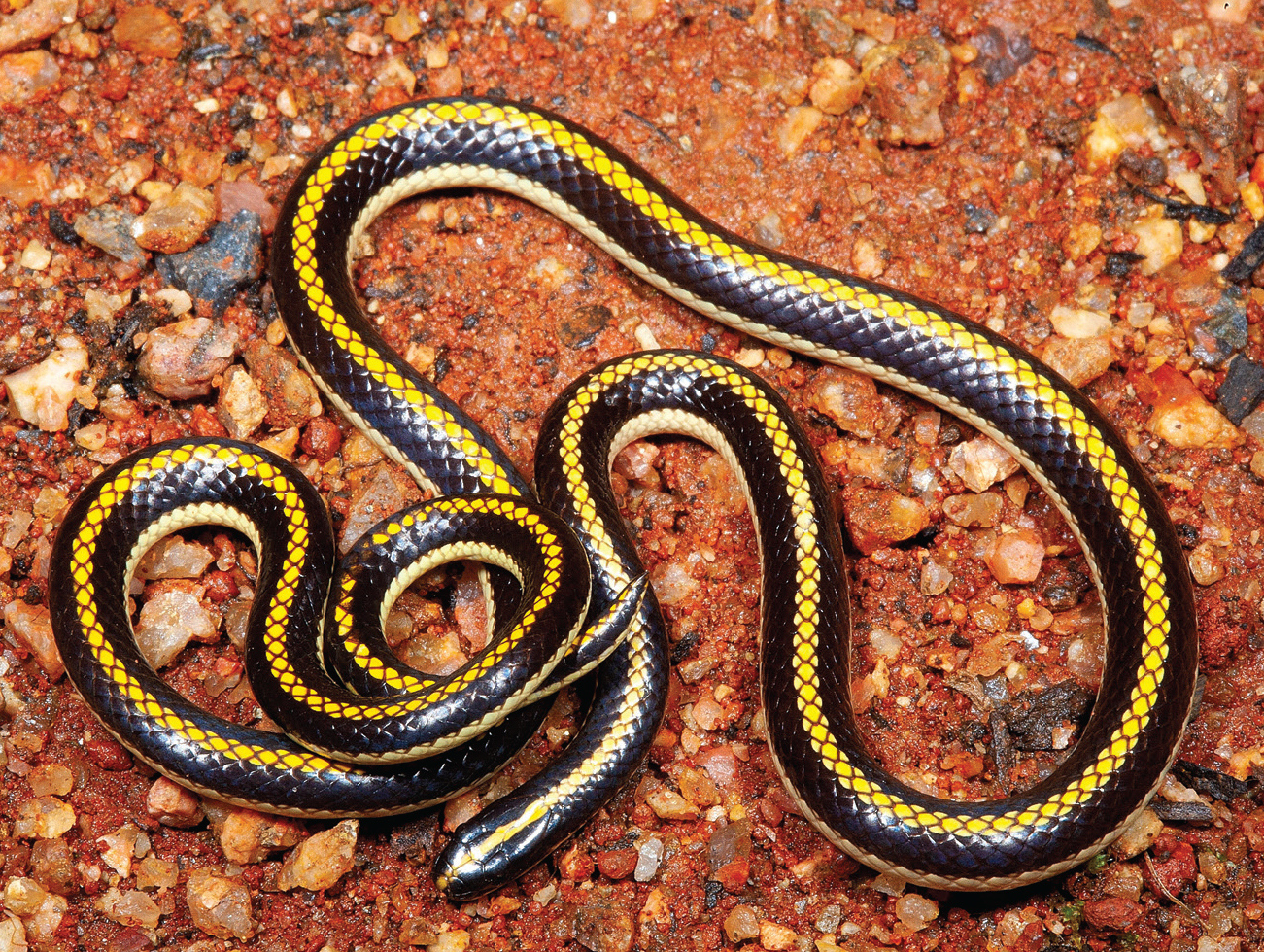
South Africa (Johan Marais).