CHAPTER 1
Introduction to Globalization
Fun Fact
The global fashion industry accounts for 3 trillion dollars, or 2 percent of the world’s Gross Domestic Product (GDP). (FashionUnited, n.d.)
OBJECTIVES
Upon completion of this chapter, you will be able to:
• Describe the global nature of the textile and apparel business.
• Compare and contrast countries by the level of economic development.
• Examine relationships between countries’ level of economic development and their roles in the global textile and apparel industry and market.
No other form of commerce can claim to be as pervasive throughout the globe as the textile and apparel business. This business provides employment for more people than any other business segment (except agriculture), directly affording a livelihood to many people in every country in the world. This text explores the complexities involved in where textile and apparel products come from, under what conditions, how these products are distributed in today’s global marketplace and what are the social and environmental impacts of textile and apparel consumption. The core of the discussion is examination of economic, political, and ethical issues that textile and apparel professionals as well as consumers face when making decisions.
Investing time, attention, and critical thinking to the topics addressed by this text will optimize the learning process and the opportunity for long-term application of principles gained. Critical thinking is the type of thinking involved in solving problems, formulating inferences, calculating likelihoods, and making decisions. It is useful in all aspects of our lives, and it will be valuable in the reading of this text as well as in making use of the information presented.
In this book, concepts and principles related to globalization of the textile and apparel business are presented in many forms: as main text and in cases and industry profiles, as well as in pictures, diagrams, and tables. Each form provides a different perspective and emphasis and different food for thought. Numbers in tables provide amazing insights, but it takes a special bit of time and attention to appreciate what they have to offer. Cases presented in each chapter provide the opportunity to apply what is learned to “real-world” scenarios. In addition, each chapter includes an industry profile—a brief description of an apparel professional’s career path and how it was affected by the global nature of the industry. Ten industry professionals were interviewed for this edition of the book to illustrate a multitude of career possibilities as well as outline opportunities, challenges and excitement of jobs within the global industry. Discussion and reflection questions are considered after each case and “Learning Activities” are positioned at the end of each chapter. To generate long-term retention as well as the ability to apply what is learned to new situations, students are asked to consider multiple perspectives, recognize assumptions, analyze relationships, and give reasons to support conclusions. This is critical thinking at its best. We encourage delving into the complexity of the global textile and apparel market and appreciating the challenges that are likely to be a part of a professional career in the field.
For your convenience, a Global Lexicon is presented at the beginning of each chapter. It lists and defines the new vocabulary and concepts discussed in the chapter. You may be familiar with many of these terms in a different context, but reviewing the lexicon before you proceed through a chapter is an active learning approach that can speed your progress and enhance your understanding of the topics discussed. Referring back to the Global Lexicon to remind yourself of definitions as you work your way through is a strategic means of building your vocabulary and developing an understanding of the concepts. Note: The Global Lexicon in Chapter 1 is “loaded”; they will become less so as the chapters progress.
From the perspective of some consumers, textile and apparel products are simply something they purchase in the marketplace to satisfy their personal needs. Many of these consumers have little understanding of or a particular interest in where these products originate or how they arrive at their favorite stores. At the opposite end of the consumer continuum are individuals who are concerned about unethical business practices, for example, labor exploitation and environmental issues. These consumers attempt to force the textile and apparel businesses to employ fair and sustainable business practices, both domestically and abroad. These viewpoints, related to labor and the environment, represent social, environmental, and economic perspectives of globalization issues. Throughout this exploration of global business and trade involving textiles and apparel, both participants and observers use multiple legitimate perspectives to reach diverse justifiable conclusions. As you read this book, keep in mind that diverse viewpoints are dependent upon content and context.
PERSPECTIVES FOR CONSIDERATION OF GLOBALIZATION
Global Interconnectedness
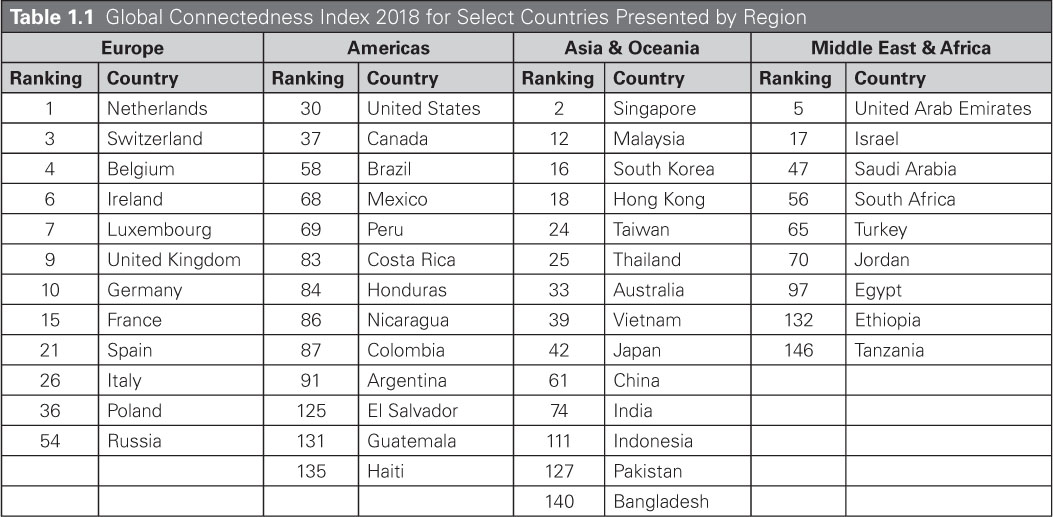
Because of globalization, the world’s people have become increasingly connected and interdependent in all facets of their lives. Individual countries, businesses, and people vary by the degree of globalization, or interconnectedness with the rest of the world. To measure how globalized world countries are, the DHL Global Connectedness Index was developed and is updated annually. The index evaluates how involved countries are in the international flows of the four factors: trade, capital, information, and people. A total of 169 countries were evaluated for the 2018 report, which offers a comprehensive assessment of developments in globalization (Altman, Ghemawat, & Bastian, 2019). Global connectedness ranking for selected countries that are most active in textile and apparel is displayed in Table 1.1. The lower the ranking, the more globalized the countries are. The countries are grouped in four regions: Europe, Americas, Asia & Oceania, and Middle East & Africa. The four regions are discussed in the last four chapters of the book with respect to textile and apparel production, trade and consumption.
GLOBAL LEXICON
accessories bags, jewelry, watches, purses, shoes, belts, and glasses
apparel industry combination of businesses that contribute to designing, developing, merchandising, producing and wholesaling of garments and accessories
apparel production the process that actually converts materials—including fabrics and findings—into garments; also known as apparel assembly
brand manager an apparel company engaged in design and product development as well as distribution, retail and marketing but owns little or no production facilities and sources garment assembly from vendors located elsewhere in the world
clothing wearing apparel including men’s, women’s, and children’s garments as well as gloves and headgear
department store retailer that provides a variety of product lines, including apparel for men, women, and children; soft goods for the home; and home furnishings, usually at moderate-to-higher price levels
discount store retailer that sells goods below typical market prices, also known as an off-price retailer
domestic trade exchange of goods and services within the boundaries of a specified state or country
exports goods or services shipped across national borders for the purpose of selling
findings materials other than face fabric used to construct garments: interlinings, pocket bags, linings, closures, and trims
firm any for-profit business, corporation, proprietorship, or partnership
global trade worldwide business that involves interactive participation of many nations in manufacturing, transporting, and distributing products and services
globalization process whereby the world’s people, their firms, and their countries become increasingly interconnected in all facets of their lives
gross domestic product (GDP) market value of all goods and services produced within a country in a year
gross domestic product (GDP) per capita gross domestic product (GDP) of a country divided by the number of people in the population after GDP has been adjusted by purchasing power parity (PPP)
gross national income (GNI) income generated by a country’s citizens, regardless of geographic location of the income; does not include the income of foreign businesses and foreign workers laboring in the country
gross national income (GNI) per capita gross national income (GNI) of a country divided by the number of country’s residents
imports foreign goods or services available for domestic consumption or materials available for domestic production because of exports of other countries
infant mortality measures how many babies die within the first year following birth and reflects availability and quality of healthcare in a country
international trade any exchange of goods and/or services across national border, involving two or more countries
life expectancy number of years a newborn is expected to live on average; reflects quality of healthcare and nutrition in a country
literacy rate percent of population who are fifteen years old and older that can read and write; indicates availability of free primary education
market capitalization the value of a company that is traded on the stock market, calculated by multiplying the total number of shares by the present share price
mass retailer firm that offers a wide variety of low-priced consumer goods in a self-service environment with broad appeal across income ranges and lifestyles
off-price retailer see discount stores
outsourcing contracting out specific operations outside the company to a domestic or foreign vendor with the goal to perform these operations more efficiently and/or at a lower cost; outsourced operations might include manufacturing, product development, logistics, IT, accounting, customer service, etc.
purchasing power parity (PPP) measure that allows comparisons of the countries’ economic output and the well-being of their populations, accounting for price level differences across countries
retail industry, or retail businesses that sell merchandise and/or services to ultimate consumers through brick-and-mortar and/or online stores
soft goods products made of textiles, including yarns, fabrics, apparel, home furnishing items, and fashion accessories
sourcing process of finding, evaluating, and partnering with a vendor to secure services, materials, production, or finished goods, or a combination of these, at a specified cost, quality, and service level, for delivery within an identified timeframe
specialty retailer retailers that focus on specific classes of merchandise to the exclusion of other products
supply chain total sequence of business processes involving single or multiple companies and countries that enables demand for products or services to be satisfied; an apparel supply chain might include some or all of the following: design and product development agencies, material suppliers, manufacturers, transporters, warehouses, retailers, and consumers
textile complex includes firms engaged in man-made fiber production, textile manufacturing (knit, woven, and nonwoven fabrics), apparel manufacturing, retailing, and product consumption and disposal
textile industry combination of businesses involved in development and manufacturing of fibers (only man-made), yarns, fabrics, and related materials
trade exchange of goods and services; can be domestic, international, or global
trade balance difference between exports and imports of a country
trade deficit negative trade balance; imports exceed exports in a country
trade surplus positive trade balance; exports exceed imports in a country
You can see from Table 1.1 that Europe was the most connected region, where eight of the top ten most globalized countries are located. With the exception of Russia (54), the countries’ rankings are less than 40. Overall, Europe had the highest scores for the trade and people interconnectedness. Netherlands was the most connected economy in the world. In contrast, North America emerged as the leader in the capital and information flows. The region was ranked second among the world regions in terms of globalization. The most globalized countries in the Americas were the United States (30) and Canada (37). The rest of the countries’ connectedness index ranges from 58 (Brazil) to 135 (Haiti).
The Middle East and North Africa region was ranked third (this does not include Sub-Saharan Africa). Notice that United Arab Emirates was ranked as the fifth most connected country in the world but the rest of countries’ indexes have a very wide range, from 17 (Israel) to 146 (Tanzania). Similarly, countries in Asia and Oceania have a wide range of global connectedness indexes: whereas Singapore was the second-most globalized country and Malaysia, South Korea, Hong Kong, Taiwan, and Thailand are more globalized than the United States, some countries, such as Pakistan (127) or Bangladesh (140) are not well integrated in the global economy yet.
In 2018, globalization reached an all-time high across all the four factors; this was despite growing nationalistic and anti-globalization sentiment in several countries (Altman, et al., 2019). Yet, the majority of trade, people movements, and information exchanges are still happening domestically. For example, the report showed:
• roughly only 20 percent of the total world’s production is exported;
• approximately 7 percent of all phone call minutes (including calls over the internet) are international;
• and only 3 percent of the world’s population live outside the countries where they were born.
In addition, the report debunks the belief that distance is becoming irrelevant. Most countries are much more connected to their neighbors than to distant nations.
Even though emerging economies trade almost as much as developed economies, they are behind in international capital, people, and information flows (Deutsche Post DHL Group, 2019). On average, advanced economies are three times more deeply integrated into international capital flow, have five times higher people movement, and are almost nine times greater with respect to information flow. The report concluded that globalization is a decisive factor of the world’s prosperity and “increasing international cooperation continues to contribute to stability so companies and countries that embrace globalization benefit tremendously” (Deutsche Post DHL Group, 2019, para 4).
Global Textile and Apparel Business
In the last thirty years the sources and methods used by textile and apparel professionals for procuring products have undergone profound changes. Until the 1980s and 1990s, the vast majority of textile and apparel products available to consumers were produced domestically. As we progressed into the twenty-first century, however, the source of these products changed from domestic to global as textile and apparel professionals sought the ever-elusive supplies of merchandise that would both satisfy their customers and generate profit necessary to sustain their businesses.
The textile complex incorporates firms around the world to accomplish man-made fiber production, textile manufacturing (for example, yarns and knit, woven, and nonwoven fabrics), apparel manufacturing, retailing, product consumption, and disposal. The apparel portion of the textile complex is the primary focus of this book. Apparel includes men’s, women’s, and children’s clothing as well as gloves and headgear. Accessories include footwear, handbags, purses, wallets, swatches, tote bags, and belts as well as eyeglasses and other devices that are attached to the body in some way for comfort, convenience, or aesthetics.
The textile complex consists of three major industries: textile industry, apparel industry, and retail industry. Textile industry can be defined as a combination of businesses involved in development and manufacturing of fibers (only man-made), yarns, fabrics, and related materials. Production of natural fibers (cotton, flax, silk, will, etc.) is part of agriculture, not the manufacturing sector. Apparel industry is a combination of businesses that contribute to designing, developing, producing, and often wholesaling of garments and other attire that covers, protects, and/or adorns the human body. Finally, retail industry is defined as a combination of firms that sell merchandise or services, or both, to ultimate consumers through brick-and-mortar and/or online stores. The primary focus of this text is on the apparel supply chain portion of the textile complex, the sequence of business processes involving single or multiple businesses and countries that enables demand for products and/or services to be satisfied. Examination of the operation of the textile complex in the global market involves language drawn from economic, political, and social perspectives.
LEVELS OF TRADE
Trade refers to exchange of goods and services and can be domestic, international, or global. Domestic trade refers to exchange of goods and services within the boundaries of a specified state or country. International trade is any exchange of goods along international borders, involving two or more countries. Global trade is a worldwide business that involves interactive participation of many nations in manufacturing, transporting and distributing products and services. Although the terms international and global are sometimes used interchangeably, most people understand global to mean a universal, comprehensive perspective that pertains to the whole world.
International Trade
International trade in textiles and apparel is not a new phenomenon. Since the centuries-old trade routes brought silk out of China by way of camel caravans that crossed the Middle East to Europe, international trade in textile products has prevailed. The silk trade involved silk fiber, silk yarn, silk fabric, and some silk garments produced domestically in China and transported to Europe and Middle East for exchange for other goods and services. Ships crossing the Mediterranean Sea from Africa and Middle East to Europe invariably included textiles in their cargoes. The first ships that arrived in the Americas carried textiles as items for trade with the natives. One of the reasons the South was unable to win the US Civil War was because of the loss of revenue from the cotton trade with Great Britain. In today’s markets, large and small textile and apparel firms import materials, finished goods, or both through international trade with firms in countries around the world. Many of these same firms are using international trade to export their products and make them available for sale in multiple countries.
A primary driver of the growth of international trade of textiles and apparel into global trade is the outsourcing of apparel assembly and other services from countries with high wages to countries with low wages. Outsourcing is contracting specific operations outside the company to a domestic or foreign vendor with the goal of acquiring more efficient operations, specific expertise, or a lower cost. Outsourced operations might include manufacturing, product development, logistics, IT, accounting, customer service, etc. The term “outsourcing” is often used interchangeably with sourcing, which is the process of finding, evaluating, and partnering with a vendor to secure services, materials, production, or finished goods, or a combination of these, at a specified cost, quality, and service level, for delivery within an identified timeframe. Apparel sourcing priorities have contributed to the globalization of trade by driving the apparel manufacturing industry around the world.
Global Trade
Lodge (1995) provided a generalized definition of the globalization concept, stating that “globalization is the process whereby the world’s people are becoming increasingly interconnected in all facets of their lives—cultural, economic, political, technological, and environmental” (p. 1). To further explain global business and the process of globalization, we must clarify the nature of global business transactions. Businesses involved with the development, production, and distribution of textile and apparel products in a global market potentially deal with a combination of financial, trade and investment, and labor transactions. These transactions incorporate the operation of businesses, labor, and governments in the global context. See and think about Figure 1.1.
An example of global trade might involve 10,000 pairs of men’s suits. These suits, sold in stores across the United States, could have been designed and developed in Canada, made with fabric woven in Taiwan out of wool fiber from Australia, with polyester lining made in South Korea, shoulder pads from China and assembled somewhere in Vietnam. In each country, individuals of different cultural backgrounds are employed; different languages are spoken; diverse tasks requiring different sets of performance skills are performed; and resources, from land and petrochemicals to water and machinery, are required to produce the product. This simple suit becomes a microcosm of globalization, involving many complex and potentially controversial issues.
Measuring Levels of Trade
Trade is often described in terms of exports and imports. Exports are goods or services sold across national borders. Exports result in the accruing of revenue to the firms in the countries where the goods originated. Imports make foreign goods and services available for domestic consumption or materials available for domestic production. Both export and import can be measured in quantities, or how many items of goods or services are traded; however, more often export and import data are reported in value (the total cost of goods and service that are being traded), usually in US dollars. The difference between exports and imports for a region or a country is called the trade balance. The trade balance is calculated as follows:
exports – imports = trade balance
A trade surplus means there is a positive trade balance; the value of exports exceeds the value of imports. A trade surplus is sometimes regarded as desirable, because, cumulatively, the firms and/or the government of the country in question has gained more revenue from the sale of exported goods than it gave up to other countries for the purchase of imported goods. It is important to note that a trade surplus does not necessarily mean that more products are available domestically. In newly developing countries it is common that goods produced for export are not made available to or affordable for domestic consumers. A trade deficit means there is a negative trade balance; the value of imports exceeds the value of exports. A negative trade balance may be regarded as undesirable, because greater revenue is accrued to foreign countries as the result of trade than to the domestic country in question.
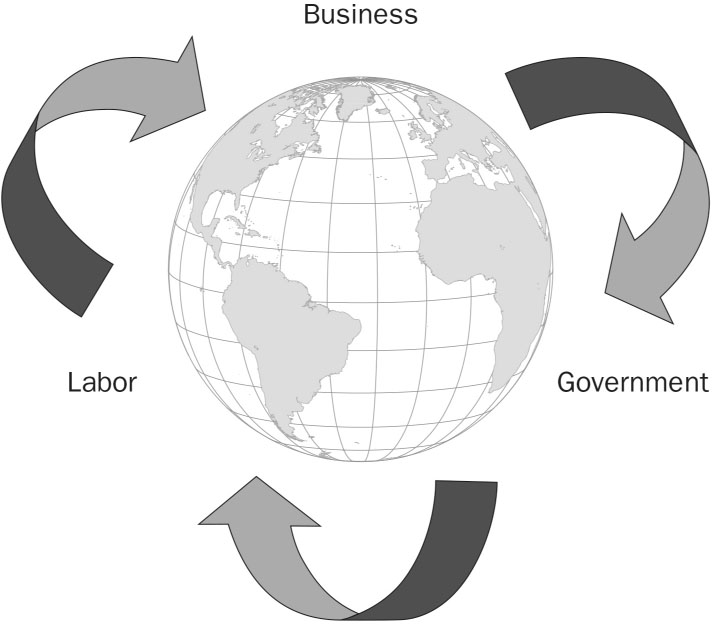
Figure 1.1
Business decisions in a global market.
CLASSIFICATION OF COUNTRIES BY LEVELS OF ECONOMIC DEVELOPMENT
GDP and GNI
To understand what role countries play in the global textile complex in relation to trade and why some countries are primarily textile and apparel exporters while other countries import more textile and/or apparel products than they export, it is necessary to consider a country’s level of economic development. The level of economic development is of particular interest to us because location of different parts of the textile and apparel supply chain tends to be determined by level of development of the countries involved. To classify countries based on level of economic development, the following economic indicators are typically used:
• country’s gross domestic product (GDP) per capita;
• country’s gross national income (GNI) per capita;
• the population’s purchasing power parity (PPP).
GDP measures market value of all goods and services produced within a country in a year; it includes income earned by foreigners and foreign businesses while they are in the country. GDP per capita is GDP divided by the number of people in a country’s population but only after GDP has been adjusted by purchasing power parity. Purchasing power parity (PPP) is a measure that allows comparisons of the countries’ economic output and the well-being of their populations, accounting for price level differences across countries. In other words, PPP equalizes the purchasing power of currencies.
GNI is income generated only by a country’s residents and businesses, regardless of where it was produced. GNI per capita is GNI divided by the number of a country’s residents. GNI does not include the income of foreign businesses and foreign workers laboring in the country. GNI per capita can be calculated after adjusting for PPP. Per capita GDP and GNI are used by researchers and major world organizations to determine a country’s level of economic development.
Table 1.2 presents both GDP per capita and GNI per capita for the world countries that are most active in textile and apparel production, trade, and/or consumption. These countries are discussed in depth in Part 3 of the book, where the four world regions and their involvement in the global textile and apparel industry are described. The countries in Table 1.2 are organized in four groups, using the World Bank’s classification system based on countries’ per capita GNI. Note that World Bank uses the Atlas method to calculate GNI; it helps reduce the impact of short-term exchange rate fluctuations.
For the 2020 fiscal year, World Bank (n.d.) classified 217 world countries into four income groups, as follows:
• 31 low income countries with GNI per capita of $1,025 or less;
• 47 lower-middle income countries with GNI per capita between $1,026 and $3,995;
• 60 upper-middle income countries with GNI per capita between $3,996 and $12,375;
• 80 high income countries with GNI per capita of $12,376 and more.
World Bank revises the country classification by income annually and releases new groupings every year on July 1. The thresholds for classifying the countries are also reviewed and adjusted periodically.
Glance over the values of the per capita GNI and GDP in Table 1.2. The range among nations’ income per capita is astounding! Note that for many countries per capita GDP doubles and for some countries nearly triples per capita GNI. The last column in Table 1.2 displays in which world region each country is located. Countries in the high-income group represent all regions of the world but Africa. The upper-middle income group includes countries from all four regions of the world: Africa and Middle East, Americas, Asia, and Europe. The same is true for the lower-middle income group. The low-income group consists primarily of African countries, along with several Asian countries and Haiti.
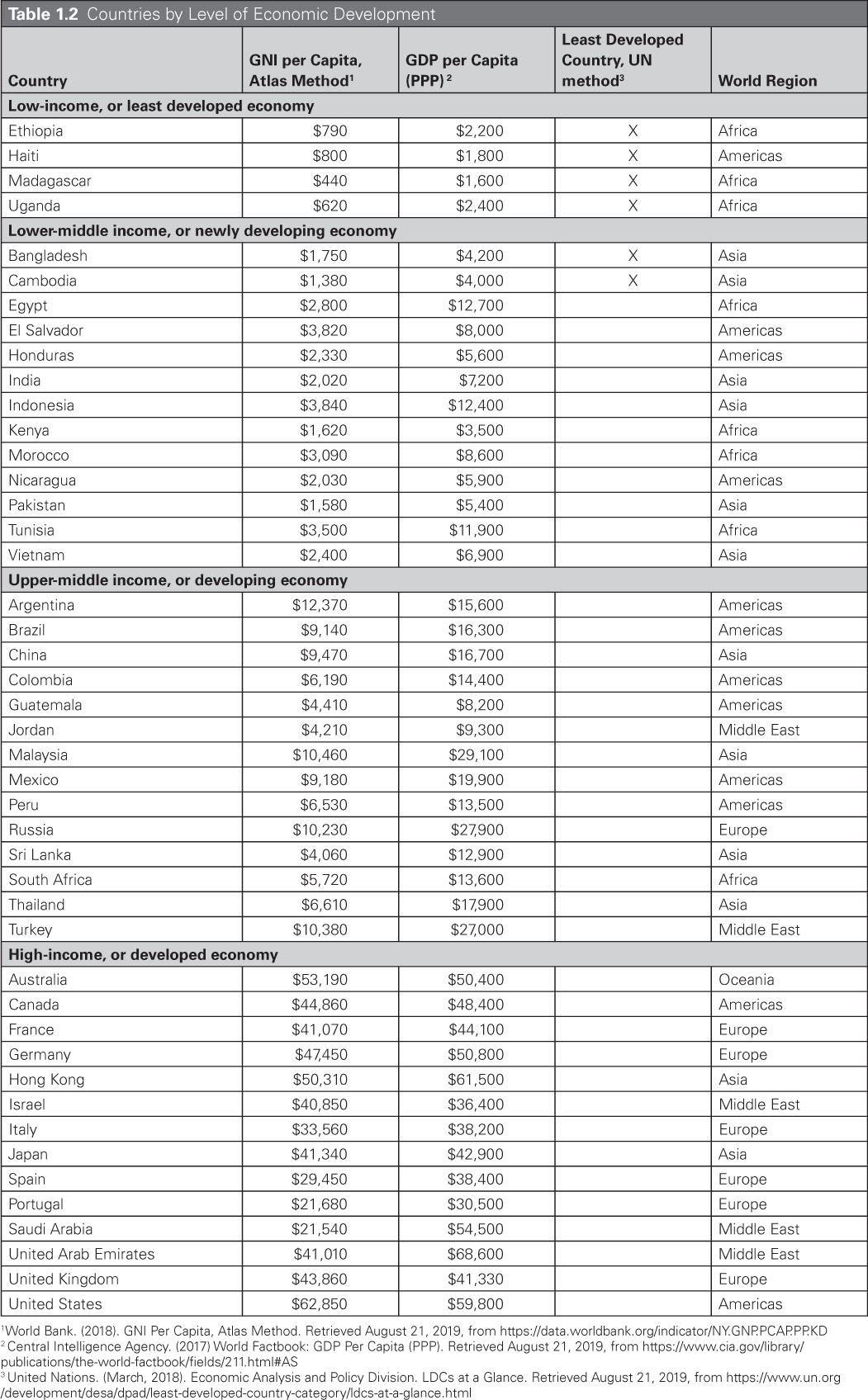
A slightly different classification of countries based on their level of development is used by United Nations (UN). In 2018, UN included 47 nations in the group of least developed countries (LDCs) with the purpose to coordinate international support measures for these economies. LDCs are “low-income countries confronting severe structural impediments to sustainable development” (United Nations, n.d., para 1). Refer to Table 1.2 where these countries are marked with an “X” (Column 3). All countries classified by World Bank into the low-income group are also included in the LDC category. In addition, several countries in the lower-middle income group, such as Bangladesh and Cambodia, are also considered as LDCs by the UN.
Every three years the LDC list is reviewed by the UN Committee for Development Policy, using three comprehensive indices:
• income, measured by GNI per capita,
• human assets, assessing health and education indicators,
• economic vulnerability that includes measures of types and stability of exports and agricultural production, among other factors.
Countries can graduate from the LDC category as well as be added to it, based on GNI per capita thresholds as well as the preceding economic and social indicators.
Another common approach for classifying world countries based on economic development is to use the four groups: developed countries, developing countries, newly developing countries, and least developed countries. World average GDP per capita (PPP) is employed to classify a country into one of the four groups. The world average GDP per capita was estimated at $17,500 for 2017. Level of development of countries can be described as follows:
• When a country’s GDP per capita is significantly higher (about twice or more) than the world average, the country is called “developed”; citizens in these countries typically have access to high-quality social services such as health care and education.
• When a country’s GDP per capita is about the same as the world average, the country is called “developing”; adequate social services such as health care and education are available in these countries but not all citizens have access to them.
• When a country’s GDP per capita is significantly lower (about three times) than the world average, the country is called “newly developing”; a significant portion of population in these countries does not have access to health care, education, and other social services.
• A country with the world’s lowest GDP per capita (eight to ten times lower than the world average) is called “least developed”; the majority of population in these counties might be at risk of a humanitarian crisis.
Carefully review the date in Table 1.2. For countries in the high-income group, GDP per capita ranges from $30,500 (Portugal) to $68,600 (United Arab Emirates), which is about twice the world average or more. These countries are considered developed economies. For most countries in the upper-middle income group, GDP per capita is in the teens, from $8,200 (Guatemala) to $27,900 (Russia). These countries are considered developing economies, including Brazil, China, Mexico, and South Africa. In the lower-middle income group, most countries’ GDP per capita is around $4,000 to 6,000. These countries are typically referred to as newly developing economies. Finally, countries in the low-income group have GDP per capita lower than $3,000. These countries are considered as least developed economies, in line with the UN classifications discussed earlier.
You can see from Table 1.2 that per capita GDP and GNI are closely related. GDP and GDP per capita indicators are more easily accessible and more often used by economists as well as media; therefore, it is used in this book to describe a country’s level of economic development. To classify a country by level of economic development, the four groups are used (Table 1.2) and labeled as either by the income group or by development level (developed, developing, newly developing, and least developed).
It is important to keep in mind that the classifications of countries by level of economic development, whether using per capita GDP or GNI, are not perfect and in many cases simply offer an estimate as to which group a country most likely belongs. Besides the income measures, it is very important to consider other economic and social indicators, such as literacy rate, life expectancy, infant mortality, unemployment, inflation and others. As a country’s economy develops and quality of life improves for its citizens, the country moves up in the classification. In contrast, if a country is weakened by civil war for a significant time (which has been the case with Syria in the 2010s), or has a prolonged political and economic crisis (like in Venezuela, for example), it might move down in the classification.
Other Indicators of Economic Development
While per capita GNI and GDP are the primary indicators for determining a country’s level of economic development, it is important to consider other indicators of population well-being. Table 1.3 presents three well-being indicators along with the world average values for each indicator:
• Literacy rates for males and females indicate the percent of people in a country who are fifteen years old and older that can read and write; it is indicative of the level of education accessibility such as free primary education systems.
• Infant mortality measures how many babies die within the first year following birth and reflects availability and quality of healthcare.
• Life expectancy indicates how many years a newborn is expected to live on average and reflects levels of nutrition and healthy lifestyle in a country.
In general, these variables present changes in a positive direction as countries become more developed.
In Table 1.3, literacy rates for developed countries are at 95–99 percent. This means that in these nations almost all people who are fifteen years old and older can read and write. Literacy rate is the same for both males and females in the United States and very close in Germany. In Japan, female literacy rate (95%) is lower than male literacy (99%). In developing countries, literacy rates are also quite high—all in the 90s percentile. However, there is a more noticeable gender difference as in all three countries more men can read and write than women do. In newly developing countries, the literacy rate is lower, in the 60s–80s percentile, with even greater difference between males and females. For example, in India, 40 percent of females age fifteen and over cannot read and write, whereas the number for males is half lower—20 percent of adult males are illiterate. In Pakistan, nearly two-thirds of adult males but under half of adult females can read and write. In the least developed economies, literacy rates are even lower: in the 40s–60s percentile. The lowest rates are in Ethiopia where 57 percent of adult males and 41 percent of adult females can read and write.
In developed countries, infant mortality is quite low. Considering the countries listed in Table 1.3, out of 1,000 births in developed countries, between two and seven babies die. In the United States the number of infant deaths is more than twice higher than in Germany and Japan. In developing and newly developing countries, infant mortality is much higher and ranges from teens to thirty baby deaths within the first year of life. Least developed countries have by far the highest infant mortality rates—forty to forty-eight babies die within the first year of their birth out of every thousand newborns.
Life expectancy tends to be higher in more developed economies because of better health care systems, nutrition, and overall quality of life. In countries that are less developed and that have lower well-being levels, people are expected to have shorter lives. The highest life expectancy is in Japan (85 years), the lowest in Ethiopia (63 years), and the world average is almost seventy years.
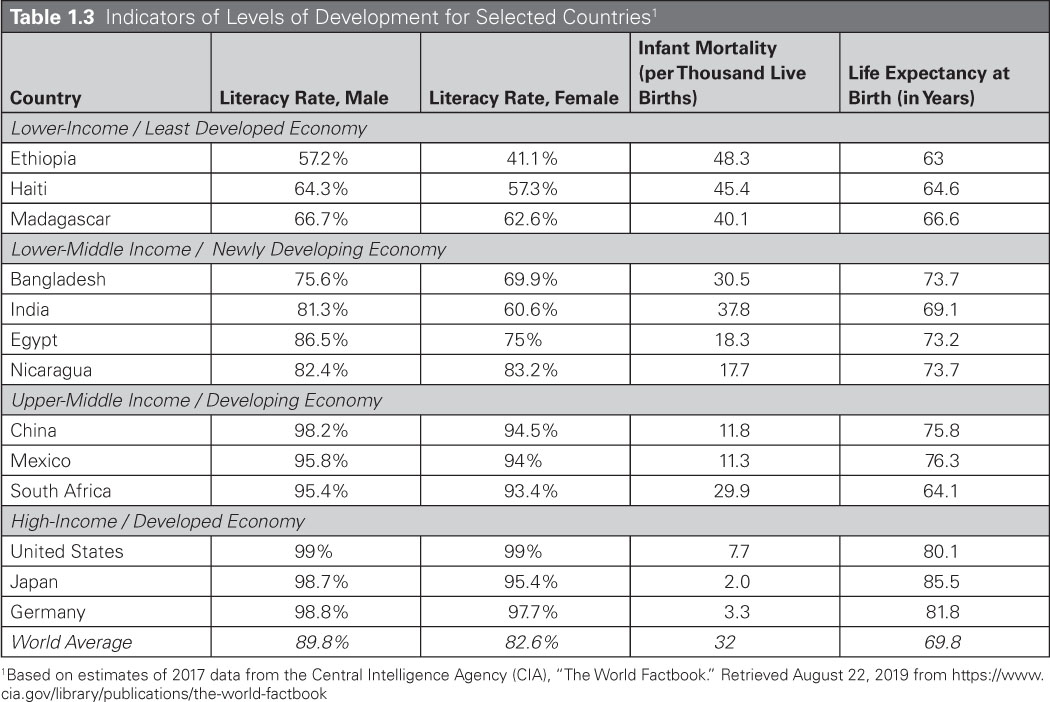
The examples in Table 1.3 illustrate that every indicator has to be considered together with other economic data and placed in appropriate context. We will be using demographics and other data like these throughout this text to examine the well-being of populations in relation to where the textile and apparel industry is located and how it works. It is important to have a good understanding of these indicators to determine a country’s level of economic development and be able to explain some differences among developed, developing, newly developing and least developed countries. How does level of economic development relate to the textile and apparel industries and trade? For an apparel professional, why is it important to know how developed (or not) a country is? The answers to these questions now begin, after discussing major characteristics of the textile and apparel industries and reviewing the basics of trade.
TEXTILE AND APPAREL INDUSTRIES
Labor Intensive Apparel Production
Historically, both the textile and apparel industries were labor intensive. It is no longer the case for the textile industry as all the processes of making yarns and fabrics are now automated: computers oversee and control quality at all the stages of spinning, weaving, dyeing, and finishing yarns and fabrics. However, all attempts to mechanize and automate apparel production have been largely unsuccessful. In fact, apparel assembly remains one of the most labor-intensive industries due to several reasons.
First and most important, materials that are used to make apparel tend to be very pliable and delicate. Yarns and fabrics can be easily overstretched or shrunk during processing, so it is not easy to use robotic elements to handle these materials. In contrast, many other industries use assembly components made of sturdy plastic, wood, glass, or metal that can hold a shape and can be handled and manipulated more easily by robotic elements.
Second, a great variety of types of materials are used to make apparel. For example, the same top can be made of silk organza, cotton calico, polyester jersey, or wool crepe, not to mention leather or its substitutes. A combination of different fibers and blends with dozens of fabric weaves and structures for the relevant garment designs results in different sewing properties that have to be accounted for when assembling a garment as well as the equipment required for making it.
Third, there is even a greater variety in apparel products. Hundreds if not thousands of styles are developed and produced by each company every year. Apparel factories have to quickly change assembly of one style of garment to the next. This is in sharp contrast with many other industries that continuously manufacture the same models and styles of products for several years.
Finally, each apparel product comes in many different sizes—from XXS to XXXL, all sizes are in petite, regular and tall. An assembly line has to accommodate all the changes in materials, product styles, and sizes very quickly and frequently, which makes it nearly impossible or prohibitively expensive to use robots for sewing. This is why “despite millions of dollars invested in research in mechanization [and technology], people are still required to piece together fabric and feed it in the sewing machine” (Rivoli, 2009, p. 86). There has been lots of new technology developed but the majority of the time the key event that makes apparel assembly possible is human hands running fabric under the needle (Figure 1.2).
In contrast to the apparel industry, the textile industry is more capital intensive and technology intensive than labor intensive. Modern textile mills are run by computers and look comparatively empty; there are a few operators who are there to adjust computer settings and address any machinery and process problems (Figure 1.3). Today, manufacturing of textiles requires little physical labor but workers need to be educated enough to operate complex computerized looms. Machinery for textile production is very expensive. In addition, textile finishing mills require compliance with environmental standards for using water for dyeing and finishing processes, and this equipment is also expensive. Typically, textile mills rely on economy of scale and require a relatively large operation to produce competitively priced fabrics, which makes the textile industry more capital intensive and technology intensive than the apparel industry.
Apparel Industry Entry Barriers
Another unique characteristic of the apparel industry is its low entry barriers, which means it is easy to enter the industry by starting a new apparel business. Entry barriers are low because if, for example, you compare apparel production with manufacturing of electronics or cars:
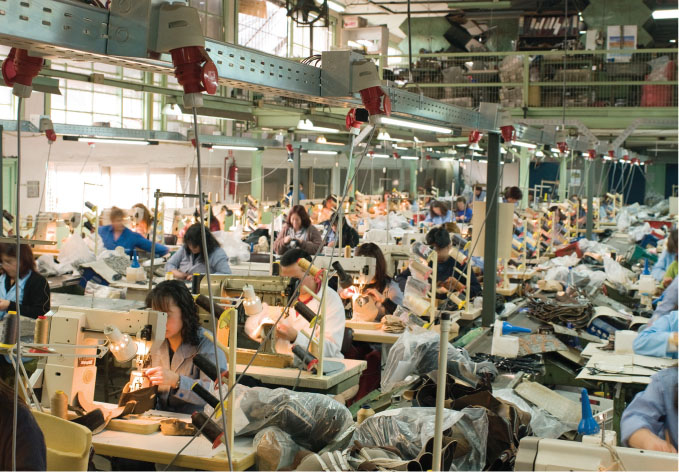
Figure 1.2
Apparel assembly line with people operating sewing machines, illustrating the labor-intensive nature of the industry.
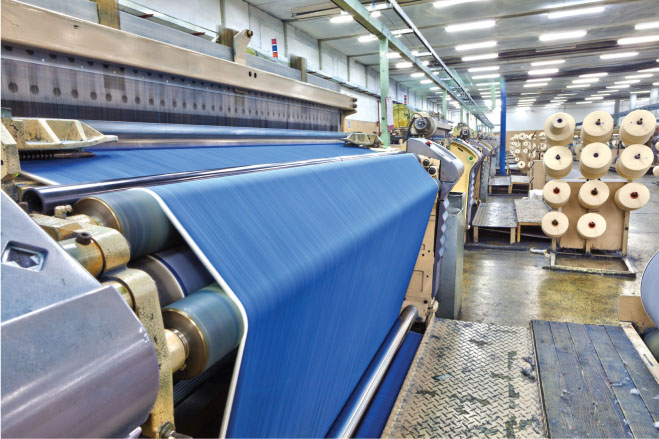
Figure 1.3
Modern textile mill in operation showing some of the machinery and technology required for producing textiles (notice: no human beings are on site).
• Relatively simple machinery and equipment is needed for apparel production.
• Machinery is fairly simple to operate; apparel assembly does not require highly skilled workers and training times tend to be short.
• Comparatively little capital is needed for a start-up because machinery and equipment are less expensive than in other industries that are more technology intensive.
These low entry barriers are the reason why practically all countries in the world began their industrialization with apparel manufacturing. Low wages are regarded as critical for labor-intensive apparel production. Labor cost depends on a country’s level of development: less-developed countries have lower wages.
Developed Countries
Developed economies have high income as measured by per capita GNI and GDP (Table 1.2) as well as highly desirable social indicators of quality of life: low infant mortality and high literacy and life expectancy (Table 1.3). For 2020, World Bank (n.d.) classified eighty countries in this group. Beginning in the late 1700s with the start of the Industrial Revolution, manufacturing of textile and apparel products formed the foundation of the economies in developed countries. In every case, the developed nations listed in Table 1.2 plus many others have at one time or another utilized textile and clothing production as a major means of achieving industrial and economic growth.
As the countries became developed and labor cost increased, there was a shift from producing textiles and clothing to consuming them. For example, recently, South Korea moved into this group because the country readily embraced industrialization in the 1970s through large scale textile and apparel production as a means of building economic development. Today, you can find very little apparel assembly in South Korea as the country produces electronics, cars, and other technology-intensive products. Some Korean high-tech and automotive brands that might be familiar to you are: Samsung, LG, Hyundai, and Kia. Typical for any developed country, as the standard of living improves, industry evolves from a primary focus on manufacturing to creative and technological aspects of a business and information-driven economy.
Due to high cost of labor, developed countries have relatively little domestic clothing manufacturing; as a result, most developed nations have a deficit in apparel trade. All developed countries but Italy in Table 1.4 import significantly more clothing than they export. For example, the United States imported about sixteen times more apparel ($91 billion) than it exported (close to $6 billion). Italy exported more clothing ($24 billion) than it imported ($16 billion). As you will learn in Chapter 9, Italy has a highly competitive textile and apparel sector that allows for significant domestic apparel production and exports of luxury fashion goods.
Many developed countries have advanced textile industries and produce a lot of man-made fibers, yarns, and fabrics. Because most of these countries have limited clothing production, they export a lot of their domestically produced textiles. For example, Italy and Germany have positive balance known as a textile trade surplus, where textile exports exceed imports. Other developed countries in Table 1.4 have a negative trade balance in textiles; however, the textile trade deficit is much smaller than the apparel trade deficit.
Developing Countries
Developing economies have upper-middle income as measured by per capita GNI and GDP (Table 1.2); their social indicators of quality of life—infant mortality, literacy, and life expectancy—are relatively good, but not as good as in developed countries (Table 1.3). For 2020, World Bank (n.d.) classified sixty countries in this group. Through industrialization, developing countries have significantly improved their overall economic conditions and well-being. Many developing nations have built impressive textile and apparel industries and successfully compete in the global marketplace. However, developing countries are no longer the lowest-cost labor sources for apparel and many other products. Thus, many of these countries, like Russia, now either outsource apparel assembly, or, like Mexico, have struggled to maintain apparel assembly in the face of lower labor costs in newly developing and least developed countries. Generally, developing countries are transitioning from focusing on production for export to increasing focus on production for domestic consumption.
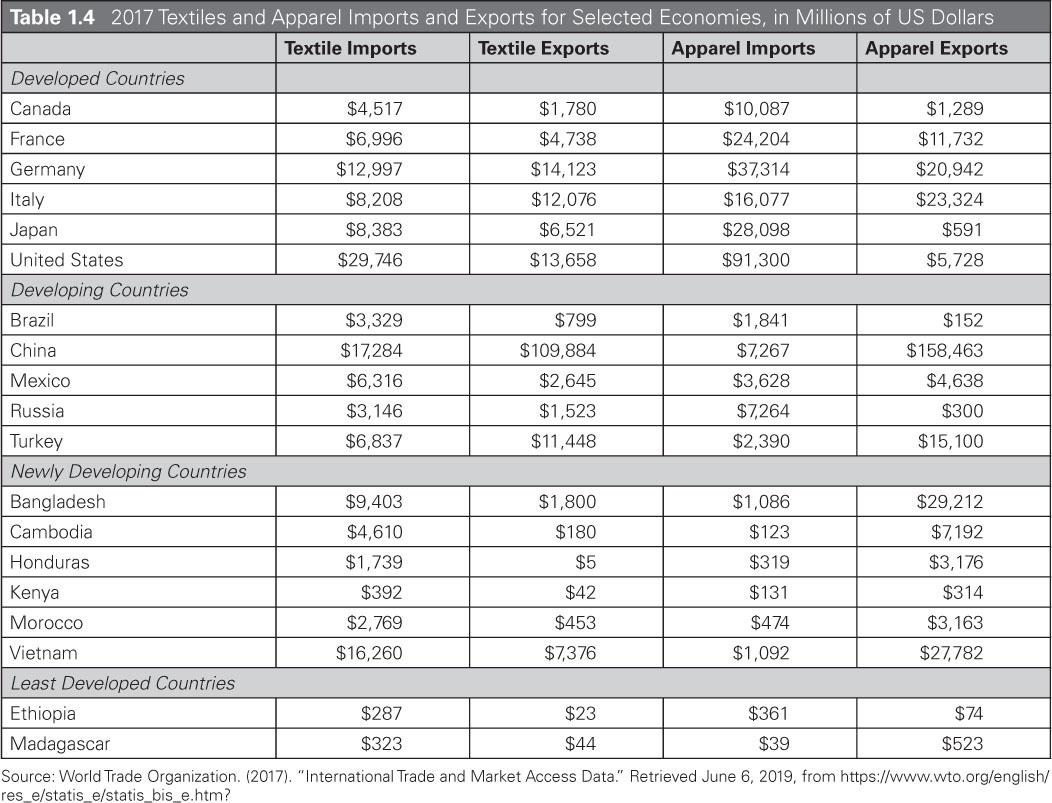
Most developing countries have either built or are in the process of establishing textile manufacturing. If these countries are major textile manufacturing nations, such as China and Turkey, they have textile trade surplus: they export more yarns and fabrics than they import. In contrast, other developing countries in Table 1.4 (Brazil, Mexico, and Russia) have a textile trade deficit as they import more textiles than they export. For example, in 2017, Turkey exported ($11 billion) twice as much textiles as it imported, and China exported ($110 billion) over twenty-two times more textiles than it imported. China is the number one textile exporter in the world and Turkey is number five, following the United States.
Apparel trade has similar patterns to the textile trade. The same major producing countries, Turkey and China, have significant trade surplus. In 2017, Turkey exported ($15 billion) six times more apparel than it imported, while China exported ($158 billion) over twenty-one times more apparel than it imported. Similar to textiles, China is the undisputable world champion in apparel production and export. In contrast, Brazil and Russia had negative apparel trade balances. In general, developing countries, over time, tend to upgrade apparel production to develop and manufacture higher-quality goods positioned at higher price points. This becomes necessary to compete with lower wages in newly developing and least developed countries.
Newly Developing Countries
Newly developing economies have lower-middle income as measured by per capita GNI and GDP (Table 1.2). Literacy in these countries is substantially lower than in developed and developing nations, especially, among women; whereas infant mortality is higher (Table 1.3). For 2020, World Bank (n.d.) classified forty-seven countries in this group. Newly developing countries tend to be economies that primarily rely on agriculture, although some countries, which actively pursue industrialization, have built significant apparel manufacturing capacities. Because the apparel industry has the lowest entry barriers in the industrial sector and labor-intensive production, newly developing countries can be ideal locations, as one of their most available resources is a low-wage workforce. In many newly developing economies apparel manufacturing often provides the only industrial employment option, especially for women, to support their families and afford education for children.
All newly developing countries in Table 1.4 have apparel trade surplus as they export more apparel than they import. Countries such as Bangladesh and Vietnam emerged as major apparel suppliers to the world, second and third only to China. These countries tend to focus more on production for export rather than on production for domestic consumption. They also import little apparel as the middle class in these nations has not yet gained much prominence.
Newly developing countries tend to have little textile production as they do not have sufficient capital, technology, and education levels to support the industry. Newly developing countries might have some natural fiber-based textile production and typically import man-made fiber-based textiles from developed and developing countries. As a result, these countries have to import the textiles needed for apparel production and, therefore, typically have a trade deficit in textiles. All newly developing countries in Table 1.4 import more textiles than they export.
Least Developed Countries
Least developed economies have low income as measured by per capita GNI and GDP (Table 1.2). Social indicators are the lowest in comparison with other countries of the world and world averages (Table 1.3). For 2020, World Bank (n.d.) classified thirty-one countries in this group. Note that United Nations (n.d.) identified forty-seven countries as least developed in 2018.
Nations in this group might suffer from social unrest, corrupt and inefficient government, or lack of appropriate laws and regulations as well as their enforcement necessary for supporting business activity. Because these countries have the lowest wages in the world, they are attractive for the labor-intensive apparel industry. In addition, many countries have large populations that might be underemployed. Many least developed countries, such as Ethiopia, have been actively building up the apparel industry by attracting investors from all over the world, as you will learn in Chapter 12. It is important for global apparel companies to contribute to economic development and social stability in these nations by providing safe working conditions and well-paid factory jobs when partnering with local companies or investing in new industrial facilities. In fact, it should be a responsibility of multibillion-dollar apparel businesses that built their fortunes on millions of low-paid workers stitching clothes for these brands around the world.
ORGANIZATION AND OPERATION OF THE TEXTILE COMPLEX
The textile complex is the combination of textile-related firms that supply soft goods to the world population. A firm is any business, be it corporation, proprietorship, or partnership. In the textile complex a firm could be engaged in (1) manufacturing; (2) sourcing; (3) supplying materials, equipment, or technology; (4) retailing; or (5) some combination of these activities. Soft goods are products made of textiles, including yarns, fabrics, apparel, home furnishing items (linens, towels, upholstery, draperies, etc.), and fashion accessories. There are three primary end uses for soft goods: apparel, household goods, and industrial products. The primary focus of discussion here is on the apparel component of the textile complex, although textile products, such as bedding, drapes, and towels, and industrial products, such as medical materials, roadbeds, and building materials, are growing components of the textile complex.
Structure of the Textile Complex
Figure 1.4 presents a conceptual model showing the five levels that are the primary components of the textile complex, from fiber and other materials supply through product consumption and disposal. The five levels of the model are linked together by a loop representing a supply chain supporting global sourcing. Note that all the different dimensions involved in operating a supply chain begin with consumer demand.
Each of the five levels of the textile complex in Figure 1.4 represent different but related areas of specialization necessary to convert raw materials into finished goods for the ultimate consumers. Each also has multiple categories, subcategories, and auxiliary activities that contribute to the necessary functions in each area of specialization. Between each of the levels is often a wholesale function for transferring ownership of goods to the next level in the textile complex. In the model, think of the five levels as floating over a sea of consumer demand that constantly requires redefinition of the products being conceptualized, planned, designed, developed, and produced. Ultimate consumers make the final decisions that determine who and what are the winners and the losers. Now, consider the activities that are necessary components of each level of the textile complex.
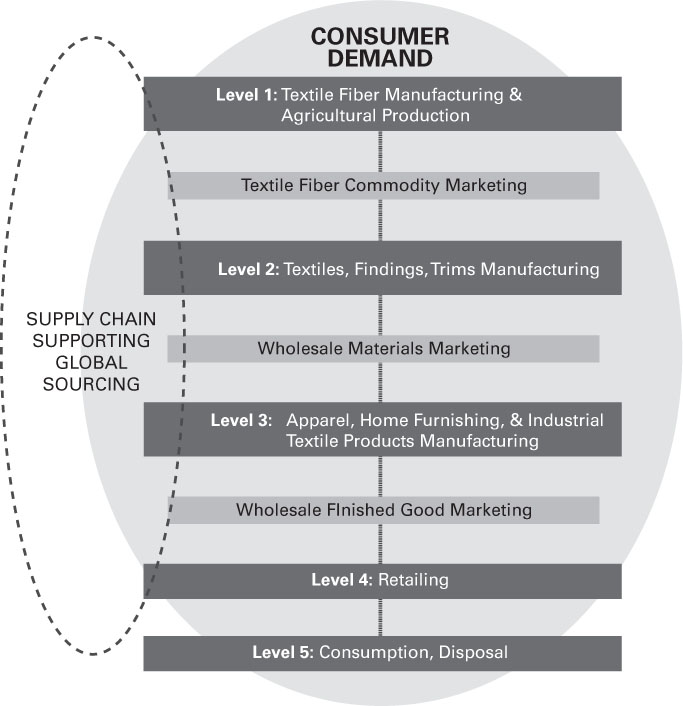
Figure 1.4
The primary components of the textile complex integrated into a global supply chain.
Level 1—Fiber Manufacturing and Agricultural Production
Natural textile fibers derived from plants and animals are two basic types: cellulose and protein. Common examples of cellulose fibers from plants include cotton, flax (or linen), and ramie. Examples of protein fibers are wool (from sheep), cashmere (from goats), and silk (from silk worms). Manufactured, or man-made fibers, including rayon and acetate, are made from cellulosic sources such as wood pulp and cotton linters that contain naturally occurring polymers. Bamboo has recently become a popular source of wood pulp for making rayon. Many synthetic fibers, including nylon, polyester, and acrylic, have polymers made from petrochemicals, so their characteristics differ greatly from those of natural and manufactured cellulosic fibers. Whether the fibers come from the farm, the forest, or the laboratory, once they are harvested or generated, many are sold in commodity markets where prices change on a daily basis, depending on supply and demand.
Production of fibers for the textile complex is spread globally. China, India and the USA are the leading suppliers of cotton. African countries as well as Pakistan and Uzbekistan are also major cotton producers. Australia supplies more wool to the world market than any other country. China and Thailand are known for production of silk. Manufacturing of manmade fibers is present on every continent; the major producing countries include China, Japan, Taiwan, South Korea, India, USA, and European Union. Manmade fibers are primarily manufactured in developed and developing countries. Because manufactured fiber production requires large-scale operations, expensive and complex machinery and special facilities as well as educated professionals, most newly developing and least developed countries do not have sufficient capital and technological and infrastructure levels to support manufacturing of polyester, nylon, and other petrochemical-based fibers.
Level 2—Textiles and Findings Manufacturing
Level 2 of the textile complex comprises all the activities related to manufacturing yarns, fabrics, fabric finishing, and the production of findings. These businesses convert fibers produced at Level 1 into textile materials that will be used at Level 3 to make textile-based products for the ultimate consumer. While some firms may specialize in only one type of activity (e.g., yarn spinning or fabric finishing), many textile mills are vertically integrated, so they make yarn, weave fabric, and finish fabric by dyeing or printing and applying different finishing (e.g., wrinkle resistance or water repellent) so that the fabrics are ready to be cut and sewn.
Findings are all the materials used in apparel products in addition to the face fabrics. Major categories of findings are as follows:
• thread, a special type of yarn that holds pieces of sewn products together
• closures, including zippers, snaps, hooks, hook and loop fasteners, and buttons
• support materials, including interlining, shoulder pads, adhesives, tapes, sleeve headers, and collar stays
• trims, including ribbon, lace, bindings, edging, and anything else that might be used to ornament or enhance garments
• labels, permanently attached information related to brand names, trademarks, fiber content, and care information
Because fabric and findings decisions need to be made very early in the apparel design process, wholesale of textile products must occur early in the apparel product development cycle (Figure 1.5). One of the major international market fairs for textile products is Première Vision, held in Paris, France. To shorten the preproduction cycle, different technology is used to test out new designer concepts. For example, digital textile printing can cut weeks off the preproduction process, making it possible to respond more quickly to changes in fashion-related consumer demand (Figure 1.6). Virtual prototyping is another strategy to shorten the time needed to develop new products as it allows to fit samples virtually on an avatar instead of a live model or a dress form.
Fabric and yarn manufacturing is present, to some extent, in every country of the world. It might vary from a simple handloom making craft fabric by the inch to multibillion-dollar conglomerates producing tons of yarns and fabrics. In 2018, top textile exporters were (Lu, 2019):
• China with $118 billion
• European Union with $74 billion
• India with $18 billion
• USA with $14 billion
• Turkey with $12 billion
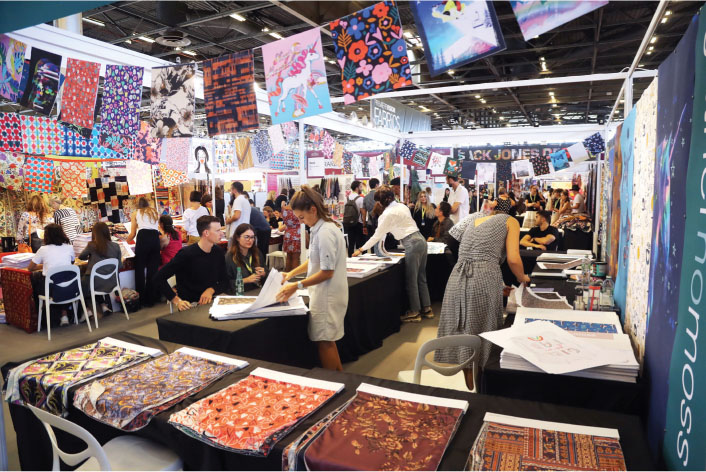
Figure 1.5
Textile product trade show.

Figure 1.6
Digitally printed fabric can be used to make apparel samples for testing designer concepts before bulk fabric is produced at textile mill.
Level 3—Apparel and Other Textile Products Manufacturing
Level 3 comprises all activities related to production of apparel and other textile-based products from yarns, fabrics, and findings manufactured at the Level 2. Apparel manufacturing encompasses processes to design, develop, merchandise, produce, and wholesale garments and accessories. Manufacturing of other textile products includes various home furnishings—from bedding and towels to upholstery, draperies, and carpets—as well as industrial textile products for medical, construction, automotive, agricultural, and other applications.
In a global supply chain, different stages of apparel manufacturing are often completed in different countries. Carefully read Case 1 and consider the questions. Preproduction processes (development of fabrics and findings, product design, merchandising, sourcing materials, approval of samples, etc.) and postproduction processes (logistics, distribution, marketing and sales) are typically carried out in developed countries, such as Canada, Australia, Japan or EU nations.
Apparel production, also known as apparel assembly, is the process that actually converts materials—including fabrics and findings—into garments. Apparel production includes the following typical processes: cutting, sewing, pressing, inspecting, and packaging. These production processes usually take place in newly developing and some developing countries, where wages are significantly lower than in developed economies. Recall that apparel production is one of the most labor-intensive sectors, requiring many hands to carefully feed the fabric under the needle. Several least developed countries were able to establish export-oriented apparel production industrial parks that attracted foreign investors but these countries are not major producers and exporters of apparel yet.
Because most apparel companies in developed economies are no longer involved in apparel production, the traditional term “apparel manufacturer” has been replaced by apparel firm or brand manager to emphasize the importance of branding, merchandising, marketing of products. Brand managing firms typically do their own design and product development as well as distribution and retail but are not involved in apparel production. Many traditional retailers are now actively engaged in preproduction and postproduction manufacturing activities by developing and selling private label lines.
In 2018, the top five apparel manufacturing and exporting countries were, by the value of exports (Lu, 2019):
• China with $158 billion
• European Union with $144 billion
• Bangladesh with $33 billion
• Vietnam with $32 billion
• India with $17 billion
Only European Union (EU) on the list has developed countries; the rest are developing (China) and newly developing (Bangladesh, Vietnam, and India) economies. You will learn in Chapter 9 that several countries in Europe (Italy, France, Germany, Spain, and United Kingdom) have viable domestic apparel production of high-end, designer clothing produced for the EU market as well as for exports.
Many apparel firms have sales forces that sell their product lines to retailers either at wholesale markets, at a retail buyer’s office, through sourcing fairs, or private showrooms. Major apparel market centers in the United States are located in New York, Los Angeles, Atlanta, Dallas, and Chicago. Major offshore apparel market centers include Milan, Paris, and London in Europe, and Tokyo, Hong Kong, and Singapore in Asia. One of the major market centers for knitwear is Florence, Italy. During market weeks, formal presentations such as fashion shows and personal presentations of styles to buyers are made to encourage sales (Figure 1.7). Most retail buyers view the options among dozens of product lines and return home to examine their merchandise plans and place orders to translate the line plans into styles, sizes, and colors of real merchandise. The product orders put the desired merchandise selections into production.
Level 4—Retail
Retail is the sale of merchandise and services to ultimate consumers. At this level, goods produced at Level 3 are sold through many different retail channels. The organization and structure of retail over the world have changed significantly in the first decade of the 2000s, with the proliferation of e-commerce and globalization of apparel supply chain. In fact, many retailers are now engaged in apparel manufacturing, specifically in the pre-production stage, including but not limited to design, product development, and sourcing apparel production. Many retailers, particularly large corporations, are also engaged in post-production stage of apparel manufacturing. They either control directly, or through established subsidiaries, logistics, ocean and in-land transportation, custom clearance, and distribution.
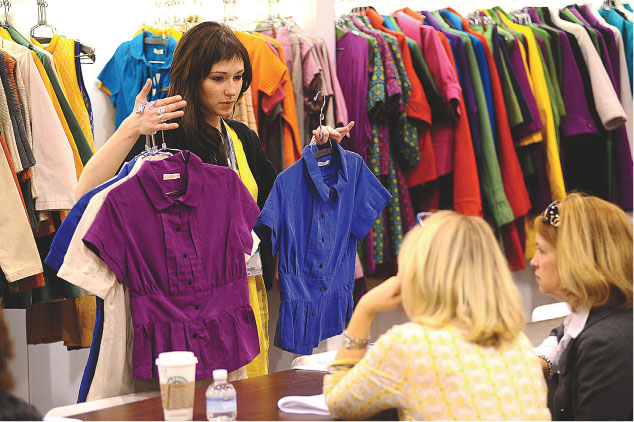
Figure 1.7
Manufacturer’s sales representative showing finished merchandise to retail buyers at a wholesale trade show.
The most common type of store is specialty retailer, which focuses on selling only selected categories of merchandise. For example, Naturalizer focuses on shoes and accessories. Nike and Adidas specialize in sportswear. Ann Taylor, a specialty chain, sells business and business casual wear for career women (Figure 1.8a). Specialty stores make up the majority of thousands of independent, single-unit retailers.
Department stores present multiple categories of merchandise in designated areas of the store. These stores provide a variety of product lines, such as apparel for men, women, and children, as well as home furnishings and other home goods. Products are priced at or near the middle- to upper-middle price ranges. Examples of department stores are Kohl’s, Belk, and Dillard’s (Figure 1.8b).
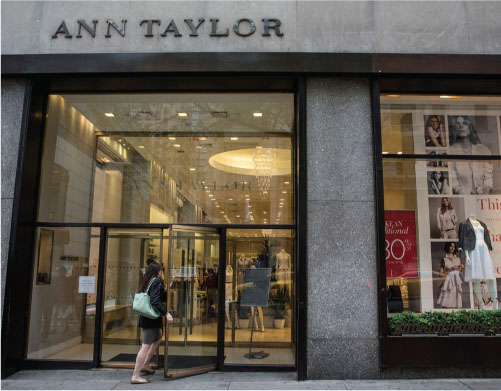
Figure 1.8a
Ann Taylor, an example of a specialty apparel retail chain for women, operates as a subsidiary of Ascena Retail Group, which also owns Justice, Dressbarn, and Lane Bryant.

Figure 1.8b
The impressive front door of a Dillard’s department store, which was founded in 1938 and had 291 stores across twenty-nine states in 2018.

Figure 1.8c
T.J. Maxx, one of the off-price and powerful US–based discount retailers.
Discount stores, or off-price retailers, sell goods below typical market prices; about 20 to 60 percent below full-price retailers (specialty and department stores). They became an important component of the retail scene. Examples of these stores are TJ Maxx, Marshalls, and Ross (Figure 1.8c). A key factor for TJ Maxx was ever-changing fresh assortments at low prices. As of 2019, TJ Maxx’s parent company, TJX Companies, was one of the world’s top fashion retailers (Table 1.5) and operated 4,300 stores in nine countries (TJX, 2019).
Mass retailers have large numbers of huge stores that offer a wide variety of goods at low prices in a self-service environment, often including groceries. Examples of mass retailers include Walmart and Target (Figure 1.8d). They are not included in the list of top fashion retailers because they sell many other goods besides fashion. This is despite the fact that Walmart, the largest retailer in the world in terms of revenue (Stores, 2019), sells every third garment in the US market—the mass market retailer’s market share is about 30 percent.
Practically all apparel retailers regardless of their type (specialty, department, discount, mass market, etc.) also sell apparel online. Another common trend is the focus on private labels. This has long been the business model of specialty retailers. Now almost all retailers—from department to discount and mass merchants—develop, source, and/or manufacture their own clothing lines. For example, TJ Maxx started by selling a mix of distressed items acquired from manufacturers and other retailers, including broken lots, end-of-season goods, and overruns. Today, a large portion of goods sold in the stores is TJ Maxx’s own labels. Similarly, Amazon (the world’s second largest retailer, after Walmart), which used to only sell fashion designed by different brands, now has its own clothing lines.
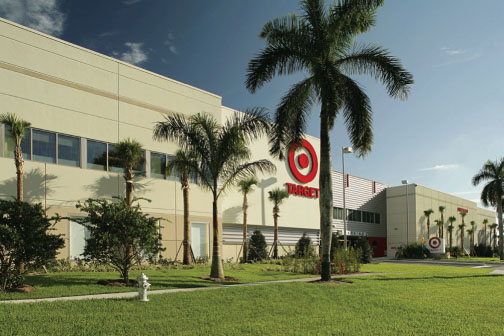
Figure 1.8d Target’s classic symbol on the front of each store means “expect more, pay less.”
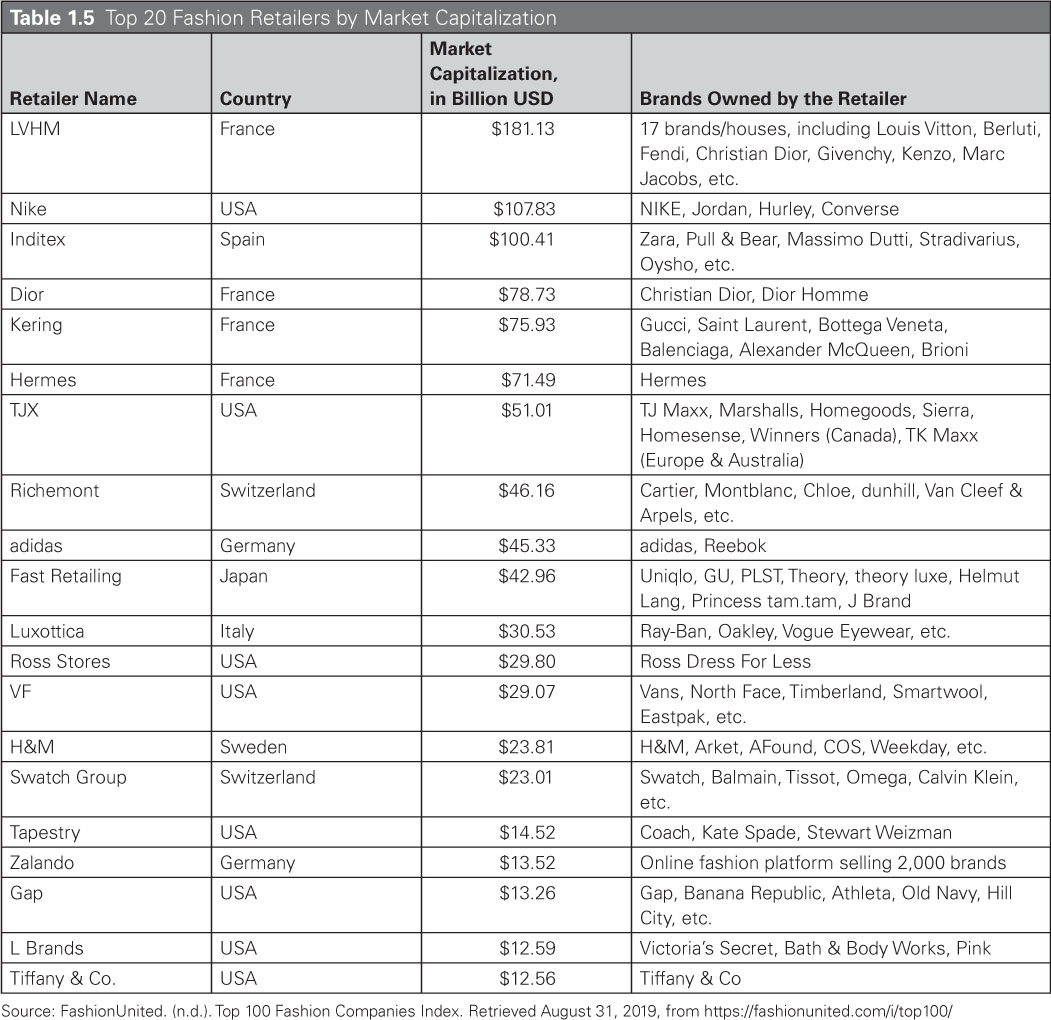
Examine Table 1.5 to get a picture of where in the world the top twenty fashion retailers are based. The list is compiled by FashionUnited, which ranks the top 100 largest listed apparel and fashion companies around the world. The Top 100 Index “comprehends the 100 largest quoted companies within the trade by market capitalization” (FashionUnited, n.d.). Market capitalization is the value of a company that is traded on the stock market, calculated by multiplying the total number of shares by the present share price.
Look at the location of their home bases—just more than half (11) of the Top 20 fashion retailers are located in Europe; eight are in the Americas (all in the United States) and one in Asia (Japan). You might not have heard of some of the companies but you are likely familiar with many brands they own. Take a few minutes to absorb the magnitude and complexity of the role of countries and companies, worldwide, that are involved in the textiles and apparel business. Keep in mind that many of the “retailers” represented by these numbers are vertically integrated backward into some aspects of apparel manufacturing.
CASE 1 Most Apparel Jobs Are in the United States Even If Labels Read “Made in China” or “Made in Vietnam”
Even though roughly 97 percent of all apparel sold in the US market is made overseas, the industry supports a lot of domestic jobs. In fact, a recent study by Moongates Associates (2013) discovered that millions of American jobs provide a major contribution to the global value chains that design, source, produce, deliver, market, and distribute clothing and accessories. Under the leadership of Susan Hester, a Seattle-based economist, several studies were conducted—the first published in 2013, with subsequent research released in 2017. After analyzing twenty categories of garments from underwear to shirts, pants, and coats, the studies concluded that an average of 70 percent of the final selling garment price was contributed by US workers (Case 1 Figure 1). Even though clothing was assembled in an overseas factory, this was only one part of the global value chain. Most parts of the supply chain remain in the United States as apparel is designed, developed, transported, marketed, and sold by American workers:
• design, research and development jobs (consumer and fashion trends research, fabric and findings development, garment design);
• apparel product development (including approval of fit, materials, construction, artistic details, etc.);
• sourcing and production management (selecting vendors for fabrics, findings, packaging and apparel assembly; compliance with legal, labor, and environmental standards; product compliance; product testing and quality assurance; tracking production dates and troubleshooting with factories);
• logistics (transportation, customs clearance, import compliance);
• distribution and sales (warehousing, merchandising, marketing, wholesale, online and brick-and-mortar sales, web development, customer service, shipping).
Most of these United States–based jobs are held by white-collar professionals. These positions span across the entire apparel supply chain. Hester’s 2017 study reported average salaries for many of these well-paid positions, as illustrated in Case 1 Figure 2. In addition, various domestic blue-collar jobs are supported across the supply chain: from clerical positions to warehouse workers and customer service associates.
Susan Hester argues that simply dividing apparel into two categories—imported and made domestically—is an outdated and inaccurate approach. As her study demonstrates, most work that went into getting T-shirts, jeans, and sweaters in your favorite stores was done in the United States by American workers despite the fact that the labels on garments can include a hundred world countries—from China, Vietnam, and Bangladesh in Asia to Ethiopia in Africa, Jordan in the Middle East, or Mexico and Honduras in the Americas. It is time to appropriately give credit to the US workers who design and develop apparel products by including the label “Designed in the USA.”
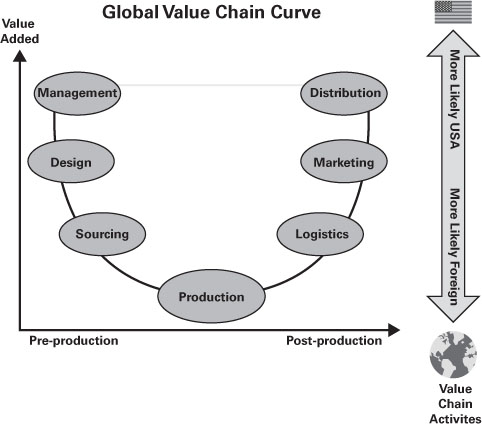
Case 1 Figure 1
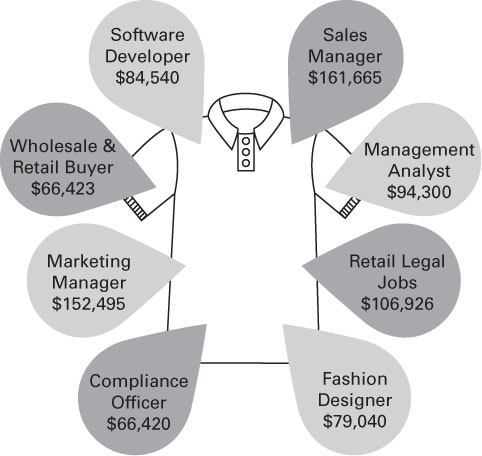
Case 1 Figure 2
1. What are the primary messages that you get from Case 1?
2. How might the information from Case 1 be useful to consumers? What about the legislature?
Based on: Moongate Associates. (2013, 2017). Analyzing the Value Chain for Apparel Designed in the United States and Manufactured Overseas. Retrieved August 20, 2019, from http://www.moongateassociates.com/documents/Apparel-GVC-Rpt.pdf
Level 5—Consumption and Disposal
At this level, apparel goods purchased at Level 4 are actually being used and, in the end, disposed when no longer wanted. This stage is often overlooked in the discussions of the textile complex and apparel supply chain, yet it is vital for continuing consumer satisfaction as they wear and care for and, ultimately, dispose of their clothing. As the effects of consumerism on society and environment become increasingly mainstream concerns, greater number and types of businesses will be created to assist people in caring for (cleaning, storing, repairing, etc.), reusing, recycling, and recovering apparel and textile materials to extend the life of products and avoid landfilling. Further discussion of this topic is presented in Chapter 4.
The review of the textile complex might have helped you appreciate the magnitude and diversity of jobs available within it to support well-functioning supply chains that are socially and environmentally responsible. Because clothing is a basic human need that comes right after food and shelter in any country and culture, the textile complex (and the jobs it provides) will always be around. The types of jobs in textile and apparel manufacturing and retail change constantly due to new technology and the way business is done, but … people will always have to have clothes on their backs. Review Industry Profile 1 for examples of global positions within the textile complex.
Consumer Demand
As represented by the “sea of consumer demand” in the model of the textile complex (refer back to Figure 1.4), the primary purpose and driving force behind the entire apparel business is satisfying the needs and wants of consumers so that profits can be made. Probably the biggest challenge is forecasting what consumers will buy. Reliable consumer preference forecasts are essential for success at all levels of the textile complex. Major shifts in consumer demographics affect the acceptance of products offered in the marketplace. For example, an increasingly aging demographic in developed nations is causing a need for changes in product styling and fit. The apparel preferences of these different consumer groups are influencing the styling and sizing of products being made available to all consumers and increasing the focus on niche marketing by retailers.
Changes in population lifestyle with greater emphases on health and fitness drive continuing casualization of clothing around the world, increased desire for comfort and other functional characteristics of garments, and proliferation of athleisure apparel. More and more people are becoming aware of the impact of consumerism including the growing effects of the textile complex on the global environment. These consumers demand textile and apparel businesses employ sustainable materials and processes when designing, manufacturing, delivering, and disposing products.
Another significant change affecting consumer apparel choices is the greater availability of electronic communication worldwide. Consumers throughout the globe are able to compare available apparel choices by exploring hundreds of retailer websites and social media, instantly seeing styles from around the world. The results of all these changes are causing something of a dichotomy. On one hand, there are more ethnically diverse ideas of what is beautiful and appropriate or fashionable to wear, and these ideas are made available to more consumers more quickly than at any time in history. However, more cultures are being influenced by what they see on television from the United States and Europe. This creates a homogenization of design ideas, with consumers from other cultures beginning to adapt their local choices in order to look like Western consumers. A prime example of this homogenization over the last hundred years is the almost universal adoption of the tailored business suit. Another is the acceptance of jeans anytime and anywhere. This dichotomy of individual and cultural differences versus universal sameness presents great challenges to the industry. One reality is that ultimate consumers still determine the winners. Consumer demand is the reason there are supply chains.
ESTABLISHING SUSTAINABLE SUPPLY CHAIN
Beginning in the 1960s, buying offices offered services that involved international business relationships, then mostly with firms based in Hong Kong, to supply US and European apparel retail buyers with finished garments different from or at a lower cost than what was being offered by domestic apparel manufacturers. Buying offices grew in number and popularity until the late 1980s, when merchandisers got involved in product development for private label lines. The race then began in earnest to find the lower-cost labor to make the garments and, ideally, maintain product quality. Apparel supply chain has become very complex, often spanning over several continents and dozens of companies. This led to the development of the standardized merchandise identification systems essential for processing goods that are transported from one country to another. This is the topic of Chapter 3.
INDUSTRY PROFILE 1
Careers in the Global Textile Complex
Because textile and apparel is a global industry, most jobs have an international component: professionals are expected to partner with vendors from all over the world, collaborate with buyers overseas, or deliver to consumers in many countries. Review real-world examples of entry-level or minimal-experience jobs and the desired skills and qualifications. What skills and knowledge are needed? What commonalities do you see in these job descriptions?
Entry Positions—Assistant Level
Sourcing Assistant, Women’s Tops, Mass Market Retailer
Description of responsibilities:
• Assist the sourcing manager;
• Maintain good relationships with buyers and potential buyers;
• Identify supplier needs across production department.
Skills and traits:
• Excellent verbal and written communication skills;
• Good negotiation and relationship building skills;
• Flexibility and attention to detail;
• Outgoing and confident.
Qualifications:
• Bachelor’s degree in sourcing or related field;
• Some experience in apparel/retail industry preferred.
Purchasing Assistant, Men’s Outerwear, Specialty Retailer
Description of responsibilities:
• Prepare purchase orders for approvals of raw materials;
• Monitor and expedite deliveries;
• Maintain appropriate purchasing records;
• Provide support to the Purchasing Manager.
Skills and traits:
• Excellent communication skills;
• Ability to travel as needed;
• Flexibility to adapt to fast-paced environment;
• Organizational and time management skills.
Qualifications:
• Bachelor’s degree in sourcing or other apparel related field;
• In-store retail experience.
2–10 Years of Experience—Associate Level
Strategic Sourcing Analyst, Children’s wear, independent fashion retailer
Description of responsibilities:
• Calculate and analyze production needs;
• Coordinate and organize all activities that pertain to the strategic sourcing function;
• Serve as a liaison between suppliers and production in the resolution of sourcing issues;
• Work closely with planning, operation, QA, and R&D to ensure materials are available on time.
Skills and traits:
• Proficient in Microsoft Suite;
• Strong organizational and analytical skills;
• Able to work with and apply complex mathematical concepts;
• Detail oriented and customer focused.
Qualifications:
• Bachelor’s degree in sourcing or apparel product sevelopment;
• Minimum of two years of experience in sourcing or product development;
• Experience working internationally preferred.
Global Materials Director, Footwear, Leading Outdoor Retailer
Description of major responsibilities:
• Ensure the right vendor, right capabilities, and right cost to support the footwear business;
• Evaluate vendor performance, assess and mitigate risk, carry out corrective actions as needed;
• Create a tiered vendor structure with expectations, goals, and incentives to drive optimal vendor performance;
• Have a pulse on the latest technologies, machinery, and vendor capabilities to inform sourcing strategy;
• Travel abroad to fully understand both Tier 1 and Tier 2 partners and their operations and to stay well connected with the Asia LO.
Skills, knowledge, and traits:
• Knowledge of footwear product development;
• Understanding of construction and manufacturing of different material types: textiles, synthetics, leathers, composites, films, plastics, and components;
• Experience managing a global team;
• Problem solving and strong presentation and communication skills.
Qualifications:
• Bachelor’s degree with specific experience in textiles, leather manufacturing, or footwear business and manufacturing;
• Ten+ years of experience in materials, development, innovation, and/or manufacturing;
• Proven track record in working within the global material supply chain.
The supply chain begins and ends with the consumer. Demand for textile and apparel products drives the industry. Chapter 2 provides perspective on changing trends in textile and apparel consumption. With the ever-growing rates of textile and apparel production and consumption, the global environmental footprint and social issues in the industry have raised the question of sustainability. This is the focus of Chapter 4.
Governments establish regulations regarding the transfer of products from one country to another as well as to verify their origin, ownership, quality, and safety. Some regulations are developed to encourage trade, whereas others aim at restricting trade to control the amount of imports in an economy. It is very important for apparel professionals to understand what effect different trade regulations might have on sourcing products and services from vendors in countries around the world. This is the topic of Chapter 5. Trade regulations of all kinds of activities by governments result in attempts to get around them. Free trade, trade restrictions, requirements for customs compliance, and intellectual property law are ongoing sources of controversy and illegal activity in the global market. This is the focus of Chapter 6.
Sourcing also entails the process of selecting countries and vendors when building supply chains. These are the topics of Chapters 7 and 8. Chapters 9 to 12 examine countries in the four regions of the world, which we have defined as Europe and the European Union, the Americas and the Caribbean Basin, Asia and Oceania, and the Middle East and Africa. We sincerely hope you find your global adventure challenging, insightful, and rewarding.
SUMMARY
A primary purpose of this chapter was to introduce perspectives central to the study of the textile and apparel industry and trade from a global perspective. There are many valid ways to view and analyze the operations of the global supply chain. Perspectives include economic and business, political and governmental, as well as social and labor. These viewpoints commonly result in conflicts among options for resolution of issues. The conflicts are part of the context we wish to address.
From the perspective of economic development, countries around the world can be viewed as least developed, newly developing, developing, or developed, based on the per capita GDP and GNI. Other related measures of standard of living and well-being in a country include literacy rate, infant mortality, and life expectancy. The level of economic development determines the roles countries play in the global apparel supply chain; it also explains textile and apparel trade balance.
The level of a country’s development determines availability of educated and skilled human capital as well as financial resources, both required for textile production. Developed countries tend to have textile industries as a result of sufficient investments in production and research as well as development of innovative products and processes. Goods produced in developed countries are less labor intensive and much more technology intensive, such as for production of synthetic fibers, yarns, and specialized fabrics with unique properties such as technical textiles. In some developing countries it is possible for textile industries to produce basic yarns and fabrics, but that is very unlikely in newly developing countries. Developed countries have higher production costs, so they focus on product development and then skip to consumption of finished products.
In general, the production portion of the apparel industry takes place primarily in countries at the middle level, in developing and newly developing countries. Least developed countries are attractive in terms of inexpensive labor but some lack business infrastructure. These countries are in the process of establishing effective apparel industries, often utilizing foreign investments. The apparel industry is often the first form of industrial development in least developed and newly developing countries and therefore it is extremely important for apparel companies and retailers to contribute to establishing a culture that ensures safe working environment and fair wages as well as promotes ongoing levels of employment. Development of sustainable global supply chains involves many areas of expertise to navigate successfully and is currently a priority in the textile and apparel industries.
LEARNING ACTIVITIES
1. To comprehend the global nature of the apparel industry, conduct this class survey:
• Make a list of all the countries represented in the labels of your clothing, and state the type of garment (e.g., jeans, Mexico; T-shirt, Haiti).
• Compare your list with those of your classmates, and tally the list of countries and types of garments to see which countries are represented most frequently and what types of garments come from the countries identified.
• Do some types of garments seem more likely to come from certain countries? Describe your results.
2. Compare and contrast the five countries based on the level of economic development and their roles in the global textile complex—Singapore, Myanmar, Guatemala, Botswana, and Belarus:
• Locate the countries on the map to determine which continent (or world region) they belong to (e.g., Europe, Asia, Africa, etc.).
• Using two different approaches presented in the chapter (GDP per capita and GNI per capita), determine the level of economic development for each of the five countries (newly developing, developing, or developed). Justify your classification.
• Based on the economic level of development, determine if each of the five countries is likely to be an: (a) importer or exporter of apparel; and (b) importer or exporter of textiles. Defend your positions.
3. Develop a list of positives and negatives that global trade brought to the textile and apparel industries in (1) more developed and (2) less developed countries. Make sure to discuss the textile industry separately from the apparel industry.
REFERENCES
Altman, S. A., Ghemawat, P., & Bastian P. (2019). DHL Global Connectedness Index 2018: The State of Globalization in a Fragile World. Retrieved June 25, 2019 from https://www.dpdhl.com/content/dam/dpdhl/en/media-center/media-relations/documents/2019/dhl-gci-2018-full-study.pdf
Central Intelligence Agency. (2017) World Factbook: GDP Per Capita (PPP). Retrieved August 21, 2019, from https://www.cia.gov/library/publications/the-world-factbook/fields/211.html#AS
Deutsche Post DHL Group. (February 12, 2019). “DHL Global Connectedness Index 2018.” Retrieved June 17, 2019 from https://www.dpdhl.com/en/media-relations/specials/global-connectedness-index.html
Deutsche Post DHL Group. (February 12, 2019). DHL Global Connectedness Index: Globalization Hits New Record High. Retrieved June 26, 2019 from https://www.dpdhl.com/en/media-relations/press-releases/2019/dhl-global-connectedness-index-2018.html
FashionUnited. (n.d.). Global Fashion Industry Statistics—International Apparel. Retrieved June 25, 2019 from https://fashionunited.com/global-fashion-industry-statistics/
FashionUnited. (n.d.). Top 100 Fashion Companies Index. Retrieved August 31, 2019, from https://fashionunited.com/i/top100/
Lodge, G. (1995). Managing Globalization in the Age of Interdependence. San Diego, CA: Pfeiffer.
Lu, S. (August 16, 2019). WTO Reports World Textile and Apparel Trade in 2018. Retrieved August 22, 2019, from https://shenglufashion.com/2019/08/16/wto-reports-world-textile-and-apparel-trade-in-2018/
Moongate Associates. (February 13, 2013). Analyzing the Value Chain for Apparel Designed in the United States and Manufactured Overseas. Retrieved August 20, 2019, from http://www.moongateassociates.com/documents/Apparel-GVC-Rpt.pdf
Rivoli, P. (2009). The Travels of a T-shirt in the Global Economy. Hoboken: John Wiley & Sons.
Stores. (2019). Top 50 Global Retailers. Retrieved June 15, 2019, from https://stores.org/2019/03/01/top-50-global-retailers/
TJX. (May 2019). Our Businesses. Retrieved August 30, 2019, from https://www.tjx.com/businesses
United Nations. (n.d.) Economic Analysis and Policy Division: Least Developed Countries (LDCs). Retrieved August 22, 2019, from https://www.un.org/development/desa/dpad/least-developed-country-category.html
United Nations. (March, 2018). Economic Analysis and Policy Division. LDCs at a Glance. Retrieved August 21, 2019, from https://www.un.org/development/desa/dpad/least-developed-country-category/ldcs-at-a-glance.html
World Bank. (2018). GNI Per Capita, Atlas Method. Retrieved August 21, 2019, from https://data.worldbank.org/indicator/NY.GNP.PCAP.PP.KD
World Bank (n.d.). World Bank Country and Lending Groups. Retrieved August 21, 2019, from https://datahelpdesk.worldbank.org/knowledgebase/articles/906519-world-bank-country-and-lending-groups
World Trade Organization. (2017). “International Trade and Market Access Data.” Retrieved June 6, 2019, from https://www.wto.org/english/res_e/statis_e/statis_bis_e.htm?